



Waste Pre-processing For Alternate Fuel and Raw Materials (AFR) Market
Waste Pre-processing For Alternate Fuel and Raw Materials (AFR) Market Forecast - 2033
Market Overview
Waste pre-processing for alternate fuel and raw materials involves sorting, shredding, drying, and blending various waste streams into standardized, homogeneous fuel and material inputs suitable for co-processing in energy-intensive industrial facilities, most notably cement kilns, as substitutes for conventional fossil fuels and raw materials. This process enables waste materials that would otherwise require landfill disposal to be diverted into productive industrial use, supporting both waste management and industrial decarbonization objectives simultaneously.
Demand growth through the 2026-2033 window is closely tied to intensifying cement industry decarbonization commitments driving increased alternate fuel substitution rates in kiln operations, expanding landfill diversion regulations and waste management policy across major markets incentivizing waste-to-resource pathways, and growing recognition of AFR co-processing as a cost-effective decarbonization strategy relative to alternative emissions reduction technologies. Continued investment in waste pre-processing infrastructure by cement producers and specialized waste management companies continues to expand the available alternate fuel and raw material supply chain.
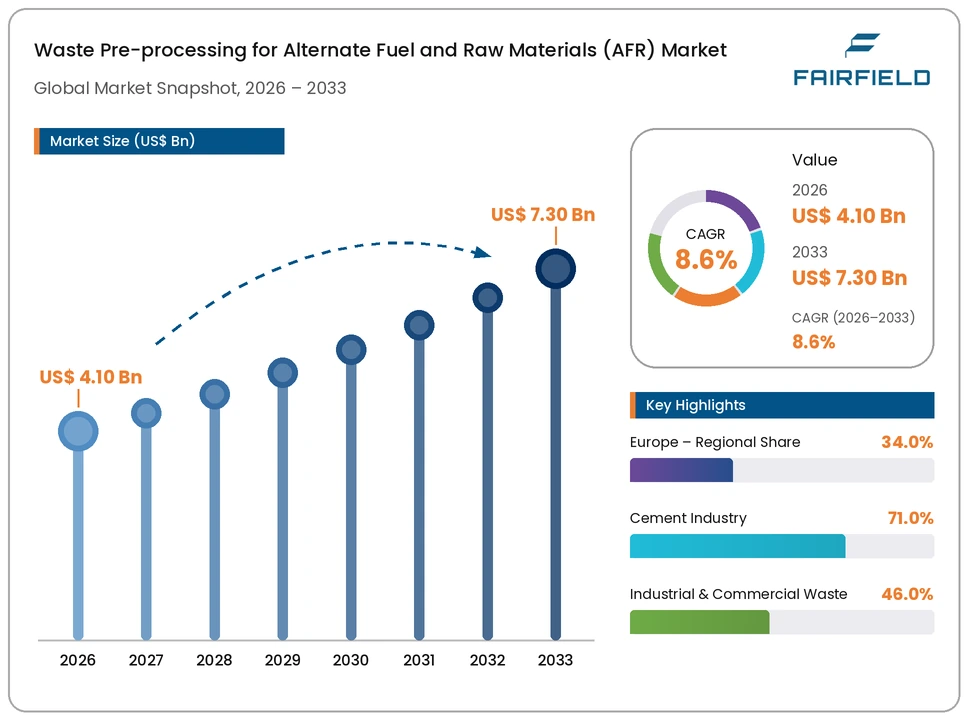
The market is valued at USD 4.10 Billion in 2026, with providers directing investment toward improved waste sorting and quality control technology that ensures consistent, high-performance alternate fuel and raw material output. By 2033, the market is forecast to reach USD 7.30 Billion, reflecting steady growth across established cement industry applications alongside expanding power generation sector adoption.
Key Highlights
- The global waste pre-processing for alternate fuel and raw materials market is valued at USD 4.10 Billion in 2026 and is projected to reach USD 7.30 Billion by 2033, expanding at a CAGR of 8.6% across the 2026-2033 forecast period.
- Industrial & Commercial Waste leads the waste-type segment with a 46.0% share in 2026, equivalent to USD 1.89 Billion.
- Cement Industry remains the dominant end-use industry, accounting for 71.0% of global demand, or USD 2.91 Billion, in 2026.
- Europe commands the largest regional share at 34.0% of the global market in 2026.
- Power generation applications are emerging as the fastest-growing end-use industry through 2033.
Key Growth Drivers
Growth in the waste pre-processing for alternate fuel and raw materials market is driven primarily by intensifying cement industry decarbonization commitments, as cement producers worldwide increasingly pursue alternate fuel substitution as a cost-effective pathway to reduce fossil fuel consumption and associated carbon emissions from kiln operations.
A second driver is expanding landfill diversion regulations and waste management policy, as governments across major markets increasingly restrict landfill disposal of combustible and recoverable waste streams, creating regulatory incentive for waste generators and municipalities to direct suitable waste toward alternate fuel and raw material pre-processing pathways.
Key Restraints
The variability in waste stream composition and quality creates ongoing processing and quality control challenges, requiring substantial investment in sorting and blending technology to consistently produce alternate fuel and raw material outputs that meet the strict specifications required by cement kiln and other industrial co-processing operations.
Additionally, public perception and permitting challenges associated with waste pre-processing and co-processing facilities, including concerns regarding emissions and local environmental impact, can create obstacles to new facility development in some regions despite the underlying environmental benefits of waste diversion.
Market Opportunities
The expansion of power generation sector adoption presents a substantial opportunity, as power plants increasingly explore alternate fuel co-firing as a decarbonization and cost management strategy, extending demand for pre-processed alternate fuels beyond the traditionally dominant cement industry application.
A second opportunity lies in the development of improved waste sorting and quality control technology that expands the range of waste streams suitable for alternate fuel and raw material conversion. Providers that successfully advance these processing capabilities stand to capture growing waste volumes as landfill diversion pressure intensifies globally.
Segmentation Analysis
- By Waste Type
Industrial & Commercial Waste leads the waste-type segment, accounting for 46.0% of global market value in 2026, equivalent to USD 1.89 Billion. Its leadership reflects the consistent volume and composition of industrial and commercial waste streams that make them well-suited to alternate fuel pre-processing. Municipal Solid Waste represents a significant, established waste-type category. Tires & Rubber Waste represents the fastest-growing waste-type category through 2033, driven by expanding tire-derived fuel adoption as a high-calorific-value alternate fuel source.
- By End-Use Industry
Cement Industry forms the leading end-use industry segment, representing 71.0% of global demand in 2026, or USD 2.91 Billion, reflecting the cement industry's long-established role as the primary consumer of pre-processed alternate fuels and raw materials through kiln co-processing. Power Generation represents the fastest-growing end-use industry category, propelled by growing power sector interest in alternate fuel co-firing as a decarbonization strategy.
Regional Insights
- Europe
Europe holds the largest regional share, at 34.0% of the global market in 2026, equivalent to USD 1.39 Billion. The region's leadership reflects stringent landfill diversion regulations and long-established cement industry alternate fuel substitution practices across major European markets.
- Asia Pacific
Asia Pacific accounts for 31.0% of the global market in 2026, valued at USD 1.27 Billion. Growth is underpinned by expanding cement production capacity and increasing waste management regulation across China, India, and Southeast Asia.
- North America
North America represents 20.0% of the global market in 2026, or USD 0.82 Billion. Demand is supported by growing cement industry decarbonization commitments and expanding landfill diversion initiatives across the United States and Canada.
- Latin America
Latin America contributes 9.0% of the global market in 2026, equivalent to USD 0.37 Billion. Brazil and Mexico anchor regional demand, supported by substantial cement production capacity increasingly adopting alternate fuel practices.
- Middle East & Africa
Middle East & Africa holds 6.0% of the global market in 2026, valued at USD 0.25 Billion. Growth remains gradual, tied to expanding cement industry sustainability initiatives across the region.
Competitive Landscape
The global waste pre-processing for alternate fuel and raw materials market is moderately fragmented, with a mix of large integrated waste management companies, dedicated co-processing subsidiaries of major cement producers, and specialized waste pre-processing providers competing across regional markets. Competition centers on waste sourcing and sorting capability, quality consistency of processed alternate fuel and raw material outputs, and the ability to provide reliable, long-term supply agreements with cement and power generation customers. Companies are increasingly differentiating through advanced sorting and quality control technology rather than competing on waste processing volume alone.
Key Market Players
- Geocycle (Holcim Ltd)
- Suez S.A.
- Veolia Environnement S.A.
- Cemex, S.A.B. de C.V.
- Heidelberg Materials AG
- Renewi plc
- Remondis SE & Co. KG
- Tradebe Environmental Services
- Cementos Argos S.A.
- Boral Limited
Market Segmentation
By Waste Type
- Municipal Solid Waste
- Industrial & Commercial Waste
- Tires & Rubber Waste
- Others
By End-Use Industry
- Cement Industry
- Power Generation
- Others
By Processing Type
- Shredding & Sorting
- Drying & Blending
By Geography
- North America
- Europe
- Asia Pacific
- Latin America
- Middle East & Africa
- Executive Summary
- Global Waste Pre-processing For Alternate Fuel and Raw Materials (AFR) Market Snapshot
- Future Projections
- Key Market Trends
- Regional Snapshot, by Value, 2026
- Analyst Recommendations
- Market Overview
- Market Definitions and Segmentations
- Market Dynamics
- Drivers
- Restraints
- Market Opportunities
- Value Chain Analysis
- COVID-19 Impact Analysis
- Porter's Five Forces Analysis
- Impact of Russia-Ukraine Conflict
- PESTLE Analysis
- Regulatory Analysis
- Price Trend Analysis
- Current Prices and Future Projections, 2025-2033
- Price Impact Factors
- Global Waste Pre-processing For Alternate Fuel and Raw Materials (AFR) Market Outlook, 2020 - 2033
- Global Waste Pre-processing For Alternate Fuel and Raw Materials (AFR) Market Outlook, by Waste Type, Value (US$ Mn), 2020-2033
- Municipal Solid Waste
- Industrial & Commercial Waste
- Tires & Rubber Waste
- Others
- Global Waste Pre-processing For Alternate Fuel and Raw Materials (AFR) Market Outlook, by End-Use Industry, Value (US$ Mn), 2020-2033
- Cement Industry
- Power Generation
- Others
- Global Waste Pre-processing For Alternate Fuel and Raw Materials (AFR) Market Outlook, by Processing Type, Value (US$ Mn), 2020-2033
- Shredding & Sorting
- Drying & Blending
- Global Waste Pre-processing For Alternate Fuel and Raw Materials (AFR) Market Outlook, by Region, Value (US$ Mn), 2020-2033
- North America
- Europe
- Asia Pacific
- Latin America
- Middle East & Africa
- Global Waste Pre-processing For Alternate Fuel and Raw Materials (AFR) Market Outlook, by Waste Type, Value (US$ Mn), 2020-2033
- North America Waste Pre-processing For Alternate Fuel and Raw Materials (AFR) Market Outlook, 2020 - 2033
- North America Waste Pre-processing For Alternate Fuel and Raw Materials (AFR) Market Outlook, by Waste Type, Value (US$ Mn), 2020-2033
- Municipal Solid Waste
- Industrial & Commercial Waste
- Tires & Rubber Waste
- Others
- North America Waste Pre-processing For Alternate Fuel and Raw Materials (AFR) Market Outlook, by End-Use Industry, Value (US$ Mn), 2020-2033
- Cement Industry
- Power Generation
- Others
- North America Waste Pre-processing For Alternate Fuel and Raw Materials (AFR) Market Outlook, by Processing Type, Value (US$ Mn), 2020-2033
- Shredding & Sorting
- Drying & Blending
- North America Waste Pre-processing For Alternate Fuel and Raw Materials (AFR) Market Outlook, by Country, Value (US$ Mn), 2020-2033
- U.S. Waste Pre-processing For Alternate Fuel and Raw Materials (AFR) Market Outlook, by Waste Type, 2020-2033
- U.S. Waste Pre-processing For Alternate Fuel and Raw Materials (AFR) Market Outlook, by End-Use Industry, 2020-2033
- U.S. Waste Pre-processing For Alternate Fuel and Raw Materials (AFR) Market Outlook, by Processing Type, 2020-2033
- Canada Waste Pre-processing For Alternate Fuel and Raw Materials (AFR) Market Outlook, by Waste Type, 2020-2033
- Canada Waste Pre-processing For Alternate Fuel and Raw Materials (AFR) Market Outlook, by End-Use Industry, 2020-2033
- Canada Waste Pre-processing For Alternate Fuel and Raw Materials (AFR) Market Outlook, by Processing Type, 2020-2033
- BPS Analysis/Market Attractiveness Analysis
- North America Waste Pre-processing For Alternate Fuel and Raw Materials (AFR) Market Outlook, by Waste Type, Value (US$ Mn), 2020-2033
- Europe Waste Pre-processing For Alternate Fuel and Raw Materials (AFR) Market Outlook, 2020 - 2033
- Europe Waste Pre-processing For Alternate Fuel and Raw Materials (AFR) Market Outlook, by Waste Type, Value (US$ Mn), 2020-2033
- Municipal Solid Waste
- Industrial & Commercial Waste
- Tires & Rubber Waste
- Others
- Europe Waste Pre-processing For Alternate Fuel and Raw Materials (AFR) Market Outlook, by End-Use Industry, Value (US$ Mn), 2020-2033
- Cement Industry
- Power Generation
- Others
- Europe Waste Pre-processing For Alternate Fuel and Raw Materials (AFR) Market Outlook, by Processing Type, Value (US$ Mn), 2020-2033
- Shredding & Sorting
- Drying & Blending
- Europe Waste Pre-processing For Alternate Fuel and Raw Materials (AFR) Market Outlook, by Country, Value (US$ Mn), 2020-2033
- Germany Waste Pre-processing For Alternate Fuel and Raw Materials (AFR) Market Outlook, by Waste Type, 2020-2033
- Germany Waste Pre-processing For Alternate Fuel and Raw Materials (AFR) Market Outlook, by End-Use Industry, 2020-2033
- Germany Waste Pre-processing For Alternate Fuel and Raw Materials (AFR) Market Outlook, by Processing Type, 2020-2033
- Italy Waste Pre-processing For Alternate Fuel and Raw Materials (AFR) Market Outlook, by Waste Type, 2020-2033
- Italy Waste Pre-processing For Alternate Fuel and Raw Materials (AFR) Market Outlook, by End-Use Industry, 2020-2033
- Italy Waste Pre-processing For Alternate Fuel and Raw Materials (AFR) Market Outlook, by Processing Type, 2020-2033
- France Waste Pre-processing For Alternate Fuel and Raw Materials (AFR) Market Outlook, by Waste Type, 2020-2033
- France Waste Pre-processing For Alternate Fuel and Raw Materials (AFR) Market Outlook, by End-Use Industry, 2020-2033
- France Waste Pre-processing For Alternate Fuel and Raw Materials (AFR) Market Outlook, by Processing Type, 2020-2033
- U.K. Waste Pre-processing For Alternate Fuel and Raw Materials (AFR) Market Outlook, by Waste Type, 2020-2033
- U.K. Waste Pre-processing For Alternate Fuel and Raw Materials (AFR) Market Outlook, by End-Use Industry, 2020-2033
- U.K. Waste Pre-processing For Alternate Fuel and Raw Materials (AFR) Market Outlook, by Processing Type, 2020-2033
- Spain Waste Pre-processing For Alternate Fuel and Raw Materials (AFR) Market Outlook, by Waste Type, 2020-2033
- Spain Waste Pre-processing For Alternate Fuel and Raw Materials (AFR) Market Outlook, by End-Use Industry, 2020-2033
- Spain Waste Pre-processing For Alternate Fuel and Raw Materials (AFR) Market Outlook, by Processing Type, 2020-2033
- Russia Waste Pre-processing For Alternate Fuel and Raw Materials (AFR) Market Outlook, by Waste Type, 2020-2033
- Russia Waste Pre-processing For Alternate Fuel and Raw Materials (AFR) Market Outlook, by End-Use Industry, 2020-2033
- Russia Waste Pre-processing For Alternate Fuel and Raw Materials (AFR) Market Outlook, by Processing Type, 2020-2033
- Rest of Europe Waste Pre-processing For Alternate Fuel and Raw Materials (AFR) Market Outlook, by Waste Type, 2020-2033
- Rest of Europe Waste Pre-processing For Alternate Fuel and Raw Materials (AFR) Market Outlook, by End-Use Industry, 2020-2033
- Rest of Europe Waste Pre-processing For Alternate Fuel and Raw Materials (AFR) Market Outlook, by Processing Type, 2020-2033
- BPS Analysis/Market Attractiveness Analysis
- Europe Waste Pre-processing For Alternate Fuel and Raw Materials (AFR) Market Outlook, by Waste Type, Value (US$ Mn), 2020-2033
- Asia Pacific Waste Pre-processing For Alternate Fuel and Raw Materials (AFR) Market Outlook, 2020 - 2033
- Asia Pacific Waste Pre-processing For Alternate Fuel and Raw Materials (AFR) Market Outlook, by Waste Type, Value (US$ Mn), 2020-2033
- Municipal Solid Waste
- Industrial & Commercial Waste
- Tires & Rubber Waste
- Others
- Asia Pacific Waste Pre-processing For Alternate Fuel and Raw Materials (AFR) Market Outlook, by End-Use Industry, Value (US$ Mn), 2020-2033
- Cement Industry
- Power Generation
- Others
- Asia Pacific Waste Pre-processing For Alternate Fuel and Raw Materials (AFR) Market Outlook, by Processing Type, Value (US$ Mn), 2020-2033
- Shredding & Sorting
- Drying & Blending
- Asia Pacific Waste Pre-processing For Alternate Fuel and Raw Materials (AFR) Market Outlook, by Country, Value (US$ Mn), 2020-2033
- China Waste Pre-processing For Alternate Fuel and Raw Materials (AFR) Market Outlook, by Waste Type, 2020-2033
- China Waste Pre-processing For Alternate Fuel and Raw Materials (AFR) Market Outlook, by End-Use Industry, 2020-2033
- China Waste Pre-processing For Alternate Fuel and Raw Materials (AFR) Market Outlook, by Processing Type, 2020-2033
- Japan Waste Pre-processing For Alternate Fuel and Raw Materials (AFR) Market Outlook, by Waste Type, 2020-2033
- Japan Waste Pre-processing For Alternate Fuel and Raw Materials (AFR) Market Outlook, by End-Use Industry, 2020-2033
- Japan Waste Pre-processing For Alternate Fuel and Raw Materials (AFR) Market Outlook, by Processing Type, 2020-2033
- South Korea Waste Pre-processing For Alternate Fuel and Raw Materials (AFR) Market Outlook, by Waste Type, 2020-2033
- South Korea Waste Pre-processing For Alternate Fuel and Raw Materials (AFR) Market Outlook, by End-Use Industry, 2020-2033
- South Korea Waste Pre-processing For Alternate Fuel and Raw Materials (AFR) Market Outlook, by Processing Type, 2020-2033
- India Waste Pre-processing For Alternate Fuel and Raw Materials (AFR) Market Outlook, by Waste Type, 2020-2033
- India Waste Pre-processing For Alternate Fuel and Raw Materials (AFR) Market Outlook, by End-Use Industry, 2020-2033
- India Waste Pre-processing For Alternate Fuel and Raw Materials (AFR) Market Outlook, by Processing Type, 2020-2033
- Southeast Asia Waste Pre-processing For Alternate Fuel and Raw Materials (AFR) Market Outlook, by Waste Type, 2020-2033
- Southeast Asia Waste Pre-processing For Alternate Fuel and Raw Materials (AFR) Market Outlook, by End-Use Industry, 2020-2033
- Southeast Asia Waste Pre-processing For Alternate Fuel and Raw Materials (AFR) Market Outlook, by Processing Type, 2020-2033
- Rest of SAO Waste Pre-processing For Alternate Fuel and Raw Materials (AFR) Market Outlook, by Waste Type, 2020-2033
- Rest of SAO Waste Pre-processing For Alternate Fuel and Raw Materials (AFR) Market Outlook, by End-Use Industry, 2020-2033
- Rest of SAO Waste Pre-processing For Alternate Fuel and Raw Materials (AFR) Market Outlook, by Processing Type, 2020-2033
- BPS Analysis/Market Attractiveness Analysis
- Asia Pacific Waste Pre-processing For Alternate Fuel and Raw Materials (AFR) Market Outlook, by Waste Type, Value (US$ Mn), 2020-2033
- Latin America Waste Pre-processing For Alternate Fuel and Raw Materials (AFR) Market Outlook, 2020 - 2033
- Latin America Waste Pre-processing For Alternate Fuel and Raw Materials (AFR) Market Outlook, by Waste Type, Value (US$ Mn), 2020-2033
- Municipal Solid Waste
- Industrial & Commercial Waste
- Tires & Rubber Waste
- Others
- Latin America Waste Pre-processing For Alternate Fuel and Raw Materials (AFR) Market Outlook, by End-Use Industry, Value (US$ Mn), 2020-2033
- Cement Industry
- Power Generation
- Others
- Latin America Waste Pre-processing For Alternate Fuel and Raw Materials (AFR) Market Outlook, by Processing Type, Value (US$ Mn), 2020-2033
- Shredding & Sorting
- Drying & Blending
- Latin America Waste Pre-processing For Alternate Fuel and Raw Materials (AFR) Market Outlook, by Country, Value (US$ Mn), 2020-2033
- Brazil Waste Pre-processing For Alternate Fuel and Raw Materials (AFR) Market Outlook, by Waste Type, 2020-2033
- Brazil Waste Pre-processing For Alternate Fuel and Raw Materials (AFR) Market Outlook, by End-Use Industry, 2020-2033
- Brazil Waste Pre-processing For Alternate Fuel and Raw Materials (AFR) Market Outlook, by Processing Type, 2020-2033
- Mexico Waste Pre-processing For Alternate Fuel and Raw Materials (AFR) Market Outlook, by Waste Type, 2020-2033
- Mexico Waste Pre-processing For Alternate Fuel and Raw Materials (AFR) Market Outlook, by End-Use Industry, 2020-2033
- Mexico Waste Pre-processing For Alternate Fuel and Raw Materials (AFR) Market Outlook, by Processing Type, 2020-2033
- Argentina Waste Pre-processing For Alternate Fuel and Raw Materials (AFR) Market Outlook, by Waste Type, 2020-2033
- Argentina Waste Pre-processing For Alternate Fuel and Raw Materials (AFR) Market Outlook, by End-Use Industry, 2020-2033
- Argentina Waste Pre-processing For Alternate Fuel and Raw Materials (AFR) Market Outlook, by Processing Type, 2020-2033
- Rest of LATAM Waste Pre-processing For Alternate Fuel and Raw Materials (AFR) Market Outlook, by Waste Type, 2020-2033
- Rest of LATAM Waste Pre-processing For Alternate Fuel and Raw Materials (AFR) Market Outlook, by End-Use Industry, 2020-2033
- Rest of LATAM Waste Pre-processing For Alternate Fuel and Raw Materials (AFR) Market Outlook, by Processing Type, 2020-2033
- BPS Analysis/Market Attractiveness Analysis
- Latin America Waste Pre-processing For Alternate Fuel and Raw Materials (AFR) Market Outlook, by Waste Type, Value (US$ Mn), 2020-2033
- Middle East & Africa Waste Pre-processing For Alternate Fuel and Raw Materials (AFR) Market Outlook, 2020 - 2033
- Middle East & Africa Waste Pre-processing For Alternate Fuel and Raw Materials (AFR) Market Outlook, by Waste Type, Value (US$ Mn), 2020-2033
- Municipal Solid Waste
- Industrial & Commercial Waste
- Tires & Rubber Waste
- Others
- Middle East & Africa Waste Pre-processing For Alternate Fuel and Raw Materials (AFR) Market Outlook, by End-Use Industry, Value (US$ Mn), 2020-2033
- Cement Industry
- Power Generation
- Others
- Middle East & Africa Waste Pre-processing For Alternate Fuel and Raw Materials (AFR) Market Outlook, by Processing Type, Value (US$ Mn), 2020-2033
- Shredding & Sorting
- Drying & Blending
- Middle East & Africa Waste Pre-processing For Alternate Fuel and Raw Materials (AFR) Market Outlook, by Country, Value (US$ Mn), 2020-2033
- GCC Waste Pre-processing For Alternate Fuel and Raw Materials (AFR) Market Outlook, by Waste Type, 2020-2033
- GCC Waste Pre-processing For Alternate Fuel and Raw Materials (AFR) Market Outlook, by End-Use Industry, 2020-2033
- GCC Waste Pre-processing For Alternate Fuel and Raw Materials (AFR) Market Outlook, by Processing Type, 2020-2033
- South Africa Waste Pre-processing For Alternate Fuel and Raw Materials (AFR) Market Outlook, by Waste Type, 2020-2033
- South Africa Waste Pre-processing For Alternate Fuel and Raw Materials (AFR) Market Outlook, by End-Use Industry, 2020-2033
- South Africa Waste Pre-processing For Alternate Fuel and Raw Materials (AFR) Market Outlook, by Processing Type, 2020-2033
- Egypt Waste Pre-processing For Alternate Fuel and Raw Materials (AFR) Market Outlook, by Waste Type, 2020-2033
- Egypt Waste Pre-processing For Alternate Fuel and Raw Materials (AFR) Market Outlook, by End-Use Industry, 2020-2033
- Egypt Waste Pre-processing For Alternate Fuel and Raw Materials (AFR) Market Outlook, by Processing Type, 2020-2033
- Nigeria Waste Pre-processing For Alternate Fuel and Raw Materials (AFR) Market Outlook, by Waste Type, 2020-2033
- Nigeria Waste Pre-processing For Alternate Fuel and Raw Materials (AFR) Market Outlook, by End-Use Industry, 2020-2033
- Nigeria Waste Pre-processing For Alternate Fuel and Raw Materials (AFR) Market Outlook, by Processing Type, 2020-2033
- Rest of Middle East Waste Pre-processing For Alternate Fuel and Raw Materials (AFR) Market Outlook, by Waste Type, 2020-2033
- Rest of Middle East Waste Pre-processing For Alternate Fuel and Raw Materials (AFR) Market Outlook, by End-Use Industry, 2020-2033
- Rest of Middle East Waste Pre-processing For Alternate Fuel and Raw Materials (AFR) Market Outlook, by Processing Type, 2020-2033
- BPS Analysis/Market Attractiveness Analysis
- Middle East & Africa Waste Pre-processing For Alternate Fuel and Raw Materials (AFR) Market Outlook, by Waste Type, Value (US$ Mn), 2020-2033
- Competitive Landscape
- Company Vs Segment Heatmap
- Company Market Share Analysis, 2025
- Competitive Dashboard
- Company Profiles
- Geocycle (Holcim Ltd)
- Company Overview
- Product Portfolio
- Financial Overview
- Business Strategies and Developments
- Suez S.A.
- Veolia Environnement S.A.
- Cemex, S.A.B. de C.V.
- Heidelberg Materials AG
- Renewi plc
- Remondis SE & Co. KG
- Tradebe Environmental Services
- Cementos Argos S.A.
- Boral Limited
- Geocycle (Holcim Ltd)
- Appendix
- Research Methodology
- Report Assumptions
- Acronyms and Abbreviations
By Waste Type
- Municipal Solid Waste
- Industrial & Commercial Waste
- Tires & Rubber Waste
- Others
By End-Use Industry
- Cement Industry
- Power Generation
- Others
By Processing Type
- Shredding & Sorting
- Drying & Blending
By Geography
- North America
- Europe
- Asia Pacific
- Latin America
- Middle East & Africa
Our Research Methodology
Considering the volatility of business today, traditional approaches to strategizing a game plan can be unfruitful if not detrimental. True ambiguity is no way to determine a forecast. A myriad of predetermined factors must be accounted for such as the degree of risk involved, the magnitude of circumstances, as well as conditions or consequences that are not known or unpredictable. To circumvent binary views that cast uncertainty, the application of market research intelligence to strategically posture, move, and enable actionable outcomes is necessary.
View Methodology
Quality Assured
Rigorous Validation Process

Confidentiality Assured
End-to-end Data Security

Custom Research Services
Tailored To Your Objectives
FAQs
The global waste pre-processing for alternate fuel and raw materials market is valued at USD 4.10 Billion in 2026, reflecting rising cement industry decarbonization investment.
The market is projected to grow at a CAGR of 8.6%, reaching USD 7.30 Billion by 2033, driven by landfill diversion regulation and expanding alternate fuel substitution.
Industrial & Commercial Waste leads with a 46.0% share in 2026, reflecting its consistent volume and composition suited to alternate fuel processing.
Europe leads with a 34.0% share in 2026, supported by stringent landfill diversion regulations and established cement industry practices.
The largest opportunity lies in power generation applications, expanding as power plants explore alternate fuel co-firing for decarbonization.
Related Reports
Solar Mobile Light Tower Market Insights, Competitive Landscape, and Market Forecast - 2033
The global solar mobile light tower market is projected to grow from US$480.00 million in 2026 to US$960.62 million by 2033, at a 10.4% CAGR.
Micro Turbine Market Insights, Competitive Landscape, and Market Forecast 2033
The micro turbine market is projected to rise from US$2.4 billion in 2026 to US$4.1 billion by 2033 at a 7.9% CAGR, driven by decentralized energy generation.
U.S. Fire Protection System Market Insights, Competitive Landscape, and Market Forecast 2026–2033
U.S. Fire Protection System Market is projected to reach US$12.86 billion by 2033, driven by stringent safety regulations and smart systems.
Underfloor Heating Market Insights, Competitive Landscape, and Market Forecast 2026–2033
Underfloor Heating Market is projected to reach US$9.72 billion by 2033, driven by energy efficiency, smart homes, premium housing, and retrofit demand.
Power Boiler Market Insights, Competitive Landscape, and Market Forecast 2026–2033
Power Boiler Market is projected to reach US$31.38 billion by 2033, driven by industrial modernization, power generation expansion, fleet replacement
Offshore Mooring Systems Market Insights, Competitive Landscape, and Market Forecast 2026–2033
Offshore Mooring Systems Market is projected to reach US$2.28 billion by 2033, driven by deepwater investments, FPSO deployment, floating wind projects