



Aged Care Market
Aged Care Market Insights, Competitive Landscape, and Market Forecast - 2033
Global Aged Care Market Forecast
The Aged Care Market is valued at USD 2.876 Bn in 2026 and is projected to reach USD 4.6 Bn, growing at a CAGR of 7% by 2033.
Quick Report Digest
A Look Back and a Look Forward - Comparative Analysis
Under the present market conditions, the worldwide geriatric care industry is undergoing substantial expansion driven by ever-evolving trends. The demand for innovative healthcare solutions, including telehealth services, advanced assistive devices, and personalised healthcare strategies, is growing due to the geriatric population and increased awareness of healthcare issues.
Pharmaceutical interventions, specifically those designed to treat prevalent chronic diseases among the elderly, hold a substantial market share. Homecare services experience significant expansion due to the growing preference of elderly individuals to age in the convenience of their residences.
Over time, the geriatric care industry has transformed, shifting its focus from conventional institutional care to a more varied sector that includes home care and cutting-edge healthcare technologies. A defining trend, the transition to preventive and personalised healthcare demonstrates the industry's responsiveness to emergent demands. Pharmaceutical innovations and the integration of technology have been instrumental in determining the historical course of the market.
Anticipating the future, the market scenario predicts ongoing growth, with the Asia Pacific region assuming a preeminent position in terms of market penetration. The imperative for specialised care is underscored by the high incidence of diabetes and other chronic ailments, which propels the pharmaceutical sector.
Technological advances, particularly those about telehealth and artificial intelligence, have the potential to revolutionise the provision of care for the geriatric by rendering it more accessible and customised to meet the unique requirements of everyone. Considering the ongoing evolution of the global aged care market, effective collaboration among policymakers, technology developers, healthcare providers, and the elderly will be critical for assuring sustainable growth and an enhanced quality of life for this demographic.
Key Growth Determinants
- Significant Ageing Population
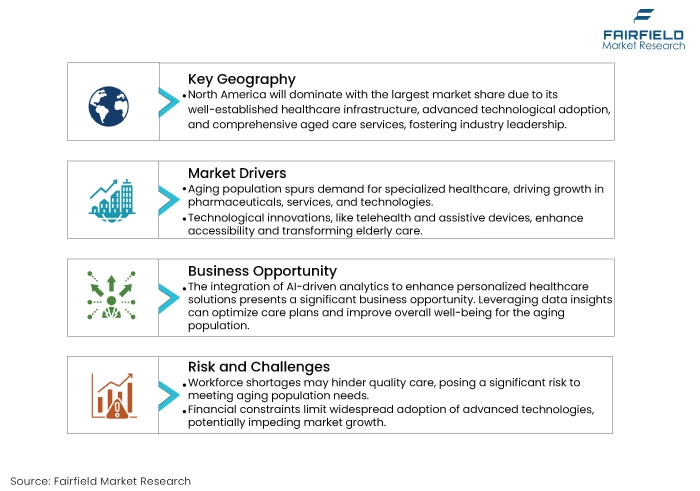
The geriatric population is a significant market catalyst, propelling the worldwide elderly care industry towards unparalleled expansion. The ageing of global populations has generated a growing need for all-encompassing healthcare solutions that are customised to address the unique requirements of the geriatric.
The escalation of chronic diseases due to this demographic transition underscores the critical need for innovative pharmaceuticals, assistive technologies, and healthcare provisions. The profound ramifications of an ageing population transcend conventional healthcare, stimulating advancements in telehealth, homecare, and personalised health management, which consequently propel the growth of the market.
- Swift Progressions in Healthcare Sector
The swift progressions in healthcare technology serve as a critical catalyst, fundamentally altering the domain of elderly care. The amalgamation of intelligent assistive devices, telehealth services, and artificial intelligence enables healthcare providers to provide the geriatric with services that are more individualised, efficient, and accessible.
In addition to augmenting diagnostic and therapeutic capacities, these technologies enable remote monitoring, preventive healthcare, and an overall enhancement of health. Market expansion is fuelled by the expanding synergy between healthcare and technology, which generates opportunities for novel solutions that address the specific healthcare requirements of the geriatric population.
- Widening Accessibility Options
Enhanced accessibility and a surge in healthcare consciousness serve as catalysts for the growth of the elderly care market. As recognition of the significance of proactive health management increases, individuals are more likely to actively pursue and embrace preventive healthcare measures.
The improvement in healthcare literacy, and government initiatives collectively contribute to the expansion of healthcare services, medication availability, and assistive device accessibility. Increased accessibility not only caters to the changing requirements of the ageing demographic but also stimulates market expansion through the promotion of a more involved and knowledgeable approach to care for the elderly.
Major Growth Barriers
- Impending Financial Forecast
The elderly care industry is substantially impeded by financial limitations. Healthcare systems worldwide are experiencing significant strain due to the increasing expenses linked to advanced healthcare technologies, pharmaceuticals, and personalised care solutions.
The potential for the market to expand more broadly and inclusively is impeded by the implementation of comprehensive and accessible geriatric care, which is complicated by insufficient funding and resource allocation.
- Higher Service Fees
A significant impediment to the market is the dearth of competent healthcare practitioners and geriatric care-specialised caregivers. The increasing need for care for the elderly surpasses the supply of qualified personnel, resulting in difficulties in delivering high-quality care.
Inadequate labour forces impede the sector's capacity to address the varied and growing demands of an ageing demographic, thereby constraining the overall growth of the market.
Key Trends and Opportunities to Look at
The convenience and accessibility of telehealth are stimulating its exponential expansion. Its widespread adoption is preponderant in North America, despite its international prominence. Notable entities such as Teladoc Health and Amwell have experienced significant expansion.
Brands are anticipated to capitalise on this development through strategic alliances, investments in user-friendly platforms, and improvements to remote monitoring capabilities to expand their service offerings and market presence in the burgeoning telehealth industry.
- Growing Focus on Wearable Technology
- Demand for Personalised Healthcare Within International Space
As the prevalence of wearable health technologies increases, healthcare is undergoing a revolution. In Europe, Asia Pacific, and North America, this trend is pervasive. Apple, Fitbit, and Samsung, among others, are leaders in the industry by introducing novel functionalities.
To capture a greater portion of the market, it is anticipated that brands will capitalise on this trend by emphasizing health-centric attributes, integrating data with healthcare providers, and developing seamless user experiences.
There is a significant increase in the demand for personalised healthcare solutions on a global scale, particularly in Europe, and North America. In this industry, IBM Watson Health and Siemens Healthineers are innovation leaders.
Brands are positioned to capitalise on this trend through strategic investments in AI-powered analytics, genomic medicine, and customised care plans. By providing individualised services to address the varied care requirements of the elderly, they can carve out a market niche.
How Does the Regulatory Scenario Shape this Industry?
The global market for senior care is governed by a multifaceted regulatory framework that differs geographically. The Centers for Medicare & Medicaid Services (CMS) regulate and supervise geriatric care services on a comprehensive scale within the United States. An additional way in which the Affordable Care Act (ACA) has affected market dynamics is through its promotion of preventive services and emphasis on value-based care.
The European Union has enacted directives and guidelines concerning the quality of social services and healthcare for the elderly. The Aged Care Quality and Safety Commission in Australia plays a significant role in ensuring adherence to quality standards.
Market participants may be substantially influenced by region-specific regulatory modifications, including revisions to reimbursement policies or the implementation of fresh care standards. As a result, their service offerings and strategies may be adjusted to conform to the ever-evolving regulatory demands.
Fairfield’s Ranking Board
Top Segments
Antibiotics are anticipated to hold the most significant market share within the senior care sector. The increasing incidence of chronic diseases among the elderly demographic has generated a significant and ongoing need for pharmaceutical interventions, supplements, and medications.
The ongoing advancement of sophisticated pharmaceuticals to tackle diverse health issues establishes this sector as a fundamental component in delivering all-encompassing and specialised healthcare for the geriatric.
Pharmaceuticals, housing, and assistive devices are all segments; however, it is expected that the assistive devices sector will expand at the quickest rate. The proliferation of assistive devices and growing recognition of their benefits are catalysts for the implementation of technological innovations that improve the quality of life for the elderly.
The ageing population's changing requirements are being met by a steady stream of innovative assistive devices, including wearable health devices and smart home technologies. As a result, this market segment is leading in terms of market penetration and expansion.
- Demand will be the Maximum in Institutional Care
- Notable Application Identified in Diabetes Care
The market share of institutional care is anticipated to be the largest in the geriatric care sector. Institutional care facilities have gained prominence due to the requirements for round-the-clock medical supervision and the demand for comprehensive and specialised healthcare services.
Because ageing populations necessitate more extensive healthcare interventions, assisted living facilities and nursing homes are examples of institutional care establishments that play a crucial role in meeting the varied healthcare requirements of the elderly.
Homecare is anticipated to experience the most rapid growth rate among adult daycare, institutional care, and home care. The rising prevalence of homecare services can be attributed to the development of sophisticated home-based healthcare technologies and the trend toward ageing in place.
In conjunction with technological advancements that facilitate remote monitoring and healthcare provision, the demand for autonomy and individualised attention positions home care as the sector that holds the greatest promise for swift expansion and acceptance in the coming years.
Among the various health segments that are considered, such as cardiovascular, respiratory, cancer, kidney, and heart diseases, diabetes is projected to hold the largest market share. The increasing prevalence of diabetes worldwide, specifically among the elderly demographic, drives the need for specialised healthcare interventions, medications, and management strategies. As a result, diabetes care has emerged as a substantial market segment within the geriatric care sector.
Neurological disorders are positioned to witness the most rapid expansion among the health sectors. The rising demand for specialised care is a result of the increasing prevalence of conditions such as Alzheimer's and Parkinson's disease, as well as developments in diagnostic technologies and therapeutic interventions.
With the increasing recognition and comprehension of neurological disorders, it is anticipated that this sector will experience rapid expansion. In this regard, groundbreaking therapies and assistance services will be pivotal in influencing the trajectory of geriatric care in the coming years.
Regional Frontrunners
Global Market Revenue Remains Concentrated in North America
North America is positioned to hold the largest market share in the worldwide elderly care sector. The area is distinguished by its sophisticated healthcare infrastructure, considerable geriatric care consciousness, and substantial elderly population.
In conjunction with a firmly established healthcare system, robust government support positions North America as the market leader. Additionally, technological advancements and a growing trend toward home-based healthcare contribute to the region's comprehensive geriatric care offerings, thereby strengthening its market share leadership.
Asia Pacific Expects Fastest Expansion in Revenue Through 2030
Asia Pacific is anticipated to witness the most rapid expansion of the worldwide senior care market. Particularly in Japan, and China, the region's geriatric population is ageing at an accelerated rate, which increases the demand for novel and diverse elderly care solutions.
The rapid expansion of the market can be attributed to a combination of government initiatives, increased healthcare spending, and a growing awareness of the health requirements of the elderly.
With the progression of technology and the enhancement of healthcare infrastructure, the Asia Pacific region has become a hub for significant expansion, offering extensive prospects for market participants to tackle the changing requirements of the geriatric population.
Fairfield’s Competitive Landscape Analysis
The pricing framework presently in place for geriatric care is influenced by the intricacy of pharmaceutical interventions, healthcare services, and advanced assistive devices. With the increase in demand, the adoption of cost-effective technologies, efficient healthcare delivery models, and government reimbursement policies are expected to exert an influence on pricing dynamics.
Prominent trends that propel competition within the realm of business include an emphasis on strategic alliances, personalised healthcare solutions, and technological innovation. It is anticipated that organisations capable of providing all-encompassing, cutting-edge, and economically viable services will attain a competitive advantage.
Who are the Leaders in the Global Aged Care Space?
An Expert’s Eye
Demand and Future Growth
The ageing of the global population is anticipated to be a significant factor in the market's sustained expansion of senior care services. The escalating incidence of chronic illnesses among the elderly guarantees an ongoing need for pharmaceutical products, specialised medical services, and cutting-edge assistive technologies.
Furthermore, the increasing inclination towards individualised and proactive healthcare solutions corresponds with the changing requirements of the geriatric population, thereby generating opportunities for sustained market growth.
Long-term market expansion is anticipated to be propelled by the need for all-encompassing, easily accessible, and technologically sophisticated geriatric care services, as individuals strive to preserve a superior standard of living during their later years.
Supply Side of the Market
Amidst an upsurge in market demand, stakeholders in the industry encounter obstacles about supply, predominantly in the form of labour force deficiencies. The potential lack of adequately trained healthcare professionals and aged care specialists may impede the sector's capacity to address the ever-growing and varied requirements of the geriatric demographic. To tackle this challenge, it is imperative to make strategic investments in education and training initiatives that cultivate a proficient labour force capable of providing superior geriatric care services.
Global Aged Care Market is Segmented as Below:
By Product Type:
- Pharmaceuticals
- Housing
- Assistive Devices
By Service:
- Institutional Care
- Homecare
- Adult Day Care
By Application:
- Heart Diseases
- Cancer
- Kidney Diseases
- Diabetes
- Osteoporosis
- Neurological
- Respiratory
- Others
By Geographic Coverage:
- North America
- Europe
- Asia Pacific
- Latin America
- Middle East & Africa
- Executive Summary
- Global Aged Care Market Snapshot
- Future Projections
- Key Market Trends
- Regional Snapshot, by Value, 2026
- Analyst Recommendations
- Market Overview
- Market Definitions and Segmentations
- Market Dynamics
- Drivers
- Restraints
- Market Opportunities
- Value Chain Analysis
- COVID-19 Impact Analysis
- Porter's Five Forces Analysis
- Impact of Russia-Ukraine Conflict
- PESTLE Analysis
- Regulatory Analysis
- Price Trend Analysis
- Current Prices and Future Projections, 2025-2033
- Price Impact Factors
- Global Aged Care Market Outlook, 2020 - 2033
- Global Aged Care Market Outlook, by Product Type, Value (US$ Bn), 2020-2033
- Pharmaceuticals
- Housing
- Assistive Devices
- Global Aged Care Market Outlook, by Service, Value (US$ Bn), 2020-2033
- Institutional Care
- Homecare
- Adult Day Care
- Global Aged Care Market Outlook, by Application, Value (US$ Bn), 2020-2033
- Heart Diseases
- Cancer
- Kidney Diseases
- Diabetes
- Osteoporosis
- Neurological
- Respiratory
- Others
- Global Aged Care Market Outlook, by Region, Value (US$ Bn), 2020-2033
- North America
- Europe
- Asia Pacific
- Latin America
- Middle East & Africa
- Global Aged Care Market Outlook, by Product Type, Value (US$ Bn), 2020-2033
- North America Aged Care Market Outlook, 2020 - 2033
- North America Aged Care Market Outlook, by Product Type, Value (US$ Bn), 2020-2033
- Pharmaceuticals
- Housing
- Assistive Devices
- North America Aged Care Market Outlook, by Service, Value (US$ Bn), 2020-2033
- Institutional Care
- Homecare
- Adult Day Care
- North America Aged Care Market Outlook, by Application, Value (US$ Bn), 2020-2033
- Heart Diseases
- Cancer
- Kidney Diseases
- Diabetes
- Osteoporosis
- Neurological
- Respiratory
- Others
- North America Aged Care Market Outlook, by Country, Value (US$ Bn), 2020-2033
- U.S. Aged Care Market Outlook, by Product Type, 2020-2033
- U.S. Aged Care Market Outlook, by Service, 2020-2033
- U.S. Aged Care Market Outlook, by Application, 2020-2033
- Canada Aged Care Market Outlook, by Product Type, 2020-2033
- Canada Aged Care Market Outlook, by Service, 2020-2033
- Canada Aged Care Market Outlook, by Application, 2020-2033
- BPS Analysis/Market Attractiveness Analysis
- North America Aged Care Market Outlook, by Product Type, Value (US$ Bn), 2020-2033
- Europe Aged Care Market Outlook, 2020 - 2033
- Europe Aged Care Market Outlook, by Product Type, Value (US$ Bn), 2020-2033
- Pharmaceuticals
- Housing
- Assistive Devices
- Europe Aged Care Market Outlook, by Service, Value (US$ Bn), 2020-2033
- Institutional Care
- Homecare
- Adult Day Care
- Europe Aged Care Market Outlook, by Application, Value (US$ Bn), 2020-2033
- Heart Diseases
- Cancer
- Kidney Diseases
- Diabetes
- Osteoporosis
- Neurological
- Respiratory
- Others
- Europe Aged Care Market Outlook, by Country, Value (US$ Bn), 2020-2033
- Germany Aged Care Market Outlook, by Product Type, 2020-2033
- Germany Aged Care Market Outlook, by Service, 2020-2033
- Germany Aged Care Market Outlook, by Application, 2020-2033
- Italy Aged Care Market Outlook, by Product Type, 2020-2033
- Italy Aged Care Market Outlook, by Service, 2020-2033
- Italy Aged Care Market Outlook, by Application, 2020-2033
- France Aged Care Market Outlook, by Product Type, 2020-2033
- France Aged Care Market Outlook, by Service, 2020-2033
- France Aged Care Market Outlook, by Application, 2020-2033
- U.K. Aged Care Market Outlook, by Product Type, 2020-2033
- U.K. Aged Care Market Outlook, by Service, 2020-2033
- U.K. Aged Care Market Outlook, by Application, 2020-2033
- Spain Aged Care Market Outlook, by Product Type, 2020-2033
- Spain Aged Care Market Outlook, by Service, 2020-2033
- Spain Aged Care Market Outlook, by Application, 2020-2033
- Russia Aged Care Market Outlook, by Product Type, 2020-2033
- Russia Aged Care Market Outlook, by Service, 2020-2033
- Russia Aged Care Market Outlook, by Application, 2020-2033
- Rest of Europe Aged Care Market Outlook, by Product Type, 2020-2033
- Rest of Europe Aged Care Market Outlook, by Service, 2020-2033
- Rest of Europe Aged Care Market Outlook, by Application, 2020-2033
- BPS Analysis/Market Attractiveness Analysis
- Europe Aged Care Market Outlook, by Product Type, Value (US$ Bn), 2020-2033
- Asia Pacific Aged Care Market Outlook, 2020 - 2033
- Asia Pacific Aged Care Market Outlook, by Product Type, Value (US$ Bn), 2020-2033
- Pharmaceuticals
- Housing
- Assistive Devices
- Asia Pacific Aged Care Market Outlook, by Service, Value (US$ Bn), 2020-2033
- Institutional Care
- Homecare
- Adult Day Care
- Asia Pacific Aged Care Market Outlook, by Application, Value (US$ Bn), 2020-2033
- Heart Diseases
- Cancer
- Kidney Diseases
- Diabetes
- Osteoporosis
- Neurological
- Respiratory
- Others
- Asia Pacific Aged Care Market Outlook, by Country, Value (US$ Bn), 2020-2033
- China Aged Care Market Outlook, by Product Type, 2020-2033
- China Aged Care Market Outlook, by Service, 2020-2033
- China Aged Care Market Outlook, by Application, 2020-2033
- Japan Aged Care Market Outlook, by Product Type, 2020-2033
- Japan Aged Care Market Outlook, by Service, 2020-2033
- Japan Aged Care Market Outlook, by Application, 2020-2033
- South Korea Aged Care Market Outlook, by Product Type, 2020-2033
- South Korea Aged Care Market Outlook, by Service, 2020-2033
- South Korea Aged Care Market Outlook, by Application, 2020-2033
- India Aged Care Market Outlook, by Product Type, 2020-2033
- India Aged Care Market Outlook, by Service, 2020-2033
- India Aged Care Market Outlook, by Application, 2020-2033
- Southeast Asia Aged Care Market Outlook, by Product Type, 2020-2033
- Southeast Asia Aged Care Market Outlook, by Service, 2020-2033
- Southeast Asia Aged Care Market Outlook, by Application, 2020-2033
- Rest of SAO Aged Care Market Outlook, by Product Type, 2020-2033
- Rest of SAO Aged Care Market Outlook, by Service, 2020-2033
- Rest of SAO Aged Care Market Outlook, by Application, 2020-2033
- BPS Analysis/Market Attractiveness Analysis
- Asia Pacific Aged Care Market Outlook, by Product Type, Value (US$ Bn), 2020-2033
- Latin America Aged Care Market Outlook, 2020 - 2033
- Latin America Aged Care Market Outlook, by Product Type, Value (US$ Bn), 2020-2033
- Pharmaceuticals
- Housing
- Assistive Devices
- Latin America Aged Care Market Outlook, by Service, Value (US$ Bn), 2020-2033
- Institutional Care
- Homecare
- Adult Day Care
- Latin America Aged Care Market Outlook, by Application, Value (US$ Bn), 2020-2033
- Heart Diseases
- Cancer
- Kidney Diseases
- Diabetes
- Osteoporosis
- Neurological
- Respiratory
- Others
- Latin America Aged Care Market Outlook, by Country, Value (US$ Bn), 2020-2033
- Brazil Aged Care Market Outlook, by Product Type, 2020-2033
- Brazil Aged Care Market Outlook, by Service, 2020-2033
- Brazil Aged Care Market Outlook, by Application, 2020-2033
- Mexico Aged Care Market Outlook, by Product Type, 2020-2033
- Mexico Aged Care Market Outlook, by Service, 2020-2033
- Mexico Aged Care Market Outlook, by Application, 2020-2033
- Argentina Aged Care Market Outlook, by Product Type, 2020-2033
- Argentina Aged Care Market Outlook, by Service, 2020-2033
- Argentina Aged Care Market Outlook, by Application, 2020-2033
- Rest of LATAM Aged Care Market Outlook, by Product Type, 2020-2033
- Rest of LATAM Aged Care Market Outlook, by Service, 2020-2033
- Rest of LATAM Aged Care Market Outlook, by Application, 2020-2033
- BPS Analysis/Market Attractiveness Analysis
- Latin America Aged Care Market Outlook, by Product Type, Value (US$ Bn), 2020-2033
- Middle East & Africa Aged Care Market Outlook, 2020 - 2033
- Middle East & Africa Aged Care Market Outlook, by Product Type, Value (US$ Bn), 2020-2033
- Pharmaceuticals
- Housing
- Assistive Devices
- Middle East & Africa Aged Care Market Outlook, by Service, Value (US$ Bn), 2020-2033
- Institutional Care
- Homecare
- Adult Day Care
- Middle East & Africa Aged Care Market Outlook, by Application, Value (US$ Bn), 2020-2033
- Heart Diseases
- Cancer
- Kidney Diseases
- Diabetes
- Osteoporosis
- Neurological
- Respiratory
- Others
- Middle East & Africa Aged Care Market Outlook, by Country, Value (US$ Bn), 2020-2033
- GCC Aged Care Market Outlook, by Product Type, 2020-2033
- GCC Aged Care Market Outlook, by Service, 2020-2033
- GCC Aged Care Market Outlook, by Application, 2020-2033
- South Africa Aged Care Market Outlook, by Product Type, 2020-2033
- South Africa Aged Care Market Outlook, by Service, 2020-2033
- South Africa Aged Care Market Outlook, by Application, 2020-2033
- Egypt Aged Care Market Outlook, by Product Type, 2020-2033
- Egypt Aged Care Market Outlook, by Service, 2020-2033
- Egypt Aged Care Market Outlook, by Application, 2020-2033
- Nigeria Aged Care Market Outlook, by Product Type, 2020-2033
- Nigeria Aged Care Market Outlook, by Service, 2020-2033
- Nigeria Aged Care Market Outlook, by Application, 2020-2033
- Rest of Middle East Aged Care Market Outlook, by Product Type, 2020-2033
- Rest of Middle East Aged Care Market Outlook, by Service, 2020-2033
- Rest of Middle East Aged Care Market Outlook, by Application, 2020-2033
- BPS Analysis/Market Attractiveness Analysis
- Middle East & Africa Aged Care Market Outlook, by Product Type, Value (US$ Bn), 2020-2033
- Competitive Landscape
- Company Vs Segment Heatmap
- Company Market Share Analysis, 2025
- Competitive Dashboard
- Company Profiles
- Koninklijke Philips N.V.
- Company Overview
- Product Portfolio
- Financial Overview
- Business Strategies and Developments
- Amedisys
- ECON Healthcare Group
- Encompass Health Corporation
- EXTENDICARE
- LHC Group, Inc.
- Medtronic
- Koninklijke Philips N.V.
|
BASE YEAR |
HISTORICAL DATA |
FORECAST PERIOD |
UNITS |
|||
 |
2025 |
 |
2020 - 2025 |
 |
2026 - 2033 |
Value: US$ Million |
|
REPORT FEATURES |
DETAILS |
|
Product Type Coverage |
|
|
Service Coverage |
|
|
Application Coverage |
|
|
Geographical Coverage |
|
|
Leading Companies |
|
|
Report Highlights |
Key Market Indicators, Macro-micro economic impact analysis, Technological Roadmap, Key Trends, Driver, Restraints, and Future Opportunities & Revenue Pockets, Porter’s 5 Forces Analysis, Historical Trend (2019-2021), Market Estimates and Forecast, Market Dynamics, Industry Trends, Competition Landscape, Category, Region, Country-wise Trends & Analysis, COVID-19 Impact Analysis (Demand and Supply Chain) |
Our Research Methodology
Considering the volatility of business today, traditional approaches to strategizing a game plan can be unfruitful if not detrimental. True ambiguity is no way to determine a forecast. A myriad of predetermined factors must be accounted for such as the degree of risk involved, the magnitude of circumstances, as well as conditions or consequences that are not known or unpredictable. To circumvent binary views that cast uncertainty, the application of market research intelligence to strategically posture, move, and enable actionable outcomes is necessary.
View Methodology
Quality Assured
Rigorous Validation Process

Confidentiality Assured
End-to-end Data Security

Custom Research Services
Tailored To Your Objectives
FAQs
The global aged care market achieved a market size of USD 2.876 Bn in 2026.
North America holds the largest share of the global aged care market.
The primary factor projected to drive the aged care market expansion is the demand for specialised healthcare is stimulated by an ageing population, which drives the expansion of pharmaceuticals, services, and technologies and technological advancements, such as telehealth and assistive devices.
In 2025, the pharmaceuticals category held a significant share of the global market.
The institutional care segment constitutes a major share of the global aged care market.
Related Reports
Oral Care Market Insights, Competitive Landscape, and Market Forecast 2033
The oral care market is forecast to reach US$49.32 Bn by 2033 from US$36.00 Bn in 2026 at a 4.6% CAGR, driven by persistent oral health needs worldwide.
Veterinary Eye Care Market Insights, Competitive Landscape, and Market Forecast 2033
The veterinary eye care market will grow from US$8.70 Bn in 2026 to US$12.66 Bn by 2033 at a 5.5% CAGR, driven by premium veterinary & ophthalmic care.
Healthcare Gamification Market Insights, Competitive Landscape, and Market Forecast 2033
Healthcare Gamification Market is projected to reach US$29.39 billion by 2033, driven by digital health adoption and patient engagement.
Veterinary Telehealth Market Insights, Competitive Landscape, and Market Forecast 2026–2033
Veterinary Telehealth Market is projected to reach US$1.67 billion by 2033, driven by pet humanization, vet shortages, and growing demand for remote care.
Pet Insurance Market Insights, Competitive Landscape, and Market Forecast 2033
Pet Insurance Market to reach US$28.68 Bn by 2033, driven by rising veterinary costs, pet humanization, comprehensive coverage, and embedded insurance.
Digital Health Market Insights, Competitive Landscape, and Market Forecast 2033
Digital Health Market to reach US$372.44 Bn by 2033, driven by telehealth, AI analytics, remote monitoring, and connected healthcare infrastructure.