



Aircraft Switches Market
Aircraft Switches Market Size, Share, Insights, Competitive Landscape, and Forecast 2026 to 2033
Aircraft Switches Market
Aircraft Switches Market Size and Trend Analysis
What Is Driving Aircraft Switch Market Growth?
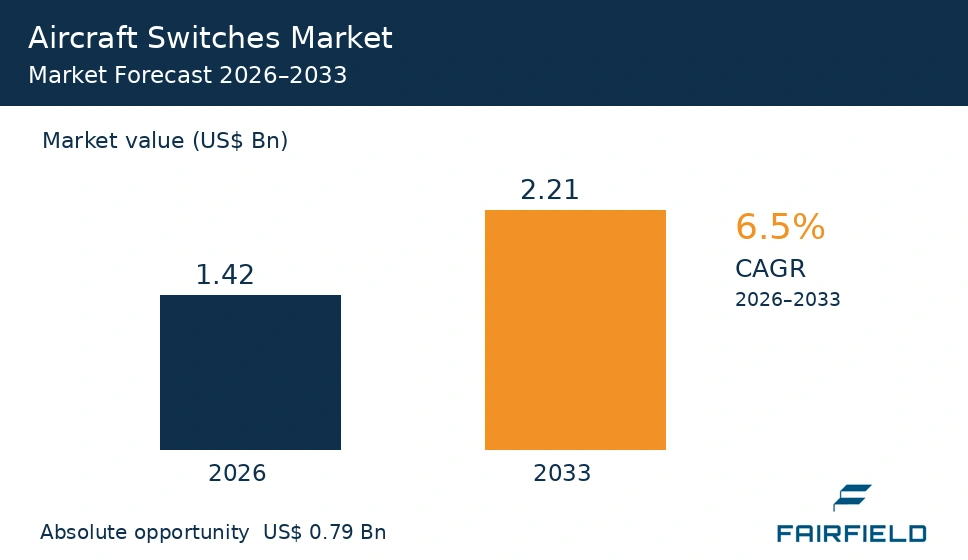
The global Aircraft Switches market size is expected to be valued at US$ 1.42 billion in 2026 and projected to reach US$ 2.21 billion by 2033, growing at a CAGR of 6.5% between 2026 and 2033. Growth rests on higher narrow-body build rates, rising electrical content per airframe, and steady retrofit work across ageing fleets. Switch demand also tracks military avionics upgrades and new rotorcraft mission systems. The absolute dollar opportunity across the period stands at US$ 790 million, a gain of 55.6% on the 2026 base. Historical expansion ran slower, at a 4.8% CAGR between 2020 and 2025, because build rates and flight activity recovered unevenly.
Key Report Takeaways
- By Switch Type: Toggle switches led with 27% share in 2026, while smart solid-state switches are projected to expand at a 9.6% CAGR through 2033, driven by weight reduction and built-in condition monitoring on newer electrical architectures.
- By Aircraft Type: Commercial aircraft led with 46% share in 2026, while business and general aviation is projected to expand at a 7.6% CAGR through 2033, driven by rising charter utilisation and a widening light-jet delivery base.
- By Application: Cockpit controls led with 34% share in 2026, while cabin systems are projected to expand at a 7.9% CAGR through 2033, driven by seat power, mood lighting and in-flight entertainment refurbishment across long-haul fleets.
- By Sales Channel: OEM fitment led with 62% share in 2026, while the aftermarket is projected to expand at a 7.2% CAGR through 2033, driven by extended aircraft service lives and broader part approval routes for replacement components.
- By Region: North America led with 38% share in 2026, while Asia Pacific is projected to expand at an 8.4% CAGR through 2033; Europe, Latin America and Middle East & Africa contribute added volume from assembly work, regional fleet growth and maintenance activity.
Market Trends and Insights
Market Growth Drivers
Higher Aircraft Build Rates Lift Switch Volumes
Higher aircraft build rates translate directly into switch volume. Each airframe carries hundreds of discrete control points spread across the flight deck, overhead panels, cabin and landing gear bays. Narrow-body production remains the single largest pull, and every added shipset multiplies demand for toggle, rocker and pushbutton units. Suppliers plan capacity against announced rate ramps rather than short-term order books.
Order backlogs at the major airframers stretch years ahead, giving component makers unusual visibility into future volume. Airlines keep replacing older aircraft with newer types that burn less fuel, and those replacement orders sustain panel-level content. Systems suppliers are scaling alongside, which pulls switch makers into longer-term capacity agreements. Delivery reliability matters more than unit price in these talks, so switch firms invest in tooling, automated assembly and second-source material qualification to hold their positions.
Cockpit Modernisation Expands Electrical Content per Airframe
Cockpit modernisation raises the value of switch content even when aircraft counts stay flat. Glass flight decks replaced many mechanical gauges, yet they added backlit panels, guarded switches, annunciator assemblies and rotary selectors around the displays. Integrated modular avionics also pushes switching functions toward networked control units. The result is fewer simple contacts and more engineered assemblies that command higher value per unit.
More-electric aircraft designs reinforce the same shift. Hydraulic and pneumatic functions are moving to electrical actuation, which multiplies circuit protection and control points throughout the airframe. Military upgrade work follows a similar path, with mission systems demanding night-vision compatible lighting and sealed controls. Suppliers answer with modular panel assemblies that bundle switches, indicators and wiring into a single qualified unit, shifting competition from parts toward subsystem design capability.
Restraints Impact Analysis of Market
Long Qualification Cycles Slow New Supplier Entry
Long qualification cycles hold back revenue growth for newcomers and limit how fast the supply base can widen. A flight-critical switch must pass extensive environmental, electrical and endurance testing before it reaches an approved supplier position. That process ties up engineering staff and capital for extended periods with no sales attached. Smaller firms often cannot carry the cost, so incumbents keep their positions on mature programmes.
The structure also slows design change on aircraft already in service. Replacing a qualified part means repeating much of the approval work, which airframers avoid unless obsolescence forces the issue. Switch makers respond by stretching product lifecycles and holding legacy tooling far longer than other electronics sectors would. That conservatism protects installed revenue, yet it delays adoption of newer switching technology and caps the pace at which the overall market can expand.
Supply Constraints in Specialty Materials and Microelectronics
Material and component shortages restrain output and squeeze supplier margins. Aircraft switches rely on precious-metal contacts, specialty alloys, high-grade polymers and sealed connector hardware that come from a narrow set of qualified mills and converters. When those inputs tighten, switch makers cannot simply substitute, because any change in material triggers fresh approval work. Lead times stretch and deliveries slip.
Semiconductor supply adds a second pressure point as solid-state switching grows. Devices rated for wide temperature ranges and high reliability compete for capacity with automotive and industrial buyers who order far larger volumes. Aerospace order quantities are small, which weakens bargaining power with foundries. Firms build buffer inventory, qualify alternate sources and redesign around more available parts, and each of those responses adds cost that is difficult to recover within fixed-price programme agreements.
Market Opportunities
Solid-State and Smart Switching Open New Revenue Pools
Solid-state and smart switching create a higher-value product tier for suppliers willing to invest. These units replace mechanical contacts with semiconductor devices, cut weight, remove arcing concerns and report their own status to aircraft health monitoring systems. Operators gain earlier fault detection and fewer unplanned removals. That value supports pricing well above the mechanical parts being displaced.
The opportunity widens as electrical power systems grow in capacity and complexity. Distributed power architectures need intelligent load control at many points in the airframe, which blends switching, protection and data reporting into one device. Suppliers with electronics design capability can move from selling components toward supplying power distribution modules. Hybrid-electric and advanced air mobility programmes offer early adoption routes, since those clean-sheet designs start without legacy mechanical equipment to protect and carry fewer approval constraints.
Aftermarket Retrofit and Cabin Upgrade Programmes
Retrofit and cabin upgrade work gives suppliers a revenue stream that is less tied to new aircraft rates. Airlines refresh interiors several times across an airframe's service life, and each refresh replaces seat controls, reading light switches, galley panels and lavatory controls. Those programmes run on shorter cycles than aircraft production, so they smooth demand when build rates soften.
Fleet age supports the same opportunity. Many operators extend service lives rather than wait for delivery slots, which raises spares consumption for switches exposed to constant crew and passenger handling. Approval routes for replacement parts let specialist firms supply components without holding the original production position. Suppliers that build spares distribution, repair capability and quick-turn stocking near major maintenance hubs can capture recurring revenue across many years, at margins that usually sit above original equipment work.
Category-wise Insights
Which Switch Type Holds the Largest Share?
Toggle switches held the largest position, at 27% share in 2026, because they remain the default control on overhead panels, electrical buses and engine start circuits. Crews read switch position by touch and sight, and the guarded toggle design suits actions that must never happen by accident. Decades of service history keep the format entrenched across both new and legacy types.
Smart and solid-state switches form the fastest-growing type, advancing at a 9.6% CAGR between 2026 and 2033. Demand comes from more-electric airframes where weight, arc suppression and self-diagnostics outweigh the simplicity of mechanical contacts. Pushbutton units hold a strong second position at 22%, supported by integrated annunciator functions. The split matters because value is shifting from stamped mechanical parts toward engineered electronic assemblies, which rewards suppliers with semiconductor and software capability.
Commercial Aircraft Anchor Volume While Business Jets Accelerate
Commercial aircraft accounted for 46% share in 2026, the largest aircraft-type position, reflecting high build rates and large fleets in daily service. A single narrow-body generates sustained switch demand through production fit, cabin refresh and routine replacement. Wide-body types add fewer units but carry more complex cabin and systems control content per airframe.
Business and general aviation is the fastest-growing category, at a 7.6% CAGR through 2033. Charter and fractional operators report strong utilisation, and light-jet and turboprop deliveries continue to broaden the installed base. Military holds 27% share, supported by avionics upgrade work on existing platforms. Rotorcraft contributes 10%, with mission equipment driving sealed and night-vision compatible designs. The mix tells suppliers that civil programmes carry volume while smaller aviation segments offer the better growth rate.
Cockpit Controls Lead as Cabin Systems Gain Pace
Cockpit controls led applications with 34% share in 2026, since the flight deck concentrates the highest density of switches in any aircraft. Overhead panels, glareshields, pedestals and side consoles all carry control points that must meet strict handling, lighting and labelling expectations. That density, plus the engineering behind each panel, keeps cockpit work the largest revenue pool.
Cabin systems grow fastest, at a 7.9% CAGR through 2033, as airlines invest in seat power, adjustable lighting, galley equipment and passenger service units. Interior refresh cycles run shorter than airframe life, which repeats the demand. Landing gear applications hold 16% share, where proximity switches confirm position and door status. For suppliers, the pattern favours firms able to serve both certified flight-deck work and faster-moving interiors programmes.
OEM Fitment Dominates While Aftermarket Grows Faster
OEM fitment accounted for 62% share in 2026, because original production positions determine which parts fly on an aircraft for decades. Winning a design slot on a new programme secures recurring shipset revenue across the entire production run. Airframers favour suppliers with proven delivery records, which concentrates original equipment work among established names.
The aftermarket grows faster, at a 7.2% CAGR through 2033, and holds 38% share. Ageing fleets, longer service lives and heavier daily utilisation all raise replacement rates for switches that crews and passengers touch constantly. Approved part routes let specialist suppliers serve operators directly rather than through the original manufacturer. That dynamic pushes component firms to build spares networks and repair capability, since aftermarket margins generally exceed those available on original equipment contracts.
Geography Analysis
Which Region Is Leading the Aircraft Switches Market?
North America leads the aircraft switches market with 38% share in 2026, growing at a 5.8% CAGR through 2033. The United States anchors that position through large-scale commercial and military airframe assembly, a deep tier-one supplier base and the world's biggest installed fleet. Canada adds regional jet, business jet and rotorcraft production.
Defence budgets fund sustained avionics upgrade work on in-service platforms, which supports steady switch replacement outside new-build cycles. The region also hosts extensive maintenance and completion centres that drive aftermarket consumption. Established approval frameworks for replacement parts give operators practical sourcing alternatives, widening the supplier field. Advanced air mobility developers concentrated in the region create early demand for solid-state switching, keeping component firms close to emerging electrical architectures.
Europe Holds a Deep Supplier Base Across Airframe Programmes
Europe held 28% share in 2026 and is set to grow at a 6.1% CAGR through 2033. France, Germany and the United Kingdom host final assembly lines, engine makers and a dense network of electrical component specialists. That proximity between airframers and suppliers shortens development cycles for new panel assemblies.
Regional programmes in combat aircraft, trainers and rotorcraft sustain military switch demand alongside civil work. Environmental policy pushes operators and manufacturers toward lighter structures and electrified systems, which favours solid-state switching and integrated power control. Italy, Spain and Poland contribute aerostructures and subassembly work that pulls in local component sourcing. A mature maintenance sector supports consistent spares consumption across both narrow-body and regional fleets operating from European bases.
Which Region Is Growing Fastest in the Aircraft Switches Market?
Asia Pacific is growing fastest in the aircraft switches market, at an 8.4% CAGR through 2033, from 22% share in 2026. Rising passenger traffic across China, India and Southeast Asia drives large fleet orders, and those deliveries convert into sustained switch content across cockpit and cabin systems.
Domestic airframe programmes in China and Japan build local component supply chains, while India expands maintenance, repair and overhaul capacity to serve its growing fleet at home. South Korea contributes aerostructures and defence rotorcraft work. Government policy in several countries ties offset arrangements and incentives to local manufacturing content, encouraging international switch makers to form regional operations. Airport construction and low-cost carrier expansion reinforce the underlying traffic growth that supports this trajectory.
Latin America Builds Share Through Regional Jet Activity
Latin America accounted for 6% share in 2026, expanding at a 6.4% CAGR through 2033. Brazil anchors the region through regional jet and business aircraft assembly, which supports a local base of electrical and interiors suppliers positioned close to the production line.
Mexico has built substantial aerospace manufacturing clusters serving North American programmes, including wiring harness and electrical assembly work that sits adjacent to switch production. Fleet modernisation among carriers in Chile, Colombia and Argentina adds retrofit and spares demand. Currency movement and financing conditions can slow aircraft acquisition in parts of the region, which makes aftermarket and maintenance spending a steadier source of switch consumption than new deliveries alone.
Middle East & Africa Gains From Fleet Expansion and Maintenance Investment
Middle East & Africa held 6% share in 2026 and is projected to grow at a 6.9% CAGR through 2033. Gulf carriers operate young wide-body fleets at high utilisation, which generates consistent cabin switch replacement as interiors are refreshed between major checks.
The United Arab Emirates, Saudi Arabia and Qatar are investing in maintenance, repair and overhaul capacity alongside national aerospace industry plans that seek local component manufacturing. Those programmes create openings for switch suppliers to establish regional stocking and repair operations. Across Africa, fleet renewal remains gradual and is weighted toward used aircraft, which sustains demand for replacement parts and panel refurbishment rather than original equipment fitment.
Competitive Landscape
The aircraft switches market is moderately concentrated. A group of diversified aerospace electrical and interconnect suppliers holds the bulk of original equipment positions, while specialist switch manufacturers retain strong niches in flight-deck controls, grips and sealed military applications. Programme positions are sticky, so share moves slowly and mainly at aircraft model transitions. Consolidation has gathered several long-established switch brands under larger component groups, which signals a market where scale in qualification, supply chain management and global support increasingly decides who wins new work.
Competition centres on engineering capability rather than unit price. Suppliers differentiate through sealing and environmental performance, tactile feel, backlighting quality, night-vision compatibility and the ability to integrate switches into complete panel assemblies with wiring and indicators. Weight reduction carries real value on every airframe, which favours firms that can design compact housings and migrate functions to solid-state devices. New entrants arrive mostly from the power electronics side, bringing semiconductor and embedded software skills that traditional switch makers are now building or buying.
Strategic activity concentrates on capability building. Component groups extend into adjacent electrical distribution and control products so they can sell subsystems instead of parts, which raises content per aircraft and deepens customer relationships. Investment in automated assembly and test supports the consistency that airframers expect at higher build rates. Research spending is weighted toward intelligent switching, condition monitoring and materials that handle higher voltages as aircraft electrical systems grow.
Vendor strategy is moving in a clear direction. Suppliers are positioning for more-electric and hybrid-electric airframes, strengthening aftermarket and repair networks to capture recurring revenue, and locating capacity closer to growing assembly and maintenance hubs.
Industry Leaders
-
Honeywell International Inc.
-
Safran S.A.
-
Eaton Corporation plc
-
TE Connectivity Ltd.
-
Collins Aerospace
-
TransDigm Group Incorporated
Companies Covered in the Report
-
Honeywell International Inc.
-
Safran S.A.
-
Eaton Corporation plc
-
TE Connectivity Ltd.
-
Collins Aerospace
-
TransDigm Group Incorporated
-
Parker Hannifin Corporation
-
AMETEK, Inc.
-
Curtiss-Wright Corporation
-
OTTO Engineering, Inc.
-
APEM Inc.
-
C&K Switches
-
ITT Inc.
-
Littelfuse, Inc.
Aircraft Switches Market Report Scope
The Aircraft Switches market is segmented by switch type, aircraft type, application, sales channel and region.
| By Switch Type | Toggle Switches, Pushbutton Switches, Rocker Switches, Rotary Switches, Proximity Switches, Smart and Solid-State Switches |
| By Aircraft Type | Commercial Aircraft, Military Aircraft, Business and General Aviation, Rotorcraft |
| By Application | Cockpit Controls, Cabin Systems, Landing Gear, Lighting Systems, Environmental Systems |
| By Sales Channel | OEM, Aftermarket |
| By Region | North America, Europe, Asia Pacific, Latin America, Middle East & Africa |
1. Executive Summary
1.1 Aircraft Switches Market Snapshot
1.2 Future Projections
1.3 Key Market Trends
1.4 Regional Snapshot
2. Market Overview
2.1 Market Definition and Report Scope
2.2 Historical Market Trends
2.3 Market Dynamics
2.3.1 Drivers
2.3.1.1 Higher Aircraft Build Rates Lift Switch Volumes
2.3.1.2 Cockpit Modernisation Expands Electrical Content per Airframe
2.3.2 Restraints
2.3.2.1 Long Qualification Cycles Slow New Supplier Entry
2.3.2.2 Supply Constraints in Specialty Materials and Microelectronics
2.3.3 Market Opportunities
2.3.3.1 Solid-State and Smart Switching Open New Revenue Pools
2.3.3.2 Aftermarket Retrofit and Cabin Upgrade Programmes
3. Global Aircraft Switches Market Outlook, 2026–2033
3.1 Global Aircraft Switches Market Outlook, by Switch Type, Value (US$ Billion), 2026–2033
3.1.1 Toggle Switches
3.1.2 Pushbutton Switches
3.1.3 Rocker Switches
3.1.4 Rotary Switches
3.1.5 Proximity Switches
3.1.6 Smart and Solid-State Switches
3.2 Global Aircraft Switches Market Outlook, by Aircraft Type, Value (US$ Billion), 2026–2033
3.2.1 Commercial Aircraft
3.2.2 Military Aircraft
3.2.3 Business and General Aviation
3.2.4 Rotorcraft
3.3 Global Aircraft Switches Market Outlook, by Application, Value (US$ Billion), 2026–2033
3.3.1 Cockpit Controls
3.3.2 Cabin Systems
3.3.3 Landing Gear
3.3.4 Lighting Systems
3.3.5 Environmental Systems
3.4 Global Aircraft Switches Market Outlook, by Sales Channel, Value (US$ Billion), 2026–2033
3.4.1 OEM
3.4.2 Aftermarket
3.5 Global Aircraft Switches Market Outlook, by Region, Value (US$ Billion), 2026–2033
3.5.1 North America
3.5.2 Europe
3.5.3 Asia Pacific
3.5.4 Latin America
3.5.5 Middle East & Africa
4. North America Aircraft Switches Market Outlook, 2026–2033
4.1 North America Aircraft Switches Market Outlook, by Switch Type, Value (US$ Billion), 2026–2033
4.1.1 Toggle Switches
4.1.2 Pushbutton Switches
4.1.3 Rocker Switches
4.1.4 Rotary Switches
4.1.5 Proximity Switches
4.1.6 Smart and Solid-State Switches
4.2 North America Aircraft Switches Market Outlook, by Aircraft Type, Value (US$ Billion), 2026–2033
4.2.1 Commercial Aircraft
4.2.2 Military Aircraft
4.2.3 Business and General Aviation
4.2.4 Rotorcraft
4.3 North America Aircraft Switches Market Outlook, by Application, Value (US$ Billion), 2026–2033
4.3.1 Cockpit Controls
4.3.2 Cabin Systems
4.3.3 Landing Gear
4.3.4 Lighting Systems
4.3.5 Environmental Systems
4.4 North America Aircraft Switches Market Outlook, by Sales Channel, Value (US$ Billion), 2026–2033
4.4.1 OEM
4.4.2 Aftermarket
4.5 North America Aircraft Switches Market Outlook, by Country, Value (US$ Billion), 2026–2033
4.5.1 United States Aircraft Switches Market Outlook, by Switch Type, 2026–2033
4.5.2 United States Aircraft Switches Market Outlook, by Aircraft Type, 2026–2033
4.5.3 United States Aircraft Switches Market Outlook, by Application, 2026–2033
4.5.4 United States Aircraft Switches Market Outlook, by Sales Channel, 2026–2033
4.5.5 Canada Aircraft Switches Market Outlook, by Switch Type, 2026–2033
4.5.6 Canada Aircraft Switches Market Outlook, by Aircraft Type, 2026–2033
4.5.7 Canada Aircraft Switches Market Outlook, by Application, 2026–2033
4.5.8 Canada Aircraft Switches Market Outlook, by Sales Channel, 2026–2033
5. Europe Aircraft Switches Market Outlook, 2026–2033
5.1 Europe Aircraft Switches Market Outlook, by Switch Type, Value (US$ Billion), 2026–2033
5.1.1 Toggle Switches
5.1.2 Pushbutton Switches
5.1.3 Rocker Switches
5.1.4 Rotary Switches
5.1.5 Proximity Switches
5.1.6 Smart and Solid-State Switches
5.2 Europe Aircraft Switches Market Outlook, by Aircraft Type, Value (US$ Billion), 2026–2033
5.2.1 Commercial Aircraft
5.2.2 Military Aircraft
5.2.3 Business and General Aviation
5.2.4 Rotorcraft
5.3 Europe Aircraft Switches Market Outlook, by Application, Value (US$ Billion), 2026–2033
5.3.1 Cockpit Controls
5.3.2 Cabin Systems
5.3.3 Landing Gear
5.3.4 Lighting Systems
5.3.5 Environmental Systems
5.4 Europe Aircraft Switches Market Outlook, by Sales Channel, Value (US$ Billion), 2026–2033
5.4.1 OEM
5.4.2 Aftermarket
5.5 Europe Aircraft Switches Market Outlook, by Country, Value (US$ Billion), 2026–2033
5.5.1 France Aircraft Switches Market Outlook, by Switch Type, 2026–2033
5.5.2 France Aircraft Switches Market Outlook, by Aircraft Type, 2026–2033
5.5.3 France Aircraft Switches Market Outlook, by Application, 2026–2033
5.5.4 France Aircraft Switches Market Outlook, by Sales Channel, 2026–2033
5.5.5 Germany Aircraft Switches Market Outlook, by Switch Type, 2026–2033
5.5.6 Germany Aircraft Switches Market Outlook, by Aircraft Type, 2026–2033
5.5.7 Germany Aircraft Switches Market Outlook, by Application, 2026–2033
5.5.8 Germany Aircraft Switches Market Outlook, by Sales Channel, 2026–2033
5.5.9 United Kingdom Aircraft Switches Market Outlook, by Switch Type, 2026–2033
5.5.10 United Kingdom Aircraft Switches Market Outlook, by Aircraft Type, 2026–2033
5.5.11 United Kingdom Aircraft Switches Market Outlook, by Application, 2026–2033
5.5.12 United Kingdom Aircraft Switches Market Outlook, by Sales Channel, 2026–2033
5.5.13 Italy Aircraft Switches Market Outlook, by Switch Type, 2026–2033
5.5.14 Italy Aircraft Switches Market Outlook, by Aircraft Type, 2026–2033
5.5.15 Italy Aircraft Switches Market Outlook, by Application, 2026–2033
5.5.16 Italy Aircraft Switches Market Outlook, by Sales Channel, 2026–2033
5.5.17 Spain Aircraft Switches Market Outlook, by Switch Type, 2026–2033
5.5.18 Spain Aircraft Switches Market Outlook, by Aircraft Type, 2026–2033
5.5.19 Spain Aircraft Switches Market Outlook, by Application, 2026–2033
5.5.20 Spain Aircraft Switches Market Outlook, by Sales Channel, 2026–2033
5.5.21 Poland Aircraft Switches Market Outlook, by Switch Type, 2026–2033
5.5.22 Poland Aircraft Switches Market Outlook, by Aircraft Type, 2026–2033
5.5.23 Poland Aircraft Switches Market Outlook, by Application, 2026–2033
5.5.24 Poland Aircraft Switches Market Outlook, by Sales Channel, 2026–2033
6. Asia Pacific Aircraft Switches Market Outlook, 2026–2033
6.1 Asia Pacific Aircraft Switches Market Outlook, by Switch Type, Value (US$ Billion), 2026–2033
6.1.1 Toggle Switches
6.1.2 Pushbutton Switches
6.1.3 Rocker Switches
6.1.4 Rotary Switches
6.1.5 Proximity Switches
6.1.6 Smart and Solid-State Switches
6.2 Asia Pacific Aircraft Switches Market Outlook, by Aircraft Type, Value (US$ Billion), 2026–2033
6.2.1 Commercial Aircraft
6.2.2 Military Aircraft
6.2.3 Business and General Aviation
6.2.4 Rotorcraft
6.3 Asia Pacific Aircraft Switches Market Outlook, by Application, Value (US$ Billion), 2026–2033
6.3.1 Cockpit Controls
6.3.2 Cabin Systems
6.3.3 Landing Gear
6.3.4 Lighting Systems
6.3.5 Environmental Systems
6.4 Asia Pacific Aircraft Switches Market Outlook, by Sales Channel, Value (US$ Billion), 2026–2033
6.4.1 OEM
6.4.2 Aftermarket
6.5 Asia Pacific Aircraft Switches Market Outlook, by Country, Value (US$ Billion), 2026–2033
6.5.1 China Aircraft Switches Market Outlook, by Switch Type, 2026–2033
6.5.2 China Aircraft Switches Market Outlook, by Aircraft Type, 2026–2033
6.5.3 China Aircraft Switches Market Outlook, by Application, 2026–2033
6.5.4 China Aircraft Switches Market Outlook, by Sales Channel, 2026–2033
6.5.5 India Aircraft Switches Market Outlook, by Switch Type, 2026–2033
6.5.6 India Aircraft Switches Market Outlook, by Aircraft Type, 2026–2033
6.5.7 India Aircraft Switches Market Outlook, by Application, 2026–2033
6.5.8 India Aircraft Switches Market Outlook, by Sales Channel, 2026–2033
6.5.9 Japan Aircraft Switches Market Outlook, by Switch Type, 2026–2033
6.5.10 Japan Aircraft Switches Market Outlook, by Aircraft Type, 2026–2033
6.5.11 Japan Aircraft Switches Market Outlook, by Application, 2026–2033
6.5.12 Japan Aircraft Switches Market Outlook, by Sales Channel, 2026–2033
6.5.13 South Korea Aircraft Switches Market Outlook, by Switch Type, 2026–2033
6.5.14 South Korea Aircraft Switches Market Outlook, by Aircraft Type, 2026–2033
6.5.15 South Korea Aircraft Switches Market Outlook, by Application, 2026–2033
6.5.16 South Korea Aircraft Switches Market Outlook, by Sales Channel, 2026–2033
7. Latin America Aircraft Switches Market Outlook, 2026–2033
7.1 Latin America Aircraft Switches Market Outlook, by Switch Type, Value (US$ Billion), 2026–2033
7.1.1 Toggle Switches
7.1.2 Pushbutton Switches
7.1.3 Rocker Switches
7.1.4 Rotary Switches
7.1.5 Proximity Switches
7.1.6 Smart and Solid-State Switches
7.2 Latin America Aircraft Switches Market Outlook, by Aircraft Type, Value (US$ Billion), 2026–2033
7.2.1 Commercial Aircraft
7.2.2 Military Aircraft
7.2.3 Business and General Aviation
7.2.4 Rotorcraft
7.3 Latin America Aircraft Switches Market Outlook, by Application, Value (US$ Billion), 2026–2033
7.3.1 Cockpit Controls
7.3.2 Cabin Systems
7.3.3 Landing Gear
7.3.4 Lighting Systems
7.3.5 Environmental Systems
7.4 Latin America Aircraft Switches Market Outlook, by Sales Channel, Value (US$ Billion), 2026–2033
7.4.1 OEM
7.4.2 Aftermarket
7.5 Latin America Aircraft Switches Market Outlook, by Country, Value (US$ Billion), 2026–2033
7.5.1 Brazil Aircraft Switches Market Outlook, by Switch Type, 2026–2033
7.5.2 Brazil Aircraft Switches Market Outlook, by Aircraft Type, 2026–2033
7.5.3 Brazil Aircraft Switches Market Outlook, by Application, 2026–2033
7.5.4 Brazil Aircraft Switches Market Outlook, by Sales Channel, 2026–2033
7.5.5 Mexico Aircraft Switches Market Outlook, by Switch Type, 2026–2033
7.5.6 Mexico Aircraft Switches Market Outlook, by Aircraft Type, 2026–2033
7.5.7 Mexico Aircraft Switches Market Outlook, by Application, 2026–2033
7.5.8 Mexico Aircraft Switches Market Outlook, by Sales Channel, 2026–2033
7.5.9 Chile Aircraft Switches Market Outlook, by Switch Type, 2026–2033
7.5.10 Chile Aircraft Switches Market Outlook, by Aircraft Type, 2026–2033
7.5.11 Chile Aircraft Switches Market Outlook, by Application, 2026–2033
7.5.12 Chile Aircraft Switches Market Outlook, by Sales Channel, 2026–2033
7.5.13 Colombia Aircraft Switches Market Outlook, by Switch Type, 2026–2033
7.5.14 Colombia Aircraft Switches Market Outlook, by Aircraft Type, 2026–2033
7.5.15 Colombia Aircraft Switches Market Outlook, by Application, 2026–2033
7.5.16 Colombia Aircraft Switches Market Outlook, by Sales Channel, 2026–2033
7.5.17 Argentina Aircraft Switches Market Outlook, by Switch Type, 2026–2033
7.5.18 Argentina Aircraft Switches Market Outlook, by Aircraft Type, 2026–2033
7.5.19 Argentina Aircraft Switches Market Outlook, by Application, 2026–2033
7.5.20 Argentina Aircraft Switches Market Outlook, by Sales Channel, 2026–2033
8. Middle East & Africa Aircraft Switches Market Outlook, 2026–2033
8.1 Middle East & Africa Aircraft Switches Market Outlook, by Switch Type, Value (US$ Billion), 2026–2033
8.1.1 Toggle Switches
8.1.2 Pushbutton Switches
8.1.3 Rocker Switches
8.1.4 Rotary Switches
8.1.5 Proximity Switches
8.1.6 Smart and Solid-State Switches
8.2 Middle East & Africa Aircraft Switches Market Outlook, by Aircraft Type, Value (US$ Billion), 2026–2033
8.2.1 Commercial Aircraft
8.2.2 Military Aircraft
8.2.3 Business and General Aviation
8.2.4 Rotorcraft
8.3 Middle East & Africa Aircraft Switches Market Outlook, by Application, Value (US$ Billion), 2026–2033
8.3.1 Cockpit Controls
8.3.2 Cabin Systems
8.3.3 Landing Gear
8.3.4 Lighting Systems
8.3.5 Environmental Systems
8.4 Middle East & Africa Aircraft Switches Market Outlook, by Sales Channel, Value (US$ Billion), 2026–2033
8.4.1 OEM
8.4.2 Aftermarket
8.5 Middle East & Africa Aircraft Switches Market Outlook, by Country, Value (US$ Billion), 2026–2033
8.5.1 United Arab Emirates Aircraft Switches Market Outlook, by Switch Type, 2026–2033
8.5.2 United Arab Emirates Aircraft Switches Market Outlook, by Aircraft Type, 2026–2033
8.5.3 United Arab Emirates Aircraft Switches Market Outlook, by Application, 2026–2033
8.5.4 United Arab Emirates Aircraft Switches Market Outlook, by Sales Channel, 2026–2033
8.5.5 Saudi Arabia Aircraft Switches Market Outlook, by Switch Type, 2026–2033
8.5.6 Saudi Arabia Aircraft Switches Market Outlook, by Aircraft Type, 2026–2033
8.5.7 Saudi Arabia Aircraft Switches Market Outlook, by Application, 2026–2033
8.5.8 Saudi Arabia Aircraft Switches Market Outlook, by Sales Channel, 2026–2033
8.5.9 Qatar Aircraft Switches Market Outlook, by Switch Type, 2026–2033
8.5.10 Qatar Aircraft Switches Market Outlook, by Aircraft Type, 2026–2033
8.5.11 Qatar Aircraft Switches Market Outlook, by Application, 2026–2033
8.5.12 Qatar Aircraft Switches Market Outlook, by Sales Channel, 2026–2033
9. Competitive Landscape
9.1 Industry Leaders
9.2 Company Profiles
9.2.1 Honeywell International Inc.
9.2.2 Safran S.A.
9.2.3 Eaton Corporation plc
9.2.4 TE Connectivity Ltd.
9.2.5 Collins Aerospace
9.2.6 TransDigm Group Incorporated
9.2.7 Parker Hannifin Corporation
9.2.8 AMETEK, Inc.
9.2.9 Curtiss-Wright Corporation
9.2.10 OTTO Engineering, Inc.
9.2.11 APEM Inc.
9.2.12 C&K Switches
9.2.13 ITT Inc.
9.2.14 Littelfuse, Inc.
10. Appendix
10.1 Research Methodology
10.2 Report Assumptions
10.3 Acronyms and Abbreviations
| By Switch Type | Toggle Switches, Pushbutton Switches, Rocker Switches, Rotary Switches, Proximity Switches, Smart and Solid-State Switches |
| By Aircraft Type | Commercial Aircraft, Military Aircraft, Business and General Aviation, Rotorcraft |
| By Application | Cockpit Controls, Cabin Systems, Landing Gear, Lighting Systems, Environmental Systems |
| By Sales Channel | OEM, Aftermarket |
| By Region | North America, Europe, Asia Pacific, Latin America, Middle East & Africa |
Our Research Methodology
Considering the volatility of business today, traditional approaches to strategizing a game plan can be unfruitful if not detrimental. True ambiguity is no way to determine a forecast. A myriad of predetermined factors must be accounted for such as the degree of risk involved, the magnitude of circumstances, as well as conditions or consequences that are not known or unpredictable. To circumvent binary views that cast uncertainty, the application of market research intelligence to strategically posture, move, and enable actionable outcomes is necessary.
View Methodology
Quality Assured
Rigorous Validation Process

Confidentiality Assured
End-to-end Data Security

Custom Research Services
Tailored To Your Objectives
FAQs
The market is valued at US$ 1.42 billion in 2026, supported by commercial build rates, military upgrade work and steady aftermarket replacement demand worldwide.
The market is projected to grow at a 6.5% CAGR between 2026 and 2033, reaching US$ 2.21 billion and adding US$ 790 million in value.
Toggle switches held 27% share in 2026, and commercial aircraft held 46% share, reflecting flight-deck density and large active commercial fleets.
Asia Pacific expands fastest at an 8.4% CAGR through 2033, driven by fleet orders, domestic airframe programmes and growing maintenance capacity.
Major companies include Honeywell International Inc., Safran S.A., Eaton Corporation plc, TE Connectivity Ltd., Collins Aerospace and TransDigm Group Incorporated.
Related Reports
Electric Vehicle (EV) Motor Market Size, Share, Insights, Competitive Landscape, and Forecast 2026 to 2033
The electric vehicle motor market is projected to grow from US$28.5 billion in 2026 to US$252.9 billion by 2033, registering a CAGR of 36.6%.
Electric Cargo Bike Market Size, Share, Insights, Competitive Landscape, and Forecast 2026 to 2033
The electric cargo bike market is projected to grow from US$2.1 billion in 2026 to US$9.7 billion by 2033, registering a CAGR of 24.4% during the forecast period.
Crash Barrier Systems Market Size, Share, Insights, Competitive Landscape, and Forecast 2026 to 2033
The crash barrier systems market is projected to grow from US$7.0 billion in 2026 to US$10.2 billion by 2033, registering a CAGR of 5.5% during the forecast period.
Automotive Kingpin Market Size, Share, Insights, Competitive Landscape, and Forecast 2026 to 2033
The automotive kingpin market is projected to grow from US$5.0 billion in 2026 to US$6.9 billion by 2033, registering a CAGR of 4.7% during the forecast period.
ANZ Automotive Battery Market Size, Share, Insights, Competitive Landscape, and Forecast 2026 to 2033
The ANZ automotive battery market is projected to grow from US$1.2 billion in 2026 to US$1.9 billion by 2033, registering a CAGR of 6.8% during the forecast period.
Radar Simulator Market Size, Share, Insights, Competitive Landscape, and Forecast 2026 to 2033
Explore the Radar Simulator Market, valued at US$3.6 billion in 2026 and forecast to reach US$5.4 billion by 2033, growing at a 6.0% CAGR.