



Renewable Chemicals Market
Renewable Chemicals Market Size, Share, Insights, Competitive Landscape, and Forecast 2026 to 2033
Renewable Chemicals Market Size and Trend Analysis
How Fast Is the Renewable Chemicals Market Growing?
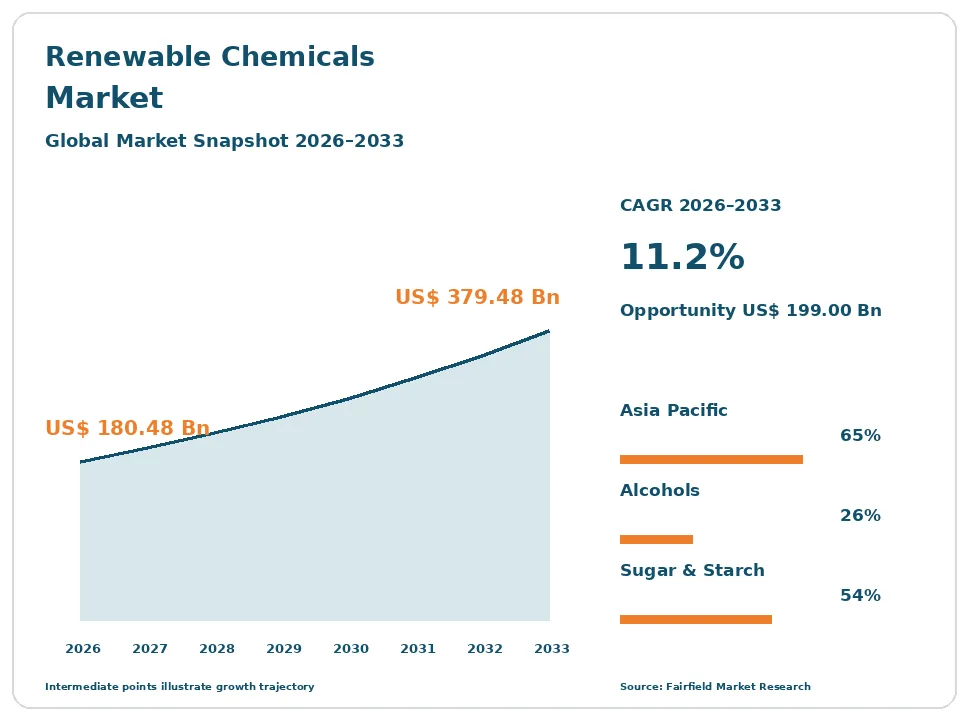
The global renewable chemicals market size is expected to be valued at US$ 180.48 billion in 2026 and projected to reach US$ 379.48 billion by 2033, growing at a CAGR of 11.2% between 2026 and 2033.
Between 2020 and 2025, the market grew at a CAGR of about 10.5%, as brand owners set targets for renewable content, governments supported bio-based industries, and oil price swings encouraged chemical makers to diversify feedstocks. Renewable chemicals are made from biomass such as sugar, starch, vegetable oils, wood, and agricultural waste, or from captured carbon, instead of fossil fuels. They include bio-based chemicals such as alcohols, organic acids, ketones, and biopolymers, used in plastics, packaging, detergents, cosmetics, textiles, and fuels. Three factors now drive growth: corporate net-zero and green chemistry commitments, consumer demand for sustainable products, and policies that support the bioeconomy. The market is shifting toward bio-based plastics for packaging, drop-in chemicals that work in existing plants, biomass feedstock from waste and residues, and carbon-capture routes. In September 2026, Avantium produced its first batch of FDCA at the world’s first commercial-scale plant in Delfzijl, a key building block for plant-based PEF plastic.
Key Report Takeaways
- By Product Type: Alcohols held 26.0% share in 2026, while Biopolymers are projected to expand at a 13.4% CAGR through 2033, driven by demand for bio-based plastics in packaging, textiles, and consumer goods.
- By Application: Petrochemical held 58.0% share in 2026, while Automotive is projected to expand at a 12.9% CAGR through 2033, driven by bio-based plastics, coatings, and lubricants that cut vehicle lifecycle emissions.
- By Feedstock: Sugar & Starch Crops held 54.0% share in 2026, while Lignocellulosic Biomass is projected to expand at a 14.1% CAGR through 2033, driven by waste-based biomass feedstock that avoids competition with food.
- By Region: Asia Pacific held 65.0% share in 2026, while North America is projected to expand at a 12.6% CAGR through 2033, driven by federal bioeconomy support, corn and soybean supply, and new biorefineries.
Global Renewable Chemicals Market Trends and Insights
Drivers Impact Analysis
| Driver | Impact on CAGR Forecast | Geographic Relevance | Impact Timeline |
| Corporate sustainability targets and consumer demand | High | Global | Long term (≥4 years) |
| Government bioeconomy policies and regulations | High | Europe, North America, Asia Pacific | Medium term (2-4 years) |
Two drivers carry the strongest influence on renewable chemicals demand during the forecast period.
Sustainability Targets Are Driving the Renewable Chemicals Market
Corporate sustainability targets and consumer demand are the strongest driver of the renewable chemicals market. Brands want to cut fossil carbon from their products.
The mechanism is pressure across the value chain. Consumer goods, packaging, apparel, and automotive companies have set targets to reduce greenhouse gas emissions, including those from purchased materials. Replacing fossil-based chemicals with bio-based chemicals can lower product carbon footprints. Brands such as Coca-Cola, Unilever, L’Oréal, and Procter & Gamble promote plant-based ingredients and packaging. Consumers, especially younger shoppers, prefer products marketed as natural or sustainable. Green chemistry principles push producers toward safer, less toxic processes. Investors reward companies with strong sustainability performance. These pressures encourage chemical makers to build renewable capacity and sign long-term supply contracts with major brands.
Bioeconomy Policies Are Expanding the Renewable Chemicals Market
Government bioeconomy policies and regulations are expanding the renewable chemicals market. Policy support lowers investment risk.
The cause is government action on climate and rural development. The European Union promotes bio-based products through its bioeconomy strategy, rules on single-use plastics, and packaging regulation. The United States supports biorefineries through loan guarantees, the BioPreferred program for federal purchasing, and tax credits for clean production. China, India, Japan, and Thailand have national plans to develop bio-based industries using local crops and residues. Carbon pricing in Europe raises the cost of fossil-based production. Policies that use agricultural waste support farm incomes. These measures help new plants reach scale. Public-private partnerships, such as the European Circular Bio-based Europe Joint Undertaking, fund demonstration plants and research, and labeling schemes help buyers identify certified bio-based content in products.
Restraints Impact Analysis
| Restraint | Impact on CAGR Forecast | Geographic Relevance | Impact Timeline |
| High production costs versus petrochemicals | High | Global | Long term (≥4 years) |
| Feedstock competition and scale-up risks | Medium | Global | Medium term (2-4 years) |
Two restraints limit how quickly the renewable chemicals market grows.
High Costs Slow the Renewable Chemicals Market
High production costs compared with petrochemicals slow the renewable chemicals market. Many bio-based chemicals still cost more than fossil alternatives.
The specific causes are scale and process efficiency. Petrochemical plants are very large, fully depreciated, and highly optimized, so they produce at low cost. Bio-based plants are often smaller and newer, with higher capital and operating costs per tonne. Fermentation and purification steps can be energy-intensive. When oil prices fall, the cost gap widens and buyers may delay switching. Green premiums are accepted mainly by brands with strong sustainability goals. Several companies, including some well-known startups, have struggled financially or closed plants. These factors slow adoption in price-sensitive markets. Producers are steadily reducing costs through better microbes, process integration, and co-products that add revenue.
Scale-Up Risks Restrict the Renewable Chemicals Market
Feedstock competition and scale-up risks restrict the renewable chemicals market. Building new value chains is difficult.
The underlying causes are supply and technology challenges. Sugar, starch, and vegetable oil feedstocks compete with food and biofuel uses, and their prices swing with harvests and weather. Using agricultural residues and wood requires complex pretreatment and collection logistics. Moving from pilot to commercial scale often reveals technical problems and cost overruns. Financing first-of-a-kind plants is hard. Sustainability certification and land-use concerns add scrutiny. These factors delay projects and raise investor caution. Partnerships between startups and large chemical companies, which bring engineering skills, sites, and customers, are becoming the preferred route to scale. Government grants and loan guarantees help close financing gaps for first commercial plants, and modular plant designs reduce construction risk.
Market Opportunities
Bio-Based Plastics and Packaging Open a Fast-Growth Revenue Pool
Bio-based plastics and packaging open a fast-growth revenue pool in the renewable chemicals market. Packaging is under strong pressure to change.
Biopolymer producers and packaging companies can capture this opportunity. Bio-based polyethylene from Braskem, polylactic acid, polyhydroxyalkanoates, and new materials such as PEF made from FDCA offer lower-carbon alternatives to fossil plastics. Avantium started up the first commercial FDCA plant in September 2026. Beverage, food, cosmetics, and e-commerce brands are actively testing bio-based bottles, films, and containers. Regulations on plastic packaging in Europe increase demand. Compostable plastics suit some food-contact and agricultural uses. Companies that secure long-term offtake agreements with major brands can scale quickly. Recycling systems that accept bio-based plastics alongside conventional ones make adoption easier for brands.
Drop-In and Waste-Based Chemicals Create a Scalable Revenue Pool
Drop-in and waste-based chemicals create a scalable revenue pool in the renewable chemicals market. Chemicals identical to fossil versions are easier to adopt.
Chemical companies and technology developers can capture this opportunity. Drop-in chemicals, such as bio-based ethylene, propylene, butadiene, and acrylonitrile, can use existing plants and supply chains without changes for customers. Trillium Renewable Chemicals chose an INEOS site for a bio-acrylonitrile demonstration plant in June 2024. Verbio announced a plant in Bitterfeld, Germany, in June 2025 to make renewable 9-DAME and 1-decene from vegetable oils. Waste oils, forestry residues, crop residues, and captured carbon greatly expand biomass feedstock supply. Independent mass balance certification lets producers blend renewable inputs into large existing plants and sell certified products to customers.
Segment Analysis
By Product Type: Alcohols Lead While Biopolymers Grow Fastest
Alcohols held 26.0% share in 2026. Bio-ethanol, bio-methanol, butanol, and glycols are widely used as solvents, chemical building blocks, and fuel additives. Archer-Daniels-Midland, Cargill, and Braskem are major producers, using corn and sugarcane feedstocks from large farming regions in the United States and Brazil.
Biopolymers are the fastest-growing product type, expanding at a 13.4% CAGR through 2033. Biopolymers such as bio-polyethylene, PLA, PHA, and bio-based polyesters serve packaging, textiles, and consumer goods. Organic acids, ketones, and other chemicals such as lactic acid, succinic acid, and bio-based surfactants make up the rest. For the market, biopolymer growth links renewable chemicals to high-volume consumer markets such as bottles, films, and fibers.
By Application: Petrochemical Leads While Automotive Grows Fastest
Petrochemical held 58.0% share in 2026. Renewable chemicals replace fossil building blocks in large-scale industrial chemical production, including solvents, resins, plasticizers, and intermediates.
Automotive is the fastest-growing application, expanding at a 12.9% CAGR through 2033. Carmakers use bio-based plastics, seat foams, coatings, and lubricants to reduce lifecycle emissions. Packaging, cleaning and detergents, pharmaceuticals, and textiles are other applications. For the market, automotive growth adds high-specification demand. Packaging is a large and fast-developing application as brands replace fossil plastics. Cleaning and detergent makers use bio-based surfactants and solvents, which are gentler and biodegradable. Pharmaceutical companies use renewable solvents and intermediates. Textile producers use bio-based nylon and polyester fibers in clothing and carpets.
By Feedstock: Sugar & Starch Crops Lead While Lignocellulosic Biomass Grows Fastest
Sugar & Starch Crops held 54.0% share in 2026. Corn, sugarcane, and cassava are the main feedstocks for fermentation-based chemicals because they are easy to process and widely available at scale.
Lignocellulosic Biomass is the fastest-growing feedstock, expanding at a 14.1% CAGR through 2033. Wood, straw, corn stover, and bagasse avoid food competition. Vegetable oils, waste oils, and captured carbon are other feedstocks. For the market, waste-based feedstocks improve sustainability. Technologies that break down cellulose into sugars, or convert wood residues into chemicals, are becoming more efficient. Used cooking oil and animal fats feed renewable chemicals and fuels. Captured carbon dioxide is being turned into methanol, ethanol, and other chemicals using renewable power and microbes.
Geography Analysis
Which Region Is Growing Fastest in the Renewable Chemicals Market?
North America is growing fastest in the renewable chemicals market at a 12.6% CAGR through 2033. The United States has abundant corn and soybean supply, large agribusinesses such as Archer-Daniels-Midland and Cargill, and federal programs that support biorefineries. Canada uses forestry and agricultural residues for wood-based chemicals. Startups in the region, supported by venture capital and federal grants, are developing biomanufacturing platforms using engineered microbes. Corn wet mills are adding chemical production lines. Key barriers include high costs compared with cheap shale-based petrochemicals. One change shaping the region is new biorefineries in the Midwest.
Europe Builds the Renewable Chemicals Market Through Regulation and Innovation
Europe is a major renewable chemicals market. Germany, the Netherlands, France, Italy, and Finland have strong bio-based industries and research. BASF in Germany and Avantium in the Netherlands are key players in the region. Finland and Sweden use forest resources for wood-based chemicals, and Italy has strong and established bioplastics producers. EU rules on single-use plastics and packaging recycling encourage renewable materials. Chemical parks in the Netherlands and Belgium host several bio-based plants. Key barriers include high energy costs and complex permits. One opportunity is bio-based packaging for food and consumer brands.
Which Region Is Leading the Renewable Chemicals Market?
Asia Pacific is leading the renewable chemicals market with a 65.0% share in 2026. China has large bio-based chemical capacity, India produces ethanol and bio-based intermediates from sugarcane, and Japan hosts Mitsubishi Chemical. Thailand promotes bioplastics through investment incentives and hosts large PLA production capacity. Large populations and fast-growing consumer markets support strong demand for sustainable products. South Korea and Indonesia are investing in bio-based materials and palm-based oleochemicals. Key barriers include feedstock prices and concerns about land use. One change shaping the region is bio-based plastics production for packaging and textiles.
Latin America Grows the Renewable Chemicals Market Through Sugarcane
Latin America is a growing renewable chemicals market. Brazil uses sugarcane to make ethanol and Braskem’s bio-based polyethylene. Argentina has large soybean and corn resources that could support bio-based chemicals. Braskem has expanded its I’m green bio-based portfolio, which uses sugarcane ethanol to make polyethylene, and is exploring new plants. Abundant land, low-cost sugarcane, and long experience with ethanol give Brazil a strong cost position. Mexico and Colombia have growing interest in bio-based materials. Key barriers include limited investment and infrastructure. One opportunity is green plastics exported to brands in North America and Europe.
Middle East & Africa Expands the Renewable Chemicals Market Through Diversification
Middle East & Africa is an emerging renewable chemicals market. Saudi Arabia and the United Arab Emirates are exploring bio-based and circular chemicals, and South Africa has sugarcane and forestry resources, and Kenya has agricultural residues suitable for biorefineries in future projects. National chemical companies such as SABIC are investing in circular and low-carbon products as part of economic diversification plans. Egypt and Morocco have agricultural residues that could supply biorefineries. Key barriers include limited local feedstock, water scarcity, and high upfront costs for new plants. One opportunity is waste-based chemicals made from municipal waste and used oils.
Competitive Landscape
The renewable chemicals market is fragmented. BASF, Cargill, Braskem, Archer-Daniels-Midland, and Mitsubishi Chemical are among the largest players, while Corbion, NatureWorks, Avantium, Verbio, Trillium Renewable Chemicals, and Genomatica focus on specific products. Many startups develop new processes.
Companies compete on cost, feedstock access, product performance, sustainability certification, and customer partnerships. Scale is key to cost, so large agribusinesses and chemical companies with existing plants have an advantage. Specialist firms compete through proprietary microbes, catalysts, and process technology. Partnerships with brand owners, such as long-term supply deals for bio-based bottles or fibers, help secure demand. Certification bodies and mass balance schemes support market trust and transparency. Startups often license their technology rather than build plants alone.
Strategic moves show how competition is changing. In June 2024, Trillium Renewable Chemicals chose an INEOS site for a bio-acrylonitrile demonstration plant. In June 2025, Verbio announced a renewable chemicals plant in Germany. In September 2026, Avantium started up its FDCA plant. These moves show competition shifting toward commercial scale, with first-of-a-kind plants moving from pilot and demonstration stages into real production and sales to brand owners in Europe and North America.
Three themes shape vendor strategy. First, companies are scaling plants. Second, they are securing offtake. Third, they are using waste feedstock and residues. Vendors that combine low-cost production, secure feedstock, and strong brand partnerships are best placed to win share.
Renewable Chemicals Market Industry Leaders
- BASF
- Cargill
- Braskem
- Archer-Daniels-Midland
- Mitsubishi Chemical
Recent Industry Developments
- September 2026: Avantium produced its first batch of FDCA at its flagship plant in Delfzijl, the world’s first commercial-scale FDCA plant - advances bio-based plastics such as PEF.
- June 2025: Verbio announced an ethenolysis plant in Bitterfeld, Germany, to produce 32,000 tonnes of renewable 9-DAME and 17,000 tonnes of 1-decene per year - expands drop-in bio-based chemicals.
- June 2024: Trillium Renewable Chemicals selected INEOS Green Lake as the site for a sustainable acrylonitrile demonstration plant - progresses renewable building blocks for fibers and plastics.
Companies Covered in the Report
- BASF
- Cargill
- Braskem
- Archer-Daniels-Midland
- Mitsubishi Chemical
- Corbion
- NatureWorks
- Avantium
- Verbio
- Trillium Renewable Chemicals
- Genomatica
- DSM-Firmenich
Renewable Chemicals Market Report Scope
This report covers renewable chemicals, including alcohols, biopolymers, organic acids, ketones, and other products, made from sugar and starch crops, lignocellulosic biomass, vegetable and waste oils, and other feedstocks, for petrochemical, automotive, packaging, cleaning and detergent, pharmaceutical, textile, and other applications. The base year is 2025, and the forecast period runs from 2026 to 2033. All values are expressed in US$ Billion.
Product Type
- Alcohols
- Biopolymers
- Organic Acids
- Ketones
- Others
Application
- Petrochemical
- Automotive
- Packaging
- Cleaning & Detergent
- Pharmaceutical
- Others
Feedstock
- Sugar & Starch Crops
- Lignocellulosic Biomass
- Vegetable & Waste Oils
- Others
Regions
- North America
- Europe
- Asia Pacific
- Latin America
- Middle East & Africa
Key Questions Answered in the Report
How big is the renewable chemicals market in 2026?
The renewable chemicals market is valued at US$ 180.48 billion in 2026, led by alcohols and Asia Pacific, its largest market.
What is the renewable chemicals market forecast to 2033?
The market is projected to reach US$ 379.48 billion by 2033, growing at an 11.2% CAGR and adding US$ 199.00 billion.
Which product type is growing fastest in the renewable chemicals market?
Biopolymers are growing fastest at a 13.4% CAGR through 2033, driven by demand for bio-based plastics in packaging and textiles.
Which region is growing fastest in the renewable chemicals market?
North America is growing fastest at a 12.6% CAGR through 2033, driven by bioeconomy support, corn and soybean supply, and new biorefineries.
Which region holds the largest renewable chemicals market share?
Asia Pacific holds the largest share at 65.0% in 2026, supported by large bio-based capacity in China, India, and Japan.
1. Executive Summary
1.1. Global Renewable Chemicals Market Snapshot
1.2. Future Projections
1.3. Key Report Takeaways
1.4. Regional Snapshot
2. Market Overview
2.1. Market Definition and Report Scope
2.2. Historical Trends 2020–2025
2.3. Market Dynamics
2.3.1. Drivers
2.3.1.1. Sustainability Targets Are Driving the Renewable Chemicals Market
2.3.1.2. Bioeconomy Policies Are Expanding the Renewable Chemicals Market
2.3.2. Restraints
2.3.2.1. High Costs Slow the Renewable Chemicals Market
2.3.2.2. Scale-Up Risks Restrict the Renewable Chemicals Market
2.3.3. Market Opportunities
2.3.3.1. Bio-Based Plastics and Packaging Open a Fast-Growth Revenue Pool
2.3.3.2. Drop-In and Waste-Based Chemicals Create a Scalable Revenue Pool
3. Global Renewable Chemicals Market Outlook, 2020-2033
3.1. Global Renewable Chemicals Market Outlook, by Product Type, Value (US$ Billion), 2020-2033
3.1.1. Alcohols
3.1.2. Biopolymers
3.1.3. Organic Acids
3.1.4. Ketones
3.1.5. Others
3.2. Global Renewable Chemicals Market Outlook, by Application, Value (US$ Billion), 2020-2033
3.2.1. Petrochemical
3.2.2. Automotive
3.2.3. Packaging
3.2.4. Cleaning & Detergent
3.2.5. Pharmaceutical
3.2.6. Others
3.3. Global Renewable Chemicals Market Outlook, by Feedstock, Value (US$ Billion), 2020-2033
3.3.1. Sugar & Starch Crops
3.3.2. Lignocellulosic Biomass
3.3.3. Vegetable & Waste Oils
3.3.4. Others
3.4. Global Renewable Chemicals Market Outlook, by Region, Value (US$ Billion), 2020-2033
3.4.1. North America
3.4.2. Europe
3.4.3. Asia Pacific
3.4.4. Latin America
3.4.5. Middle East & Africa
4. North America Renewable Chemicals Market Outlook, 2020-2033
4.1. North America Renewable Chemicals Market Outlook, by Product Type, Value (US$ Billion), 2020-2033
4.1.1. Alcohols
4.1.2. Biopolymers
4.1.3. Organic Acids
4.1.4. Ketones
4.1.5. Others
4.2. North America Renewable Chemicals Market Outlook, by Application, Value (US$ Billion), 2020-2033
4.2.1. Petrochemical
4.2.2. Automotive
4.2.3. Packaging
4.2.4. Cleaning & Detergent
4.2.5. Pharmaceutical
4.2.6. Others
4.3. North America Renewable Chemicals Market Outlook, by Feedstock, Value (US$ Billion), 2020-2033
4.3.1. Sugar & Starch Crops
4.3.2. Lignocellulosic Biomass
4.3.3. Vegetable & Waste Oils
4.3.4. Others
4.4. North America Renewable Chemicals Market Outlook, by Country, Value (US$ Billion), 2020-2033
4.4.1. United States Renewable Chemicals Market Outlook, by Product Type, 2020-2033
4.4.2. United States Renewable Chemicals Market Outlook, by Application, 2020-2033
4.4.3. United States Renewable Chemicals Market Outlook, by Feedstock, 2020-2033
4.4.4. Canada Renewable Chemicals Market Outlook, by Product Type, 2020-2033
4.4.5. Canada Renewable Chemicals Market Outlook, by Application, 2020-2033
4.4.6. Canada Renewable Chemicals Market Outlook, by Feedstock, 2020-2033
5. Europe Renewable Chemicals Market Outlook, 2020-2033
5.1. Europe Renewable Chemicals Market Outlook, by Product Type, Value (US$ Billion), 2020-2033
5.1.1. Alcohols
5.1.2. Biopolymers
5.1.3. Organic Acids
5.1.4. Ketones
5.1.5. Others
5.2. Europe Renewable Chemicals Market Outlook, by Application, Value (US$ Billion), 2020-2033
5.2.1. Petrochemical
5.2.2. Automotive
5.2.3. Packaging
5.2.4. Cleaning & Detergent
5.2.5. Pharmaceutical
5.2.6. Others
5.3. Europe Renewable Chemicals Market Outlook, by Feedstock, Value (US$ Billion), 2020-2033
5.3.1. Sugar & Starch Crops
5.3.2. Lignocellulosic Biomass
5.3.3. Vegetable & Waste Oils
5.3.4. Others
5.4. Europe Renewable Chemicals Market Outlook, by Country, Value (US$ Billion), 2020-2033
5.4.1. Germany Renewable Chemicals Market Outlook, by Product Type, 2020-2033
5.4.2. Germany Renewable Chemicals Market Outlook, by Application, 2020-2033
5.4.3. Germany Renewable Chemicals Market Outlook, by Feedstock, 2020-2033
5.4.4. Netherlands Renewable Chemicals Market Outlook, by Product Type, 2020-2033
5.4.5. Netherlands Renewable Chemicals Market Outlook, by Application, 2020-2033
5.4.6. Netherlands Renewable Chemicals Market Outlook, by Feedstock, 2020-2033
5.4.7. France Renewable Chemicals Market Outlook, by Product Type, 2020-2033
5.4.8. France Renewable Chemicals Market Outlook, by Application, 2020-2033
5.4.9. France Renewable Chemicals Market Outlook, by Feedstock, 2020-2033
5.4.10. Italy Renewable Chemicals Market Outlook, by Product Type, 2020-2033
5.4.11. Italy Renewable Chemicals Market Outlook, by Application, 2020-2033
5.4.12. Italy Renewable Chemicals Market Outlook, by Feedstock, 2020-2033
5.4.13. Finland Renewable Chemicals Market Outlook, by Product Type, 2020-2033
5.4.14. Finland Renewable Chemicals Market Outlook, by Application, 2020-2033
5.4.15. Finland Renewable Chemicals Market Outlook, by Feedstock, 2020-2033
5.4.16. Sweden Renewable Chemicals Market Outlook, by Product Type, 2020-2033
5.4.17. Sweden Renewable Chemicals Market Outlook, by Application, 2020-2033
5.4.18. Sweden Renewable Chemicals Market Outlook, by Feedstock, 2020-2033
5.4.19. Belgium Renewable Chemicals Market Outlook, by Product Type, 2020-2033
5.4.20. Belgium Renewable Chemicals Market Outlook, by Application, 2020-2033
5.4.21. Belgium Renewable Chemicals Market Outlook, by Feedstock, 2020-2033
6. Asia Pacific Renewable Chemicals Market Outlook, 2020-2033
6.1. Asia Pacific Renewable Chemicals Market Outlook, by Product Type, Value (US$ Billion), 2020-2033
6.1.1. Alcohols
6.1.2. Biopolymers
6.1.3. Organic Acids
6.1.4. Ketones
6.1.5. Others
6.2. Asia Pacific Renewable Chemicals Market Outlook, by Application, Value (US$ Billion), 2020-2033
6.2.1. Petrochemical
6.2.2. Automotive
6.2.3. Packaging
6.2.4. Cleaning & Detergent
6.2.5. Pharmaceutical
6.2.6. Others
6.3. Asia Pacific Renewable Chemicals Market Outlook, by Feedstock, Value (US$ Billion), 2020-2033
6.3.1. Sugar & Starch Crops
6.3.2. Lignocellulosic Biomass
6.3.3. Vegetable & Waste Oils
6.3.4. Others
6.4. Asia Pacific Renewable Chemicals Market Outlook, by Country, Value (US$ Billion), 2020-2033
6.4.1. China Renewable Chemicals Market Outlook, by Product Type, 2020-2033
6.4.2. China Renewable Chemicals Market Outlook, by Application, 2020-2033
6.4.3. China Renewable Chemicals Market Outlook, by Feedstock, 2020-2033
6.4.4. India Renewable Chemicals Market Outlook, by Product Type, 2020-2033
6.4.5. India Renewable Chemicals Market Outlook, by Application, 2020-2033
6.4.6. India Renewable Chemicals Market Outlook, by Feedstock, 2020-2033
6.4.7. Japan Renewable Chemicals Market Outlook, by Product Type, 2020-2033
6.4.8. Japan Renewable Chemicals Market Outlook, by Application, 2020-2033
6.4.9. Japan Renewable Chemicals Market Outlook, by Feedstock, 2020-2033
6.4.10. Thailand Renewable Chemicals Market Outlook, by Product Type, 2020-2033
6.4.11. Thailand Renewable Chemicals Market Outlook, by Application, 2020-2033
6.4.12. Thailand Renewable Chemicals Market Outlook, by Feedstock, 2020-2033
6.4.13. South Korea Renewable Chemicals Market Outlook, by Product Type, 2020-2033
6.4.14. South Korea Renewable Chemicals Market Outlook, by Application, 2020-2033
6.4.15. South Korea Renewable Chemicals Market Outlook, by Feedstock, 2020-2033
6.4.16. Indonesia Renewable Chemicals Market Outlook, by Product Type, 2020-2033
6.4.17. Indonesia Renewable Chemicals Market Outlook, by Application, 2020-2033
6.4.18. Indonesia Renewable Chemicals Market Outlook, by Feedstock, 2020-2033
7. Latin America Renewable Chemicals Market Outlook, 2020-2033
7.1. Latin America Renewable Chemicals Market Outlook, by Product Type, Value (US$ Billion), 2020-2033
7.1.1. Alcohols
7.1.2. Biopolymers
7.1.3. Organic Acids
7.1.4. Ketones
7.1.5. Others
7.2. Latin America Renewable Chemicals Market Outlook, by Application, Value (US$ Billion), 2020-2033
7.2.1. Petrochemical
7.2.2. Automotive
7.2.3. Packaging
7.2.4. Cleaning & Detergent
7.2.5. Pharmaceutical
7.2.6. Others
7.3. Latin America Renewable Chemicals Market Outlook, by Feedstock, Value (US$ Billion), 2020-2033
7.3.1. Sugar & Starch Crops
7.3.2. Lignocellulosic Biomass
7.3.3. Vegetable & Waste Oils
7.3.4. Others
7.4. Latin America Renewable Chemicals Market Outlook, by Country, Value (US$ Billion), 2020-2033
7.4.1. Brazil Renewable Chemicals Market Outlook, by Product Type, 2020-2033
7.4.2. Brazil Renewable Chemicals Market Outlook, by Application, 2020-2033
7.4.3. Brazil Renewable Chemicals Market Outlook, by Feedstock, 2020-2033
7.4.4. Argentina Renewable Chemicals Market Outlook, by Product Type, 2020-2033
7.4.5. Argentina Renewable Chemicals Market Outlook, by Application, 2020-2033
7.4.6. Argentina Renewable Chemicals Market Outlook, by Feedstock, 2020-2033
7.4.7. Mexico Renewable Chemicals Market Outlook, by Product Type, 2020-2033
7.4.8. Mexico Renewable Chemicals Market Outlook, by Application, 2020-2033
7.4.9. Mexico Renewable Chemicals Market Outlook, by Feedstock, 2020-2033
7.4.10. Colombia Renewable Chemicals Market Outlook, by Product Type, 2020-2033
7.4.11. Colombia Renewable Chemicals Market Outlook, by Application, 2020-2033
7.4.12. Colombia Renewable Chemicals Market Outlook, by Feedstock, 2020-2033
8. Middle East & Africa Renewable Chemicals Market Outlook, 2020-2033
8.1. Middle East & Africa Renewable Chemicals Market Outlook, by Product Type, Value (US$ Billion), 2020-2033
8.1.1. Alcohols
8.1.2. Biopolymers
8.1.3. Organic Acids
8.1.4. Ketones
8.1.5. Others
8.2. Middle East & Africa Renewable Chemicals Market Outlook, by Application, Value (US$ Billion), 2020-2033
8.2.1. Petrochemical
8.2.2. Automotive
8.2.3. Packaging
8.2.4. Cleaning & Detergent
8.2.5. Pharmaceutical
8.2.6. Others
8.3. Middle East & Africa Renewable Chemicals Market Outlook, by Feedstock, Value (US$ Billion), 2020-2033
8.3.1. Sugar & Starch Crops
8.3.2. Lignocellulosic Biomass
8.3.3. Vegetable & Waste Oils
8.3.4. Others
8.4. Middle East & Africa Renewable Chemicals Market Outlook, by Country, Value (US$ Billion), 2020-2033
8.4.1. Saudi Arabia Renewable Chemicals Market Outlook, by Product Type, 2020-2033
8.4.2. Saudi Arabia Renewable Chemicals Market Outlook, by Application, 2020-2033
8.4.3. Saudi Arabia Renewable Chemicals Market Outlook, by Feedstock, 2020-2033
8.4.4. United Arab Emirates Renewable Chemicals Market Outlook, by Product Type, 2020-2033
8.4.5. United Arab Emirates Renewable Chemicals Market Outlook, by Application, 2020-2033
8.4.6. United Arab Emirates Renewable Chemicals Market Outlook, by Feedstock, 2020-2033
8.4.7. South Africa Renewable Chemicals Market Outlook, by Product Type, 2020-2033
8.4.8. South Africa Renewable Chemicals Market Outlook, by Application, 2020-2033
8.4.9. South Africa Renewable Chemicals Market Outlook, by Feedstock, 2020-2033
8.4.10. Kenya Renewable Chemicals Market Outlook, by Product Type, 2020-2033
8.4.11. Kenya Renewable Chemicals Market Outlook, by Application, 2020-2033
8.4.12. Kenya Renewable Chemicals Market Outlook, by Feedstock, 2020-2033
8.4.13. Egypt Renewable Chemicals Market Outlook, by Product Type, 2020-2033
8.4.14. Egypt Renewable Chemicals Market Outlook, by Application, 2020-2033
8.4.15. Egypt Renewable Chemicals Market Outlook, by Feedstock, 2020-2033
8.4.16. Morocco Renewable Chemicals Market Outlook, by Product Type, 2020-2033
8.4.17. Morocco Renewable Chemicals Market Outlook, by Application, 2020-2033
8.4.18. Morocco Renewable Chemicals Market Outlook, by Feedstock, 2020-2033
9. Competitive Landscape
9.1. Market Concentration and Industry Leaders
9.2. Competitive Differentiation
9.3. Strategic Moves and Market Direction
9.4. Recent Industry Developments
9.5. Company Profiles
9.5.1. BASF
9.5.2. Cargill
9.5.3. Braskem
9.5.4. Archer-Daniels-Midland
9.5.5. Mitsubishi Chemical
9.5.6. Corbion
9.5.7. NatureWorks
9.5.8. Avantium
9.5.9. Verbio
9.5.10. Trillium Renewable Chemicals
9.5.11. Genomatica
9.5.12. DSM-Firmenich
10. Appendix
10.1. Research Methodology
10.2. Report Assumptions
10.3. Acronyms and Abbreviations
| Product Type | Alcohols, Biopolymers, Organic Acids, Ketones, Others |
| Application | Petrochemical, Automotive, Packaging, Cleaning & Detergent, Pharmaceutical, Others |
| Feedstock | Sugar & Starch Crops, Lignocellulosic Biomass, Vegetable & Waste Oils, Others |
| Regions | North America, Europe, Asia Pacific, Latin America, Middle East & Africa |
Our Research Methodology
Considering the volatility of business today, traditional approaches to strategizing a game plan can be unfruitful if not detrimental. True ambiguity is no way to determine a forecast. A myriad of predetermined factors must be accounted for such as the degree of risk involved, the magnitude of circumstances, as well as conditions or consequences that are not known or unpredictable. To circumvent binary views that cast uncertainty, the application of market research intelligence to strategically posture, move, and enable actionable outcomes is necessary.
View Methodology
Quality Assured
Rigorous Validation Process

Confidentiality Assured
End-to-end Data Security

Custom Research Services
Tailored To Your Objectives
FAQs
The renewable chemicals market is valued at US$ 180.48 billion in 2026, led by alcohols and Asia Pacific, its largest market.
The market is projected to reach US$ 379.48 billion by 2033, growing at an 11.2% CAGR and adding US$ 199.00 billion.
Biopolymers are growing fastest at a 13.4% CAGR through 2033, driven by demand for bio-based plastics in packaging and textiles.
North America is growing fastest at a 12.6% CAGR through 2033, driven by bioeconomy support, corn and soybean supply, and new biorefineries.
Asia Pacific holds the largest share at 65.0% in 2026, supported by large bio-based capacity in China, India, and Japan.
Related Reports
Rigid Bulk Packaging Market Size, Share, Insights, Competitive Landscape, and Forecast 2026 to 2033
The global rigid bulk packaging market is valued at US$68.5 billion in 2026, reaching US$96.4 billion by 2033, growing at a 5.0% CAGR
Probiotics Packaging Market Size, Share, Insights, Competitive Landscape, and Forecast 2026 to 2033
Explore the probiotics packaging market, valued at US$ 1.4 billion in 2026 and projected to reach US$ 2.4 billion by 2033, growing at an 8.0% CAGR.
Epoxy Composites Market Size, Share, Insights, Competitive Landscape, and Forecast 2026 to 2033
Explore the epoxy composites market, projected to reach US$ 22.3 billion by 2033 at a 6.7% CAGR, with resin, reinforcement and regional insights.
Advanced Materials Market Size, Share, Insights, Competitive Landscape, and Forecast 2026 to 2033
Explore the advanced materials market, projected to reach US$ 121.08 billion by 2033 at a 6.6% CAGR, with product, application and regional insights.
Biopolymer Coatings Market Size, Share, Insights, Competitive Landscape, and Forecast 2026 to 2033
Explore the biopolymer coatings market, projected to reach US$ 2.5 billion by 2033 at a 7.6% CAGR, with product, technology and regional insights.
Dry Construction Market Size, Share, Insights, Competitive Landscape, and Forecast 2026 to 2033
Explore the dry construction market, projected to reach US$ 134.87 billion by 2033 at a 4.7% CAGR, with material, system and regional insights.