



Elevator Maintenance Market
Elevator Maintenance Market Size, Share, Insights, Competitive Landscape, and Forecast 2026 to 2033
Elevator Maintenance Market Size and Trend Analysis
How Fast Is the Elevator Maintenance Market Growing?
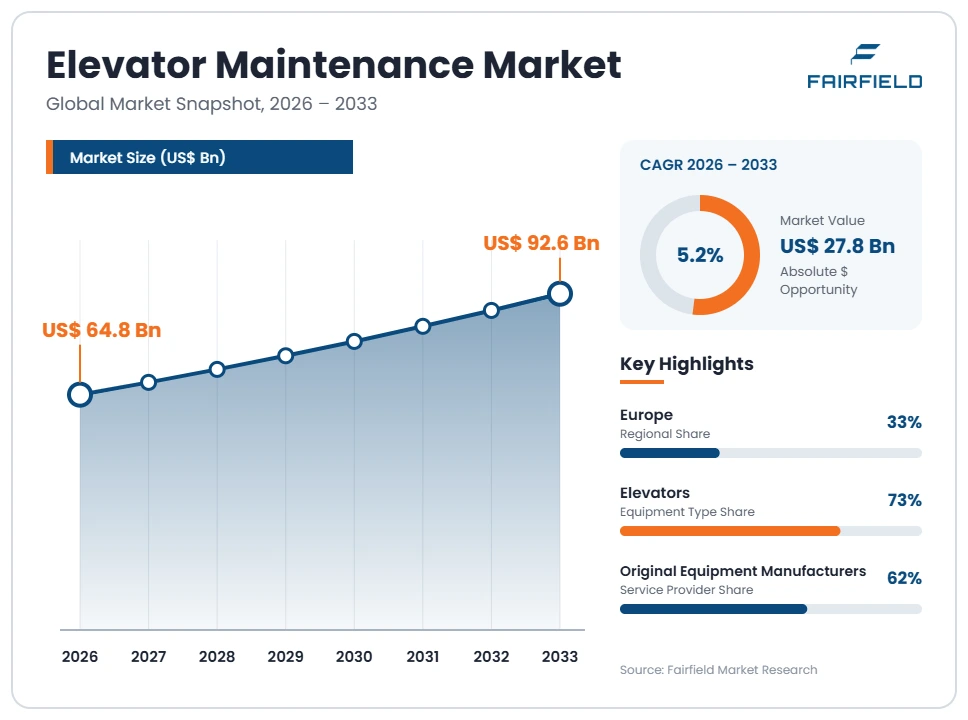
The global elevator maintenance market size is expected to be valued at US$ 64.8 billion in 2026 and projected to reach US$ 92.6 billion by 2033, growing at a CAGR of 5.2% between 2026 and 2033.
Between 2020 and 2025 the market grew at a 4.6% CAGR, rising from about US$ 49.3 billion to roughly US$ 61.9 billion. Three factors carried that growth. First, the global installed base of lifts, escalators and moving walks kept expanding, and each unit enters a paid service contract once its warranty lapses. Second, ageing equipment in Europe and North America required more frequent repair visits, component replacement and control system upgrades. Third, tighter periodic inspection regimes widened the minimum scope of every maintenance visit. The outlook to 2033 is steady rather than cyclical, because service revenue follows the installed unit base instead of new equipment orders, which makes this one of the most predictable income streams in building technology.
Key Report Takeaways
- By Service Type: Preventive maintenance contracts held 41% share in 2026, while modernization and upgrade services are projected to expand at a 7.1% CAGR through 2033, driven by owners replacing pre-EN 81-20 control systems rather than whole lifts.
- By Equipment Type: Elevators held 73% share in 2026, while escalators are projected to expand at a 5.8% CAGR through 2033, driven by metro rail expansion and heavier step-chain and handrail wear in transit environments.
- By Service Provider: Original equipment manufacturers held 62% share in 2026, while independent service providers are projected to expand at a 6.3% CAGR through 2033, driven by procurement teams tendering portfolios to cut per-unit contract cost.
- By End Use: Residential buildings held 42% share in 2026, while institutional and infrastructure properties are projected to expand at a 6.5% CAGR through 2033, driven by airport, hospital and transit uptime penalties written into service agreements.
- By Geography: Europe held 33% share in 2026 on high contract value per unit, while Asia Pacific is projected to expand at a 6.8% CAGR through 2033 as warranty periods end on a decade of Chinese and Indian installations.
Global Elevator Maintenance Market Trends and Insights
Drivers Impact Analysis
Two forces account for most of the forecast growth in lift servicing revenue.
| Driver | Impact on CAGR Forecast | Geographic Relevance | Impact Timeline |
| Ageing installed lift base requiring heavier repair and parts spend | High | Europe, North America | Long term (≥4 years) |
| Mandatory periodic inspection and existing-lift safety upgrade rules | Medium | Europe, North America, Asia Pacific | Medium term (2–4 years) |
Ageing Installed Lift Base Pushes Elevator Maintenance Spend Toward Repair and Parts
An ageing fleet raises service revenue per unit far faster than the unit count grows. A large share of lifts in Europe and North America has been in service for more than twenty-five years. Older units consume more door operator parts, rope and sheave replacements, and controller repairs, and they fail more often between scheduled visits. Each unplanned callout bills above the contract rate, lifting annual revenue per lift.
The mechanism is physical wear combined with obsolescence. Control boards from the 1990s are no longer produced, so service firms must harvest used parts or fit replacement drives, which converts a routine repair into a billable upgrade. EN 81-80, the standard on improving the safety of existing lifts, gives building owners a documented list of hazards on legacy equipment, and that list converts deferred work into funded work orders.
Periodic Inspection Regimes and Accessibility Rules Raise the Minimum Scope of Each Service Visit
Statutory inspection widens the paid scope of maintenance across every major market. National regimes require lifts and escalators in public and workplace buildings to be examined at fixed intervals by a competent body. Any defect recorded by the inspector must be closed, which converts an inspection finding into chargeable repair work. Service providers therefore earn both the contracted visit fee and the remedial work that follows.
Regulation is the causal driver. The Lifts Directive 2014/33/EU sets essential health and safety requirements for lifts placed on the European market, while ASME A17.1 and CSA B44 govern elevators and escalators in North America, with ASME A17.3 addressing existing installations. Accessibility rules under the Americans with Disabilities Act, together with EN 81-70 on access for persons with disabilities and EN 81-28 on remote alarms, require working emergency communication and compliant signalling that must be tested and maintained.
Restraints Impact Analysis
Two constraints hold back margin expansion and provider switching in the lift service sector.
| Restraint | Impact on CAGR Forecast | Geographic Relevance | Impact Timeline |
| Shortage of qualified lift technicians and rising field labour cost | High | North America, Europe | Medium term (2–4 years) |
| Proprietary controllers and restricted diagnostic tool access | Medium | Global | Long term (≥4 years) |
Technician Scarcity and Field Labour Cost Compress Elevator Maintenance Margins
A shortage of licensed lift technicians limits how many units any provider can service profitably. Field labour is the single largest cost line in a maintenance contract, typically well above parts. Contractors in North America and Europe report unfilled vacancies, long apprenticeship pipelines and a retiring workforce. When routes cannot be filled, response times slip, penalty clauses trigger and overtime replaces scheduled coverage, which erodes the margin on contracts priced years earlier.
The underlying cause is the licensing structure of the trade. A lift mechanic needs multi-year apprenticeship hours, electrical competence and jurisdiction-specific certification, so capacity cannot be added quickly when demand rises. Wage settlements in unionised North American markets have outpaced the escalation clauses written into older contracts. Providers respond by densifying routes, extending visit intervals where codes permit, and shifting simple checks to remote monitoring.
Controller Lock-In and Parts Access Disputes Limit Competitive Switching in Lift Servicing
Restricted access to proprietary software and spare parts limits how freely building owners can change service provider. Original equipment manufacturers install controllers whose fault codes, parameter settings and commissioning routines require a licensed tool. Without that tool an independent firm can perform lubrication, cleaning and mechanical adjustment, but cannot reset certain faults or recommission a drive. Owners facing that barrier often stay with the installer and accept weaker price competition.
The cause is commercial design rather than engineering necessity. Maintenance is the highest-margin part of the lift business, so manufacturers protect it through encrypted controllers, serialised boards and tool licensing terms. Competition authorities and owner associations in several European countries have examined whether these practices restrict the aftermarket. The unresolved question of access to parts and software remains the most consequential competitive and regulatory issue in the sector.
Market Opportunities
Modernization of Pre-EN 81-20 Lifts Opens a Funded Upgrade Revenue Pool
Modernization converts a maintenance account into a project sale worth many years of contract value. A controller and drive replacement on an ageing lift is billed as a capital upgrade, yet it is sold, scoped and delivered by the service organisation already on site. Door systems, safety gear and signalling upgrades follow the same path. This pool grows as legacy equipment built to withdrawn standards reaches the end of economic repair.
Service providers with incumbent contracts are best placed to capture it, because they hold the fault history and the owner relationship. Demand comes from residential block managers, hospital estates and commercial landlords facing rising callout rates. The hazard catalogue in EN 81-80 and the existing-installation provisions of ASME A17.3 give owners a defensible technical basis for releasing capital budget.
Connected Monitoring and Predictive Diagnostics Create Subscription Revenue Beyond the Base Contract
Remote monitoring opens a recurring software revenue line on top of the mechanical service fee. Sensors on door operators, drives and brakes stream usage and fault data to a platform that flags degradation before a shutdown. Owners pay a monthly fee for dashboards, uptime reporting and guaranteed response levels. For portfolio owners the value is fewer entrapments, and for providers it is higher revenue per unit without an extra site visit.
Providers that already hold large contract portfolios can capture this pool fastest, since the economics depend on fleet density. Demand is strongest from transit operators, airports and large commercial landlords with contractual uptime obligations. Mandatory remote alarm functionality under EN 81-28 has already put a communication link in many cars, lowering the cost of adding diagnostic telemetry.
Segment Analysis
- By Service Type: Preventive Contracts Hold the Base While Modernization Accelerates
Preventive maintenance contracts led with 41% of revenue in 2026, because almost every lift in commercial use sits under a periodic visit agreement that bills whether or not a fault occurs. These contracts are the anchor product, and repair services and spare parts supply are sold against the same account. Modernization and upgrade services are the fastest-growing line at a 7.1% CAGR to 2033, as owners replace obsolete controllers, drives and door operators instead of funding full equipment replacement. The shift matters commercially because modernization carries project margins and locks the incumbent provider in for another service cycle. Withdrawn construction standards, spare part obsolescence and energy efficiency targets on regenerative drives all push ageing units toward upgrade rather than continued repair, raising average revenue per serviced unit across the portfolio.
- By Equipment Type: Elevators Dominate Volume as Escalator Servicing Grows Faster
Elevators accounted for 73% of service revenue in 2026, simply because they outnumber escalators and moving walks by a wide margin in residential, commercial and institutional buildings. Their contracts are also longer and more standardised. Escalator maintenance is expanding fastest at a 5.8% CAGR through 2033, driven by metro, airport and large retail installations where continuous operation accelerates step chain, handrail and comb plate wear. Escalators in transit duty often run twenty hours a day, which compresses overhaul intervals and raises parts consumption per unit. Moving walkway servicing remains a small but stable line concentrated in airports. The implication is that providers with transit-sector capability earn a disproportionate share of heavy repair work, since escalator overhauls are labour-intensive and require specialist lifting and safety procedures that general lift technicians do not routinely hold.
- By Service Provider: Manufacturers Retain the Installed Base While Independents Gain Share
Original equipment manufacturers held 62% of contracted maintenance revenue in 2026, because the installer usually converts the warranty period into a long-term service agreement and controls the diagnostic tools for its own controllers. Independent service providers are growing fastest at a 6.3% CAGR to 2033, winning multi-site tenders on price, response-time guarantees and willingness to service mixed-brand portfolios. In-house maintenance teams remain a minor category limited to a few transit authorities and large hospital estates. Property managers increasingly bundle hundreds of units into a single competitive tender, which favours providers with regional route density rather than brand loyalty. The business implication is a slow erosion of manufacturer pricing power in commodity residential servicing, while high-rise, high-speed and heavily instrumented equipment stays with the original supplier for technical and liability reasons.
- By End Use: Residential Buildings Lead Volume While Infrastructure Sites Grow Quickest
Residential buildings generated 42% of elevator maintenance revenue in 2026, reflecting the enormous number of low-rise and mid-rise apartment lifts in Europe, China and Latin America. Contract values per unit are modest, but volume and renewal rates are high. Institutional and infrastructure properties are the fastest-growing end use at a 6.5% CAGR through 2033, covering airports, metro stations, hospitals and stadiums where downtime carries contractual penalties and passenger flow consequences. These sites buy enhanced service levels, spare part consignment stock and on-site technicians, which lifts revenue per unit well above the residential average. Commercial offices and industrial facilities fill the middle of the market. The practical effect is that providers are reallocating senior technicians toward infrastructure accounts, where service level agreements justify premium pricing and longer contract terms.
Geography Analysis
- North America Converts an Ageing Fleet Into High-Value Repair and Upgrade Work
North America held 25% of global elevator maintenance revenue in 2026, with a 4.4% CAGR expected to 2033. The region has a comparatively small installed base but the highest contract value per unit, reflecting licensed labour rates and demanding code enforcement. The United States dominates spending, with Canada adding a smaller but similarly regulated market. ASME A17.1 and CSA B44 set the safety code, ASME A17.3 governs existing installations, and accessibility obligations under the Americans with Disabilities Act keep emergency communication and signalling within scope. Many units in older office towers date from the 1970s and 1980s, so controller obsolescence drives steady upgrade demand. The main constraint is technician supply, and the clearest opportunity is portfolio-level contracting by institutional landlords seeking consolidated service pricing.
- Which Region Is Leading the Elevator Maintenance Market?
Europe leads the elevator maintenance market with 33% revenue share in 2026 and a 4.3% CAGR to 2033. Leadership rests on the oldest large installed base in the world combined with strict statutory inspection. Germany, Italy, France, Spain and the United Kingdom together hold several million units, many installed decades before current construction standards. The Lifts Directive 2014/33/EU applies to new placements, while EN 81-20 and EN 81-50 define construction and installation requirements that replaced EN 81-1 and EN 81-2. EN 81-80 gives owners a structured route for raising the safety of existing lifts, which steadily converts legacy equipment into modernization projects. Regular statutory examination by notified inspection bodies guarantees recurring work. The live issue is aftermarket access, as owner associations press for fair availability of parts and diagnostic software.
- Which Region Is Growing Fastest in the Elevator Maintenance Market?
Asia Pacific is growing fastest at a 6.8% CAGR through 2033, from 30% revenue share in 2026. The region holds by far the largest unit count, led by China, where a decade of high-rise residential construction created a vast fleet now moving out of warranty into paid service. India, South Korea, Japan and Australia add dense urban demand. Contract value per unit is lower than in developed markets, so revenue share sits below the region’s share of installed units, but that gap is narrowing as inspection enforcement tightens and labour costs rise. Japan and South Korea behave like mature markets with heavy modernization activity. The defining change is the maturing Chinese fleet, which shifts the regional mix from installation toward recurring maintenance and controller upgrades.
- Latin America Builds Service Density Around Urban Residential Towers
Latin America accounted for 7% of elevator maintenance revenue in 2026 and is forecast to grow at a 5.0% CAGR to 2033. Brazil and Mexico supply most demand, with Chile, Colombia and Argentina contributing dense apartment stock in capital cities. Residential buildings dominate the serviced fleet, so contracts are numerous but individually small, and independent firms hold a strong local position. Barriers are significant: currency volatility raises the cost of imported spare parts, informal servicing persists in smaller cities, and inspection enforcement varies widely between municipalities. Deferred maintenance in older buildings has produced visible safety incidents and growing municipal pressure for documented inspection. The opportunity lies in formalising contracts for mid-rise residential portfolios, where building administrators are shifting from ad hoc repair calls to scheduled preventive agreements.
- Middle East & Africa Serves High-Rise and Transit Assets Under Hot-Climate Duty
Middle East & Africa represented 5% of global revenue in 2026, expanding at a 5.6% CAGR through 2033. Demand concentrates in the United Arab Emirates, Saudi Arabia and Qatar, where tall towers, airports, metro networks and large mixed-use developments require high-specification servicing. South Africa, Egypt and Nigeria form the main sub-Saharan and North African markets. Equipment works in demanding conditions, since dust ingress and high ambient temperatures shorten the life of door operators, brakes and electronic components, which raises parts consumption. Barriers include a thin pool of certified technicians, reliance on expatriate labour and uneven inspection enforcement outside the Gulf states. The clearest opportunity is long-term service contracting tied to giga-project developments and new transit lines, where owners specify guaranteed availability levels from the outset.
Competitive Landscape
The elevator maintenance market is moderately concentrated. A small group of global manufacturers holds the majority of contracted revenue, because the firm that installs a lift usually keeps the service account for the life of the equipment. Around that core sits a long tail of regional independents, many servicing a few hundred units in one metropolitan area. Consolidation is continuous rather than dramatic: large providers buy local service books to add route density, and the acquired portfolio is usually absorbed rather than kept as a separate brand. Concentration is highest in high-rise and transit segments and lowest in residential servicing.
Competition turns on four factors. Price per unit per year matters most in residential tenders. Response time and entrapment release performance decide infrastructure and healthcare contracts. Technical access to the controller determines whether an independent can bid at all on a given portfolio. Reputation with inspection bodies and insurers influences renewal. New entrants are mostly digital: monitoring specialists and platform firms that sell fault prediction and dispatch software to independents, giving smaller providers capability once limited to manufacturers.
Strategic activity concentrates on portfolio consolidation, parts logistics and remote diagnostics. Manufacturers invest in connected service platforms to raise technician productivity and defend the installed base, while independents expand through regional acquisition and multi-brand tooling. Training capacity has become a competitive asset in its own right, since technician supply limits growth more than demand does.
Strategic direction across the sector points toward data-led servicing, mixed-brand capability and modernization selling. Providers are repositioning maintenance as an asset-management service with documented compliance and availability reporting, rather than as a scheduled visit billed by the hour.
Recent Industry Developments
- April 2016: The Lifts Directive 2014/33/EU became applicable across the European Union, replacing the earlier lifts directive and setting the essential health and safety requirements that frame installation, inspection and upgrade practice.
- September 2017: EN 81-1 and EN 81-2 were withdrawn in favour of EN 81-20 and EN 81-50, making the newer construction and installation rules the reference point for assessing and modernising older lifts.
- July 2023: The Machinery Regulation (EU) 2023/1230 entered into force, applying from 20 January 2027 and tightening requirements relevant to escalators, moving walks and digital safety components.
- 2022: The updated edition of the ASME A17.1/CSA B44 safety code for elevators and escalators was issued, keeping inspection scope and maintenance documentation requirements current across North America.
Companies Covered in the Report
- Otis Worldwide Corporation
- Schindler Group
- KONE Corporation
- TK Elevator
- Mitsubishi Electric Corporation
- Hitachi, Ltd.
- Fujitec Co., Ltd.
- Toshiba Elevator and Building Systems Corporation
- Hyundai Elevator Co., Ltd.
- Shanghai Mechanical & Electrical Industry Co., Ltd.
- Stannah Lifts Holdings Ltd.
- Orona S. Coop.
- Wittur Holding GmbH
- Sigma Elevator Company
- IGV Group S.p.A.
Elevator Maintenance Market Report Scope
| Metric | Value |
| Study Period | 2020–2033 |
| Market Size 2026 | US$ 64.8 Billion |
| Market Size 2033 | US$ 92.6 Billion |
| CAGR 2026–2033 | 5.2% |
| Absolute Dollar Opportunity | US$ 27.8 Billion |
| Largest Market | Europe (33% share in 2026) |
| Fastest-Growing Market | Asia Pacific (6.8% CAGR) |
| Market Concentration | Medium |
| Major Players | Otis, Schindler, KONE, TK Elevator, Mitsubishi Electric |
Elevator Maintenance Market Segmentation
Service Type
- Preventive Maintenance Contracts
- Repair and Breakdown Services
- Spare Parts and Components
- Modernization and Upgrade Services
Equipment Type
- Elevators
- Escalators
- Moving Walkways
Service Provider
- Original Equipment Manufacturers
- Independent Service Providers
- In-House Maintenance Teams
End Use
- Residential Buildings
- Commercial Offices and Retail
- Industrial Facilities
- Institutional and Infrastructure Properties
Regions
- North America
- Europe
- Asia Pacific
- Latin America
- Middle East & Africa
- Executive Summary
- Global Elevator Maintenance Market Snapshot
- Market Size and Trend Analysis 2020–2033
- Historical Growth 2020–2025
- Base Year 2025
- Forecast Outlook 2026–2033
- Key Report Takeaways
- Market Overview
- Market Definition and Report Scope
- Market Dynamics
- Drivers
- Ageing Installed Lift Base Pushes Elevator Maintenance Spend Toward Repair and Parts
- Periodic Inspection Regimes and Accessibility Rules Raise the Minimum Scope of Each Service Visit
- Restraints
- Technician Scarcity and Field Labour Cost Compress Elevator Maintenance Margins
- Controller Lock-In and Parts Access Disputes Limit Competitive Switching in Lift Servicing
- Market Opportunities
- Modernization of Pre-EN 81-20 Lifts Opens a Funded Upgrade Revenue Pool
- Connected Monitoring and Predictive Diagnostics Create Subscription Revenue Beyond the Base Contract
- Drivers
- Segment Analysis
- By Service Type: Preventive Contracts Hold the Base While Modernization Accelerates
- By Equipment Type: Elevators Dominate Volume as Escalator Servicing Grows Faster
- By Service Provider: Manufacturers Retain the Installed Base While Independents Gain Share
- By End Use: Residential Buildings Lead Volume While Infrastructure Sites Grow Quickest
- Global Elevator Maintenance Market Outlook, 2020–2033
- Global Elevator Maintenance Market Outlook, by Service Type, Value (US$ Billion), 2020–2033
- Preventive Maintenance Contracts
- Repair and Breakdown Services
- Spare Parts and Components
- Modernization and Upgrade Services
- Global Elevator Maintenance Market Outlook, by Equipment Type, Value (US$ Billion), 2020–2033
- Elevators
- Escalators
- Moving Walkways
- Global Elevator Maintenance Market Outlook, by Service Provider, Value (US$ Billion), 2020–2033
- Original Equipment Manufacturers
- Independent Service Providers
- In-House Maintenance Teams
- Global Elevator Maintenance Market Outlook, by End Use, Value (US$ Billion), 2020–2033
- Residential Buildings
- Commercial Offices and Retail
- Industrial Facilities
- Institutional and Infrastructure Properties
- Global Elevator Maintenance Market Outlook, by Region, Value (US$ Billion), 2020–2033
- North America
- Europe
- Asia Pacific
- Latin America
- Middle East & Africa
- Global Elevator Maintenance Market Outlook, by Service Type, Value (US$ Billion), 2020–2033
- North America Elevator Maintenance Market Outlook, 2020–2033
- North America Converts an Ageing Fleet Into High-Value Repair and Upgrade Work
- North America Elevator Maintenance Market Outlook, by Service Type, Value (US$ Billion), 2020–2033
- Preventive Maintenance Contracts
- Repair and Breakdown Services
- Spare Parts and Components
- Modernization and Upgrade Services
- North America Elevator Maintenance Market Outlook, by Equipment Type, Value (US$ Billion), 2020–2033
- Elevators
- Escalators
- Moving Walkways
- North America Elevator Maintenance Market Outlook, by Service Provider, Value (US$ Billion), 2020–2033
- Original Equipment Manufacturers
- Independent Service Providers
- In-House Maintenance Teams
- North America Elevator Maintenance Market Outlook, by End Use, Value (US$ Billion), 2020–2033
- Residential Buildings
- Commercial Offices and Retail
- Industrial Facilities
- Institutional and Infrastructure Properties
- North America Elevator Maintenance Market Outlook, by Country, Value (US$ Billion), 2020–2033
- United States Elevator Maintenance Market Outlook, by Service Type, 2020–2033
- United States Elevator Maintenance Market Outlook, by Equipment Type, 2020–2033
- United States Elevator Maintenance Market Outlook, by Service Provider, 2020–2033
- United States Elevator Maintenance Market Outlook, by End Use, 2020–2033
- Canada Elevator Maintenance Market Outlook, by Service Type, 2020–2033
- Canada Elevator Maintenance Market Outlook, by Equipment Type, 2020–2033
- Canada Elevator Maintenance Market Outlook, by Service Provider, 2020–2033
- Canada Elevator Maintenance Market Outlook, by End Use, 2020–2033
- Europe Elevator Maintenance Market Outlook, 2020–2033
- Regional Market Leadership
- Europe Elevator Maintenance Market Outlook, by Service Type, Value (US$ Billion), 2020–2033
- Preventive Maintenance Contracts
- Repair and Breakdown Services
- Spare Parts and Components
- Modernization and Upgrade Services
- Europe Elevator Maintenance Market Outlook, by Equipment Type, Value (US$ Billion), 2020–2033
- Elevators
- Escalators
- Moving Walkways
- Europe Elevator Maintenance Market Outlook, by Service Provider, Value (US$ Billion), 2020–2033
- Original Equipment Manufacturers
- Independent Service Providers
- In-House Maintenance Teams
- Europe Elevator Maintenance Market Outlook, by End Use, Value (US$ Billion), 2020–2033
- Residential Buildings
- Commercial Offices and Retail
- Industrial Facilities
- Institutional and Infrastructure Properties
- Europe Elevator Maintenance Market Outlook, by Country, Value (US$ Billion), 2020–2033
- Germany Elevator Maintenance Market Outlook, by Service Type, 2020–2033
- Germany Elevator Maintenance Market Outlook, by Equipment Type, 2020–2033
- Germany Elevator Maintenance Market Outlook, by Service Provider, 2020–2033
- Germany Elevator Maintenance Market Outlook, by End Use, 2020–2033
- Italy Elevator Maintenance Market Outlook, by Service Type, 2020–2033
- Italy Elevator Maintenance Market Outlook, by Equipment Type, 2020–2033
- Italy Elevator Maintenance Market Outlook, by Service Provider, 2020–2033
- Italy Elevator Maintenance Market Outlook, by End Use, 2020–2033
- France Elevator Maintenance Market Outlook, by Service Type, 2020–2033
- France Elevator Maintenance Market Outlook, by Equipment Type, 2020–2033
- France Elevator Maintenance Market Outlook, by Service Provider, 2020–2033
- France Elevator Maintenance Market Outlook, by End Use, 2020–2033
- Spain Elevator Maintenance Market Outlook, by Service Type, 2020–2033
- Spain Elevator Maintenance Market Outlook, by Equipment Type, 2020–2033
- Spain Elevator Maintenance Market Outlook, by Service Provider, 2020–2033
- Spain Elevator Maintenance Market Outlook, by End Use, 2020–2033
- United Kingdom Elevator Maintenance Market Outlook, by Service Type, 2020–2033
- United Kingdom Elevator Maintenance Market Outlook, by Equipment Type, 2020–2033
- United Kingdom Elevator Maintenance Market Outlook, by Service Provider, 2020–2033
- United Kingdom Elevator Maintenance Market Outlook, by End Use, 2020–2033
- Asia Pacific Elevator Maintenance Market Outlook, 2020–2033
- Regional Growth Outlook
- Asia Pacific Elevator Maintenance Market Outlook, by Service Type, Value (US$ Billion), 2020–2033
- Preventive Maintenance Contracts
- Repair and Breakdown Services
- Spare Parts and Components
- Modernization and Upgrade Services
- Asia Pacific Elevator Maintenance Market Outlook, by Equipment Type, Value (US$ Billion), 2020–2033
- Elevators
- Escalators
- Moving Walkways
- Asia Pacific Elevator Maintenance Market Outlook, by Service Provider, Value (US$ Billion), 2020–2033
- Original Equipment Manufacturers
- Independent Service Providers
- In-House Maintenance Teams
- Asia Pacific Elevator Maintenance Market Outlook, by End Use, Value (US$ Billion), 2020–2033
- Residential Buildings
- Commercial Offices and Retail
- Industrial Facilities
- Institutional and Infrastructure Properties
- Asia Pacific Elevator Maintenance Market Outlook, by Country, Value (US$ Billion), 2020–2033
- China Elevator Maintenance Market Outlook, by Service Type, 2020–2033
- China Elevator Maintenance Market Outlook, by Equipment Type, 2020–2033
- China Elevator Maintenance Market Outlook, by Service Provider, 2020–2033
- China Elevator Maintenance Market Outlook, by End Use, 2020–2033
- India Elevator Maintenance Market Outlook, by Service Type, 2020–2033
- India Elevator Maintenance Market Outlook, by Equipment Type, 2020–2033
- India Elevator Maintenance Market Outlook, by Service Provider, 2020–2033
- India Elevator Maintenance Market Outlook, by End Use, 2020–2033
- South Korea Elevator Maintenance Market Outlook, by Service Type, 2020–2033
- South Korea Elevator Maintenance Market Outlook, by Equipment Type, 2020–2033
- South Korea Elevator Maintenance Market Outlook, by Service Provider, 2020–2033
- South Korea Elevator Maintenance Market Outlook, by End Use, 2020–2033
- Japan Elevator Maintenance Market Outlook, by Service Type, 2020–2033
- Japan Elevator Maintenance Market Outlook, by Equipment Type, 2020–2033
- Japan Elevator Maintenance Market Outlook, by Service Provider, 2020–2033
- Japan Elevator Maintenance Market Outlook, by End Use, 2020–2033
- Australia Elevator Maintenance Market Outlook, by Service Type, 2020–2033
- Australia Elevator Maintenance Market Outlook, by Equipment Type, 2020–2033
- Australia Elevator Maintenance Market Outlook, by Service Provider, 2020–2033
- Australia Elevator Maintenance Market Outlook, by End Use, 2020–2033
- Latin America Elevator Maintenance Market Outlook, 2020–2033
- Latin America Builds Service Density Around Urban Residential Towers
- Latin America Elevator Maintenance Market Outlook, by Service Type, Value (US$ Billion), 2020–2033
- Preventive Maintenance Contracts
- Repair and Breakdown Services
- Spare Parts and Components
- Modernization and Upgrade Services
- Latin America Elevator Maintenance Market Outlook, by Equipment Type, Value (US$ Billion), 2020–2033
- Elevators
- Escalators
- Moving Walkways
- Latin America Elevator Maintenance Market Outlook, by Service Provider, Value (US$ Billion), 2020–2033
- Original Equipment Manufacturers
- Independent Service Providers
- In-House Maintenance Teams
- Latin America Elevator Maintenance Market Outlook, by End Use, Value (US$ Billion), 2020–2033
- Residential Buildings
- Commercial Offices and Retail
- Industrial Facilities
- Institutional and Infrastructure Properties
- Latin America Elevator Maintenance Market Outlook, by Country, Value (US$ Billion), 2020–2033
- Brazil Elevator Maintenance Market Outlook, by Service Type, 2020–2033
- Brazil Elevator Maintenance Market Outlook, by Equipment Type, 2020–2033
- Brazil Elevator Maintenance Market Outlook, by Service Provider, 2020–2033
- Brazil Elevator Maintenance Market Outlook, by End Use, 2020–2033
- Mexico Elevator Maintenance Market Outlook, by Service Type, 2020–2033
- Mexico Elevator Maintenance Market Outlook, by Equipment Type, 2020–2033
- Mexico Elevator Maintenance Market Outlook, by Service Provider, 2020–2033
- Mexico Elevator Maintenance Market Outlook, by End Use, 2020–2033
- Chile Elevator Maintenance Market Outlook, by Service Type, 2020–2033
- Chile Elevator Maintenance Market Outlook, by Equipment Type, 2020–2033
- Chile Elevator Maintenance Market Outlook, by Service Provider, 2020–2033
- Chile Elevator Maintenance Market Outlook, by End Use, 2020–2033
- Colombia Elevator Maintenance Market Outlook, by Service Type, 2020–2033
- Colombia Elevator Maintenance Market Outlook, by Equipment Type, 2020–2033
- Colombia Elevator Maintenance Market Outlook, by Service Provider, 2020–2033
- Colombia Elevator Maintenance Market Outlook, by End Use, 2020–2033
- Argentina Elevator Maintenance Market Outlook, by Service Type, 2020–2033
- Argentina Elevator Maintenance Market Outlook, by Equipment Type, 2020–2033
- Argentina Elevator Maintenance Market Outlook, by Service Provider, 2020–2033
- Argentina Elevator Maintenance Market Outlook, by End Use, 2020–2033
- Middle East & Africa Elevator Maintenance Market Outlook, 2020–2033
- Middle East & Africa Serves High-Rise and Transit Assets Under Hot-Climate Duty
- Middle East & Africa Elevator Maintenance Market Outlook, by Service Type, Value (US$ Billion), 2020–2033
- Preventive Maintenance Contracts
- Repair and Breakdown Services
- Spare Parts and Components
- Modernization and Upgrade Services
- Middle East & Africa Elevator Maintenance Market Outlook, by Equipment Type, Value (US$ Billion), 2020–2033
- Elevators
- Escalators
- Moving Walkways
- Middle East & Africa Elevator Maintenance Market Outlook, by Service Provider, Value (US$ Billion), 2020–2033
- Original Equipment Manufacturers
- Independent Service Providers
- In-House Maintenance Teams
- Middle East & Africa Elevator Maintenance Market Outlook, by End Use, Value (US$ Billion), 2020–2033
- Residential Buildings
- Commercial Offices and Retail
- Industrial Facilities
- Institutional and Infrastructure Properties
- Middle East & Africa Elevator Maintenance Market Outlook, by Country, Value (US$ Billion), 2020–2033
- United Arab Emirates Elevator Maintenance Market Outlook, by Service Type, 2020–2033
- United Arab Emirates Elevator Maintenance Market Outlook, by Equipment Type, 2020–2033
- United Arab Emirates Elevator Maintenance Market Outlook, by Service Provider, 2020–2033
- United Arab Emirates Elevator Maintenance Market Outlook, by End Use, 2020–2033
- Saudi Arabia Elevator Maintenance Market Outlook, by Service Type, 2020–2033
- Saudi Arabia Elevator Maintenance Market Outlook, by Equipment Type, 2020–2033
- Saudi Arabia Elevator Maintenance Market Outlook, by Service Provider, 2020–2033
- Saudi Arabia Elevator Maintenance Market Outlook, by End Use, 2020–2033
- Qatar Elevator Maintenance Market Outlook, by Service Type, 2020–2033
- Qatar Elevator Maintenance Market Outlook, by Equipment Type, 2020–2033
- Qatar Elevator Maintenance Market Outlook, by Service Provider, 2020–2033
- Qatar Elevator Maintenance Market Outlook, by End Use, 2020–2033
- South Africa Elevator Maintenance Market Outlook, by Service Type, 2020–2033
- South Africa Elevator Maintenance Market Outlook, by Equipment Type, 2020–2033
- South Africa Elevator Maintenance Market Outlook, by Service Provider, 2020–2033
- South Africa Elevator Maintenance Market Outlook, by End Use, 2020–2033
- Egypt Elevator Maintenance Market Outlook, by Service Type, 2020–2033
- Egypt Elevator Maintenance Market Outlook, by Equipment Type, 2020–2033
- Egypt Elevator Maintenance Market Outlook, by Service Provider, 2020–2033
- Egypt Elevator Maintenance Market Outlook, by End Use, 2020–2033
- Nigeria Elevator Maintenance Market Outlook, by Service Type, 2020–2033
- Nigeria Elevator Maintenance Market Outlook, by Equipment Type, 2020–2033
- Nigeria Elevator Maintenance Market Outlook, by Service Provider, 2020–2033
- Nigeria Elevator Maintenance Market Outlook, by End Use, 2020–2033
- Competitive Landscape
- Market Concentration and Supplier Participation
- Competitive Factors and Strategic Direction
- Recent Industry Developments
- EU Lifts Directive Application April 2016
- EN 81-1 and EN 81-2 Withdrawal September 2017
- EU Machinery Regulation Entry into Force July 2023
- ASME A17.1 and CSA B44 Safety Code Update 2022
- Company Profiles
- Otis Worldwide Corporation
- Schindler Group
- KONE Corporation
- TK Elevator
- Mitsubishi Electric Corporation
- Hitachi, Ltd.
- Fujitec Co., Ltd.
- Toshiba Elevator and Building Systems Corporation
- Hyundai Elevator Co., Ltd.
- Shanghai Mechanical & Electrical Industry Co., Ltd.
- Stannah Lifts Holdings Ltd.
- Orona S. Coop.
- Wittur Holding GmbH
- Sigma Elevator Company
- IGV Group S.p.A.
- Appendix
- Research Methodology
- Report Assumptions
- Acronyms and Abbreviations
Service Type
- Preventive Maintenance Contracts
- Repair and Breakdown Services
- Spare Parts and Components
- Modernization and Upgrade Services
Equipment Type
- Elevators
- Escalators
- Moving Walkways
Service Provider
- Original Equipment Manufacturers
- Independent Service Providers
- In-House Maintenance Teams
End Use
- Residential Buildings
- Commercial Offices and Retail
- Industrial Facilities
- Institutional and Infrastructure Properties
Regions
- North America
- Europe
- Asia Pacific
- Latin America
- Middle East & Africa
Our Research Methodology
Considering the volatility of business today, traditional approaches to strategizing a game plan can be unfruitful if not detrimental. True ambiguity is no way to determine a forecast. A myriad of predetermined factors must be accounted for such as the degree of risk involved, the magnitude of circumstances, as well as conditions or consequences that are not known or unpredictable. To circumvent binary views that cast uncertainty, the application of market research intelligence to strategically posture, move, and enable actionable outcomes is necessary.
View Methodology
Quality Assured
Rigorous Validation Process

Confidentiality Assured
End-to-end Data Security

Custom Research Services
Tailored To Your Objectives
FAQs
The elevator maintenance market is valued at US$ 64.8 billion in 2026, covering preventive contracts, repairs, spare parts and modernization work on installed equipment worldwide.
The market is projected to reach US$ 92.6 billion by 2033, growing at a 5.2% CAGR and adding US$ 27.8 billion in absolute revenue opportunity.
Preventive maintenance contracts lead with 41% of revenue in 2026, because nearly every commercially operated lift sits under a recurring scheduled visit agreement.
Asia Pacific grows fastest at a 6.8% CAGR to 2033, as a large Chinese and Indian installed base moves out of warranty into paid service.
Concentration is medium: a few global manufacturers hold most contracted revenue, while many regional independent providers compete on price and response time.
Related Reports
Gas Insulated Power Equipment Market Size, Share, Insights, Competitive Landscape, and Forecast 2026 to 2033
The gas insulated power equipment market is valued at US$ 24.0 Bn in 2026 and is projected to reach US$ 40.5 Bn by 2033, growing at a CAGR of 7.8%
Chain Conveyors Market Size, Share, Insights, Competitive Landscape, and Forecast 2026 to 2033
The global chain conveyors market will grow from US$9.78 billion in 2026 to US$15.45 billion by 2033, at a CAGR of 6.75%, driven by industrial automation.
Reciprocating Plunger Pumps Market Size, Share, Insights, Competitive Landscape, and Forecast 2026 to 2033
The reciprocating plunger pumps market will grow from US$4.89 billion in 2026 to US$7.45 billion by 2033, at a CAGR of 6.2%.
Plastic Injection Molding Machine for MedTech Market Size, Share, Insights, Competitive Landscape, and Forecast 2026 to 2033
The plastic injection molding machine for MedTech market will grow from US$2.1 billion in 2026 to US$3.46 billion by 2033, at a CAGR of 7.4%.
Plastic Processing Machinery Market Size, Share, Insights, Competitive Landscape, and Forecast 2026 to 2033
The plastic processing machinery market will grow from US$38.5 billion in 2026 to US$55.3 billion by 2033, at a 5.3% CAGR, driven by industrial demand.
Padel Court Construction Market Size, Share, Insights, Competitive Landscape, and Market Forecast - 2033
The Padel Court Construction Market is projected to reach US$8.9 billion by 2033, growing at 13.8% CAGR from US$3.6 billion in 2026.