



Organic Baby Food Market
Organic Baby Food Market Insights, Competitive Landscape, and Market Forecast - 2033
Global Organic Baby Food Market Forecast
- The organic baby food market is projected to reach a size of USD 16.6 Bn by 2033, showing significant growth from the USD 8.4 Bn achieved in 2026.
- The market for organic baby food is expected to show a significant expansion rate, with an estimated CAGR of 10% from 2026 to 2033.
Organic Baby Food Market Insights
A Look Back and a Look Forward - Comparative Analysis
The organic baby food market growth during the historical period ranging between 2019 to 2025 was driven by rising parental awareness regarding the benefits of organic nutrition for infants. Increasing demand for chemical-free, non-GMO, and nutrient-rich baby food options prompted manufacturers to innovate and diversify product offerings.
Growing influence of e-commerce further amplified market accessibility. Online platforms have made organic baby food readily available to urban and rural consumers.
Over the forecast period, the market is likely to experience accelerated growth fueled by transformative trends and emerging opportunities. Rising adoption of plant-based organic baby food aligns with the global shift toward sustainable and allergen-free diets.
Expansion in developing regions is anticipated to drive significant growth owing to increasing urbanization, awareness campaigns, and supportive government initiatives promoting organic farming. With parents seeking transparency and quality, new organic baby food innovations along with robust regulatory support are projected to propel the market forward.
Key Growth Determinants
- Concerns Regarding Child Health Prompt Consumers to Opt for Organic Food Products
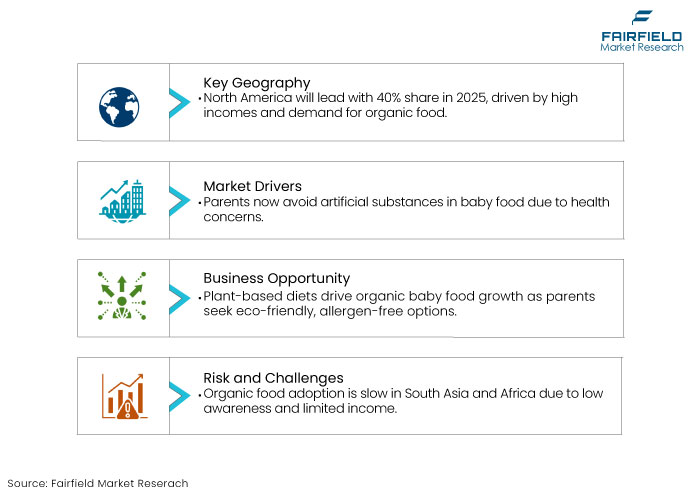
Recent years have witnessed rising concerns regarding the consumption of food products containing artificial substances by new-borns and young children. Parents have become increasingly conscious of various food elements.
The swift internet penetration has enabled parents to become aware of the latest market offerings that ideal for their children. Accessibility of organic products in smaller regions is witnessing growth, contributing to market expansion.
Prominent food manufacturers are keen on organic goods owing to their appeal within the infant food sector. Growing adoption of organic products in tier 2 and tier 3 cities has facilitated expansion in smaller communities, which is anticipated to enhance growth.
- Promotion and Marketing in Mainstream Distribution Channels
The market for organic baby food products is gradually transitioning from a niche to a substantial industry category. Availability of products varies significantly among countries, as it is contingent upon the market environment.
- Organic baby food products are in high demand in developed countries, such as Germany, where large retail chains account for 70% of the product sales.
Even though baby food products are relatively expensive, retailers offer great discounts, encouraging consumers to purchase. Market growth in developing countries is significantly influenced by the expansion of supermarkets and hypermarkets in tier 2 and 3 cities.
For the past few years, consumers have been aware of and purchased products through such retail channels. Continuous expansion in hypermarkets and supermarkets is anticipated to facilitate substantial growth in the future.
Key Growth Barriers
- Limited Availability in Developing Markets
Adoption rate of organic food items is sluggish in developing markets, particularly in South Asia and Africa. Several consumers' lack awareness and understanding which results in transient demand from a restricted income demographic.
Despite growing awareness of organic products, their availability in developing regions is limited. The lack of well-established distribution channels and fewer organic-certified local producers restricts accessibility in countries across Asia, Africa, and Latin America. Higher cost of importing organic baby food adds to affordability issues in these regions. Consumers in these regions often rely on locally available conventional baby food products.
Organic Baby Food Market Trends and Opportunities
- Rising Demand for Plant-Based Organic Baby Food
Increasing preference for plant-based diets impacts the organic baby food market, presenting numerous growth opportunities. Modern parents are more conscious about introducing eco-friendly and allergen-free foods in their children's diets.
Plant-based organic baby food, crafted from nutrient-rich ingredients like quinoa, lentils, and almond milk, are gaining traction as a healthier and sustainable alternative to conventional options. Such products cater to families seeking to align their dietary choices with environmental and ethical considerations.
The trend highlights plant-based nutrition's role in promoting infants' overall health and well-being. As consumers continue to embrace plant-based options, companies have an opportunity to create a niche and strengthen their brand equity.
- Expansion of Online Retail Channels
Rapid growth of e-commerce is revolutionizing how parents shop for organic baby food, as it offers substantial convenience and accessibility. Online platforms like Amazon, Walmart, and specialized baby food stores enable parents to explore a wide range of organic products. These channels allow parents to read detailed descriptions, compare prices, and even subscribe to regular deliveries.
The shift to online shopping appeals to time-strapped urban families who value convenience. Several online retailers now offer exclusive deals, fast delivery, and customer reviews, making the buying process smoother and more reliable.
How is Regulatory Scenario Shaping this Industry?
The organic baby food market is heavily influenced by evolving regulatory frameworks that ensure product safety, quality, and authenticity. Stringent government regulations, particularly in regions like North America and Europe, drive manufacturers to adhere to high standards for organic certification.
Certifications require compliance with stringent guidelines, like non-GMO ingredients, no synthetic pesticides, and environmentally sustainable farming practices. In emerging economies, governments are increasingly introducing initiatives to promote organic farming. They are also creating certification systems, paving the way for expansion.
Segment Covered in the Report
- Convenience of Prepared Baby Food to Augment Growth
Prepared baby food segment is anticipated to dominate owing to its convenience, uniformity, and nutritional reliability. Ready-to-eat organic baby foods conserve time for busy parents by obviating meal preparation. They also guarantee that each product adheres to rigorous quality control requirements for safety and consistency.
Prepared foods are specifically formulated to satisfy new-borns’ nutritional requirements and are available in various flavours and textures that is appealing to parents and infants. Extended shelf life of prepared infant foods diminishes the necessity for frequent grocery outings while enhancing the overall convenience. Certified organic alternatives from esteemed brands provide confidence regarding product safety and authenticity.
- Supermarkets/Hypermarkets are Gaining Traction as Parents can Evaluate Options
The supermarkets/ hypermarkets distribution channel is predicted to dominate with a share of 45% in 2025. This growth is attributed to their ability to offer consumers a wide range of products under one roof, providing convenience and variety.
Parents prefer shopping in supermarkets and hypermarkets as they can physically inspect the products and compare prices. Physical stores also enable them to evaluate options for ingredients, packaging, and certifications like USDA Organic.
Retail giants like Walmart, Tesco, and Carrefour play a significant role in this dominance, with dedicated sections for organic and health-focused products. The availability of in-store promotions and discounts encourages bulk purchases, particularly for families with infants.
Supermarkets and hypermarkets are evolving to meet the rising demand for organic products by expanding their inventory and collaborating with premium organic baby food brands. Consistent accessibility and tailored offerings in urban and suburban areas reinforce their dominant position in the market.
Regional Analysis
- Health Oriented Parenting Patterns to Bolster Growth in North America
North America is anticipated to dominate with a share of 40% in 2025. Growth in the region is primarily driven by elevated disposable incomes, health-oriented parenting patterns, and the extensive accessibility of organic food.
Parents in the North America are emphasizing their baby's health by selecting chemical-free, nutrient-dense, and environmentally sustainable baby food alternatives. Consumer preference for clean-label products with precise ingredient sourcing corresponds with the increasing recognition of the long-term advantages of organic nutrition.
Prominent organic baby food brands allocate substantial resources to research and innovation. They are also constantly launching new product variations to address changing consumer preferences, including plant-based and allergen-free alternatives.
- Europe Ranks as the Second Leading Region with 25% of the Market Share
Europe is predicted to emerge as the second-largest market with a share of 25% in 2025. High consumer awareness and an established preference for organic and sustainable products support the region's growth. Countries like Germany, the U.K., and France are at the forefront owing to robust government support for organic farming and eco-friendly initiatives.
Increasing availability of innovative product varieties, including gluten-free and allergen-free organic baby food, caters to specific dietary requirements, boosting demand. Europe's stringent organic certification standards and wide retail distribution networks have made organic baby food a staple choice among parents across the region.
Fairfield’s Competitive Landscape Analysis
The organic baby food market is highly competitive, with established brands and new entrants striving to capture market share. Key players like Nestlé, The Hain Celestial Group, and Danone are projected to dominate the market with extensive product portfolios and strong brand recognition. Companies are focusing on innovation, offering diverse options, like plant-based, allergen-free, and gluten-free baby food, to cater to evolving consumer needs.
Emergence of smaller regional players is reshaping the market dynamics by emphasizing on locally sourced organic ingredients. Distribution through e-commerce platforms and retail stores is critical for expansion, while certifications like USDA Organic are pivotal in building consumer trust.
Key Market Companies
- Nestle SA
- Abbott Laboratories
- Danone SA
- The Kraft Heinz Company
- Mead Johnson & Company, LLC
- Lactalis
- The Hain Celestial Group Inc.
- Hero Group
- Sprout Organic Foods, Inc
- Hipp Gmbh & Co Vertrieb KG
- Baby Gourmet Foods Inc.
- Amara Organic Foods
An Expert’s Eye
- Rising awareness among parents about the long-term health benefits of organic baby food is a key driver.
- Industry analysts highlight the significant role of strict regulatory standards in enhancing consumer trust.
- Expansion of e-commerce platforms has opened new doors for organic baby food brands, making it easier for parents to access a wider variety of products directly from home.
- Experts predict that continued innovation in flavours, such as exotic fruits and vegetables, will appeal to health-conscious parents.
Global Organic Baby Food Market is Segmented as-
By Product
- Infant Milk Formula
- Prepared Baby Food
- Dried Baby Food
By Distribution Channel
- Supermarket/ Hypermarkets
- Convenience Stores
- Online Retails
- Others
By Region
- North America
- Europe
- Asia Pacific
- Latin America
- Middle East & Africa
- Executive Summary
- Global Organic Baby Food Market Snapshot
- Future Projections
- Key Market Trends
- Regional Snapshot, by Value, 2026
- Analyst Recommendations
- Market Overview
- Market Definitions and Segmentations
- Market Dynamics
- Drivers
- Restraints
- Market Opportunities
- Value Chain Analysis
- COVID-19 Impact Analysis
- Porter's Five Forces Analysis
- Impact of Russia-Ukraine Conflict
- PESTLE Analysis
- Regulatory Analysis
- Price Trend Analysis
- Current Prices and Future Projections, 2025-2033
- Price Impact Factors
- Global Organic Baby Food Market Outlook, 2020 - 2033
- Global Organic Baby Food Market Outlook, by Product, Value (US$ Mn), 2020-2033
- Infant Milk Formula
- Prepared Baby Food
- Prepared Baby Food
- Global Organic Baby Food Market Outlook, by Distribution Channel, Value (US$ Mn), 2020-2033
- Supermarket/ Hypermarkets
- Convenience Stores
- Online Retails
- Others
- Global Organic Baby Food Market Outlook, by Region, Value (US$ Mn), 2020-2033
- North America
- Europe
- Asia Pacific
- Latin America
- Middle East & Africa
- Global Organic Baby Food Market Outlook, by Product, Value (US$ Mn), 2020-2033
- North America Organic Baby Food Market Outlook, 2020 - 2033
- North America Organic Baby Food Market Outlook, by Product, Value (US$ Mn), 2020-2033
- Infant Milk Formula
- Prepared Baby Food
- Prepared Baby Food
- North America Organic Baby Food Market Outlook, by Distribution Channel, Value (US$ Mn), 2020-2033
- Supermarket/ Hypermarkets
- Convenience Stores
- Online Retails
- Others
- North America Organic Baby Food Market Outlook, by Country, Value (US$ Mn), 2020-2033
- U.S. Organic Baby Food Market Outlook, by Product, 2020-2033
- U.S. Organic Baby Food Market Outlook, by Distribution Channel, 2020-2033
- Canada Organic Baby Food Market Outlook, by Product, 2020-2033
- Canada Organic Baby Food Market Outlook, by Distribution Channel, 2020-2033
- BPS Analysis/Market Attractiveness Analysis
- North America Organic Baby Food Market Outlook, by Product, Value (US$ Mn), 2020-2033
- Europe Organic Baby Food Market Outlook, 2020 - 2033
- Europe Organic Baby Food Market Outlook, by Product, Value (US$ Mn), 2020-2033
- Infant Milk Formula
- Prepared Baby Food
- Prepared Baby Food
- Europe Organic Baby Food Market Outlook, by Distribution Channel, Value (US$ Mn), 2020-2033
- Supermarket/ Hypermarkets
- Convenience Stores
- Online Retails
- Others
- Europe Organic Baby Food Market Outlook, by Country, Value (US$ Mn), 2020-2033
- Germany Organic Baby Food Market Outlook, by Product, 2020-2033
- Germany Organic Baby Food Market Outlook, by Distribution Channel, 2020-2033
- Italy Organic Baby Food Market Outlook, by Product, 2020-2033
- Italy Organic Baby Food Market Outlook, by Distribution Channel, 2020-2033
- France Organic Baby Food Market Outlook, by Product, 2020-2033
- France Organic Baby Food Market Outlook, by Distribution Channel, 2020-2033
- U.K. Organic Baby Food Market Outlook, by Product, 2020-2033
- U.K. Organic Baby Food Market Outlook, by Distribution Channel, 2020-2033
- Spain Organic Baby Food Market Outlook, by Product, 2020-2033
- Spain Organic Baby Food Market Outlook, by Distribution Channel, 2020-2033
- Russia Organic Baby Food Market Outlook, by Product, 2020-2033
- Russia Organic Baby Food Market Outlook, by Distribution Channel, 2020-2033
- Rest of Europe Organic Baby Food Market Outlook, by Product, 2020-2033
- Rest of Europe Organic Baby Food Market Outlook, by Distribution Channel, 2020-2033
- BPS Analysis/Market Attractiveness Analysis
- Europe Organic Baby Food Market Outlook, by Product, Value (US$ Mn), 2020-2033
- Asia Pacific Organic Baby Food Market Outlook, 2020 - 2033
- Asia Pacific Organic Baby Food Market Outlook, by Product, Value (US$ Mn), 2020-2033
- Infant Milk Formula
- Prepared Baby Food
- Prepared Baby Food
- Asia Pacific Organic Baby Food Market Outlook, by Distribution Channel, Value (US$ Mn), 2020-2033
- Supermarket/ Hypermarkets
- Convenience Stores
- Online Retails
- Others
- Asia Pacific Organic Baby Food Market Outlook, by Country, Value (US$ Mn), 2020-2033
- China Organic Baby Food Market Outlook, by Product, 2020-2033
- China Organic Baby Food Market Outlook, by Distribution Channel, 2020-2033
- Japan Organic Baby Food Market Outlook, by Product, 2020-2033
- Japan Organic Baby Food Market Outlook, by Distribution Channel, 2020-2033
- South Korea Organic Baby Food Market Outlook, by Product, 2020-2033
- South Korea Organic Baby Food Market Outlook, by Distribution Channel, 2020-2033
- India Organic Baby Food Market Outlook, by Product, 2020-2033
- India Organic Baby Food Market Outlook, by Distribution Channel, 2020-2033
- Southeast Asia Organic Baby Food Market Outlook, by Product, 2020-2033
- Southeast Asia Organic Baby Food Market Outlook, by Distribution Channel, 2020-2033
- Rest of SAO Organic Baby Food Market Outlook, by Product, 2020-2033
- Rest of SAO Organic Baby Food Market Outlook, by Distribution Channel, 2020-2033
- BPS Analysis/Market Attractiveness Analysis
- Asia Pacific Organic Baby Food Market Outlook, by Product, Value (US$ Mn), 2020-2033
- Latin America Organic Baby Food Market Outlook, 2020 - 2033
- Latin America Organic Baby Food Market Outlook, by Product, Value (US$ Mn), 2020-2033
- Infant Milk Formula
- Prepared Baby Food
- Prepared Baby Food
- Latin America Organic Baby Food Market Outlook, by Distribution Channel, Value (US$ Mn), 2020-2033
- Supermarket/ Hypermarkets
- Convenience Stores
- Online Retails
- Others
- Latin America Organic Baby Food Market Outlook, by Country, Value (US$ Mn), 2020-2033
- Brazil Organic Baby Food Market Outlook, by Product, 2020-2033
- Brazil Organic Baby Food Market Outlook, by Distribution Channel, 2020-2033
- Mexico Organic Baby Food Market Outlook, by Product, 2020-2033
- Mexico Organic Baby Food Market Outlook, by Distribution Channel, 2020-2033
- Argentina Organic Baby Food Market Outlook, by Product, 2020-2033
- Argentina Organic Baby Food Market Outlook, by Distribution Channel, 2020-2033
- Rest of LATAM Organic Baby Food Market Outlook, by Product, 2020-2033
- Rest of LATAM Organic Baby Food Market Outlook, by Distribution Channel, 2020-2033
- BPS Analysis/Market Attractiveness Analysis
- Latin America Organic Baby Food Market Outlook, by Product, Value (US$ Mn), 2020-2033
- Middle East & Africa Organic Baby Food Market Outlook, 2020 - 2033
- Middle East & Africa Organic Baby Food Market Outlook, by Product, Value (US$ Mn), 2020-2033
- Infant Milk Formula
- Prepared Baby Food
- Prepared Baby Food
- Middle East & Africa Organic Baby Food Market Outlook, by Distribution Channel, Value (US$ Mn), 2020-2033
- Supermarket/ Hypermarkets
- Convenience Stores
- Online Retails
- Others
- Middle East & Africa Organic Baby Food Market Outlook, by Country, Value (US$ Mn), 2020-2033
- GCC Organic Baby Food Market Outlook, by Product, 2020-2033
- GCC Organic Baby Food Market Outlook, by Distribution Channel, 2020-2033
- South Africa Organic Baby Food Market Outlook, by Product, 2020-2033
- South Africa Organic Baby Food Market Outlook, by Distribution Channel, 2020-2033
- Egypt Organic Baby Food Market Outlook, by Product, 2020-2033
- Egypt Organic Baby Food Market Outlook, by Distribution Channel, 2020-2033
- Nigeria Organic Baby Food Market Outlook, by Product, 2020-2033
- Nigeria Organic Baby Food Market Outlook, by Distribution Channel, 2020-2033
- Rest of Middle East Organic Baby Food Market Outlook, by Product, 2020-2033
- Rest of Middle East Organic Baby Food Market Outlook, by Distribution Channel, 2020-2033
- BPS Analysis/Market Attractiveness Analysis
- Middle East & Africa Organic Baby Food Market Outlook, by Product, Value (US$ Mn), 2020-2033
- Competitive Landscape
- Company Vs Segment Heatmap
- Company Market Share Analysis, 2025
- Competitive Dashboard
- Company Profiles
- Nestle SA
- Company Overview
- Product Portfolio
- Financial Overview
- Business Strategies and Developments
- Abbott Laboratories
- Danone SA
- The Kraft Heinz Company
- Mead Johnson & Company, LLC
- Lactalis
- The Hain Celestial Group Inc.
- Hero Group
- Sprout Organic Foods, Inc
- Hipp Gmbh & Co Vertrieb KG
- Nestle SA
- Appendix
- Research Methodology
- Report Assumptions
- Acronyms and Abbreviations
|
BASE YEAR |
HISTORICAL DATA |
FORECAST PERIOD |
UNITS |
|||
 |
2025 |
 |
2019 - 2025 |
 |
2026 - 2033 |
Value: US$ Billion |
|
REPORT FEATURES |
DETAILS |
|
Product Coverage |
|
|
Distribution Channel Coverage |
|
|
Geographical Coverage |
|
|
Leading Companies |
|
|
Report Highlights |
Key Market Indicators, Macro-micro economic impact analysis, Technological Roadmap, Key Trends, Driver, Restraints, and Future Opportunities & Revenue Pockets, Porter’s 5 Forces Analysis, Historical Trend (2019-2021), Market Estimates and Forecast, Market Dynamics, Industry Trends, Competition Landscape, Category, Region, Country-wise Trends & Analysḍis, COVID-19 Impact Analysis (Demand and Supply Chain) |
Our Research Methodology
Considering the volatility of business today, traditional approaches to strategizing a game plan can be unfruitful if not detrimental. True ambiguity is no way to determine a forecast. A myriad of predetermined factors must be accounted for such as the degree of risk involved, the magnitude of circumstances, as well as conditions or consequences that are not known or unpredictable. To circumvent binary views that cast uncertainty, the application of market research intelligence to strategically posture, move, and enable actionable outcomes is necessary.
View Methodology
Quality Assured
Rigorous Validation Process

Confidentiality Assured
End-to-end Data Security

Custom Research Services
Tailored To Your Objectives
FAQs
The organic baby food industry is estimated to be valued at USD 8.4 Bn in 2026.
North America is projected to account for the largest market revenue share in 2025.
The organic baby food industry is estimated to rise at a CAGR of 10% from 2026 to 2033.
Baby snacks are the fastest-growing baby food products.
Nestle SA, Abbott Laboratories, and Danone SA are a few top brands.
Related Reports
Ammonium Chloride Food Grade Market
The global ammonium chloride food grade market will reach US$ 447.95 Mn by 2033, growing at a 5.4% CAGR from 2026-2033, driven by rising demand for food additives
Rendered Poultry Products Market
Rendered Poultry Products Market is valued at USD 14.50 Billion in 2026 and is projected to reach USD 21.23 Billion by 2033, growing at a 5.6% CAGR.
Casein Peptone Market Insights, Competitive Landscape, and Market Forecast 2033
The global casein peptone market is valued at USD 320 Mn in 2026 and projected to reach USD 520.62 Mn by 2033, growing at a 7.2% CAGR by 2033
Kids' Brain Health Supplements Market
Kids' Brain Health Supplements Market is valued at USD 1.60 Billion in 2026 and projected to reach USD 3.95 Billion by 2033, growing at 13.8% CAGR.
Vegetable Parchment Paper Market Insights, Competitive Landscape, and Market Forecast 2033
The vegetable parchment paper market reaches USD 2.50 Bn by 2033, growing at a 6.6% CAGR from USD 1.60 Bn in 2026, driven by sustainable packaging use
Peptide-based Sweeteners Market Insights, Competitive Landscape, and Market Forecast 2033
The global peptide-based sweeteners market is valued at USD 210.00 Mn in 2026 and projected to reach USD 551.83 Mn by 2033, at a 14.8% CAGR period