



Smart Retail Analytics Market
Smart Retail Analytics Market
Market Overview
Smart retail analytics applies data analytics and artificial intelligence to retail operations, spanning customer behavior analysis, inventory and supply chain optimization, and pricing and promotion analytics that support more informed, data-driven retail decision-making. As retailers navigate increasingly complex omnichannel operations and evolving consumer expectations, analytics capability has become central to optimizing inventory, personalizing customer engagement, and improving overall operational efficiency across physical and digital retail channels.
Demand growth through the 2026-2033 window is closely tied to intensifying retail competition driving investment in data-driven decision-making capability, growing complexity of omnichannel retail operations requiring sophisticated inventory and supply chain coordination, and continued advancement in artificial intelligence and machine learning capability improving the practical value of retail analytics insights. Expanding availability of in-store sensor and computer vision technology continues to provide retailers with richer data inputs supporting more sophisticated analytics applications.
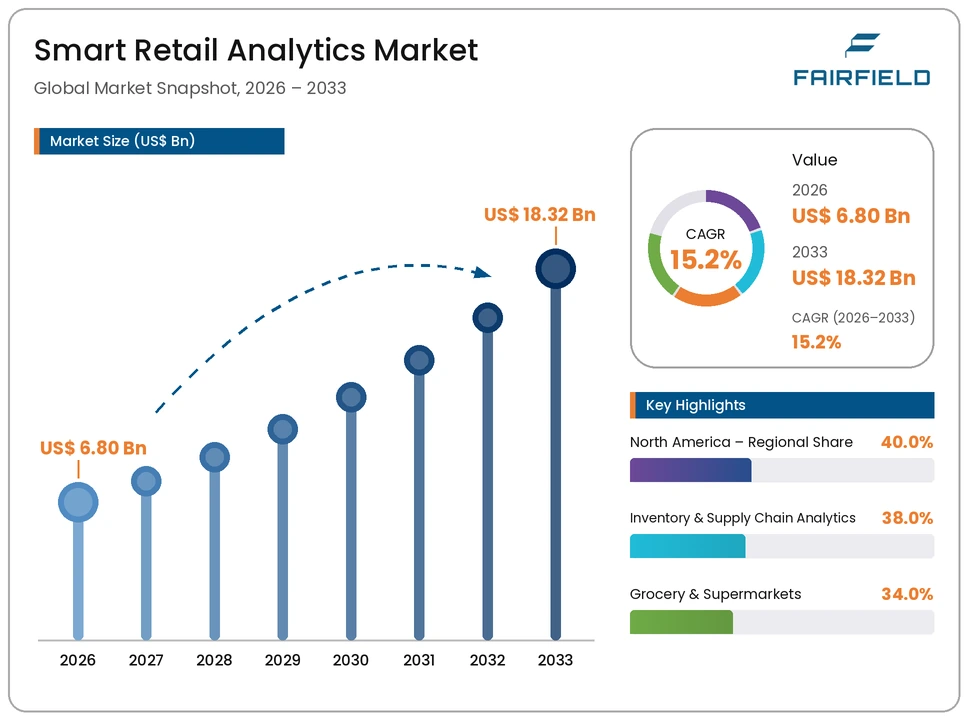
The market is valued at USD 6.80 Billion in 2026, with technology providers directing substantial investment toward improved AI-driven analytics capability that translates raw retail data into actionable operational and merchandising recommendations. By 2033, the market is forecast to reach USD 18.32 Billion, reflecting steady growth across established inventory and supply chain applications alongside rapidly expanding customer behavior analytics adoption.
Key Highlights
- The global smart retail analytics market is valued at USD 6.80 Billion in 2026 and is projected to reach USD 18.32 Billion by 2033, expanding at a CAGR of 15.2% across the 2026-2033 forecast period.
- Inventory & Supply Chain Analytics leads the application segment with a 38.0% share in 2026, equivalent to USD 2.58 Billion.
- Grocery & Supermarkets remain the dominant end-user segment, accounting for 34.0% of global demand, or USD 2.31 Billion, in 2026.
- North America commands the largest regional share at 40.0% of the global market in 2026.
- Customer behavior analytics is emerging as the fastest-growing application through 2033.
Key Growth Drivers
Growth in the smart retail analytics market is driven primarily by intensifying retail competition, as retailers increasingly view sophisticated analytics capability as essential to optimizing pricing, inventory, and customer engagement in an increasingly competitive retail environment.
A second driver is growing complexity of omnichannel retail operations, as retailers managing both physical stores and digital channels require sophisticated analytics to coordinate inventory, fulfillment, and customer experience across these increasingly interconnected channels.
Key Restraints
Data integration challenges across disparate retail systems, including point-of-sale, inventory management, and e-commerce platforms, create implementation complexity that can slow analytics platform deployment and limit near-term return on investment.
Additionally, the specialized technical expertise required to effectively deploy and interpret advanced retail analytics creates an adoption barrier for smaller retailers without dedicated data science capability.
Market Opportunities
The expansion of customer behavior analytics presents a substantial opportunity, as retailers increasingly seek deeper understanding of in-store and online customer behavior to inform merchandising, store layout, and personalized marketing decisions.
A second opportunity lies in continued integration of computer vision and sensor-based data collection that provides retailers with more granular, real-time insight into customer behavior and inventory status. Companies that successfully combine these data sources with sophisticated analytics capability stand to capture growing retailer demand for comprehensive, actionable insight.
Segmentation Analysis
- By Application
Inventory & Supply Chain Analytics leads the application segment, accounting for 38.0% of global market value in 2026, equivalent to USD 2.58 Billion. Its leadership reflects the direct, measurable cost savings retailers achieve through improved inventory accuracy and supply chain optimization. Pricing & Promotion Analytics represents a significant, established application category. Customer Behavior Analytics represents the fastest-growing application category through 2033, driven by growing retailer investment in personalized customer engagement.
- By End User
Grocery & Supermarkets form the leading end-user segment, representing 34.0% of global demand in 2026, or USD 2.31 Billion, reflecting this sector's substantial inventory complexity and thin margins that reward analytics-driven efficiency gains. Fashion & Apparel represents the fastest-growing end-user category, propelled by growing analytics adoption supporting trend forecasting and inventory optimization.
Regional Insights
- North America
North America holds the largest regional share, at 40.0% of the global market in 2026, equivalent to USD 2.72 Billion. The region's leadership reflects mature retail technology adoption and substantial retailer investment in analytics capability across the United States and Canada.
- Asia Pacific
Asia Pacific accounts for 28.0% of the global market in 2026, valued at USD 1.90 Billion. Growth is underpinned by rapidly expanding retail technology adoption and large retail industry scale across China, Japan, and India.
- Europe
Europe represents 25.0% of the global market in 2026, or USD 1.70 Billion. Demand is supported by growing retail analytics adoption and expanding omnichannel retail investment across major European markets.
- Latin America
Latin America contributes 4.0% of the global market in 2026, equivalent to USD 0.27 Billion. Growth is linked to expanding retail technology adoption in Brazil and Mexico.
- Middle East & Africa
Middle East & Africa holds 3.0% of the global market in 2026, valued at USD 0.20 Billion. Growth remains gradual, tied to expanding retail technology infrastructure across the region.
Competitive Landscape
The global smart retail analytics market is moderately fragmented, with a mix of large enterprise technology companies and specialized retail analytics providers competing for retailer adoption. Competition centers on analytics accuracy and AI sophistication, breadth of integration with existing retail systems, and the ability to translate data insights into actionable operational recommendations. Companies are increasingly differentiating through expanded computer vision and sensor-based data integration rather than competing on transaction data analysis alone.
Key Market Players
- Microsoft Corporation
- SAP SE
- Oracle Corporation
- IBM Corporation
- Salesforce, Inc.
- NIQ Global Intelligence Inc.
- RetailNext, Inc.
- Trax Technology Solutions Pte Ltd
- Zebra Technologies Corporation
- Google LLC
Market Segmentation
By Application
- Customer Behavior Analytics
- Inventory & Supply Chain Analytics
- Pricing & Promotion Analytics
- Others
By End User
- Grocery & Supermarkets
- Fashion & Apparel
- Electronics & Others
By Deployment Mode
- Cloud-Based
- On-Premise
By Geography
- North America
- Europe
- Asia Pacific
- Latin America
- Middle East & Africa
- Executive Summary
- Global Smart Retail Analytics Market Snapshot
- Future Projections
- Key Market Trends
- Regional Snapshot, by Value, 2026
- Analyst Recommendations
- Market Overview
- Market Definitions and Segmentations
- Market Dynamics
- Drivers
- Restraints
- Market Opportunities
- Value Chain Analysis
- COVID-19 Impact Analysis
- Porter's Five Forces Analysis
- Impact of Russia-Ukraine Conflict
- PESTLE Analysis
- Regulatory Analysis
- Price Trend Analysis
- Current Prices and Future Projections, 2025-2033
- Price Impact Factors
- Global Smart Retail Analytics Market Outlook, 2020 - 2033
- Global Smart Retail Analytics Market Outlook, by Application, Value (US$ Bn), 2020-2033
- Customer Behavior Analytics
- Inventory & Supply Chain Analytics
- Pricing & Promotion Analytics
- Others
- Global Smart Retail Analytics Market Outlook, by End User, Value (US$ Bn), 2020-2033
- Grocery & Supermarkets
- Fashion & Apparel
- Electronics & Others
- Global Smart Retail Analytics Market Outlook, by Deployment Mode, Value (US$ Bn), 2020-2033
- Cloud-Based
- On-Premise
- Global Smart Retail Analytics Market Outlook, by Region, Value (US$ Bn), 2020-2033
- North America
- Europe
- Asia Pacific
- Latin America
- Middle East & Africa
- Global Smart Retail Analytics Market Outlook, by Application, Value (US$ Bn), 2020-2033
- North America Smart Retail Analytics Market Outlook, 2020 - 2033
- North America Smart Retail Analytics Market Outlook, by Application, Value (US$ Bn), 2020-2033
- Customer Behavior Analytics
- Inventory & Supply Chain Analytics
- Pricing & Promotion Analytics
- Others
- North America Smart Retail Analytics Market Outlook, by End User, Value (US$ Bn), 2020-2033
- Grocery & Supermarkets
- Fashion & Apparel
- Electronics & Others
- North America Smart Retail Analytics Market Outlook, by Deployment Mode, Value (US$ Bn), 2020-2033
- Cloud-Based
- On-Premise
- North America Smart Retail Analytics Market Outlook, by Country, Value (US$ Bn), 2020-2033
- U.S. Smart Retail Analytics Market Outlook, by Application, 2020-2033
- U.S. Smart Retail Analytics Market Outlook, by End User, 2020-2033
- U.S. Smart Retail Analytics Market Outlook, by Deployment Mode, 2020-2033
- Canada Smart Retail Analytics Market Outlook, by Application, 2020-2033
- Canada Smart Retail Analytics Market Outlook, by End User, 2020-2033
- Canada Smart Retail Analytics Market Outlook, by Deployment Mode, 2020-2033
- BPS Analysis/Market Attractiveness Analysis
- North America Smart Retail Analytics Market Outlook, by Application, Value (US$ Bn), 2020-2033
- Europe Smart Retail Analytics Market Outlook, 2020 - 2033
- Europe Smart Retail Analytics Market Outlook, by Application, Value (US$ Bn), 2020-2033
- Customer Behavior Analytics
- Inventory & Supply Chain Analytics
- Pricing & Promotion Analytics
- Others
- Europe Smart Retail Analytics Market Outlook, by End User, Value (US$ Bn), 2020-2033
- Grocery & Supermarkets
- Fashion & Apparel
- Electronics & Others
- Europe Smart Retail Analytics Market Outlook, by Deployment Mode, Value (US$ Bn), 2020-2033
- Cloud-Based
- On-Premise
- Europe Smart Retail Analytics Market Outlook, by Country, Value (US$ Bn), 2020-2033
- Germany Smart Retail Analytics Market Outlook, by Application, 2020-2033
- Germany Smart Retail Analytics Market Outlook, by End User, 2020-2033
- Germany Smart Retail Analytics Market Outlook, by Deployment Mode, 2020-2033
- Italy Smart Retail Analytics Market Outlook, by Application, 2020-2033
- Italy Smart Retail Analytics Market Outlook, by End User, 2020-2033
- Italy Smart Retail Analytics Market Outlook, by Deployment Mode, 2020-2033
- France Smart Retail Analytics Market Outlook, by Application, 2020-2033
- France Smart Retail Analytics Market Outlook, by End User, 2020-2033
- France Smart Retail Analytics Market Outlook, by Deployment Mode, 2020-2033
- U.K. Smart Retail Analytics Market Outlook, by Application, 2020-2033
- U.K. Smart Retail Analytics Market Outlook, by End User, 2020-2033
- U.K. Smart Retail Analytics Market Outlook, by Deployment Mode, 2020-2033
- Spain Smart Retail Analytics Market Outlook, by Application, 2020-2033
- Spain Smart Retail Analytics Market Outlook, by End User, 2020-2033
- Spain Smart Retail Analytics Market Outlook, by Deployment Mode, 2020-2033
- Russia Smart Retail Analytics Market Outlook, by Application, 2020-2033
- Russia Smart Retail Analytics Market Outlook, by End User, 2020-2033
- Russia Smart Retail Analytics Market Outlook, by Deployment Mode, 2020-2033
- Rest of Europe Smart Retail Analytics Market Outlook, by Application, 2020-2033
- Rest of Europe Smart Retail Analytics Market Outlook, by End User, 2020-2033
- Rest of Europe Smart Retail Analytics Market Outlook, by Deployment Mode, 2020-2033
- BPS Analysis/Market Attractiveness Analysis
- Europe Smart Retail Analytics Market Outlook, by Application, Value (US$ Bn), 2020-2033
- Asia Pacific Smart Retail Analytics Market Outlook, 2020 - 2033
- Asia Pacific Smart Retail Analytics Market Outlook, by Application, Value (US$ Bn), 2020-2033
- Customer Behavior Analytics
- Inventory & Supply Chain Analytics
- Pricing & Promotion Analytics
- Others
- Asia Pacific Smart Retail Analytics Market Outlook, by End User, Value (US$ Bn), 2020-2033
- Grocery & Supermarkets
- Fashion & Apparel
- Electronics & Others
- Asia Pacific Smart Retail Analytics Market Outlook, by Deployment Mode, Value (US$ Bn), 2020-2033
- Cloud-Based
- On-Premise
- Asia Pacific Smart Retail Analytics Market Outlook, by Country, Value (US$ Bn), 2020-2033
- China Smart Retail Analytics Market Outlook, by Application, 2020-2033
- China Smart Retail Analytics Market Outlook, by End User, 2020-2033
- China Smart Retail Analytics Market Outlook, by Deployment Mode, 2020-2033
- Japan Smart Retail Analytics Market Outlook, by Application, 2020-2033
- Japan Smart Retail Analytics Market Outlook, by End User, 2020-2033
- Japan Smart Retail Analytics Market Outlook, by Deployment Mode, 2020-2033
- South Korea Smart Retail Analytics Market Outlook, by Application, 2020-2033
- South Korea Smart Retail Analytics Market Outlook, by End User, 2020-2033
- South Korea Smart Retail Analytics Market Outlook, by Deployment Mode, 2020-2033
- India Smart Retail Analytics Market Outlook, by Application, 2020-2033
- India Smart Retail Analytics Market Outlook, by End User, 2020-2033
- India Smart Retail Analytics Market Outlook, by Deployment Mode, 2020-2033
- Southeast Asia Smart Retail Analytics Market Outlook, by Application, 2020-2033
- Southeast Asia Smart Retail Analytics Market Outlook, by End User, 2020-2033
- Southeast Asia Smart Retail Analytics Market Outlook, by Deployment Mode, 2020-2033
- Rest of SAO Smart Retail Analytics Market Outlook, by Application, 2020-2033
- Rest of SAO Smart Retail Analytics Market Outlook, by End User, 2020-2033
- Rest of SAO Smart Retail Analytics Market Outlook, by Deployment Mode, 2020-2033
- BPS Analysis/Market Attractiveness Analysis
- Asia Pacific Smart Retail Analytics Market Outlook, by Application, Value (US$ Bn), 2020-2033
- Latin America Smart Retail Analytics Market Outlook, 2020 - 2033
- Latin America Smart Retail Analytics Market Outlook, by Application, Value (US$ Bn), 2020-2033
- Customer Behavior Analytics
- Inventory & Supply Chain Analytics
- Pricing & Promotion Analytics
- Others
- Latin America Smart Retail Analytics Market Outlook, by End User, Value (US$ Bn), 2020-2033
- Grocery & Supermarkets
- Fashion & Apparel
- Electronics & Others
- Latin America Smart Retail Analytics Market Outlook, by Deployment Mode, Value (US$ Bn), 2020-2033
- Cloud-Based
- On-Premise
- Latin America Smart Retail Analytics Market Outlook, by Country, Value (US$ Bn), 2020-2033
- Brazil Smart Retail Analytics Market Outlook, by Application, 2020-2033
- Brazil Smart Retail Analytics Market Outlook, by End User, 2020-2033
- Brazil Smart Retail Analytics Market Outlook, by Deployment Mode, 2020-2033
- Mexico Smart Retail Analytics Market Outlook, by Application, 2020-2033
- Mexico Smart Retail Analytics Market Outlook, by End User, 2020-2033
- Mexico Smart Retail Analytics Market Outlook, by Deployment Mode, 2020-2033
- Argentina Smart Retail Analytics Market Outlook, by Application, 2020-2033
- Argentina Smart Retail Analytics Market Outlook, by End User, 2020-2033
- Argentina Smart Retail Analytics Market Outlook, by Deployment Mode, 2020-2033
- Rest of LATAM Smart Retail Analytics Market Outlook, by Application, 2020-2033
- Rest of LATAM Smart Retail Analytics Market Outlook, by End User, 2020-2033
- Rest of LATAM Smart Retail Analytics Market Outlook, by Deployment Mode, 2020-2033
- BPS Analysis/Market Attractiveness Analysis
- Latin America Smart Retail Analytics Market Outlook, by Application, Value (US$ Bn), 2020-2033
- Middle East & Africa Smart Retail Analytics Market Outlook, 2020 - 2033
- Middle East & Africa Smart Retail Analytics Market Outlook, by Application, Value (US$ Bn), 2020-2033
- Customer Behavior Analytics
- Inventory & Supply Chain Analytics
- Pricing & Promotion Analytics
- Others
- Middle East & Africa Smart Retail Analytics Market Outlook, by End User, Value (US$ Bn), 2020-2033
- Grocery & Supermarkets
- Fashion & Apparel
- Electronics & Others
- Middle East & Africa Smart Retail Analytics Market Outlook, by Deployment Mode, Value (US$ Bn), 2020-2033
- Cloud-Based
- On-Premise
- Middle East & Africa Smart Retail Analytics Market Outlook, by Country, Value (US$ Bn), 2020-2033
- GCC Smart Retail Analytics Market Outlook, by Application, 2020-2033
- GCC Smart Retail Analytics Market Outlook, by End User, 2020-2033
- GCC Smart Retail Analytics Market Outlook, by Deployment Mode, 2020-2033
- South Africa Smart Retail Analytics Market Outlook, by Application, 2020-2033
- South Africa Smart Retail Analytics Market Outlook, by End User, 2020-2033
- South Africa Smart Retail Analytics Market Outlook, by Deployment Mode, 2020-2033
- Egypt Smart Retail Analytics Market Outlook, by Application, 2020-2033
- Egypt Smart Retail Analytics Market Outlook, by End User, 2020-2033
- Egypt Smart Retail Analytics Market Outlook, by Deployment Mode, 2020-2033
- Nigeria Smart Retail Analytics Market Outlook, by Application, 2020-2033
- Nigeria Smart Retail Analytics Market Outlook, by End User, 2020-2033
- Nigeria Smart Retail Analytics Market Outlook, by Deployment Mode, 2020-2033
- Rest of Middle East Smart Retail Analytics Market Outlook, by Application, 2020-2033
- Rest of Middle East Smart Retail Analytics Market Outlook, by End User, 2020-2033
- Rest of Middle East Smart Retail Analytics Market Outlook, by Deployment Mode, 2020-2033
- BPS Analysis/Market Attractiveness Analysis
- Middle East & Africa Smart Retail Analytics Market Outlook, by Application, Value (US$ Bn), 2020-2033
- Competitive Landscape
- Company Vs Segment Heatmap
- Company Market Share Analysis, 2025
- Competitive Dashboard
- Company Profiles
- Microsoft Corporation
- Company Overview
- Product Portfolio
- Financial Overview
- Business Strategies and Developments
- SAP SE
- Oracle Corporation
- IBM Corporation
- Salesforce, Inc.
- NIQ Global Intelligence Inc.
- RetailNext, Inc.
- Trax Technology Solutions Pte Ltd
- Zebra Technologies Corporation
- Google LLC
- Microsoft Corporation
- Appendix
- Research Methodology
- Report Assumptions
- Acronyms and Abbreviations
By Application
- Customer Behavior Analytics
- Inventory & Supply Chain Analytics
- Pricing & Promotion Analytics
- Others
By End User
- Grocery & Supermarkets
- Fashion & Apparel
- Electronics & Others
By Deployment Mode
- Cloud-Based
- On-Premise
By Geography
- North America
- Europe
- Asia Pacific
- Latin America
- Middle East & Africa
Our Research Methodology
Considering the volatility of business today, traditional approaches to strategizing a game plan can be unfruitful if not detrimental. True ambiguity is no way to determine a forecast. A myriad of predetermined factors must be accounted for such as the degree of risk involved, the magnitude of circumstances, as well as conditions or consequences that are not known or unpredictable. To circumvent binary views that cast uncertainty, the application of market research intelligence to strategically posture, move, and enable actionable outcomes is necessary.
View Methodology
Quality Assured
Rigorous Validation Process

Confidentiality Assured
End-to-end Data Security

Custom Research Services
Tailored To Your Objectives
FAQs
The global smart retail analytics market is valued at USD 6.80 Billion in 2026, reflecting growing retailer investment in data-driven decision-making.
The market is projected to grow at a CAGR of 15.2%, reaching USD 18.32 Billion by 2033, driven by intensifying retail competition and omnichannel complexity.
Inventory & Supply Chain Analytics leads with a 38.0% share in 2026, reflecting its direct, measurable cost savings for retailers.
North America leads with a 40.0% share in 2026, supported by mature retail technology adoption.
The largest opportunity lies in customer behavior analytics, expanding as retailers seek deeper insight into customer engagement.
Related Reports
2D Barcode Reader Market Size, Share, Insights, Competitive Landscape, and Forecast 2026 to 2033
The global 2D barcode reader market is valued at US$4.8 billion in 2026, reaching US$8.6 billion by 2033, growing at an 8.7% CAGR
Tunnel Construction Market Size, Share, Insights, Competitive Landscape, and Forecast 2026 to 2033
The global tunnel construction market is valued at US$29.52 billion in 2026, reaching US$47.09 billion by 2033, growing at a 6.9% CAGR
Sports Analytics Market Size, Share, Insights, Competitive Landscape, and Forecast 2026 to 2033
The global sports analytics market is valued at US$7.06 billion in 2026, reaching US$23.15 billion by 2033, growing at an 18.5% CAGR
Distributed Acoustic Sensing Market Size, Share, Insights, Competitive Landscape, and Forecast 2026 to 2033
The global distributed acoustic sensing market is valued at US$0.565 billion in 2026, reaching US$1.173 billion by 2033, growing at an 11.0% CAGR
Secure Flash Drive Market Size, Share, Insights, Competitive Landscape, and Forecast 2026 to 2033
The global secure flash drive market is valued at US$0.8 billion in 2026, reaching US$1.1 billion by 2033, growing at a 4.7% CAGR
Optical I/O for AI Chips Market Size, Share, Insights, Competitive Landscape, and Forecast 2026 to 2033
The global optical I/O for AI chips market is valued at US$1.6 billion in 2026, reaching US$14.5 billion by 2033, growing at a 37.01% CAGR