



Turf Grass Market
Turf Grass Market Size, Share, Insights, Competitive Landscape, and Forecast 2026 to 2033
Turf Grass Market
Turf Grass Market Size and Trend Analysis
What Is Driving Growth in the Turf Grass Market?
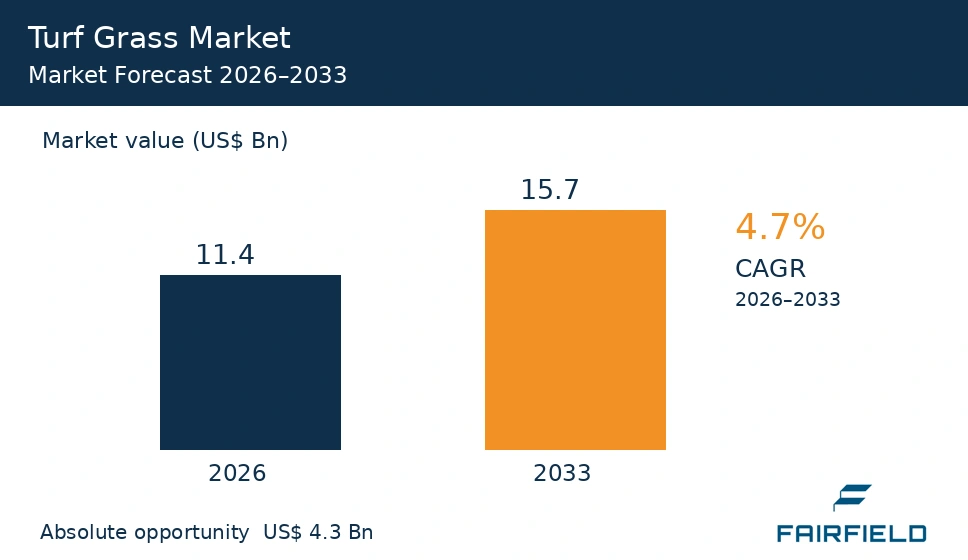
The global Turf Grass market size is expected to be valued at US$ 11.4 billion in 2026 and projected to reach US$ 15.7 billion by 2033, growing at a CAGR of 4.7% between 2026 and 2033. The forecast implies an absolute dollar opportunity of US$ 4.3 billion, against a historical CAGR of 3.9% recorded between 2020 and 2025. Demand rests on housing completions, landscape renovation budgets and steady sod orders from sports and golf facilities. Improved warm-season cultivars and mechanised harvesting are lifting saleable yield per acre at established sod farms. Water limits in dry regions temper volume growth, yet they also shift value toward drought-tolerant seed blends and certified sod.
Key Report Takeaways
- By Product Form: Sod led with 46.8% share in 2026, while sprigs and plugs are projected to expand at a 5.8% CAGR through 2033, driven by vegetative establishment of licensed hybrid bermudagrass on sports surfaces.
- By Grass Type: Cool-season grasses led with 57.4% share in 2026, while warm-season grasses are projected to expand at a 5.4% CAGR through 2033, driven by heat tolerance and lower irrigation draw across southern growing zones.
- By Application: Residential lawns led with 38.6% share in 2026, while sports fields and golf courses are projected to expand at a 5.9% CAGR through 2033, driven by stadium renovation cycles and new multi-sport complex construction.
- By Distribution Channel: Direct sales from sod farms led with 44.2% share in 2026, while online channels are projected to expand at a 7.6% CAGR through 2033, driven by seed subscription models and contractor procurement platforms.
- By Region: North America led with 37.8% share in 2026, while Asia Pacific is projected to expand at a 6.3% CAGR through 2033; Europe, Latin America and Middle East & Africa add steady orders from stadium, resort and civic planting work.
Market Trends and Insights
Market Growth Drivers
Housing Completions and Outdoor Living Spending Lift Sod Volumes
New residential construction remains the largest single pull on cultivated turf volumes. Builders install sod at handover because it gives an instant finished lawn and holds graded soil against erosion before occupancy. A completed detached home absorbs several thousand square feet of sod, so housing starts convert almost directly into farm orders. Replacement work compounds that base, as owners relay worn lawns during exterior upgrades and resale preparation.
Outdoor living has become a mainstream line within home improvement spending, and lawns anchor the patios, decks and play areas built around them. Contractors now hold steadier year-round schedules, which supports forward contracting with growers and smoother harvest planning. Many suburban development codes require a vegetated finish on disturbed ground before final inspection, locking a baseline of sod demand into the approval process itself.
Sports Field and Golf Course Construction Sustains Premium Turf Orders
Sports and golf buyers pay the highest unit values in the market and order on predictable cycles. A single stadium pitch, training ground or championship green carries tight specifications on cultivar, sand content and rootzone compatibility, which rules out commodity supply. Facility operators also resurface on fixed intervals rather than waiting for failure, so replacement demand holds up even when construction slows.
Behind that spending sits sustained investment in community sports complexes, academy training sites and resort golf courses. Tournament calendars and broadcast standards push venues toward uniform, consistent playing surfaces, favouring big-roll sod, washed turf and sand-based grown systems. Specialist growers respond by dedicating whole fields to single certified cultivars and holding mature stock ready for short-notice installation, which raises both working capital and achievable margin.
Restraints Impact Analysis of Market
Water Use Restrictions and Turf Removal Incentives Limit Lawn Area
Water policy is the most material constraint on this market. In drought-affected regions, utilities and authorities restrict outdoor irrigation, cap watering days, and in some cases limit or prohibit purely ornamental turf in new commercial and civic developments. Several jurisdictions also run incentive programmes that pay property owners to replace lawn with low-water plantings. Each measure reduces the installed area available to sod and seed suppliers.
The effect is uneven but cumulative. Restrictions concentrate in arid and semi-arid zones, where they reshape specification long before they change national totals, and they influence builder and facility manager choices well beyond the areas directly covered. Rules commonly exempt functional turf such as sports fields, parks and school grounds, so the pressure falls hardest on decorative residential and commercial lawn area rather than on recreational surfaces.
Input Costs, Land Pressure and Labour Scarcity Squeeze Sod Growers
Sod production economics limit how quickly supply can answer demand. Growing a saleable crop ties up land for a full season or longer, and fuel, fertiliser, seed and equipment costs all sit ahead of revenue. Harvested sod is perishable, so freight radius is short and delivery must be scheduled tightly. Those conditions cap pricing flexibility and expose growers to weather losses they cannot hedge.
Land availability tightens the squeeze further. Sod farms often occupy flat, irrigated ground close to metropolitan edges, exactly where residential and logistics development bids hardest for available acreage. Skilled seasonal labour for harvesting and installation work is scarce in many producing regions. Smaller family farms facing succession questions exit instead of reinvesting, which thins regional supply and lengthens lead times during peak spring and autumn windows.
Market Opportunities
Drought-Tolerant Cultivar Breeding and Variety Licensing Open New Revenue
Variety development is becoming a profit centre rather than a cost. Breeders that release grasses with lower water requirement, deeper rooting, salt tolerance or reduced mowing frequency can license them to sod farms and seed producers across multiple territories. Royalty income scales without proportional land investment, and protected cultivars give growers a defensible position against undifferentiated commodity turf.
Demand pull for these grasses is strengthening steadily as water policy tightens and input costs keep rising. Public turfgrass breeding programmes at agricultural universities continue to release improved cool-season and warm-season lines, while private breeders build branded cultivar families supported by contracted grower networks and quality certification schemes. Independent turfgrass evaluation trials give specifiers comparable performance data, which helps promising new varieties move from trial plots into commercial production faster than before.
Urban Green Infrastructure Programmes in Emerging Markets Expand Demand
Fast-urbanising economies represent the clearest volume opportunity. City authorities across Asia Pacific, Latin America and the Gulf are building parks, riverfront promenades, school grounds and civic plazas, and managed turf is a standard element of those designs. Hosting international sporting events accelerates the same spending, because venues, training sites and surrounding public realm all need finished surfaces within fixed deadlines.
Supply capacity is forming alongside that demand. Domestic sod farms are being established near major metropolitan areas to cut freight distance and spoilage losses, often working with imported certified seed or licensed vegetative planting material. Warm-season species suited to hot, humid or saline conditions fit these climates well. Local growing also lowers landed cost against imported turf, which widens the addressable base from flagship projects toward routine municipal and residential work.
Category-wise Insights
Which Product Form Accounts for the Largest Share?
Sod accounts for the largest product form share at 46.8% in 2026, because it delivers a finished surface on the day of installation. Builders, facility operators and civic buyers accept its premium over seed to avoid establishment delay, erosion risk and weed pressure on exposed ground. Seed holds 41.5% share, supported by overseeding, repair work and large-area projects where cost per square metre governs the decision.
Sprigs and plugs are the fastest-growing form at a 5.8% CAGR through 2033. Many high-performance warm-season hybrids do not come true from seed, so vegetative planting is the only route to a uniform stand of a licensed cultivar. Sprigging suits large sports and golf areas where sod freight would be costly. The split points to a market where establishment speed and cultivar identity increasingly outrank raw material price.
Cool-Season Grasses Hold Volume While Warm-Season Types Grow Faster
Cool-season grasses led the grass type category with 57.4% share in 2026, reflecting the concentration of established turf demand in temperate North America and Europe. Kentucky bluegrass, perennial ryegrass and tall fescue dominate lawn, park and pitch specification across those zones, and mature seed production and sod farm capacity reinforce that position.
Warm-season grasses are growing fastest at a 5.4% CAGR through 2033. Bermudagrass, zoysiagrass and seashore paspalum tolerate heat, traffic and saline irrigation while using less water than cool-season equivalents. That profile fits southern, tropical and Gulf markets, and it also attracts buyers in transition zones responding to water policy and summer stress. Transition-zone blends and other species hold the remaining 6.4%. The direction of travel favours growers able to supply both temperature classes from the same distribution footprint.
Residential Lawns Anchor Demand as Sports Turf Accelerates
Residential lawns led applications with 38.6% share in 2026, carried by new home completions and renovation work across suburban markets. Sports fields and golf courses held 26.5%, commercial and institutional landscaping 24.3%, and municipal and public green spaces 10.6%. Residential volume is large but fragmented, which keeps average order size small and freight sensitivity high for growers serving that base.
Sports fields and golf courses form the fastest-growing application at a 5.9% CAGR through 2033. Stadium and training ground renovation runs on short cycles, specification is exacting, and failure is publicly visible, so operators pay for certified cultivars, big-roll delivery and sand-based grown surfaces. Community and academy facility construction extends the same requirements to mid-tier venues. For suppliers, this is the segment where technical capability converts most directly into realised margin.
Direct Farm Sales Dominate While Online Channels Scale Quickly
Direct sales from sod farms led distribution with 44.2% share in 2026, a consequence of how perishable harvested turf is. Short freight radius, same-week delivery and cut-to-order scheduling favour the grower selling straight to builders, contractors and facility managers. Landscape contractors and distributors held 29.8%, while garden centres and retail chains took 18.5%, mostly in seed and small-order turf.
Online channels are the fastest-growing route at a 7.6% CAGR through 2033, from a 7.5% base. Seed is light, storable and well suited to e-commerce, including repeat subscription supply of blends matched to climate zone. Contractors increasingly place sod orders through grower portals and procurement platforms that confirm cultivar, quantity and harvest date. Digital ordering is compressing quoting cycles and giving growers better forward visibility of harvest scheduling.
Geography Analysis
Which Region Is Leading the Turf Grass Market?
North America leads the turf grass market with 37.8% share in 2026, supported by the deepest installed base of managed lawns, parks and golf facilities worldwide. The United States contributes most of that total, with concentrated sod production in the Southeast, Midwest and Pacific regions, alongside major cool-season seed production in the Pacific Northwest. Canada adds steady cool-season demand across its urban corridors.
Suburban housing form, a dense network of golf courses and school and municipal sports infrastructure all sustain replacement volumes. Established grower associations, cultivar certification schemes and university turfgrass programmes underpin quality standards. Water policy in the Southwest and parts of the West restrains ornamental lawn area, which is redirecting regional demand toward drought-tolerant varieties rather than removing it from the market.
Europe Combines Mature Lawn Demand With Sports Surface Specification
Europe holds 27.4% share in 2026, built on long-established domestic lawn culture and exacting sports surface standards. The United Kingdom, Germany, France, the Netherlands and Italy account for the bulk of regional consumption. Dutch and Danish seed breeding capability gives the region genuine depth in cool-season cultivar development and certified seed supply.
Professional football, rugby and golf venues drive the premium end, where reinforced and hybrid rootzone systems demand precise cultivar selection and consistent sod quality. Public procurement for parks, schools and social housing grounds provides a steady institutional floor. Environmental rules on fertiliser and plant protection inputs push buyers toward varieties that perform with fewer applications, which favours breeders with low-input genetics in their portfolios.
Which Region Is Growing Fastest in the Turf Grass Market?
Asia Pacific is growing fastest at a 6.3% CAGR through 2033, from 23.1% share in 2026. Rapid urbanisation is creating parks, residential compounds and civic open space at scale across China and India, while Japan, South Korea and Australia contribute mature sports turf and golf demand with high specification standards.
Growth rests on several concrete foundations. Domestic sod farms are being set up near large metropolitan areas to shorten haulage and limit spoilage. Government urban greening and heat mitigation programmes make managed turf a budgeted element of city planning rather than a discretionary extra. International sporting events continue to lift stadium and training facility construction. Warm-season species suited to humid and saline conditions give the region a workable agronomic base for local production.
Latin America Builds Local Sod Capacity Around Stadiums and Resorts
Latin America holds 7.2% share in 2026, with Brazil and Mexico supplying most regional volume. Football is the structural anchor: professional clubs, training centres and municipal pitches sustain consistent orders for warm-season sod, particularly bermudagrass and zoysiagrass suited to the climate.
Coastal resort and residential development in Mexico, the Caribbean basin and northern Brazil adds golf course and hotel landscaping demand that pays premium unit values. Local growers have expanded to serve these buyers directly, since import freight is impractical for a perishable product. Currency volatility and uneven municipal budgets still restrain public-sector work, so the private residential, hospitality and sports segments carry most of the region's growth.
Middle East & Africa Demand Concentrates in Gulf Sports and Civic Projects
Middle East & Africa accounts for 4.5% share in 2026, the smallest regional position but a technically demanding one. Gulf states including the United Arab Emirates, Saudi Arabia and Qatar drive most spending through stadium, golf resort and large civic landscaping projects tied to tourism and event hosting programmes.
Agronomic conditions shape what sells. Heat, sandy soils and saline or treated irrigation water favour seashore paspalum and salt-tolerant bermudagrass, supplied as sod or sprigs from regional farms. South Africa supports a separate base of golf and residential turf demand with a broader species range. Severe water scarcity caps purely ornamental turf area across the region, concentrating volumes in sports, resort and high-visibility public spaces where irrigation is justified.
Competitive Landscape
The turf grass market is fragmented, with a different structure at each stage of the chain. Sod production is highly regional, because perishability limits haulage distance and most growers serve a single metropolitan catchment. Seed breeding and distribution are far more concentrated, with a small group of international houses controlling much of the certified cool-season genetics traded worldwide. Consolidation is slow and local, usually taking the form of established farms acquiring neighbouring acreage or succession-driven exits transferring capacity between regional operators.
Competition turns on cultivar performance, consistency and delivery reliability rather than price alone. Suppliers differentiate on drought and salinity tolerance, traffic recovery, colour retention and reduced mowing and fertiliser requirement, all validated through independent evaluation trials that specifiers read closely. Big-roll harvesting, washed turf, sand-based production and reinforced hybrid systems separate growers serving professional sports from those serving housing. Variety licensing is the pivot between the two tiers, letting breeders reach many territories through grower networks while growers gain a protected product.
Strategic activity centres on capability rather than scale. Investment in breeding programmes matters because a cultivar with a lower water requirement answers the market's sharpest constraint directly. Capacity added close to growing metropolitan areas matters because it shortens freight and protects product quality on arrival. Certification and grower-network agreements matter because they let a protected variety reach distant markets without the licensor farming there.
Direction of travel points toward lower-input genetics, tighter traceability from field to installation, and digital ordering that links harvest scheduling to contractor programmes. Vendors with both cool-season and warm-season portfolios are best placed as transition-zone specification shifts.
Industry Leaders
-
DLF Seeds A/S
-
Royal Barenbrug Group
-
The Scotts Miracle-Gro Company
-
Pennington Seed, Inc.
-
Jacklin Seed by Simplot
-
Sod Solutions, Inc.
-
Rolawn Limited
-
West Coast Turf
Companies Covered in the Report
-
DLF Seeds A/S
-
Royal Barenbrug Group
-
The Scotts Miracle-Gro Company
-
Pennington Seed, Inc.
-
Jacklin Seed by Simplot
-
Mountain View Seeds
-
Sod Solutions, Inc.
-
Rolawn Limited
-
Tillers Turf Company Ltd.
-
West Coast Turf
-
King Ranch Turfgrass
-
Delta Bluegrass Company
-
Bethel Farms
-
Atlas Turf International
-
Evergreen Turf
Turf Grass Market Report Scope
Fairfield Market Research segments the global turf grass market by product form, grass type, application, distribution channel and region.
| By Product Form | Sod (Rolls and Slabs), Seed, Sprigs and Plugs |
| By Grass Type | Cool-Season Grasses (Kentucky Bluegrass, Perennial Ryegrass, Tall Fescue, Creeping Bentgrass), Warm-Season Grasses (Bermudagrass, Zoysiagrass, St. Augustinegrass, Centipedegrass, Seashore Paspalum), Transition-Zone Blends and Other Species |
| By Application | Residential Lawns, Commercial and Institutional Landscaping, Sports Fields and Golf Courses, Municipal and Public Green Spaces |
| By Distribution Channel | Direct Sales from Sod Farms, Landscape Contractors and Distributors, Garden Centres and Retail Chains, Online Channels |
| By Region | North America, Europe, Asia Pacific, Latin America, Middle East & Africa |
1. Executive Summary
1.1 Turf Grass Market Snapshot
1.2 Future Projections
1.3 Key Market Trends
1.4 Regional Snapshot
2. Market Overview
2.1 Market Definition and Report Scope
2.2 Historical Market Trends
2.3 Market Dynamics
2.3.1 Drivers
2.3.1.1 Housing Completions and Outdoor Living Spending Lift Sod Volumes
2.3.1.2 Sports Field and Golf Course Construction Sustains Premium Turf Orders
2.3.2 Restraints
2.3.2.1 Water Use Restrictions and Turf Removal Incentives Limit Lawn Area
2.3.2.2 Input Costs, Land Pressure and Labour Scarcity Squeeze Sod Growers
2.3.3 Market Opportunities
2.3.3.1 Drought-Tolerant Cultivar Breeding and Variety Licensing Open New Revenue
2.3.3.2 Urban Green Infrastructure Programmes in Emerging Markets Expand Demand
3. Global Turf Grass Market Outlook, 2026–2033
3.1 Global Turf Grass Market Outlook, by Product Form, Value (US$ Billion), 2026–2033
3.1.1 Sod (Rolls and Slabs)
3.1.2 Seed
3.1.3 Sprigs and Plugs
3.2 Global Turf Grass Market Outlook, by Grass Type, Value (US$ Billion), 2026–2033
3.2.1 Cool-Season Grasses (Kentucky Bluegrass, Perennial Ryegrass, Tall Fescue, Creeping Bentgrass)
3.2.2 Warm-Season Grasses (Bermudagrass, Zoysiagrass, St. Augustinegrass, Centipedegrass, Seashore Paspalum)
3.2.3 Transition-Zone Blends and Other Species
3.3 Global Turf Grass Market Outlook, by Application, Value (US$ Billion), 2026–2033
3.3.1 Residential Lawns
3.3.2 Commercial and Institutional Landscaping
3.3.3 Sports Fields and Golf Courses
3.3.4 Municipal and Public Green Spaces
3.4 Global Turf Grass Market Outlook, by Distribution Channel, Value (US$ Billion), 2026–2033
3.4.1 Direct Sales from Sod Farms
3.4.2 Landscape Contractors and Distributors
3.4.3 Garden Centres and Retail Chains
3.4.4 Online Channels
3.5 Global Turf Grass Market Outlook, by Region, Value (US$ Billion), 2026–2033
3.5.1 North America
3.5.2 Europe
3.5.3 Asia Pacific
3.5.4 Latin America
3.5.5 Middle East & Africa
4. North America Turf Grass Market Outlook, 2026–2033
4.1 North America Turf Grass Market Outlook, by Product Form, Value (US$ Billion), 2026–2033
4.1.1 Sod (Rolls and Slabs)
4.1.2 Seed
4.1.3 Sprigs and Plugs
4.2 North America Turf Grass Market Outlook, by Grass Type, Value (US$ Billion), 2026–2033
4.2.1 Cool-Season Grasses (Kentucky Bluegrass, Perennial Ryegrass, Tall Fescue, Creeping Bentgrass)
4.2.2 Warm-Season Grasses (Bermudagrass, Zoysiagrass, St. Augustinegrass, Centipedegrass, Seashore Paspalum)
4.2.3 Transition-Zone Blends and Other Species
4.3 North America Turf Grass Market Outlook, by Application, Value (US$ Billion), 2026–2033
4.3.1 Residential Lawns
4.3.2 Commercial and Institutional Landscaping
4.3.3 Sports Fields and Golf Courses
4.3.4 Municipal and Public Green Spaces
4.4 North America Turf Grass Market Outlook, by Distribution Channel, Value (US$ Billion), 2026–2033
4.4.1 Direct Sales from Sod Farms
4.4.2 Landscape Contractors and Distributors
4.4.3 Garden Centres and Retail Chains
4.4.4 Online Channels
4.5 North America Turf Grass Market Outlook, by Country, Value (US$ Billion), 2026–2033
4.5.1 United States Turf Grass Market Outlook, by Product Form, 2026–2033
4.5.2 United States Turf Grass Market Outlook, by Grass Type, 2026–2033
4.5.3 United States Turf Grass Market Outlook, by Application, 2026–2033
4.5.4 United States Turf Grass Market Outlook, by Distribution Channel, 2026–2033
4.5.5 Canada Turf Grass Market Outlook, by Product Form, 2026–2033
4.5.6 Canada Turf Grass Market Outlook, by Grass Type, 2026–2033
4.5.7 Canada Turf Grass Market Outlook, by Application, 2026–2033
4.5.8 Canada Turf Grass Market Outlook, by Distribution Channel, 2026–2033
5. Europe Turf Grass Market Outlook, 2026–2033
5.1 Europe Turf Grass Market Outlook, by Product Form, Value (US$ Billion), 2026–2033
5.1.1 Sod (Rolls and Slabs)
5.1.2 Seed
5.1.3 Sprigs and Plugs
5.2 Europe Turf Grass Market Outlook, by Grass Type, Value (US$ Billion), 2026–2033
5.2.1 Cool-Season Grasses (Kentucky Bluegrass, Perennial Ryegrass, Tall Fescue, Creeping Bentgrass)
5.2.2 Warm-Season Grasses (Bermudagrass, Zoysiagrass, St. Augustinegrass, Centipedegrass, Seashore Paspalum)
5.2.3 Transition-Zone Blends and Other Species
5.3 Europe Turf Grass Market Outlook, by Application, Value (US$ Billion), 2026–2033
5.3.1 Residential Lawns
5.3.2 Commercial and Institutional Landscaping
5.3.3 Sports Fields and Golf Courses
5.3.4 Municipal and Public Green Spaces
5.4 Europe Turf Grass Market Outlook, by Distribution Channel, Value (US$ Billion), 2026–2033
5.4.1 Direct Sales from Sod Farms
5.4.2 Landscape Contractors and Distributors
5.4.3 Garden Centres and Retail Chains
5.4.4 Online Channels
5.5 Europe Turf Grass Market Outlook, by Country, Value (US$ Billion), 2026–2033
5.5.1 United Kingdom Turf Grass Market Outlook, by Product Form, 2026–2033
5.5.2 United Kingdom Turf Grass Market Outlook, by Grass Type, 2026–2033
5.5.3 United Kingdom Turf Grass Market Outlook, by Application, 2026–2033
5.5.4 United Kingdom Turf Grass Market Outlook, by Distribution Channel, 2026–2033
5.5.5 Germany Turf Grass Market Outlook, by Product Form, 2026–2033
5.5.6 Germany Turf Grass Market Outlook, by Grass Type, 2026–2033
5.5.7 Germany Turf Grass Market Outlook, by Application, 2026–2033
5.5.8 Germany Turf Grass Market Outlook, by Distribution Channel, 2026–2033
5.5.9 France Turf Grass Market Outlook, by Product Form, 2026–2033
5.5.10 France Turf Grass Market Outlook, by Grass Type, 2026–2033
5.5.11 France Turf Grass Market Outlook, by Application, 2026–2033
5.5.12 France Turf Grass Market Outlook, by Distribution Channel, 2026–2033
5.5.13 Netherlands Turf Grass Market Outlook, by Product Form, 2026–2033
5.5.14 Netherlands Turf Grass Market Outlook, by Grass Type, 2026–2033
5.5.15 Netherlands Turf Grass Market Outlook, by Application, 2026–2033
5.5.16 Netherlands Turf Grass Market Outlook, by Distribution Channel, 2026–2033
5.5.17 Italy Turf Grass Market Outlook, by Product Form, 2026–2033
5.5.18 Italy Turf Grass Market Outlook, by Grass Type, 2026–2033
5.5.19 Italy Turf Grass Market Outlook, by Application, 2026–2033
5.5.20 Italy Turf Grass Market Outlook, by Distribution Channel, 2026–2033
6. Asia Pacific Turf Grass Market Outlook, 2026–2033
6.1 Asia Pacific Turf Grass Market Outlook, by Product Form, Value (US$ Billion), 2026–2033
6.1.1 Sod (Rolls and Slabs)
6.1.2 Seed
6.1.3 Sprigs and Plugs
6.2 Asia Pacific Turf Grass Market Outlook, by Grass Type, Value (US$ Billion), 2026–2033
6.2.1 Cool-Season Grasses (Kentucky Bluegrass, Perennial Ryegrass, Tall Fescue, Creeping Bentgrass)
6.2.2 Warm-Season Grasses (Bermudagrass, Zoysiagrass, St. Augustinegrass, Centipedegrass, Seashore Paspalum)
6.2.3 Transition-Zone Blends and Other Species
6.3 Asia Pacific Turf Grass Market Outlook, by Application, Value (US$ Billion), 2026–2033
6.3.1 Residential Lawns
6.3.2 Commercial and Institutional Landscaping
6.3.3 Sports Fields and Golf Courses
6.3.4 Municipal and Public Green Spaces
6.4 Asia Pacific Turf Grass Market Outlook, by Distribution Channel, Value (US$ Billion), 2026–2033
6.4.1 Direct Sales from Sod Farms
6.4.2 Landscape Contractors and Distributors
6.4.3 Garden Centres and Retail Chains
6.4.4 Online Channels
6.5 Asia Pacific Turf Grass Market Outlook, by Country, Value (US$ Billion), 2026–2033
6.5.1 China Turf Grass Market Outlook, by Product Form, 2026–2033
6.5.2 China Turf Grass Market Outlook, by Grass Type, 2026–2033
6.5.3 China Turf Grass Market Outlook, by Application, 2026–2033
6.5.4 China Turf Grass Market Outlook, by Distribution Channel, 2026–2033
6.5.5 India Turf Grass Market Outlook, by Product Form, 2026–2033
6.5.6 India Turf Grass Market Outlook, by Grass Type, 2026–2033
6.5.7 India Turf Grass Market Outlook, by Application, 2026–2033
6.5.8 India Turf Grass Market Outlook, by Distribution Channel, 2026–2033
6.5.9 Japan Turf Grass Market Outlook, by Product Form, 2026–2033
6.5.10 Japan Turf Grass Market Outlook, by Grass Type, 2026–2033
6.5.11 Japan Turf Grass Market Outlook, by Application, 2026–2033
6.5.12 Japan Turf Grass Market Outlook, by Distribution Channel, 2026–2033
6.5.13 South Korea Turf Grass Market Outlook, by Product Form, 2026–2033
6.5.14 South Korea Turf Grass Market Outlook, by Grass Type, 2026–2033
6.5.15 South Korea Turf Grass Market Outlook, by Application, 2026–2033
6.5.16 South Korea Turf Grass Market Outlook, by Distribution Channel, 2026–2033
6.5.17 Australia Turf Grass Market Outlook, by Product Form, 2026–2033
6.5.18 Australia Turf Grass Market Outlook, by Grass Type, 2026–2033
6.5.19 Australia Turf Grass Market Outlook, by Application, 2026–2033
6.5.20 Australia Turf Grass Market Outlook, by Distribution Channel, 2026–2033
7. Latin America Turf Grass Market Outlook, 2026–2033
7.1 Latin America Turf Grass Market Outlook, by Product Form, Value (US$ Billion), 2026–2033
7.1.1 Sod (Rolls and Slabs)
7.1.2 Seed
7.1.3 Sprigs and Plugs
7.2 Latin America Turf Grass Market Outlook, by Grass Type, Value (US$ Billion), 2026–2033
7.2.1 Cool-Season Grasses (Kentucky Bluegrass, Perennial Ryegrass, Tall Fescue, Creeping Bentgrass)
7.2.2 Warm-Season Grasses (Bermudagrass, Zoysiagrass, St. Augustinegrass, Centipedegrass, Seashore Paspalum)
7.2.3 Transition-Zone Blends and Other Species
7.3 Latin America Turf Grass Market Outlook, by Application, Value (US$ Billion), 2026–2033
7.3.1 Residential Lawns
7.3.2 Commercial and Institutional Landscaping
7.3.3 Sports Fields and Golf Courses
7.3.4 Municipal and Public Green Spaces
7.4 Latin America Turf Grass Market Outlook, by Distribution Channel, Value (US$ Billion), 2026–2033
7.4.1 Direct Sales from Sod Farms
7.4.2 Landscape Contractors and Distributors
7.4.3 Garden Centres and Retail Chains
7.4.4 Online Channels
7.5 Latin America Turf Grass Market Outlook, by Country and Subregion, Value (US$ Billion), 2026–2033
7.5.1 Brazil Turf Grass Market Outlook, by Product Form, 2026–2033
7.5.2 Brazil Turf Grass Market Outlook, by Grass Type, 2026–2033
7.5.3 Brazil Turf Grass Market Outlook, by Application, 2026–2033
7.5.4 Brazil Turf Grass Market Outlook, by Distribution Channel, 2026–2033
7.5.5 Mexico Turf Grass Market Outlook, by Product Form, 2026–2033
7.5.6 Mexico Turf Grass Market Outlook, by Grass Type, 2026–2033
7.5.7 Mexico Turf Grass Market Outlook, by Application, 2026–2033
7.5.8 Mexico Turf Grass Market Outlook, by Distribution Channel, 2026–2033
7.5.9 Caribbean Turf Grass Market Outlook, by Product Form, 2026–2033
7.5.10 Caribbean Turf Grass Market Outlook, by Grass Type, 2026–2033
7.5.11 Caribbean Turf Grass Market Outlook, by Application, 2026–2033
7.5.12 Caribbean Turf Grass Market Outlook, by Distribution Channel, 2026–2033
8. Middle East & Africa Turf Grass Market Outlook, 2026–2033
8.1 Middle East & Africa Turf Grass Market Outlook, by Product Form, Value (US$ Billion), 2026–2033
8.1.1 Sod (Rolls and Slabs)
8.1.2 Seed
8.1.3 Sprigs and Plugs
8.2 Middle East & Africa Turf Grass Market Outlook, by Grass Type, Value (US$ Billion), 2026–2033
8.2.1 Cool-Season Grasses (Kentucky Bluegrass, Perennial Ryegrass, Tall Fescue, Creeping Bentgrass)
8.2.2 Warm-Season Grasses (Bermudagrass, Zoysiagrass, St. Augustinegrass, Centipedegrass, Seashore Paspalum)
8.2.3 Transition-Zone Blends and Other Species
8.3 Middle East & Africa Turf Grass Market Outlook, by Application, Value (US$ Billion), 2026–2033
8.3.1 Residential Lawns
8.3.2 Commercial and Institutional Landscaping
8.3.3 Sports Fields and Golf Courses
8.3.4 Municipal and Public Green Spaces
8.4 Middle East & Africa Turf Grass Market Outlook, by Distribution Channel, Value (US$ Billion), 2026–2033
8.4.1 Direct Sales from Sod Farms
8.4.2 Landscape Contractors and Distributors
8.4.3 Garden Centres and Retail Chains
8.4.4 Online Channels
8.5 Middle East & Africa Turf Grass Market Outlook, by Country and Subregion, Value (US$ Billion), 2026–2033
8.5.1 Gulf states Turf Grass Market Outlook, by Product Form, 2026–2033
8.5.2 Gulf states Turf Grass Market Outlook, by Grass Type, 2026–2033
8.5.3 Gulf states Turf Grass Market Outlook, by Application, 2026–2033
8.5.4 Gulf states Turf Grass Market Outlook, by Distribution Channel, 2026–2033
8.5.5 United Arab Emirates Turf Grass Market Outlook, by Product Form, 2026–2033
8.5.6 United Arab Emirates Turf Grass Market Outlook, by Grass Type, 2026–2033
8.5.7 United Arab Emirates Turf Grass Market Outlook, by Application, 2026–2033
8.5.8 United Arab Emirates Turf Grass Market Outlook, by Distribution Channel, 2026–2033
8.5.9 Saudi Arabia Turf Grass Market Outlook, by Product Form, 2026–2033
8.5.10 Saudi Arabia Turf Grass Market Outlook, by Grass Type, 2026–2033
8.5.11 Saudi Arabia Turf Grass Market Outlook, by Application, 2026–2033
8.5.12 Saudi Arabia Turf Grass Market Outlook, by Distribution Channel, 2026–2033
8.5.13 Qatar Turf Grass Market Outlook, by Product Form, 2026–2033
8.5.14 Qatar Turf Grass Market Outlook, by Grass Type, 2026–2033
8.5.15 Qatar Turf Grass Market Outlook, by Application, 2026–2033
8.5.16 Qatar Turf Grass Market Outlook, by Distribution Channel, 2026–2033
8.5.17 South Africa Turf Grass Market Outlook, by Product Form, 2026–2033
8.5.18 South Africa Turf Grass Market Outlook, by Grass Type, 2026–2033
8.5.19 South Africa Turf Grass Market Outlook, by Application, 2026–2033
8.5.20 South Africa Turf Grass Market Outlook, by Distribution Channel, 2026–2033
9. Competitive Landscape
9.1 Industry Leaders
9.2 Company Profiles
9.2.1 DLF Seeds A/S
9.2.2 Royal Barenbrug Group
9.2.3 The Scotts Miracle-Gro Company
9.2.4 Pennington Seed, Inc.
9.2.5 Jacklin Seed by Simplot
9.2.6 Mountain View Seeds
9.2.7 Sod Solutions, Inc.
9.2.8 Rolawn Limited
9.2.9 Tillers Turf Company Ltd.
9.2.10 West Coast Turf
9.2.11 King Ranch Turfgrass
9.2.12 Delta Bluegrass Company
9.2.13 Bethel Farms
9.2.14 Atlas Turf International
9.2.15 Evergreen Turf
10. Appendix
10.1 Research Methodology
10.2 Report Assumptions
10.3 Acronyms and Abbreviations
| By Product Form | Sod (Rolls and Slabs), Seed, Sprigs and Plugs |
| By Grass Type | Cool-Season Grasses (Kentucky Bluegrass, Perennial Ryegrass, Tall Fescue, Creeping Bentgrass), Warm-Season Grasses (Bermudagrass, Zoysiagrass, St. Augustinegrass, Centipedegrass, Seashore Paspalum), Transition-Zone Blends and Other Species |
| By Application | Residential Lawns, Commercial and Institutional Landscaping, Sports Fields and Golf Courses, Municipal and Public Green Spaces |
| By Distribution Channel | Direct Sales from Sod Farms, Landscape Contractors and Distributors, Garden Centres and Retail Chains, Online Channels |
| By Region | North America, Europe, Asia Pacific, Latin America, Middle East & Africa |
Our Research Methodology
Considering the volatility of business today, traditional approaches to strategizing a game plan can be unfruitful if not detrimental. True ambiguity is no way to determine a forecast. A myriad of predetermined factors must be accounted for such as the degree of risk involved, the magnitude of circumstances, as well as conditions or consequences that are not known or unpredictable. To circumvent binary views that cast uncertainty, the application of market research intelligence to strategically posture, move, and enable actionable outcomes is necessary.
View Methodology
Quality Assured
Rigorous Validation Process

Confidentiality Assured
End-to-end Data Security

Custom Research Services
Tailored To Your Objectives
FAQs
The market is valued at US$ 11.4 billion in 2026 and projected to reach US$ 15.7 billion by 2033, a gain of US$ 4.3 billion.
Residential lawns lead with 38.6% share in 2026, while sports fields and golf courses grow fastest at a 5.9% CAGR between 2026 and 2033.
Asia Pacific expands fastest at a 6.3% CAGR through 2033, supported by urban greening programmes, new sports venues and locally established sod production capacity.
Sod supply is fragmented and regional because turf is perishable, while certified seed breeding and distribution sit with a smaller group of international suppliers.
The market is projected to grow at a CAGR of 4.7% from 2026 to 2033.
Related Reports
Nitrogen Flushing Machine Market Size, Share, Insights, Competitive Landscape, and Forecast 2026 to 2033
The nitrogen flushing machine market is projected to grow from US$2.6 billion in 2026 to US$4.1 billion by 2033, registering a CAGR of 6.7%.
Seed Biostimulants Market Size, Share, Insights, Competitive Landscape, and Forecast 2026 to 2033
The seed biostimulants market is projected to grow from US$1.2 billion in 2026 to US$2.4 billion by 2033, registering a CAGR of 10.4% during the forecast period.
Medical Plastics Market Size, Share, Insights, Competitive Landscape, and Forecast 2026 to 2033
The medical plastics market is projected to grow from US$32.4 billion in 2026 to US$51.4 billion by 2033, registering a CAGR of 6.8%.
Molded Fiber Packaging Market Size, Share, Insights, Competitive Landscape, and Forecast 2026 to 2033
The molded fiber packaging market is projected to grow from US$5.2 billion in 2026 to US$8.91 billion by 2033 at a CAGR of 8.0%.
Automotive Refinish Coatings Market Size, Share, Insights, Competitive Landscape, and Forecast 2026 to 2033
The automotive refinish coatings market is projected to grow from US$3.3 billion in 2026 to US$4.3 billion by 2033, registering a CAGR of 3.9%.
Acetic Acid Market Size, Share, Insights, Competitive Landscape, and Forecast 2026 to 2033
The acetic acid market is projected to grow from US$16.8 billion in 2026 to US$24.6 billion by 2033, registering a CAGR of 5.6% during the forecast period.