



Vibrating Screen Market
Vibrating Screen Market Insights, Competitive Landscape, and Market Forecast - 2033
Global Vibrating Screen Market Forecast
The Vibrating Screen Market is expected to grow from USD 2.7 Billion in 2026 to USD 4.5 Billion by 2033, reflecting strong industry expansion and registering a CAGR of 7.8% during the forecast period from 2026 to 2033.
Executive Summary & Key Highlights
- Linear vibrating screens lead the global landscape with ~50% share, driven by heavy adoption in mining and construction applications requiring high-capacity screening.
- Circular vibrating screens are the fastest-growing product type, expanding 2–4 points above overall growth due to rising use in quarrying, coal processing, and recycling operations.
- Mining remains the dominant end-user with over 40% share in 2025, supported by strong mineral extraction activity across Asia Pacific, Latin America, and Africa.
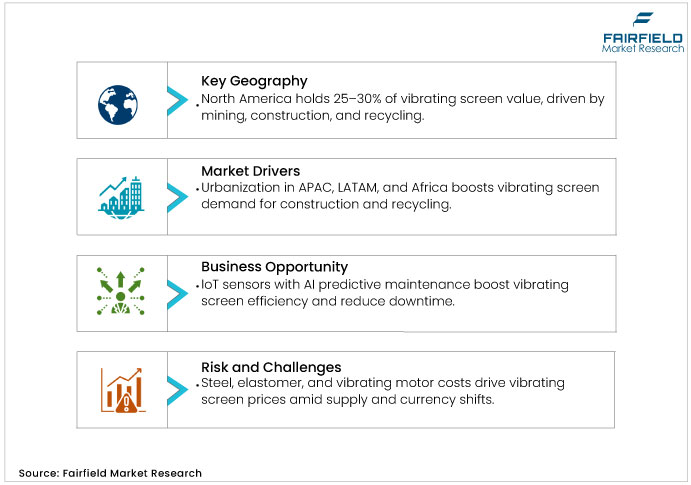
- Asia Pacific holds the largest regional share of ~45%, led by China’s volume-driven demand and India’s rapid infrastructure expansion across highways, rail, and industrial corridors.
- Europe accounts for 25–30% share, with ESG-aligned regulations accelerating the shift toward energy-efficient elliptical and high-frequency vibrating screens.
- Construction and infrastructure growth acts as a core market driver, with every square foot of built area requiring 1.5–2 pounds of screened material, boosting linear and circular screen installations.
- IoT-enabled predictive maintenance remains a key opportunity as connected sensors reduce downtime by 30–50%, supporting adoption across mining, construction, and Middle East & Africa industrial sectors.
Market Dynamics: Drivers, Restraints, and Opportunities Analysis
Market Drivers
- Construction and Infrastructure Development in Emerging Markets
Rapid urbanization across Asia Pacific, Latin America, and parts of Africa is boosting demand for construction aggregates, concrete materials, and recycled debris, all of which require efficient vibrating screen systems. With 1.5 to 2 pounds of screened material needed per square foot of built surface, infrastructure growth directly elevates equipment demand.
Construction-sector participation in global screening demand is expanding at or above the vibrating screen market growth, supported by stricter material quality regulations that drive compliance-based procurement. Producers offering customized screening solutions tailored to aggregate and recycling material specifications are capturing outsized growth in emerging markets.
- Recycling Integration and Circular Economy Regulatory Requirements
Global regulations mandating waste diversion, material recovery, and circular economy adoption are creating strong structural demand for advanced sorting and screening technologies. EU waste directives, along with emerging policies in North America and Asia Pacific, make recycling equipment procurement a compliance requirement, with vibrating screens essential for separating metal, plastic, mineral fractions, and C&D waste.
The recycling segment is expanding faster than overall market growth in developed regions, supported by rising government investments in recycling infrastructure. A sustained focus on sustainability and resource efficiency ensures that this driver will remain strong throughout the forecast period.
Market Restraints
- Raw Material Cost Volatility and Supply Chain Complexity
Steel and elastomer inputs form major cost components in vibrating screen production, with prices fluctuating due to commodity volatility, currency shifts, and supply chain disruptions. Rising costs for vibrating motors and polyurethane or steel mesh materials squeeze margins for manufacturers operating on moderate profitability, often forcing price increases in price-sensitive markets.
Supply chain fragmentation, sourcing compliance requirements, and logistics volatility further limit manufacturing flexibility, especially for smaller and mid-sized producers lacking integrated supply networks. This restraint is projected to suppress the vibrating screen market expansion by 1–2 percentage points through 2030 as companies manage cost pressures amid unstable input pricing.
- Competition from Substitute Screening Technologies
Alternative separation technologies—such as hydrocyclones, density separators, and air classifiers—compete with vibrating screens in select applications, offering advantages in precise sizing, water-based processing, and fine-particle performance. This limits vibrating screen adoption in industries such as food processing, pharmaceuticals, and chemicals, and creates price pressure where substitutes achieve functional parity.
Manufacturers that do not differentiate through technology upgrades, stronger customer support, or application-specific customization face displacement risk. The restraint is most pronounced in developed markets with sophisticated buyers and multiple alternatives, while emerging regions see reduced impact as vibrating screens remain the dominant standard.
Market Opportunities
- IoT Integration and Predictive Maintenance Service Monetization
IoT-enabled sensors combined with AI-driven predictive maintenance create a major value opportunity for vibrating screen manufacturers. With vibration, temperature, and operational analytics generating real-time data, predictive models can identify degradation patterns and forecast failures, helping reduce unplanned downtime by 30% to 50% and extending equipment life through condition-based maintenance.
This shift enables companies to evolve from equipment-only models to integrated equipment-plus-services ecosystems with recurring revenue potential. Manufacturers able to monetize data analytics, remote monitoring, and predictive insights strengthen customer retention and achieve higher margins compared to traditional equipment sales.
- Emerging Markets Mining Expansion and Geographic Diversification
Mining expansion across sub-Saharan Africa, Latin America, and Southeast Asia is creating significant opportunity for vibrating screen suppliers, supported by rising mineral extraction, processing infrastructure development, and increased equipment procurement. Sustained commodity prices and expanding exploration activities further elevate regional demand.
Manufacturers building regional distribution networks, localized service capabilities, and strong customer relationships are best positioned to capture this growth. Companies offering equipment tailored to local conditions, responsive technical support, and financing suited to emerging-market constraints gain competitive advantage in these high-growth mining clusters.
Regional Market Assessment: Strategic Geography Analysis
- North America: Mature Market Positioning and Replacement Cycle Dynamics
North America, valued at USD 775 million in 2025 and representing 25–30% of global vibrating screen market value, stands as the second-largest region with a mature equipment base and steady replacement cycles. Growth is driven by mining equipment renewal, construction modernization, and rising recycling adoption shaped by OSHA and EPA compliance requirements that influence equipment specifications.
The region’s innovation ecosystem fuels advancements in high-frequency screening, predictive maintenance, and IoT-enabled monitoring. Competitive intensity is strengthened by multinational and regional suppliers, while consolidation accelerates—highlighted by Metso's October 2024 acquisition of Diamond Z and Screen Machine Industries—reflecting a strategic push toward recycling and mobile screening solutions for construction and demolition applications.
- Europe: Regulatory Harmonization and Sustainability-Driven Market Evolution
Europe is expected to exceed USD 1.44 billion by 2032, accounting for 25–30% of global market value, with Germany contributing 20–25% and the UK 10–15% of the regional share. Germany’s strength lies in precision engineering and high-frequency automation-integrated systems, while the UK combines traditional mining and aggregates demand with growing recycling infrastructure expansion.
EU environmental directives, sustainability frameworks, and circular economy policies significantly shape equipment design, procurement criteria, and competitive positioning. Energy-efficient designs and sustainable material sourcing are becoming key differentiators as Europe’s mature industrial base drives replacement-cycle demand. Vibrating screen market entry and expansion require country-specific regulatory assessment and competitive analysis due to varied national dynamics.
- Asia Pacific: Differential Growth and Competitive Positioning Leadership
Asia Pacific is the largest regional market, projected to exceed USD 2.16 billion by 2032 and account for ~45% of global vibrating screen market share. China contributes 40–60% of regional value through strong mining, construction, and manufacturing activity, while India is the fastest-growing market at a sustainable CAGR, driven by large-scale infrastructure programs across highways, rail, and industrial capacity expansion.
The region’s manufacturing strength, supply chain depth, and technology capability—led by China’s scale and India’s growing localization—reshape global competitive dynamics and pricing structures. Country-specific opportunities vary: China provides volume-driven demand, India offers rapid expansion potential for localized manufacturing, and Southeast Asia presents collective growth through accelerating infrastructure and industrial development.
Segmentation Analysis: Category-Wise Strategic Assessment
- Linear Vibrating Screens Market Performance and Strategic Positioning
Linear vibrating screens hold approximately 50% of the global vibrating screen market, serving as the core screening technology across mining, construction aggregates, and recycling. Their dominance stems from high-capacity reliability, lower maintenance needs, and cost-effectiveness, supported by strong competition from global players such as Metso, Terex, and Weir Group, as well as regional manufacturers. Innovation remains incremental, centered on energy efficiency and wear-resistant materials.
Circular vibrating screens are growing at a sustainable CAGR, outpacing overall market expansion by 2–4 percentage points. Their rising adoption reflects superior versatility, consistent particle sizing, and strong performance in quarrying and coal mining. This structural migration toward circular designs signals the need for linear-focused manufacturers to modernize portfolios and adjust competitive positioning.
- Mining Sector Dominance and Strategic Concentration
Mining operations account over 40% of global vibrating screen demand in 2025, making it the largest application segment with structurally inelastic equipment needs for ore grading, sorting, and processing. Expansion in global mining activity—driven by battery metal demand, exploration in emerging markets, and modernization of aging infrastructure—supports continued investment. Asia Pacific contributes 45–50% of mining-related equipment demand, intensifying competition among multinational and regional suppliers focused on high-efficiency, high-throughput mining screens.
Construction and recycling currently represent second and third largest applications for demand respectively outpacing mining. Construction growth stems from expanding infrastructure projects, while recycling is driven by regulatory mandates and improving material recovery economics. Success in these segments requires segment-specific solutions—portability and contamination control for recycling, and modular, mobile configurations for construction—positioning suppliers for above-market growth and broader geographic expansion.
Key Players
• Terex Corporation
• Haulotte Group
• Oshkosh Corporation
• Linamar Corporation
• Tadano Ltd
• Aichi Corporation
• MEC Aerial Work Platforms
• Palfinger AG
• Hunan Sinoboom Heavy Industries Co. Ltd
• Zhejiang Dingli Machinery Co. Ltd
Global Vibrating Screen Market Segmentation-
Product Type:
• Linear Vibrating Screens
• Circular Vibrating Screens
• Elliptical Vibrating Screens
• Feeder
Drive Type:
• Direct Drive
• Indirect Drive
End Use:
• Construction
• Mining
• Recycling
• Others
By Region:
• North America
• Europe
• Asia Pacific
• Latin America
• Middle East & Africa
- Executive Summary
- Global Vibrating Screen Market Snapshot
- Future Projections
- Key Market Trends
- Regional Snapshot, by Value, 2026
- Analyst Recommendations
- Market Overview
- Market Definitions and Segmentations
- Market Dynamics
- Drivers
- Restraints
- Market Opportunities
- Value Chain Analysis
- COVID-19 Impact Analysis
- Porter's Five Forces Analysis
- Impact of Russia-Ukraine Conflict
- PESTLE Analysis
- Regulatory Analysis
- Price Trend Analysis
- Current Prices and Future Projections, 2025-2033
- Price Impact Factors
- Global Vibrating Screen Market Outlook, 2020 - 2033
- Global Vibrating Screen Market Outlook, by Product Type, Value (US$ Bn), 2020-2033
- Linear Vibrating Screens
- Circular Vibrating Screens
- Elliptical Vibrating Screens
- Feeder
- Global Vibrating Screen Market Outlook, by Drive Type, Value (US$ Bn), 2020-2033
- Direct Drive
- Indirect Drive
- Global Vibrating Screen Market Outlook, by End Use, Value (US$ Bn), 2020-2033
- Construction
- Mining
- Recycling
- Global Vibrating Screen Market Outlook, by Region, Value (US$ Bn), 2020-2033
- North America
- Europe
- Asia Pacific
- Latin America
- Middle East & Africa
- Global Vibrating Screen Market Outlook, by Product Type, Value (US$ Bn), 2020-2033
- North America Vibrating Screen Market Outlook, 2020 - 2033
- North America Vibrating Screen Market Outlook, by Product Type, Value (US$ Bn), 2020-2033
- Linear Vibrating Screens
- Circular Vibrating Screens
- Elliptical Vibrating Screens
- Feeder
- North America Vibrating Screen Market Outlook, by Drive Type, Value (US$ Bn), 2020-2033
- Direct Drive
- Indirect Drive
- North America Vibrating Screen Market Outlook, by End Use, Value (US$ Bn), 2020-2033
- Construction
- Mining
- Recycling
- North America Vibrating Screen Market Outlook, by Country, Value (US$ Bn), 2020-2033
- U.S. Vibrating Screen Market Outlook, by Product Type, 2020-2033
- U.S. Vibrating Screen Market Outlook, by Drive Type, 2020-2033
- U.S. Vibrating Screen Market Outlook, by End Use, 2020-2033
- Canada Vibrating Screen Market Outlook, by Product Type, 2020-2033
- Canada Vibrating Screen Market Outlook, by Drive Type, 2020-2033
- Canada Vibrating Screen Market Outlook, by End Use, 2020-2033
- BPS Analysis/Market Attractiveness Analysis
- North America Vibrating Screen Market Outlook, by Product Type, Value (US$ Bn), 2020-2033
- Europe Vibrating Screen Market Outlook, 2020 - 2033
- Europe Vibrating Screen Market Outlook, by Product Type, Value (US$ Bn), 2020-2033
- Linear Vibrating Screens
- Circular Vibrating Screens
- Elliptical Vibrating Screens
- Feeder
- Europe Vibrating Screen Market Outlook, by Drive Type, Value (US$ Bn), 2020-2033
- Direct Drive
- Indirect Drive
- Europe Vibrating Screen Market Outlook, by End Use, Value (US$ Bn), 2020-2033
- Construction
- Mining
- Recycling
- Europe Vibrating Screen Market Outlook, by Country, Value (US$ Bn), 2020-2033
- Germany Vibrating Screen Market Outlook, by Product Type, 2020-2033
- Germany Vibrating Screen Market Outlook, by Drive Type, 2020-2033
- Germany Vibrating Screen Market Outlook, by End Use, 2020-2033
- Italy Vibrating Screen Market Outlook, by Product Type, 2020-2033
- Italy Vibrating Screen Market Outlook, by Drive Type, 2020-2033
- Italy Vibrating Screen Market Outlook, by End Use, 2020-2033
- France Vibrating Screen Market Outlook, by Product Type, 2020-2033
- France Vibrating Screen Market Outlook, by Drive Type, 2020-2033
- France Vibrating Screen Market Outlook, by End Use, 2020-2033
- U.K. Vibrating Screen Market Outlook, by Product Type, 2020-2033
- U.K. Vibrating Screen Market Outlook, by Drive Type, 2020-2033
- U.K. Vibrating Screen Market Outlook, by End Use, 2020-2033
- Spain Vibrating Screen Market Outlook, by Product Type, 2020-2033
- Spain Vibrating Screen Market Outlook, by Drive Type, 2020-2033
- Spain Vibrating Screen Market Outlook, by End Use, 2020-2033
- Russia Vibrating Screen Market Outlook, by Product Type, 2020-2033
- Russia Vibrating Screen Market Outlook, by Drive Type, 2020-2033
- Russia Vibrating Screen Market Outlook, by End Use, 2020-2033
- Rest of Europe Vibrating Screen Market Outlook, by Product Type, 2020-2033
- Rest of Europe Vibrating Screen Market Outlook, by Drive Type, 2020-2033
- Rest of Europe Vibrating Screen Market Outlook, by End Use, 2020-2033
- BPS Analysis/Market Attractiveness Analysis
- Europe Vibrating Screen Market Outlook, by Product Type, Value (US$ Bn), 2020-2033
- Asia Pacific Vibrating Screen Market Outlook, 2020 - 2033
- Asia Pacific Vibrating Screen Market Outlook, by Product Type, Value (US$ Bn), 2020-2033
- Linear Vibrating Screens
- Circular Vibrating Screens
- Elliptical Vibrating Screens
- Feeder
- Asia Pacific Vibrating Screen Market Outlook, by Drive Type, Value (US$ Bn), 2020-2033
- Direct Drive
- Indirect Drive
- Asia Pacific Vibrating Screen Market Outlook, by End Use, Value (US$ Bn), 2020-2033
- Construction
- Mining
- Recycling
- Asia Pacific Vibrating Screen Market Outlook, by Country, Value (US$ Bn), 2020-2033
- China Vibrating Screen Market Outlook, by Product Type, 2020-2033
- China Vibrating Screen Market Outlook, by Drive Type, 2020-2033
- China Vibrating Screen Market Outlook, by End Use, 2020-2033
- Japan Vibrating Screen Market Outlook, by Product Type, 2020-2033
- Japan Vibrating Screen Market Outlook, by Drive Type, 2020-2033
- Japan Vibrating Screen Market Outlook, by End Use, 2020-2033
- South Korea Vibrating Screen Market Outlook, by Product Type, 2020-2033
- South Korea Vibrating Screen Market Outlook, by Drive Type, 2020-2033
- South Korea Vibrating Screen Market Outlook, by End Use, 2020-2033
- India Vibrating Screen Market Outlook, by Product Type, 2020-2033
- India Vibrating Screen Market Outlook, by Drive Type, 2020-2033
- India Vibrating Screen Market Outlook, by End Use, 2020-2033
- Southeast Asia Vibrating Screen Market Outlook, by Product Type, 2020-2033
- Southeast Asia Vibrating Screen Market Outlook, by Drive Type, 2020-2033
- Southeast Asia Vibrating Screen Market Outlook, by End Use, 2020-2033
- Rest of SAO Vibrating Screen Market Outlook, by Product Type, 2020-2033
- Rest of SAO Vibrating Screen Market Outlook, by Drive Type, 2020-2033
- Rest of SAO Vibrating Screen Market Outlook, by End Use, 2020-2033
- BPS Analysis/Market Attractiveness Analysis
- Asia Pacific Vibrating Screen Market Outlook, by Product Type, Value (US$ Bn), 2020-2033
- Latin America Vibrating Screen Market Outlook, 2020 - 2033
- Latin America Vibrating Screen Market Outlook, by Product Type, Value (US$ Bn), 2020-2033
- Linear Vibrating Screens
- Circular Vibrating Screens
- Elliptical Vibrating Screens
- Feeder
- Latin America Vibrating Screen Market Outlook, by Drive Type, Value (US$ Bn), 2020-2033
- Direct Drive
- Indirect Drive
- Latin America Vibrating Screen Market Outlook, by End Use, Value (US$ Bn), 2020-2033
- Construction
- Mining
- Recycling
- Latin America Vibrating Screen Market Outlook, by Country, Value (US$ Bn), 2020-2033
- Brazil Vibrating Screen Market Outlook, by Product Type, 2020-2033
- Brazil Vibrating Screen Market Outlook, by Drive Type, 2020-2033
- Brazil Vibrating Screen Market Outlook, by End Use, 2020-2033
- Mexico Vibrating Screen Market Outlook, by Product Type, 2020-2033
- Mexico Vibrating Screen Market Outlook, by Drive Type, 2020-2033
- Mexico Vibrating Screen Market Outlook, by End Use, 2020-2033
- Argentina Vibrating Screen Market Outlook, by Product Type, 2020-2033
- Argentina Vibrating Screen Market Outlook, by Drive Type, 2020-2033
- Argentina Vibrating Screen Market Outlook, by End Use, 2020-2033
- Rest of LATAM Vibrating Screen Market Outlook, by Product Type, 2020-2033
- Rest of LATAM Vibrating Screen Market Outlook, by Drive Type, 2020-2033
- Rest of LATAM Vibrating Screen Market Outlook, by End Use, 2020-2033
- BPS Analysis/Market Attractiveness Analysis
- Latin America Vibrating Screen Market Outlook, by Product Type, Value (US$ Bn), 2020-2033
- Middle East & Africa Vibrating Screen Market Outlook, 2020 - 2033
- Middle East & Africa Vibrating Screen Market Outlook, by Product Type, Value (US$ Bn), 2020-2033
- Linear Vibrating Screens
- Circular Vibrating Screens
- Elliptical Vibrating Screens
- Feeder
- Middle East & Africa Vibrating Screen Market Outlook, by Drive Type, Value (US$ Bn), 2020-2033
- Direct Drive
- Indirect Drive
- Middle East & Africa Vibrating Screen Market Outlook, by End Use, Value (US$ Bn), 2020-2033
- Construction
- Mining
- Recycling
- Middle East & Africa Vibrating Screen Market Outlook, by Country, Value (US$ Bn), 2020-2033
- GCC Vibrating Screen Market Outlook, by Product Type, 2020-2033
- GCC Vibrating Screen Market Outlook, by Drive Type, 2020-2033
- GCC Vibrating Screen Market Outlook, by End Use, 2020-2033
- South Africa Vibrating Screen Market Outlook, by Product Type, 2020-2033
- South Africa Vibrating Screen Market Outlook, by Drive Type, 2020-2033
- South Africa Vibrating Screen Market Outlook, by End Use, 2020-2033
- Egypt Vibrating Screen Market Outlook, by Product Type, 2020-2033
- Egypt Vibrating Screen Market Outlook, by Drive Type, 2020-2033
- Egypt Vibrating Screen Market Outlook, by End Use, 2020-2033
- Nigeria Vibrating Screen Market Outlook, by Product Type, 2020-2033
- Nigeria Vibrating Screen Market Outlook, by Drive Type, 2020-2033
- Nigeria Vibrating Screen Market Outlook, by End Use, 2020-2033
- Rest of Middle East Vibrating Screen Market Outlook, by Product Type, 2020-2033
- Rest of Middle East Vibrating Screen Market Outlook, by Drive Type, 2020-2033
- Rest of Middle East Vibrating Screen Market Outlook, by End Use, 2020-2033
- BPS Analysis/Market Attractiveness Analysis
- Middle East & Africa Vibrating Screen Market Outlook, by Product Type, Value (US$ Bn), 2020-2033
- Competitive Landscape
- Company Vs Segment Heatmap
- Company Market Share Analysis, 2025
- Competitive Dashboard
- Company Profiles
- Terex Corporation
- Company Overview
- Product Portfolio
- Financial Overview
- Business Strategies and Developments
- Haulotte Group
- Oshkosh Corporation
- Linamar Corporation
- Tadano Ltd
- Aichi Corporation
- MEC Aerial Work Platforms
- Palfinger AG
- Hunan Sinoboom Heavy Industries Co. Ltd
- Zhejiang Dingli Machinery Co. Ltd
- Terex Corporation
- Appendix
- Research Methodology
- Report Assumptions
- Acronyms and Abbreviations
|
BASE YEAR |
HISTORICAL DATA |
FORECAST PERIOD |
UNITS |
|||
 |
2025 |
 |
2020 - 2025 |
 |
2026 - 2033 |
Value: US$ Billion |
Our Research Methodology
Considering the volatility of business today, traditional approaches to strategizing a game plan can be unfruitful if not detrimental. True ambiguity is no way to determine a forecast. A myriad of predetermined factors must be accounted for such as the degree of risk involved, the magnitude of circumstances, as well as conditions or consequences that are not known or unpredictable. To circumvent binary views that cast uncertainty, the application of market research intelligence to strategically posture, move, and enable actionable outcomes is necessary.
View Methodology
Quality Assured
Rigorous Validation Process

Confidentiality Assured
End-to-end Data Security

Custom Research Services
Tailored To Your Objectives
FAQs
The Vibrating Screen market is expected to reach USD 2.7 billion in 2026.
The Vibrating Screen market is projected to grow at a 7.8% CAGR through 2033.
The Vibrating Screen market growth is driven by expanding construction and infrastructure projects, increasing mining activities, and rising demand for recycling and circular economy solutions.
Asia Pacific is the dominant regional market for the Vibrating Screen market.
Terex Corporation, Tadano Ltd, Palfinger AG, Hunan Sinoboom Heavy Industries Co. Ltd, and Zhejiang Dingli Machinery Co. Ltd are some of the leading industry players in the Vibrating Screen market.
Related Reports
Ultralight & Light Aircraft Market Insights, Competitive Landscape, and Market Forecast 2026–2033
Ultralight & Light Aircraft Market is projected to reach US$29.05 billion by 2033, driven by flight training, recreational aviation, VTOL, and electric aircraft adoption.
Motor Soft Starter Market Insights, Competitive Landscape, and Market Forecast 2033
Motor Soft Starter Market to reach US$3.98 Bn by 2033 at 6.1% CAGR, driven by industrial automation, water infrastructure, and motor efficiency.
Global Sand Blasting Machines Market Insights, Competitive Landscape, and Market Forecast 2033
The global sand blasting machines market is valued at US$536.60 Mn in 2026 and is projected to reach US$725.36 Mn by 2033, growing at a 4.4% CAGR
Garage and Overhead Doors Market Insights, Competitive Landscape, and Market Forecast 2033
Garage and Overhead Doors Market to reach US$11.71 Bn by 2033 at 5.6% CAGR, driven by housing, smart connectivity, and energy efficiency.
Wafer Inspection Equipment Market Insights, Competitive Landscape, and Market Forecast 2026–2033
Wafer Inspection Equipment Market to reach US$12.5 Bn by 2033 at 8.2% CAGR, driven by AI defect detection, advanced fabs, and chip demand.
Super Precision Bearing Market Insights, Competitive Landscape, and Market Forecast 2026–2033
Super Precision Bearing Market to reach US$19.58 Bn by 2033 at 7.5% CAGR, driven by semiconductors, aerospace, EVs, and medical robotics.