



3D Bioprinted Human Tissue Market
3D Bioprinted Human Tissue Market Size, Share, Insights, Competitive Landscape, and Forecast 2026 to 2033
3D Bioprinted Human Tissue Market Size and Trend Analysis
How Fast Is the 3D Bioprinted Human Tissue Market Growing?
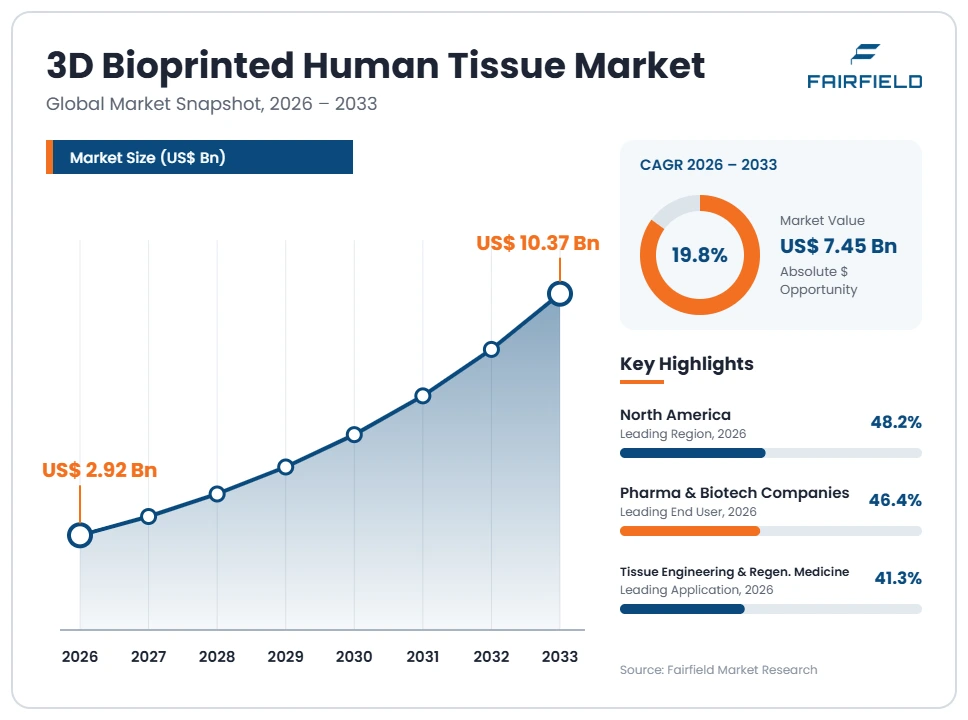
The global 3D bioprinted human tissue market size is expected to be valued at US$ 2.92 billion in 2026 and projected to reach US$ 10.37 billion by 2033, growing at a CAGR of 19.8% between 2026 and 2033.
Between 2020 and 2025, the market grew at a CAGR of about 17.6%, as drug developers adopted printed liver, skin, and tumor models for early safety and efficacy testing alongside traditional cell cultures. Three main factors now drive faster growth: regulatory moves that encourage human-relevant alternatives to animal testing, large partnerships between bioprinting companies and drug makers, and progress toward implantable printed tissues such as corneas, breast implants, and pancreatic tissue. The market is steadily shifting from research-grade models toward validated drug testing platforms and early clinical products.
Key Report Takeaways
- By Application: Tissue Engineering & Regenerative Medicine held 41.3% share in 2026, while Drug Discovery & Toxicology Testing is projected to expand at a 26.4% CAGR through 2033, driven by regulators accepting human tissue models in place of animal studies.
- By Tissue Type: Skin held 27.8% share in 2026, while Liver is projected to expand at a 24.2% CAGR through 2033, driven by demand for drug-induced liver injury testing.
- By Technology: Extrusion-based held 37.2% share in 2026, while Hybrid & 4D Bioprinting is projected to expand at a 28.7% CAGR through 2033, driven by multi-material tissues with built-in blood vessels.
- By End User: Pharmaceutical & Biotechnology Companies held 46.4% share in 2026, while Contract Research Organizations are projected to expand at a 23.6% CAGR through 2033, driven by outsourced human-relevant safety testing.
- By Region: North America held 48.2% share in 2026, while Asia Pacific is projected to expand at a 22.4% CAGR through 2033, driven by government support for regenerative medicine in China, Japan, and South Korea.
Global 3D Bioprinted Human Tissue Market Trends and Insights
Drivers Impact Analysis
Two drivers carry the strongest influence on 3D bioprinted human tissue demand during the forecast period.
| Driver | Impact on CAGR Forecast | Geographic Relevance | Impact Timeline |
| Regulatory shift toward human-relevant testing models | High | North America, Europe | Medium term (2–4 years) |
| Pharma partnerships and investment in printed tissue therapeutics | High | North America, Europe, Asia Pacific | Long term (≥4 years) |
Regulatory Shift Away From Animal Testing Is Driving 3D Bioprinted Human Tissue Demand
Regulatory moves to reduce animal testing are the strongest driver of 3D bioprinted human tissue demand. Drug developers need human-relevant models that can predict safety and efficacy before clinical trials.
The evidence is clear policy change. The FDA Modernization Act 2.0, signed in December 2022, removed the federal requirement for animal testing before human drug trials. In April 2025, the U.S. Food and Drug Administration announced a plan to phase out animal testing requirements for monoclonal antibodies and other drugs, promoting computer models, organoids, and organ-on-a-chip systems as alternatives. Bioprinted human tissues fit within these new approach methodologies because they recreate human cell types and structures. Animal studies often fail to predict human toxicity, especially for the liver and immune system. This creates strong demand for printed liver, kidney, and tumor models for drug screening.
Pharma Partnerships and Funding Are Accelerating 3D Bioprinted Human Tissue Development
Partnerships between bioprinting companies and drug makers, along with large funding rounds, are accelerating 3D bioprinted human tissue development. These deals provide capital, scientific validation, and access to clinical pipelines and manufacturing expertise.
The evidence is recent deal activity. In January 2025, Aspect Biosystems in Canada announced about CAD 165 million, or roughly US$ 120 million, to advance printed tissue therapeutics, building on its partnership with Novo Nordisk for diabetes and obesity treatments. In February 2025, Organovo sold intellectual property to Eli Lilly for about US$ 10 million. In September 2025, Prellis Biologics began a multi-target drug discovery collaboration with Eli Lilly. Together, these partnerships show large pharmaceutical companies treating bioprinted tissue as a strategic platform for both drug discovery and regenerative medicine.
Restraints Impact Analysis
Two restraints limit how quickly 3D bioprinted human tissue reaches clinical and commercial scale.
| Restraint | Impact on CAGR Forecast | Geographic Relevance | Impact Timeline |
| Vascularization and tissue maturation challenges | High | Global | Long term (≥4 years) |
| Regulatory uncertainty and validation costs | Medium | North America, Europe | Medium term (2–4 years) |
Vascularization and Maturation Challenges Limit 3D Bioprinted Human Tissue
Difficulties in building blood vessels and mature tissue structure limit 3D bioprinted human tissue, especially for large implants. Thick tissues need networks of vessels to deliver oxygen and nutrients, or cells in the center die.
The underlying causes are biological complexity and printing limits. Most printers cannot yet produce capillary-sized vessels at high resolution across large volumes. Printed cells often remain immature compared with adult tissue, which affects function and drug responses. Different cell types must be arranged precisely and kept alive during printing and culture. Bioreactors that mimic body conditions, such as flow and mechanical stress, add cost and complexity. As a result, most commercial products today are thin tissues or small models for drug testing, while solid organs such as kidneys and hearts remain years from clinical use.
Regulatory Uncertainty and Validation Costs Slow 3D Bioprinted Human Tissue Adoption
Regulatory uncertainty and high validation costs slow adoption of 3D bioprinted human tissue for both drug testing and therapy. Companies must prove that their models give reliable, reproducible results before regulators and customers rely on them.
The specific causes are new technology and limited standards. For drug testing, developers must show that printed tissues predict human outcomes better than existing methods, which requires costly studies with known drugs. For implants, printed tissues containing living cells are regulated as advanced therapies, combining device and biologic rules. Manufacturing must meet good manufacturing practice, with strict control of cells, bioinks, and printers. Few regulatory precedents exist for printed living implants, so sponsors often need extensive early discussions with agencies. These factors increase development time and cost, especially for small start-ups with limited cash runways.
Market Opportunities
Validated Drug Testing Platforms Open a Fast-Growing Revenue Pool for 3D Bioprinted Human Tissue
Validated human tissue platforms for drug testing create a fast-growing revenue pool for 3D bioprinted human tissue. Drug makers need models that reduce late-stage failures caused by liver, kidney, heart, or gut toxicity.
Bioprinting companies and contract research organizations offering standardized assays can capture this demand. In April 2026, VivoSim Labs reported progress on its human tissue-based gastrointestinal safety platform. Printed liver and kidney models can test many drug candidates at once and capture toxicity effects missed by animal studies. The FDA’s plan to reduce animal testing supports regulatory acceptance of such data. Pharmaceutical companies, biotech firms, and contract research organizations are the main customers for these services. Service-based business models, where providers run tests and deliver reports, create recurring revenue and lower barriers for customers.
Implantable Printed Tissues Create a High-Value Clinical Revenue Pool
Implantable printed tissues create a high-value clinical revenue pool for 3D bioprinted human tissue. Patients need replacements for damaged corneas, cartilage, skin, and breast tissue, and donor supply is limited in most countries.
Companies with clinical-stage products can capture this demand. In October 2025, Precise Bio reported the first human implant of its 3D bioprinted corneal implant, PB-001, in a Phase 1 trial. In August 2024, CollPlant and Stratasys announced a preclinical study of 200 cc regenerative breast implants made from plant-derived recombinant human collagen. In December 2024, the FDA cleared PrintBio’s 3DMatrix resorbable surgical mesh. Hospitals, reconstructive surgeons, and eye clinics are the main customers for these products. Successful approvals could command premium prices and open large reconstructive and ophthalmic markets.
Segment Analysis
- By Application: Tissue Engineering Leads While Drug Discovery & Toxicology Testing Grows Fastest
Tissue Engineering & Regenerative Medicine held 41.3% share in 2026. Researchers and companies use bioprinting to create skin, cartilage, bone, cornea, and other tissues for repair and replacement. Academic programs, government grants, and early clinical studies account for much of this spending.
Drug Discovery & Toxicology Testing is the fastest-growing application, expanding at a 26.4% CAGR through 2033. Pharmaceutical companies use printed human tissues to test drug safety and efficacy before clinical trials. Regulatory support for alternatives to animal testing increases adoption. Printed tumor models help test cancer drugs in more realistic, three-dimensional environments. Cosmetic testing also uses printed skin, especially in Europe, where animal testing for cosmetics is banned. For the market, drug testing growth creates nearer-term revenue than implants.
- By Tissue Type: Skin Leads While Liver Grows Fastest
Skin held 27.8% share in 2026. Printed skin models are used for cosmetic and chemical testing, wound healing research, and early graft development. Skin is relatively thin and easier to print than solid organs, which makes it one of the most mature applications.
Liver is the fastest-growing tissue type, expanding at a 24.2% CAGR through 2033. Drug-induced liver injury is a leading reason drugs fail or are withdrawn, so accurate liver models are highly valuable. Printed liver tissues can maintain liver cell function longer than traditional cultures. Bone, cartilage, cardiac, kidney, and tumor tissues are also growing. For the market, liver models address a major pain point in drug development and support premium pricing for validated platforms.
- By Technology: Extrusion-based Leads While Hybrid & 4D Bioprinting Grows Fastest
Extrusion-based held 37.2% share in 2026. Extrusion printers push bioinks through nozzles to build tissue layer by layer. They handle many materials and cell densities, are widely available, and are relatively affordable for research labs.
Hybrid & 4D Bioprinting is the fastest-growing technology, expanding at a 28.7% CAGR through 2033. Hybrid systems combine extrusion, light-based, and droplet printing to build complex structures with blood vessel channels. 4D bioprinting uses materials that change shape over time after printing. Light-based methods such as stereolithography offer very high resolution for fine structures. For the market, advanced technologies help address vascularization challenges and enable more realistic tissues for both testing and implants, which raises the value of printers and bioinks.
- By End User: Pharmaceutical & Biotechnology Companies Lead While CROs Grow Fastest
Pharmaceutical & Biotechnology Companies held 46.4% share in 2026. Drug developers buy printed tissues, printers, and services to improve preclinical testing and develop regenerative therapies. Large partnerships with bioprinting firms reflect long-term strategic investment in human-relevant models.
Contract Research Organizations are the fastest-growing end user, expanding at a 23.6% CAGR through 2033. Many sponsors prefer to outsource human tissue testing rather than build in-house capability. Contract research organizations are adding bioprinted models to their safety and efficacy testing menus. Academic and research institutes remain important for innovation and early method development. Hospitals use printed tissues in early clinical studies and surgical planning. For the market, outsourced testing expands access to smaller biotech companies and creates recurring service revenue.
Geography Analysis
- Which Region Is Leading the 3D Bioprinted Human Tissue Market?
North America is leading the 3D bioprinted human tissue market with a 48.2% share in 2026. The United States has the largest pharmaceutical industry, strong research funding, and many bioprinting companies, including 3D Systems, Organovo, and Prellis Biologics. The FDA’s move away from animal testing supports demand for human tissue models. Canada hosts Aspect Biosystems, which partners with Novo Nordisk. Universities such as Wake Forest and Harvard lead research. Strong venture funding supports a large number of start-ups. One change shaping the region is greater regulatory acceptance of new approach methodologies in drug submissions.
- Europe Combines Animal Testing Bans and Research Strength in 3D Bioprinted Human Tissue
Europe is a major market where bans on animal testing for cosmetics have long encouraged human tissue models. Sweden is home to BICO, owner of CELLINK, a leading bioprinter and bioink brand. Germany, the Netherlands, France, and the United Kingdom have strong research and biotech sectors. Belgium’s Materialise supports medical 3D printing. The European Union funds research on alternatives to animal testing through programs such as Horizon Europe. Regulation of printed implants as advanced therapies raises approval costs. One opportunity is validated skin and liver models for chemical and cosmetic safety testing under REACH.
- Which Region Is Growing Fastest in the 3D Bioprinted Human Tissue Market?
Asia Pacific is growing fastest in the 3D bioprinted human tissue market at a 22.4% CAGR through 2033. China invests heavily in regenerative medicine and has many bioprinting research groups and companies. Japan offers a conditional approval pathway for regenerative medicine products. South Korea supports bioprinting through government programs and companies such as Rokit Healthcare. India and Singapore are building dedicated research hubs and biotech parks. Lower research costs and large patient populations attract international partnerships. Regulatory differences between countries remain a barrier to regional scale. One opportunity is printed skin and cartilage for regional clinical use in burn and orthopedic care.
- Latin America Builds Research Capacity in the 3D Bioprinted Human Tissue Market
Latin America is an emerging region in this market, with growing university research in bioprinting. Brazil leads the region, with university research centers working on printed skin, bone, and cartilage. Mexico, Argentina, and Chile have smaller but active academic programs. Key barriers include limited research funding, high import costs for printers and bioinks, and very few local suppliers. Clinical translation is slow because of regulatory and manufacturing gaps. One clear opportunity is regional collaboration with global companies to provide printers and training, and to develop skin models for cosmetics testing in Brazil, which has restricted animal testing for cosmetics.
- Middle East & Africa Explores Regenerative Medicine in the 3D Bioprinted Human Tissue Market
Middle East & Africa is an early-stage region with growing investment in medical research. Saudi Arabia, the United Arab Emirates, and Qatar fund regenerative medicine and research centers as part of national development plans. Israel, home to CollPlant and Precise Bio, is a significant innovation hub for bioprinting and recombinant collagen. In Africa, South Africa has limited but growing research activity at leading universities. Key barriers include scarce expertise, limited funding outside major centers, and high equipment and bioink costs. One opportunity is partnerships with Israeli and global companies to build regional research capacity.
Competitive Landscape
The 3D bioprinted human tissue market is fragmented, with no single company holding a dominant share across tissues and applications. BICO, through CELLINK, and 3D Systems supply bioprinters and bioinks, while Aspect Biosystems, CollPlant, Organovo, Prellis Biologics, Precise Bio, and VivoSim Labs focus on tissues and therapeutics. Stratasys and Materialise support medical printing. Many university spin-offs compete in niche tissues, often licensing technology from their founding institutions.
Companies compete on tissue function, batch reproducibility, scalability, validation data, and the strength of their pharmaceutical partnerships. Proven predictive value in drug testing and early clinical results are key differentiators when pharmaceutical customers select partners. Intellectual property in bioinks, cell sources, and printing methods also matters, because it protects platforms from fast followers.
Recent strategic moves show clearly how competition is changing. Aspect Biosystems raised about US$ 120 million in January 2025. Organovo sold intellectual property to Eli Lilly in February 2025, and Prellis Biologics began a collaboration with Eli Lilly in September 2025. Precise Bio reported its first human corneal implant in October 2025. CollPlant and Stratasys advanced regenerative breast implants. These moves show the market moving from research tools toward partnered therapeutics and validated testing platforms.
Three themes shape vendor strategy. First, companies are partnering with large drug makers to fund development. Second, they are validating tissue models with reference drugs so regulators accept their data. Third, they are advancing implantable tissues such as corneas, skin, and breast tissue through clinical trials.
Recent Industry Developments
- October 2025: Precise Bio reported the first human implant of its bioprinted cornea PB-001 – marks clinical progress for printed implants.
- September 2025: Prellis Biologics entered a drug discovery collaboration with Eli Lilly – validates human tissue models in pharma research.
- April 2025: The FDA announced a plan to phase out some animal testing requirements – supports demand for human-relevant tissue models.
- January 2025: Aspect Biosystems announced about US$ 120 million in funding – accelerates printed tissue therapeutics.
Companies Covered in the Report
- BICO (CELLINK)
- Aspect Biosystems
- CollPlant Biotechnologies
- 3D Systems
- Organovo
- Prellis Biologics
- Precise Bio
- Stratasys
- Materialise
- VivoSim Labs
- Rokit Healthcare
- Poietis
3D Bioprinted Human Tissue Market Report Scope
| Metric | Value |
| Study Period | 2020–2033 |
| Market Size 2026 | US$ 2.92 Billion |
| Market Size 2033 | US$ 10.37 Billion |
| CAGR 2026–2033 | 19.8% |
| Absolute Dollar Opportunity | US$ 7.45 Billion |
| Largest Market | North America |
| Fastest-Growing Market | Asia Pacific |
| Market Concentration | Low |
| Major Players | BICO (CELLINK), Aspect Biosystems, CollPlant Biotechnologies, 3D Systems, Organovo |
3D Bioprinted Human Tissue Market Segmentation
Application
- Tissue Engineering & Regenerative Medicine
- Drug Discovery & Toxicology Testing
- Cosmetic & Chemical Testing
- Research & Disease Modeling
Tissue Type
- Skin
- Liver
- Bone & Cartilage
- Cardiac
- Kidney
- Tumor Models
- Cornea & Others
Technology
- Extrusion-based
- Inkjet-based
- Laser-assisted
- Light-based
- Hybrid & 4D Bioprinting
End User
- Pharmaceutical & Biotechnology Companies
- Contract Research Organizations
- Academic & Research Institutes
- Hospitals
Regions
- North America
- Europe
- Asia Pacific
- Latin America
- Middle East & Africa
- Executive Summary
- Global 3D Bioprinted Human Tissue Market Snapshot
- Future Projections
- Key Report Takeaways
- Regional Snapshot
- Market Overview
- Market Definition and Report Scope
- Historical Trends 2020–2025
- Market Dynamics
- Drivers
- Regulatory Shift Away From Animal Testing Is Driving 3D Bioprinted Human Tissue Demand
- Pharma Partnerships and Funding Are Accelerating 3D Bioprinted Human Tissue Development
- Restraints
- Vascularization and Maturation Challenges Limit 3D Bioprinted Human Tissue
- Regulatory Uncertainty and Validation Costs Slow 3D Bioprinted Human Tissue Adoption
- Market Opportunities
- Validated Drug Testing Platforms Open a Fast-Growing Revenue Pool for 3D Bioprinted Human Tissue
- Implantable Printed Tissues Create a High-Value Clinical Revenue Pool
- Drivers
- Global 3D Bioprinted Human Tissue Market Outlook, 2020–2033
- Global 3D Bioprinted Human Tissue Market Outlook, by Application, Value (US$ Billion), 2020–2033
- Tissue Engineering & Regenerative Medicine
- Drug Discovery & Toxicology Testing
- Cosmetic & Chemical Testing
- Research & Disease Modeling
- Global 3D Bioprinted Human Tissue Market Outlook, by Tissue Type, Value (US$ Billion), 2020–2033
- Skin
- Liver
- Bone & Cartilage
- Cardiac
- Kidney
- Tumor Models
- Cornea & Others
- Global 3D Bioprinted Human Tissue Market Outlook, by Technology, Value (US$ Billion), 2020–2033
- Extrusion-based
- Inkjet-based
- Laser-assisted
- Light-based
- Hybrid & 4D Bioprinting
- Global 3D Bioprinted Human Tissue Market Outlook, by End User, Value (US$ Billion), 2020–2033
- Pharmaceutical & Biotechnology Companies
- Contract Research Organizations
- Academic & Research Institutes
- Hospitals
- Global 3D Bioprinted Human Tissue Market Outlook, by Region, Value (US$ Billion), 2020–2033
- North America
- Europe
- Asia Pacific
- Latin America
- Middle East & Africa
- Global 3D Bioprinted Human Tissue Market Outlook, by Application, Value (US$ Billion), 2020–2033
- North America 3D Bioprinted Human Tissue Market Outlook, 2020–2033
- North America 3D Bioprinted Human Tissue Market Outlook, by Application, Value (US$ Billion), 2020–2033
- Tissue Engineering & Regenerative Medicine
- Drug Discovery & Toxicology Testing
- Cosmetic & Chemical Testing
- Research & Disease Modeling
- North America 3D Bioprinted Human Tissue Market Outlook, by Tissue Type, Value (US$ Billion), 2020–2033
- Skin
- Liver
- Bone & Cartilage
- Cardiac
- Kidney
- Tumor Models
- Cornea & Others
- North America 3D Bioprinted Human Tissue Market Outlook, by Technology, Value (US$ Billion), 2020–2033
- Extrusion-based
- Inkjet-based
- Laser-assisted
- Light-based
- Hybrid & 4D Bioprinting
- North America 3D Bioprinted Human Tissue Market Outlook, by End User, Value (US$ Billion), 2020–2033
- Pharmaceutical & Biotechnology Companies
- Contract Research Organizations
- Academic & Research Institutes
- Hospitals
- North America 3D Bioprinted Human Tissue Market Outlook, by Country, Value (US$ Billion), 2020–2033
- United States 3D Bioprinted Human Tissue Market Outlook, by Application, 2020–2033
- United States 3D Bioprinted Human Tissue Market Outlook, by Tissue Type, 2020–2033
- United States 3D Bioprinted Human Tissue Market Outlook, by Technology, 2020–2033
- United States 3D Bioprinted Human Tissue Market Outlook, by End User, 2020–2033
- Canada 3D Bioprinted Human Tissue Market Outlook, by Application, 2020–2033
- Canada 3D Bioprinted Human Tissue Market Outlook, by Tissue Type, 2020–2033
- Canada 3D Bioprinted Human Tissue Market Outlook, by Technology, 2020–2033
- Canada 3D Bioprinted Human Tissue Market Outlook, by End User, 2020–2033
- North America 3D Bioprinted Human Tissue Market Outlook, by Application, Value (US$ Billion), 2020–2033
- Europe 3D Bioprinted Human Tissue Market Outlook, 2020–2033
- Europe 3D Bioprinted Human Tissue Market Outlook, by Application, Value (US$ Billion), 2020–2033
- Tissue Engineering & Regenerative Medicine
- Drug Discovery & Toxicology Testing
- Cosmetic & Chemical Testing
- Research & Disease Modeling
- Europe 3D Bioprinted Human Tissue Market Outlook, by Tissue Type, Value (US$ Billion), 2020–2033
- Skin
- Liver
- Bone & Cartilage
- Cardiac
- Kidney
- Tumor Models
- Cornea & Others
- Europe 3D Bioprinted Human Tissue Market Outlook, by Technology, Value (US$ Billion), 2020–2033
- Extrusion-based
- Inkjet-based
- Laser-assisted
- Light-based
- Hybrid & 4D Bioprinting
- Europe 3D Bioprinted Human Tissue Market Outlook, by End User, Value (US$ Billion), 2020–2033
- Pharmaceutical & Biotechnology Companies
- Contract Research Organizations
- Academic & Research Institutes
- Hospitals
- Europe 3D Bioprinted Human Tissue Market Outlook, by Country, Value (US$ Billion), 2020–2033
- Sweden 3D Bioprinted Human Tissue Market Outlook, by Application, 2020–2033
- Sweden 3D Bioprinted Human Tissue Market Outlook, by Tissue Type, 2020–2033
- Sweden 3D Bioprinted Human Tissue Market Outlook, by Technology, 2020–2033
- Sweden 3D Bioprinted Human Tissue Market Outlook, by End User, 2020–2033
- Germany 3D Bioprinted Human Tissue Market Outlook, by Application, 2020–2033
- Germany 3D Bioprinted Human Tissue Market Outlook, by Tissue Type, 2020–2033
- Germany 3D Bioprinted Human Tissue Market Outlook, by Technology, 2020–2033
- Germany 3D Bioprinted Human Tissue Market Outlook, by End User, 2020–2033
- Netherlands 3D Bioprinted Human Tissue Market Outlook, by Application, 2020–2033
- Netherlands 3D Bioprinted Human Tissue Market Outlook, by Tissue Type, 2020–2033
- Netherlands 3D Bioprinted Human Tissue Market Outlook, by Technology, 2020–2033
- Netherlands 3D Bioprinted Human Tissue Market Outlook, by End User, 2020–2033
- France 3D Bioprinted Human Tissue Market Outlook, by Application, 2020–2033
- France 3D Bioprinted Human Tissue Market Outlook, by Tissue Type, 2020–2033
- France 3D Bioprinted Human Tissue Market Outlook, by Technology, 2020–2033
- France 3D Bioprinted Human Tissue Market Outlook, by End User, 2020–2033
- United Kingdom 3D Bioprinted Human Tissue Market Outlook, by Application, 2020–2033
- United Kingdom 3D Bioprinted Human Tissue Market Outlook, by Tissue Type, 2020–2033
- United Kingdom 3D Bioprinted Human Tissue Market Outlook, by Technology, 2020–2033
- United Kingdom 3D Bioprinted Human Tissue Market Outlook, by End User, 2020–2033
- Belgium 3D Bioprinted Human Tissue Market Outlook, by Application, 2020–2033
- Belgium 3D Bioprinted Human Tissue Market Outlook, by Tissue Type, 2020–2033
- Belgium 3D Bioprinted Human Tissue Market Outlook, by Technology, 2020–2033
- Belgium 3D Bioprinted Human Tissue Market Outlook, by End User, 2020–2033
- Europe 3D Bioprinted Human Tissue Market Outlook, by Application, Value (US$ Billion), 2020–2033
- Asia Pacific 3D Bioprinted Human Tissue Market Outlook, 2020–2033
- Asia Pacific 3D Bioprinted Human Tissue Market Outlook, by Application, Value (US$ Billion), 2020–2033
- Tissue Engineering & Regenerative Medicine
- Drug Discovery & Toxicology Testing
- Cosmetic & Chemical Testing
- Research & Disease Modeling
- Asia Pacific 3D Bioprinted Human Tissue Market Outlook, by Tissue Type, Value (US$ Billion), 2020–2033
- Skin
- Liver
- Bone & Cartilage
- Cardiac
- Kidney
- Tumor Models
- Cornea & Others
- Asia Pacific 3D Bioprinted Human Tissue Market Outlook, by Technology, Value (US$ Billion), 2020–2033
- Extrusion-based
- Inkjet-based
- Laser-assisted
- Light-based
- Hybrid & 4D Bioprinting
- Asia Pacific 3D Bioprinted Human Tissue Market Outlook, by End User, Value (US$ Billion), 2020–2033
- Pharmaceutical & Biotechnology Companies
- Contract Research Organizations
- Academic & Research Institutes
- Hospitals
- Asia Pacific 3D Bioprinted Human Tissue Market Outlook, by Country, Value (US$ Billion), 2020–2033
- China 3D Bioprinted Human Tissue Market Outlook, by Application, 2020–2033
- China 3D Bioprinted Human Tissue Market Outlook, by Tissue Type, 2020–2033
- China 3D Bioprinted Human Tissue Market Outlook, by Technology, 2020–2033
- China 3D Bioprinted Human Tissue Market Outlook, by End User, 2020–2033
- Japan 3D Bioprinted Human Tissue Market Outlook, by Application, 2020–2033
- Japan 3D Bioprinted Human Tissue Market Outlook, by Tissue Type, 2020–2033
- Japan 3D Bioprinted Human Tissue Market Outlook, by Technology, 2020–2033
- Japan 3D Bioprinted Human Tissue Market Outlook, by End User, 2020–2033
- South Korea 3D Bioprinted Human Tissue Market Outlook, by Application, 2020–2033
- South Korea 3D Bioprinted Human Tissue Market Outlook, by Tissue Type, 2020–2033
- South Korea 3D Bioprinted Human Tissue Market Outlook, by Technology, 2020–2033
- South Korea 3D Bioprinted Human Tissue Market Outlook, by End User, 2020–2033
- India 3D Bioprinted Human Tissue Market Outlook, by Application, 2020–2033
- India 3D Bioprinted Human Tissue Market Outlook, by Tissue Type, 2020–2033
- India 3D Bioprinted Human Tissue Market Outlook, by Technology, 2020–2033
- India 3D Bioprinted Human Tissue Market Outlook, by End User, 2020–2033
- Singapore 3D Bioprinted Human Tissue Market Outlook, by Application, 2020–2033
- Singapore 3D Bioprinted Human Tissue Market Outlook, by Tissue Type, 2020–2033
- Singapore 3D Bioprinted Human Tissue Market Outlook, by Technology, 2020–2033
- Singapore 3D Bioprinted Human Tissue Market Outlook, by End User, 2020–2033
- Asia Pacific 3D Bioprinted Human Tissue Market Outlook, by Application, Value (US$ Billion), 2020–2033
- Latin America 3D Bioprinted Human Tissue Market Outlook, 2020–2033
- Latin America 3D Bioprinted Human Tissue Market Outlook, by Application, Value (US$ Billion), 2020–2033
- Tissue Engineering & Regenerative Medicine
- Drug Discovery & Toxicology Testing
- Cosmetic & Chemical Testing
- Research & Disease Modeling
- Latin America 3D Bioprinted Human Tissue Market Outlook, by Tissue Type, Value (US$ Billion), 2020–2033
- Skin
- Liver
- Bone & Cartilage
- Cardiac
- Kidney
- Tumor Models
- Cornea & Others
- Latin America 3D Bioprinted Human Tissue Market Outlook, by Technology, Value (US$ Billion), 2020–2033
- Extrusion-based
- Inkjet-based
- Laser-assisted
- Light-based
- Hybrid & 4D Bioprinting
- Latin America 3D Bioprinted Human Tissue Market Outlook, by End User, Value (US$ Billion), 2020–2033
- Pharmaceutical & Biotechnology Companies
- Contract Research Organizations
- Academic & Research Institutes
- Hospitals
- Latin America 3D Bioprinted Human Tissue Market Outlook, by Country, Value (US$ Billion), 2020–2033
- Brazil 3D Bioprinted Human Tissue Market Outlook, by Application, 2020–2033
- Brazil 3D Bioprinted Human Tissue Market Outlook, by Tissue Type, 2020–2033
- Brazil 3D Bioprinted Human Tissue Market Outlook, by Technology, 2020–2033
- Brazil 3D Bioprinted Human Tissue Market Outlook, by End User, 2020–2033
- Mexico 3D Bioprinted Human Tissue Market Outlook, by Application, 2020–2033
- Mexico 3D Bioprinted Human Tissue Market Outlook, by Tissue Type, 2020–2033
- Mexico 3D Bioprinted Human Tissue Market Outlook, by Technology, 2020–2033
- Mexico 3D Bioprinted Human Tissue Market Outlook, by End User, 2020–2033
- Argentina 3D Bioprinted Human Tissue Market Outlook, by Application, 2020–2033
- Argentina 3D Bioprinted Human Tissue Market Outlook, by Tissue Type, 2020–2033
- Argentina 3D Bioprinted Human Tissue Market Outlook, by Technology, 2020–2033
- Argentina 3D Bioprinted Human Tissue Market Outlook, by End User, 2020–2033
- Chile 3D Bioprinted Human Tissue Market Outlook, by Application, 2020–2033
- Chile 3D Bioprinted Human Tissue Market Outlook, by Tissue Type, 2020–2033
- Chile 3D Bioprinted Human Tissue Market Outlook, by Technology, 2020–2033
- Chile 3D Bioprinted Human Tissue Market Outlook, by End User, 2020–2033
- Latin America 3D Bioprinted Human Tissue Market Outlook, by Application, Value (US$ Billion), 2020–2033
- Middle East & Africa 3D Bioprinted Human Tissue Market Outlook, 2020–2033
- Middle East & Africa 3D Bioprinted Human Tissue Market Outlook, by Application, Value (US$ Billion), 2020–2033
- Tissue Engineering & Regenerative Medicine
- Drug Discovery & Toxicology Testing
- Cosmetic & Chemical Testing
- Research & Disease Modeling
- Middle East & Africa 3D Bioprinted Human Tissue Market Outlook, by Tissue Type, Value (US$ Billion), 2020–2033
- Skin
- Liver
- Bone & Cartilage
- Cardiac
- Kidney
- Tumor Models
- Cornea & Others
- Middle East & Africa 3D Bioprinted Human Tissue Market Outlook, by Technology, Value (US$ Billion), 2020–2033
- Extrusion-based
- Inkjet-based
- Laser-assisted
- Light-based
- Hybrid & 4D Bioprinting
- Middle East & Africa 3D Bioprinted Human Tissue Market Outlook, by End User, Value (US$ Billion), 2020–2033
- Pharmaceutical & Biotechnology Companies
- Contract Research Organizations
- Academic & Research Institutes
- Hospitals
- Middle East & Africa 3D Bioprinted Human Tissue Market Outlook, by Country, Value (US$ Billion), 2020–2033
- Saudi Arabia 3D Bioprinted Human Tissue Market Outlook, by Application, 2020–2033
- Saudi Arabia 3D Bioprinted Human Tissue Market Outlook, by Tissue Type, 2020–2033
- Saudi Arabia 3D Bioprinted Human Tissue Market Outlook, by Technology, 2020–2033
- Saudi Arabia 3D Bioprinted Human Tissue Market Outlook, by End User, 2020–2033
- United Arab Emirates 3D Bioprinted Human Tissue Market Outlook, by Application, 2020–2033
- United Arab Emirates 3D Bioprinted Human Tissue Market Outlook, by Tissue Type, 2020–2033
- United Arab Emirates 3D Bioprinted Human Tissue Market Outlook, by Technology, 2020–2033
- United Arab Emirates 3D Bioprinted Human Tissue Market Outlook, by End User, 2020–2033
- Qatar 3D Bioprinted Human Tissue Market Outlook, by Application, 2020–2033
- Qatar 3D Bioprinted Human Tissue Market Outlook, by Tissue Type, 2020–2033
- Qatar 3D Bioprinted Human Tissue Market Outlook, by Technology, 2020–2033
- Qatar 3D Bioprinted Human Tissue Market Outlook, by End User, 2020–2033
- Israel 3D Bioprinted Human Tissue Market Outlook, by Application, 2020–2033
- Israel 3D Bioprinted Human Tissue Market Outlook, by Tissue Type, 2020–2033
- Israel 3D Bioprinted Human Tissue Market Outlook, by Technology, 2020–2033
- Israel 3D Bioprinted Human Tissue Market Outlook, by End User, 2020–2033
- South Africa 3D Bioprinted Human Tissue Market Outlook, by Application, 2020–2033
- South Africa 3D Bioprinted Human Tissue Market Outlook, by Tissue Type, 2020–2033
- South Africa 3D Bioprinted Human Tissue Market Outlook, by Technology, 2020–2033
- South Africa 3D Bioprinted Human Tissue Market Outlook, by End User, 2020–2033
- Middle East & Africa 3D Bioprinted Human Tissue Market Outlook, by Application, Value (US$ Billion), 2020–2033
- Competitive Landscape
- Market Concentration and Industry Leaders
- Competitive Differentiation
- Strategic Moves and Market Direction
- Recent Industry Developments
- Company Profiles
- BICO (CELLINK)
- Aspect Biosystems
- CollPlant Biotechnologies
- 3D Systems
- Organovo
- Prellis Biologics
- Precise Bio
- Stratasys
- Materialise
- VivoSim Labs
- Rokit Healthcare
- Poietis
- Appendix
- Research Methodology
- Report Assumptions
- Acronyms and Abbreviations
Application
- Tissue Engineering & Regenerative Medicine
- Drug Discovery & Toxicology Testing
- Cosmetic & Chemical Testing
- Research & Disease Modeling
Tissue Type
- Skin
- Liver
- Bone & Cartilage
- Cardiac
- Kidney
- Tumor Models
- Cornea & Others
Technology
- Extrusion-based
- Inkjet-based
- Laser-assisted
- Light-based
- Hybrid & 4D Bioprinting
End User
- Pharmaceutical & Biotechnology Companies
- Contract Research Organizations
- Academic & Research Institutes
- Hospitals
Regions
- North America
- Europe
- Asia Pacific
- Latin America
- Middle East & Africa
Our Research Methodology
Considering the volatility of business today, traditional approaches to strategizing a game plan can be unfruitful if not detrimental. True ambiguity is no way to determine a forecast. A myriad of predetermined factors must be accounted for such as the degree of risk involved, the magnitude of circumstances, as well as conditions or consequences that are not known or unpredictable. To circumvent binary views that cast uncertainty, the application of market research intelligence to strategically posture, move, and enable actionable outcomes is necessary.
View Methodology
Quality Assured
Rigorous Validation Process

Confidentiality Assured
End-to-end Data Security

Custom Research Services
Tailored To Your Objectives
FAQs
The 3D bioprinted human tissue market is valued at US$ 2.92 billion in 2026, led by tissue engineering applications.
The market is projected to reach US$ 10.37 billion by 2033, growing at a 19.8% CAGR and adding US$ 7.45 billion.
Drug Discovery & Toxicology Testing is growing fastest at a 26.4% CAGR through 2033, driven by alternatives to animal studies.
Asia Pacific is growing fastest at a 22.4% CAGR through 2033, driven by regenerative medicine support in China, Japan, and South Korea.
North America holds the largest share at 48.2% in 2026, supported by pharmaceutical demand and many bioprinting companies.
Related Reports
Diagnostic Imaging Services Market Size, Share, Insights, Competitive Landscape, and Forecast 2026 to 2033
The diagnostic imaging services market is valued at US$600.05 billion in 2026 and is projected to reach US$908.23 billion by 2033, growing at a 6.1% CAGR.
TAVR (Transcatheter Aortic Valve Replacement) Market Size, Share, Insights, Competitive Landscape, and Forecast 2026 to 2033
The global TAVR market is valued at US$7.2 billion in 2026 and is projected to reach US$14 billion by 2033, growing at 9.97% CAGR
Specimen Collection Cards Market Size, Share, Insights, Competitive Landscape, and Forecast 2026 to 2033
The specimen collection cards market is valued at US$498.5 million in 2026 and is projected to reach US$687.5 million by 2033, growing at a 4.7% CAGR.
Point of Care CT Imaging Systems Market Size, Share, Insights, Competitive Landscape, and Forecast 2026 to 2033
The global point-of-care CT imaging systems market is valued at US$0.7 billion in 2026, reaching US$1.4 billion by 2033, growing at a 10.41% CAGR
Transcutaneous Oximetry Systems Market Size, Share, Insights, Competitive Landscape, and Forecast 2026 to 2033
The global transcutaneous oximetry systems market is projected to grow from US$0.4 billion in 2026 to US$0.6 billion by 2033, at a 5.96% CAGR
Healthcare Quality Management Software Market Size, Share, Insights, Competitive Landscape, and Forecast 2026 to 2033
The global healthcare quality management software market will reach US$ 3.80 Billion by 2033, growing at 12.2% CAGR from 2026-2033