



Active Pharmaceutical Ingredients Market
Active Pharmaceutical Ingredients Market Insights, Competitive Landscape, and Market Forecast 2033
Global Active Pharmaceutical Ingredients Market Size and Trend Analysis
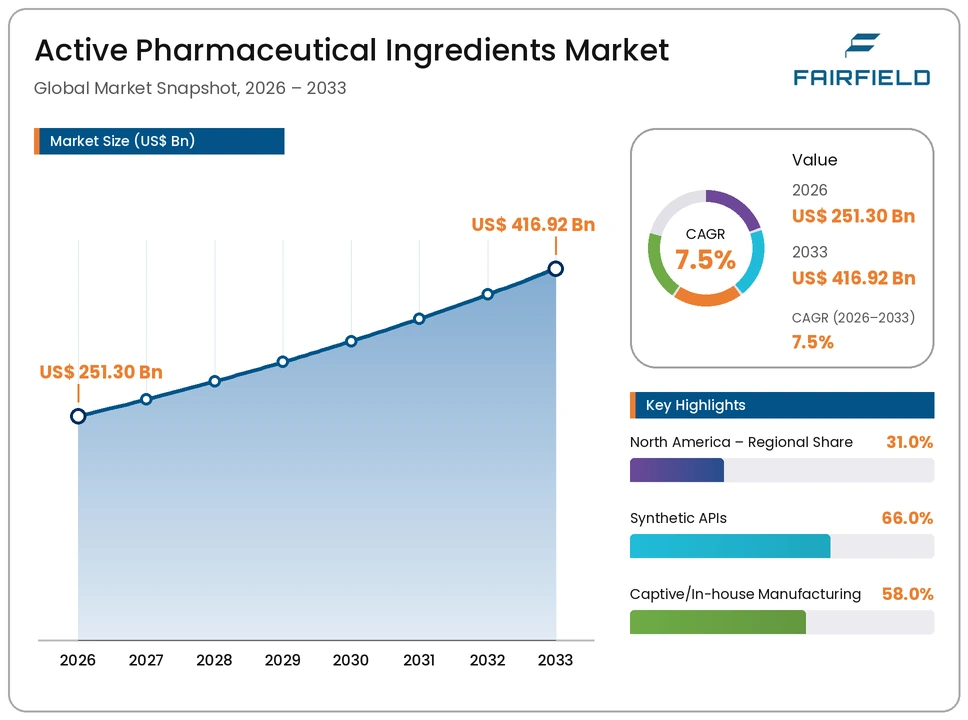
The global active pharmaceutical ingredients market is expected to be valued at US$ 251.30 Billion in 2026 and is projected to reach US$ 416.92 Billion by 2033, growing at a CAGR of 7.5% between 2026 and 2033. This trajectory reflects converging structural forces: ageing populations in high-income economies, accelerating biologics pipelines, and government-driven onshoring mandates. The U.S. Food and Drug Administration (FDA) has intensified scrutiny of foreign API manufacturing facilities since 2023, reinforcing domestic and allied-nation sourcing as both a regulatory and strategic imperative for formulators and contract manufacturers alike.
Key Highlights
- North America's US$ 77.90 Billion API market reflects more than scale, it reflects strategic urgency.
- Biotech APIs are outpacing all other ingredient categories in growth momentum, propelled by a biologics approval wave and the commercial scaling of antibody-drug conjugates.
- Synthetic APIs control 66.0% of the active pharmaceutical ingredients market because they underpin generic drug supply chains that national health systems cannot function without.
- Oncology is reshaping how API manufacturers design their facility investment cases. Cytotoxic containment infrastructure, once a niche specialism, is now a baseline competitive requirement as targeted cancer therapies and ADC payloads dominate late-stage pharmaceutical pipelines. Manufacturers investing in Occupational Exposure Band (OEB) 4 and 5 containment suites today are positioning for a decade of structural demand.
- India's US$ 21.11 Billion API market represents the most compelling single-country growth opportunity in the active pharmaceutical ingredients space through 2033.
Key Growth Determinants
- Surge in Chronic Disease Burden and Corresponding Formulary Expansion
The global prevalence of chronic non-communicable diseases, cardiovascular disorders, diabetes, and oncological conditions, has created a structurally durable demand base for small-molecule and biological APIs. The World Health Organization (WHO) estimates that non-communicable diseases account for approximately 74% of all global deaths annually, sustaining high-volume procurement from hospital systems, national health services, and managed care organisations. Generic pharmaceutical manufacturers, in particular, require continuous API offtake to fulfil formulary obligations under national essential medicines programmes across Europe and Asia, sustaining procurement cycles regardless of broader economic cycles. This demand inelasticity differentiates the active pharmaceutical ingredients sector from most industrial chemical segments.
Key Growth Barriers
- Regulatory Compliance Complexity Across Multi-Jurisdictional Manufacturing
API manufacturers supplying global pharmaceutical customers must satisfy concurrent Good Manufacturing Practice (GMP) frameworks enforced by the FDA, EMA, and national regulators such as Japan's Pharmaceuticals and Medical Devices Agency (PMDA). Each inspection cycle, and the remediation actions that follow warning letters or import alerts, imposes significant cost and time burdens, particularly for contract manufacturers operating across multiple geographies. A single FDA Form 483 observation can disrupt supply commitments for months, creating reputational and contractual liabilities that smaller API producers cannot easily absorb.
Market Opportunities
- Outsourcing Acceleration Among Innovator Pharmaceutical Companies
Large innovator firms are increasingly externalising API manufacturing for non-core molecules, redirecting internal capital toward clinical development and commercial operations. Pfizer Inc.'s expanded collaboration with contract development and manufacturing organisations (CDMOs) for post-patent small-molecule APIs exemplifies a broader strategic shift: innovator companies are treating API manufacturing as a supply chain function rather than a core competency. This structural outsourcing trend creates durable, long-cycle revenue opportunities for CDMOs with validated cGMP facilities, particularly those capable of handling highly potent APIs (HPAPIs) and cytotoxic compounds, a technically demanding niche where capacity remains constrained relative to pipeline demand.
Category-wise Insights
- Ingredients Type Analysis
Synthetic APIs account for 66.0% of the global active pharmaceutical ingredients market in 2026, equivalent to US$ 165.86 Billion. This dominance reflects the entrenched position of small-molecule drugs across primary care therapeutics, antihypertensives, statins, antidiabetics, and antibiotics, where chemical synthesis remains the most cost-effective and scalable production route. Generic drug manufacturers across India and Europe source synthetic APIs in bulk to supply national health system tenders, where price competitiveness and pharmacopoeial compliance, against United States Pharmacopeia (USP) and European Pharmacopoeia (Ph. Eur.) standards, are the primary purchasing criteria.
Biotech APIs are the fastest-growing segment, propelled by the commercial scaling of monoclonal antibodies, antibody-drug conjugates (ADCs), and gene therapy vectors. Regeneron Pharmaceuticals, Inc.'s expanding Dupixent franchise and the accelerating ADC pipeline, with AstraZeneca plc and Daiichi Sankyo Co., Ltd. advancing multiple biologic payloads through late-stage trials, are driving sustained demand for fermentation-derived and recombinant API capabilities at CDMO partners globally.
- Manufacturer Type Analysis
Captive/In-house Manufacturing accounts for 58.0% of the global active pharmaceutical ingredients market in 2026, equivalent to US$ 145.75 Billion. Major integrated pharmaceutical companies, including Novartis AG and Sanofi S.A., retain in-house API production for strategically critical, high-volume molecules where supply security and intellectual property protection outweigh the economics of outsourcing. For proprietary small molecules still under patent protection, in-house synthesis enables tight control over process analytical technology (PAT) parameters and prevents inadvertent technology transfer to potential future generic competitors.
Merchant/Contract API Manufacturers represent the fastest-growing manufacturer type, accelerated by the post-pandemic outsourcing wave among mid-size specialty pharma companies. Lonza Group AG's expansion of its Visp, Switzerland HPAPI facility, commissioned in phases through 2024, exemplifies the scale of CDMO investment responding to innovator pharmaceutical demand for outsourced synthesis of complex, potent compounds. Biotech startups entering late-stage clinical development represent a newly addressable buyer group: lacking internal manufacturing infrastructure, they depend entirely on contract API manufacturers for Phase III and commercial launch supply
- Therapeutic Application Analysis
Cardiovascular APIs account for 31.0% of the global active pharmaceutical ingredients market in 2026, equivalent to US$ 77.90 Billion. This segment leads because cardiovascular therapeutics, antihypertensives such as amlodipine and losartan, anticoagulants including apixaban, and lipid-lowering agents such as atorvastatin, represent the highest-volume generic drug categories globally. National health systems across Europe, Japan, and North America procure these APIs at government-negotiated prices, creating predictable, high-volume demand. The International Society of Hypertension estimates that over 1.28 billion adults worldwide live with hypertension, anchoring antihypertensive API demand structurally regardless of patent status.
Oncology is the fastest-growing therapeutic application segment, driven by an accelerating pipeline of targeted therapies and ADCs. Merck & Co., Inc.'s pembrolizumab (Keytruda) programme and the broader immuno-oncology category have dramatically expanded the volume and complexity of oncological API requirements at CDMOs equipped with cytotoxic handling capabilities. FDA Oncology Center of Excellence approvals through 2023–2024 span an unprecedented range of mechanisms, KRAS inhibitors, HER2-directed ADCs, and CAR-T manufacturing intermediates, each requiring specialised API synthesis infrastructure and stringent containment protocols.
Regional Insights
- North America Active Pharmaceutical Ingredients Market Trends and Insights
North America accounts for 31.0% of the global active pharmaceutical ingredients market in 2026, representing US$ 77.90 Billion. The region's leadership reflects a combination of mature branded pharmaceutical revenues, the world's deepest oncology and rare disease pipeline, and intensifying policy pressure, via the BIOSECURE Act advancing through the U.S. Congress in 2024, to restrict API sourcing from geopolitically sensitive suppliers. Domestic CDMO capacity investment is accelerating in response, positioning North America for sustained share consolidation through 2033.
United States Active Pharmaceutical Ingredients Market Size
The United States active pharmaceutical ingredients market represents 87.0% of the North America regional market in 2026, equivalent to US$ 67.78 Billion. Demand is anchored by the country's US$ 600 Billion-plus pharmaceutical revenue base and the concentrated purchasing power of pharmacy benefit managers (PBMs) and hospital group purchasing organisations (GPOs). The proposed BIOSECURE Act is expected to structurally redirect API procurement away from Chinese contract manufacturers toward domestic and allied-nation alternatives.
Canada Active Pharmaceutical Ingredients Market Size
The Canada active pharmaceutical ingredients market represents 13.0% of the North America regional market in 2026, equivalent to US$ 10.13 Billion. Health Canada's progressive alignment with ICH Q-series guidelines for pharmaceutical quality systems is raising the compliance baseline for API suppliers serving Canadian formulators, favouring established cGMP manufacturers. Canada's generic-heavy pharmaceutical consumption profile sustains steady demand for commodity synthetic APIs through national drug benefit formularies.
- Asia Pacific Active Pharmaceutical Ingredients Market Trends and Insights
Asia Pacific accounts for 28.0% of the global active pharmaceutical ingredients market in 2026, representing US$ 70.36 Billion, and is the fastest-growing regional market at an estimated 7% CAGR. The region functions simultaneously as the world's dominant API production hub and a rapidly expanding consumption market, as universal health coverage programmes across Southeast Asia drive formulary expansion. India's PLI scheme and China's consolidation of its API manufacturing base under stricter environmental regulations are together reshaping the region's competitive geography.
China Active Pharmaceutical Ingredients Market Size
The China active pharmaceutical ingredients market represents 36.0% of the Asia Pacific regional market in 2026, equivalent to US$ 25.33 Billion. China remains the world's largest producer of key starting materials (KSMs) and intermediates, supplying API manufacturers globally, while domestic demand grows as the National Healthcare Security Administration (NHSA) volume-based procurement programme expands drug access. Environmental compliance enforcement, particularly targeting solvent discharge from API synthesis clusters in Shandong and Hebei, is accelerating consolidation toward larger, compliant producers.
Japan Active Pharmaceutical Ingredients Market Size
The Japan active pharmaceutical ingredients market represents 15.0% of the Asia Pacific regional market in 2026, equivalent to US$ 10.55 Billion. PMDA's evolving GMP framework, increasingly aligned with ICH Q12 lifecycle management guidelines, creates a technically demanding compliance environment that favours established API suppliers with robust change management systems. Japan's accelerating biosimilar policy, designed to achieve 80% biosimilar substitution by volume by 2029, will drive sustained biotech API demand from domestic formulators.
India Active Pharmaceutical Ingredients Market Size
The India active pharmaceutical ingredients market represents 30.0% of the Asia Pacific regional market in 2026, equivalent to US$ 21.11 Billion. India supplies approximately 20% of global generic medicines by volume, according to the Pharmaceuticals Export Promotion Council of India (Pharmexcil), making domestic API availability a strategic national priority. The PLI Scheme for Bulk Drugs is directly incentivising new capacity for 41 critical APIs, including penicillin G, paracetamol, and key fermentation-derived antibiotics, with production expected to scale materially through 2026–2028.
Competitive Landscape
The active pharmaceutical ingredients industry operates across two distinct competitive tiers. A concentrated upper tier, comprising integrated innovators such as Pfizer Inc., Novartis AG, and Merck KGaA, manufactures proprietary APIs in-house and selectively licenses or outsources off-patent molecules. A broader, more fragmented second tier of CDMOs and generic API specialists, led by Lonza Group AG, Teva Pharmaceutical Industries Ltd., Dr. Reddy's Laboratories Ltd., and Aurobindo Pharma Ltd., competes principally on cGMP compliance breadth, therapeutic area specialisation, and delivered cost. Winning positions increasingly depend on containment capabilities for HPAPIs, regulatory filing portfolios (particularly Drug Master Files with the FDA and EMA), and geographic diversity of synthesis capacity.
Companies Covered in Active Pharmaceutical Ingredients Market
- Pfizer Inc.
- Merck KGaA
- Lonza Group AG
- Teva Pharmaceutical Industries Ltd.
- Viatris Inc.
- Dr. Reddy's Laboratories Ltd.
- Sun Pharmaceutical Industries Ltd.
- Aurobindo Pharma Ltd.
- Divi's Laboratories Ltd.
- Cambrex Corporation
- Novartis AG
- Sanofi S.A.
- AbbVie Inc.
- Boehringer Ingelheim GmbH
- Samsung Biologics Co., Ltd.
- Cipla Ltd.
- Hikma Pharmaceuticals PLC
- BASF SE (Pharma Solutions)
- Evonik Industries AG (Health Care)
- WuXi AppTec Co., Ltd.
Market Segmentation
By Ingredients Type
- Synthetic APIs
- Biotech APIs
By Manufacturer Type
- Captive/In-house Manufacturing
- Merchant/Contract API Manufacturers
By Therapeutic Application
- Oncology
- Cardiovascular
- Infectious Diseases & Others
By Regions
- North America
- Europe
- East Asia
- South Asia & Oceania
- Latin America
- Middle East & Africa
- Executive Summary
- Global Active Pharmaceutical Ingredients Market Snapshot
- Future Projections
- Key Market Trends
- Regional Snapshot, by Value, 2026
- Analyst Recommendations
- Market Overview
- Market Definitions and Segmentations
- Market Dynamics
- Drivers
- Restraints
- Market Opportunities
- Value Chain Analysis
- COVID-19 Impact Analysis
- Porter's Five Forces Analysis
- Impact of Russia-Ukraine Conflict
- PESTLE Analysis
- Regulatory Analysis
- Price Trend Analysis
- Current Prices and Future Projections, 2025-2033
- Price Impact Factors
- Global Active Pharmaceutical Ingredients Market Outlook, 2020 - 2033
- Global Active Pharmaceutical Ingredients Market Outlook, by Ingredients Type, Value (US$ Bn), 2020-2033
- Synthetic APIs
- Biotech APIs
- Global Active Pharmaceutical Ingredients Market Outlook, by Manufacturer Type, Value (US$ Bn), 2020-2033
- Captive/In-house Manufacturing
- Merchant/Contract API Manufacturers
- Global Active Pharmaceutical Ingredients Market Outlook, by Therapeutic Application, Value (US$ Bn), 2020-2033
- Oncology
- Cardiovascular
- Infectious Diseases & Others
- Global Active Pharmaceutical Ingredients Market Outlook, by Region, Value (US$ Bn), 2020-2033
- North America
- Europe
- Asia Pacific
- Latin America
- Middle East & Africa
- Global Active Pharmaceutical Ingredients Market Outlook, by Ingredients Type, Value (US$ Bn), 2020-2033
- North America Active Pharmaceutical Ingredients Market Outlook, 2020 - 2033
- North America Active Pharmaceutical Ingredients Market Outlook, by Ingredients Type, Value (US$ Bn), 2020-2033
- Synthetic APIs
- Biotech APIs
- North America Active Pharmaceutical Ingredients Market Outlook, by Manufacturer Type, Value (US$ Bn), 2020-2033
- Captive/In-house Manufacturing
- Merchant/Contract API Manufacturers
- North America Active Pharmaceutical Ingredients Market Outlook, by Therapeutic Application, Value (US$ Bn), 2020-2033
- Oncology
- Cardiovascular
- Infectious Diseases & Others
- North America Active Pharmaceutical Ingredients Market Outlook, by Country, Value (US$ Bn), 2020-2033
- U.S. Active Pharmaceutical Ingredients Market Outlook, by Ingredients Type, 2020-2033
- U.S. Active Pharmaceutical Ingredients Market Outlook, by Manufacturer Type, 2020-2033
- U.S. Active Pharmaceutical Ingredients Market Outlook, by Therapeutic Application, 2020-2033
- Canada Active Pharmaceutical Ingredients Market Outlook, by Ingredients Type, 2020-2033
- Canada Active Pharmaceutical Ingredients Market Outlook, by Manufacturer Type, 2020-2033
- Canada Active Pharmaceutical Ingredients Market Outlook, by Therapeutic Application, 2020-2033
- BPS Analysis/Market Attractiveness Analysis
- North America Active Pharmaceutical Ingredients Market Outlook, by Ingredients Type, Value (US$ Bn), 2020-2033
- Europe Active Pharmaceutical Ingredients Market Outlook, 2020 - 2033
- Europe Active Pharmaceutical Ingredients Market Outlook, by Ingredients Type, Value (US$ Bn), 2020-2033
- Synthetic APIs
- Biotech APIs
- Europe Active Pharmaceutical Ingredients Market Outlook, by Manufacturer Type, Value (US$ Bn), 2020-2033
- Captive/In-house Manufacturing
- Merchant/Contract API Manufacturers
- Europe Active Pharmaceutical Ingredients Market Outlook, by Therapeutic Application, Value (US$ Bn), 2020-2033
- Oncology
- Cardiovascular
- Infectious Diseases & Others
- Europe Active Pharmaceutical Ingredients Market Outlook, by Country, Value (US$ Bn), 2020-2033
- Germany Active Pharmaceutical Ingredients Market Outlook, by Ingredients Type, 2020-2033
- Germany Active Pharmaceutical Ingredients Market Outlook, by Manufacturer Type, 2020-2033
- Germany Active Pharmaceutical Ingredients Market Outlook, by Therapeutic Application, 2020-2033
- Italy Active Pharmaceutical Ingredients Market Outlook, by Ingredients Type, 2020-2033
- Italy Active Pharmaceutical Ingredients Market Outlook, by Manufacturer Type, 2020-2033
- Italy Active Pharmaceutical Ingredients Market Outlook, by Therapeutic Application, 2020-2033
- France Active Pharmaceutical Ingredients Market Outlook, by Ingredients Type, 2020-2033
- France Active Pharmaceutical Ingredients Market Outlook, by Manufacturer Type, 2020-2033
- France Active Pharmaceutical Ingredients Market Outlook, by Therapeutic Application, 2020-2033
- U.K. Active Pharmaceutical Ingredients Market Outlook, by Ingredients Type, 2020-2033
- U.K. Active Pharmaceutical Ingredients Market Outlook, by Manufacturer Type, 2020-2033
- U.K. Active Pharmaceutical Ingredients Market Outlook, by Therapeutic Application, 2020-2033
- Spain Active Pharmaceutical Ingredients Market Outlook, by Ingredients Type, 2020-2033
- Spain Active Pharmaceutical Ingredients Market Outlook, by Manufacturer Type, 2020-2033
- Spain Active Pharmaceutical Ingredients Market Outlook, by Therapeutic Application, 2020-2033
- Russia Active Pharmaceutical Ingredients Market Outlook, by Ingredients Type, 2020-2033
- Russia Active Pharmaceutical Ingredients Market Outlook, by Manufacturer Type, 2020-2033
- Russia Active Pharmaceutical Ingredients Market Outlook, by Therapeutic Application, 2020-2033
- Rest of Europe Active Pharmaceutical Ingredients Market Outlook, by Ingredients Type, 2020-2033
- Rest of Europe Active Pharmaceutical Ingredients Market Outlook, by Manufacturer Type, 2020-2033
- Rest of Europe Active Pharmaceutical Ingredients Market Outlook, by Therapeutic Application, 2020-2033
- BPS Analysis/Market Attractiveness Analysis
- Europe Active Pharmaceutical Ingredients Market Outlook, by Ingredients Type, Value (US$ Bn), 2020-2033
- Asia Pacific Active Pharmaceutical Ingredients Market Outlook, 2020 - 2033
- Asia Pacific Active Pharmaceutical Ingredients Market Outlook, by Ingredients Type, Value (US$ Bn), 2020-2033
- Synthetic APIs
- Biotech APIs
- Asia Pacific Active Pharmaceutical Ingredients Market Outlook, by Manufacturer Type, Value (US$ Bn), 2020-2033
- Captive/In-house Manufacturing
- Merchant/Contract API Manufacturers
- Asia Pacific Active Pharmaceutical Ingredients Market Outlook, by Therapeutic Application, Value (US$ Bn), 2020-2033
- Oncology
- Cardiovascular
- Infectious Diseases & Others
- Asia Pacific Active Pharmaceutical Ingredients Market Outlook, by Country, Value (US$ Bn), 2020-2033
- China Active Pharmaceutical Ingredients Market Outlook, by Ingredients Type, 2020-2033
- China Active Pharmaceutical Ingredients Market Outlook, by Manufacturer Type, 2020-2033
- China Active Pharmaceutical Ingredients Market Outlook, by Therapeutic Application, 2020-2033
- Japan Active Pharmaceutical Ingredients Market Outlook, by Ingredients Type, 2020-2033
- Japan Active Pharmaceutical Ingredients Market Outlook, by Manufacturer Type, 2020-2033
- Japan Active Pharmaceutical Ingredients Market Outlook, by Therapeutic Application, 2020-2033
- South Korea Active Pharmaceutical Ingredients Market Outlook, by Ingredients Type, 2020-2033
- South Korea Active Pharmaceutical Ingredients Market Outlook, by Manufacturer Type, 2020-2033
- South Korea Active Pharmaceutical Ingredients Market Outlook, by Therapeutic Application, 2020-2033
- India Active Pharmaceutical Ingredients Market Outlook, by Ingredients Type, 2020-2033
- India Active Pharmaceutical Ingredients Market Outlook, by Manufacturer Type, 2020-2033
- India Active Pharmaceutical Ingredients Market Outlook, by Therapeutic Application, 2020-2033
- Southeast Asia Active Pharmaceutical Ingredients Market Outlook, by Ingredients Type, 2020-2033
- Southeast Asia Active Pharmaceutical Ingredients Market Outlook, by Manufacturer Type, 2020-2033
- Southeast Asia Active Pharmaceutical Ingredients Market Outlook, by Therapeutic Application, 2020-2033
- Rest of SAO Active Pharmaceutical Ingredients Market Outlook, by Ingredients Type, 2020-2033
- Rest of SAO Active Pharmaceutical Ingredients Market Outlook, by Manufacturer Type, 2020-2033
- Rest of SAO Active Pharmaceutical Ingredients Market Outlook, by Therapeutic Application, 2020-2033
- BPS Analysis/Market Attractiveness Analysis
- Asia Pacific Active Pharmaceutical Ingredients Market Outlook, by Ingredients Type, Value (US$ Bn), 2020-2033
- Latin America Active Pharmaceutical Ingredients Market Outlook, 2020 - 2033
- Latin America Active Pharmaceutical Ingredients Market Outlook, by Ingredients Type, Value (US$ Bn), 2020-2033
- Synthetic APIs
- Biotech APIs
- Latin America Active Pharmaceutical Ingredients Market Outlook, by Manufacturer Type, Value (US$ Bn), 2020-2033
- Captive/In-house Manufacturing
- Merchant/Contract API Manufacturers
- Latin America Active Pharmaceutical Ingredients Market Outlook, by Therapeutic Application, Value (US$ Bn), 2020-2033
- Oncology
- Cardiovascular
- Infectious Diseases & Others
- Latin America Active Pharmaceutical Ingredients Market Outlook, by Country, Value (US$ Bn), 2020-2033
- Brazil Active Pharmaceutical Ingredients Market Outlook, by Ingredients Type, 2020-2033
- Brazil Active Pharmaceutical Ingredients Market Outlook, by Manufacturer Type, 2020-2033
- Brazil Active Pharmaceutical Ingredients Market Outlook, by Therapeutic Application, 2020-2033
- Mexico Active Pharmaceutical Ingredients Market Outlook, by Ingredients Type, 2020-2033
- Mexico Active Pharmaceutical Ingredients Market Outlook, by Manufacturer Type, 2020-2033
- Mexico Active Pharmaceutical Ingredients Market Outlook, by Therapeutic Application, 2020-2033
- Argentina Active Pharmaceutical Ingredients Market Outlook, by Ingredients Type, 2020-2033
- Argentina Active Pharmaceutical Ingredients Market Outlook, by Manufacturer Type, 2020-2033
- Argentina Active Pharmaceutical Ingredients Market Outlook, by Therapeutic Application, 2020-2033
- Rest of LATAM Active Pharmaceutical Ingredients Market Outlook, by Ingredients Type, 2020-2033
- Rest of LATAM Active Pharmaceutical Ingredients Market Outlook, by Manufacturer Type, 2020-2033
- Rest of LATAM Active Pharmaceutical Ingredients Market Outlook, by Therapeutic Application, 2020-2033
- BPS Analysis/Market Attractiveness Analysis
- Latin America Active Pharmaceutical Ingredients Market Outlook, by Ingredients Type, Value (US$ Bn), 2020-2033
- Middle East & Africa Active Pharmaceutical Ingredients Market Outlook, 2020 - 2033
- Middle East & Africa Active Pharmaceutical Ingredients Market Outlook, by Ingredients Type, Value (US$ Bn), 2020-2033
- Synthetic APIs
- Biotech APIs
- Middle East & Africa Active Pharmaceutical Ingredients Market Outlook, by Manufacturer Type, Value (US$ Bn), 2020-2033
- Captive/In-house Manufacturing
- Merchant/Contract API Manufacturers
- Middle East & Africa Active Pharmaceutical Ingredients Market Outlook, by Therapeutic Application, Value (US$ Bn), 2020-2033
- Oncology
- Cardiovascular
- Infectious Diseases & Others
- Middle East & Africa Active Pharmaceutical Ingredients Market Outlook, by Country, Value (US$ Bn), 2020-2033
- GCC Active Pharmaceutical Ingredients Market Outlook, by Ingredients Type, 2020-2033
- GCC Active Pharmaceutical Ingredients Market Outlook, by Manufacturer Type, 2020-2033
- GCC Active Pharmaceutical Ingredients Market Outlook, by Therapeutic Application, 2020-2033
- South Africa Active Pharmaceutical Ingredients Market Outlook, by Ingredients Type, 2020-2033
- South Africa Active Pharmaceutical Ingredients Market Outlook, by Manufacturer Type, 2020-2033
- South Africa Active Pharmaceutical Ingredients Market Outlook, by Therapeutic Application, 2020-2033
- Egypt Active Pharmaceutical Ingredients Market Outlook, by Ingredients Type, 2020-2033
- Egypt Active Pharmaceutical Ingredients Market Outlook, by Manufacturer Type, 2020-2033
- Egypt Active Pharmaceutical Ingredients Market Outlook, by Therapeutic Application, 2020-2033
- Nigeria Active Pharmaceutical Ingredients Market Outlook, by Ingredients Type, 2020-2033
- Nigeria Active Pharmaceutical Ingredients Market Outlook, by Manufacturer Type, 2020-2033
- Nigeria Active Pharmaceutical Ingredients Market Outlook, by Therapeutic Application, 2020-2033
- Rest of Middle East Active Pharmaceutical Ingredients Market Outlook, by Ingredients Type, 2020-2033
- Rest of Middle East Active Pharmaceutical Ingredients Market Outlook, by Manufacturer Type, 2020-2033
- Rest of Middle East Active Pharmaceutical Ingredients Market Outlook, by Therapeutic Application, 2020-2033
- BPS Analysis/Market Attractiveness Analysis
- Middle East & Africa Active Pharmaceutical Ingredients Market Outlook, by Ingredients Type, Value (US$ Bn), 2020-2033
- Competitive Landscape
- Company Vs Segment Heatmap
- Company Market Share Analysis, 2025
- Competitive Dashboard
- Company Profiles
- Pfizer Inc.
- Company Overview
- Product Portfolio
- Financial Overview
- Business Strategies and Developments
- Merck KGaA
- Lonza Group AG
- Teva Pharmaceutical Industries Ltd.
- Viatris Inc.
- Dr. Reddy's Laboratories Ltd.
- Sun Pharmaceutical Industries Ltd.
- Aurobindo Pharma Ltd.
- Divi's Laboratories Ltd.
- Cambrex Corporation
- Pfizer Inc.
- Appendix
- Research Methodology
- Report Assumptions
- Acronyms and Abbreviations
By Ingredients Type
- Synthetic APIs
- Biotech APIs
By Manufacturer Type
- Captive/In-house Manufacturing
- Merchant/Contract API Manufacturers
By Therapeutic Application
- Oncology
- Cardiovascular
- Infectious Diseases & Others
By Regions
- North America
- Europe
- East Asia
- South Asia & Oceania
- Latin America
- Middle East & Africa
Our Research Methodology
Considering the volatility of business today, traditional approaches to strategizing a game plan can be unfruitful if not detrimental. True ambiguity is no way to determine a forecast. A myriad of predetermined factors must be accounted for such as the degree of risk involved, the magnitude of circumstances, as well as conditions or consequences that are not known or unpredictable. To circumvent binary views that cast uncertainty, the application of market research intelligence to strategically posture, move, and enable actionable outcomes is necessary.
View Methodology
Quality Assured
Rigorous Validation Process

Confidentiality Assured
End-to-end Data Security

Custom Research Services
Tailored To Your Objectives
FAQs
The global active pharmaceutical ingredients market is valued at US$ 251.30 Billion in 2026 and is projected to reach US$ 416.92 Billion by 2033 at a 7.5% CAGR, generating an incremental opportunity of US$ 165.62 Billion.
Rising prevalence of chronic diseases, quantified by the WHO at approximately 74% of all global deaths attributable to non-communicable conditions, sustains inelastic formulary demand for high-volume APIs. Concurrently, ICH Q13 guidelines on continuous manufacturing of drug substances are enabling API producers to improve yields and reduce batch cycle times, lowering cost-per-gram and accelerating the commercial viability of complex molecule synthesis.
Synthetic APIs command 66.0% of the market, anchored by their indispensable role in generic drug supply chains serving national health system formularies across Europe, Asia, and North America.
North America leads with 31.0% global share, sustained by the world's largest branded pharmaceutical revenue base and a regulatory environment, enforced by the FDA, that sets the de facto global compliance standard for API manufacturers.
The most consequential opportunity lies in HPAPI and bioconjugation infrastructure, where demand from the ADC pipeline is structurally outpacing available CDMO capacity globally. Companies with validated OEB 4–5 containment facilities, linker-payload synthesis expertise, and established FDA Drug Master File (DMF) portfolios are best positioned to capture this premium-margin segment as over 100 ADCs in clinical development approach commercialisation.
Related Reports
Industrial Biomanufacturing Market Size, Share, Insights, Competitive Landscape, and Forecast 2026 to 2033
Industrial biomanufacturing market to reach US$105.0 billion by 2033 at 10.6% CAGR. Explore fermentation trends, segments, regions and key players.
Clinical Nutrition Market Size, Share, Insights, Competitive Landscape, and Forecast 2026 to 2033
The global clinical nutrition market is valued at US$35.90 billion in 2026, reaching US$51.50 billion by 2033, growing at a 5.29% CAGR
Fluoroquinolones Market Size, Share, Insights, Competitive Landscape, and Forecast 2026 to 2033
The global fluoroquinolones market is valued at US$9.4 billion in 2026, reaching US$10.6 billion by 2033, growing at a 1.73% CAGR
Fabry Disease Treatment Market Size, Share, Insights, Competitive Landscape, and Forecast 2026 to 2033
The global Fabry disease treatment market is valued at US$2.2 billion in 2026, reaching US$3.3 billion by 2033, growing at a 6.0% CAGR
gRNA Market Size, Share, Insights, Competitive Landscape, and Forecast 2026 to 2033
The global gRNA market is valued at US$0.40 billion in 2026, reaching US$0.90 billion by 2033, growing at a 12.3% CAGR
Pharmaceutical Glass Ampoules Market Size, Share, Insights, Competitive Landscape, and Forecast 2026 to 2033
The global pharmaceutical glass ampoules market is valued at US$1.4 billion in 2026, reaching US$1.9 billion by 2033, growing at a 4.5% CAGR