



Drug Repurposing Market
Drug Repurposing Market Insights, Competitive Landscape, and Market Forecast 2026–2033
Global Drug Repurposing Market Size and Trend Analysis
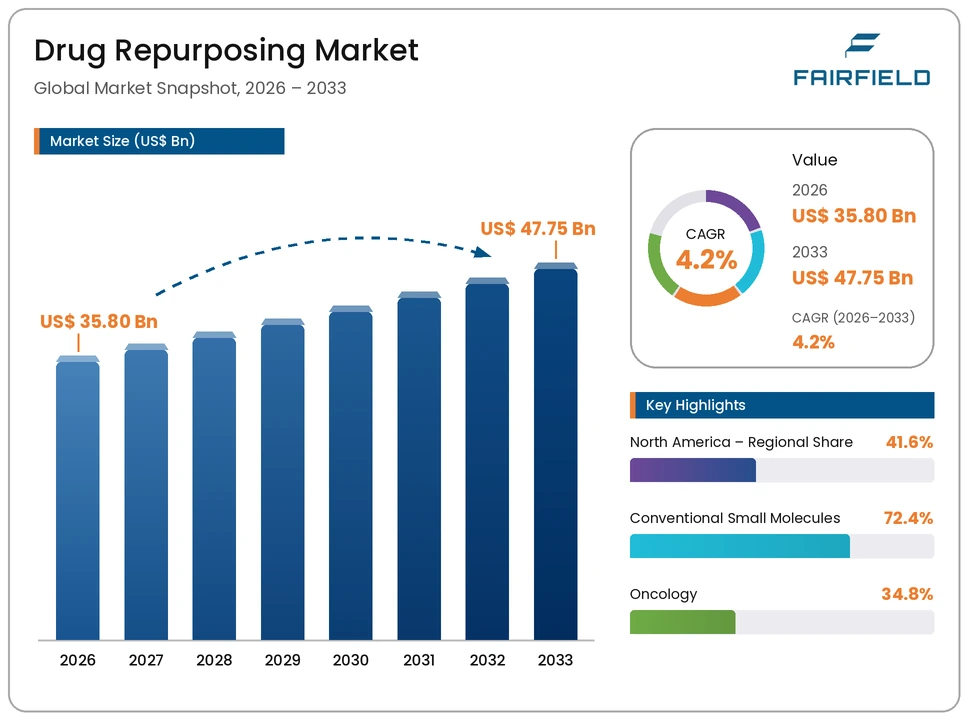
The global drug repurposing market is expected to be valued at US$ 35.80 Billion in 2026 and is projected to reach US$ 47.75 Billion by 2033, growing at a CAGR of 4.2% between 2026 and 2033.
This trajectory reflects sustained pharmaceutical investment in computational screening, phenotypic profiling, and AI-assisted target identification. The United States National Institutes of Health (NIH) National Center for Advancing Translational Sciences (NCATS), through its Discovering New Therapeutic Uses for Existing Molecules programme, has accelerated academic-industry partnerships that validate repurposed candidates at Phase II a structural tailwind that supports this market's measured but durable growth profile.
Key Highlights
- North America leads the drug repurposing market with a 41.6% share, supported by the FDA’s 505(b)(2) approval pathway, strong NIH funding, and a well-established pharmaceutical R&D ecosystem.
- Asia Pacific is the fastest-growing region with a 5.8% CAGR, driven by regulatory modernization, expanding biotechnology investments, and cost-effective clinical trial capabilities.
- Oncology accounts for 34.8% of the market, supported by growing use of drug repurposing strategies for targeted cancer therapies and indication expansion.
- Biologics and peptide-based drugs are the fastest-growing drug type segment, driven by increasing research on immunotherapies and precision medicine applications.
- Contract research organizations (CROs) represent the fastest-growing end-use segment as pharmaceutical companies increasingly outsource adaptive clinical trials and real-world evidence studies for drug repurposing.
Key Growth Barriers
- AI-Driven Target Identification Compressing Repurposing Timelines
Artificial intelligence and machine learning platforms are fundamentally reshaping how pharmaceutical researchers identify viable repurposing candidates. By cross-referencing molecular binding affinities, gene expression datasets, and electronic health record outcomes simultaneously, AI platforms can surface repositioning hypotheses in weeks rather than years. BenevolentAI demonstrated this capability by identifying baricitinib originally approved for rheumatoid arthritis as a candidate for COVID-19 treatment, a hypothesis subsequently validated in RECOVERY Collaborative Group clinical data published in 2022. Broader adoption of these platforms across mid-size and large pharma is systematically expanding the repurposing pipeline, raising the probability of regulatory approval for candidates entering clinical evaluation.
Key Growth Barriers
- Intellectual Property Complexity Limiting Commercial Exclusivity
The drug repurposing sector confronts a structural IP dilemma: compounds identified as repurposing candidates are frequently off-patent, making it difficult to secure exclusivity over the new indication. Without robust composition-of-matter or method-of-use patent protection, generic manufacturers can rapidly erode first-mover revenue. The World Intellectual Property Organization (WIPO) acknowledges this as a persistent deterrent for private investment in repurposing programmes involving older small molecules. Resolving this tension requires sophisticated patent strategy and, in many cases, regulatory exclusivity periods as the primary protection mechanism.
Drug Repurposing Market Opportunities
- Integration of Multi-Omics Data Platforms Opening New Repurposing Hypotheses
Advances in proteomics, transcriptomics, and metabolomics are creating rich datasets that substantially expand the hypothesis space for drug repurposing. Academic medical centres and biotech companies are mining large-scale biobanks including the UK Biobank, which holds genetic and health data on approximately 500,000 participants to identify genotype-phenotype associations that predict drug response across previously untested indications. This multi-omics infrastructure is particularly actionable for neurological and metabolic conditions where mechanistic overlap between diseases creates repurposing opportunities that phenotypic screening alone would miss. Investors and pharmaceutical companies positioned to license or co-develop candidates validated through these platforms will capture disproportionate value as datasets mature.
Market Segmentation Analysis
- Disease Area Analysis
Oncology commands 34.8% of the global drug repurposing market in 2026, equivalent to US$ 12.46 Billion. Oncology leads because the biological complexity of cancer where single-pathway inhibition rarely suffices creates systematic demand for combination strategies that incorporate repositioned compounds. Pharmaceutical companies such as Pfizer Inc. have actively explored approved kinase inhibitors for off-label tumour subtypes, while academic oncology centres regularly test metabolic drugs like metformin in cancer combination trials, identifying durable repurposing candidates through adaptive platform study designs. The breadth of tumour types, combined with willingness among oncologists to accept repositioned agents in salvage settings, sustains this segment's structural dominance.
Cardiovascular Conditions is the fastest-growing disease area segment. The catalyst is mechanistic convergence: cardiometabolic pathways overlap with inflammation and fibrosis targets increasingly validated across therapeutic areas. AstraZeneca's 2023 investigation of dapagliflozin originally an SGLT2 inhibitor for type 2 diabetes in heart failure with preserved ejection fraction exemplifies how approved agents are being repositioned into high-prevalence cardiovascular indications where unmet need remains substantial.
- Drug Type Analysis
Conventional Small Molecules account for 72.4% of the global drug repurposing market in 2026, equivalent to US$ 25.92 Billion. Small molecules dominate because their physicochemical properties, manufacturing scalability, and oral bioavailability are already fully characterised, eliminating the formulation risk that complicates biologics repositioning.
Researchers at institutions including the Broad Institute of MIT and Harvard routinely screen established small-molecule libraries against novel disease targets using high-throughput phenotypic assays, identifying repurposing candidates with known tolerability profiles precisely the risk-reduction logic that makes this drug type the preferred starting point for commercial sponsors.
Biologics and Peptide-based Drugs represent the fastest-growing drug type segment. The specific catalyst is the maturation of biosimilar-era knowledge: as biologics lose exclusivity, researchers gain unprecedented access to mechanistic data that enables systematic exploration of new indications. Roche Holding AG's investigation of tocilizumab an IL-6 receptor antagonist originally approved for rheumatoid arthritis across cytokine storm syndromes and COVID-19 critical care (validated in the RECOVERY trial) established a model that the industry is now actively replicating across oncology and neurology pipelines.
- End Use Analysis
Biopharmaceutical & Pharmaceutical Companies account for 58.6% of the global drug repurposing market in 2026, equivalent to US$ 20.98 Billion. This segment leads because large pharma holds the compound libraries, clinical operations infrastructure, and regulatory relationships necessary to advance repurposing candidates at speed and scale.
Companies such as Novartis AG and Eli Lilly and Company maintain dedicated indication-expansion teams that systematically screen approved portfolios for repositioning potential particularly targeting late-lifecycle products where repurposing extends commercial relevance before generic entry.
Clinical Research Organizations (CROs) represent the fastest-growing end-use segment. The catalyst is pharmaceutical outsourcing: as sponsors seek to reduce fixed costs, they are contracting repurposing trial design and execution to specialised CROs with adaptive trial expertise. IQVIA Holdings Inc. has invested specifically in real-world evidence capabilities and decentralised trial platforms that are well-suited to the repositioning use case, where diverse patient populations and multiple-indication endpoints demand flexible clinical infrastructure not typically available in-house.
Regional Insights
- North America Drug Repurposing Market Trends and Insights
North America accounts for 41.6% of the global drug repurposing market in 2026, representing US$ 14.89 Billion. The region's dominance reflects the concentration of Tier-1 pharmaceutical R&D operations, NIH-funded translational research infrastructure, and the FDA's established regulatory pathways including the 505(b)(2) New Drug Application route that specifically facilitate approval of repurposed compounds with reduced clinical data requirements. Continued federal investment through NCATS and BARDA reinforces North America's structural leadership through the forecast period.
U.S. Drug Repurposing Market Size
The U.S. drug repurposing market represents 88.5% of the North America regional market in 2026, equivalent to US$ 13.18 Billion. The primary demand driver is the concentration of pharmaceutical headquarters, biotech clusters, and academic medical centers particularly in Boston–Cambridge and the San Francisco Bay Area that generate and commercialize repurposing candidates. Sustained FDA engagement with Real-World Evidence frameworks under the 21st Century Cures Act will further streamline indication-expansion approvals through 2033.
Canada Drug Repurposing Market Size
The Canada drug repurposing market represents 8.2% of the North America regional market in 2026, equivalent to US$ 1.22 Billion. Health Canada's progressive adoption of Extraordinary Use New Drugs pathways and the country's publicly funded academic research networks particularly through the Canadian Institutes of Health Research (CIHR) sustain domestic repositioning activity. Expansion of university-industry partnerships in Toronto and Montreal signals incremental market growth through the forecast period.
- Asia Pacific Drug Repurposing Market Trends and Insights
Asia Pacific accounts for 22.4% of the global drug repurposing market in 2026, representing US$ 8.02 Billion, and is expanding at the fastest regional CAGR of 5.8%. The primary acceleration force is generic pharmaceutical manufacturing expertise combined with growing regulatory capacity: The Central Drugs Standard Control Organisation (CDSCO) in India and the National Medical Products Administration (NMPA) in China are both modernising indication-expansion approval frameworks. Increasing clinical trial activity across the region, supported by lower per-patient trial costs, positions Asia Pacific as both a production base and a growing commercial market for repurposed therapeutics.
China Drug Repurposing Market Size
The China drug repurposing market represents 32.8% of the Asia Pacific regional market in 2026, equivalent to US$ 2.63 Billion. China's NMPA has accelerated review timelines for drugs with existing international approval under its Priority Review procedures, directly reducing barriers for companies seeking to enter new indications in the Chinese market. Continued expansion of domestic biotech capabilities particularly in oncology repurposing signals above-regional-average growth through 2033.
Japan Drug Repurposing Market Size
The Japan drug repurposing market represents 21.5% of the Asia Pacific regional market in 2026, equivalent to US$ 1.72 Billion. The Japan Agency for Medical Research and Development (AMED) has funded targeted repurposing programmes focused on rare neurological diseases, reflecting Japan's ageing demographic and high burden of neurodegenerative conditions. The Pharmaceuticals and Medical Devices Agency (PMDA)'s science consultation framework supports early regulatory engagement, reducing repositioning approval risk
India Drug Repurposing Market Size
The India drug repurposing market represents 18.6% of the Asia Pacific regional market in 2026, equivalent to US$ 1.49 Billion. India's generic manufacturing infrastructure and large patient population make it uniquely positioned for large-scale repurposing trials at cost-efficient economics. The Indian Council of Medical Research (ICMR) has actively promoted repositioning research through institutional grants, and India's inclusion in global adaptive trial networks will drive commercial momentum through the forecast period.
Competitive Landscape
The drug repurposing industry is moderately consolidated at the commercial tier, with large integrated pharmaceutical companies commanding substantial advantages through proprietary compound libraries, clinical development infrastructure, and established regulatory relationships. Pfizer Inc., Roche Holding AG, and Novartis AG each maintain dedicated indication-expansion programmes embedded within their R&D operations. Competition is not primarily won on discovery speed but on translational execution: the ability to design mechanistically credible clinical trials, engage regulators early through frameworks such as the FDA's 505(b)(2) pathway, and secure intellectual property sufficient to justify commercial investment. Specialist biotechs including those deploying AI-driven repositioning platforms are intensifying competitive pressure on large incumbents by narrowing the discovery advantage that scale once conferred.
Companies Covered in Drug Repurposing Market
- Eli Lilly and Company
- Pfizer Inc.
- Roche Holding AG
- Novartis AG
- Bayer AG
- GSK plc
- Amgen Inc.
- Biogen Inc.
- Teva Pharmaceutical Industries Ltd.
- Vertex Pharmaceuticals Incorporated
Market Segmentation
By Disease Area
- Oncology
- Neurology Disorders
- Infectious Diseases
- Cardiovascular Conditions
- Metabolic Disorders
- Others Therapeutic Areas
By Drug Type
- Conventional Small Molecules
- Biologics and Peptide-based Drugs
By End Use
- Biopharmaceutical & Pharmaceutical Companies
- Clinical Research Organizations (CROs)
- Universities & Research Institutions
By Region
- North America
- Europe
- Asia Pacific
- Latin America
- Middle East & Africa
- Executive Summary
- Global Drug Repurposing Market Snapshot
- Future Projections
- Key Market Trends
- Regional Snapshot, by Value, 2026
- Analyst Recommendations
- Market Overview
- Market Definitions and Segmentations
- Market Dynamics
- Drivers
- Restraints
- Market Opportunities
- Value Chain Analysis
- COVID-19 Impact Analysis
- Porter's Five Forces Analysis
- Impact of Russia-Ukraine Conflict
- PESTLE Analysis
- Regulatory Analysis
- Price Trend Analysis
- Current Prices and Future Projections, 2025-2033
- Price Impact Factors
- Global Drug Repurposing Market Outlook, 2020 - 2033
- Global Drug Repurposing Market Outlook, by Disease Area, Value (US$ Bn), 2020-2033
- Oncology
- Neurology Disorders
- Infectious Diseases
- Cardiovascular Conditions
- Metabolic Disorders
- Others Therapeutic Areas
- Global Drug Repurposing Market Outlook, by Drug Type , Value (US$ Bn), 2020-2033
- Conventional Small Molecules
- Biologics and Peptide-based Drugs
- Global Drug Repurposing Market Outlook, by End Use , Value (US$ Bn), 2020-2033
- Biopharmaceutical & Pharmaceutical Companies
- Clinical Research Organizations (CROs)
- Universities & Research Institutions
- Global Drug Repurposing Market Outlook, by Region, Value (US$ Bn), 2020-2033
- North America
- Europe
- Asia Pacific
- Latin America
- Middle East & Africa
- Global Drug Repurposing Market Outlook, by Disease Area, Value (US$ Bn), 2020-2033
- North America Drug Repurposing Market Outlook, 2020 - 2033
- North America Drug Repurposing Market Outlook, by Disease Area, Value (US$ Bn), 2020-2033
- Oncology
- Neurology Disorders
- Infectious Diseases
- Cardiovascular Conditions
- Metabolic Disorders
- Others Therapeutic Areas
- North America Drug Repurposing Market Outlook, by Drug Type , Value (US$ Bn), 2020-2033
- Conventional Small Molecules
- Biologics and Peptide-based Drugs
- North America Drug Repurposing Market Outlook, by End Use , Value (US$ Bn), 2020-2033
- Biopharmaceutical & Pharmaceutical Companies
- Clinical Research Organizations (CROs)
- Universities & Research Institutions
- North America Drug Repurposing Market Outlook, by Country, Value (US$ Bn), 2020-2033
- U.S. Drug Repurposing Market Outlook, by Disease Area, 2020-2033
- U.S. Drug Repurposing Market Outlook, by Drug Type , 2020-2033
- U.S. Drug Repurposing Market Outlook, by End Use , 2020-2033
- Canada Drug Repurposing Market Outlook, by Disease Area, 2020-2033
- Canada Drug Repurposing Market Outlook, by Drug Type , 2020-2033
- Canada Drug Repurposing Market Outlook, by End Use , 2020-2033
- BPS Analysis/Market Attractiveness Analysis
- North America Drug Repurposing Market Outlook, by Disease Area, Value (US$ Bn), 2020-2033
- Europe Drug Repurposing Market Outlook, 2020 - 2033
- Europe Drug Repurposing Market Outlook, by Disease Area, Value (US$ Bn), 2020-2033
- Oncology
- Neurology Disorders
- Infectious Diseases
- Cardiovascular Conditions
- Metabolic Disorders
- Others Therapeutic Areas
- Europe Drug Repurposing Market Outlook, by Drug Type , Value (US$ Bn), 2020-2033
- Conventional Small Molecules
- Biologics and Peptide-based Drugs
- Europe Drug Repurposing Market Outlook, by End Use , Value (US$ Bn), 2020-2033
- Biopharmaceutical & Pharmaceutical Companies
- Clinical Research Organizations (CROs)
- Universities & Research Institutions
- Europe Drug Repurposing Market Outlook, by Country, Value (US$ Bn), 2020-2033
- Germany Drug Repurposing Market Outlook, by Disease Area, 2020-2033
- Germany Drug Repurposing Market Outlook, by Drug Type , 2020-2033
- Germany Drug Repurposing Market Outlook, by End Use , 2020-2033
- Italy Drug Repurposing Market Outlook, by Disease Area, 2020-2033
- Italy Drug Repurposing Market Outlook, by Drug Type , 2020-2033
- Italy Drug Repurposing Market Outlook, by End Use , 2020-2033
- France Drug Repurposing Market Outlook, by Disease Area, 2020-2033
- France Drug Repurposing Market Outlook, by Drug Type , 2020-2033
- France Drug Repurposing Market Outlook, by End Use , 2020-2033
- U.K. Drug Repurposing Market Outlook, by Disease Area, 2020-2033
- U.K. Drug Repurposing Market Outlook, by Drug Type , 2020-2033
- U.K. Drug Repurposing Market Outlook, by End Use , 2020-2033
- Spain Drug Repurposing Market Outlook, by Disease Area, 2020-2033
- Spain Drug Repurposing Market Outlook, by Drug Type , 2020-2033
- Spain Drug Repurposing Market Outlook, by End Use , 2020-2033
- Russia Drug Repurposing Market Outlook, by Disease Area, 2020-2033
- Russia Drug Repurposing Market Outlook, by Drug Type , 2020-2033
- Russia Drug Repurposing Market Outlook, by End Use , 2020-2033
- Rest of Europe Drug Repurposing Market Outlook, by Disease Area, 2020-2033
- Rest of Europe Drug Repurposing Market Outlook, by Drug Type , 2020-2033
- Rest of Europe Drug Repurposing Market Outlook, by End Use , 2020-2033
- BPS Analysis/Market Attractiveness Analysis
- Europe Drug Repurposing Market Outlook, by Disease Area, Value (US$ Bn), 2020-2033
- Asia Pacific Drug Repurposing Market Outlook, 2020 - 2033
- Asia Pacific Drug Repurposing Market Outlook, by Disease Area, Value (US$ Bn), 2020-2033
- Oncology
- Neurology Disorders
- Infectious Diseases
- Cardiovascular Conditions
- Metabolic Disorders
- Others Therapeutic Areas
- Asia Pacific Drug Repurposing Market Outlook, by Drug Type , Value (US$ Bn), 2020-2033
- Conventional Small Molecules
- Biologics and Peptide-based Drugs
- Asia Pacific Drug Repurposing Market Outlook, by End Use , Value (US$ Bn), 2020-2033
- Biopharmaceutical & Pharmaceutical Companies
- Clinical Research Organizations (CROs)
- Universities & Research Institutions
- Asia Pacific Drug Repurposing Market Outlook, by Country, Value (US$ Bn), 2020-2033
- China Drug Repurposing Market Outlook, by Disease Area, 2020-2033
- China Drug Repurposing Market Outlook, by Drug Type , 2020-2033
- China Drug Repurposing Market Outlook, by End Use , 2020-2033
- Japan Drug Repurposing Market Outlook, by Disease Area, 2020-2033
- Japan Drug Repurposing Market Outlook, by Drug Type , 2020-2033
- Japan Drug Repurposing Market Outlook, by End Use , 2020-2033
- South Korea Drug Repurposing Market Outlook, by Disease Area, 2020-2033
- South Korea Drug Repurposing Market Outlook, by Drug Type , 2020-2033
- South Korea Drug Repurposing Market Outlook, by End Use , 2020-2033
- India Drug Repurposing Market Outlook, by Disease Area, 2020-2033
- India Drug Repurposing Market Outlook, by Drug Type , 2020-2033
- India Drug Repurposing Market Outlook, by End Use , 2020-2033
- Southeast Asia Drug Repurposing Market Outlook, by Disease Area, 2020-2033
- Southeast Asia Drug Repurposing Market Outlook, by Drug Type , 2020-2033
- Southeast Asia Drug Repurposing Market Outlook, by End Use , 2020-2033
- Rest of SAO Drug Repurposing Market Outlook, by Disease Area, 2020-2033
- Rest of SAO Drug Repurposing Market Outlook, by Drug Type , 2020-2033
- Rest of SAO Drug Repurposing Market Outlook, by End Use , 2020-2033
- BPS Analysis/Market Attractiveness Analysis
- Asia Pacific Drug Repurposing Market Outlook, by Disease Area, Value (US$ Bn), 2020-2033
- Latin America Drug Repurposing Market Outlook, 2020 - 2033
- Latin America Drug Repurposing Market Outlook, by Disease Area, Value (US$ Bn), 2020-2033
- Oncology
- Neurology Disorders
- Infectious Diseases
- Cardiovascular Conditions
- Metabolic Disorders
- Others Therapeutic Areas
- Latin America Drug Repurposing Market Outlook, by Drug Type , Value (US$ Bn), 2020-2033
- Conventional Small Molecules
- Biologics and Peptide-based Drugs
- Latin America Drug Repurposing Market Outlook, by End Use , Value (US$ Bn), 2020-2033
- Biopharmaceutical & Pharmaceutical Companies
- Clinical Research Organizations (CROs)
- Universities & Research Institutions
- Latin America Drug Repurposing Market Outlook, by Country, Value (US$ Bn), 2020-2033
- Brazil Drug Repurposing Market Outlook, by Disease Area, 2020-2033
- Brazil Drug Repurposing Market Outlook, by Drug Type , 2020-2033
- Brazil Drug Repurposing Market Outlook, by End Use , 2020-2033
- Mexico Drug Repurposing Market Outlook, by Disease Area, 2020-2033
- Mexico Drug Repurposing Market Outlook, by Drug Type , 2020-2033
- Mexico Drug Repurposing Market Outlook, by End Use , 2020-2033
- Argentina Drug Repurposing Market Outlook, by Disease Area, 2020-2033
- Argentina Drug Repurposing Market Outlook, by Drug Type , 2020-2033
- Argentina Drug Repurposing Market Outlook, by End Use , 2020-2033
- Rest of LATAM Drug Repurposing Market Outlook, by Disease Area, 2020-2033
- Rest of LATAM Drug Repurposing Market Outlook, by Drug Type , 2020-2033
- Rest of LATAM Drug Repurposing Market Outlook, by End Use , 2020-2033
- BPS Analysis/Market Attractiveness Analysis
- Latin America Drug Repurposing Market Outlook, by Disease Area, Value (US$ Bn), 2020-2033
- Middle East & Africa Drug Repurposing Market Outlook, 2020 - 2033
- Middle East & Africa Drug Repurposing Market Outlook, by Disease Area, Value (US$ Bn), 2020-2033
- Oncology
- Neurology Disorders
- Infectious Diseases
- Cardiovascular Conditions
- Metabolic Disorders
- Others Therapeutic Areas
- Middle East & Africa Drug Repurposing Market Outlook, by Drug Type , Value (US$ Bn), 2020-2033
- Conventional Small Molecules
- Biologics and Peptide-based Drugs
- Middle East & Africa Drug Repurposing Market Outlook, by End Use , Value (US$ Bn), 2020-2033
- Biopharmaceutical & Pharmaceutical Companies
- Clinical Research Organizations (CROs)
- Universities & Research Institutions
- Middle East & Africa Drug Repurposing Market Outlook, by Country, Value (US$ Bn), 2020-2033
- GCC Drug Repurposing Market Outlook, by Disease Area, 2020-2033
- GCC Drug Repurposing Market Outlook, by Drug Type , 2020-2033
- GCC Drug Repurposing Market Outlook, by End Use , 2020-2033
- South Africa Drug Repurposing Market Outlook, by Disease Area, 2020-2033
- South Africa Drug Repurposing Market Outlook, by Drug Type , 2020-2033
- South Africa Drug Repurposing Market Outlook, by End Use , 2020-2033
- Egypt Drug Repurposing Market Outlook, by Disease Area, 2020-2033
- Egypt Drug Repurposing Market Outlook, by Drug Type , 2020-2033
- Egypt Drug Repurposing Market Outlook, by End Use , 2020-2033
- Nigeria Drug Repurposing Market Outlook, by Disease Area, 2020-2033
- Nigeria Drug Repurposing Market Outlook, by Drug Type , 2020-2033
- Nigeria Drug Repurposing Market Outlook, by End Use , 2020-2033
- Rest of Middle East Drug Repurposing Market Outlook, by Disease Area, 2020-2033
- Rest of Middle East Drug Repurposing Market Outlook, by Drug Type , 2020-2033
- Rest of Middle East Drug Repurposing Market Outlook, by End Use , 2020-2033
- BPS Analysis/Market Attractiveness Analysis
- Middle East & Africa Drug Repurposing Market Outlook, by Disease Area, Value (US$ Bn), 2020-2033
- Competitive Landscape
- Company Vs Segment Heatmap
- Company Market Share Analysis, 2025
- Competitive Dashboard
- Company Profiles
- Eli Lilly and Company
- Company Overview
- Product Portfolio
- Financial Overview
- Business Strategies and Developments
- Pfizer Inc.
- Roche Holding AG
- Novartis AG
- Bayer AG
- GSK plc
- Amgen Inc.
- Biogen Inc.
- Teva Pharmaceutical
- Vertex Pharmaceuticals
- Eli Lilly and Company
- Appendix
- Research Methodology
- Report Assumptions
- Acronyms and Abbreviations
By Disease Area
- Oncology
- Neurology Disorders
- Infectious Diseases
- Cardiovascular Conditions
- Metabolic Disorders
- Others Therapeutic Areas
By Drug Type
- Conventional Small Molecules
- Biologics and Peptide-based Drugs
By End Use
- Biopharmaceutical & Pharmaceutical Companies
- Clinical Research Organizations (CROs)
- Universities & Research Institutions
By Region
- North America
- Europe
- Asia Pacific
- Latin America
- Middle East & Africa
Our Research Methodology
Considering the volatility of business today, traditional approaches to strategizing a game plan can be unfruitful if not detrimental. True ambiguity is no way to determine a forecast. A myriad of predetermined factors must be accounted for such as the degree of risk involved, the magnitude of circumstances, as well as conditions or consequences that are not known or unpredictable. To circumvent binary views that cast uncertainty, the application of market research intelligence to strategically posture, move, and enable actionable outcomes is necessary.
View Methodology
Quality Assured
Rigorous Validation Process

Confidentiality Assured
End-to-end Data Security

Custom Research Services
Tailored To Your Objectives
FAQs
The global drug repurposing market is valued at US$ 35.80 Billion in 2026 and is projected to reach US$ 47.75 Billion by 2033, growing at a CAGR of 4.2%.
Growth is driven by advances in multi-omics technologies, AI-based drug discovery, and increasing government support for rapid therapeutic development and pandemic preparedness.
Oncology leads with a 34.8% market share due to the broad potential of existing drugs to treat multiple cancer types through indication expansion.
North America dominates with a 41.6% market share, supported by strong pharmaceutical R&D investment, favorable regulatory pathways, and a robust biotechnology ecosystem.
Rare neurological diseases present the greatest opportunity as advances in neuroscience, orphan drug incentives, and patient data resources accelerate drug repositioning efforts.
Related Reports
CBD Hemp Products Market Size, Share, Insights, Competitive Landscape, and Forecast 2026 to 2033
Explore the CBD hemp products market, reaching US$ 15.5 billion by 2033 at 9.0% CAGR, with product, regional and competitive insights.
Biocompatible Materials Market Size, Share, Insights, Competitive Landscape, and Forecast 2026 to 2033
Explore the biocompatible materials market, reaching US$ 25.0 billion by 2033 at 8.1% CAGR, with material, regional and competitive insights.
Industrial Biomanufacturing Market Size, Share, Insights, Competitive Landscape, and Forecast 2026 to 2033
Industrial biomanufacturing market to reach US$105.0 billion by 2033 at 10.6% CAGR. Explore fermentation trends, segments, regions and key players.
Clinical Nutrition Market Size, Share, Insights, Competitive Landscape, and Forecast 2026 to 2033
The global clinical nutrition market is valued at US$35.90 billion in 2026, reaching US$51.50 billion by 2033, growing at a 5.29% CAGR
Fluoroquinolones Market Size, Share, Insights, Competitive Landscape, and Forecast 2026 to 2033
The global fluoroquinolones market is valued at US$9.4 billion in 2026, reaching US$10.6 billion by 2033, growing at a 1.73% CAGR
Fabry Disease Treatment Market Size, Share, Insights, Competitive Landscape, and Forecast 2026 to 2033
The global Fabry disease treatment market is valued at US$2.2 billion in 2026, reaching US$3.3 billion by 2033, growing at a 6.0% CAGR