



Fabry Disease Treatment Market
Fabry Disease Treatment Market Size, Share, Insights, Competitive Landscape, and Forecast 2026 to 2033
Fabry Disease Treatment Market Size and Trend Analysis
How Fast Is the Fabry Disease Treatment Market Growing?
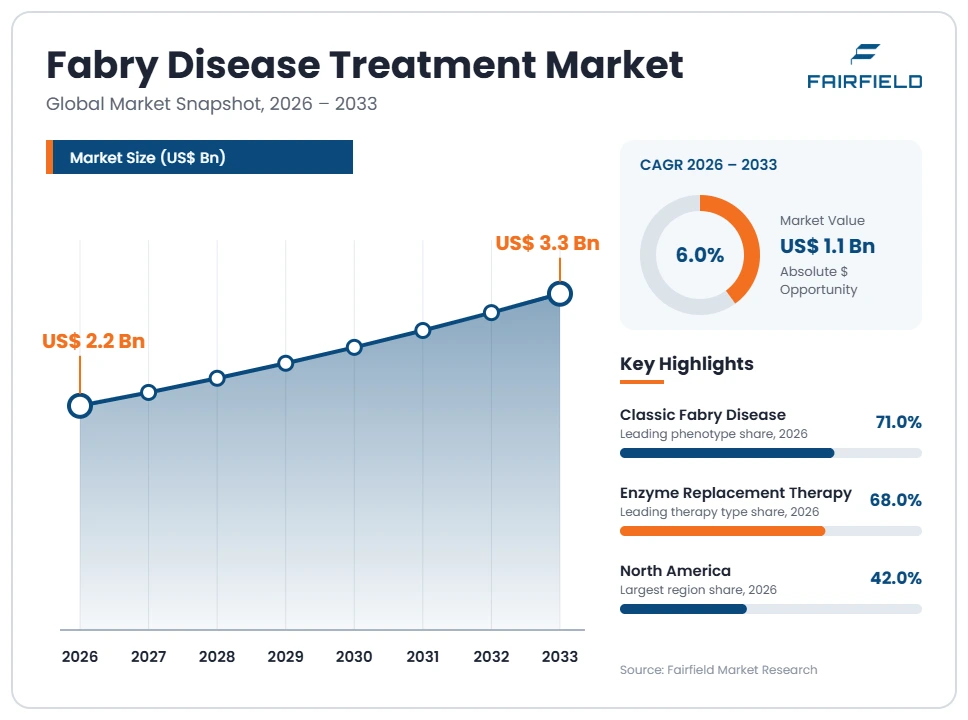
The global Fabry disease treatment market size is expected to be valued at US$ 2.2 billion in 2026 and projected to reach US$ 3.3 billion by 2033, growing at a CAGR of 6.0% between 2026 and 2033.
Between 2020 and 2025, the market expanded at an estimated 5.1% CAGR, as enzyme replacement therapy remained the backbone of care and oral chaperone therapy built a steady prescriber base. Three factors shape the 2026–2033 outlook. First, newborn screening and cascade family testing identify patients earlier, shortening a diagnostic delay that the clinical literature measures in years. Second, home infusion and specialty pharmacy networks improve treatment persistence across North America and Europe. Third, reimbursement for rare disease treatment is widening across Asia Pacific. Growth stays moderate rather than steep, because the diagnosed population is small and payers scrutinise every incremental cost per patient.
Key Report Takeaways
- By Therapy Type: Enzyme Replacement Therapy held 68% share in 2026, while Oral Chaperone Therapy is projected to expand at an 8.6% CAGR through 2033, driven by genotype testing that identifies amenable missense variants.
- By Disease Phenotype: Classic Fabry Disease held 71% share in 2026, while Later-Onset Fabry Disease is projected to expand at a 7.9% CAGR through 2033, as cardiac and renal screening uncovers previously unrecognised cases.
- By End User: Hospitals and Specialty Clinics held 52% share in 2026, while Homecare and Home Infusion Settings are projected to expand at an 8.4% CAGR through 2033, supported by nurse-administered infusion programmes.
- By Distribution Channel: Specialty Pharmacies held 49% share in 2026, while Online and Mail-Order Pharmacies are projected to expand at an 8.1% CAGR through 2033, because oral therapy suits direct-to-patient dispensing.
- By Geography: North America held 42% share in 2026, while Asia Pacific is projected to expand at an 8.4% CAGR through 2033, as national rare disease lists add lysosomal storage disorder therapies.
Global Fabry Disease Treatment Market Trends and Insights
Drivers Impact Analysis
Two forces explain most of the forecast growth in Fabry disease therapy demand.
| Driver | Impact on CAGR Forecast | Geographic Relevance | Impact Timeline |
| Earlier diagnosis through newborn screening and cascade family testing | High | North America, Europe, Asia Pacific | Medium term (2–4 years) |
| Migration of infused therapy into home and ambulatory settings | Medium | North America, Europe | Short term (≤2 years) |
Newborn Screening Programmes Shorten the Fabry Diagnostic Delay and Enlarge the Treated Pool
Earlier diagnosis is the single largest growth lever in Fabry disease treatment. Published case series consistently describe diagnostic delays measured in years, and many patients reach treatment only after irreversible renal or cardiac damage. Where Fabry disease has been added to newborn screening panels, far more infants with alpha-galactosidase A variants are identified than historical prevalence estimates predicted. Each confirmed index case then triggers cascade testing of relatives.
The causal mechanism is straightforward. Dried blood spot enzyme assays followed by confirmatory genetic sequencing are now inexpensive enough for population programmes, and several screening jurisdictions have adopted them. Cascade testing typically identifies several affected relatives per index case, including women who were once wrongly considered unaffected carriers. A larger confirmed patient register converts directly into prescription volume once treatment criteria are met.
Home Infusion and Specialty Pharmacy Networks Lift Treatment Persistence in Fabry Care
Delivery setting now influences Fabry revenue almost as much as diagnosis rates. Enzyme replacement therapy requires infusions roughly every two weeks for life, and hospital-based schedules impose a heavy burden on working patients. Programmes that move stable patients to supervised home infusion reduce missed doses, which protects the recurring revenue base and improves the clinical record supporting continued reimbursement.
The underlying change is operational rather than scientific. Specialty pharmacy networks, nurse-led infusion services and cold-chain distribution have matured around orphan drug portfolios, so payers increasingly accept home administration for patients with no history of infusion reactions. Oral chaperone therapy reinforces the same shift, because it removes the infusion visit entirely for eligible patients. Together these channels make long-term adherence more achievable in geographically dispersed rare disease populations, particularly in countries where treatment centres are concentrated in a handful of large cities.
Restraints Impact Analysis
Two structural constraints hold the growth rate well below that of larger specialty drug categories.
| Restraint | Impact on CAGR Forecast | Geographic Relevance | Impact Timeline |
| Payer scrutiny of six-figure annual therapy costs and future price erosion | High | North America, Europe | Medium term (2–4 years) |
| Very small diagnosed patient pools limiting trial recruitment and scale | Medium | Asia Pacific, Latin America, Middle East & Africa | Long term (≥4 years) |
Six-Figure Annual Therapy Costs Invite Payer Scrutiny of Fabry Treatment Budgets
Cost per patient, not patient numbers, decides most Fabry reimbursement debates. Annual treatment costs for approved therapies sit in the high six figures in several markets, so a single health plan with a handful of members can face a material budget line. Health technology assessment bodies in Europe and Canada have repeatedly questioned the strength of hard clinical endpoint evidence relative to that price.
The cost source is specific. Enzyme replacement therapy is a recombinant glycoprotein produced in mammalian cell culture, purified under strict glycosylation control, and supplied through a validated cold chain, which keeps the cost of goods and quality burden far above small-molecule norms. Managed entry agreements, outcome-based rebates and dose-optimisation protocols are now common. The eventual arrival of biosimilar enzyme products adds a further expectation of price erosion that tempers long-term revenue forecasts.
Small Diagnosed Patient Pools Constrain Trial Recruitment and Commercial Scale
The addressable population limits what any Fabry programme can earn. Reported prevalence varies widely by screening method, but confirmed and treated patients number only in the tens of thousands worldwide. Sales forces, distribution contracts and market access teams must therefore be funded from a narrow revenue base, which discourages entrants without an existing rare disease infrastructure.
The operational cause lies in trial design. Recruiting enough patients for an adequately powered study of renal or cardiac endpoints can take years and requires dozens of specialist centres across several continents. Regulators have responded by accepting surrogate endpoints and conditional pathways, yet confirmatory evidence obligations remain. Heterogeneous genotypes, variable phenotype severity and the ethical difficulty of placebo arms in a progressive lysosomal storage disorder all slow development further, and they raise the cost of every additional study a sponsor must fund.
Market Opportunities
Gene and Cell Therapy Candidates Open a Prospective One-Time Treatment Revenue Pool
Investigational gene and cell therapies represent the largest potential new revenue pool in Fabry disease. Several adeno-associated virus and lentiviral ex vivo approaches are in clinical development, each designed to give patients durable endogenous alpha-galactosidase A activity instead of lifelong infusions. None is curative or approved, and long-term durability data remain limited. If any candidate succeeds, pricing would likely follow the one-time, high-value model used for other genetic medicines.
Capture depends on infrastructure as much as science. Developers with viral vector manufacturing capacity, qualified treatment centres and experience negotiating outcome-based payment terms are best placed. Demand would come first from younger classic-phenotype patients facing decades of infusions, and from payers seeking an alternative to open-ended annual spending. Accelerated and conditional regulatory pathways give such candidates a realistic route to early market entry.
Undertreated Later-Onset and Female Patients Form an Addressable Fabry Revenue Pool
The untreated share of the diagnosed population is a sizeable and underexploited revenue pool. Historically, women with alpha-galactosidase A variants were described as carriers and often went untreated, although evidence now shows that many develop significant cardiac, renal and cerebrovascular disease. Later-onset cardiac variant patients were similarly missed because their presentation resembles common hypertrophic cardiomyopathy rather than classic Fabry disease.
Capturing this pool requires cardiology and nephrology engagement rather than conventional rare disease marketing. Enzyme testing within unexplained left ventricular hypertrophy cohorts, and within dialysis and transplant registries, reliably identifies cases that genetics clinics never see. Companies that fund such screening collaborations, support clinician education and publish natural history registries build the evidence base that payers require before approving treatment for less severely affected patients, and they shape the treatment criteria that follow.
Segment Analysis
- By Therapy Type: Enzyme Replacement Remains the Backbone While Oral Chaperone Therapy Gains Ground
Enzyme replacement therapy held 68% share of the Fabry disease treatment market in 2026, reflecting more than two decades of clinical use, established reimbursement and broad applicability across genotypes. It is the only option for patients whose variants are not amenable to chaperone binding, which is the majority of the classic phenotype. Oral Chaperone Therapy is the fastest-growing segment at an 8.6% CAGR through 2033, as routine genotyping identifies the amenable missense variants for which it is indicated and patients favour oral dosing over biweekly infusion.
Substrate Reduction Therapy and Gene and Cell Therapy remain developmental, with candidates in clinical trials rather than commercial supply. Adjunctive and Supportive Care, covering renal protection, antiarrhythmic management and pain control, stays clinically essential but contributes little branded revenue. The practical implication is that genotype testing has become a commercial gatekeeper, because it determines which therapy class a patient can even be considered for.
- By Disease Phenotype: Classic Fabry Disease Dominates as Later-Onset Cases Expand Faster
Classic Fabry Disease accounted for 71% of 2026 revenue, because these patients have negligible residual enzyme activity, present with early multisystem symptoms and meet treatment criteria without debate. Their lifelong therapy requirement gives the segment a predictable and durable revenue profile across North America and Europe.
Later-Onset Fabry Disease is growing faster, at a 7.9% CAGR through 2033. Cardiac and renal variant patients are increasingly found through enzyme and genetic testing in hypertrophic cardiomyopathy clinics, dialysis units and unexplained stroke workups. Newborn screening data suggest later-onset variants are considerably more common than classic disease, so the diagnosed base keeps widening.
Treatment decisions in this group are less clear-cut, and several health systems require documented organ involvement before funding therapy. That evidence requirement makes registry participation and biomarker monitoring commercially important for manufacturers serving this phenotype.
- By End User: Hospitals and Specialty Clinics Lead While Home Infusion Settings Accelerate
Hospitals and Specialty Clinics held 52% share in 2026, because initial diagnosis, genotype confirmation, first infusions and infusion-reaction management all occur in supervised settings. Academic lysosomal storage disorder centres also run the registries and multidisciplinary clinics that national reimbursement schemes expect.
Homecare and Home Infusion Settings form the fastest-growing end user segment at an 8.4% CAGR through 2033. Stable patients with no reaction history can be transitioned to nurse-administered home infusion, which removes travel burden and improves adherence over a treatment horizon measured in decades. Ambulatory Infusion Centres take a smaller intermediate share, serving patients who need supervision without hospital admission.
For manufacturers, the shift changes service economics. Nursing networks, cold-chain logistics and remote monitoring become part of the value proposition, and payers increasingly treat home delivery as a condition of continued funding rather than a convenience.
- By Distribution Channel: Specialty Pharmacies Hold the Core as Mail-Order Dispensing Expands
Specialty Pharmacies held 49% share in 2026 and remain the default channel for orphan drug products requiring prior authorisation, temperature-controlled handling and patient support programmes. They also run the benefit investigation and copay assistance functions that determine whether a prescription converts into a dispensed course.
Online and Mail-Order Pharmacies are the fastest-growing channel at an 8.1% CAGR through 2033, driven almost entirely by oral chaperone therapy, which needs no infusion appointment and travels well by courier. Hospital Pharmacies retain a large share tied to inpatient and clinic-administered infusions, while Retail Pharmacies play only a marginal role in this category.
The commercial implication is channel concentration. A small number of specialty distributors control access to most treated patients, giving them meaningful influence over launch sequencing, data reporting and net price realisation.
Geography Analysis
- Which Region Is Leading the Fabry Disease Treatment Market?
North America leads the Fabry disease treatment market with 42% share in 2026, because it combines early diagnosis, broad reimbursement and the highest realised prices. The United States supplies most of that value, supported by the Orphan Drug Act incentive framework, established specialty pharmacy infrastructure and a dense network of genetics and metabolic centres. Canada adds a smaller but stable contribution through provincial rare disease funding arrangements.
Several US states have added Fabry disease to newborn screening panels, which steadily increases the confirmed patient register. Commercial and Medicaid plans nonetheless apply strict prior authorisation and periodic reauthorisation based on documented organ involvement.
The main change shaping the region is cost containment. Payers are building outcome-linked contracts and preparing for lower-cost enzyme alternatives, which may moderate revenue per patient even as the treated population grows.
- Europe Converts Orphan Regulation Incentives Into Broad Fabry Treatment Access
Europe held 34% of global revenue in 2026, the second largest position, built on centralised marketing authorisation and the ten-year market exclusivity granted under Regulation (EC) No 141/2000. Germany, France, Italy, Spain and the United Kingdom account for most spending, each operating designated lysosomal storage disorder centres with structured patient registries.
Access is wide but price discipline is firm. National health technology assessment bodies negotiate confidential discounts, and several require registry enrolment as a funding condition. The European Commission proposal to revise the general pharmaceutical legislation, which would restructure orphan market exclusivity, is an active policy debate for developers planning European launches.
The region’s principal opportunity lies in cardiology-led case finding. Screening within hypertrophic cardiomyopathy cohorts has repeatedly uncovered later-onset patients who never reached a genetics clinic.
- Which Region Is Growing Fastest in the Fabry Disease Treatment Market?
Asia Pacific is growing fastest in the Fabry disease treatment market, at an 8.4% CAGR between 2026 and 2033, from a 17% share in 2026. Japan has the longest-established treatment and reimbursement framework, with national coverage for designated intractable diseases. China has expanded access by adding rare disease therapies to its national reimbursement list, while South Korea, Australia and Taiwan fund treatment through dedicated rare disease schemes.
Taiwan is widely cited in the clinical literature for population newborn screening that detected later-onset cardiac variants at rates far above earlier prevalence estimates. India remains largely out-of-pocket, with access limited to a few metropolitan centres and charitable programmes.
The regional opportunity is diagnostic capacity. Expanding enzyme assay and sequencing availability in tier-two cities would convert a large undiagnosed population into treatable patients.
- Latin America Builds Fabry Access Through Public Funding and Court-Driven Claims
Latin America contributed 4% of global revenue in 2026, with Brazil, Argentina, Mexico and Colombia accounting for most treated patients. Brazil has the region’s most developed framework, combining public rare disease protocols with reference centres in major university hospitals.
The main barriers are budgetary and administrative. Public payers face currency exposure on imported biologics, and funding decisions are frequently resolved through litigation rather than standing coverage policy, which makes volumes unpredictable for suppliers. Diagnostic capacity outside large cities is limited, so many patients are identified late.
One constructive change is regional registry development. Collaborative patient registries across several countries are improving epidemiological evidence, which strengthens the case for structured reimbursement and reduces reliance on case-by-case judicial awards.
- Middle East & Africa Depends on National Rare Disease Programmes for Fabry Therapy Funding
Middle East & Africa represented 3% of global revenue in 2026, the smallest regional pool. Saudi Arabia, the United Arab Emirates, Israel and Qatar account for most treated patients, funded through national health programmes that cover high-cost therapies for citizens. Israel has well-developed genetics services and an established treated cohort.
Barriers are severe elsewhere. Across most of Africa, enzyme testing and genetic sequencing are unavailable outside a few referral hospitals in South Africa and Egypt, so Fabry disease is rarely diagnosed and often misattributed to more common renal or cardiac conditions.
The clearest opportunity is Gulf health system investment. Precision medicine and national genome programmes are expanding sequencing capacity, which should raise diagnosis rates and create a modest but reliable treated population.
Competitive Landscape
The Fabry disease treatment market is highly concentrated. A small number of companies supply nearly all commercial volume, a structure typical of orphan indications where market exclusivity, specialised manufacturing and tiny patient pools deter entry. Sanofi and Takeda Pharmaceutical Company anchor the infused enzyme category, Amicus Therapeutics built its position around oral chaperone therapy for amenable variants, and Chiesi Farmaceutici, JCR Pharmaceuticals and Protalix BioTherapeutics hold more regionally defined positions. Consolidation has been limited, because the therapeutic area is too small to justify large transactions on its own.
Competition turns on a narrow set of factors. The first is genotype amenability, since the testing result decides which therapy class a patient can receive. The second is tolerability and immunogenicity, because anti-drug antibody formation affects long-term response to infused enzyme. The third is service wrap: infusion nursing, home delivery, adherence support and registry data collection. Price matters less than in common disease categories but is rising in importance as payers prepare for follow-on enzyme products. New entrants are arriving mainly from gene and cell therapy, with Sangamo Therapeutics and 4D Molecular Therapeutics among the developers pursuing durable enzyme expression.
Strategic activity concentrates on evidence generation rather than commercial expansion. Companies invest in long-running patient registries, natural history studies and investigator collaborations, because payers in Europe and North America increasingly condition funding on documented clinical outcomes. Regional licensing partnerships are the preferred route into Asia Pacific and Latin America, where local regulatory and reimbursement navigation matters more than scale.
Strategic direction across the field points three ways: broadening the treated population through cardiology and nephrology case finding, reducing treatment burden through less frequent or oral administration, and preparing for a future in which durable one-time therapies and lower-cost enzyme alternatives coexist with established products.
Recent Industry Developments
- January 1983: The United States enacted the Orphan Drug Act, creating tax credits, fee waivers and seven-year market exclusivity that made small lysosomal storage disorder populations commercially viable to serve.
- January 2000: Regulation (EC) No 141/2000 on orphan medicinal products entered into force in the European Union, granting ten-year market exclusivity and protocol assistance that underpin current Fabry therapy economics.
- December 2022: The United States enacted the Food and Drug Omnibus Reform Act, tightening confirmatory trial obligations and withdrawal procedures for products cleared through accelerated approval using surrogate endpoints.
- April 2023: The European Commission published its proposal to revise the general pharmaceutical legislation, including changes to orphan market exclusivity that remain under negotiation and affect long-range rare disease planning.
Companies Covered in the Report
- Sanofi
- Takeda Pharmaceutical Company
- Amicus Therapeutics
- Chiesi Farmaceutici
- JCR Pharmaceuticals
- Protalix BioTherapeutics
- Sangamo Therapeutics
- 4D Molecular Therapeutics
- Idorsia Pharmaceuticals
- Isu Abxis
Fabry Disease Treatment Market Report Scope
| Metric | Value |
| Study Period | 2020–2033 |
| Market Size 2026 | US$ 2.2 Billion |
| Market Size 2033 | US$ 3.3 Billion |
| CAGR 2026–2033 | 6.0% |
| Absolute Dollar Opportunity | US$ 1.1 Billion |
| Largest Market | North America, 42% share in 2026 |
| Fastest-Growing Market | Asia Pacific, 8.4% CAGR 2026–2033 |
| Market Concentration | High |
| Major Players | Sanofi, Takeda Pharmaceutical Company, Amicus Therapeutics, Chiesi Farmaceutici, JCR Pharmaceuticals |
Fabry Disease Treatment Market Segmentation
Therapy Type
- Enzyme Replacement Therapy
- Oral Chaperone Therapy
- Substrate Reduction Therapy
- Gene and Cell Therapy
- Adjunctive and Supportive Care
Disease Phenotype
- Classic Fabry Disease
- Later-Onset Fabry Disease
End User
- Hospitals and Specialty Clinics
- Ambulatory Infusion Centres
- Homecare and Home Infusion Settings
Distribution Channel
- Specialty Pharmacies
- Hospital Pharmacies
- Retail Pharmacies
- Online and Mail-Order Pharmacies
Regions
- North America
- Europe
- Asia Pacific
- Latin America
- Middle East & Africa
- Executive Summary
- Global Fabry Disease Treatment Market Snapshot
- Future Projections
- Key Report Takeaways
- Regional Snapshot
- Market Overview
- Market Definition and Report Scope
- Historical Trends 2020–2025
- Market Dynamics
- Drivers
- Newborn Screening Programmes Shorten the Fabry Diagnostic Delay and Enlarge the Treated Pool
- Home Infusion and Specialty Pharmacy Networks Lift Treatment Persistence in Fabry Care
- Restraints
- Six-Figure Annual Therapy Costs Invite Payer Scrutiny of Fabry Treatment Budgets
- Small Diagnosed Patient Pools Constrain Trial Recruitment and Commercial Scale
- Market Opportunities
- Gene and Cell Therapy Candidates Open a Prospective One-Time Treatment Revenue Pool
- Undertreated Later-Onset and Female Patients Form an Addressable Fabry Revenue Pool
- Drivers
- Global Fabry Disease Treatment Market Outlook, 2020–2033
- Global Fabry Disease Treatment Market Outlook, by Therapy Type, Value (US$ Billion), 2020–2033
- Enzyme Replacement Therapy
- Oral Chaperone Therapy
- Substrate Reduction Therapy
- Gene and Cell Therapy
- Adjunctive and Supportive Care
- Global Fabry Disease Treatment Market Outlook, by Disease Phenotype, Value (US$ Billion), 2020–2033
- Classic Fabry Disease
- Later-Onset Fabry Disease
- Global Fabry Disease Treatment Market Outlook, by End User, Value (US$ Billion), 2020–2033
- Hospitals and Specialty Clinics
- Ambulatory Infusion Centres
- Homecare and Home Infusion Settings
- Global Fabry Disease Treatment Market Outlook, by Distribution Channel, Value (US$ Billion), 2020–2033
- Specialty Pharmacies
- Hospital Pharmacies
- Retail Pharmacies
- Online and Mail-Order Pharmacies
- Global Fabry Disease Treatment Market Outlook, by Region, Value (US$ Billion), 2020–2033
- North America
- Europe
- Asia Pacific
- Latin America
- Middle East & Africa
- Global Fabry Disease Treatment Market Outlook, by Therapy Type, Value (US$ Billion), 2020–2033
- North America Fabry Disease Treatment Market Outlook, 2020–2033
- North America Fabry Disease Treatment Market Outlook, by Therapy Type, Value (US$ Billion), 2020–2033
- Enzyme Replacement Therapy
- Oral Chaperone Therapy
- Substrate Reduction Therapy
- Gene and Cell Therapy
- Adjunctive and Supportive Care
- North America Fabry Disease Treatment Market Outlook, by Disease Phenotype, Value (US$ Billion), 2020–2033
- Classic Fabry Disease
- Later-Onset Fabry Disease
- North America Fabry Disease Treatment Market Outlook, by End User, Value (US$ Billion), 2020–2033
- Hospitals and Specialty Clinics
- Ambulatory Infusion Centres
- Homecare and Home Infusion Settings
- North America Fabry Disease Treatment Market Outlook, by Distribution Channel, Value (US$ Billion), 2020–2033
- Specialty Pharmacies
- Hospital Pharmacies
- Retail Pharmacies
- Online and Mail-Order Pharmacies
- North America Fabry Disease Treatment Market Outlook, by Country, Value (US$ Billion), 2020–2033
- United States Fabry Disease Treatment Market Outlook, by Therapy Type, 2020–2033
- United States Fabry Disease Treatment Market Outlook, by Disease Phenotype, 2020–2033
- United States Fabry Disease Treatment Market Outlook, by End User, 2020–2033
- United States Fabry Disease Treatment Market Outlook, by Distribution Channel, 2020–2033
- Canada Fabry Disease Treatment Market Outlook, by Therapy Type, 2020–2033
- Canada Fabry Disease Treatment Market Outlook, by Disease Phenotype, 2020–2033
- Canada Fabry Disease Treatment Market Outlook, by End User, 2020–2033
- Canada Fabry Disease Treatment Market Outlook, by Distribution Channel, 2020–2033
- North America Fabry Disease Treatment Market Outlook, by Therapy Type, Value (US$ Billion), 2020–2033
- Europe Fabry Disease Treatment Market Outlook, 2020–2033
- Europe Fabry Disease Treatment Market Outlook, by Therapy Type, Value (US$ Billion), 2020–2033
- Enzyme Replacement Therapy
- Oral Chaperone Therapy
- Substrate Reduction Therapy
- Gene and Cell Therapy
- Adjunctive and Supportive Care
- Europe Fabry Disease Treatment Market Outlook, by Disease Phenotype, Value (US$ Billion), 2020–2033
- Classic Fabry Disease
- Later-Onset Fabry Disease
- Europe Fabry Disease Treatment Market Outlook, by End User, Value (US$ Billion), 2020–2033
- Hospitals and Specialty Clinics
- Ambulatory Infusion Centres
- Homecare and Home Infusion Settings
- Europe Fabry Disease Treatment Market Outlook, by Distribution Channel, Value (US$ Billion), 2020–2033
- Specialty Pharmacies
- Hospital Pharmacies
- Retail Pharmacies
- Online and Mail-Order Pharmacies
- Europe Fabry Disease Treatment Market Outlook, by Country, Value (US$ Billion), 2020–2033
- Germany Fabry Disease Treatment Market Outlook, by Therapy Type, 2020–2033
- Germany Fabry Disease Treatment Market Outlook, by Disease Phenotype, 2020–2033
- Germany Fabry Disease Treatment Market Outlook, by End User, 2020–2033
- Germany Fabry Disease Treatment Market Outlook, by Distribution Channel, 2020–2033
- France Fabry Disease Treatment Market Outlook, by Therapy Type, 2020–2033
- France Fabry Disease Treatment Market Outlook, by Disease Phenotype, 2020–2033
- France Fabry Disease Treatment Market Outlook, by End User, 2020–2033
- France Fabry Disease Treatment Market Outlook, by Distribution Channel, 2020–2033
- Italy Fabry Disease Treatment Market Outlook, by Therapy Type, 2020–2033
- Italy Fabry Disease Treatment Market Outlook, by Disease Phenotype, 2020–2033
- Italy Fabry Disease Treatment Market Outlook, by End User, 2020–2033
- Italy Fabry Disease Treatment Market Outlook, by Distribution Channel, 2020–2033
- Spain Fabry Disease Treatment Market Outlook, by Therapy Type, 2020–2033
- Spain Fabry Disease Treatment Market Outlook, by Disease Phenotype, 2020–2033
- Spain Fabry Disease Treatment Market Outlook, by End User, 2020–2033
- Spain Fabry Disease Treatment Market Outlook, by Distribution Channel, 2020–2033
- United Kingdom Fabry Disease Treatment Market Outlook, by Therapy Type, 2020–2033
- United Kingdom Fabry Disease Treatment Market Outlook, by Disease Phenotype, 2020–2033
- United Kingdom Fabry Disease Treatment Market Outlook, by End User, 2020–2033
- United Kingdom Fabry Disease Treatment Market Outlook, by Distribution Channel, 2020–2033
- Europe Fabry Disease Treatment Market Outlook, by Therapy Type, Value (US$ Billion), 2020–2033
- Asia Pacific Fabry Disease Treatment Market Outlook, 2020–2033
- Asia Pacific Fabry Disease Treatment Market Outlook, by Therapy Type, Value (US$ Billion), 2020–2033
- Enzyme Replacement Therapy
- Oral Chaperone Therapy
- Substrate Reduction Therapy
- Gene and Cell Therapy
- Adjunctive and Supportive Care
- Asia Pacific Fabry Disease Treatment Market Outlook, by Disease Phenotype, Value (US$ Billion), 2020–2033
- Classic Fabry Disease
- Later-Onset Fabry Disease
- Asia Pacific Fabry Disease Treatment Market Outlook, by End User, Value (US$ Billion), 2020–2033
- Hospitals and Specialty Clinics
- Ambulatory Infusion Centres
- Homecare and Home Infusion Settings
- Asia Pacific Fabry Disease Treatment Market Outlook, by Distribution Channel, Value (US$ Billion), 2020–2033
- Specialty Pharmacies
- Hospital Pharmacies
- Retail Pharmacies
- Online and Mail-Order Pharmacies
- Asia Pacific Fabry Disease Treatment Market Outlook, by Country, Value (US$ Billion), 2020–2033
- Japan Fabry Disease Treatment Market Outlook, by Therapy Type, 2020–2033
- Japan Fabry Disease Treatment Market Outlook, by Disease Phenotype, 2020–2033
- Japan Fabry Disease Treatment Market Outlook, by End User, 2020–2033
- Japan Fabry Disease Treatment Market Outlook, by Distribution Channel, 2020–2033
- China Fabry Disease Treatment Market Outlook, by Therapy Type, 2020–2033
- China Fabry Disease Treatment Market Outlook, by Disease Phenotype, 2020–2033
- China Fabry Disease Treatment Market Outlook, by End User, 2020–2033
- China Fabry Disease Treatment Market Outlook, by Distribution Channel, 2020–2033
- South Korea Fabry Disease Treatment Market Outlook, by Therapy Type, 2020–2033
- South Korea Fabry Disease Treatment Market Outlook, by Disease Phenotype, 2020–2033
- South Korea Fabry Disease Treatment Market Outlook, by End User, 2020–2033
- South Korea Fabry Disease Treatment Market Outlook, by Distribution Channel, 2020–2033
- Australia Fabry Disease Treatment Market Outlook, by Therapy Type, 2020–2033
- Australia Fabry Disease Treatment Market Outlook, by Disease Phenotype, 2020–2033
- Australia Fabry Disease Treatment Market Outlook, by End User, 2020–2033
- Australia Fabry Disease Treatment Market Outlook, by Distribution Channel, 2020–2033
- Taiwan Fabry Disease Treatment Market Outlook, by Therapy Type, 2020–2033
- Taiwan Fabry Disease Treatment Market Outlook, by Disease Phenotype, 2020–2033
- Taiwan Fabry Disease Treatment Market Outlook, by End User, 2020–2033
- Taiwan Fabry Disease Treatment Market Outlook, by Distribution Channel, 2020–2033
- India Fabry Disease Treatment Market Outlook, by Therapy Type, 2020–2033
- India Fabry Disease Treatment Market Outlook, by Disease Phenotype, 2020–2033
- India Fabry Disease Treatment Market Outlook, by End User, 2020–2033
- India Fabry Disease Treatment Market Outlook, by Distribution Channel, 2020–2033
- Asia Pacific Fabry Disease Treatment Market Outlook, by Therapy Type, Value (US$ Billion), 2020–2033
- Latin America Fabry Disease Treatment Market Outlook, 2020–2033
- Latin America Fabry Disease Treatment Market Outlook, by Therapy Type, Value (US$ Billion), 2020–2033
- Enzyme Replacement Therapy
- Oral Chaperone Therapy
- Substrate Reduction Therapy
- Gene and Cell Therapy
- Adjunctive and Supportive Care
- Latin America Fabry Disease Treatment Market Outlook, by Disease Phenotype, Value (US$ Billion), 2020–2033
- Classic Fabry Disease
- Later-Onset Fabry Disease
- Latin America Fabry Disease Treatment Market Outlook, by End User, Value (US$ Billion), 2020–2033
- Hospitals and Specialty Clinics
- Ambulatory Infusion Centres
- Homecare and Home Infusion Settings
- Latin America Fabry Disease Treatment Market Outlook, by Distribution Channel, Value (US$ Billion), 2020–2033
- Specialty Pharmacies
- Hospital Pharmacies
- Retail Pharmacies
- Online and Mail-Order Pharmacies
- Latin America Fabry Disease Treatment Market Outlook, by Country, Value (US$ Billion), 2020–2033
- Brazil Fabry Disease Treatment Market Outlook, by Therapy Type, 2020–2033
- Brazil Fabry Disease Treatment Market Outlook, by Disease Phenotype, 2020–2033
- Brazil Fabry Disease Treatment Market Outlook, by End User, 2020–2033
- Brazil Fabry Disease Treatment Market Outlook, by Distribution Channel, 2020–2033
- Argentina Fabry Disease Treatment Market Outlook, by Therapy Type, 2020–2033
- Argentina Fabry Disease Treatment Market Outlook, by Disease Phenotype, 2020–2033
- Argentina Fabry Disease Treatment Market Outlook, by End User, 2020–2033
- Argentina Fabry Disease Treatment Market Outlook, by Distribution Channel, 2020–2033
- Mexico Fabry Disease Treatment Market Outlook, by Therapy Type, 2020–2033
- Mexico Fabry Disease Treatment Market Outlook, by Disease Phenotype, 2020–2033
- Mexico Fabry Disease Treatment Market Outlook, by End User, 2020–2033
- Mexico Fabry Disease Treatment Market Outlook, by Distribution Channel, 2020–2033
- Colombia Fabry Disease Treatment Market Outlook, by Therapy Type, 2020–2033
- Colombia Fabry Disease Treatment Market Outlook, by Disease Phenotype, 2020–2033
- Colombia Fabry Disease Treatment Market Outlook, by End User, 2020–2033
- Colombia Fabry Disease Treatment Market Outlook, by Distribution Channel, 2020–2033
- Latin America Fabry Disease Treatment Market Outlook, by Therapy Type, Value (US$ Billion), 2020–2033
- Middle East & Africa Fabry Disease Treatment Market Outlook, 2020–2033
- Middle East & Africa Fabry Disease Treatment Market Outlook, by Therapy Type, Value (US$ Billion), 2020–2033
- Enzyme Replacement Therapy
- Oral Chaperone Therapy
- Substrate Reduction Therapy
- Gene and Cell Therapy
- Adjunctive and Supportive Care
- Middle East & Africa Fabry Disease Treatment Market Outlook, by Disease Phenotype, Value (US$ Billion), 2020–2033
- Classic Fabry Disease
- Later-Onset Fabry Disease
- Middle East & Africa Fabry Disease Treatment Market Outlook, by End User, Value (US$ Billion), 2020–2033
- Hospitals and Specialty Clinics
- Ambulatory Infusion Centres
- Homecare and Home Infusion Settings
- Middle East & Africa Fabry Disease Treatment Market Outlook, by Distribution Channel, Value (US$ Billion), 2020–2033
- Specialty Pharmacies
- Hospital Pharmacies
- Retail Pharmacies
- Online and Mail-Order Pharmacies
- Middle East & Africa Fabry Disease Treatment Market Outlook, by Country, Value (US$ Billion), 2020–2033
- Saudi Arabia Fabry Disease Treatment Market Outlook, by Therapy Type, 2020–2033
- Saudi Arabia Fabry Disease Treatment Market Outlook, by Disease Phenotype, 2020–2033
- Saudi Arabia Fabry Disease Treatment Market Outlook, by End User, 2020–2033
- Saudi Arabia Fabry Disease Treatment Market Outlook, by Distribution Channel, 2020–2033
- United Arab Emirates Fabry Disease Treatment Market Outlook, by Therapy Type, 2020–2033
- United Arab Emirates Fabry Disease Treatment Market Outlook, by Disease Phenotype, 2020–2033
- United Arab Emirates Fabry Disease Treatment Market Outlook, by End User, 2020–2033
- United Arab Emirates Fabry Disease Treatment Market Outlook, by Distribution Channel, 2020–2033
- Israel Fabry Disease Treatment Market Outlook, by Therapy Type, 2020–2033
- Israel Fabry Disease Treatment Market Outlook, by Disease Phenotype, 2020–2033
- Israel Fabry Disease Treatment Market Outlook, by End User, 2020–2033
- Israel Fabry Disease Treatment Market Outlook, by Distribution Channel, 2020–2033
- Qatar Fabry Disease Treatment Market Outlook, by Therapy Type, 2020–2033
- Qatar Fabry Disease Treatment Market Outlook, by Disease Phenotype, 2020–2033
- Qatar Fabry Disease Treatment Market Outlook, by End User, 2020–2033
- Qatar Fabry Disease Treatment Market Outlook, by Distribution Channel, 2020–2033
- South Africa Fabry Disease Treatment Market Outlook, by Therapy Type, 2020–2033
- South Africa Fabry Disease Treatment Market Outlook, by Disease Phenotype, 2020–2033
- South Africa Fabry Disease Treatment Market Outlook, by End User, 2020–2033
- South Africa Fabry Disease Treatment Market Outlook, by Distribution Channel, 2020–2033
- Egypt Fabry Disease Treatment Market Outlook, by Therapy Type, 2020–2033
- Egypt Fabry Disease Treatment Market Outlook, by Disease Phenotype, 2020–2033
- Egypt Fabry Disease Treatment Market Outlook, by End User, 2020–2033
- Egypt Fabry Disease Treatment Market Outlook, by Distribution Channel, 2020–2033
- Middle East & Africa Fabry Disease Treatment Market Outlook, by Therapy Type, Value (US$ Billion), 2020–2033
- Competitive Landscape
- Market Concentration and Industry Leaders
- Competitive Differentiation
- Strategic Moves and Market Direction
- Recent Industry Developments
- Company Profiles
- Sanofi
- Takeda Pharmaceutical Company
- Amicus Therapeutics
- Chiesi Farmaceutici
- JCR Pharmaceuticals
- Protalix BioTherapeutics
- Sangamo Therapeutics
- 4D Molecular Therapeutics
- Idorsia Pharmaceuticals
- Isu Abxis
- Appendix
- Research Methodology
- Report Assumptions
- Acronyms and Abbreviations
Therapy Type
- Enzyme Replacement Therapy
- Oral Chaperone Therapy
- Substrate Reduction Therapy
- Gene and Cell Therapy
- Adjunctive and Supportive Care
Disease Phenotype
- Classic Fabry Disease
- Later-Onset Fabry Disease
End User
- Hospitals and Specialty Clinics
- Ambulatory Infusion Centres
- Homecare and Home Infusion Settings
Distribution Channel
- Specialty Pharmacies
- Hospital Pharmacies
- Retail Pharmacies
- Online and Mail-Order Pharmacies
Regions
- North America
- Europe
- Asia Pacific
- Latin America
- Middle East & Africa
Our Research Methodology
Considering the volatility of business today, traditional approaches to strategizing a game plan can be unfruitful if not detrimental. True ambiguity is no way to determine a forecast. A myriad of predetermined factors must be accounted for such as the degree of risk involved, the magnitude of circumstances, as well as conditions or consequences that are not known or unpredictable. To circumvent binary views that cast uncertainty, the application of market research intelligence to strategically posture, move, and enable actionable outcomes is necessary.
View Methodology
Quality Assured
Rigorous Validation Process

Confidentiality Assured
End-to-end Data Security

Custom Research Services
Tailored To Your Objectives
FAQs
The Fabry disease treatment market is valued at US$ 2.2 billion in 2026, reflecting a small diagnosed population treated with very high-cost therapies.
The market is projected to reach US$ 3.3 billion by 2033, growing at a 6.0% CAGR and adding US$ 1.1 billion in absolute opportunity.
Enzyme Replacement Therapy leads with 68% share in 2026, because it suits all genotypes and has the longest record of reimbursed clinical use.
Oral Chaperone Therapy grows fastest among therapies at 8.6% CAGR, while Asia Pacific leads regional growth at 8.4% CAGR through 2033.
North America holds 42% share in 2026, supported by orphan drug incentives, early diagnosis programmes and broad specialty pharmacy reimbursement coverage.
Related Reports
Fluoroquinolones Market Size, Share, Insights, Competitive Landscape, and Forecast 2026 to 2033
The global fluoroquinolones market is valued at US$9.4 billion in 2026, reaching US$10.6 billion by 2033, growing at a 1.73% CAGR
gRNA Market Size, Share, Insights, Competitive Landscape, and Forecast 2026 to 2033
The global gRNA market is valued at US$0.40 billion in 2026, reaching US$0.90 billion by 2033, growing at a 12.3% CAGR
Pharmaceutical Glass Ampoules Market Size, Share, Insights, Competitive Landscape, and Forecast 2026 to 2033
The global pharmaceutical glass ampoules market is valued at US$1.4 billion in 2026, reaching US$1.9 billion by 2033, growing at a 4.5% CAGR
Mouth Ulcers Treatment Market Size, Share, Insights, Competitive Landscape, and Forecast 2026 to 2033
The global mouth ulcers treatment market is valued at US$1.2 billion in 2026, reaching US$1.7 billion by 2033, growing at a 5.1% CAGR
Mouth Ulcers Treatment Market Size, Share, Insights, Competitive Landscape, and Forecast 2026 to 2033
The global mouth ulcers treatment market is valued at US$1.2 billion in 2026, reaching US$1.7 billion by 2033, growing at a 5.1% CAGR
Ayurveda Medicine Market Size, Share, Insights, Competitive Landscape, and Forecast 2026 to 2033
The global ayurveda medicine market is valued at US$14.8 billion in 2026, reaching US$27.8 billion by 2033, growing at a 9.4% CAGR