



Pharmaceutical Glass Ampoules Market
Pharmaceutical Glass Ampoules Market Size, Share, Insights, Competitive Landscape, and Forecast 2026 to 2033
Pharmaceutical Glass Ampoules Market Size and Trend Analysis
How Big Is the Pharmaceutical Glass Ampoules Market?
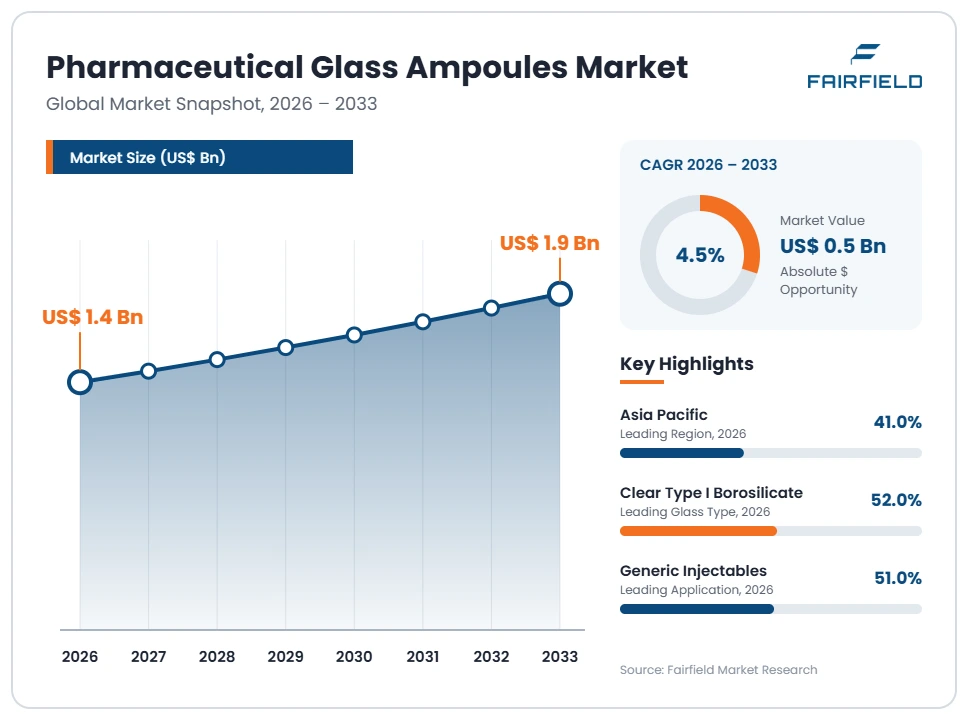
The global Pharmaceutical Glass Ampoules market size is expected to be valued at US$ 1.4 billion in 2026 and projected to reach US$ 1.9 billion by 2033, growing at a CAGR of 4.5% between 2026 and 2033.
The category grew at a slower 3.4% CAGR between 2020 and 2025, reaching roughly US$ 1,340 million in 2025. Growth now rests on three specific factors. Generic injectable output in India, China and Brazil keeps consuming high unit volumes of low-cost sealed containers. Revised sterile manufacturing rules reward the fusion-sealed format, which has no elastomeric closure to test. Veterinary and emergency medicines continue to specify ampoules for shelf stability. Direction is clear and two-sided: unit volumes rise in cost-led markets, while developed-market share drifts toward vials and prefilled syringes. The result is a mature primary pharmaceutical packaging category with modest value growth and a shrinking premium tier.
Key Report Takeaways
- By Product Type: Open-funnel ampoules held 44% share in 2026, while colour-break ring ampoules are projected to expand at a 6.3% CAGR through 2033, driven by filling lines that reject ceramic-marked opening systems on particulate grounds.
- By Capacity: The up to 2 mL range held 38% share in 2026, while the 5–10 mL range is projected to expand at a 5.9% CAGR through 2033, driven by higher-volume veterinary and anaesthetic presentations.
- By Glass Type: Clear Type I borosilicate held 52% share in 2026, while amber Type I borosilicate is projected to expand at a 5.6% CAGR through 2033, driven by light-sensitive cytotoxic and vitamin formulations.
- By Application: Generic injectables held 51% share in 2026, while cosmetic and nutraceutical preparations are projected to expand at a 7.1% CAGR through 2033, driven by single-dose serum formats sold outside pharmacy channels.
- By Geography: Asia Pacific held 41% share in 2026, while Middle East & Africa is projected to expand at a 6.4% CAGR through 2033, driven by new regional fill-finish capacity for essential medicines.
Global Pharmaceutical Glass Ampoules Market Trends and Insights
Drivers Impact Analysis
Two forces explain most of the forecast growth in sealed single-dose glass containers for injectables.
| Driver | Impact on CAGR Forecast | Geographic Relevance | Impact Timeline |
| Generic injectable volume growth in cost-led health systems | High | Asia Pacific, Latin America, Middle East & Africa | Long term (≥4 years) |
| Sterile manufacturing rules that favour fusion-sealed containers | Medium | Europe, North America | Medium term (2–4 years) |
Generic Injectable Output in Cost-Led Health Systems Keeps Ampoule Unit Volumes Rising
Generic injectable manufacturing is the single largest demand source for glass ampoules, and it is concentrated where cost per sealed dose decides the packaging choice. Public tenders in India, Indonesia, Egypt and Brazil award large contracts for anaesthetics, analgesics, antibiotics and electrolyte solutions. For these products the ampoule remains the cheapest hermetic container available, typically a fraction of the delivered cost of a stoppered vial. High unit counts therefore offset flat or falling prices per piece.
The causal mechanism is procurement arithmetic rather than technology. A vial requires a rubber stopper, an aluminium seal and a capping step, each adding components, suppliers and inspection points. An ampoule needs only glass and a flame. World Health Organization essential medicines lists keep many of these molecules in continuous production, so converters near filling sites run tubing-to-ampoule lines at steady utilisation.
Revised Sterile Manufacturing Rules Reward the Fusion-Sealed Ampoule Format
Container closure integrity expectations under revised European sterile manufacturing rules have improved the technical standing of ampoules on regulated lines. A flame-sealed ampoule forms a continuous glass boundary with no elastomeric interface, so it avoids stopper reseal, coring and crimp-torque failure modes. Validation teams can demonstrate integrity with deterministic methods such as helium leak or high-voltage leak detection. That simplifies the contamination control strategy documentation that inspectors now expect.
The underlying change is procedural. The revised EU GMP Annex 1 on sterile medicinal products requires a documented contamination control strategy and discourages reliance on probabilistic integrity testing. Fully sealed glass units also suit restricted access barrier systems and isolator-based filling, since no closure feeding is needed. For older small-volume parenteral products already registered in ampoules, retaining the format avoids a comparability and stability package.
Restraints Impact Analysis
Two structural limits cap value growth in the sterile parenteral packaging niche that ampoules occupy.
| Restraint | Impact on CAGR Forecast | Geographic Relevance | Impact Timeline |
| Substitution by vials and prefilled syringes in developed markets | High | North America, Europe | Long term (≥4 years) |
| Glass particulate and sharps exposure at the point of opening | Medium | Global | Short term (≤2 years) |
Vial and Prefilled Syringe Substitution Erodes Ampoule Share Across Developed Markets
Format substitution is the main reason ampoule value grows slowly in North America and Europe. Hospital pharmacy and anaesthesia groups have steadily moved high-use molecules into ready-to-administer prefilled syringes and stoppered vials. Those formats support multi-dose presentation, barcode-level identification and compounding workflows that ampoules cannot match. Each conversion permanently removes a high-volume line item, and conversions rarely reverse once a dossier is updated.
The cause is operational cost inside the hospital, not the price of the container. Drawing a dose from an ampoule requires a dedicated filter needle, a second needle change and manual inspection, all of which consume nursing time. Medication-error reviews in hospital systems consistently favour clearly labelled, ready-to-use presentations over manual preparation at the bedside. Prefilled syringe filling capacity has also expanded faster than ampoule capacity, so originators now default to syringes for new injectable launches.
Particulate Generation and Sharps Exposure at Opening Limit Clinical Acceptance
Safety objections at the point of use restrict where ampoules are specified, particularly for paediatric, oncology and critical-care products. Snapping the neck generates glass fragments that can enter the dose, and the open neck exposes staff to cuts. Infection-control committees in several European hospitals now restrict ampoule use for selected preparations. These restrictions remove premium applications rather than bulk volume, which compresses the mix toward lower-priced formats.
The underlying cause combines glass mechanics and regulation. Documented glass delamination and lamellae findings in injectable containers drew regulatory attention to inner-surface durability, which is assessed under ISO 4802 for hydrolytic resistance of interior surfaces. Sharps-injury rules in the European Union and the United States push employers toward closed systems. Filter needles add consumable cost per dose, which procurement teams increasingly attribute to the ampoule itself.
Market Opportunities
Two revenue pools sit outside the mature hospital injectable base.
Regional Fill-Finish Build-Out Creates New Ampoule Supply Pools Near Emerging Manufacturing Hubs
Local sterile fill-finish investment opens a supply pool that incumbent exporters do not currently serve. Programmes to manufacture essential medicines and vaccines within Africa, Southeast Asia and Latin America create demand for glass tubing conversion close to the filling site. Ampoules are heavy, fragile and costly to ship, so freight and breakage make imports uncompetitive beyond a few thousand kilometres. Converters that place forming lines near new plants can capture long-term supply agreements.
Glass tubing suppliers, regional converters and contract manufacturing organisations are best placed to capture this pool. The customer group is national and regional generic manufacturers filling anaesthetics, antibiotics and oxytocics under ministry tenders. Supporting developments include pooled procurement by the African Union member states and donor-funded quality upgrades aligned with World Health Organization prequalification requirements for sterile products.
Colour-Break and Score-Ring Upgrades Build a Premium Tier Inside a Commodity Ampoule Category
Opening-system upgrades create a defensible price premium in a category where unit prices otherwise fall. Colour-break ring and one-point-cut ampoules open with lower force and less fragment generation than ceramic-scored designs. Buyers running high-speed automated opening equipment pay more for consistent break force and tighter dimensional control under ISO 9187. This converts a commodity sale into a specified component with switching costs.
Converters with precision forming and inspection capability can capture the premium, supported by automated camera inspection for neck geometry and cosmetic defects. Demand comes from contract manufacturers and hospital compounding units that automate dose preparation, where fragment counts and break failures interrupt throughput. Growing use of robotic compounding systems in oncology pharmacies supports the shift, since these machines require repeatable, low-particulate opening behaviour from every unit.
Segment Analysis
- By Product Type: Open-Funnel Ampoules Lead While Colour-Break Ring Designs Gain Ground
Open-funnel ampoules held 44% of the market in 2026 because they suit the widest range of filling equipment. The wide funnel accepts standard filling needles, tolerates viscous solutions and simplifies cleaning validation on older lines. Generic manufacturers with mixed product portfolios favour this flexibility. Colour-break ring ampoules are the fastest-growing product type at a 6.3% CAGR through 2033. Their advantage is the absence of ceramic marking material, which eliminates a known source of surface particulate and removes a visual inspection point. Automated opening systems in hospital compounding and in high-speed fill lines also require consistent break force, which colour-break designs deliver more reliably than scored alternatives. Closed and score-ring formats hold steady positions in veterinary and legacy products. The business implication is a slow mix shift toward engineered opening systems within an otherwise flat injectable drug packaging base.
- By Capacity: Small-Volume Ampoules Dominate as Mid-Range Sizes Expand Fastest
The up to 2 mL capacity range held 38% share in 2026, reflecting the dominance of single-dose anaesthetics, analgesics, antiemetics and vitamin injections. These molecules are dosed in one or two millilitres, and the small format minimises glass weight, tubing consumption and sterilisation energy per unit. The 5–10 mL range is the fastest-growing capacity at a 5.9% CAGR through 2033. Growth comes from veterinary medicines, local anaesthetic volumes used in dental and surgical practice, and diluent presentations packed alongside lyophilised products. Larger ampoules also serve contrast and irrigation preparations in markets where plastic alternatives are not registered. The 2–5 mL band remains a stable middle, while volumes above 10 mL stay niche because vials dominate that range. For converters, the mix shift favours lines that change format quickly without long tubing changeovers.
- By Glass Type: Clear Type I Borosilicate Leads While Amber Grades Grow Faster
Clear Type I borosilicate held 52% share in 2026 because pharmacopoeial expectations for parenteral containers favour it and because visual inspection for particulate requires transparency. Type I glass offers the hydrolytic resistance that aqueous injectables need across shelf life, and it is the default specification in most registered dossiers. Amber Type I borosilicate is the fastest-growing glass type at a 5.6% CAGR through 2033, driven by light-sensitive products including certain cytotoxics, vitamin preparations and photolabile antibiotics. Amber tubing costs more and complicates automated inspection, but it removes the need for secondary light-protective packaging. Treated Type II and soda-lime Type III grades remain limited to selected non-parenteral and veterinary uses. The practical implication is that tubing supply security for both clear and amber Type I borosilicate glass containers is now a procurement priority for converters.
- By Application: Generic Injectables Anchor Volume as Cosmetic Ampoules Scale Quickest
Generic injectables held 51% share in 2026, making them the anchor application for sealed single-dose glass containers. High-volume anaesthetics, antibiotics, corticosteroids and electrolyte solutions are produced continuously and packaged at the lowest achievable cost per dose. Cosmetic and nutraceutical preparations form the fastest-growing application at a 7.1% CAGR through 2033. Single-dose serum and concentrate ampoules sold through beauty retail and direct channels use the same forming technology but sell at far higher unit prices. Vaccines and biologics remain a smaller share because those products increasingly specify vials and prefilled syringes. Veterinary medicines provide stable demand, and diagnostic and contrast agents contribute modest volume. The strategic implication is that converters can offset slow pharmaceutical value growth by qualifying non-pharmaceutical customers on existing ampoule filling and sealing lines without new capital.
Geography Analysis
- North America Holds a Shrinking but High-Specification Ampoule Base
North America accounted for 19% of the market in 2026 and is forecast to grow at just 2.4% through 2033, the slowest rate of the five regions. The United States dominates regional consumption, with Canada and Mexico adding contract manufacturing volume. Demand concentrates in anaesthesia, emergency medicine and veterinary products, where ampoules remain specified. Hospital conversion to ready-to-administer presentations is the main brake, supported by medication-safety programmes that discourage manual dose preparation. Domestic converting capacity is limited, so a significant share of units is imported. One change shaping the region is onshoring of sterile fill-finish for essential medicines, which could stabilise demand for locally supplied containers. Buyers here pay above-average prices for tight dimensional tolerance and documented particulate performance rather than for volume.
- Europe Sets the Quality Benchmark for Sterile Ampoule Manufacturing
Europe held 25% share in 2026 and is projected to grow at 2.9% through 2033. Germany, Italy, France and Spain host both major glass converters and large generic injectable fillers, giving the region unusual depth across the supply chain. Regulatory expectations are the defining feature: the revised EU GMP Annex 1 and the European Pharmacopoeia chapters on glass containers set the specifications that converters worldwide design against. Demand is mature, with volume flat and value supported by premium opening systems and documentation. Energy cost for glass tubing production remains a structural disadvantage against Asian suppliers. The clearest regional change is consolidation of small converting sites into fewer, highly automated plants, which raises inspection quality while reducing the number of qualified European suppliers available to buyers.
- Which Region Is Leading the Pharmaceutical Glass Ampoules Market?
Asia Pacific leads the market with 41% share in 2026 and will also grow strongly at 5.8% through 2033. China and India account for most of that position, combining very large domestic generic injectable industries with the bulk of world glass tubing and ampoule converting capacity. Japan and South Korea add high-specification demand, while Indonesia, Vietnam and Thailand expand public-sector injectable procurement. The region leads because manufacturing and consumption sit in the same place, eliminating freight and breakage costs that burden imports. Government tenders that award on delivered cost per dose keep the ampoule competitive against alternative formats. Rising domestic quality expectations are the main change underway, as national regulators tighten inspection of particulate and hydrolytic resistance, pushing smaller converters to invest in automated camera inspection or exit.
- Latin America Builds Ampoule Demand Around Public Injectable Procurement
Latin America represented 8% of the market in 2026 with a forecast CAGR of 5.4% through 2033. Brazil, Mexico, Argentina and Colombia drive demand through public health systems that procure injectables centrally and price-sensitively. Local fillers supply anaesthetics, analgesics and obstetric medicines in ampoule format because it is the lowest-cost sterile option available. Barriers are real: currency volatility raises the cost of imported glass tubing, regional converting capacity is thin, and inspection standards vary between national authorities. Logistics across long distances increase breakage losses. The main opportunity is import substitution, since several governments now favour locally packaged essential medicines in tenders. Converters that establish regional forming capacity can serve this demand while avoiding the freight penalty that makes long-distance ampoule shipment uneconomic for standard sizes.
- Which Region Is Growing Fastest in the Pharmaceutical Glass Ampoules Market?
Middle East & Africa is the fastest-growing geography at a 6.4% CAGR through 2033, from a small 7% share in 2026. Egypt, Saudi Arabia, South Africa, Algeria and Nigeria lead the expansion. Growth is driven by new sterile fill-finish plants built under national pharmaceutical self-sufficiency programmes and by donor-supported efforts to manufacture essential medicines closer to patients. Ampoules suit these facilities because the format needs no closure supply chain and tolerates demanding storage conditions. Barriers remain significant: scarce qualified glass tubing supply, limited inspection infrastructure and dependence on imported forming equipment. Skilled operator availability constrains line uptime. The defining opportunity is regional procurement coordination, which aggregates small national volumes into contracts large enough to justify dedicated ampoule converting capacity within the region rather than continued import dependence.
Competitive Landscape
The pharmaceutical glass ampoules market is moderately concentrated. A small group of integrated glass companies controls borosilicate tubing production and the highest-specification converting capacity, while several hundred regional converters serve local filling plants. Tubing ownership is the real barrier to entry, because converters without it face volatile input pricing and allocation risk during shortages. Consolidation continues at the regional level, as small converting sites lacking automated inspection are acquired or closed. The result is a two-tier structure: global suppliers serving regulated export markets, and domestic converters competing on delivered price.
Competition is based on glass quality consistency, dimensional tolerance under ISO 9187, particulate and cosmetic defect rates, break-force repeatability, delivery reliability and proximity to the filling site. Documentation depth matters increasingly, because fillers must support contamination control strategies during inspection. Price remains decisive in tender-driven markets. New approaches come from converters offering ready-to-use washed and depyrogenated ampoules in sealed nests, which transfer cleaning steps from the filler to the supplier, and from equipment makers integrating camera inspection directly into forming lines.
Strategic activity centres on capacity placement rather than product innovation. Suppliers position converting lines near large generic injectable clusters to avoid freight and breakage costs, and they add inspection automation to meet tightening particulate expectations. Several have expanded tubing capacity to secure internal supply. Partnerships with contract manufacturing organisations lock in multi-year volume.
Strategic direction across the industry points toward quality differentiation inside a declining premium tier, selective geographic expansion into emerging fill-finish hubs, and diversification into adjacent single-dose glass applications outside injectable medicines.
Recent Industry Developments
- August 2022: The European Commission published the revised EU GMP Annex 1 on the manufacture of sterile medicinal products – it reset contamination control and container closure integrity expectations that govern how ampoule filling lines are designed and inspected.
- August 2023: The revised EU GMP Annex 1 came into operation across European Union member states – fillers had to document a contamination control strategy, which favours fusion-sealed formats with no elastomeric closure to validate.
- August 2024: The deferred lyophilisation provisions of EU GMP Annex 1 became applicable – this completed the transition and removed the last grace period for sterile product facilities packaging small-volume parenterals.
Companies Covered in the Report
- SCHOTT AG
- Gerresheimer AG
- Nipro Corporation
- Stevanato Group
- Shandong Pharmaceutical Glass Co., Ltd.
- SGD Pharma
- Bormioli Pharma S.p.A.
- PGP Glass Private Limited
- DWK Life Sciences GmbH
- Adelphi Healthcare Packaging
- J. Penner Corporation
- Linuo Group
Pharmaceutical Glass Ampoules Market Report Scope
| Metric | Value |
| Study Period | 2020–2033 |
| Market Size 2026 | US$ 1.4 Billion |
| Market Size 2033 | US$ 1.9 Billion |
| CAGR 2026–2033 | 4.5% |
| Absolute Dollar Opportunity | US$ 0.5 Billion |
| Largest Market | Asia Pacific (41% share in 2026) |
| Fastest-Growing Market | Middle East & Africa (6.4% CAGR) |
| Market Concentration | Medium |
| Major Players | SCHOTT AG, Gerresheimer AG, Nipro Corporation, Stevanato Group, Shandong Pharmaceutical Glass Co., Ltd. |
Pharmaceutical Glass Ampoules Market Segmentation
Product Type
- Open-Funnel Ampoules
- Closed Ampoules
- Colour-Break Ring Ampoules
- Score-Ring Ampoules
Capacity
- Up to 2 mL
- 2–5 mL
- 5–10 mL
- Above 10 mL
Glass Type
- Clear Type I Borosilicate
- Amber Type I Borosilicate
- Treated Type II Soda-Lime
- Type III Soda-Lime
Application
- Generic Injectables
- Vaccines and Biologics
- Veterinary Medicines
- Diagnostic and Contrast Agents
- Cosmetic and Nutraceutical Preparations
Regions
- North America
- Europe
- Asia Pacific
- Latin America
- Middle East & Africa
- Executive Summary
- Global Pharmaceutical Glass Ampoules Market Snapshot
- Future Projections
- Key Report Takeaways
- Regional Snapshot
- Market Overview
- Market Definition and Report Scope
- Historical Trends 2020–2025
- Market Dynamics
- Drivers
- Generic Injectable Output in Cost-Led Health Systems Keeps Ampoule Unit Volumes Rising
- Revised Sterile Manufacturing Rules Reward the Fusion-Sealed Ampoule Format
- Restraints
- Vial and Prefilled Syringe Substitution Erodes Ampoule Share Across Developed Markets
- Particulate Generation and Sharps Exposure at Opening Limit Clinical Acceptance
- Market Opportunities
- Regional Fill-Finish Build-Out Creates New Ampoule Supply Pools Near Emerging Manufacturing Hubs
- Colour-Break and Score-Ring Upgrades Build a Premium Tier Inside a Commodity Ampoule Category
- Drivers
- Global Pharmaceutical Glass Ampoules Market Outlook, 2020–2033
- Global Pharmaceutical Glass Ampoules Market Outlook, by Product Type, Value (US$ Billion), 2020–2033
- Open-Funnel Ampoules
- Closed Ampoules
- Colour-Break Ring Ampoules
- Score-Ring Ampoules
- Global Pharmaceutical Glass Ampoules Market Outlook, by Capacity, Value (US$ Billion), 2020–2033
- Up to 2 mL
- 2–5 mL
- 5–10 mL
- Above 10 mL
- Global Pharmaceutical Glass Ampoules Market Outlook, by Glass Type, Value (US$ Billion), 2020–2033
- Clear Type I Borosilicate
- Amber Type I Borosilicate
- Treated Type II Soda-Lime
- Type III Soda-Lime
- Global Pharmaceutical Glass Ampoules Market Outlook, by Application, Value (US$ Billion), 2020–2033
- Generic Injectables
- Vaccines and Biologics
- Veterinary Medicines
- Diagnostic and Contrast Agents
- Cosmetic and Nutraceutical Preparations
- Global Pharmaceutical Glass Ampoules Market Outlook, by Region, Value (US$ Billion), 2020–2033
- North America
- Europe
- Asia Pacific
- Latin America
- Middle East & Africa
- Global Pharmaceutical Glass Ampoules Market Outlook, by Product Type, Value (US$ Billion), 2020–2033
- North America Pharmaceutical Glass Ampoules Market Outlook, 2020–2033
- North America Pharmaceutical Glass Ampoules Market Outlook, by Product Type, Value (US$ Billion), 2020–2033
- Open-Funnel Ampoules
- Closed Ampoules
- Colour-Break Ring Ampoules
- Score-Ring Ampoules
- North America Pharmaceutical Glass Ampoules Market Outlook, by Capacity, Value (US$ Billion), 2020–2033
- Up to 2 mL
- 2–5 mL
- 5–10 mL
- Above 10 mL
- North America Pharmaceutical Glass Ampoules Market Outlook, by Glass Type, Value (US$ Billion), 2020–2033
- Clear Type I Borosilicate
- Amber Type I Borosilicate
- Treated Type II Soda-Lime
- Type III Soda-Lime
- North America Pharmaceutical Glass Ampoules Market Outlook, by Application, Value (US$ Billion), 2020–2033
- Generic Injectables
- Vaccines and Biologics
- Veterinary Medicines
- Diagnostic and Contrast Agents
- Cosmetic and Nutraceutical Preparations
- North America Pharmaceutical Glass Ampoules Market Outlook, by Country, Value (US$ Billion), 2020–2033
- United States Pharmaceutical Glass Ampoules Market Outlook, by Product Type, 2020–2033
- United States Pharmaceutical Glass Ampoules Market Outlook, by Capacity, 2020–2033
- United States Pharmaceutical Glass Ampoules Market Outlook, by Glass Type, 2020–2033
- United States Pharmaceutical Glass Ampoules Market Outlook, by Application, 2020–2033
- Canada Pharmaceutical Glass Ampoules Market Outlook, by Product Type, 2020–2033
- Canada Pharmaceutical Glass Ampoules Market Outlook, by Capacity, 2020–2033
- Canada Pharmaceutical Glass Ampoules Market Outlook, by Glass Type, 2020–2033
- Canada Pharmaceutical Glass Ampoules Market Outlook, by Application, 2020–2033
- Mexico Pharmaceutical Glass Ampoules Market Outlook, by Product Type, 2020–2033
- Mexico Pharmaceutical Glass Ampoules Market Outlook, by Capacity, 2020–2033
- Mexico Pharmaceutical Glass Ampoules Market Outlook, by Glass Type, 2020–2033
- Mexico Pharmaceutical Glass Ampoules Market Outlook, by Application, 2020–2033
- North America Pharmaceutical Glass Ampoules Market Outlook, by Product Type, Value (US$ Billion), 2020–2033
- Europe Pharmaceutical Glass Ampoules Market Outlook, 2020–2033
- Europe Pharmaceutical Glass Ampoules Market Outlook, by Product Type, Value (US$ Billion), 2020–2033
- Open-Funnel Ampoules
- Closed Ampoules
- Colour-Break Ring Ampoules
- Score-Ring Ampoules
- Europe Pharmaceutical Glass Ampoules Market Outlook, by Capacity, Value (US$ Billion), 2020–2033
- Up to 2 mL
- 2–5 mL
- 5–10 mL
- Above 10 mL
- Europe Pharmaceutical Glass Ampoules Market Outlook, by Glass Type, Value (US$ Billion), 2020–2033
- Clear Type I Borosilicate
- Amber Type I Borosilicate
- Treated Type II Soda-Lime
- Type III Soda-Lime
- Europe Pharmaceutical Glass Ampoules Market Outlook, by Application, Value (US$ Billion), 2020–2033
- Generic Injectables
- Vaccines and Biologics
- Veterinary Medicines
- Diagnostic and Contrast Agents
- Cosmetic and Nutraceutical Preparations
- Europe Pharmaceutical Glass Ampoules Market Outlook, by Country, Value (US$ Billion), 2020–2033
- Germany Pharmaceutical Glass Ampoules Market Outlook, by Product Type, 2020–2033
- Germany Pharmaceutical Glass Ampoules Market Outlook, by Capacity, 2020–2033
- Germany Pharmaceutical Glass Ampoules Market Outlook, by Glass Type, 2020–2033
- Germany Pharmaceutical Glass Ampoules Market Outlook, by Application, 2020–2033
- Italy Pharmaceutical Glass Ampoules Market Outlook, by Product Type, 2020–2033
- Italy Pharmaceutical Glass Ampoules Market Outlook, by Capacity, 2020–2033
- Italy Pharmaceutical Glass Ampoules Market Outlook, by Glass Type, 2020–2033
- Italy Pharmaceutical Glass Ampoules Market Outlook, by Application, 2020–2033
- France Pharmaceutical Glass Ampoules Market Outlook, by Product Type, 2020–2033
- France Pharmaceutical Glass Ampoules Market Outlook, by Capacity, 2020–2033
- France Pharmaceutical Glass Ampoules Market Outlook, by Glass Type, 2020–2033
- France Pharmaceutical Glass Ampoules Market Outlook, by Application, 2020–2033
- Spain Pharmaceutical Glass Ampoules Market Outlook, by Product Type, 2020–2033
- Spain Pharmaceutical Glass Ampoules Market Outlook, by Capacity, 2020–2033
- Spain Pharmaceutical Glass Ampoules Market Outlook, by Glass Type, 2020–2033
- Spain Pharmaceutical Glass Ampoules Market Outlook, by Application, 2020–2033
- Europe Pharmaceutical Glass Ampoules Market Outlook, by Product Type, Value (US$ Billion), 2020–2033
- Asia Pacific Pharmaceutical Glass Ampoules Market Outlook, 2020–2033
- Asia Pacific Pharmaceutical Glass Ampoules Market Outlook, by Product Type, Value (US$ Billion), 2020–2033
- Open-Funnel Ampoules
- Closed Ampoules
- Colour-Break Ring Ampoules
- Score-Ring Ampoules
- Asia Pacific Pharmaceutical Glass Ampoules Market Outlook, by Capacity, Value (US$ Billion), 2020–2033
- Up to 2 mL
- 2–5 mL
- 5–10 mL
- Above 10 mL
- Asia Pacific Pharmaceutical Glass Ampoules Market Outlook, by Glass Type, Value (US$ Billion), 2020–2033
- Clear Type I Borosilicate
- Amber Type I Borosilicate
- Treated Type II Soda-Lime
- Type III Soda-Lime
- Asia Pacific Pharmaceutical Glass Ampoules Market Outlook, by Application, Value (US$ Billion), 2020–2033
- Generic Injectables
- Vaccines and Biologics
- Veterinary Medicines
- Diagnostic and Contrast Agents
- Cosmetic and Nutraceutical Preparations
- Asia Pacific Pharmaceutical Glass Ampoules Market Outlook, by Country, Value (US$ Billion), 2020–2033
- China Pharmaceutical Glass Ampoules Market Outlook, by Product Type, 2020–2033
- China Pharmaceutical Glass Ampoules Market Outlook, by Capacity, 2020–2033
- China Pharmaceutical Glass Ampoules Market Outlook, by Glass Type, 2020–2033
- China Pharmaceutical Glass Ampoules Market Outlook, by Application, 2020–2033
- India Pharmaceutical Glass Ampoules Market Outlook, by Product Type, 2020–2033
- India Pharmaceutical Glass Ampoules Market Outlook, by Capacity, 2020–2033
- India Pharmaceutical Glass Ampoules Market Outlook, by Glass Type, 2020–2033
- India Pharmaceutical Glass Ampoules Market Outlook, by Application, 2020–2033
- Japan Pharmaceutical Glass Ampoules Market Outlook, by Product Type, 2020–2033
- Japan Pharmaceutical Glass Ampoules Market Outlook, by Capacity, 2020–2033
- Japan Pharmaceutical Glass Ampoules Market Outlook, by Glass Type, 2020–2033
- Japan Pharmaceutical Glass Ampoules Market Outlook, by Application, 2020–2033
- South Korea Pharmaceutical Glass Ampoules Market Outlook, by Product Type, 2020–2033
- South Korea Pharmaceutical Glass Ampoules Market Outlook, by Capacity, 2020–2033
- South Korea Pharmaceutical Glass Ampoules Market Outlook, by Glass Type, 2020–2033
- South Korea Pharmaceutical Glass Ampoules Market Outlook, by Application, 2020–2033
- Indonesia Pharmaceutical Glass Ampoules Market Outlook, by Product Type, 2020–2033
- Indonesia Pharmaceutical Glass Ampoules Market Outlook, by Capacity, 2020–2033
- Indonesia Pharmaceutical Glass Ampoules Market Outlook, by Glass Type, 2020–2033
- Indonesia Pharmaceutical Glass Ampoules Market Outlook, by Application, 2020–2033
- Vietnam Pharmaceutical Glass Ampoules Market Outlook, by Product Type, 2020–2033
- Vietnam Pharmaceutical Glass Ampoules Market Outlook, by Capacity, 2020–2033
- Vietnam Pharmaceutical Glass Ampoules Market Outlook, by Glass Type, 2020–2033
- Vietnam Pharmaceutical Glass Ampoules Market Outlook, by Application, 2020–2033
- Thailand Pharmaceutical Glass Ampoules Market Outlook, by Product Type, 2020–2033
- Thailand Pharmaceutical Glass Ampoules Market Outlook, by Capacity, 2020–2033
- Thailand Pharmaceutical Glass Ampoules Market Outlook, by Glass Type, 2020–2033
- Thailand Pharmaceutical Glass Ampoules Market Outlook, by Application, 2020–2033
- Asia Pacific Pharmaceutical Glass Ampoules Market Outlook, by Product Type, Value (US$ Billion), 2020–2033
- Latin America Pharmaceutical Glass Ampoules Market Outlook, 2020–2033
- Latin America Pharmaceutical Glass Ampoules Market Outlook, by Product Type, Value (US$ Billion), 2020–2033
- Open-Funnel Ampoules
- Closed Ampoules
- Colour-Break Ring Ampoules
- Score-Ring Ampoules
- Latin America Pharmaceutical Glass Ampoules Market Outlook, by Capacity, Value (US$ Billion), 2020–2033
- Up to 2 mL
- 2–5 mL
- 5–10 mL
- Above 10 mL
- Latin America Pharmaceutical Glass Ampoules Market Outlook, by Glass Type, Value (US$ Billion), 2020–2033
- Clear Type I Borosilicate
- Amber Type I Borosilicate
- Treated Type II Soda-Lime
- Type III Soda-Lime
- Latin America Pharmaceutical Glass Ampoules Market Outlook, by Application, Value (US$ Billion), 2020–2033
- Generic Injectables
- Vaccines and Biologics
- Veterinary Medicines
- Diagnostic and Contrast Agents
- Cosmetic and Nutraceutical Preparations
- Latin America Pharmaceutical Glass Ampoules Market Outlook, by Country, Value (US$ Billion), 2020–2033
- Brazil Pharmaceutical Glass Ampoules Market Outlook, by Product Type, 2020–2033
- Brazil Pharmaceutical Glass Ampoules Market Outlook, by Capacity, 2020–2033
- Brazil Pharmaceutical Glass Ampoules Market Outlook, by Glass Type, 2020–2033
- Brazil Pharmaceutical Glass Ampoules Market Outlook, by Application, 2020–2033
- Mexico Pharmaceutical Glass Ampoules Market Outlook, by Product Type, 2020–2033
- Mexico Pharmaceutical Glass Ampoules Market Outlook, by Capacity, 2020–2033
- Mexico Pharmaceutical Glass Ampoules Market Outlook, by Glass Type, 2020–2033
- Mexico Pharmaceutical Glass Ampoules Market Outlook, by Application, 2020–2033
- Argentina Pharmaceutical Glass Ampoules Market Outlook, by Product Type, 2020–2033
- Argentina Pharmaceutical Glass Ampoules Market Outlook, by Capacity, 2020–2033
- Argentina Pharmaceutical Glass Ampoules Market Outlook, by Glass Type, 2020–2033
- Argentina Pharmaceutical Glass Ampoules Market Outlook, by Application, 2020–2033
- Colombia Pharmaceutical Glass Ampoules Market Outlook, by Product Type, 2020–2033
- Colombia Pharmaceutical Glass Ampoules Market Outlook, by Capacity, 2020–2033
- Colombia Pharmaceutical Glass Ampoules Market Outlook, by Glass Type, 2020–2033
- Colombia Pharmaceutical Glass Ampoules Market Outlook, by Application, 2020–2033
- Latin America Pharmaceutical Glass Ampoules Market Outlook, by Product Type, Value (US$ Billion), 2020–2033
- Middle East & Africa Pharmaceutical Glass Ampoules Market Outlook, 2020–2033
- Middle East & Africa Pharmaceutical Glass Ampoules Market Outlook, by Product Type, Value (US$ Billion), 2020–2033
- Open-Funnel Ampoules
- Closed Ampoules
- Colour-Break Ring Ampoules
- Score-Ring Ampoules
- Middle East & Africa Pharmaceutical Glass Ampoules Market Outlook, by Capacity, Value (US$ Billion), 2020–2033
- Up to 2 mL
- 2–5 mL
- 5–10 mL
- Above 10 mL
- Middle East & Africa Pharmaceutical Glass Ampoules Market Outlook, by Glass Type, Value (US$ Billion), 2020–2033
- Clear Type I Borosilicate
- Amber Type I Borosilicate
- Treated Type II Soda-Lime
- Type III Soda-Lime
- Middle East & Africa Pharmaceutical Glass Ampoules Market Outlook, by Application, Value (US$ Billion), 2020–2033
- Generic Injectables
- Vaccines and Biologics
- Veterinary Medicines
- Diagnostic and Contrast Agents
- Cosmetic and Nutraceutical Preparations
- Middle East & Africa Pharmaceutical Glass Ampoules Market Outlook, by Country, Value (US$ Billion), 2020–2033
- Egypt Pharmaceutical Glass Ampoules Market Outlook, by Product Type, 2020–2033
- Egypt Pharmaceutical Glass Ampoules Market Outlook, by Capacity, 2020–2033
- Egypt Pharmaceutical Glass Ampoules Market Outlook, by Glass Type, 2020–2033
- Egypt Pharmaceutical Glass Ampoules Market Outlook, by Application, 2020–2033
- Saudi Arabia Pharmaceutical Glass Ampoules Market Outlook, by Product Type, 2020–2033
- Saudi Arabia Pharmaceutical Glass Ampoules Market Outlook, by Capacity, 2020–2033
- Saudi Arabia Pharmaceutical Glass Ampoules Market Outlook, by Glass Type, 2020–2033
- Saudi Arabia Pharmaceutical Glass Ampoules Market Outlook, by Application, 2020–2033
- South Africa Pharmaceutical Glass Ampoules Market Outlook, by Product Type, 2020–2033
- South Africa Pharmaceutical Glass Ampoules Market Outlook, by Capacity, 2020–2033
- South Africa Pharmaceutical Glass Ampoules Market Outlook, by Glass Type, 2020–2033
- South Africa Pharmaceutical Glass Ampoules Market Outlook, by Application, 2020–2033
- Algeria Pharmaceutical Glass Ampoules Market Outlook, by Product Type, 2020–2033
- Algeria Pharmaceutical Glass Ampoules Market Outlook, by Capacity, 2020–2033
- Algeria Pharmaceutical Glass Ampoules Market Outlook, by Glass Type, 2020–2033
- Algeria Pharmaceutical Glass Ampoules Market Outlook, by Application, 2020–2033
- Nigeria Pharmaceutical Glass Ampoules Market Outlook, by Product Type, 2020–2033
- Nigeria Pharmaceutical Glass Ampoules Market Outlook, by Capacity, 2020–2033
- Nigeria Pharmaceutical Glass Ampoules Market Outlook, by Glass Type, 2020–2033
- Nigeria Pharmaceutical Glass Ampoules Market Outlook, by Application, 2020–2033
- Middle East & Africa Pharmaceutical Glass Ampoules Market Outlook, by Product Type, Value (US$ Billion), 2020–2033
- Competitive Landscape
- Market Concentration and Industry Leaders
- Competitive Differentiation
- Strategic Moves and Market Direction
- Recent Industry Developments
- Company Profiles
- SCHOTT AG
- Gerresheimer AG
- Nipro Corporation
- Stevanato Group
- Shandong Pharmaceutical Glass Co., Ltd.
- SGD Pharma
- Bormioli Pharma S.p.A.
- PGP Glass Private Limited
- DWK Life Sciences GmbH
- Adelphi Healthcare Packaging
- J. Penner Corporation
- Linuo Group
- Appendix
- Research Methodology
- Report Assumptions
- Acronyms and Abbreviations
Product Type
- Open-Funnel Ampoules
- Closed Ampoules
- Colour-Break Ring Ampoules
- Score-Ring Ampoules
Capacity
- Up to 2 mL
- 2–5 mL
- 5–10 mL
- Above 10 mL
Glass Type
- Clear Type I Borosilicate
- Amber Type I Borosilicate
- Treated Type II Soda-Lime
- Type III Soda-Lime
Application
- Generic Injectables
- Vaccines and Biologics
- Veterinary Medicines
- Diagnostic and Contrast Agents
- Cosmetic and Nutraceutical Preparations
Regions
- North America
- Europe
- Asia Pacific
- Latin America
- Middle East & Africa
Our Research Methodology
Considering the volatility of business today, traditional approaches to strategizing a game plan can be unfruitful if not detrimental. True ambiguity is no way to determine a forecast. A myriad of predetermined factors must be accounted for such as the degree of risk involved, the magnitude of circumstances, as well as conditions or consequences that are not known or unpredictable. To circumvent binary views that cast uncertainty, the application of market research intelligence to strategically posture, move, and enable actionable outcomes is necessary.
View Methodology
Quality Assured
Rigorous Validation Process

Confidentiality Assured
End-to-end Data Security

Custom Research Services
Tailored To Your Objectives
FAQs
The market is valued at US$ 1.4 billion in 2026, equivalent to about US$ 1,400 million in global manufacturer-level sales of sealed single-dose glass containers.
The market is projected to reach US$ 1.9 billion by 2033, expanding at a 4.5% CAGR and adding US$ 0.5 billion in absolute dollar opportunity.
Open-funnel ampoules lead with 44% share in 2026, because the wide funnel suits the broadest range of filling equipment and solution viscosities.
Middle East & Africa grows fastest at a 6.4% CAGR through 2033, supported by new sterile fill-finish plants built under national pharmaceutical self-sufficiency programmes.
Concentration is medium, with integrated borosilicate tubing owners serving regulated export markets while several hundred regional converters compete on delivered price.
Related Reports
Nanoparticle Formulation Market Size, Share, Insights, Competitive Landscape, and Forecast 2026 to 2033
The nanoparticle formulation market is projected to grow from US$6.80 billion in 2026 to US$12.67 billion by 2033, at a 9.3% CAGR, driven by RNA therapies.
Renal Biomarkers Market Size, Share, Insights, Competitive Landscape, and Forecast 2026 to 2033
The renal biomarkers market is projected to grow from US$1.73 billion in 2026 to US$2.87 billion by 2033, at a 7.5% CAGR, driven by early kidney testing.
Gene Switch Market Size, Share, Insights, Competitive Landscape, and Forecast 2026 to 2033
The gene switch market is projected to grow from US$899.0 million in 2026 to US$1,979.4 million by 2033, at an 11.9% CAGR, driven by cell and gene therapies.
Omics-Based Clinical Trials Market Size, Share, Insights, Competitive Landscape, and Forecast 2026 to 2033
Omics-based clinical trials market to grow from US$38.32 Bn in 2026 to US$65.67 Bn by 2033 at 8.0% CAGR. Explore trial phases, indications and regions.
Ocular Hypertension Market Size, Share, Insights, Competitive Landscape, and Forecast 2026 to 2033
Ocular hypertension market to reach US$ 8.05 billion by 2033 at an 8.2% CAGR. Explore drug classes, delivery modes, pharmacy channels and regional trends.
Obesity GLP-1 Market Size, Share, Insights, Competitive Landscape, and Forecast 2026 to 2033
Obesity GLP-1 market to reach US$ 65.20 billion by 2033 at a 13.1% CAGR. Explore drugs, administration routes, pharmacy channels and regional trends.