



Sleep Supplement Market
Sleep Supplement Market Insights, Competitive Landscape, and Market Forecast - 2033
Global Sleep Supplement Market: Comprehensive Strategic Analysis
Executive Summary & Key Highlights
- The global sleep supplement market is valued at USD 7.8 Bn in 2026 and is projected to reach USD 12.8 Bn, growing at a CAGR of 5% by 2033.
- Melatonin leads the product landscape with 35% share, reflecting strong clinical acceptance and widespread use across major dosage forms.
- Minerals represent the fastest-growing product category, fuelled by rising demand for magnesium-based sleep support solutions.
- Natural formulations hold 55% share, driven by consumer preference for clean-label and plant-derived sleep ingredients.
- Insomnia dominates the indication spectrum with more than 50% share, supported by increasing stress-related sleep disturbance across demographics.
- Online pharmacies and direct-to-consumer models are the fastest-expanding channels, aligned with digital purchasing and privacy-driven behavior.
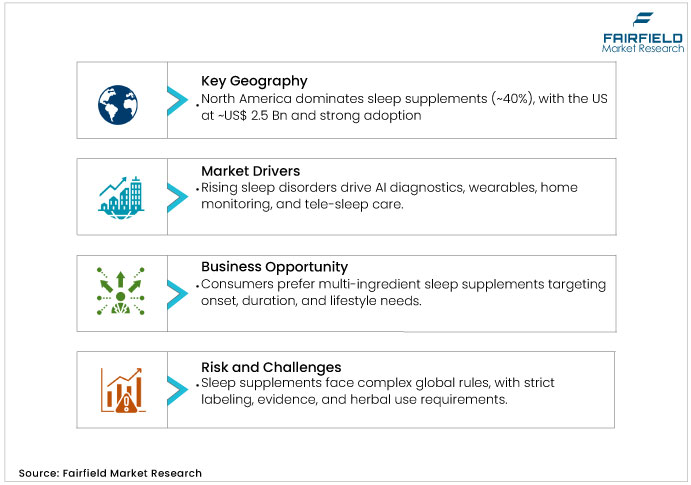
- North America holds approximately 40% share, while Asia Pacific remains the fastest-advancing region with accelerating adoption across China and India.
Market Dynamics: Drivers, Restraints, and Opportunities Analysis
Market Drivers
- Rise in Sleep Disorder Prevalence and Advancements in Diagnosis
Sleep disorder incidence is rising sharply across developed regions, with the American Academy of Sleep Medicine reporting 70 million Americans diagnosed and 30–40% of U.S. adults experiencing insomnia symptoms each year. The CDC now recognizes insufficient sleep as a public health priority, highlighting its growing epidemiological significance. Recent innovations in sleep disorder diagnostics feature AI-driven polysomnography, advanced wearable trackers, and convenient home-based monitoring solutions. Machine learning now enables precise analysis of sleep patterns for accurate detection of conditions such as apnea, insomnia, and circadian rhythm disorders. Additionally, portable EEG devices and telemedicine integration allow real-time data sharing, enhancing accessibility and enabling personalized treatment plans.
Similar patterns are emerging in Asia-Pacific, where urbanization, stress, and lifestyle shifts are increasing sleep disturbance rates. For the Sleep Supplement Market, this widens the addressable consumer base and favors companies investing in diagnostics, awareness, and education, while brands relying solely on traditional retail may face pressure from faster-growing, privacy-focused direct-to-consumer models.
- Consumer Preference Shift Toward Natural and Non-Prescription Formulations
Consumer preference is shifting away from prescription sleep medications due to concerns over dependency and growing interest in preventive wellness. Market data shows that 55% of global sleep supplement demand is driven by natural formulations, compared to 45% for synthetic products, reflecting perceptions of better safety, fewer FDA-reported side effects, and greater comfort with self-managed OTC solutions.
This trend varies regionally, with strong natural preference in North America and Europe, and increasing demand in Asia for hybrid formulas blending traditional herbal medicine with modern supplement science. As a growth driver, it supports sustained market expansion, with brands offering clinically backed natural formulations positioned to achieve a 150–200 basis-point growth premium over synthetic alternatives.
Market Restraints
- Regulatory Classification Ambiguity and Market Access Barriers
Sleep supplements operate in a complex regulatory space between pharmaceuticals and dietary supplements, with the FDA, European Traditional Herbal Registration requirements, and other frameworks imposing varying rules on labeling, substantiation, and clinical validation. Some herbal ingredients in Europe require proof of 30+ years of traditional use, adding another layer of compliance difficulty.
Companies selling across multiple markets may need to manage 8–12 distinct regulatory environments, each with unique rules for claims, formulations, and post-market monitoring. This regulatory fragmentation slows category expansion by 1–2 percentage points and disproportionately challenges smaller manufacturers without dedicated regulatory teams.
- Clinical Evidence Gaps and Efficacy Skepticism
Although melatonin benefits are well-supported clinically, evidence for other sleep supplements remains inconsistent, with studies on valerian root, chamomile, and magnesium often showing effects such as placebo in meta-analyses. This inconsistency fuels skepticism among healthcare professionals, creates uncertainty for consumers, and invites media scrutiny that weakens perceived category credibility.
As a result, adoption of emerging products progresses more slowly than established pharmaceuticals, particularly for novel blends or delivery systems lacking peer-reviewed validation. This restraint suppresses overall market growth by an estimated 1–2 percentage points, with the strongest impact on innovation-driven subcategories outside well-established clinical frameworks.
Market Opportunities
- Combination Formulations and Targeted Indication Specificity
Growing consumer sophistication is driving demand for multi-ingredient sleep formulations, often combining botanicals, minerals, and melatonin to target both sleep onset and sleep maintenance. These blended products are increasingly preferred over single-ingredient supplements, especially among consumers seeking solutions tailored to age groups, lifestyle-related sleep disruption, or conditions such as jet lag and shift-work fatigue.
While single-ingredient products continue to occupy a meaningful portion of the category, most new product development now focuses on targeted multi-ingredient formulations linked to specific sleep health outcomes. Companies aligning innovation with clinically supported blends and indication-specific positioning are capturing stronger momentum and competitive advantage within the evolving market landscape.
- Geographic Expansion in High-Growth Asian Markets
Asia-Pacific represents a large and still underpenetrated sleep supplement landscape, with demand led by China and expanding rapidly across India and Southeast Asia. Limited access to formal sleep diagnostics and treatment infrastructure has driven strong consumer reliance on over-the-counter options, positioning supplements as a primary pathway for sleep support across much of the region.
India’s growing urban workforce, rising stress levels, and increasing health awareness are accelerating adoption patterns that now resemble early-stage behavior seen in developed markets. Companies building early footprints in manufacturing, branding, and distribution across India and ASEAN are positioned to capture long-term growth momentum and secure early competitive advantages as the category scales.
Regional Market Assessment: Strategic Geography Analysis
- North America Market
North America remains the largest regional sleep supplement market, accounting for approximately 40% of global value, with the U.S. valued at around US$2.5 billion in 2025. Market maturity is supported by FDA-recognized supplement pathways, high consumer awareness, digital health integration, and substantial economic burden from untreated sleep disorders estimated at US$150 billion annually. Widespread retail and online availability further support category stability and scale.
Growth is driven by high insomnia prevalence among working-age populations and strong consumer preference for self-managed solutions over prescription medications. Strategic considerations include consolidation among major retail pharmacy chains, rising e-commerce penetration now representing approximately 25–30% of distribution, and ongoing discussions regarding potential insurance reimbursement, signalling future shifts in market access and competitive positioning.
- Europe Market
Europe shows diverse market dynamics, with regional value expected to surpass US$4 billion by 2033, led by Germany and the United Kingdom, which account for approximately 20–25% and 15–20% of sleep supplement market value respectively. Germany is the most mature market due to long-standing herbal medicine integration and Traditional Herbal Registration pathways, while the U.K. is experiencing acceleration as regulatory conditions evolve post-Brexit.
The region operates under stricter evidence and labeling requirements than North America, including 30+ years of documented traditional use for certain herbal claims and varying national regulatory frameworks. Market success increasingly depends on sustainability practices, transparent sourcing, and country-specific strategies, with distinct patterns such as strong botanical pharmaceutical players in Germany, rising direct-to-consumer adoption in the U.K., and high natural product affinity in Southern Europe—particularly in France, where clean-label herbal sleep supplements such as valerian, lavender, and passionflower are gaining momentum.
- Asia-Pacific Market
The Asia-Pacific region is the fastest-growing of sleep supplement market, projected to surpass US$3.1 billion by 2033, with China driving demand and contributing approximately 45–50% of regional value. India is emerging as the fastest-accelerating market due to population growth, increasing urban stress, and rising digital health awareness, while regional manufacturing and ingredient sourcing hubs in China and India are reshaping global supply dynamics.
Competitive intensity remains lower than in North America and Europe, creating strong entry opportunities—particularly in India, Southeast Asia, and emerging ASEAN markets. Japan behaves such as a developed market with aging population-driven demand, while China requires premium and clinically differentiated positioning due to cost-competitive local brands. Strategic expansion should prioritize country-specific models, with India and ASEAN offering high-growth potential and China requiring refined branding and regulatory alignment.
Segmentation Analysis: Category-Wise Strategic Assessment
- Product Type Analysis
Melatonin remains the dominant segment, holding 35% of the global sleep supplement market in 2025, supported by strong clinical validation demonstrating 30–50-minute reductions in sleep onset time and a clear FDA-recognized regulatory pathway. Competition is centered on dosage optimization, delivery innovation such as gummies, sublingual and extended-release formats, and broad availability across retail, online, and mass distribution channels.
The minerals category is the fastest-expanding segment, driven by rising awareness of magnesium deficiency and growing scientific interest in neurological relaxation benefits. Herbal sleep formulations, including valerian root, account for a significant share of consumer demand, with use particularly strong in Europe due to cultural acceptance and long-standing traditional medicine recognition, despite mixed efficacy findings in clinical reviews.
- Source Segmentation Analysis
Natural formulations account for 55% of the global sleep supplement market, reflecting strong consumer preference for plant-derived ingredients perceived as safer than synthetic alternatives. Growth is supported by rising ingredient transparency expectations, regulatory flexibility for established botanicals, and increasing clinical literature validating select herbal extracts. Competitive strength in this segment is built around sourcing disclosure, organic certification, and third-party testing, enabling premium pricing advantages.
Synthetic formulations represent 45% of the market and are expanding more slowly due to ongoing consumer caution toward non-natural compounds. While synthetic melatonin remains widely accepted because of strong scientific validation, other synthetic formulations face competitive pressure from natural alternatives. Sustaining competitiveness in the synthetic segment requires stronger clinical differentiation and cost efficiency, as price-based positioning outperforms premium branding strategies in this category.
- Dosage Form Analysis
Tablet formats are emerging as the fastest-growing delivery form, supported by demand for portability, convenience, and standardized dosing. Innovations such as sublingual and chewable formats are reshaping consumer expectations and gradually challenging traditional formats, particularly as tablets align with cost-efficient manufacturing and broader accessibility in price-sensitive markets.
Capsules currently lead with approximately 35% of sleep supplement market share in 2025, supported by strong consumer familiarity and historical dominance in botanical and nutrient-based formulations. However, growth momentum is moderating as newer delivery forms gain traction, while powders and liquids continue to serve niche populations such as pediatric and geriatric users, where improved flavor systems, stability enhancements, and single-serve formats remain key adoption drivers.
- Indication Analysis
Insomnia remains the leading indication, accounting for approximately 55% of the global sleep supplement market, driven by widespread prevalence across working-age adults, older populations, and high-stress professions. Limited access to sleep specialists and strong consumer preference for non-prescription, self-managed approaches further reinforce dominance, with brands increasingly tailoring formulations for sleep initiation, sleep maintenance, and overall sleep quality improvement.
Sleep apnea and other sleep disorders collectively occupy the remaining share of the category, with sleep apnea emerging as a key growth area as supplements gain recognition as part of adjunctive management strategies. Narcolepsy and shift-work-related formulations remain smaller niches but are gaining traction, creating opportunities for companies offering indication-specific solutions with lower competitive pressure than general insomnia-focused products.
- Distribution Channel Analysis
Retail pharmacies remain the leading distribution channel, holding approximately 45% of sleep supplement market share in 2025, supported by strong consumer trust, pharmacist guidance, and widespread retail infrastructure. Brand visibility, shelf space competition, and clinical recommendation influence play key roles in maintaining leadership, particularly as manufacturers strengthen product differentiation and in-store marketing strategies.
Online pharmacy and direct-to-consumer channels are expanding rapidly as digital purchasing behavior accelerates, especially among younger and tech-enabled consumers. Specialty stores and hospital pharmacies account for a smaller share but support premium positioning and clinical alignment, offering brands opportunities to build credibility and target wellness-focused or medically supervised consumer segments.
Competitive Landscape: Market Structure and Strategic Positioning
The global sleep supplement market remains moderately fragmented, with approximately 20–25 multinational pharmaceutical and consumer health companies holding around 50–55% of total market share, while specialized nutraceutical and direct-to-consumer brands control the remaining 45–50%. This structure supports both large-scale consolidation strategies and niche competitive positioning among focused category innovators.
Entry barriers are moderate, with manufacturing and distribution requiring US$10–50 million and regulatory compliance costing US$2–8 million depending on jurisdiction. Consolidation momentum is increasing, with companies such as Abbott, Nestlé Health Science, and Pfizer Consumer Health acquiring specialized sleep supplement manufacturers, signaling rising strategic value and long-term category growth expectations.
Key Players
- The Nature’s Bounty Co.
- Natrol LLC
- NOW Foods
- Herbalife Nutrition Ltd.
- OLLY
- Nestlé S.A.
- Bayer Consumer Health
- Hims & Hers Health, Inc.
- By-Health
- Swisse
- GNC Holdings LLC
- Life Extension
- Solgar, Inc.
- Amway (Nutrilite)
- Moon Juice
Global Sleep Supplement Market Segmentation-
By Product Type:
- Minerals
- Vitamin
- Melatonin
- Valerian root
- Others
By Source:
- Synthetic
- Natural
By Dosage Form:
- Tablets
- Capsules
- Powders
- Liquid
By Indication:
- Insomnia
- Sleep Apnea
- Narcolepsy
- Other sleep disorders
By Distribution Channel:
- Retail Pharmacies
- Hospital Pharmacies
- Online Pharmacies
- Specialty Stores
By Region:
- North America
- Latin America
- Europe
- Asia Pacific
- Middle East and Africa
- Executive Summary
- Global Sleep Supplement Market Snapshot
- Future Projections
- Key Market Trends
- Regional Snapshot, by Value, 2026
- Analyst Recommendations
- Market Overview
- Market Definitions and Segmentations
- Market Dynamics
- Drivers
- Restraints
- Market Opportunities
- Value Chain Analysis
- COVID-19 Impact Analysis
- Porter's Five Forces Analysis
- Impact of Russia-Ukraine Conflict
- PESTLE Analysis
- Regulatory Analysis
- Price Trend Analysis
- Current Prices and Future Projections, 2025-2033
- Price Impact Factors
- Global Sleep Supplement Market Outlook, 2020 - 2033
- Global Sleep Supplement Market Outlook, by Product Type, Value (US$ Mn), 2020-2033
- Minerals
- Vitamin
- Melatonin
- Valerian root
- Others
- Global Sleep Supplement Market Outlook, by Source, Value (US$ Mn), 2020-2033
- Synthetic
- Natural
- Global Sleep Supplement Market Outlook, by Dosage Form, Value (US$ Mn), 2020-2033
- Tablets
- Capsules
- Powders
- Liquid
- Global Sleep Supplement Market Outlook, by Indication, Value (US$ Mn), 2020-2033
- Insomnia
- Sleep Apnea
- Narcolepsy
- Other sleep disorders
- Global Sleep Supplement Market Outlook, by Distribution Channel, Value (US$ Mn), 2020-2033
- Retail Pharmacies
- Hospital Pharmacies
- Online Pharmacies
- Specialty Stores
- Global Sleep Supplement Market Outlook, by Region, Value (US$ Mn), 2020-2033
- North America
- Europe
- Asia Pacific
- Latin America
- Middle East & Africa
- Global Sleep Supplement Market Outlook, by Product Type, Value (US$ Mn), 2020-2033
- North America Sleep Supplement Market Outlook, 2020 - 2033
- North America Sleep Supplement Market Outlook, by Product Type, Value (US$ Mn), 2020-2033
- Minerals
- Vitamin
- Melatonin
- Valerian root
- Others
- North America Sleep Supplement Market Outlook, by Source, Value (US$ Mn), 2020-2033
- Synthetic
- Natural
- North America Sleep Supplement Market Outlook, by Dosage Form, Value (US$ Mn), 2020-2033
- Tablets
- Capsules
- Powders
- Liquid
- North America Sleep Supplement Market Outlook, by Indication, Value (US$ Mn), 2020-2033
- Insomnia
- Sleep Apnea
- Narcolepsy
- Other sleep disorders
- North America Sleep Supplement Market Outlook, by Distribution Channel, Value (US$ Mn), 2020-2033
- Retail Pharmacies
- Hospital Pharmacies
- Online Pharmacies
- Specialty Stores
- North America Sleep Supplement Market Outlook, by Country, Value (US$ Mn), 2020-2033
- U.S. Sleep Supplement Market Outlook, by Product Type, 2020-2033
- U.S. Sleep Supplement Market Outlook, by Source, 2020-2033
- U.S. Sleep Supplement Market Outlook, by Dosage Form, 2020-2033
- U.S. Sleep Supplement Market Outlook, by Indication, 2020-2033
- U.S. Sleep Supplement Market Outlook, by Distribution Channel, 2020-2033
- Canada Sleep Supplement Market Outlook, by Product Type, 2020-2033
- Canada Sleep Supplement Market Outlook, by Source, 2020-2033
- Canada Sleep Supplement Market Outlook, by Dosage Form, 2020-2033
- Canada Sleep Supplement Market Outlook, by Indication, 2020-2033
- Canada Sleep Supplement Market Outlook, by Distribution Channel, 2020-2033
- BPS Analysis/Market Attractiveness Analysis
- North America Sleep Supplement Market Outlook, by Product Type, Value (US$ Mn), 2020-2033
- Europe Sleep Supplement Market Outlook, 2020 - 2033
- Europe Sleep Supplement Market Outlook, by Product Type, Value (US$ Mn), 2020-2033
- Minerals
- Vitamin
- Melatonin
- Valerian root
- Others
- Europe Sleep Supplement Market Outlook, by Source, Value (US$ Mn), 2020-2033
- Synthetic
- Natural
- Europe Sleep Supplement Market Outlook, by Dosage Form, Value (US$ Mn), 2020-2033
- Tablets
- Capsules
- Powders
- Liquid
- Europe Sleep Supplement Market Outlook, by Indication, Value (US$ Mn), 2020-2033
- Insomnia
- Sleep Apnea
- Narcolepsy
- Other sleep disorders
- Europe Sleep Supplement Market Outlook, by Distribution Channel, Value (US$ Mn), 2020-2033
- Retail Pharmacies
- Hospital Pharmacies
- Online Pharmacies
- Specialty Stores
- Europe Sleep Supplement Market Outlook, by Country, Value (US$ Mn), 2020-2033
- Germany Sleep Supplement Market Outlook, by Product Type, 2020-2033
- Germany Sleep Supplement Market Outlook, by Source, 2020-2033
- Germany Sleep Supplement Market Outlook, by Dosage Form, 2020-2033
- Germany Sleep Supplement Market Outlook, by Indication, 2020-2033
- Germany Sleep Supplement Market Outlook, by Distribution Channel, 2020-2033
- Italy Sleep Supplement Market Outlook, by Product Type, 2020-2033
- Italy Sleep Supplement Market Outlook, by Source, 2020-2033
- Italy Sleep Supplement Market Outlook, by Dosage Form, 2020-2033
- Italy Sleep Supplement Market Outlook, by Indication, 2020-2033
- Italy Sleep Supplement Market Outlook, by Distribution Channel, 2020-2033
- France Sleep Supplement Market Outlook, by Product Type, 2020-2033
- France Sleep Supplement Market Outlook, by Source, 2020-2033
- France Sleep Supplement Market Outlook, by Dosage Form, 2020-2033
- France Sleep Supplement Market Outlook, by Indication, 2020-2033
- France Sleep Supplement Market Outlook, by Distribution Channel, 2020-2033
- U.K. Sleep Supplement Market Outlook, by Product Type, 2020-2033
- U.K. Sleep Supplement Market Outlook, by Source, 2020-2033
- U.K. Sleep Supplement Market Outlook, by Dosage Form, 2020-2033
- U.K. Sleep Supplement Market Outlook, by Indication, 2020-2033
- U.K. Sleep Supplement Market Outlook, by Distribution Channel, 2020-2033
- Spain Sleep Supplement Market Outlook, by Product Type, 2020-2033
- Spain Sleep Supplement Market Outlook, by Source, 2020-2033
- Spain Sleep Supplement Market Outlook, by Dosage Form, 2020-2033
- Spain Sleep Supplement Market Outlook, by Indication, 2020-2033
- Spain Sleep Supplement Market Outlook, by Distribution Channel, 2020-2033
- Russia Sleep Supplement Market Outlook, by Product Type, 2020-2033
- Russia Sleep Supplement Market Outlook, by Source, 2020-2033
- Russia Sleep Supplement Market Outlook, by Dosage Form, 2020-2033
- Russia Sleep Supplement Market Outlook, by Indication, 2020-2033
- Russia Sleep Supplement Market Outlook, by Distribution Channel, 2020-2033
- Rest of Europe Sleep Supplement Market Outlook, by Product Type, 2020-2033
- Rest of Europe Sleep Supplement Market Outlook, by Source, 2020-2033
- Rest of Europe Sleep Supplement Market Outlook, by Dosage Form, 2020-2033
- Rest of Europe Sleep Supplement Market Outlook, by Indication, 2020-2033
- Rest of Europe Sleep Supplement Market Outlook, by Distribution Channel, 2020-2033
- BPS Analysis/Market Attractiveness Analysis
- Europe Sleep Supplement Market Outlook, by Product Type, Value (US$ Mn), 2020-2033
- Asia Pacific Sleep Supplement Market Outlook, 2020 - 2033
- Asia Pacific Sleep Supplement Market Outlook, by Product Type, Value (US$ Mn), 2020-2033
- Minerals
- Vitamin
- Melatonin
- Valerian root
- Others
- Asia Pacific Sleep Supplement Market Outlook, by Source, Value (US$ Mn), 2020-2033
- Synthetic
- Natural
- Asia Pacific Sleep Supplement Market Outlook, by Dosage Form, Value (US$ Mn), 2020-2033
- Tablets
- Capsules
- Powders
- Liquid
- Asia Pacific Sleep Supplement Market Outlook, by Indication, Value (US$ Mn), 2020-2033
- Insomnia
- Sleep Apnea
- Narcolepsy
- Other sleep disorders
- Asia Pacific Sleep Supplement Market Outlook, by Distribution Channel, Value (US$ Mn), 2020-2033
- Retail Pharmacies
- Hospital Pharmacies
- Online Pharmacies
- Specialty Stores
- Asia Pacific Sleep Supplement Market Outlook, by Country, Value (US$ Mn), 2020-2033
- China Sleep Supplement Market Outlook, by Product Type, 2020-2033
- China Sleep Supplement Market Outlook, by Source, 2020-2033
- China Sleep Supplement Market Outlook, by Dosage Form, 2020-2033
- China Sleep Supplement Market Outlook, by Indication, 2020-2033
- China Sleep Supplement Market Outlook, by Distribution Channel, 2020-2033
- Japan Sleep Supplement Market Outlook, by Product Type, 2020-2033
- Japan Sleep Supplement Market Outlook, by Source, 2020-2033
- Japan Sleep Supplement Market Outlook, by Dosage Form, 2020-2033
- Japan Sleep Supplement Market Outlook, by Indication, 2020-2033
- Japan Sleep Supplement Market Outlook, by Distribution Channel, 2020-2033
- South Korea Sleep Supplement Market Outlook, by Product Type, 2020-2033
- South Korea Sleep Supplement Market Outlook, by Source, 2020-2033
- South Korea Sleep Supplement Market Outlook, by Dosage Form, 2020-2033
- South Korea Sleep Supplement Market Outlook, by Indication, 2020-2033
- South Korea Sleep Supplement Market Outlook, by Distribution Channel, 2020-2033
- India Sleep Supplement Market Outlook, by Product Type, 2020-2033
- India Sleep Supplement Market Outlook, by Source, 2020-2033
- India Sleep Supplement Market Outlook, by Dosage Form, 2020-2033
- India Sleep Supplement Market Outlook, by Indication, 2020-2033
- India Sleep Supplement Market Outlook, by Distribution Channel, 2020-2033
- Southeast Asia Sleep Supplement Market Outlook, by Product Type, 2020-2033
- Southeast Asia Sleep Supplement Market Outlook, by Source, 2020-2033
- Southeast Asia Sleep Supplement Market Outlook, by Dosage Form, 2020-2033
- Southeast Asia Sleep Supplement Market Outlook, by Indication, 2020-2033
- Southeast Asia Sleep Supplement Market Outlook, by Distribution Channel, 2020-2033
- Rest of SAO Sleep Supplement Market Outlook, by Product Type, 2020-2033
- Rest of SAO Sleep Supplement Market Outlook, by Source, 2020-2033
- Rest of SAO Sleep Supplement Market Outlook, by Dosage Form, 2020-2033
- Rest of SAO Sleep Supplement Market Outlook, by Indication, 2020-2033
- Rest of SAO Sleep Supplement Market Outlook, by Distribution Channel, 2020-2033
- BPS Analysis/Market Attractiveness Analysis
- Asia Pacific Sleep Supplement Market Outlook, by Product Type, Value (US$ Mn), 2020-2033
- Latin America Sleep Supplement Market Outlook, 2020 - 2033
- Latin America Sleep Supplement Market Outlook, by Product Type, Value (US$ Mn), 2020-2033
- Minerals
- Vitamin
- Melatonin
- Valerian root
- Others
- Latin America Sleep Supplement Market Outlook, by Source, Value (US$ Mn), 2020-2033
- Synthetic
- Natural
- Latin America Sleep Supplement Market Outlook, by Dosage Form, Value (US$ Mn), 2020-2033
- Tablets
- Capsules
- Powders
- Liquid
- Latin America Sleep Supplement Market Outlook, by Indication, Value (US$ Mn), 2020-2033
- Insomnia
- Sleep Apnea
- Narcolepsy
- Other sleep disorders
- Latin America Sleep Supplement Market Outlook, by Distribution Channel, Value (US$ Mn), 2020-2033
- Retail Pharmacies
- Hospital Pharmacies
- Online Pharmacies
- Specialty Stores
- Latin America Sleep Supplement Market Outlook, by Country, Value (US$ Mn), 2020-2033
- Brazil Sleep Supplement Market Outlook, by Product Type, 2020-2033
- Brazil Sleep Supplement Market Outlook, by Source, 2020-2033
- Brazil Sleep Supplement Market Outlook, by Dosage Form, 2020-2033
- Brazil Sleep Supplement Market Outlook, by Indication, 2020-2033
- Brazil Sleep Supplement Market Outlook, by Distribution Channel, 2020-2033
- Mexico Sleep Supplement Market Outlook, by Product Type, 2020-2033
- Mexico Sleep Supplement Market Outlook, by Source, 2020-2033
- Mexico Sleep Supplement Market Outlook, by Dosage Form, 2020-2033
- Mexico Sleep Supplement Market Outlook, by Indication, 2020-2033
- Mexico Sleep Supplement Market Outlook, by Distribution Channel, 2020-2033
- Argentina Sleep Supplement Market Outlook, by Product Type, 2020-2033
- Argentina Sleep Supplement Market Outlook, by Source, 2020-2033
- Argentina Sleep Supplement Market Outlook, by Dosage Form, 2020-2033
- Argentina Sleep Supplement Market Outlook, by Indication, 2020-2033
- Argentina Sleep Supplement Market Outlook, by Distribution Channel, 2020-2033
- Rest of LATAM Sleep Supplement Market Outlook, by Product Type, 2020-2033
- Rest of LATAM Sleep Supplement Market Outlook, by Source, 2020-2033
- Rest of LATAM Sleep Supplement Market Outlook, by Dosage Form, 2020-2033
- Rest of LATAM Sleep Supplement Market Outlook, by Indication, 2020-2033
- Rest of LATAM Sleep Supplement Market Outlook, by Distribution Channel, 2020-2033
- BPS Analysis/Market Attractiveness Analysis
- Latin America Sleep Supplement Market Outlook, by Product Type, Value (US$ Mn), 2020-2033
- Middle East & Africa Sleep Supplement Market Outlook, 2020 - 2033
- Middle East & Africa Sleep Supplement Market Outlook, by Product Type, Value (US$ Mn), 2020-2033
- Minerals
- Vitamin
- Melatonin
- Valerian root
- Others
- Middle East & Africa Sleep Supplement Market Outlook, by Source, Value (US$ Mn), 2020-2033
- Synthetic
- Natural
- Middle East & Africa Sleep Supplement Market Outlook, by Dosage Form, Value (US$ Mn), 2020-2033
- Tablets
- Capsules
- Powders
- Liquid
- Middle East & Africa Sleep Supplement Market Outlook, by Indication, Value (US$ Mn), 2020-2033
- Insomnia
- Sleep Apnea
- Narcolepsy
- Other sleep disorders
- Middle East & Africa Sleep Supplement Market Outlook, by Distribution Channel, Value (US$ Mn), 2020-2033
- Retail Pharmacies
- Hospital Pharmacies
- Online Pharmacies
- Specialty Stores
- Middle East & Africa Sleep Supplement Market Outlook, by Country, Value (US$ Mn), 2020-2033
- GCC Sleep Supplement Market Outlook, by Product Type, 2020-2033
- GCC Sleep Supplement Market Outlook, by Source, 2020-2033
- GCC Sleep Supplement Market Outlook, by Dosage Form, 2020-2033
- GCC Sleep Supplement Market Outlook, by Indication, 2020-2033
- GCC Sleep Supplement Market Outlook, by Distribution Channel, 2020-2033
- South Africa Sleep Supplement Market Outlook, by Product Type, 2020-2033
- South Africa Sleep Supplement Market Outlook, by Source, 2020-2033
- South Africa Sleep Supplement Market Outlook, by Dosage Form, 2020-2033
- South Africa Sleep Supplement Market Outlook, by Indication, 2020-2033
- South Africa Sleep Supplement Market Outlook, by Distribution Channel, 2020-2033
- Egypt Sleep Supplement Market Outlook, by Product Type, 2020-2033
- Egypt Sleep Supplement Market Outlook, by Source, 2020-2033
- Egypt Sleep Supplement Market Outlook, by Dosage Form, 2020-2033
- Egypt Sleep Supplement Market Outlook, by Indication, 2020-2033
- Egypt Sleep Supplement Market Outlook, by Distribution Channel, 2020-2033
- Nigeria Sleep Supplement Market Outlook, by Product Type, 2020-2033
- Nigeria Sleep Supplement Market Outlook, by Source, 2020-2033
- Nigeria Sleep Supplement Market Outlook, by Dosage Form, 2020-2033
- Nigeria Sleep Supplement Market Outlook, by Indication, 2020-2033
- Nigeria Sleep Supplement Market Outlook, by Distribution Channel, 2020-2033
- Rest of Middle East Sleep Supplement Market Outlook, by Product Type, 2020-2033
- Rest of Middle East Sleep Supplement Market Outlook, by Source, 2020-2033
- Rest of Middle East Sleep Supplement Market Outlook, by Dosage Form, 2020-2033
- Rest of Middle East Sleep Supplement Market Outlook, by Indication, 2020-2033
- Rest of Middle East Sleep Supplement Market Outlook, by Distribution Channel, 2020-2033
- BPS Analysis/Market Attractiveness Analysis
- Middle East & Africa Sleep Supplement Market Outlook, by Product Type, Value (US$ Mn), 2020-2033
- Competitive Landscape
- Company Vs Segment Heatmap
- Company Market Share Analysis, 2025
- Competitive Dashboard
- Company Profiles
- The Nature’s Bounty Co.
- Company Overview
- Product Portfolio
- Financial Overview
- Business Strategies and Developments
- Natrol LLC
- NOW Foods
- Herbalife Nutrition Ltd.
- OLLY
- Nestlé S.A.
- Bayer Consumer Health
- Hims & Hers Health, Inc.
- By-Health
- Swisse
- The Nature’s Bounty Co.
- Appendix
- Research Methodology
- Report Assumptions
- Acronyms and Abbreviations
|
BASE YEAR |
HISTORICAL DATA |
FORECAST PERIOD |
UNITS |
|||
 |
2025 |
 |
2019 - 2025 |
 |
2026 - 2033 |
Value: US$ Billion |
|
REPORT FEATURES |
DETAILS |
|
By Product Type Coverage |
|
|
By Source Coverage |
|
|
By Dosage Form Coverage |
|
|
By Indication Coverage |
|
|
By Distribution Channel Coverage |
|
|
Geographical Coverage |
|
|
Leading Companies |
|
|
Report Highlights |
Key Market Indicators, Macro-micro economic impact analysis, Technological Roadmap, Key Trends, Driver, Restraints, and Future Opportunities & Revenue Pockets, Porter’s 5 Forces Analysis, Historical Trend (2019-2024), Market Estimates and Forecast, Market Dynamics, Industry Trends, Competition Landscape, Category, Region, Country-wise Trends & Analysis, COVID-19 Impact Analysis (Demand and Supply Chain) |
Our Research Methodology
Considering the volatility of business today, traditional approaches to strategizing a game plan can be unfruitful if not detrimental. True ambiguity is no way to determine a forecast. A myriad of predetermined factors must be accounted for such as the degree of risk involved, the magnitude of circumstances, as well as conditions or consequences that are not known or unpredictable. To circumvent binary views that cast uncertainty, the application of market research intelligence to strategically posture, move, and enable actionable outcomes is necessary.
View Methodology
Quality Assured
Rigorous Validation Process

Confidentiality Assured
End-to-end Data Security

Custom Research Services
Tailored To Your Objectives
FAQs
The global sleep supplement market size is USD 7.8 Bn in 2026.
The sleep supplement market is projected to grow at a 5% CAGR to reach USD 12.8 Bn by 2033.
Growth is driven by rising sleep disorder prevalence, a consumer shift toward natural/non-prescription formulations, and rapid e-commerce/direct-to-consumer expansion.
North America is the dominant region for the sleep supplement market.
Nature’s Bounty Co., Natrol, NOW Foods, Nestlé Health Science, and Bayer Consumer Health are some leading industry players.
Related Reports
Enzymatic RNA Manufacturing Market Insights, Competitive Landscape, and Market Forecast - 2033
The enzymatic RNA manufacturing market, valued at USD 1.10 billion in 2026 and projected to reach USD 4.32 billion by 2033, at a 21.6% CAGR
Nephrology Drugs Market Insights, Competitive Landscape, and Market Forecast 2033
The nephrology drugs market is forecast to grow from USD 24.50 billion in 2026 to USD 40.39 billion by 2033, driven by novel disease-modifying treatments.
Active Pharmaceutical Ingredients Market Insights, Competitive Landscape, and Market Forecast 2033
Dementia Care Market Analysis Market Insights, Competitive Landscape, and Market Forecast 2033
Dementia Care Market to reach US$46.60 Mn by 2033, growing at 5.9% CAGR, driven by ageing populations, home care, and specialized dementia services.
Drug Repurposing Market Insights, Competitive Landscape, and Market Forecast 2026–2033
Drug Repurposing Market to reach US$47.75 billion by 2033, growing at 4.2% CAGR, driven by AI-assisted screening, R&D investment, and clinical trials.
Precision Medicine Market Insights, Competitive Landscape, and Market Forecast 2033
Precision Medicine Market is projected to reach US$405.17 billion by 2033, driven by genomics, companion diagnostics, oncology, and personalized therapies.