



Nutraceutical Cdmo Market
Nutraceutical CDMO Market Insights, Competitive Landscape, and Market Forecast - 2033
Global Nutraceutical CDMO Market: Comprehensive Strategic Analysis
Executive Summary & Key Highlights
- The Nutraceutical CDMO Market is valued at USD 39.8 Bn in 2026 and is projected to reach USD 65.4 Bn, growing at a CAGR of 6% by 2033. driven by rising preventive healthcare demand and increased outsourcing.
- Tablets & Capsules remain the leading dosage form with ~40% share, supported by mature manufacturing & packaging capabilities and strong consumer acceptance.
- Manufacturing & Packaging dominates with ~35% share, reflecting strong outsourcing needs from mid-sized companies seeking scale and operational efficiencies.
- Asia-Pacific is the fastest-advancing geography, supported by China’s strong manufacturing ecosystem and India’s major role in global botanical ingredient sourcing for R&D and analytical services.
- Digital transformation and AI-driven formulation optimization represent the strongest market opportunity, enabling CDMOs to accelerate development cycles, enhance compliance, and support personalized nutrition models.
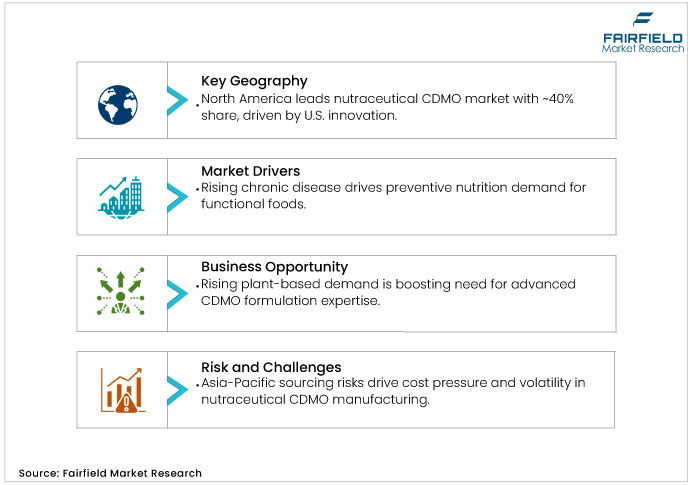
- North America leads with ~40% regional share, enabled by FDA-regulated quality systems and strong market maturity across large companies.
Market Dynamics: Drivers, Restraints, and Opportunities Analysis
Market Drivers
- Chronic Disease Prevalence and Preventive Health Orientation
Escalating chronic disease prevalence is pushing consumers toward preventive nutrition solutions as global death rates from chronic conditions continue to rise. This shift strengthens demand for functional foods, dietary supplements, and therapeutic nutraceuticals focused on immune, metabolic, cognitive, and cardiovascular support.
Growing emphasis on preventive health is accelerating formulation complexity, production requirements, and innovation cycles across the nutraceutical industry. CDMOs offering advanced formulation development, regulatory support, and rapid scale-up capture stronger client engagement, while those limited to standardized manufacturing face increasing competitive and margin pressures.
- Outsourcing Adoption Among Mid-Market Nutraceutical Companies
Mid-sized nutraceutical enterprises increasingly rely on CDMO partnerships as a capital-efficient alternative to building in-house manufacturing, driven by gaps in formulation, regulatory, engineering, and scale-up capabilities. This segment accounts for a significant portion of CDMO demand and allocates a much larger share of development budgets to outsourcing compared to large companies.
CDMO partnerships offer meaningful cost-optimization benefits and provide access to specialized expertise that mid-market organizations cannot maintain internally. This outsourcing trend is projected to drive a substantial share of industry expansion, particularly in Asia-Pacific, with CDMOs offering flexible, tiered service models best positioned to capture rising demand.
Market Restraints
- Supply Chain Volatility and Raw Material Cost Pressures
Nutraceutical manufacturing faces significant raw material volatility due to heavy ingredient sourcing concentration in Asia-Pacific, magnifying geographic and tariff-related risks. Trade restrictions and supply disruptions have added pressure on CDMO cost structures, particularly affecting categories such as vitamins and capsule-based supplements.
Pandemic-era manufacturing interruptions and logistics bottlenecks have reduced CDMO capacity utilization and extended delivery timelines, prompting some clients to explore alternative sourcing or partial in-house production. Leading CDMOs are mitigating these risks through diversified supplier networks, forward contracting, and strategic inventory strategies, while those lacking advanced procurement systems risk margin erosion and client loss.
- Regulatory Compliance Cost Burden and Innovation Delays
Expanding regulatory requirements across major nutraceutical CDMO markets are increasing compliance burdens for manufacturers and CDMOs, with NDI submissions, audits, and stability testing adding fixed costs to every product launch. This structure places greater strain on low-margin categories and disproportionately affects smaller CDMOs that lack the scale to absorb rising regulatory expenses.
Lengthy review timelines—especially EFSA health claim assessments—compress commercialization windows and create uncertainty for clients pursuing new product development. Mid-market CDMOs are now required to embed regulatory expertise, invest in compliance infrastructure, and adopt specialized systems to stay competitive amid growing cost pressures.
Market Opportunities
- Plant-Based and Functional Formulation Specialization
Shifting consumer demand toward plant-based, clean-label, and functional ingredients is driving more complex formulation needs that increasingly require specialized CDMO capabilities. Plant-based and vegan supplements are expanding far faster than conventional formats, intensifying demand for advanced expertise in bioavailability, taste masking, and stability management.
CDMOs with proprietary technologies for botanical extraction, plant-based delivery systems, and functional ingredient enhancement are positioned to secure premium, high-margin opportunities concentrated in North America and Europe. Success depends on strong in-house research capabilities, regulatory expertise for Novel Food pathways, and client education to support optimized plant-based formulation strategies.
- Digital Transformation and AI-Driven Formulation Optimization
The integration of AI, data analytics, and digitalization into formulation and manufacturing is creating strong differentiation opportunities for technologically advanced CDMOs. AI-enabled optimization accelerates development cycles, enhances bioavailability prediction, and supports scalable personalized nutrition, while data-driven process monitoring lifts productivity and strengthens compliance.
This opportunity is especially attractive for mid-market CDMOs aiming to stand out without competing solely on cost, though adoption requires significant technology infrastructure, specialized talent, and client education. Strategic tech partnerships and shared analytics platforms are enabling more capital-efficient adoption, contributing meaningful incremental value for early adopters through the next decade.
Regional Market Assessment: Strategic Geography Analysis
- North America: Market Maturity and Regulatory Premium Positioning
North America, led by the U.S. nutraceutical CDMO market valued at ~US$ 13 billion in 2025, represents the largest global concentration with ~40% share, supported by strong consumer health awareness, advanced regulatory systems, and a concentrated CDMO ecosystem. Growth is driven by chronic disease prevalence, FDA-driven compliance complexity, and innovation clusters in California accelerating formulation and delivery technology advancement.
The FDA framework under DSHEA and 21 CFR Part 111, along with inspections occurring every 3–5 years, creates high compliance costs that strengthen demand for certified CDMOs. Market maturity is reflected in sophisticated buyer behavior, stringent retailer requirements, and competition centered on differentiation rather than cost. Strategic expansion requires assessing certifications, audit history, and geographic alignment with client hubs in California, Texas, Florida, and the Northeast.
- Europe: Regulatory Harmonization and Differentiated Market Dynamics
Europe nutraceutical CDMO market shows notable geographic variation, with the region projected to reach ~US$ 17 billion by 2032. Germany accounting for around 15% of the regions market share benefits from strong pharmaceutical infrastructure and regulatory expertise, while the U.K. reflects post-Brexit regulatory divergence and selective CDMO specialization.
EU Regulation 1924/2006, Directive 2002/46/EC, and EFSA processes requiring 12–24 months create significant compliance complexity and longer development timelines. Emerging ESG and circular-economy mandates reshape competitive priorities, while country-specific dynamics—from quality-driven Germany to cost-competitive Southern Europe—require tailored strategies aligned with regulatory variation and ingredient sourcing strengths.
- Asia-Pacific: Differential Growth and Manufacturing Advantages
Asia-Pacific is the fastest-growing region, projected to reach ~US$ 25 billion by 2032, with China contributing ~40–45% of regional value supported by rising preventive-health demand, TCM integration, and strong e-commerce penetration. India holds ~15–20% share, driven by brand proliferation, e-commerce expansion, and its role as a global Ayurvedic and botanical sourcing hub.
Regional competitiveness is shaped by China’s upgraded FDA- and EFSA-compliant CDMO infrastructure and India’s ingredient sourcing strength, including ~60–70% of global botanical supply. ASEAN markets provide cost-competitive manufacturing alternatives, while Japan advances specialized FOSHU-aligned formulations. Expansion success depends on country-specific regulatory expertise, strong local partnerships, and capabilities supporting both regional demand and international client requirements.
Segmentation Analysis: Category-Wise Strategic Assessment
- By Dosage Form: Tablets & Capsules Leadership with Powder Acceleration
Tablets and capsules hold the dominant position in the Nutraceutical CDMO Market with ~40% share, valued at ~US$ 16 billion in 2025, supported by consumer familiarity, regulatory standardization, and mature manufacturing infrastructure. Their strength comes from portable and shelf-stable formats, pharmaceutical-grade standards, and cost-efficient production, with competition driven by scale, certifications, and efficiency among players such as Sirio Pharma and Nutraceutical Innovations Group.
Powders account for ~25% share and are growing at mid-to-high single-digit CAGR, fueled by demand for versatile, mixable, and clean-label formats and rising use in functional beverages and personalized nutrition. Higher formulation complexity—taste masking, moisture control, and ingredient stability—creates opportunities for CDMOs with strong R&D and process engineering expertise, though capability expansion requires investment and specialized manufacturing know-how.
- By Services: Manufacturing and Packaging Leadership with Formulation Development Growth
Manufacturing and packaging services lead with ~35% of nutraceutical CDMO market share, valued at ~US$ 14 billion in 2025, driven by strong outsourcing demand from major supplement brands seeking production capacity and logistics support. CDMOs benefit from economies of scale, advanced equipment utilization, and process efficiencies that create substantial client cost savings. Competitive dynamics remain moderately fragmented, with large CDMOs competing alongside regional players on pricing and delivery reliability.
Product formulation and development services hold significant share and are expanding at accelerated rates, supported by rising product complexity, regulatory challenges, and growing demand for innovative formulations. These capabilities enable CDMOs to command premium pricing and strengthen differentiation relative to commoditized manufacturing services. Regulatory support and analytical testing services also show strong potential as compliance requirements intensify, especially in regions where local formulation expertise is limited.
- By Company Size: Mid-Market Dominance with Divergent Growth Trajectories
Mid-sized nutraceutical companies remain the primary CDMO client group, holding ~45% of nutraceutical CDMO market value due to strong reliance on outsourcing for capital efficiency and technical expertise. Their dominance is reinforced by limited in-house capabilities and the need for flexible formulation and manufacturing support across global regions.
Small nutraceutical companies continue to expand rapidly, driven by rising brand creation and strong dependence on external formulation, regulatory, and manufacturing capabilities. Although presenting both high engagement potential and relationship volatility, they require CDMOs with flexible capacity and rapid development capabilities. Large pharmaceutical companies maintain selective partnerships focused on specialized capabilities rather than volume production.
Competitive Landscape: Market Structure and Strategic Positioning
The competitive landscape of nutraceutical CDMO market is highly fragmented, with leading CDMOs collectively holding ~25–30% of global share, while mid-market and small providers contribute significantly to specialized segments. Consolidation is accelerating, highlighted by Sirio Pharma’s January 2023 acquisition of Best Formulations, driven by high entry barriers such as manufacturing infrastructure requirements and regulatory compliance investments.
Differentiation varies widely: large CDMOs leverage scale, integrated service portfolios, and global infrastructure, while mid-market providers focus on specialized dosage forms, therapeutic areas, or flexible service models. Barriers including FDA/ISO certifications, regulatory history, and formulation science expertise reinforce competitive moats, with consolidation pressuring mid-market players to upscale or specialize and small CDMOs facing margin compression in commoditized service areas.
Key Players
- Catalent Inc.
- Lonza Group Ltd.
- NUTRASCIENCE LABS Inc.
- Robinson Pharma, Inc.
- Health Wright Products, Inc.
- Innovations in Nutrition + Wellness
- INPHARMA S.p.A.
- Aenova Group
- NutraPak USA
- SFI Health Pty Ltd.
- PLT Health Solutions
- B&D Nutritional Ingredients
- Vitakem Nutraceutical Inc.
- Softigel (Procaps Group)
- INW Manufacturing, LLC
Global Nutraceutical Cdmo Market Segmentation-
By Dosage Form
- Tablets & Capsules
- Powder
- Softgel
- Liquid Formulations
- Others (Gummies, Sprays, Sachets, Topical Forms)
By Services
- Product Formulation and Development
- Manufacturing and Packaging
- Research and Development
- Analytical and Testing Services
- Regulatory Support
By Company Size
- Small Companies
- Mid-sized Companies
- Large Companies
By Region
- North America
- Europe
- Asia Pacific
- Latin America
- Middle East & Africa
- Executive Summary
- Global Nutraceutical CDMO Market Snapshot
- Future Projections
- Key Market Trends
- Regional Snapshot, by Value, 2026
- Analyst Recommendations
- Market Overview
- Market Definitions and Segmentations
- Market Dynamics
- Drivers
- Restraints
- Market Opportunities
- Value Chain Analysis
- COVID-19 Impact Analysis
- Porter's Five Forces Analysis
- Impact of Russia-Ukraine Conflict
- PESTLE Analysis
- Regulatory Analysis
- Price Trend Analysis
- Current Prices and Future Projections, 2025-2033
- Price Impact Factors
- Global Nutraceutical CDMO Market Outlook, 2020 - 2033
- Global Nutraceutical CDMO Market Outlook, by Dosage Form, Value (US$ Mn), 2020-2033
- Tablets & Capsules
- Powder
- Softgel
- Liquid Formulations
- Liquid Formulations
- Global Nutraceutical CDMO Market Outlook, by Services, Value (US$ Mn), 2020-2033
- Product Formulation and Development
- Manufacturing and Packaging
- Research and Development
- Research and Development
- Regulatory Support
- Global Nutraceutical CDMO Market Outlook, by Company Size, Value (US$ Mn), 2020-2033
- Small Companies
- Mid-sized Companies
- Large Companies
- Global Nutraceutical CDMO Market Outlook, by Region, Value (US$ Mn), 2020-2033
- North America
- Europe
- Asia Pacific
- Latin America
- Middle East & Africa
- Global Nutraceutical CDMO Market Outlook, by Dosage Form, Value (US$ Mn), 2020-2033
- North America Nutraceutical CDMO Market Outlook, 2020 - 2033
- North America Nutraceutical CDMO Market Outlook, by Dosage Form, Value (US$ Mn), 2020-2033
- Tablets & Capsules
- Powder
- Softgel
- Liquid Formulations
- Liquid Formulations
- North America Nutraceutical CDMO Market Outlook, by Services, Value (US$ Mn), 2020-2033
- Product Formulation and Development
- Manufacturing and Packaging
- Research and Development
- Research and Development
- Regulatory Support
- North America Nutraceutical CDMO Market Outlook, by Company Size, Value (US$ Mn), 2020-2033
- Small Companies
- Mid-sized Companies
- Large Companies
- North America Nutraceutical CDMO Market Outlook, by Country, Value (US$ Mn), 2020-2033
- U.S. Nutraceutical CDMO Market Outlook, by Dosage Form, 2020-2033
- U.S. Nutraceutical CDMO Market Outlook, by Services, 2020-2033
- U.S. Nutraceutical CDMO Market Outlook, by Company Size, 2020-2033
- Canada Nutraceutical CDMO Market Outlook, by Dosage Form, 2020-2033
- Canada Nutraceutical CDMO Market Outlook, by Services, 2020-2033
- Canada Nutraceutical CDMO Market Outlook, by Company Size, 2020-2033
- BPS Analysis/Market Attractiveness Analysis
- North America Nutraceutical CDMO Market Outlook, by Dosage Form, Value (US$ Mn), 2020-2033
- Europe Nutraceutical CDMO Market Outlook, 2020 - 2033
- Europe Nutraceutical CDMO Market Outlook, by Dosage Form, Value (US$ Mn), 2020-2033
- Tablets & Capsules
- Powder
- Softgel
- Liquid Formulations
- Liquid Formulations
- Europe Nutraceutical CDMO Market Outlook, by Services, Value (US$ Mn), 2020-2033
- Product Formulation and Development
- Manufacturing and Packaging
- Research and Development
- Research and Development
- Regulatory Support
- Europe Nutraceutical CDMO Market Outlook, by Company Size, Value (US$ Mn), 2020-2033
- Small Companies
- Mid-sized Companies
- Large Companies
- Europe Nutraceutical CDMO Market Outlook, by Country, Value (US$ Mn), 2020-2033
- Germany Nutraceutical CDMO Market Outlook, by Dosage Form, 2020-2033
- Germany Nutraceutical CDMO Market Outlook, by Services, 2020-2033
- Germany Nutraceutical CDMO Market Outlook, by Company Size, 2020-2033
- Italy Nutraceutical CDMO Market Outlook, by Dosage Form, 2020-2033
- Italy Nutraceutical CDMO Market Outlook, by Services, 2020-2033
- Italy Nutraceutical CDMO Market Outlook, by Company Size, 2020-2033
- France Nutraceutical CDMO Market Outlook, by Dosage Form, 2020-2033
- France Nutraceutical CDMO Market Outlook, by Services, 2020-2033
- France Nutraceutical CDMO Market Outlook, by Company Size, 2020-2033
- U.K. Nutraceutical CDMO Market Outlook, by Dosage Form, 2020-2033
- U.K. Nutraceutical CDMO Market Outlook, by Services, 2020-2033
- U.K. Nutraceutical CDMO Market Outlook, by Company Size, 2020-2033
- Spain Nutraceutical CDMO Market Outlook, by Dosage Form, 2020-2033
- Spain Nutraceutical CDMO Market Outlook, by Services, 2020-2033
- Spain Nutraceutical CDMO Market Outlook, by Company Size, 2020-2033
- Russia Nutraceutical CDMO Market Outlook, by Dosage Form, 2020-2033
- Russia Nutraceutical CDMO Market Outlook, by Services, 2020-2033
- Russia Nutraceutical CDMO Market Outlook, by Company Size, 2020-2033
- Rest of Europe Nutraceutical CDMO Market Outlook, by Dosage Form, 2020-2033
- Rest of Europe Nutraceutical CDMO Market Outlook, by Services, 2020-2033
- Rest of Europe Nutraceutical CDMO Market Outlook, by Company Size, 2020-2033
- BPS Analysis/Market Attractiveness Analysis
- Europe Nutraceutical CDMO Market Outlook, by Dosage Form, Value (US$ Mn), 2020-2033
- Asia Pacific Nutraceutical CDMO Market Outlook, 2020 - 2033
- Asia Pacific Nutraceutical CDMO Market Outlook, by Dosage Form, Value (US$ Mn), 2020-2033
- Tablets & Capsules
- Powder
- Softgel
- Liquid Formulations
- Liquid Formulations
- Asia Pacific Nutraceutical CDMO Market Outlook, by Services, Value (US$ Mn), 2020-2033
- Product Formulation and Development
- Manufacturing and Packaging
- Research and Development
- Research and Development
- Regulatory Support
- Asia Pacific Nutraceutical CDMO Market Outlook, by Company Size, Value (US$ Mn), 2020-2033
- Small Companies
- Mid-sized Companies
- Large Companies
- Asia Pacific Nutraceutical CDMO Market Outlook, by Country, Value (US$ Mn), 2020-2033
- China Nutraceutical CDMO Market Outlook, by Dosage Form, 2020-2033
- China Nutraceutical CDMO Market Outlook, by Services, 2020-2033
- China Nutraceutical CDMO Market Outlook, by Company Size, 2020-2033
- Japan Nutraceutical CDMO Market Outlook, by Dosage Form, 2020-2033
- Japan Nutraceutical CDMO Market Outlook, by Services, 2020-2033
- Japan Nutraceutical CDMO Market Outlook, by Company Size, 2020-2033
- South Korea Nutraceutical CDMO Market Outlook, by Dosage Form, 2020-2033
- South Korea Nutraceutical CDMO Market Outlook, by Services, 2020-2033
- South Korea Nutraceutical CDMO Market Outlook, by Company Size, 2020-2033
- India Nutraceutical CDMO Market Outlook, by Dosage Form, 2020-2033
- India Nutraceutical CDMO Market Outlook, by Services, 2020-2033
- India Nutraceutical CDMO Market Outlook, by Company Size, 2020-2033
- Southeast Asia Nutraceutical CDMO Market Outlook, by Dosage Form, 2020-2033
- Southeast Asia Nutraceutical CDMO Market Outlook, by Services, 2020-2033
- Southeast Asia Nutraceutical CDMO Market Outlook, by Company Size, 2020-2033
- Rest of SAO Nutraceutical CDMO Market Outlook, by Dosage Form, 2020-2033
- Rest of SAO Nutraceutical CDMO Market Outlook, by Services, 2020-2033
- Rest of SAO Nutraceutical CDMO Market Outlook, by Company Size, 2020-2033
- BPS Analysis/Market Attractiveness Analysis
- Asia Pacific Nutraceutical CDMO Market Outlook, by Dosage Form, Value (US$ Mn), 2020-2033
- Latin America Nutraceutical CDMO Market Outlook, 2020 - 2033
- Latin America Nutraceutical CDMO Market Outlook, by Dosage Form, Value (US$ Mn), 2020-2033
- Tablets & Capsules
- Powder
- Softgel
- Liquid Formulations
- Liquid Formulations
- Latin America Nutraceutical CDMO Market Outlook, by Services, Value (US$ Mn), 2020-2033
- Product Formulation and Development
- Manufacturing and Packaging
- Research and Development
- Research and Development
- Regulatory Support
- Latin America Nutraceutical CDMO Market Outlook, by Company Size, Value (US$ Mn), 2020-2033
- Small Companies
- Mid-sized Companies
- Large Companies
- Latin America Nutraceutical CDMO Market Outlook, by Country, Value (US$ Mn), 2020-2033
- Brazil Nutraceutical CDMO Market Outlook, by Dosage Form, 2020-2033
- Brazil Nutraceutical CDMO Market Outlook, by Services, 2020-2033
- Brazil Nutraceutical CDMO Market Outlook, by Company Size, 2020-2033
- Mexico Nutraceutical CDMO Market Outlook, by Dosage Form, 2020-2033
- Mexico Nutraceutical CDMO Market Outlook, by Services, 2020-2033
- Mexico Nutraceutical CDMO Market Outlook, by Company Size, 2020-2033
- Argentina Nutraceutical CDMO Market Outlook, by Dosage Form, 2020-2033
- Argentina Nutraceutical CDMO Market Outlook, by Services, 2020-2033
- Argentina Nutraceutical CDMO Market Outlook, by Company Size, 2020-2033
- Rest of LATAM Nutraceutical CDMO Market Outlook, by Dosage Form, 2020-2033
- Rest of LATAM Nutraceutical CDMO Market Outlook, by Services, 2020-2033
- Rest of LATAM Nutraceutical CDMO Market Outlook, by Company Size, 2020-2033
- BPS Analysis/Market Attractiveness Analysis
- Latin America Nutraceutical CDMO Market Outlook, by Dosage Form, Value (US$ Mn), 2020-2033
- Middle East & Africa Nutraceutical CDMO Market Outlook, 2020 - 2033
- Middle East & Africa Nutraceutical CDMO Market Outlook, by Dosage Form, Value (US$ Mn), 2020-2033
- Tablets & Capsules
- Powder
- Softgel
- Liquid Formulations
- Liquid Formulations
- Middle East & Africa Nutraceutical CDMO Market Outlook, by Services, Value (US$ Mn), 2020-2033
- Product Formulation and Development
- Manufacturing and Packaging
- Research and Development
- Research and Development
- Regulatory Support
- Middle East & Africa Nutraceutical CDMO Market Outlook, by Company Size, Value (US$ Mn), 2020-2033
- Small Companies
- Mid-sized Companies
- Large Companies
- Middle East & Africa Nutraceutical CDMO Market Outlook, by Country, Value (US$ Mn), 2020-2033
- GCC Nutraceutical CDMO Market Outlook, by Dosage Form, 2020-2033
- GCC Nutraceutical CDMO Market Outlook, by Services, 2020-2033
- GCC Nutraceutical CDMO Market Outlook, by Company Size, 2020-2033
- South Africa Nutraceutical CDMO Market Outlook, by Dosage Form, 2020-2033
- South Africa Nutraceutical CDMO Market Outlook, by Services, 2020-2033
- South Africa Nutraceutical CDMO Market Outlook, by Company Size, 2020-2033
- Egypt Nutraceutical CDMO Market Outlook, by Dosage Form, 2020-2033
- Egypt Nutraceutical CDMO Market Outlook, by Services, 2020-2033
- Egypt Nutraceutical CDMO Market Outlook, by Company Size, 2020-2033
- Nigeria Nutraceutical CDMO Market Outlook, by Dosage Form, 2020-2033
- Nigeria Nutraceutical CDMO Market Outlook, by Services, 2020-2033
- Nigeria Nutraceutical CDMO Market Outlook, by Company Size, 2020-2033
- Rest of Middle East Nutraceutical CDMO Market Outlook, by Dosage Form, 2020-2033
- Rest of Middle East Nutraceutical CDMO Market Outlook, by Services, 2020-2033
- Rest of Middle East Nutraceutical CDMO Market Outlook, by Company Size, 2020-2033
- BPS Analysis/Market Attractiveness Analysis
- Middle East & Africa Nutraceutical CDMO Market Outlook, by Dosage Form, Value (US$ Mn), 2020-2033
- Competitive Landscape
- Company Vs Segment Heatmap
- Company Market Share Analysis, 2025
- Competitive Dashboard
- Company Profiles
- Catalent Inc.
- Company Overview
- Product Portfolio
- Financial Overview
- Business Strategies and Developments
- Lonza Group Ltd.
- NUTRASCIENCE LABS Inc.
- Robinson Pharma, Inc.
- Health Wright Products, Inc.
- Innovations in Nutrition + Wellness
- INPHARMA S.p.A.
- Aenova Group
- NutraPak USA
- SFI Health Pty Ltd.
- Catalent Inc.
- Appendix
- Research Methodology
- Report Assumptions
- Acronyms and Abbreviations
|
BASE YEAR |
HISTORICAL DATA |
FORECAST PERIOD |
UNITS |
|||
 |
2025 |
 |
2019 - 2025 |
 |
2025 - 2032 |
Value: US$ Billion |
|
REPORT FEATURES |
DETAILS |
|
By Dosage Form Coverage |
|
|
By Services Coverage |
|
|
By Company Size Coverage |
|
|
Geographical Coverage |
|
|
Leading Companies |
|
|
Report Highlights |
Key Market Indicators, Macro-micro economic impact analysis, Technological Roadmap, Key Trends, Driver, Restraints, and Future Opportunities & Revenue Pockets, Porter’s 5 Forces Analysis, Historical Trend (2019-2024), Market Estimates and Forecast, Market Dynamics, Industry Trends, Competition Landscape, Category, Region, Country-wise Trends & Analysis, COVID-19 Impact Analysis (Demand and Supply Chain) |
Our Research Methodology
Considering the volatility of business today, traditional approaches to strategizing a game plan can be unfruitful if not detrimental. True ambiguity is no way to determine a forecast. A myriad of predetermined factors must be accounted for such as the degree of risk involved, the magnitude of circumstances, as well as conditions or consequences that are not known or unpredictable. To circumvent binary views that cast uncertainty, the application of market research intelligence to strategically posture, move, and enable actionable outcomes is necessary.
View Methodology
Quality Assured
Rigorous Validation Process

Confidentiality Assured
End-to-end Data Security

Custom Research Services
Tailored To Your Objectives
FAQs
The nutraceutical CDMO market size is USD 39.8 Bn in 2026.
The nutraceutical CDMO market is projected to grow at an 6% CAGR by 2033.
The nutraceutical CDMO market growth drivers include rising chronic-disease/preventive-health demand, outsourcing adoption by mid-market companies, and digital/AI-driven formulation innovation.
North America is the dominating region for the nutraceutical CDMO market.
Catalent, Lonza, Aenova Group, NUTRASCIENCE LABS, and Robinson Pharma are some leading industry players in the nutraceutical CDMO market.
Related Reports
CBD Hemp Products Market Size, Share, Insights, Competitive Landscape, and Forecast 2026 to 2033
Explore the CBD hemp products market, reaching US$ 15.5 billion by 2033 at 9.0% CAGR, with product, regional and competitive insights.
Biocompatible Materials Market Size, Share, Insights, Competitive Landscape, and Forecast 2026 to 2033
Explore the biocompatible materials market, reaching US$ 25.0 billion by 2033 at 8.1% CAGR, with material, regional and competitive insights.
Industrial Biomanufacturing Market Size, Share, Insights, Competitive Landscape, and Forecast 2026 to 2033
Industrial biomanufacturing market to reach US$105.0 billion by 2033 at 10.6% CAGR. Explore fermentation trends, segments, regions and key players.
Clinical Nutrition Market Size, Share, Insights, Competitive Landscape, and Forecast 2026 to 2033
The global clinical nutrition market is valued at US$35.90 billion in 2026, reaching US$51.50 billion by 2033, growing at a 5.29% CAGR
Fluoroquinolones Market Size, Share, Insights, Competitive Landscape, and Forecast 2026 to 2033
The global fluoroquinolones market is valued at US$9.4 billion in 2026, reaching US$10.6 billion by 2033, growing at a 1.73% CAGR
Fabry Disease Treatment Market Size, Share, Insights, Competitive Landscape, and Forecast 2026 to 2033
The global Fabry disease treatment market is valued at US$2.2 billion in 2026, reaching US$3.3 billion by 2033, growing at a 6.0% CAGR