



gRNA Market
gRNA Market Size, Share, Insights, Competitive Landscape, and Forecast 2026 to 2033
gRNA Market Size and Trend Analysis
How Big Is the Guide RNA Market in 2026?
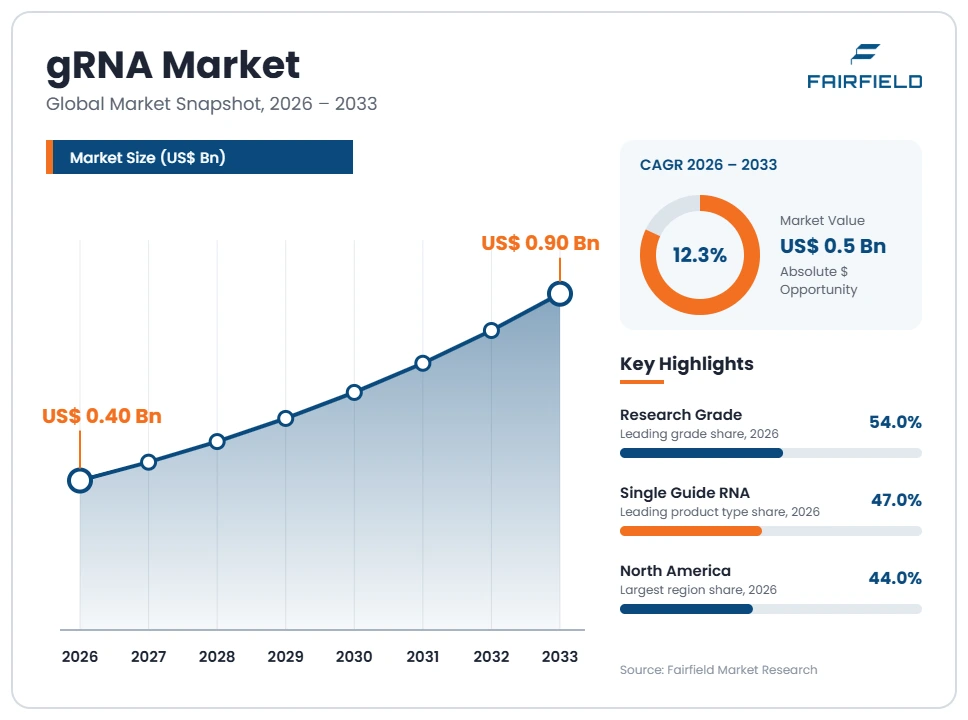
The global gRNA market size is expected to be valued at US$ 0.40 billion in 2026 and projected to reach US$ 0.90 billion by 2033, growing at a CAGR of 12.3% between 2026 and 2033.
Between 2020 and 2025 the market expanded at an estimated 14.8% CAGR, as academic screening work and preclinical pipelines absorbed rising volumes of synthetic guide RNA. Precise values are US$ 402 million in 2026 and US$ 904 million in 2033. The figures count three revenue pools together: research-grade catalogue reagents, high-purity preclinical and GMP-grade material, and custom guide design and synthesis services. They exclude nucleases, delivery vehicles and editing instruments. Three factors carry the forecast: the movement of CRISPR programmes into clinical manufacture, wider adoption of chemically modified single guide RNA, and a confirmed commercial pathway for gene-edited medicines. The direction of travel is toward fewer but far larger GMP orders, alongside flat pricing on catalogue research reagents.
Key Report Takeaways
- By Product Type: Single guide RNA held 47% share in 2026, while custom design and synthesis services are projected to expand at a 14.9% CAGR through 2033, driven by sponsor-specific sequences that cannot be served from catalogue stock.
- By Grade: Research grade held 54% share in 2026, while GMP grade is projected to expand at a 17.4% CAGR through 2033, driven by clinical manufacturing campaigns that consume gram-scale synthetic oligonucleotide under qualified specifications.
- By Application: Basic research and target discovery held 38% share in 2026, while therapeutic development and clinical manufacture is projected to expand at a 16.8% CAGR through 2033, supported by an established regulatory route for gene-edited medicines.
- By End User: Biotechnology and pharmaceutical companies held 41% share in 2026, while contract development and manufacturing organisations are projected to expand at a 15.6% CAGR through 2033, as sponsors outsource editing reagent qualification and batch release.
- By Geography: North America held 44% share in 2026, while Asia Pacific is projected to expand at a 15.4% CAGR through 2033, helped by national genome editing programmes and rapid growth in domestic oligonucleotide synthesis capacity.
Global gRNA Market Trends and Insights
Drivers Impact Analysis
Two demand forces carry most of the forecast growth in synthetic guide RNA, and they act on very different customer groups.
| Driver | Impact on CAGR Forecast | Geographic Relevance | Impact Timeline |
| Movement of CRISPR programmes into GMP clinical manufacture | High | North America, Europe | Medium term (2–4 years) |
| Expansion of pooled CRISPR screening in drug discovery | Medium | North America, Asia Pacific | Short term (≤2 years) |
Clinical Manufacturing Shifts gRNA Buying From Vials to Gram-Scale GMP Contracts
Clinical-stage genome editing programmes are moving guide RNA purchasing from catalogue vials to long-term GMP supply contracts. One ex vivo cell therapy campaign can consume grams of synthetic single guide RNA, against the milligram quantities that a research laboratory orders in a year. That shift lifts revenue per customer sharply, because GMP-grade material is priced at a large multiple of research-grade equivalents and is bought under multi-year agreements with fixed specifications and audited change control.
The mechanism is regulatory as much as technical. Once national regulators approved a CRISPR-based gene-edited therapy, the guide RNA used in manufacture became a critical starting material requiring documented synthesis, impurity profiling and stability data. Sponsors qualify suppliers early and rarely switch, so volumes concentrate on the few oligonucleotide manufacturers holding ICH Q7 compliant capacity and sterile fill capability under EU GMP Annex 1.
Pooled CRISPR Screening Keeps Guide RNA Library Volumes Rising in Drug Discovery
Pooled CRISPR screening has become a standard target discovery method, and it consumes guide RNA in bulk rather than by the construct. A genome-wide knockout library needs tens of thousands of distinct sequences, and screens are repeated across cell models, timepoints and arms. This creates steady, repeatable reagent demand that is far less sensitive to clinical trial timelines than therapeutic supply, which stabilises revenue for catalogue vendors during slow biotech funding cycles.
The causal change is the industrialisation of functional genomics inside pharmaceutical research. Target identification teams now run arrayed and pooled formats side by side, combine knockout with CRISPR interference and activation, and feed results into internal data platforms. Each of those formats needs its own guide design, synthesis chemistry and quality threshold, which expands orders for libraries, controls and design software subscriptions alike.
Restraints Impact Analysis
Two constraints hold back faster conversion of genome editing interest into guide RNA revenue.
| Restraint | Impact on CAGR Forecast | Geographic Relevance | Impact Timeline |
| Delivery limits outside liver and ex vivo cells | High | Global | Long term (≥4 years) |
| Off-target assessment and characterisation requirements | Medium | North America, Europe | Medium term (2–4 years) |
Delivery Bottlenecks Outside Liver and Ex Vivo Cells Cap Therapeutic gRNA Volumes
The real limit on therapeutic guide RNA volume is delivery, not guide design. Editing works reliably in cells taken out of the body and in hepatocytes reached by lipid nanoparticles, but reaching muscle, lung, central nervous system or solid tumour tissue remains unsolved at scale. Because indication breadth drives total grams consumed, a narrow delivery envelope keeps the addressable therapeutic reagent pool small even when guide design itself is routine and inexpensive.
The underlying cause is biodistribution and manufacturing cost in the delivery layer rather than in the oligonucleotide. Lipid nanoparticle formulations accumulate in liver after systemic dosing, and viral vector capacity is expensive, batch-limited and tied to long release testing cycles. Until tissue-targeted carriers mature, sponsors restrict programmes to a handful of indications, and guide RNA suppliers see fewer commercial-scale campaigns than pipeline counts suggest.
Off-Target Characterisation Requirements Lengthen gRNA Qualification and Release Cycles
Regulatory expectations for off-target assessment slow the point at which a guide RNA sequence becomes a revenue-generating GMP order. Sponsors must show nomination rationale, computational prediction, biochemical mapping and cell-based confirmation before a candidate is locked. Each additional study delays supplier qualification, and sequences that fail characterisation are abandoned after material has already been synthesised, so suppliers absorb unrecovered development work on a share of programmes.
The specific cost source is analytical, not synthetic. High-purity analysis, mass confirmation, residual solvent and endotoxin testing, plus stability programmes for each sequence, add fixed costs per batch that do not fall with volume. The U.S. Food and Drug Administration guidance on human gene therapy products incorporating genome editing and the European Union Advanced Therapy Medicinal Products framework both set documentation depth that smaller synthesis houses struggle to fund.
Market Opportunities
Dedicated GMP Oligonucleotide Capacity Opens a High-Value gRNA Supply Pool
Dedicated GMP synthesis capacity for guide RNA is the clearest untapped revenue pool in this market. Research-grade material is close to a commodity sold on price and turnaround, but GMP-grade guide RNA carries very high price per gram and lead times measured in months. Suppliers that add qualified suites, sterile handling and validated analytical methods can convert low-margin catalogue relationships into contracted manufacturing revenue with far better retention.
Capture favours oligonucleotide manufacturers and contract development and manufacturing organisations that already hold ICH Q7 compliant plants, rather than new entrants. Demand comes from cell therapy sponsors, in vivo editing developers and the academic translational centres that run early-phase trials. Capacity investment announced across synthetic oligonucleotide manufacturing supports the shift, and buyers increasingly ask for dual-site supply to remove single-source risk from clinical programmes.
Agricultural and Industrial Genome Editing Builds a Non-Clinical gRNA Revenue Pool
Agricultural and industrial genome editing is an emerging revenue pool that sits outside the clinical cycle entirely. Crop trait development, livestock breeding, microbial strain engineering for enzymes and biomanufacturing all use guide RNA at research and pilot scale. These buyers need reliable, well-characterised material rather than GMP documentation, which suits existing high-purity preclinical production lines and improves utilisation between therapeutic campaigns.
Seed and crop science companies, industrial biotechnology firms and national agricultural research institutes are positioned to create this demand. Regulatory treatment supports it: several jurisdictions assess gene-edited plants carrying no foreign DNA under lighter frameworks than transgenic organisms, which shortens development timelines and encourages more editing cycles per programme. Suppliers offering guide design services, validated sequence libraries for major crop genomes and bulk pricing are best placed to win this work.
Segment Analysis
- By Product Type: Single Guide RNA Leads While Custom Synthesis Services Gain Momentum
Single guide RNA held 47% of revenue in 2026, because the fused format is simpler to order, store and transfect than annealed two-part systems. Most protocols now default to it, and catalogue availability across common model organisms keeps repeat purchasing high. Two-part crRNA–tracrRNA remains preferred where laboratories reuse a universal tracrRNA across many targets to cut cost per experiment. Custom design and synthesis services are the fastest-growing product line at a 14.9% CAGR through 2033, since therapeutic and agricultural sequences are programme-specific and cannot be served from stock. Guide RNA libraries hold a stable niche in pooled screening. The implication is a widening margin gap: catalogue single guide RNA competes on price and shipping speed, while custom work is sold on design expertise, chemistry options and documentation quality.
- By Grade: Research Grade Dominates Volume as GMP Grade Drives Value Growth
Research grade accounted for 54% of 2026 revenue, reflecting the very large number of academic, government and industrial laboratories that buy small quantities frequently. Prices here have fallen steadily and turnaround is now measured in days, so the segment behaves like a reagent commodity. High-purity preclinical grade bridges discovery and clinical work, supplying toxicology and process development studies. GMP grade is the growth engine at a 17.4% CAGR through 2033, because clinical and commercial manufacture requires qualified starting material with full traceability. One gram of GMP guide RNA can outvalue thousands of research vials. The business implication is clear: unit volumes will keep sitting in research grade, but the revenue mix tilts toward GMP, and suppliers without qualified capacity face shrinking share of the profitable end.
- By Application: Basic Research Holds Share While Therapeutic Manufacture Scales Fastest
Basic research and target discovery represented 38% of 2026 revenue, supported by sustained public funding for functional genomics and by the breadth of CRISPR use across cell biology. Drug discovery and screening follows, with cell line engineering and bioproduction supplying edited production hosts for biologics. Therapeutic development and clinical manufacture is the fastest-growing application at a 16.8% CAGR through 2033, following regulatory approval of a CRISPR-based gene-edited therapy that proved the class can reach patients. Agricultural biotechnology adds steady non-clinical volume. The commercial implication is that forecasting this market from publication counts is misleading. Revenue now tracks the number of programmes entering manufacture and the grams each consumes, which concentrates growth among suppliers serving regulated customers rather than catalogue buyers.
- By End User: Biopharmaceutical Companies Lead and Contract Manufacturers Grow Quickest
Biotechnology and pharmaceutical companies held 41% of 2026 revenue, since they run the largest internal screening operations and fund the clinical programmes that consume high-grade material. Academic and government research institutes remain the broadest customer base by headcount, though average order values are small. Contract development and manufacturing organisations are expanding fastest at a 15.6% CAGR through 2033, as sponsors outsource reagent qualification, analytical release and fill operations rather than build them. Agricultural and industrial biotechnology users round out demand. For suppliers, this changes the sales motion: contract manufacturers buy against validated specifications and audit supplier quality systems directly, so technical documentation, second-source availability and consistent impurity profiles now matter more than list price or next-day delivery. Suppliers selling only to catalogue buyers will find growth harder to sustain.
Geography Analysis
- Which Region Is Leading the gRNA Market?
North America is leading the guide RNA market with 44% share in 2026, built on the deepest concentration of genome editing companies, academic centres and oligonucleotide manufacturing capacity. The United States supplies most of that demand, with Canada contributing through university research networks. Clinical programmes based in Boston, the San Francisco Bay Area and North Carolina account for a large share of high-grade material consumption. The U.S. Food and Drug Administration guidance on gene therapy products incorporating genome editing gives sponsors predictable characterisation expectations, which shortens supplier qualification. The main barrier is biotech funding volatility, which has slowed early-stage programme starts. The clearest regional opportunity is onshore GMP oligonucleotide capacity, as sponsors seek domestic supply to reduce lead times and simplify regulatory inspection logistics for commercial manufacture.
- Europe Anchors Guide RNA Demand in Advanced Therapy Manufacturing Standards
Europe holds 27% share in 2026, with demand concentrated in Germany, the United Kingdom, France, Switzerland and the Netherlands. The region’s strength is regulated manufacture rather than reagent volume. Regulation (EC) No 1394/2007 on Advanced Therapy Medicinal Products, together with EU GMP Annex 1 for sterile manufacture, sets the documentation depth that suppliers must meet to serve clinical customers. National genomics initiatives and well-funded academic hospitals sustain preclinical ordering. The limiting factor is fragmented reimbursement, which delays commercial scale-up of approved gene-edited medicines and therefore the size of repeat manufacturing orders. The region’s opportunity lies in contract manufacturing: several established oligonucleotide producers are converting capacity to clinical grade, giving sponsors a European supply route that avoids cross-border shipping of temperature-sensitive material.
- Which Region Is Growing Fastest in the gRNA Market?
Asia Pacific is growing fastest at a 15.4% CAGR between 2026 and 2033, from a 21% base share in 2026. China drives the bulk of that expansion through state-backed life science infrastructure and a large domestic base of synthesis houses that compete aggressively on price. Japan and South Korea contribute regulated demand through advanced therapy frameworks and strong contract manufacturing sectors, while India, Singapore and Australia add research volume. Agricultural genome editing is a meaningful second engine, with crop trait programmes consuming design services and bulk guide RNA. The structural barrier is quality perception: international sponsors still audit regional suppliers closely before qualifying them. The opportunity is import substitution, as local manufacturers upgrade from research grade toward preclinical and clinical specifications.
- Latin America Builds Guide RNA Demand From Agricultural Editing Programmes
Latin America accounts for 4% share in 2026, with Brazil, Argentina, Chile and Mexico forming the active base. Demand is weighted toward agricultural and veterinary genome editing rather than clinical work, reflecting the region’s large crop science and livestock sectors. Regulatory agencies in Brazil and Argentina assess gene-edited organisms without foreign DNA under lighter frameworks than transgenic products, which encourages more editing cycles per research programme. Barriers are real: customs delays for temperature-controlled shipments, limited local synthesis capacity and currency exposure on dollar-priced reagents all raise effective cost. Public university funding is also uneven between budget years. The opportunity is regional distribution partnerships that hold local stock, since turnaround time rather than list price is the binding constraint for most laboratories here.
- Middle East & Africa Genome Editing Capacity Creates Early Guide RNA Demand
Middle East & Africa holds 4% share in 2026, the smallest of the five regions but with a visible upward trend. Saudi Arabia, the United Arab Emirates and Israel account for most spending, supported by sovereign investment in biotechnology research institutes and precision medicine programmes. South Africa and Egypt anchor academic demand on the African continent, often through international research collaborations. Constraints are structural rather than scientific: limited cold-chain logistics, few local suppliers, small domestic clinical trial activity and dependence on imported reagents extend lead times considerably. Skilled workforce availability also restricts how quickly new laboratories reach productive throughput. The opportunity sits in national genomics programmes, which fund sequencing and editing infrastructure together and create multi-year institutional purchasing rather than one-off grant-funded orders.
Competitive Landscape
The guide RNA market is moderately concentrated, and concentration differs sharply by grade. Research-grade supply is crowded, with dozens of synthesis houses competing on price, turnaround and ordering convenience, so switching costs are minimal. GMP-grade supply is far tighter, because qualified suites, validated analytical methods and inspection history take years to build. A handful of oligonucleotide manufacturers therefore hold most clinical volume. Consolidation has followed that logic, with large life science groups acquiring specialist synthesis capability to secure a position in regulated manufacture.
Competition is based on different factors at each end. Catalogue vendors compete on price per nanomole, delivery speed, design software quality and breadth of validated sequences across model organisms. Clinical suppliers compete on quality systems, impurity control, chemistry options such as 2’-O-methyl and phosphorothioate modification, scale capability and willingness to support regulatory filings. New entrants have come mainly from enzymatic and flow-chemistry synthesis approaches that aim to cut cost and solvent use at gram scale.
Strategic activity concentrates on capacity and capability rather than on market share. Established suppliers have added GMP suites, expanded analytical laboratories and integrated guide design software with ordering systems to lock in workflow users. Several have also extended into adjacent editing components, offering nucleases and messenger RNA alongside guide RNA so sponsors can qualify fewer vendors.
Strategic direction across the vendor base points the same way: move value from the sequence itself toward documentation, chemistry and supply assurance. Vendors increasingly position guide RNA as part of a qualified editing package, with design services and regulatory support bundled in, because the oligonucleotide alone is becoming difficult to differentiate.
Recent Industry Developments
- November 2023: The Medicines and Healthcare products Regulatory Agency in the United Kingdom authorised the first CRISPR-based gene-edited therapy anywhere in the world – establishing that guide-RNA-dependent medicines can reach a national market.
- December 2023: The U.S. Food and Drug Administration approved the first CRISPR-based gene-edited cell therapy in the United States – confirming that synthetic guide RNA is treated as a critical starting material with full characterisation expectations.
- January 2024: The U.S. Food and Drug Administration Center for Biologics Evaluation and Research issued final guidance on human gene therapy products incorporating genome editing – giving sponsors a stable reference for off-target assessment and manufacturing controls.
- February 2024: The European Commission granted conditional marketing authorisation for a CRISPR-based gene-edited therapy following European Medicines Agency review – extending the commercial pathway for the class into the European Union.
Companies Covered in the Report
- Integrated DNA Technologies
- Synthego Corporation
- Thermo Fisher Scientific Inc.
- Merck KGaA
- Agilent Technologies, Inc.
- GenScript Biotech Corporation
- Revvity, Inc.
- Aldevron
- Twist Bioscience Corporation
- TriLink BioTechnologies
- Bio-Synthesis, Inc.
- Creative Biogene
gRNA Market Report Scope
| Metric | Value |
| Study Period | 2020–2033 |
| Market Size 2026 | US$ 0.4 Billion |
| Market Size 2033 | US$ 0.9 Billion |
| CAGR 2026–2033 | 12.3% |
| Absolute Dollar Opportunity | US$ 0.5 Billion |
| Largest Market | North America (44% share in 2026) |
| Fastest-Growing Market | Asia Pacific (15.4% CAGR) |
| Market Concentration | Medium |
| Major Players | Integrated DNA Technologies, Thermo Fisher Scientific, Merck KGaA, Agilent Technologies, Synthego Corporation |
gRNA Market Segmentation
Product Type
- Single Guide RNA
- Two-Part crRNA–tracrRNA
- Guide RNA Libraries
- Custom Design and Synthesis Services
Grade
- Research Grade
- High-Purity Preclinical Grade
- GMP Grade
Application
- Basic Research and Target Discovery
- Drug Discovery and Screening
- Cell Line Engineering and Bioproduction
- Therapeutic Development and Clinical Manufacture
- Agricultural Biotechnology
End User
- Academic and Government Research Institutes
- Biotechnology and Pharmaceutical Companies
- Contract Development and Manufacturing Organisations
- Agricultural and Industrial Biotechnology Companies
Regions
- North America
- Europe
- Asia Pacific
- Latin America
- Middle East & Africa
- Executive Summary
- Global gRNA Market Snapshot
- Future Projections
- Key Report Takeaways
- Regional Snapshot
- Market Overview
- Market Definition and Report Scope
- Historical Trends 2020–2025
- Market Dynamics
- Drivers
- Clinical Manufacturing Shifts gRNA Buying From Vials to Gram-Scale GMP Contracts
- Pooled CRISPR Screening Keeps Guide RNA Library Volumes Rising in Drug Discovery
- Restraints
- Delivery Bottlenecks Outside Liver and Ex Vivo Cells Cap Therapeutic gRNA Volumes
- Off-Target Characterisation Requirements Lengthen gRNA Qualification and Release Cycles
- Market Opportunities
- Dedicated GMP Oligonucleotide Capacity Opens a High-Value gRNA Supply Pool
- Agricultural and Industrial Genome Editing Builds a Non-Clinical gRNA Revenue Pool
- Drivers
- Global gRNA Market Outlook, 2020–2033
- Global gRNA Market Outlook, by Product Type, Value (US$ Billion), 2020–2033
- Single Guide RNA
- Two-Part crRNA–tracrRNA
- Guide RNA Libraries
- Custom Design and Synthesis Services
- Global gRNA Market Outlook, by Grade, Value (US$ Billion), 2020–2033
- Research Grade
- High-Purity Preclinical Grade
- GMP Grade
- Global gRNA Market Outlook, by Application, Value (US$ Billion), 2020–2033
- Basic Research and Target Discovery
- Drug Discovery and Screening
- Cell Line Engineering and Bioproduction
- Therapeutic Development and Clinical Manufacture
- Agricultural Biotechnology
- Global gRNA Market Outlook, by End User, Value (US$ Billion), 2020–2033
- Academic and Government Research Institutes
- Biotechnology and Pharmaceutical Companies
- Contract Development and Manufacturing Organisations
- Agricultural and Industrial Biotechnology Companies
- Global gRNA Market Outlook, by Region, Value (US$ Billion), 2020–2033
- North America
- Europe
- Asia Pacific
- Latin America
- Middle East & Africa
- Global gRNA Market Outlook, by Product Type, Value (US$ Billion), 2020–2033
- North America gRNA Market Outlook, 2020–2033
- North America gRNA Market Outlook, by Product Type, Value (US$ Billion), 2020–2033
- Single Guide RNA
- Two-Part crRNA–tracrRNA
- Guide RNA Libraries
- Custom Design and Synthesis Services
- North America gRNA Market Outlook, by Grade, Value (US$ Billion), 2020–2033
- Research Grade
- High-Purity Preclinical Grade
- GMP Grade
- North America gRNA Market Outlook, by Application, Value (US$ Billion), 2020–2033
- Basic Research and Target Discovery
- Drug Discovery and Screening
- Cell Line Engineering and Bioproduction
- Therapeutic Development and Clinical Manufacture
- Agricultural Biotechnology
- North America gRNA Market Outlook, by End User, Value (US$ Billion), 2020–2033
- Academic and Government Research Institutes
- Biotechnology and Pharmaceutical Companies
- Contract Development and Manufacturing Organisations
- Agricultural and Industrial Biotechnology Companies
- North America gRNA Market Outlook, by Country, Value (US$ Billion), 2020–2033
- United States gRNA Market Outlook, by Product Type, 2020–2033
- United States gRNA Market Outlook, by Grade, 2020–2033
- United States gRNA Market Outlook, by Application, 2020–2033
- United States gRNA Market Outlook, by End User, 2020–2033
- Canada gRNA Market Outlook, by Product Type, 2020–2033
- Canada gRNA Market Outlook, by Grade, 2020–2033
- Canada gRNA Market Outlook, by Application, 2020–2033
- Canada gRNA Market Outlook, by End User, 2020–2033
- North America gRNA Market Outlook, by Product Type, Value (US$ Billion), 2020–2033
- Europe gRNA Market Outlook, 2020–2033
- Europe gRNA Market Outlook, by Product Type, Value (US$ Billion), 2020–2033
- Single Guide RNA
- Two-Part crRNA–tracrRNA
- Guide RNA Libraries
- Custom Design and Synthesis Services
- Europe gRNA Market Outlook, by Grade, Value (US$ Billion), 2020–2033
- Research Grade
- High-Purity Preclinical Grade
- GMP Grade
- Europe gRNA Market Outlook, by Application, Value (US$ Billion), 2020–2033
- Basic Research and Target Discovery
- Drug Discovery and Screening
- Cell Line Engineering and Bioproduction
- Therapeutic Development and Clinical Manufacture
- Agricultural Biotechnology
- Europe gRNA Market Outlook, by End User, Value (US$ Billion), 2020–2033
- Academic and Government Research Institutes
- Biotechnology and Pharmaceutical Companies
- Contract Development and Manufacturing Organisations
- Agricultural and Industrial Biotechnology Companies
- Europe gRNA Market Outlook, by Country, Value (US$ Billion), 2020–2033
- Germany gRNA Market Outlook, by Product Type, 2020–2033
- Germany gRNA Market Outlook, by Grade, 2020–2033
- Germany gRNA Market Outlook, by Application, 2020–2033
- Germany gRNA Market Outlook, by End User, 2020–2033
- United Kingdom gRNA Market Outlook, by Product Type, 2020–2033
- United Kingdom gRNA Market Outlook, by Grade, 2020–2033
- United Kingdom gRNA Market Outlook, by Application, 2020–2033
- United Kingdom gRNA Market Outlook, by End User, 2020–2033
- France gRNA Market Outlook, by Product Type, 2020–2033
- France gRNA Market Outlook, by Grade, 2020–2033
- France gRNA Market Outlook, by Application, 2020–2033
- France gRNA Market Outlook, by End User, 2020–2033
- Switzerland gRNA Market Outlook, by Product Type, 2020–2033
- Switzerland gRNA Market Outlook, by Grade, 2020–2033
- Switzerland gRNA Market Outlook, by Application, 2020–2033
- Switzerland gRNA Market Outlook, by End User, 2020–2033
- Netherlands gRNA Market Outlook, by Product Type, 2020–2033
- Netherlands gRNA Market Outlook, by Grade, 2020–2033
- Netherlands gRNA Market Outlook, by Application, 2020–2033
- Netherlands gRNA Market Outlook, by End User, 2020–2033
- Europe gRNA Market Outlook, by Product Type, Value (US$ Billion), 2020–2033
- Asia Pacific gRNA Market Outlook, 2020–2033
- Asia Pacific gRNA Market Outlook, by Product Type, Value (US$ Billion), 2020–2033
- Single Guide RNA
- Two-Part crRNA–tracrRNA
- Guide RNA Libraries
- Custom Design and Synthesis Services
- Asia Pacific gRNA Market Outlook, by Grade, Value (US$ Billion), 2020–2033
- Research Grade
- High-Purity Preclinical Grade
- GMP Grade
- Asia Pacific gRNA Market Outlook, by Application, Value (US$ Billion), 2020–2033
- Basic Research and Target Discovery
- Drug Discovery and Screening
- Cell Line Engineering and Bioproduction
- Therapeutic Development and Clinical Manufacture
- Agricultural Biotechnology
- Asia Pacific gRNA Market Outlook, by End User, Value (US$ Billion), 2020–2033
- Academic and Government Research Institutes
- Biotechnology and Pharmaceutical Companies
- Contract Development and Manufacturing Organisations
- Agricultural and Industrial Biotechnology Companies
- Asia Pacific gRNA Market Outlook, by Country, Value (US$ Billion), 2020–2033
- China gRNA Market Outlook, by Product Type, 2020–2033
- China gRNA Market Outlook, by Grade, 2020–2033
- China gRNA Market Outlook, by Application, 2020–2033
- China gRNA Market Outlook, by End User, 2020–2033
- Japan gRNA Market Outlook, by Product Type, 2020–2033
- Japan gRNA Market Outlook, by Grade, 2020–2033
- Japan gRNA Market Outlook, by Application, 2020–2033
- Japan gRNA Market Outlook, by End User, 2020–2033
- South Korea gRNA Market Outlook, by Product Type, 2020–2033
- South Korea gRNA Market Outlook, by Grade, 2020–2033
- South Korea gRNA Market Outlook, by Application, 2020–2033
- South Korea gRNA Market Outlook, by End User, 2020–2033
- India gRNA Market Outlook, by Product Type, 2020–2033
- India gRNA Market Outlook, by Grade, 2020–2033
- India gRNA Market Outlook, by Application, 2020–2033
- India gRNA Market Outlook, by End User, 2020–2033
- Singapore gRNA Market Outlook, by Product Type, 2020–2033
- Singapore gRNA Market Outlook, by Grade, 2020–2033
- Singapore gRNA Market Outlook, by Application, 2020–2033
- Singapore gRNA Market Outlook, by End User, 2020–2033
- Australia gRNA Market Outlook, by Product Type, 2020–2033
- Australia gRNA Market Outlook, by Grade, 2020–2033
- Australia gRNA Market Outlook, by Application, 2020–2033
- Australia gRNA Market Outlook, by End User, 2020–2033
- Asia Pacific gRNA Market Outlook, by Product Type, Value (US$ Billion), 2020–2033
- Latin America gRNA Market Outlook, 2020–2033
- Latin America gRNA Market Outlook, by Product Type, Value (US$ Billion), 2020–2033
- Single Guide RNA
- Two-Part crRNA–tracrRNA
- Guide RNA Libraries
- Custom Design and Synthesis Services
- Latin America gRNA Market Outlook, by Grade, Value (US$ Billion), 2020–2033
- Research Grade
- High-Purity Preclinical Grade
- GMP Grade
- Latin America gRNA Market Outlook, by Application, Value (US$ Billion), 2020–2033
- Basic Research and Target Discovery
- Drug Discovery and Screening
- Cell Line Engineering and Bioproduction
- Therapeutic Development and Clinical Manufacture
- Agricultural Biotechnology
- Latin America gRNA Market Outlook, by End User, Value (US$ Billion), 2020–2033
- Academic and Government Research Institutes
- Biotechnology and Pharmaceutical Companies
- Contract Development and Manufacturing Organisations
- Agricultural and Industrial Biotechnology Companies
- Latin America gRNA Market Outlook, by Country, Value (US$ Billion), 2020–2033
- Brazil gRNA Market Outlook, by Product Type, 2020–2033
- Brazil gRNA Market Outlook, by Grade, 2020–2033
- Brazil gRNA Market Outlook, by Application, 2020–2033
- Brazil gRNA Market Outlook, by End User, 2020–2033
- Argentina gRNA Market Outlook, by Product Type, 2020–2033
- Argentina gRNA Market Outlook, by Grade, 2020–2033
- Argentina gRNA Market Outlook, by Application, 2020–2033
- Argentina gRNA Market Outlook, by End User, 2020–2033
- Chile gRNA Market Outlook, by Product Type, 2020–2033
- Chile gRNA Market Outlook, by Grade, 2020–2033
- Chile gRNA Market Outlook, by Application, 2020–2033
- Chile gRNA Market Outlook, by End User, 2020–2033
- Mexico gRNA Market Outlook, by Product Type, 2020–2033
- Mexico gRNA Market Outlook, by Grade, 2020–2033
- Mexico gRNA Market Outlook, by Application, 2020–2033
- Mexico gRNA Market Outlook, by End User, 2020–2033
- Latin America gRNA Market Outlook, by Product Type, Value (US$ Billion), 2020–2033
- Middle East & Africa gRNA Market Outlook, 2020–2033
- Middle East & Africa gRNA Market Outlook, by Product Type, Value (US$ Billion), 2020–2033
- Single Guide RNA
- Two-Part crRNA–tracrRNA
- Guide RNA Libraries
- Custom Design and Synthesis Services
- Middle East & Africa gRNA Market Outlook, by Grade, Value (US$ Billion), 2020–2033
- Research Grade
- High-Purity Preclinical Grade
- GMP Grade
- Middle East & Africa gRNA Market Outlook, by Application, Value (US$ Billion), 2020–2033
- Basic Research and Target Discovery
- Drug Discovery and Screening
- Cell Line Engineering and Bioproduction
- Therapeutic Development and Clinical Manufacture
- Agricultural Biotechnology
- Middle East & Africa gRNA Market Outlook, by End User, Value (US$ Billion), 2020–2033
- Academic and Government Research Institutes
- Biotechnology and Pharmaceutical Companies
- Contract Development and Manufacturing Organisations
- Agricultural and Industrial Biotechnology Companies
- Middle East & Africa gRNA Market Outlook, by Country, Value (US$ Billion), 2020–2033
- Saudi Arabia gRNA Market Outlook, by Product Type, 2020–2033
- Saudi Arabia gRNA Market Outlook, by Grade, 2020–2033
- Saudi Arabia gRNA Market Outlook, by Application, 2020–2033
- Saudi Arabia gRNA Market Outlook, by End User, 2020–2033
- United Arab Emirates gRNA Market Outlook, by Product Type, 2020–2033
- United Arab Emirates gRNA Market Outlook, by Grade, 2020–2033
- United Arab Emirates gRNA Market Outlook, by Application, 2020–2033
- United Arab Emirates gRNA Market Outlook, by End User, 2020–2033
- Israel gRNA Market Outlook, by Product Type, 2020–2033
- Israel gRNA Market Outlook, by Grade, 2020–2033
- Israel gRNA Market Outlook, by Application, 2020–2033
- Israel gRNA Market Outlook, by End User, 2020–2033
- South Africa gRNA Market Outlook, by Product Type, 2020–2033
- South Africa gRNA Market Outlook, by Grade, 2020–2033
- South Africa gRNA Market Outlook, by Application, 2020–2033
- South Africa gRNA Market Outlook, by End User, 2020–2033
- Egypt gRNA Market Outlook, by Product Type, 2020–2033
- Egypt gRNA Market Outlook, by Grade, 2020–2033
- Egypt gRNA Market Outlook, by Application, 2020–2033
- Egypt gRNA Market Outlook, by End User, 2020–2033
- Middle East & Africa gRNA Market Outlook, by Product Type, Value (US$ Billion), 2020–2033
- Competitive Landscape
- Market Concentration and Industry Leaders
- Competitive Differentiation
- Strategic Moves and Market Direction
- Recent Industry Developments
- Company Profiles
- Integrated DNA Technologies
- Synthego Corporation
- Thermo Fisher Scientific Inc.
- Merck KGaA
- Agilent Technologies, Inc.
- GenScript Biotech Corporation
- Revvity, Inc.
- Aldevron
- Twist Bioscience Corporation
- TriLink BioTechnologies
- Bio-Synthesis, Inc.
- Creative Biogene
- Appendix
- Research Methodology
- Report Assumptions
- Acronyms and Abbreviations
Product Type
- Single Guide RNA
- Two-Part crRNA–tracrRNA
- Guide RNA Libraries
- Custom Design and Synthesis Services
Grade
- Research Grade
- High-Purity Preclinical Grade
- GMP Grade
Application
- Basic Research and Target Discovery
- Drug Discovery and Screening
- Cell Line Engineering and Bioproduction
- Therapeutic Development and Clinical Manufacture
- Agricultural Biotechnology
End User
- Academic and Government Research Institutes
- Biotechnology and Pharmaceutical Companies
- Contract Development and Manufacturing Organisations
- Agricultural and Industrial Biotechnology Companies
Regions
- North America
- Europe
- Asia Pacific
- Latin America
- Middle East & Africa
Our Research Methodology
Considering the volatility of business today, traditional approaches to strategizing a game plan can be unfruitful if not detrimental. True ambiguity is no way to determine a forecast. A myriad of predetermined factors must be accounted for such as the degree of risk involved, the magnitude of circumstances, as well as conditions or consequences that are not known or unpredictable. To circumvent binary views that cast uncertainty, the application of market research intelligence to strategically posture, move, and enable actionable outcomes is necessary.
View Methodology
Quality Assured
Rigorous Validation Process

Confidentiality Assured
End-to-end Data Security

Custom Research Services
Tailored To Your Objectives
FAQs
The guide RNA market is valued at US$ 0.40 billion, or US$ 402 million, in 2026, covering research reagents, high-grade material and custom synthesis services.
The market is projected to reach US$ 0.90 billion by 2033, growing at a 12.3% CAGR and adding US$ 0.5 billion in absolute dollar opportunity.
Single guide RNA leads with 47% share in 2026, because the fused format simplifies ordering, storage and transfection compared with annealed two-part systems.
GMP grade is growing fastest at a 17.4% CAGR through 2033, as clinical manufacturing campaigns consume gram-scale material under qualified, fully documented specifications.
North America holds 44% share in 2026, supported by its concentration of genome editing companies, academic centres and qualified oligonucleotide manufacturing capacity.
Related Reports
Fluoroquinolones Market Size, Share, Insights, Competitive Landscape, and Forecast 2026 to 2033
The global fluoroquinolones market is valued at US$9.4 billion in 2026, reaching US$10.6 billion by 2033, growing at a 1.73% CAGR
Fabry Disease Treatment Market Size, Share, Insights, Competitive Landscape, and Forecast 2026 to 2033
The global Fabry disease treatment market is valued at US$2.2 billion in 2026, reaching US$3.3 billion by 2033, growing at a 6.0% CAGR
Pharmaceutical Glass Ampoules Market Size, Share, Insights, Competitive Landscape, and Forecast 2026 to 2033
The global pharmaceutical glass ampoules market is valued at US$1.4 billion in 2026, reaching US$1.9 billion by 2033, growing at a 4.5% CAGR
Mouth Ulcers Treatment Market Size, Share, Insights, Competitive Landscape, and Forecast 2026 to 2033
The global mouth ulcers treatment market is valued at US$1.2 billion in 2026, reaching US$1.7 billion by 2033, growing at a 5.1% CAGR
Mouth Ulcers Treatment Market Size, Share, Insights, Competitive Landscape, and Forecast 2026 to 2033
The global mouth ulcers treatment market is valued at US$1.2 billion in 2026, reaching US$1.7 billion by 2033, growing at a 5.1% CAGR
Ayurveda Medicine Market Size, Share, Insights, Competitive Landscape, and Forecast 2026 to 2033
The global ayurveda medicine market is valued at US$14.8 billion in 2026, reaching US$27.8 billion by 2033, growing at a 9.4% CAGR