



Fluoroquinolones Market
Fluoroquinolones Market Size, Share, Insights, Competitive Landscape, and Forecast 2026 to 2033
Fluoroquinolones Market Size and Trend Analysis
What Is the Growth Outlook for Fluoroquinolone Antibiotics?
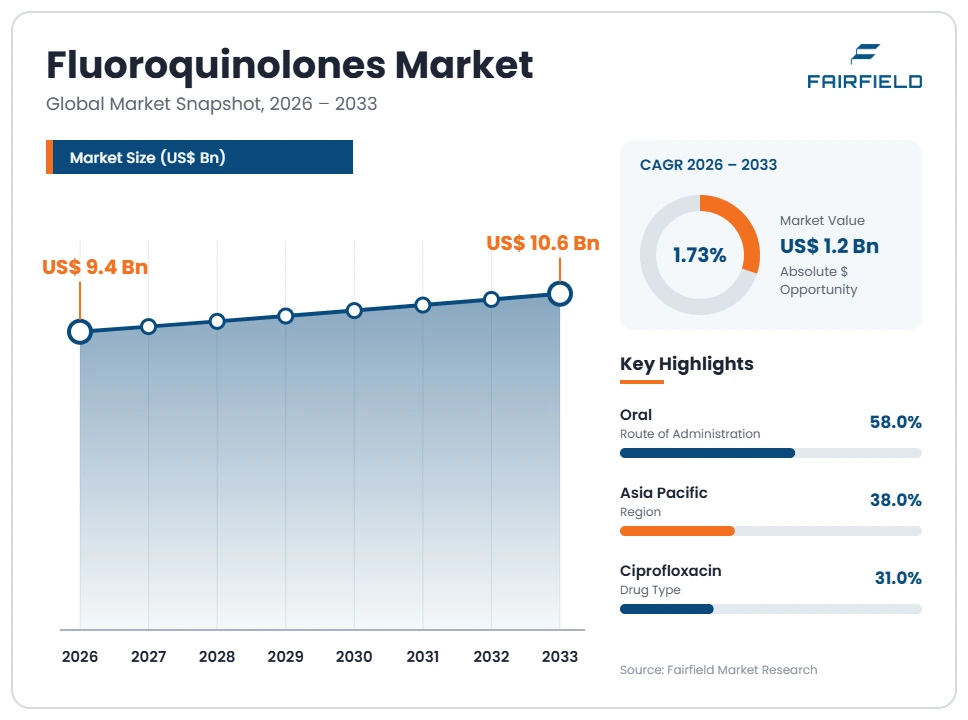
The global Fluoroquinolones market size is expected to be valued at US$ 9.4 billion in 2026 and projected to reach US$ 10.6 billion by 2033, growing at a CAGR of 1.73% between 2026 and 2033.
Between 2020 and 2025 the class expanded at roughly 1.1% a year, a subdued pace that reflects falling systemic prescribing in regulated markets. Three forces shape the outlook. Hospital demand for intravenous agents active against resistant Gram-negative organisms remains firm. Ophthalmic and otic formulations keep growing because they sit outside the systemic restrictions issued by the US Food and Drug Administration and the European Medicines Agency. Volume growth in lower-income health systems partly offsets contraction elsewhere. The direction of travel is a mature, price-deflated generic antibiotic class with narrow pockets of real expansion rather than broad-based growth.
Key Report Takeaways
- By Drug Type: Ciprofloxacin held 31% share in 2026, while delafloxacin is projected to expand at a 5.8% CAGR through 2033, driven by its narrow role in resistant acute bacterial skin and skin structure infections.
- By Route of Administration: Oral formulations held 58% share in 2026, while ophthalmic formulations are projected to expand at a 3.4% CAGR through 2033, because topical eye use was not covered by systemic prescribing restrictions.
- By Indication: Urinary tract infections held 27% share in 2026, while skin and soft tissue infections are projected to expand at a 3.8% CAGR through 2033, reflecting hospital use against methicillin-resistant organisms.
- By Distribution Channel: Retail pharmacies held 44% share in 2026, while online pharmacies are projected to expand at a 5.1% CAGR through 2033, supported by electronic prescription systems in Asia Pacific and Latin America.
- By Geography: Asia Pacific held 38% share in 2026, while Middle East & Africa is projected to expand at a 3.2% CAGR through 2033, on rising hospital admissions and wider public procurement of essential antibacterials.
Global Fluoroquinolones Market Trends and Insights
Drivers Impact Analysis
Two forces account for most of the incremental revenue in the quinolone antibacterials class through 2033.
| Driver | Impact on CAGR Forecast | Geographic Relevance | Impact Timeline |
| Resistant Gram-negative infections sustaining hospital intravenous use | Medium | North America, Europe, Asia Pacific | Medium term (2–4 years) |
| Expansion of ophthalmic and otic fluoroquinolone formulations | Medium | Global, led by Asia Pacific | Long term (≥4 years) |
Resistant Gram-Negative Infections Keep Hospital Fluoroquinolone Volumes Intact
Hospital demand for intravenous ciprofloxacin and levofloxacin remains firm because resistant Gram-negative infections leave prescribers with few usable options. These agents retain a defined place in complicated urinary tract infections, intra-abdominal infections, and hospital-acquired pneumonia. The inpatient base is the most defensible pool of value in the class because it was not the target of the outpatient restrictions regulators imposed.
The mechanism is clinical rather than commercial. Surveillance networks run by national public health agencies and the World Health Organization record rising resistance in Escherichia coli, Klebsiella pneumoniae, and Pseudomonas aeruginosa, shortening the list of effective oral agents. Where culture and susceptibility testing confirm activity, a fluoroquinolone is often the only oral drug that allows a patient to be discharged early. That intravenous-to-oral step-down role protects injectable and high-dose oral volumes even while total prescriptions decline.
Ophthalmic and Otic Formulations Grow Outside Systemic Quinolone Restrictions
Ophthalmic and otic fluoroquinolones are the clearest growth line in the class because the regulatory actions that curtailed systemic use did not extend to them. Eye drops containing moxifloxacin, ofloxacin, and levofloxacin are standard in cataract surgery prophylaxis, bacterial conjunctivitis, and corneal ulcer treatment. Ear drops are widely used in otitis externa. Both carry higher unit prices than commodity oral tablets.
The underlying cause is surgical volume. Cataract procedures are among the most frequently performed operations worldwide, and each episode typically involves a perioperative topical antibacterial course. Ageing populations in Japan, China, and Western Europe keep raising procedure counts, while public eye-care programmes in India expand access. Because topical delivery produces minimal systemic exposure, the tendon, nerve, and aortic warnings attached to oral and injectable products do not constrain this segment.
Restraints Impact Analysis
Two structural constraints hold the fluoroquinolone antibiotics class close to flat in its historically largest markets.
| Restraint | Impact on CAGR Forecast | Geographic Relevance | Impact Timeline |
| Regulatory boxed warnings and stewardship limits on systemic prescribing | High | North America, Europe | Short term (≤2 years) |
| Generic price erosion across off-patent oral and injectable products | High | Global | Medium term (2–4 years) |
Boxed Warnings and Stewardship Rules Have Permanently Cut Systemic Prescribing
Regulatory restriction is the single largest limit on this market. The US Food and Drug Administration advised against systemic fluoroquinolones for uncomplicated urinary tract infection, acute sinusitis, and acute bronchitis where other options exist, citing disabling and potentially irreversible reactions involving tendons, muscles, joints, and the nervous system. The agency later added warnings on aortic aneurysm and dissection. Comparable EU-wide restrictions followed a referral review by the European Medicines Agency.
The cause is a documented safety profile rather than a commercial setback. Because the restricted indications were high-volume primary care diagnoses, removing them cut prescription counts far more than it cut revenue. National antimicrobial stewardship programmes reinforce the effect by setting prescribing targets, and the World Health Organization AWaRe classification places this class in the Watch group, which health systems are asked to use sparingly.
Commodity Generic Pricing Compresses Fluoroquinolone Manufacturer Margins
Price erosion limits the revenue that remaining volume can generate. Almost every molecule in the class is off patent, so ciprofloxacin, levofloxacin, ofloxacin, and norfloxacin compete as commodities. Tender-based public procurement in Europe, India, and Brazil regularly awards contracts on unit price alone, and many oral courses now sell for less than a dollar. Rising volumes in emerging markets therefore translate into very little additional value.
The specific cost pressure sits in active pharmaceutical ingredient supply and compliance. Fluoroquinolone intermediates are concentrated in a small number of Chinese and Indian plants, leaving converters exposed to input price swings they cannot pass on. Regulatory inspection remediation, serialisation, and nitrosamine impurity testing all add fixed cost per batch. Several manufacturers have exited low-margin oral presentations rather than fund these requirements.
Market Opportunities
Two revenue pools remain genuinely underexploited within the global fluoroquinolone antibacterials landscape.
Resistant Infection Niches Open a Premium Pool for Newer Fluoroquinolones
The resistant-infection niche is the only part of this class where premium pricing is realistic. Newer agents such as delafloxacin are positioned for acute bacterial skin and skin structure infections where both Gram-positive and Gram-negative coverage is needed, including activity against methicillin-resistant Staphylococcus aureus. Hospital formularies will pay branded prices for a reserve option, which is impossible in the commodity oral segment.
Capture belongs to specialty pharmaceutical firms with hospital sales infrastructure and infectious disease medical affairs teams. The demand comes from tertiary hospitals, emergency departments, and antimicrobial stewardship committees that need a documented alternative when first-line therapy fails. Pull incentives and reimbursement reforms for reserve antibacterials, debated across North America and Europe, would support this pool further. Diagnostic stewardship and faster susceptibility testing also help by identifying the patients for whom these agents are appropriate.
Companion Animal and Aquaculture Channels Form a Separate Veterinary Pool
Veterinary use is a distinct revenue pool with its own regulatory boundaries. Enrofloxacin, marbofloxacin, and pradofloxacin are established in companion animal medicine for skin, urinary, and respiratory infections, where owner willingness to pay supports branded pricing. This pool is structurally separate from human generics and is not exposed to the same tender-driven deflation.
Animal health divisions of diversified pharmaceutical companies and dedicated veterinary firms are best placed to capture it. Demand comes from companion animal clinics in urban Asia Pacific and Latin America, where pet ownership and veterinary spending are climbing. The limits are clear and worth stating: several jurisdictions, including the European Union, restrict fluoroquinolone use in food-producing animals, and routine prophylactic group treatment is prohibited there. Growth therefore concentrates in companion animals and in aquaculture markets with lighter rules.
Segment Analysis
- By Drug Type: Ciprofloxacin Leads While Delafloxacin Grows From a Small Base
Ciprofloxacin held 31% of the global fluoroquinolones market in 2026, the largest share of any molecule. Its position rests on decades of clinical familiarity, inclusion in national essential medicines lists, oral and intravenous availability, and the lowest unit cost in the class. Levofloxacin follows at roughly 24%, supported by respiratory indications, while moxifloxacin, ofloxacin, and norfloxacin divide most of the remainder.
Delafloxacin is the fastest-growing molecule at a 5.8% CAGR through 2033, although it starts from a very small revenue base. Its growth comes from hospital use in resistant skin and skin structure infections rather than from outpatient prescribing. For manufacturers the implication is sharp: volume sits with the old molecules and margin sits with the newest one. Portfolio value increasingly depends on holding low-cost scale in ciprofloxacin while selectively entering reserve-antibacterial niches.
- By Route of Administration: Oral Dominance Persists as Ophthalmic Delivery Accelerates
Oral formulations accounted for 58% of 2026 revenue, the leading route by a wide margin. Tablets and suspensions remain the default for outpatient therapy and for intravenous-to-oral step-down in hospitals, and they carry the lowest cost of goods. Intravenous products hold about 22%, concentrated in inpatient care, while otic and other topical presentations make up the balance.
Ophthalmic formulations are the fastest-growing route at a 3.4% CAGR, expanding from roughly 14% of revenue in 2026. Cataract surgery prophylaxis, bacterial conjunctivitis, and corneal infection drive this demand, and single-dose preservative-free presentations are gaining ground. Because topical ocular use produces limited systemic exposure, these ophthalmic fluoroquinolones were untouched by the systemic prescribing restrictions. The business implication is that sterile ophthalmic manufacturing capability, not oral tableting scale, now separates growing suppliers from shrinking ones.
- By Indication: Urinary Tract Infections Hold Share as Skin Infections Expand Fastest
Urinary tract infections represented 27% of fluoroquinolone use in 2026, the leading indication group. Complicated and catheter-associated cases, along with pyelonephritis, sustain this position even though regulators advised against routine use in uncomplicated cystitis. Respiratory tract infections follow at about 22%, mainly in exacerbations of chronic obstructive pulmonary disease and hospital-acquired pneumonia where culture results justify the choice.
Skin and soft tissue infections are the fastest-growing indication at a 3.8% CAGR, supported by hospital use against resistant organisms and by the entry of newer agents designed for that setting. Gastrointestinal, ophthalmic, and bone and joint uses complete the picture. The implication for suppliers is that indication mix now determines pricing power. Infections treated in hospital after susceptibility testing hold value, while community indications continue to migrate toward narrower-spectrum alternatives recommended by stewardship guidance.
- By Distribution Channel: Retail Pharmacies Lead While Online Dispensing Scales Quickly
Retail pharmacies dispensed 44% of fluoroquinolone volume by value in 2026, reflecting the class’s outpatient history and its position on reimbursement formularies. Hospital pharmacies hold about 34% and command a higher revenue per unit because they purchase injectables and newer branded agents. Veterinary and animal health channels account for a smaller but more profitable slice.
Online pharmacies are the fastest-growing channel at a 5.1% CAGR through 2033. Electronic prescribing, chronic-care home delivery, and national digital health identifiers in India, China, and Brazil are moving refills online. Regulators in several countries have tightened verification rules for prescription-only antibacterials sold through digital channels, which favours licensed operators over informal sellers. For manufacturers the practical consequence is a shift in commercial spend from field detailing toward channel partnerships, pack-level traceability, and dispensing-data analytics.
Geography Analysis
- North America Records the Steepest Decline in Systemic Fluoroquinolone Prescribing
North America holds 22% of the global fluoroquinolones market in 2026 but posts the weakest growth at 0.3% CAGR, the direct result of regulatory action. The US Food and Drug Administration restricted systemic use in uncomplicated urinary tract infection, acute sinusitis, and acute bronchitis where alternatives exist, and added warnings covering tendon, nerve, central nervous system, and aortic risks. Health Canada issued parallel safety communications. Outpatient prescription counts fell materially across both countries.
What value remains is concentrated in hospitals and in ophthalmic products. United States inpatient formularies still stock intravenous ciprofloxacin and levofloxacin for culture-confirmed resistant infections, and ambulatory surgery centres consume large volumes of ophthalmic drops. The region’s opportunity lies in reserve-antibacterial reimbursement reform, which would make premium hospital agents commercially viable in a market otherwise defined by contraction.
- Europe Operates the Tightest Quinolone Restrictions and a Hard Tender Market
Europe accounts for 21% of global revenue in 2026 and grows at just 0.4% CAGR, held down by both regulation and procurement. The European Medicines Agency conducted an Article 31 referral review of quinolone and fluoroquinolone antibiotics, after which EU-wide restrictions removed several mild and self-limiting indications and required prescriber warnings on long-lasting, disabling adverse reactions. National regulators in Germany, France, and the Netherlands reinforced these limits through stewardship targets.
Procurement compounds the effect. Hospital and regional tenders in Germany, Italy, Spain, and the Nordic countries award on price, leaving suppliers with minimal margin on oral courses. The region does provide a template worth watching: national resistance surveillance and reporting are mature, and several countries link prescribing data to reimbursement. The emerging opportunity is in hospital ophthalmic and reserve injectable presentations rather than community oral products.
- Which Region Is Leading the Fluoroquinolones Market?
Asia Pacific leads the fluoroquinolones market with 38% share in 2026, the result of population scale, high infectious disease burden, and lighter prescribing restrictions. China and India together supply most of the world’s fluoroquinolone active pharmaceutical ingredient and also consume enormous domestic volumes. Japan, South Korea, Indonesia, and Vietnam add substantial hospital and retail demand, and public insurance expansion keeps antibacterials affordable.
The region also grows at a healthy 2.8% CAGR, second only to its fastest-growing peer. Growth is driven by hospital construction, rising cataract surgery volumes, and the expansion of online pharmacy networks. Resistance is a real constraint here: national surveillance in China and India documents high fluoroquinolone non-susceptibility in Escherichia coli, and stewardship programmes are tightening. The opportunity sits with domestic manufacturers scaling sterile ophthalmic and injectable capacity for both home and export demand.
- Latin America Sustains High Outpatient Antibacterial Volumes Despite Access Gaps
Latin America contributes 11% of global fluoroquinolone revenue in 2026 and expands at 2.4% CAGR. Brazil and Mexico generate most of the demand through large public health systems that procure essential antibacterials centrally, with Argentina, Colombia, and Chile adding steady retail volume. Outpatient use remains comparatively high, and local generic manufacturers supply most oral presentations at low cost.
Barriers are structural. Public tender pricing caps revenue, currency volatility raises the cost of imported active ingredients, and pharmacy dispensing without a prescription persists in parts of the region despite rules against it. Regulatory agencies in Brazil and Mexico have strengthened prescription controls and resistance surveillance in response. The clearest regional change is digital prescribing, which gives health ministries visibility over antibacterial consumption for the first time and supports targeted stewardship.
- Which Region Is Growing Fastest in the Fluoroquinolones Market?
Middle East & Africa is growing fastest in the fluoroquinolones market at 3.2% CAGR through 2033, from an 8% share in 2026. Growth reflects hospital capacity building in Saudi Arabia, the United Arab Emirates, Egypt, and South Africa, alongside donor-supported and government procurement of essential antibacterials across sub-Saharan health systems. Typhoid, shigellosis, and complicated urinary infections keep clinical demand high.
Constraints are significant. Procurement budgets are tight, cold chain and distribution infrastructure is uneven outside major cities, and substandard or falsified antibacterials remain a documented problem that the World Health Organization has repeatedly flagged. Local manufacturing is limited, so most supply is imported from Indian and Chinese producers. The main opportunity is regional manufacturing investment, supported by the African Medicines Agency framework, which could shorten supply lines and stabilise availability.
Competitive Landscape
The fluoroquinolones market has low concentration and behaves like a classic off-patent generic category. Every major molecule lost exclusivity years ago, so dozens of manufacturers across India, China, Europe, and the United States supply the same products. Bayer AG retains brand recognition from originator ciprofloxacin, but volume leadership belongs to large generic houses including Teva Pharmaceutical Industries, Sun Pharmaceutical Industries, Cipla Limited, Hikma Pharmaceuticals, Aurobindo Pharma, and Lupin Limited. Consolidation has occurred mainly through broader generics mergers rather than deals aimed at this class.
Competition runs on manufacturing cost, regulatory compliance record, and reliability of supply rather than on clinical differentiation. Tender success depends on being the lowest compliant bidder with an inspection history free of serious findings. Sterile capability is the real dividing line: firms able to make ophthalmic drops and injectables to current standards defend better margins than those limited to oral solids. Entrants are almost entirely Asian active ingredient producers moving downstream into finished dosage forms, while specialty firms such as Melinta Therapeutics compete on a narrow reserve-antibacterial position instead of on price.
Strategic activity concentrates on portfolio rationalisation and quality investment. Several companies have withdrawn from unprofitable oral presentations, redirecting capital toward sterile ophthalmic lines, complex injectables, and animal health. Capacity investment is flowing into inspection-ready sterile fill-finish sites in India and nitrosamine control programmes across the supply base. Animal health divisions, including those of Zoetis and diversified pharmaceutical groups, pursue companion animal formulations where branded pricing survives.
The strategic direction is consistent across the field. Suppliers are treating human systemic fluoroquinolones as a declining cash-generating base, funding selective expansion in ophthalmic, veterinary, and hospital reserve segments. Compliance capability and supply continuity now matter more to customers than brand, and procurement bodies increasingly weight security of supply alongside price.
Recent Industry Developments
- May 2016: The US Food and Drug Administration advised restricting systemic fluoroquinolones for uncomplicated urinary tract infection, acute sinusitis, and acute bronchitis where alternatives exist, following a review of disabling and potentially irreversible adverse effects – permanently removing the class’s highest-volume outpatient indications.
- June 2017: The World Health Organization introduced the AWaRe classification in its Model List of Essential Medicines, placing fluoroquinolones in the Watch group – establishing a global benchmark that steers national formularies toward restricted use.
- December 2018: The US Food and Drug Administration warned that systemic fluoroquinolones may increase the risk of aortic aneurysm and dissection in certain patients – further narrowing the eligible patient population in the largest branded market.
- March 2019: The European Commission adopted EU-wide restrictions on quinolone and fluoroquinolone antibiotics following the European Medicines Agency Article 31 referral review – aligning European prescribing limits with United States practice and accelerating the class’s revenue decline in the region.
- January 2022: Regulation (EU) 2019/6 on veterinary medicinal products became applicable, prohibiting routine prophylactic group treatment and reserving certain antimicrobials for human use – restructuring the European veterinary fluoroquinolone opportunity toward companion animals.
Companies Covered in the Report
- Bayer AG
- Merck & Co., Inc.
- Johnson & Johnson
- Pfizer Inc.
- Teva Pharmaceutical Industries
- Sun Pharmaceutical Industries
- Cipla Limited
- Dr. Reddy’s Laboratories
- Hikma Pharmaceuticals
- Aurobindo Pharma
- Lupin Limited
- Fresenius Kabi
- Melinta Therapeutics
- Alcon
- Zoetis
Fluoroquinolones Market Report Scope
| Metric | Value |
| Study Period | 2020–2033 |
| Market Size 2026 | US$ 9.4 Billion |
| Market Size 2033 | US$ 10.6 Billion |
| CAGR 2026–2033 | 1.73% |
| Absolute Dollar Opportunity | US$ 1.2 Billion |
| Largest Market | Asia Pacific, 38% share in 2026 |
| Fastest-Growing Market | Middle East & Africa, 3.2% CAGR |
| Market Concentration | Low |
| Major Players | Bayer AG, Teva Pharmaceutical Industries, Sun Pharmaceutical Industries, Cipla Limited |
Fluoroquinolones Market Segmentation
Drug Type
- Ciprofloxacin
- Levofloxacin
- Moxifloxacin
- Ofloxacin
- Norfloxacin
- Delafloxacin
- Other Fluoroquinolones
Route of Administration
- Oral
- Intravenous
- Ophthalmic
- Otic
- Topical
Indication
- Urinary Tract Infections
- Respiratory Tract Infections
- Skin and Soft Tissue Infections
- Gastrointestinal Infections
- Ophthalmic Infections
- Bone and Joint Infections
- Other Indications
Distribution Channel
- Retail Pharmacies
- Hospital Pharmacies
- Online Pharmacies
- Veterinary and Animal Health Channels
Regions
- North America
- Europe
- Asia Pacific
- Latin America
- Middle East & Africa
- Executive Summary
- Global Fluoroquinolones Market Snapshot
- Future Projections
- Key Report Takeaways
- Regional Snapshot
- Market Overview
- Market Definition and Report Scope
- Historical Trends 2020–2025
- Market Dynamics
- Drivers
- Resistant Gram-Negative Infections Keep Hospital Fluoroquinolone Volumes Intact
- Ophthalmic and Otic Formulations Grow Outside Systemic Quinolone Restrictions
- Restraints
- Boxed Warnings and Stewardship Rules Have Permanently Cut Systemic Prescribing
- Commodity Generic Pricing Compresses Fluoroquinolone Manufacturer Margins
- Market Opportunities
- Resistant Infection Niches Open a Premium Pool for Newer Fluoroquinolones
- Companion Animal and Aquaculture Channels Form a Separate Veterinary Pool
- Drivers
- Global Fluoroquinolones Market Outlook, 2020–2033
- Global Fluoroquinolones Market Outlook, by Drug Type, Value (US$ Billion), 2020–2033
- Ciprofloxacin
- Levofloxacin
- Moxifloxacin
- Ofloxacin
- Norfloxacin
- Delafloxacin
- Other Fluoroquinolones
- Global Fluoroquinolones Market Outlook, by Route of Administration, Value (US$ Billion), 2020–2033
- Oral
- Intravenous
- Ophthalmic
- Otic
- Topical
- Global Fluoroquinolones Market Outlook, by Indication, Value (US$ Billion), 2020–2033
- Urinary Tract Infections
- Respiratory Tract Infections
- Skin and Soft Tissue Infections
- Gastrointestinal Infections
- Ophthalmic Infections
- Bone and Joint Infections
- Other Indications
- Global Fluoroquinolones Market Outlook, by Distribution Channel, Value (US$ Billion), 2020–2033
- Retail Pharmacies
- Hospital Pharmacies
- Online Pharmacies
- Veterinary and Animal Health Channels
- Global Fluoroquinolones Market Outlook, by Region, Value (US$ Billion), 2020–2033
- North America
- Europe
- Asia Pacific
- Latin America
- Middle East & Africa
- Global Fluoroquinolones Market Outlook, by Drug Type, Value (US$ Billion), 2020–2033
- North America Fluoroquinolones Market Outlook, 2020–2033
- North America Fluoroquinolones Market Outlook, by Drug Type, Value (US$ Billion), 2020–2033
- Ciprofloxacin
- Levofloxacin
- Moxifloxacin
- Ofloxacin
- Norfloxacin
- Delafloxacin
- Other Fluoroquinolones
- North America Fluoroquinolones Market Outlook, by Route of Administration, Value (US$ Billion), 2020–2033
- Oral
- Intravenous
- Ophthalmic
- Otic
- Topical
- North America Fluoroquinolones Market Outlook, by Indication, Value (US$ Billion), 2020–2033
- Urinary Tract Infections
- Respiratory Tract Infections
- Skin and Soft Tissue Infections
- Gastrointestinal Infections
- Ophthalmic Infections
- Bone and Joint Infections
- Other Indications
- North America Fluoroquinolones Market Outlook, by Distribution Channel, Value (US$ Billion), 2020–2033
- Retail Pharmacies
- Hospital Pharmacies
- Online Pharmacies
- Veterinary and Animal Health Channels
- North America Fluoroquinolones Market Outlook, by Country, Value (US$ Billion), 2020–2033
- Canada Fluoroquinolones Market Outlook, by Drug Type, 2020–2033
- Canada Fluoroquinolones Market Outlook, by Route of Administration, 2020–2033
- Canada Fluoroquinolones Market Outlook, by Indication, 2020–2033
- Canada Fluoroquinolones Market Outlook, by Distribution Channel, 2020–2033
- United States Fluoroquinolones Market Outlook, by Drug Type, 2020–2033
- United States Fluoroquinolones Market Outlook, by Route of Administration, 2020–2033
- United States Fluoroquinolones Market Outlook, by Indication, 2020–2033
- United States Fluoroquinolones Market Outlook, by Distribution Channel, 2020–2033
- North America Fluoroquinolones Market Outlook, by Drug Type, Value (US$ Billion), 2020–2033
- Europe Fluoroquinolones Market Outlook, 2020–2033
- Europe Fluoroquinolones Market Outlook, by Drug Type, Value (US$ Billion), 2020–2033
- Ciprofloxacin
- Levofloxacin
- Moxifloxacin
- Ofloxacin
- Norfloxacin
- Delafloxacin
- Other Fluoroquinolones
- Europe Fluoroquinolones Market Outlook, by Route of Administration, Value (US$ Billion), 2020–2033
- Oral
- Intravenous
- Ophthalmic
- Otic
- Topical
- Europe Fluoroquinolones Market Outlook, by Indication, Value (US$ Billion), 2020–2033
- Urinary Tract Infections
- Respiratory Tract Infections
- Skin and Soft Tissue Infections
- Gastrointestinal Infections
- Ophthalmic Infections
- Bone and Joint Infections
- Other Indications
- Europe Fluoroquinolones Market Outlook, by Distribution Channel, Value (US$ Billion), 2020–2033
- Retail Pharmacies
- Hospital Pharmacies
- Online Pharmacies
- Veterinary and Animal Health Channels
- Europe Fluoroquinolones Market Outlook, by Country, Value (US$ Billion), 2020–2033
- Germany Fluoroquinolones Market Outlook, by Drug Type, 2020–2033
- Germany Fluoroquinolones Market Outlook, by Route of Administration, 2020–2033
- Germany Fluoroquinolones Market Outlook, by Indication, 2020–2033
- Germany Fluoroquinolones Market Outlook, by Distribution Channel, 2020–2033
- France Fluoroquinolones Market Outlook, by Drug Type, 2020–2033
- France Fluoroquinolones Market Outlook, by Route of Administration, 2020–2033
- France Fluoroquinolones Market Outlook, by Indication, 2020–2033
- France Fluoroquinolones Market Outlook, by Distribution Channel, 2020–2033
- Netherlands Fluoroquinolones Market Outlook, by Drug Type, 2020–2033
- Netherlands Fluoroquinolones Market Outlook, by Route of Administration, 2020–2033
- Netherlands Fluoroquinolones Market Outlook, by Indication, 2020–2033
- Netherlands Fluoroquinolones Market Outlook, by Distribution Channel, 2020–2033
- Italy Fluoroquinolones Market Outlook, by Drug Type, 2020–2033
- Italy Fluoroquinolones Market Outlook, by Route of Administration, 2020–2033
- Italy Fluoroquinolones Market Outlook, by Indication, 2020–2033
- Italy Fluoroquinolones Market Outlook, by Distribution Channel, 2020–2033
- Spain Fluoroquinolones Market Outlook, by Drug Type, 2020–2033
- Spain Fluoroquinolones Market Outlook, by Route of Administration, 2020–2033
- Spain Fluoroquinolones Market Outlook, by Indication, 2020–2033
- Spain Fluoroquinolones Market Outlook, by Distribution Channel, 2020–2033
- Nordic countries Fluoroquinolones Market Outlook, by Drug Type, 2020–2033
- Nordic countries Fluoroquinolones Market Outlook, by Route of Administration, 2020–2033
- Nordic countries Fluoroquinolones Market Outlook, by Indication, 2020–2033
- Nordic countries Fluoroquinolones Market Outlook, by Distribution Channel, 2020–2033
- Europe Fluoroquinolones Market Outlook, by Drug Type, Value (US$ Billion), 2020–2033
- Asia Pacific Fluoroquinolones Market Outlook, 2020–2033
- Asia Pacific Fluoroquinolones Market Outlook, by Drug Type, Value (US$ Billion), 2020–2033
- Ciprofloxacin
- Levofloxacin
- Moxifloxacin
- Ofloxacin
- Norfloxacin
- Delafloxacin
- Other Fluoroquinolones
- Asia Pacific Fluoroquinolones Market Outlook, by Route of Administration, Value (US$ Billion), 2020–2033
- Oral
- Intravenous
- Ophthalmic
- Otic
- Topical
- Asia Pacific Fluoroquinolones Market Outlook, by Indication, Value (US$ Billion), 2020–2033
- Urinary Tract Infections
- Respiratory Tract Infections
- Skin and Soft Tissue Infections
- Gastrointestinal Infections
- Ophthalmic Infections
- Bone and Joint Infections
- Other Indications
- Asia Pacific Fluoroquinolones Market Outlook, by Distribution Channel, Value (US$ Billion), 2020–2033
- Retail Pharmacies
- Hospital Pharmacies
- Online Pharmacies
- Veterinary and Animal Health Channels
- Asia Pacific Fluoroquinolones Market Outlook, by Country, Value (US$ Billion), 2020–2033
- China Fluoroquinolones Market Outlook, by Drug Type, 2020–2033
- China Fluoroquinolones Market Outlook, by Route of Administration, 2020–2033
- China Fluoroquinolones Market Outlook, by Indication, 2020–2033
- China Fluoroquinolones Market Outlook, by Distribution Channel, 2020–2033
- India Fluoroquinolones Market Outlook, by Drug Type, 2020–2033
- India Fluoroquinolones Market Outlook, by Route of Administration, 2020–2033
- India Fluoroquinolones Market Outlook, by Indication, 2020–2033
- India Fluoroquinolones Market Outlook, by Distribution Channel, 2020–2033
- Japan Fluoroquinolones Market Outlook, by Drug Type, 2020–2033
- Japan Fluoroquinolones Market Outlook, by Route of Administration, 2020–2033
- Japan Fluoroquinolones Market Outlook, by Indication, 2020–2033
- Japan Fluoroquinolones Market Outlook, by Distribution Channel, 2020–2033
- South Korea Fluoroquinolones Market Outlook, by Drug Type, 2020–2033
- South Korea Fluoroquinolones Market Outlook, by Route of Administration, 2020–2033
- South Korea Fluoroquinolones Market Outlook, by Indication, 2020–2033
- South Korea Fluoroquinolones Market Outlook, by Distribution Channel, 2020–2033
- Indonesia Fluoroquinolones Market Outlook, by Drug Type, 2020–2033
- Indonesia Fluoroquinolones Market Outlook, by Route of Administration, 2020–2033
- Indonesia Fluoroquinolones Market Outlook, by Indication, 2020–2033
- Indonesia Fluoroquinolones Market Outlook, by Distribution Channel, 2020–2033
- Vietnam Fluoroquinolones Market Outlook, by Drug Type, 2020–2033
- Vietnam Fluoroquinolones Market Outlook, by Route of Administration, 2020–2033
- Vietnam Fluoroquinolones Market Outlook, by Indication, 2020–2033
- Vietnam Fluoroquinolones Market Outlook, by Distribution Channel, 2020–2033
- Asia Pacific Fluoroquinolones Market Outlook, by Drug Type, Value (US$ Billion), 2020–2033
- Latin America Fluoroquinolones Market Outlook, 2020–2033
- Latin America Fluoroquinolones Market Outlook, by Drug Type, Value (US$ Billion), 2020–2033
- Ciprofloxacin
- Levofloxacin
- Moxifloxacin
- Ofloxacin
- Norfloxacin
- Delafloxacin
- Other Fluoroquinolones
- Latin America Fluoroquinolones Market Outlook, by Route of Administration, Value (US$ Billion), 2020–2033
- Oral
- Intravenous
- Ophthalmic
- Otic
- Topical
- Latin America Fluoroquinolones Market Outlook, by Indication, Value (US$ Billion), 2020–2033
- Urinary Tract Infections
- Respiratory Tract Infections
- Skin and Soft Tissue Infections
- Gastrointestinal Infections
- Ophthalmic Infections
- Bone and Joint Infections
- Other Indications
- Latin America Fluoroquinolones Market Outlook, by Distribution Channel, Value (US$ Billion), 2020–2033
- Retail Pharmacies
- Hospital Pharmacies
- Online Pharmacies
- Veterinary and Animal Health Channels
- Latin America Fluoroquinolones Market Outlook, by Country, Value (US$ Billion), 2020–2033
- Brazil Fluoroquinolones Market Outlook, by Drug Type, 2020–2033
- Brazil Fluoroquinolones Market Outlook, by Route of Administration, 2020–2033
- Brazil Fluoroquinolones Market Outlook, by Indication, 2020–2033
- Brazil Fluoroquinolones Market Outlook, by Distribution Channel, 2020–2033
- Mexico Fluoroquinolones Market Outlook, by Drug Type, 2020–2033
- Mexico Fluoroquinolones Market Outlook, by Route of Administration, 2020–2033
- Mexico Fluoroquinolones Market Outlook, by Indication, 2020–2033
- Mexico Fluoroquinolones Market Outlook, by Distribution Channel, 2020–2033
- Argentina Fluoroquinolones Market Outlook, by Drug Type, 2020–2033
- Argentina Fluoroquinolones Market Outlook, by Route of Administration, 2020–2033
- Argentina Fluoroquinolones Market Outlook, by Indication, 2020–2033
- Argentina Fluoroquinolones Market Outlook, by Distribution Channel, 2020–2033
- Colombia Fluoroquinolones Market Outlook, by Drug Type, 2020–2033
- Colombia Fluoroquinolones Market Outlook, by Route of Administration, 2020–2033
- Colombia Fluoroquinolones Market Outlook, by Indication, 2020–2033
- Colombia Fluoroquinolones Market Outlook, by Distribution Channel, 2020–2033
- Chile Fluoroquinolones Market Outlook, by Drug Type, 2020–2033
- Chile Fluoroquinolones Market Outlook, by Route of Administration, 2020–2033
- Chile Fluoroquinolones Market Outlook, by Indication, 2020–2033
- Chile Fluoroquinolones Market Outlook, by Distribution Channel, 2020–2033
- Latin America Fluoroquinolones Market Outlook, by Drug Type, Value (US$ Billion), 2020–2033
- Middle East & Africa Fluoroquinolones Market Outlook, 2020–2033
- Middle East & Africa Fluoroquinolones Market Outlook, by Drug Type, Value (US$ Billion), 2020–2033
- Ciprofloxacin
- Levofloxacin
- Moxifloxacin
- Ofloxacin
- Norfloxacin
- Delafloxacin
- Other Fluoroquinolones
- Middle East & Africa Fluoroquinolones Market Outlook, by Route of Administration, Value (US$ Billion), 2020–2033
- Oral
- Intravenous
- Ophthalmic
- Otic
- Topical
- Middle East & Africa Fluoroquinolones Market Outlook, by Indication, Value (US$ Billion), 2020–2033
- Urinary Tract Infections
- Respiratory Tract Infections
- Skin and Soft Tissue Infections
- Gastrointestinal Infections
- Ophthalmic Infections
- Bone and Joint Infections
- Other Indications
- Middle East & Africa Fluoroquinolones Market Outlook, by Distribution Channel, Value (US$ Billion), 2020–2033
- Retail Pharmacies
- Hospital Pharmacies
- Online Pharmacies
- Veterinary and Animal Health Channels
- Middle East & Africa Fluoroquinolones Market Outlook, by Country, Value (US$ Billion), 2020–2033
- Saudi Arabia Fluoroquinolones Market Outlook, by Drug Type, 2020–2033
- Saudi Arabia Fluoroquinolones Market Outlook, by Route of Administration, 2020–2033
- Saudi Arabia Fluoroquinolones Market Outlook, by Indication, 2020–2033
- Saudi Arabia Fluoroquinolones Market Outlook, by Distribution Channel, 2020–2033
- United Arab Emirates Fluoroquinolones Market Outlook, by Drug Type, 2020–2033
- United Arab Emirates Fluoroquinolones Market Outlook, by Route of Administration, 2020–2033
- United Arab Emirates Fluoroquinolones Market Outlook, by Indication, 2020–2033
- United Arab Emirates Fluoroquinolones Market Outlook, by Distribution Channel, 2020–2033
- Egypt Fluoroquinolones Market Outlook, by Drug Type, 2020–2033
- Egypt Fluoroquinolones Market Outlook, by Route of Administration, 2020–2033
- Egypt Fluoroquinolones Market Outlook, by Indication, 2020–2033
- Egypt Fluoroquinolones Market Outlook, by Distribution Channel, 2020–2033
- South Africa Fluoroquinolones Market Outlook, by Drug Type, 2020–2033
- South Africa Fluoroquinolones Market Outlook, by Route of Administration, 2020–2033
- South Africa Fluoroquinolones Market Outlook, by Indication, 2020–2033
- South Africa Fluoroquinolones Market Outlook, by Distribution Channel, 2020–2033
- Middle East & Africa Fluoroquinolones Market Outlook, by Drug Type, Value (US$ Billion), 2020–2033
- Competitive Landscape
- Market Concentration and Industry Leaders
- Competitive Differentiation
- Strategic Moves and Market Direction
- Recent Industry Developments
- Company Profiles
- Bayer AG
- Merck & Co., Inc.
- Johnson & Johnson
- Pfizer Inc.
- Teva Pharmaceutical Industries
- Sun Pharmaceutical Industries
- Cipla Limited
- Dr. Reddy's Laboratories
- Hikma Pharmaceuticals
- Aurobindo Pharma
- Lupin Limited
- Fresenius Kabi
- Melinta Therapeutics
- Alcon
- Zoetis
- Appendix
- Research Methodology
- Report Assumptions
- Acronyms and Abbreviations
Drug Type
- Ciprofloxacin
- Levofloxacin
- Moxifloxacin
- Ofloxacin
- Norfloxacin
- Delafloxacin
- Other Fluoroquinolones
Route of Administration
- Oral
- Intravenous
- Ophthalmic
- Otic
- Topical
Indication
- Urinary Tract Infections
- Respiratory Tract Infections
- Skin and Soft Tissue Infections
- Gastrointestinal Infections
- Ophthalmic Infections
- Bone and Joint Infections
- Other Indications
Distribution Channel
- Retail Pharmacies
- Hospital Pharmacies
- Online Pharmacies
- Veterinary and Animal Health Channels
Regions
- North America
- Europe
- Asia Pacific
- Latin America
- Middle East & Africa
Our Research Methodology
Considering the volatility of business today, traditional approaches to strategizing a game plan can be unfruitful if not detrimental. True ambiguity is no way to determine a forecast. A myriad of predetermined factors must be accounted for such as the degree of risk involved, the magnitude of circumstances, as well as conditions or consequences that are not known or unpredictable. To circumvent binary views that cast uncertainty, the application of market research intelligence to strategically posture, move, and enable actionable outcomes is necessary.
View Methodology
Quality Assured
Rigorous Validation Process

Confidentiality Assured
End-to-end Data Security

Custom Research Services
Tailored To Your Objectives
FAQs
The global fluoroquinolones market is valued at US$ 9.4 billion in 2026, reflecting a large prescription volume base combined with low generic unit pricing worldwide.
The market is projected to reach US$ 10.6 billion by 2033, growing at a 1.73% CAGR and adding an absolute dollar opportunity of US$ 1.2 billion.
Ciprofloxacin leads with 31% share in 2026, supported by essential medicines listings, dual oral and intravenous availability, and the lowest unit cost in the class.
Delafloxacin grows fastest among molecules at 5.8% CAGR, while Middle East & Africa is the fastest-expanding region at 3.2% CAGR through 2033.
Asia Pacific holds the largest share at 38% in 2026, driven by population scale, domestic manufacturing depth, and less restrictive prescribing than regulated Western markets.
Related Reports
Fabry Disease Treatment Market Size, Share, Insights, Competitive Landscape, and Forecast 2026 to 2033
The global Fabry disease treatment market is valued at US$2.2 billion in 2026, reaching US$3.3 billion by 2033, growing at a 6.0% CAGR
gRNA Market Size, Share, Insights, Competitive Landscape, and Forecast 2026 to 2033
The global gRNA market is valued at US$0.40 billion in 2026, reaching US$0.90 billion by 2033, growing at a 12.3% CAGR
Pharmaceutical Glass Ampoules Market Size, Share, Insights, Competitive Landscape, and Forecast 2026 to 2033
The global pharmaceutical glass ampoules market is valued at US$1.4 billion in 2026, reaching US$1.9 billion by 2033, growing at a 4.5% CAGR
Mouth Ulcers Treatment Market Size, Share, Insights, Competitive Landscape, and Forecast 2026 to 2033
The global mouth ulcers treatment market is valued at US$1.2 billion in 2026, reaching US$1.7 billion by 2033, growing at a 5.1% CAGR
Mouth Ulcers Treatment Market Size, Share, Insights, Competitive Landscape, and Forecast 2026 to 2033
The global mouth ulcers treatment market is valued at US$1.2 billion in 2026, reaching US$1.7 billion by 2033, growing at a 5.1% CAGR
Ayurveda Medicine Market Size, Share, Insights, Competitive Landscape, and Forecast 2026 to 2033
The global ayurveda medicine market is valued at US$14.8 billion in 2026, reaching US$27.8 billion by 2033, growing at a 9.4% CAGR