



Mouth Ulcers Treatment Market
Mouth Ulcers Treatment Market Size, Share, Insights, Competitive Landscape, and Forecast 2026 to 2033
Mouth Ulcers Treatment Market Size and Trend Analysis
How Fast Is the Mouth Ulcers Treatment Market Growing?
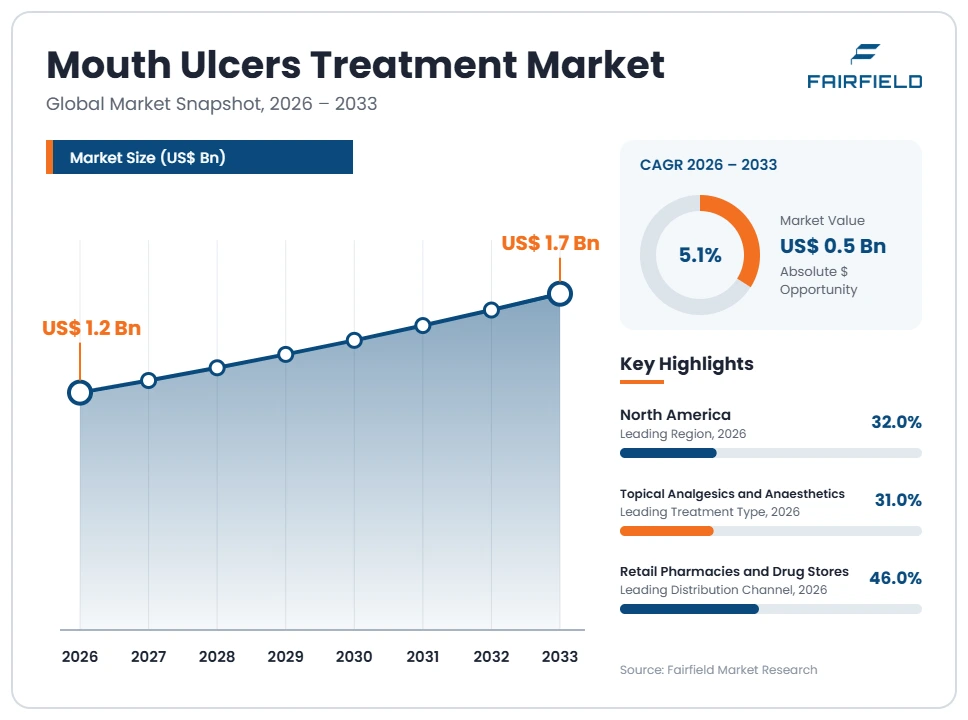
The global Mouth Ulcers Treatment market size is expected to be valued at US$ 1.2 billion in 2026 and projected to reach US$ 1.7 billion by 2033, growing at a CAGR of 5.1% between 2026 and 2033.
The category grew at about 4.3% annually from 2020 to 2025, reaching roughly US$ 1,140 million in 2025. Growth comes from three sources. Retail pharmacy distribution is widening in middle-income countries, bringing branded oral care remedies to new shoppers. Dosage-form innovation, mainly adhesive patches and film-forming gels, supports modest price increases in an otherwise flat category. Online pharmacy channels are lifting purchase frequency for discreet, low-value items. Overall direction is steady but unspectacular. This remains a low-value, high-volume consumer health category with limited product differentiation, strong private-label penetration and pricing pressure in mature retail markets.
Key Report Takeaways
- By Treatment Type: Topical analgesics and anaesthetics held 31% share in 2026, while protective barrier pastes and films are projected to expand at a 6.8% CAGR through 2033, driven by shoppers seeking longer relief between applications.
- By Dosage Form: Gels and pastes held 38% share in 2026, while patches and films are projected to expand at a 7.2% CAGR through 2033, driven by adhesion that survives eating and speaking better than viscous gels.
- By Prescription Mode: Over-the-counter products held 72% share in 2026, while prescription products are projected to expand at a 5.8% CAGR through 2033, driven by specialist management of severe and recurrent oral ulceration.
- By Distribution Channel: Retail pharmacies and drug stores held 46% share in 2026, while online pharmacies and e-commerce are projected to expand at an 8.4% CAGR through 2033, driven by subscription refills and discreet purchasing behaviour.
- By Geography: North America held 32% share in 2026, while Asia Pacific is projected to expand at a 7.3% CAGR through 2033, driven by organised retail pharmacy growth and rising branded oral care spending.
Global Mouth Ulcers Treatment Market Trends and Insights
Drivers Impact Analysis
Two commercial forces explain most of the forecast growth in oral ulcer relief products.
| Driver | Impact on CAGR Forecast | Geographic Relevance | Impact Timeline |
| Retail pharmacy and modern trade expansion in middle-income markets | High | Asia Pacific, Latin America, Middle East & Africa | Long term (≥4 years) |
| Shift from simple gels to barrier films and adhesive patches | Medium | North America, Europe | Medium term (2–4 years) |
Retail Pharmacy Expansion in Middle-Income Markets Widens Access to Oral Ulcer Remedies
Distribution growth, not clinical change, is the largest driver of volume in this category. Organised pharmacy chains and modern trade outlets are expanding rapidly in India, Indonesia, Vietnam, Brazil and Egypt. Each new outlet stocks a standard oral care set that includes a mouth ulcer gel or rinse. Shoppers who previously used home remedies or simply waited for healing now encounter a branded product at eye level during routine visits.
The mechanism is shelf availability combined with rising discretionary spending on self-care. Mouth ulcer products are inexpensive impulse purchases, typically bought without a consultation, so conversion depends heavily on physical presence. Regulators in several of these markets classify common topical anaesthetics and antiseptic rinses for general sale, which lets supermarkets and non-pharmacy retailers stock them. That broadens the addressable outlet base well beyond pharmacies.
Movement From Basic Gels to Barrier Films Lifts Average Selling Prices in Oral Ulcer Care
Format upgrading is the main way value grows faster than unit volume in this flat category. Protective barrier films, adhesive patches and film-forming gels sell at a clear premium over simple anaesthetic gels. Because they stay in place longer, shoppers perceive better value despite the higher price, and repeat purchase rates improve. Retailers support the shift because premium formats lift category margin without taking extra shelf space.
The underlying change is formulation and regulatory classification. Bioadhesive polymers such as hydroxypropyl cellulose and hyaluronic acid form a physical film over the lesion, acting mechanically rather than pharmacologically. In the European Union several such products are placed on the market as medical devices under the EU Medical Device Regulation (EU) 2017/745 rather than as medicines, which changes the evidence pathway and the claims that may be made.
Restraints Impact Analysis
Two structural limits keep this category small and hold back pricing power.
| Restraint | Impact on CAGR Forecast | Geographic Relevance | Impact Timeline |
| Self-limiting condition and modest evidence base for many products | High | Global | Long term (≥4 years) |
| Private-label penetration and low product differentiation | Medium | North America, Europe | Short term (≤2 years) |
Self-Limiting Ulcers and a Modest Evidence Base Cap Willingness to Pay
The clinical reality of the condition is the hardest ceiling on this market. Most mouth ulcers resolve without treatment within one to two weeks. No marketed product is curative, and none is established as preventing recurrence. Available options manage pain and protect the lesion surface while natural healing proceeds. Many shoppers therefore buy nothing, use the product for a day or two, or abandon it once discomfort eases.
The underlying cause is the evidence base itself. Systematic reviews of treatments for recurrent aphthous stomatitis consistently report small trials, inconsistent outcome measures and weak or uncertain benefit for several widely sold over-the-counter options. Regulators restrict claims accordingly, so marketing is limited to symptomatic relief language. Without a demonstrable effect on healing time or recurrence, manufacturers cannot justify premium pricing or sustained advertising investment at scale.
Private-Label Competition and Formula Similarity Compress Branded Margins
Low differentiation is the second restraint, and it directly erodes margin for branded manufacturers. Most over-the-counter oral ulcer products use a short list of well-known actives: benzocaine or lidocaine for pain, chlorhexidine or cetylpyridinium for antisepsis, and standard bioadhesive polymers for barrier products. Retailers can commission near-identical formulations and price them well below national brands, which caps what branded products can charge.
The cost source is reformulation and marketing, not manufacturing. Contract manufacturers produce gels, rinses and pastes cheaply at scale, so unit cost is low and similar for everyone. A branded player must fund shelf listing fees, advertising and pharmacist education to defend price, while a private-label equivalent carries none of that. In mature North America and Europe retail, store brands hold substantial share of the oral ulcer shelf.
Market Opportunities
Two revenue pools remain under-served in oral ulceration care.
Treatment-Induced Oral Mucositis Support Creates a Higher-Value Adjacent Pool
Supportive products for cancer treatment-related oral ulceration open a far higher-value pool than general consumer relief. Patients receiving chemotherapy or head and neck radiotherapy frequently develop extensive oral mucositis, and management runs for weeks under clinical supervision. Products sold into this setting command hospital and specialty pharmacy pricing rather than retail price points, and purchase volumes per patient are substantially larger than a single consumer tube.
Companies with medical device or prescription capability can capture this, since barrier rinses and film-forming gels in this setting are typically supplied through oncology units and specialist pharmacies. Demand is created by oncology supportive care protocols, which now treat mucositis management as a standard element of cancer care. Classification as a medical device under the EU Medical Device Regulation (EU) 2017/745 gives a defined route for mechanical-action barrier products.
Online Pharmacy and Subscription Channels Unlock Repeat Purchase in a Low-Involvement Category
Digital channels open incremental revenue that physical retail cannot easily reach in this category. Mouth ulcer products are discreet, low-cost and repeat-purchased by people with recurrent episodes, which suits subscription and auto-replenishment models. Online baskets also allow bundling with other oral care items, raising order value above the single-tube purchase typical in a pharmacy. Direct channels give brands first-party data on recurrence patterns that retail shelves never provide.
Branded consumer health companies and digital-first challengers can capture this pool, selling to adults with recurrent oral ulceration who already buy health products online. Supporting developments include the steady liberalisation of online pharmacy rules in India, China and parts of the European Union, plus marketplace logistics that finally make low-value single-item shipping economically workable for sellers at national scale rather than only in dense urban delivery zones.
Segment Analysis
- By Treatment Type: Topical Anaesthetics Lead While Barrier Products Gain Share
Topical analgesics and anaesthetics held 31% share in 2026, the largest treatment type because pain relief is the immediate reason people buy. Benzocaine, lidocaine and choline salicylate preparations act quickly, are cheaply manufactured and are widely available without a prescription. Protective barrier pastes and films are the fastest-growing type at a 6.8% CAGR through 2033. Their appeal is duration: a bioadhesive layer shields the lesion from food, salt and acid for hours rather than minutes, which shoppers experience as better value. Antiseptic and antimicrobial rinses retain a solid position, often used alongside other formats. Topical corticosteroids remain largely prescription-bound and clinician-directed. Cauterising agents and vitamin or supplement adjuncts stay niche. The business implication is that value growth depends on format benefits rather than new actives, since the pharmacology in oral ulcer relief has barely changed.
- By Dosage Form: Gels and Pastes Dominate as Patches and Films Expand Fastest
Gels and pastes held 38% share in 2026 because they are familiar, inexpensive, easy to apply with a fingertip and suitable for lesions anywhere in the mouth. They also carry the lowest manufacturing and packaging cost, which matters in a price-sensitive consumer health category. Patches and films form the fastest-growing dosage form at a 7.2% CAGR through 2033. An adhesive patch stays attached while eating, drinking and speaking, which addresses the most common complaint about gels being washed away within minutes. Mouthwashes and rinses remain important for multiple or hard-to-reach lesions and for antiseptic use. Sprays serve posterior lesions and paediatric use. Tablets and lozenges play a smaller adjunctive role. For manufacturers, patches require different converting equipment, which creates a modest technical barrier in an otherwise easily copied category.
- By Prescription Mode: Over-the-Counter Dominates While Prescription Grows Marginally Faster
Over-the-counter products held 72% share in 2026, reflecting that most oral ulceration is mild, self-diagnosed and self-managed without any clinical contact. Retail availability, low unit price and established brand familiarity sustain that dominance. Prescription products are growing slightly faster at a 5.8% CAGR through 2033, driven by specialist management of severe, large or persistently recurrent ulceration where topical corticosteroids and immunomodulating approaches are used under supervision. Dental and oral medicine clinics account for much of that prescribing. In the United States, over-the-counter oral health care drug products are governed by a monograph framework that the CARES Act reformed into an administrative order process, which changed how formulation updates reach the market. The implication is that the two routes serve different severities, and growth in the smaller prescription segment does not threaten the retail base.
- By Distribution Channel: Retail Pharmacy Holds the Shelf While E-Commerce Scales Quickest
Retail pharmacies and drug stores held 46% share in 2026, the dominant channel because purchases are unplanned and triggered by discomfort. Pharmacist recommendation still influences brand choice for oral ulcer remedies, particularly where several similar products sit together. Online pharmacies and e-commerce are the fastest-growing channel at an 8.4% CAGR through 2033. Growth comes from repeat buyers with recurrent episodes, bundling with wider oral care baskets, and the discretion of ordering without a counter conversation. Supermarkets and hypermarkets hold meaningful share in markets where these products are classified for general sale. Hospital pharmacies remain small, serving prescription corticosteroids and supportive care for treatment-related mucositis. The strategic implication is that brands must now fund search visibility and marketplace content alongside traditional shelf listings, which raises the cost of defending position.
Geography Analysis
- Which Region Is Leading the Mouth Ulcers Treatment Market?
North America leads with 32% share in 2026, growing at 4.3% through 2033. The United States supplies most of that value, supported by high per-capita spending on self-care products, dense drug store networks and long-established national brands in oral discomfort relief. Canada adds a smaller but similar market. Leadership rests on price realisation rather than volume: shoppers here pay more per unit than in any other region. The US Food and Drug Administration oversees these products through the over-the-counter monograph system for oral health care drug products, which standardises permitted actives and labelling. Private-label penetration is the defining pressure, with store brands holding substantial shelf share. The main regional change is channel migration, as subscription and marketplace purchasing gradually erode the impulse-buy advantage that physical drug stores have historically enjoyed.
- Europe Splits Oral Ulcer Products Between Medicines and Medical Devices
Europe held 29% share in 2026 and is forecast to grow at 3.9% through 2033, the slowest regional rate. Germany, France, Italy, Spain and the United Kingdom account for most consumption, each with strong pharmacy-led purchasing traditions and high pharmacist influence over brand choice. Regulation is unusually fragmented: identical bioadhesive barrier products may be placed on the market as medicines in one member state and as medical devices under the EU Medical Device Regulation (EU) 2017/745 in another. That raises compliance cost for pan-regional brands and slows launches. Mature penetration limits volume growth, and pharmacy own-brands compete hard on price. The clearest regional change is reclassification activity, as manufacturers reposition mechanical-action products under device rules to access clearer labelling routes and shorter approval timelines.
- Which Region Is Growing Fastest in the Mouth Ulcers Treatment Market?
Asia Pacific is the fastest-growing geography at a 7.3% CAGR through 2033, from 25% share in 2026. India, China, Indonesia, Japan and South Korea drive the expansion. Three causes stand out. Organised pharmacy chains and modern trade are replacing fragmented independent retail, which puts branded oral ulcer products within reach of far more shoppers. Rising household spending on packaged self-care converts traditional home remedy use into retail purchases. Online pharmacy liberalisation in India and China adds a fast-scaling channel with strong delivery coverage. Local manufacturers supply low-priced gels and rinses, keeping unit prices well below Western levels, so volume growth outpaces value growth. The defining change is premiumisation at the top of the market, where multinational brands introduce patch and film formats to urban consumers.
- Latin America Grows Steadily on Pharmacy Chain Consolidation
Latin America accounted for 8% of the market in 2026, with a forecast CAGR of 5.4% through 2033. Brazil and Mexico dominate, followed by Argentina, Colombia and Chile. Growth is driven by consolidation of pharmacy chains, which standardises assortment and improves availability of branded oral care remedies outside major cities. Consumers here respond strongly to pharmacist recommendation and to familiar multinational brands. Barriers are clear: currency volatility raises the landed cost of imported products, income sensitivity caps willingness to pay for premium formats, and informal retail still handles meaningful volume in smaller towns. Regulatory classification of topical anaesthetics varies between countries. The main opportunity is locally manufactured mid-priced formats, which can bridge the gap between cheap generic gels and imported premium patches that most shoppers find unaffordable.
- Middle East & Africa Remains Small With Uneven Product Availability
Middle East & Africa represented 6% of the market in 2026 and is projected to grow at 5.6% through 2033. The United Arab Emirates, Saudi Arabia, South Africa, Egypt and Nigeria account for most current sales. Gulf markets behave like mature retail markets, with high per-capita spending, international brand availability and well-stocked pharmacy chains. Across much of Africa the picture differs sharply. Barriers include limited pharmacy density outside cities, low discretionary spending on symptomatic relief, reliance on traditional remedies, and inconsistent product registration between national authorities. Counterfeit and unregistered imports also affect brand trust. The main opportunity is low-price sachet and single-use formats, which reduce the entry price for first-time buyers and suit the small-basket purchasing patterns that dominate independent retail across the region’s lower-income markets.
Competitive Landscape
The mouth ulcers treatment market is fragmented and only loosely organised. A group of large consumer health companies holds recognisable brands in several countries, but no company approaches global dominance, and national or regional brands frequently outsell multinationals in their home markets. Low technical barriers explain this. Formulations rely on established actives, contract manufacturers can produce them at scale, and no patent protection shields the core products. Retailer own-brands add a further layer of fragmentation, particularly in mature pharmacy markets where store brands occupy a substantial portion of the shelf.
Competition is based on brand familiarity, pharmacist recommendation, shelf position, pack economics and format convenience rather than clinical superiority. Because claims are restricted to symptomatic relief, marketing emphasises speed of pain relief, duration of coverage and ease of application. New entrants come from two directions: private-label suppliers who copy leading formats within months, and digital-first oral care brands that bypass retail shelves and sell subscription packs directly to recurrent sufferers. Natural and herbal positioning is a further entry route, especially in Asia Pacific markets where traditional remedies have strong consumer acceptance.
Strategic activity concentrates on portfolio and channel management rather than research. Consumer health businesses have been reorganised and separated from pharmaceutical parents in recent years, which sharpened focus on retail execution. Companies extend existing oral care brands into ulcer relief to reuse shelf equity, and they manage regulatory classification carefully to control claims.
Strategic direction points toward format differentiation, device-route barrier products, selective emerging market expansion and investment in online discoverability.
Recent Industry Developments
- March 2020: The CARES Act reformed the United States over-the-counter monograph system, replacing notice-and-comment rulemaking with an administrative order process – it created a faster route for changing permitted actives and labelling in oral health care drug products.
- May 2021: The EU Medical Device Regulation (EU) 2017/745 became fully applicable – bioadhesive barrier pastes and films marketed on a mechanical mode of action moved under device conformity assessment, changing their evidence and labelling requirements.
- March 2023: Regulation (EU) 2023/607 entered into force, extending the EU Medical Device Regulation transition deadlines – it gave manufacturers of legacy oral barrier devices additional time to complete recertification without withdrawing products from sale.
Companies Covered in the Report
- Haleon plc
- Kenvue Inc.
- Reckitt Benckiser Group plc
- Church & Dwight Co., Inc.
- Colgate-Palmolive Company
- Perrigo Company plc
- Prestige Consumer Healthcare Inc.
- Sunstar Group
- Blistex Inc.
- Zydus Lifesciences Limited
- Dr. Reddy’s Laboratories Ltd.
- Pfizer Inc.
Mouth Ulcers Treatment Market Report Scope
| Metric | Value |
| Study Period | 2020–2033 |
| Market Size 2026 | US$ 1.2 Billion |
| Market Size 2033 | US$ 1.7 Billion |
| CAGR 2026–2033 | 5.1% |
| Absolute Dollar Opportunity | US$ 0.5 Billion |
| Largest Market | North America (32% share in 2026) |
| Fastest-Growing Market | Asia Pacific (7.3% CAGR) |
| Market Concentration | Low |
| Major Players | Haleon plc, Kenvue Inc., Reckitt Benckiser Group plc, Church & Dwight Co., Inc., Colgate-Palmolive Company |
Mouth Ulcers Treatment Market Segmentation
Treatment Type
- Topical Analgesics and Anaesthetics
- Topical Corticosteroids
- Antiseptic and Antimicrobial Rinses
- Protective Barrier Pastes and Films
- Cauterising Agents
- Vitamin and Supplement Adjuncts
Dosage Form
- Gels and Pastes
- Mouthwashes and Rinses
- Sprays
- Patches and Films
- Tablets and Lozenges
Prescription Mode
- Over-the-Counter
- Prescription
Distribution Channel
- Retail Pharmacies and Drug Stores
- Hospital Pharmacies
- Supermarkets and Hypermarkets
- Online Pharmacies and E-Commerce
Regions
- North America
- Europe
- Asia Pacific
- Latin America
- Middle East & Africa
- Executive Summary
- Global Mouth Ulcers Treatment Market Snapshot
- Future Projections
- Key Report Takeaways
- Regional Snapshot
- Market Overview
- Market Definition and Report Scope
- Historical Trends 2020–2025
- Market Dynamics
- Drivers
- Retail Pharmacy Expansion in Middle-Income Markets Widens Access to Oral Ulcer Remedies
- Movement From Basic Gels to Barrier Films Lifts Average Selling Prices in Oral Ulcer Care
- Restraints
- Self-Limiting Ulcers and a Modest Evidence Base Cap Willingness to Pay
- Private-Label Competition and Formula Similarity Compress Branded Margins
- Market Opportunities
- Treatment-Induced Oral Mucositis Support Creates a Higher-Value Adjacent Pool
- Online Pharmacy and Subscription Channels Unlock Repeat Purchase in a Low-Involvement Category
- Drivers
- Global Mouth Ulcers Treatment Market Outlook, 2020–2033
- Global Mouth Ulcers Treatment Market Outlook, by Treatment Type, Value (US$ Billion), 2020–2033
- Topical Analgesics and Anaesthetics
- Topical Corticosteroids
- Antiseptic and Antimicrobial Rinses
- Protective Barrier Pastes and Films
- Cauterising Agents
- Vitamin and Supplement Adjuncts
- Global Mouth Ulcers Treatment Market Outlook, by Dosage Form, Value (US$ Billion), 2020–2033
- Gels and Pastes
- Mouthwashes and Rinses
- Sprays
- Patches and Films
- Tablets and Lozenges
- Global Mouth Ulcers Treatment Market Outlook, by Prescription Mode, Value (US$ Billion), 2020–2033
- Over-the-Counter
- Prescription
- Global Mouth Ulcers Treatment Market Outlook, by Distribution Channel, Value (US$ Billion), 2020–2033
- Retail Pharmacies and Drug Stores
- Hospital Pharmacies
- Supermarkets and Hypermarkets
- Online Pharmacies and E-Commerce
- Global Mouth Ulcers Treatment Market Outlook, by Region, Value (US$ Billion), 2020–2033
- North America
- Europe
- Asia Pacific
- Latin America
- Middle East & Africa
- Global Mouth Ulcers Treatment Market Outlook, by Treatment Type, Value (US$ Billion), 2020–2033
- North America Mouth Ulcers Treatment Market Outlook, 2020–2033
- North America Mouth Ulcers Treatment Market Outlook, by Treatment Type, Value (US$ Billion), 2020–2033
- Topical Analgesics and Anaesthetics
- Topical Corticosteroids
- Antiseptic and Antimicrobial Rinses
- Protective Barrier Pastes and Films
- Cauterising Agents
- Vitamin and Supplement Adjuncts
- North America Mouth Ulcers Treatment Market Outlook, by Dosage Form, Value (US$ Billion), 2020–2033
- Gels and Pastes
- Mouthwashes and Rinses
- Sprays
- Patches and Films
- Tablets and Lozenges
- North America Mouth Ulcers Treatment Market Outlook, by Prescription Mode, Value (US$ Billion), 2020–2033
- Over-the-Counter
- Prescription
- North America Mouth Ulcers Treatment Market Outlook, by Distribution Channel, Value (US$ Billion), 2020–2033
- Retail Pharmacies and Drug Stores
- Hospital Pharmacies
- Supermarkets and Hypermarkets
- Online Pharmacies and E-Commerce
- North America Mouth Ulcers Treatment Market Outlook, by Country, Value (US$ Billion), 2020–2033
- United States Mouth Ulcers Treatment Market Outlook, by Treatment Type, 2020–2033
- United States Mouth Ulcers Treatment Market Outlook, by Dosage Form, 2020–2033
- United States Mouth Ulcers Treatment Market Outlook, by Prescription Mode, 2020–2033
- United States Mouth Ulcers Treatment Market Outlook, by Distribution Channel, 2020–2033
- Canada Mouth Ulcers Treatment Market Outlook, by Treatment Type, 2020–2033
- Canada Mouth Ulcers Treatment Market Outlook, by Dosage Form, 2020–2033
- Canada Mouth Ulcers Treatment Market Outlook, by Prescription Mode, 2020–2033
- Canada Mouth Ulcers Treatment Market Outlook, by Distribution Channel, 2020–2033
- North America Mouth Ulcers Treatment Market Outlook, by Treatment Type, Value (US$ Billion), 2020–2033
- Europe Mouth Ulcers Treatment Market Outlook, 2020–2033
- Europe Mouth Ulcers Treatment Market Outlook, by Treatment Type, Value (US$ Billion), 2020–2033
- Topical Analgesics and Anaesthetics
- Topical Corticosteroids
- Antiseptic and Antimicrobial Rinses
- Protective Barrier Pastes and Films
- Cauterising Agents
- Vitamin and Supplement Adjuncts
- Europe Mouth Ulcers Treatment Market Outlook, by Dosage Form, Value (US$ Billion), 2020–2033
- Gels and Pastes
- Mouthwashes and Rinses
- Sprays
- Patches and Films
- Tablets and Lozenges
- Europe Mouth Ulcers Treatment Market Outlook, by Prescription Mode, Value (US$ Billion), 2020–2033
- Over-the-Counter
- Prescription
- Europe Mouth Ulcers Treatment Market Outlook, by Distribution Channel, Value (US$ Billion), 2020–2033
- Retail Pharmacies and Drug Stores
- Hospital Pharmacies
- Supermarkets and Hypermarkets
- Online Pharmacies and E-Commerce
- Europe Mouth Ulcers Treatment Market Outlook, by Country, Value (US$ Billion), 2020–2033
- Germany Mouth Ulcers Treatment Market Outlook, by Treatment Type, 2020–2033
- Germany Mouth Ulcers Treatment Market Outlook, by Dosage Form, 2020–2033
- Germany Mouth Ulcers Treatment Market Outlook, by Prescription Mode, 2020–2033
- Germany Mouth Ulcers Treatment Market Outlook, by Distribution Channel, 2020–2033
- France Mouth Ulcers Treatment Market Outlook, by Treatment Type, 2020–2033
- France Mouth Ulcers Treatment Market Outlook, by Dosage Form, 2020–2033
- France Mouth Ulcers Treatment Market Outlook, by Prescription Mode, 2020–2033
- France Mouth Ulcers Treatment Market Outlook, by Distribution Channel, 2020–2033
- Italy Mouth Ulcers Treatment Market Outlook, by Treatment Type, 2020–2033
- Italy Mouth Ulcers Treatment Market Outlook, by Dosage Form, 2020–2033
- Italy Mouth Ulcers Treatment Market Outlook, by Prescription Mode, 2020–2033
- Italy Mouth Ulcers Treatment Market Outlook, by Distribution Channel, 2020–2033
- Spain Mouth Ulcers Treatment Market Outlook, by Treatment Type, 2020–2033
- Spain Mouth Ulcers Treatment Market Outlook, by Dosage Form, 2020–2033
- Spain Mouth Ulcers Treatment Market Outlook, by Prescription Mode, 2020–2033
- Spain Mouth Ulcers Treatment Market Outlook, by Distribution Channel, 2020–2033
- United Kingdom Mouth Ulcers Treatment Market Outlook, by Treatment Type, 2020–2033
- United Kingdom Mouth Ulcers Treatment Market Outlook, by Dosage Form, 2020–2033
- United Kingdom Mouth Ulcers Treatment Market Outlook, by Prescription Mode, 2020–2033
- United Kingdom Mouth Ulcers Treatment Market Outlook, by Distribution Channel, 2020–2033
- Europe Mouth Ulcers Treatment Market Outlook, by Treatment Type, Value (US$ Billion), 2020–2033
- Asia Pacific Mouth Ulcers Treatment Market Outlook, 2020–2033
- Asia Pacific Mouth Ulcers Treatment Market Outlook, by Treatment Type, Value (US$ Billion), 2020–2033
- Topical Analgesics and Anaesthetics
- Topical Corticosteroids
- Antiseptic and Antimicrobial Rinses
- Protective Barrier Pastes and Films
- Cauterising Agents
- Vitamin and Supplement Adjuncts
- Asia Pacific Mouth Ulcers Treatment Market Outlook, by Dosage Form, Value (US$ Billion), 2020–2033
- Gels and Pastes
- Mouthwashes and Rinses
- Sprays
- Patches and Films
- Tablets and Lozenges
- Asia Pacific Mouth Ulcers Treatment Market Outlook, by Prescription Mode, Value (US$ Billion), 2020–2033
- Over-the-Counter
- Prescription
- Asia Pacific Mouth Ulcers Treatment Market Outlook, by Distribution Channel, Value (US$ Billion), 2020–2033
- Retail Pharmacies and Drug Stores
- Hospital Pharmacies
- Supermarkets and Hypermarkets
- Online Pharmacies and E-Commerce
- Asia Pacific Mouth Ulcers Treatment Market Outlook, by Country, Value (US$ Billion), 2020–2033
- India Mouth Ulcers Treatment Market Outlook, by Treatment Type, 2020–2033
- India Mouth Ulcers Treatment Market Outlook, by Dosage Form, 2020–2033
- India Mouth Ulcers Treatment Market Outlook, by Prescription Mode, 2020–2033
- India Mouth Ulcers Treatment Market Outlook, by Distribution Channel, 2020–2033
- China Mouth Ulcers Treatment Market Outlook, by Treatment Type, 2020–2033
- China Mouth Ulcers Treatment Market Outlook, by Dosage Form, 2020–2033
- China Mouth Ulcers Treatment Market Outlook, by Prescription Mode, 2020–2033
- China Mouth Ulcers Treatment Market Outlook, by Distribution Channel, 2020–2033
- Indonesia Mouth Ulcers Treatment Market Outlook, by Treatment Type, 2020–2033
- Indonesia Mouth Ulcers Treatment Market Outlook, by Dosage Form, 2020–2033
- Indonesia Mouth Ulcers Treatment Market Outlook, by Prescription Mode, 2020–2033
- Indonesia Mouth Ulcers Treatment Market Outlook, by Distribution Channel, 2020–2033
- Japan Mouth Ulcers Treatment Market Outlook, by Treatment Type, 2020–2033
- Japan Mouth Ulcers Treatment Market Outlook, by Dosage Form, 2020–2033
- Japan Mouth Ulcers Treatment Market Outlook, by Prescription Mode, 2020–2033
- Japan Mouth Ulcers Treatment Market Outlook, by Distribution Channel, 2020–2033
- South Korea Mouth Ulcers Treatment Market Outlook, by Treatment Type, 2020–2033
- South Korea Mouth Ulcers Treatment Market Outlook, by Dosage Form, 2020–2033
- South Korea Mouth Ulcers Treatment Market Outlook, by Prescription Mode, 2020–2033
- South Korea Mouth Ulcers Treatment Market Outlook, by Distribution Channel, 2020–2033
- Asia Pacific Mouth Ulcers Treatment Market Outlook, by Treatment Type, Value (US$ Billion), 2020–2033
- Latin America Mouth Ulcers Treatment Market Outlook, 2020–2033
- Latin America Mouth Ulcers Treatment Market Outlook, by Treatment Type, Value (US$ Billion), 2020–2033
- Topical Analgesics and Anaesthetics
- Topical Corticosteroids
- Antiseptic and Antimicrobial Rinses
- Protective Barrier Pastes and Films
- Cauterising Agents
- Vitamin and Supplement Adjuncts
- Latin America Mouth Ulcers Treatment Market Outlook, by Dosage Form, Value (US$ Billion), 2020–2033
- Gels and Pastes
- Mouthwashes and Rinses
- Sprays
- Patches and Films
- Tablets and Lozenges
- Latin America Mouth Ulcers Treatment Market Outlook, by Prescription Mode, Value (US$ Billion), 2020–2033
- Over-the-Counter
- Prescription
- Latin America Mouth Ulcers Treatment Market Outlook, by Distribution Channel, Value (US$ Billion), 2020–2033
- Retail Pharmacies and Drug Stores
- Hospital Pharmacies
- Supermarkets and Hypermarkets
- Online Pharmacies and E-Commerce
- Latin America Mouth Ulcers Treatment Market Outlook, by Country, Value (US$ Billion), 2020–2033
- Brazil Mouth Ulcers Treatment Market Outlook, by Treatment Type, 2020–2033
- Brazil Mouth Ulcers Treatment Market Outlook, by Dosage Form, 2020–2033
- Brazil Mouth Ulcers Treatment Market Outlook, by Prescription Mode, 2020–2033
- Brazil Mouth Ulcers Treatment Market Outlook, by Distribution Channel, 2020–2033
- Mexico Mouth Ulcers Treatment Market Outlook, by Treatment Type, 2020–2033
- Mexico Mouth Ulcers Treatment Market Outlook, by Dosage Form, 2020–2033
- Mexico Mouth Ulcers Treatment Market Outlook, by Prescription Mode, 2020–2033
- Mexico Mouth Ulcers Treatment Market Outlook, by Distribution Channel, 2020–2033
- Argentina Mouth Ulcers Treatment Market Outlook, by Treatment Type, 2020–2033
- Argentina Mouth Ulcers Treatment Market Outlook, by Dosage Form, 2020–2033
- Argentina Mouth Ulcers Treatment Market Outlook, by Prescription Mode, 2020–2033
- Argentina Mouth Ulcers Treatment Market Outlook, by Distribution Channel, 2020–2033
- Colombia Mouth Ulcers Treatment Market Outlook, by Treatment Type, 2020–2033
- Colombia Mouth Ulcers Treatment Market Outlook, by Dosage Form, 2020–2033
- Colombia Mouth Ulcers Treatment Market Outlook, by Prescription Mode, 2020–2033
- Colombia Mouth Ulcers Treatment Market Outlook, by Distribution Channel, 2020–2033
- Chile Mouth Ulcers Treatment Market Outlook, by Treatment Type, 2020–2033
- Chile Mouth Ulcers Treatment Market Outlook, by Dosage Form, 2020–2033
- Chile Mouth Ulcers Treatment Market Outlook, by Prescription Mode, 2020–2033
- Chile Mouth Ulcers Treatment Market Outlook, by Distribution Channel, 2020–2033
- Latin America Mouth Ulcers Treatment Market Outlook, by Treatment Type, Value (US$ Billion), 2020–2033
- Middle East & Africa Mouth Ulcers Treatment Market Outlook, 2020–2033
- Middle East & Africa Mouth Ulcers Treatment Market Outlook, by Treatment Type, Value (US$ Billion), 2020–2033
- Topical Analgesics and Anaesthetics
- Topical Corticosteroids
- Antiseptic and Antimicrobial Rinses
- Protective Barrier Pastes and Films
- Cauterising Agents
- Vitamin and Supplement Adjuncts
- Middle East & Africa Mouth Ulcers Treatment Market Outlook, by Dosage Form, Value (US$ Billion), 2020–2033
- Gels and Pastes
- Mouthwashes and Rinses
- Sprays
- Patches and Films
- Tablets and Lozenges
- Middle East & Africa Mouth Ulcers Treatment Market Outlook, by Prescription Mode, Value (US$ Billion), 2020–2033
- Over-the-Counter
- Prescription
- Middle East & Africa Mouth Ulcers Treatment Market Outlook, by Distribution Channel, Value (US$ Billion), 2020–2033
- Retail Pharmacies and Drug Stores
- Hospital Pharmacies
- Supermarkets and Hypermarkets
- Online Pharmacies and E-Commerce
- Middle East & Africa Mouth Ulcers Treatment Market Outlook, by Country, Value (US$ Billion), 2020–2033
- United Arab Emirates Mouth Ulcers Treatment Market Outlook, by Treatment Type, 2020–2033
- United Arab Emirates Mouth Ulcers Treatment Market Outlook, by Dosage Form, 2020–2033
- United Arab Emirates Mouth Ulcers Treatment Market Outlook, by Prescription Mode, 2020–2033
- United Arab Emirates Mouth Ulcers Treatment Market Outlook, by Distribution Channel, 2020–2033
- Saudi Arabia Mouth Ulcers Treatment Market Outlook, by Treatment Type, 2020–2033
- Saudi Arabia Mouth Ulcers Treatment Market Outlook, by Dosage Form, 2020–2033
- Saudi Arabia Mouth Ulcers Treatment Market Outlook, by Prescription Mode, 2020–2033
- Saudi Arabia Mouth Ulcers Treatment Market Outlook, by Distribution Channel, 2020–2033
- South Africa Mouth Ulcers Treatment Market Outlook, by Treatment Type, 2020–2033
- South Africa Mouth Ulcers Treatment Market Outlook, by Dosage Form, 2020–2033
- South Africa Mouth Ulcers Treatment Market Outlook, by Prescription Mode, 2020–2033
- South Africa Mouth Ulcers Treatment Market Outlook, by Distribution Channel, 2020–2033
- Egypt Mouth Ulcers Treatment Market Outlook, by Treatment Type, 2020–2033
- Egypt Mouth Ulcers Treatment Market Outlook, by Dosage Form, 2020–2033
- Egypt Mouth Ulcers Treatment Market Outlook, by Prescription Mode, 2020–2033
- Egypt Mouth Ulcers Treatment Market Outlook, by Distribution Channel, 2020–2033
- Nigeria Mouth Ulcers Treatment Market Outlook, by Treatment Type, 2020–2033
- Nigeria Mouth Ulcers Treatment Market Outlook, by Dosage Form, 2020–2033
- Nigeria Mouth Ulcers Treatment Market Outlook, by Prescription Mode, 2020–2033
- Nigeria Mouth Ulcers Treatment Market Outlook, by Distribution Channel, 2020–2033
- Middle East & Africa Mouth Ulcers Treatment Market Outlook, by Treatment Type, Value (US$ Billion), 2020–2033
- Competitive Landscape
- Market Concentration and Industry Leaders
- Competitive Differentiation
- Strategic Moves and Market Direction
- Recent Industry Developments
- Company Profiles
- Haleon plc
- Kenvue Inc.
- Reckitt Benckiser Group plc
- Church & Dwight Co., Inc.
- Colgate-Palmolive Company
- Perrigo Company plc
- Prestige Consumer Healthcare Inc.
- Sunstar Group
- Blistex Inc.
- Zydus Lifesciences Limited
- Dr. Reddy's Laboratories Ltd.
- Pfizer Inc.
- Appendix
- Research Methodology
- Report Assumptions
- Acronyms and Abbreviations
Treatment Type
- Topical Analgesics and Anaesthetics
- Topical Corticosteroids
- Antiseptic and Antimicrobial Rinses
- Protective Barrier Pastes and Films
- Cauterising Agents
- Vitamin and Supplement Adjuncts
Dosage Form
- Gels and Pastes
- Mouthwashes and Rinses
- Sprays
- Patches and Films
- Tablets and Lozenges
Prescription Mode
- Over-the-Counter
- Prescription
Distribution Channel
- Retail Pharmacies and Drug Stores
- Hospital Pharmacies
- Supermarkets and Hypermarkets
- Online Pharmacies and E-Commerce
Regions
- North America
- Europe
- Asia Pacific
- Latin America
- Middle East & Africa
Our Research Methodology
Considering the volatility of business today, traditional approaches to strategizing a game plan can be unfruitful if not detrimental. True ambiguity is no way to determine a forecast. A myriad of predetermined factors must be accounted for such as the degree of risk involved, the magnitude of circumstances, as well as conditions or consequences that are not known or unpredictable. To circumvent binary views that cast uncertainty, the application of market research intelligence to strategically posture, move, and enable actionable outcomes is necessary.
View Methodology
Quality Assured
Rigorous Validation Process

Confidentiality Assured
End-to-end Data Security

Custom Research Services
Tailored To Your Objectives
FAQs
The market is valued at US$ 1.2 billion in 2026, equal to roughly US$ 1,200 million in global retail and prescription sales of oral ulcer products.
The market is forecast to reach US$ 1.7 billion by 2033, growing at a 5.1% CAGR and adding US$ 0.5 billion in absolute dollar opportunity.
Topical analgesics and anaesthetics lead with 31% share in 2026, because immediate pain relief is the main reason shoppers buy these products.
Online pharmacies and e-commerce grow fastest at an 8.4% CAGR through 2033, helped by repeat purchasing, basket bundling and discreet ordering.
Concentration is low, with fragmented national brands, limited differentiation between formulations and substantial retailer private-label share across mature pharmacy markets.
Related Reports
Immune Checkpoint Inhibitors Market Size, Share, Insights, Competitive Landscape, and Forecast 2026 to 2033
The global immune checkpoint inhibitors market is valued at US$52.0 billion in 2026, reaching US$68.0 billion by 2033, growing at a 3.91% CAGR
Geriatric Medicines Market Size, Share, Insights, Competitive Landscape, and Forecast 2026 to 2033
The global geriatric medicines market is valued at US$412.0 billion in 2026, reaching US$538.0 billion by 2033, growing at a 3.9% CAGR
Pharmaceutical Temperature Controlled Packaging Solutions Market Size, Share, Insights, Competitive Landscape, and Forecast 2026 to 2033
Pharmaceutical temperature controlled packaging solutions market to grow from US$ 6.86 billion in 2026 to US$ 13.98 billion by 2033 at a 10.7% CAGR.
Dermatology CRO Market Size, Share, Insights, Competitive Landscape, and Forecast 2026 to 2033
Explore the dermatology CRO market, projected to reach US$ 9.7 billion by 2033 at a 6.6% CAGR, with service, indication and regional insights.
Acetaminophen Market Size, Share, Insights, Competitive Landscape, and Forecast 2026 to 2033
The global acetaminophen market is valued at US$11.70 billion in 2026, reaching US$15.93 billion by 2033, growing at a 4.5% CAGR
Allergy Diagnostics and Therapeutics Market Size, Share, Insights, Competitive Landscape, and Forecast 2026 to 2033
The global allergy diagnostics and therapeutics market is valued at US$41.50 billion in 2026, reaching US$88.30 billion by 2033, growing at an 11.4% CAGR