



Allergy Diagnostics and Therapeutics Market
Allergy Diagnostics and Therapeutics Market Size, Share, Insights, Competitive Landscape, and Forecast 2026 to 2033
Allergy Diagnostics and Therapeutics Market Size and Trend Analysis
How Fast Is the Allergy Diagnostics and Therapeutics Market Growing?
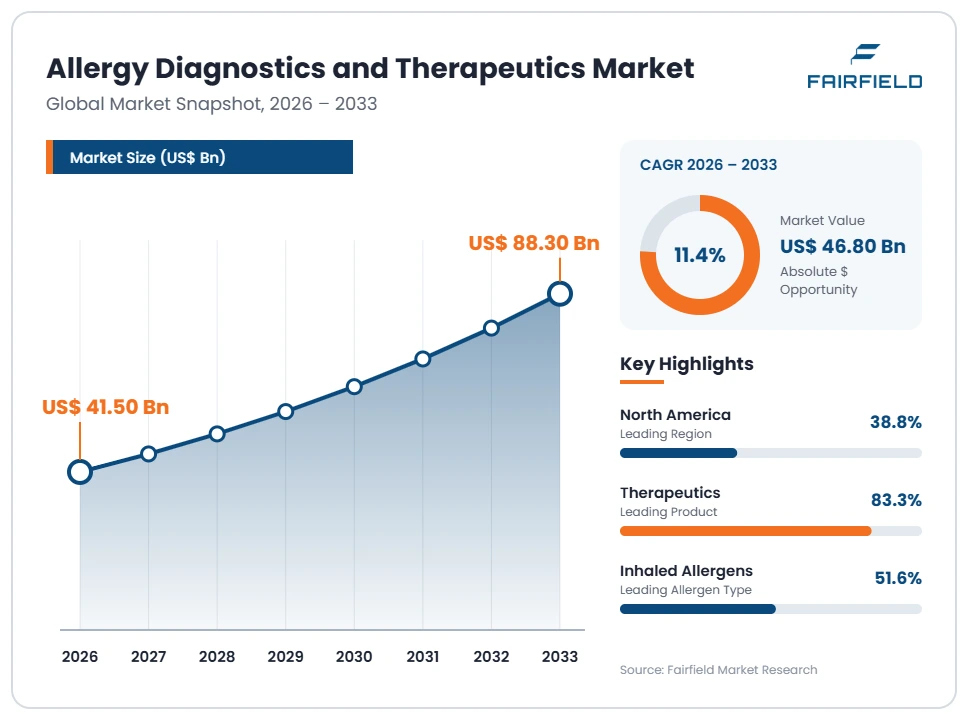
The global allergy diagnostics and therapeutics market size is expected to be valued at US$ 41.50 billion in 2026 and projected to reach US$ 88.30 billion by 2033, growing at a CAGR of 11.4% between 2026 and 2033.
Between 2020 and 2025, the market grew at a CAGR of about 10.3%, as allergy rates kept rising worldwide, biologics for allergic and inflammatory diseases gained new approvals, and more children were diagnosed with food allergy. Allergy diagnostics identify what a person is allergic to through skin prick tests, blood-based IgE testing, and component tests, while therapeutics include antihistamines, corticosteroids, epinephrine, allergen immunotherapy, and biologic drugs. Three factors now drive growth: urbanization, pollution, and climate change that lengthen pollen seasons and raise allergic rhinitis and asthma rates, rising food allergy in children, and new treatments that change the course of disease rather than only relieve symptoms. The market is shifting toward molecular allergy diagnostics, oral and sublingual immunotherapy, needle-free epinephrine, and biologics that target the immune pathways behind allergy. In April 2026, the U.S. Food and Drug Administration approved Regeneron and Sanofi’s Dupixent for children aged two to eleven with chronic spontaneous urticaria.
Key Report Takeaways
- By Product: Therapeutics held 83.3% share in 2026, while Diagnostics are projected to expand at a 12.8% CAGR through 2033, driven by molecular IgE testing, automated analyzers, and growing diagnosis of food allergy in children.
- By Allergen Type: Inhaled Allergens held 51.6% share in 2026, while Food Allergens are projected to expand at a 13.1% CAGR through 2033, driven by rising peanut, milk, and egg allergies and new oral and patch therapies.
- By Therapy Type: Antihistamines held 31.0% share in 2026, while Biologics are projected to expand at a 15.0% CAGR through 2033, driven by approvals for asthma, urticaria, nasal polyps, and food allergy.
- By Region: North America held 38.8% share in 2026, while Asia Pacific is projected to expand at a 13.6% CAGR through 2033, driven by urbanization, pollution, and better diagnostic access in China, India, and Japan.
Global Allergy Diagnostics and Therapeutics Market Trends and Insights
Drivers Impact Analysis
Two drivers carry the strongest influence on allergy diagnostics and therapeutics demand during the forecast period.
| Driver | Impact on CAGR Forecast | Geographic Relevance | Impact Timeline |
| Rising prevalence of allergic diseases | High | Global | Long term (≥4 years) |
| New biologics and disease-modifying therapies | High | North America, Europe, Asia Pacific | Medium term (2–4 years) |
Rising Allergy Rates Are Driving the Allergy Diagnostics and Therapeutics Market
The rising prevalence of allergic diseases is the strongest driver of the allergy diagnostics and therapeutics market. Allergies now affect a large share of the world’s population.
The mechanism is environmental and lifestyle change. Urban living, air pollution, less contact with microbes in early childhood, and changing diets are linked to higher rates of allergic rhinitis, asthma, eczema, and food allergy. Climate change is making pollen seasons longer and more intense in many regions. Food allergy affects millions of children, and peanut allergy in particular has become more common in North America, Europe, and Australia. More people seek testing to identify triggers and avoid dangerous reactions. Schools, airlines, and restaurants are increasing allergy awareness, which encourages diagnosis. As the number of patients grows, so does demand for tests, daily medicines, emergency epinephrine, and long-term treatments. These trends create steady, recurring demand.
New Therapies Are Expanding the Allergy Diagnostics and Therapeutics Market
New biologics and disease-modifying therapies are expanding the allergy diagnostics and therapeutics market. Patients now have options beyond symptom relief.
The cause is scientific progress in understanding the immune system. Biologics such as Dupixent from Regeneron and Sanofi, Xolair from Genentech and Novartis, and Tezspire from Amgen and AstraZeneca block specific immune signals that drive allergic and inflammatory disease. They are approved for asthma, nasal polyps, eczema, chronic urticaria, and, in the case of Xolair, food allergy. Allergen immunotherapy tablets and drops from ALK-Abelló and Stallergenes Greer retrain the immune system to tolerate allergens. Peanut oral immunotherapy and the investigational Viaskin Peanut patch from DBV Technologies target food allergy. Needle-free epinephrine nasal spray adds a new emergency option. These high-value treatments increase market value.
Restraints Impact Analysis
Two restraints limit how quickly the allergy diagnostics and therapeutics market grows.
| Restraint | Impact on CAGR Forecast | Geographic Relevance | Impact Timeline |
| High cost of biologics and immunotherapy | High | Global | Long term (≥4 years) |
| Underdiagnosis and limited specialist access | Medium | Asia Pacific, Latin America, Middle East & Africa | Medium term (2–4 years) |
High Treatment Costs Slow the Allergy Diagnostics and Therapeutics Market
The high cost of biologics and immunotherapy slows the allergy diagnostics and therapeutics market. Advanced treatments are expensive and require long commitments.
The specific causes are pricing and reimbursement limits. Biologic drugs can cost tens of thousands of dollars per patient per year, and insurers often require proof that cheaper treatments have failed before approving them. Allergen immunotherapy usually lasts three to five years, and many patients stop early because of cost, time, or side effects. Reimbursement for immunotherapy varies widely between countries. Generic antihistamines and steroid sprays are cheap and widely available over the counter, which limits value growth in those segments. Price pressure from payers, pharmacy benefit managers, and governments affects margins across the market. These factors restrict access, especially in lower-income markets and among uninsured patients.
Underdiagnosis Restricts the Allergy Diagnostics and Therapeutics Market
Underdiagnosis and limited access to specialists restrict the allergy diagnostics and therapeutics market. Many people never receive a proper allergy diagnosis.
The underlying causes are low awareness and too few allergists. Many people treat symptoms with over-the-counter medicines without testing, so they never learn their exact triggers. Allergists are scarce in many countries, especially in rural areas, and primary care doctors may not order tests. Diagnostic laboratories and equipment are limited in developing regions. Some tests are hard to interpret without specialist knowledge. Lack of reimbursement for testing in some countries discourages diagnosis. These factors leave large patient groups untreated or poorly controlled. Education campaigns, simpler blood tests ordered by primary care doctors, and telemedicine consultations with allergists are helping to close the gap, especially in large countries with few specialists.
Market Opportunities
Food Allergy Therapies Open a Fast-Growth Revenue Pool
Food allergy therapies open a fast-growth revenue pool in the allergy diagnostics and therapeutics market. Families want protection against accidental reactions.
Drugmakers and biotech firms can capture this opportunity. Xolair became the first biologic approved to reduce reactions to multiple foods. Palforzia, now owned by Stallergenes Greer, gained European approval for toddlers aged one to three in January 2025. DBV Technologies reported positive Phase 3 results for its Viaskin Peanut patch in children aged four to seven in December 2025, with a filing planned in 2026. Early treatment in young children may build lasting tolerance. Companion diagnostics help select the right patients. Companies with safe, convenient therapies can grow quickly. Parents value treatments that reduce the fear of accidental exposure at school, parties, and restaurants.
Molecular Diagnostics and Digital Care Create a Precision Revenue Pool
Molecular diagnostics and digital care create a precision revenue pool in the allergy diagnostics and therapeutics market. Precise diagnosis guides better treatment.
Diagnostic companies and digital health firms can capture this opportunity. Component-resolved and multiplex tests measure reactions to individual allergen proteins, helping doctors judge risk and choose immunotherapy. Thermo Fisher Scientific with its ImmunoCAP platform, Siemens Healthineers, and HYCOR Biomedical offer automated IgE testing. Point-of-care tests can speed diagnosis in primary care clinics and pharmacies, reducing referral delays. Pollen forecasting apps, symptom trackers, and telemedicine help patients manage symptoms day to day. Companies that link diagnosis, treatment, and monitoring can build strong positions. Home sample collection kits and online test ordering are also expanding access, and AI tools can help doctors interpret complex test panels.
Segment Analysis
- By Product: Therapeutics Lead While Diagnostics Grow Fastest
Therapeutics held 83.3% share in 2026. Antihistamines, corticosteroids, epinephrine, allergen immunotherapy, and biologics make up most spending, with biologics accounting for the largest and fastest-rising share of value in recent years. Sanofi, Regeneron, ALK-Abelló, Stallergenes Greer, and Viatris are major suppliers.
Diagnostics are the fastest-growing product, expanding at a 12.8% CAGR through 2033. Blood-based IgE testing, skin prick tests, and molecular component tests are used more often as awareness rises. Thermo Fisher Scientific, Siemens Healthineers, Danaher, and bioMérieux lead in diagnostic instruments and assays. For the market, diagnostic growth supports targeted therapy. Better diagnosis leads more patients to immunotherapy and biologics, raising value across the whole care pathway.
- By Allergen Type: Inhaled Allergens Lead While Food Allergens Grow Fastest
Inhaled Allergens held 51.6% share in 2026. Pollen, dust mites, mold, and pet dander cause allergic rhinitis and allergic asthma, the most common allergic conditions worldwide.
Food Allergens are the fastest-growing allergen type, expanding at a 13.1% CAGR through 2033. Peanut, tree nut, milk, egg, and shellfish allergies are rising, and several new therapies are now available. Drug allergies rank next, followed by insect venom and other allergens. For the market, food allergy growth adds high-value therapies. Drug allergies, especially to penicillin, are often misdiagnosed, and testing programs to remove incorrect allergy labels are growing in hospitals. Insect venom immunotherapy is highly effective and protects people at risk of severe reactions to bee and wasp stings.
- By Therapy Type: Antihistamines Lead While Biologics Grow Fastest
Antihistamines held 31.0% share in 2026. These widely used medicines relieve sneezing, itching, and hives and are sold mainly over the counter at low prices.
Biologics are the fastest-growing therapy type, expanding at a 15.0% CAGR through 2033. Biologics treat severe asthma, urticaria, nasal polyps, eczema, and food allergy. Corticosteroids, epinephrine, and immunotherapy are other therapy types. For the market, biologic growth raises value per patient. Corticosteroid nasal sprays remain the main treatment for moderate allergic rhinitis. Epinephrine auto-injectors and the newer nasal spray are essential for people at risk of anaphylaxis, and many families keep several devices at home and school. Immunotherapy tablets for grass, ragweed, tree pollen, and dust mites are growing in use.
Geography Analysis
- Which Region Is Leading the Allergy Diagnostics and Therapeutics Market?
North America is leading the allergy diagnostics and therapeutics market with a 38.8% share in 2026. The United States has high allergy rates, strong use of biologics, widespread testing, and many specialist allergists. Regeneron, Viatris, and ARS Pharmaceuticals are key players in the country. Canada has high rates of food allergy and active patient advocacy groups. Many schools stock epinephrine and train staff to respond to reactions. Key barriers include high drug costs and insurer restrictions on biologics. One change shaping the region is food allergy treatment, with new biologic, oral, and patch options for children.
- Europe Builds the Allergy Diagnostics and Therapeutics Market Through Immunotherapy
Europe is a major allergy diagnostics and therapeutics market. Germany, France, Italy, Spain, and the United Kingdom have strong, long-standing traditions of allergen immunotherapy. ALK-Abelló in Denmark, Stallergenes Greer in France, and HAL Allergy in the Netherlands are global immunotherapy leaders. Sublingual immunotherapy tablets and drops are widely prescribed, and several countries reimburse them. Pollen seasons are lengthening across the region, raising symptom burden for millions of patients. Key barriers include large reimbursement differences between countries and strict rules for allergen products. One opportunity is food allergy therapy for young children.
- Which Region Is Growing Fastest in the Allergy Diagnostics and Therapeutics Market?
Asia Pacific is growing fastest in the allergy diagnostics and therapeutics market at a 13.6% CAGR through 2033. China leads the region, with rising urban allergy rates and pollution, while Japan has high cedar pollen allergy rates. India and Australia add demand, and Australia has one of the world’s highest rates of childhood food allergy. South Korea and Singapore have strong allergy care systems. Air pollution in large cities worsens asthma and allergic rhinitis. Key barriers include few specialists and limited reimbursement for advanced treatments. One change shaping the region is better diagnostics, with laboratories adopting automated IgE testing platforms.
- Latin America Grows the Allergy Diagnostics and Therapeutics Market Through Urbanization
Latin America is a growing allergy diagnostics and therapeutics market. Brazil, Mexico, and Argentina have rising asthma and allergy rates in cities. Dust mite and pollen allergies are very common in tropical and subtropical areas, and food allergy awareness is growing quickly among urban parents. Public health systems in Brazil and Mexico cover basic allergy medicines, but advanced therapies are limited to private care. Colombia and Chile have growing numbers of allergy specialists and testing laboratories. Key barriers include high costs of biologics and limited private insurance coverage. One opportunity is allergy testing in private laboratories and clinics.
- Middle East & Africa Expands the Allergy Diagnostics and Therapeutics Market Through Healthcare Investment
Middle East & Africa is an emerging allergy diagnostics and therapeutics market. Saudi Arabia and the United Arab Emirates have dust and pollen allergies. Desert dust, date palm pollen, and indoor allergens trigger asthma and allergic rhinitis, and rapid urbanization adds to the burden. Governments in Saudi Arabia, the United Arab Emirates, and Qatar are expanding hospital capacity, laboratory networks, and specialist training. South Africa and Egypt have growing private healthcare sectors that offer allergy testing and treatment. Key barriers include few allergy specialists and limited public awareness. One opportunity is diagnostics in new hospitals and laboratories.
Competitive Landscape
The allergy diagnostics and therapeutics market is moderately concentrated. Sanofi and Regeneron lead in biologics with Dupixent, while ALK-Abelló, Stallergenes Greer, and HAL Allergy lead in allergen immunotherapy. Thermo Fisher Scientific, Siemens Healthineers, Danaher, bioMérieux, and HYCOR Biomedical lead in diagnostics, and Viatris and ARS Pharmaceuticals in epinephrine.
Companies compete on efficacy, safety, convenience, test accuracy, price, and specialist relationships. Biologics compete on new indications, dosing frequency, and safety, and each new approval opens a fresh patient group. Immunotherapy makers compete on standardized allergen extracts, convenient tablets, and evidence of long-term benefit. Diagnostic companies compete on test menus, automation, and links to laboratory systems. Generic makers dominate antihistamines and steroid sprays. Biotech firms bring new approaches such as patches and vaccines.
Strategic moves show how competition is changing. In January 2025, Palforzia gained European approval for toddlers. In October 2025, Tezspire won US approval for nasal polyps. In December 2025, DBV Technologies reported positive Phase 3 results. In April 2026, Dupixent won approval for children with urticaria. These moves show competition shifting toward biologics and new food allergy treatments for young children, areas where effective options were limited until recently.
Three themes shape vendor strategy. First, companies are expanding indications. Second, they are targeting food allergy in children. Third, they are improving diagnostics to identify the right patients for therapy. Vendors that combine innovative therapies, accurate tests, and strong specialist relationships are best placed to win share.
Recent Industry Developments
- April 2026: The U.S. Food and Drug Administration approved Regeneron and Sanofi’s Dupixent for children aged two to eleven with chronic spontaneous urticaria – expands biologics in pediatric allergy care.
- December 2025: DBV Technologies reported positive Phase 3 VITESSE results for Viaskin Peanut in children aged four to seven, with 46.6% reaching the response goal versus 14.8% on placebo – advances food allergy treatment.
- October 2025: The U.S. Food and Drug Administration approved Amgen and AstraZeneca’s Tezspire for chronic rhinosinusitis with nasal polyps – adds a biologic option.
- January 2025: The European Commission approved Palforzia from Stallergenes Greer for toddlers aged one to three with peanut allergy – extends oral immunotherapy to younger children.
Companies Covered in the Report
- Sanofi
- Regeneron Pharmaceuticals
- Thermo Fisher Scientific
- Siemens Healthineers
- ALK-Abelló
- Stallergenes Greer
- HAL Allergy
- bioMérieux
- HYCOR Biomedical
- Viatris
- ARS Pharmaceuticals
- DBV Technologies
Allergy Diagnostics and Therapeutics Market Report Scope
| Metric | Value |
| Study Period | 2020–2033 |
| Market Size 2026 | US$ 41.50 Billion |
| Market Size 2033 | US$ 88.30 Billion |
| CAGR 2026–2033 | 11.4% |
| Absolute Dollar Opportunity | US$ 46.80 Billion |
| Largest Market | North America |
| Fastest-Growing Market | Asia Pacific |
| Market Concentration | Moderate |
| Major Players | Sanofi, Thermo Fisher Scientific, ALK-Abelló, Stallergenes Greer, Siemens Healthineers |
Allergy Diagnostics and Therapeutics Market Segmentation
Product
- Diagnostics
- Therapeutics
Allergen Type
- Inhaled Allergens
- Food Allergens
- Drug Allergens
- Insect Venom
- Others
Therapy Type
- Antihistamines
- Corticosteroids
- Epinephrine
- Immunotherapy
- Biologics
Regions
- North America
- Europe
- Asia Pacific
- Latin America
- Middle East & Africa
- Executive Summary
- Global Allergy Diagnostics and Therapeutics Market Snapshot
- Future Projections
- Key Report Takeaways
- Regional Snapshot
- Market Overview
- Market Definition and Report Scope
- Historical Trends 2020–2025
- Market Dynamics
- Drivers
- Rising Allergy Rates Are Driving the Allergy Diagnostics and Therapeutics Market
- New Therapies Are Expanding the Allergy Diagnostics and Therapeutics Market
- Restraints
- High Treatment Costs Slow the Allergy Diagnostics and Therapeutics Market
- Underdiagnosis Restricts the Allergy Diagnostics and Therapeutics Market
- Market Opportunities
- Food Allergy Therapies Open a Fast-Growth Revenue Pool
- Molecular Diagnostics and Digital Care Create a Precision Revenue Pool
- Drivers
- Global Allergy Diagnostics and Therapeutics Market Outlook, 2020-2033
- Global Allergy Diagnostics and Therapeutics Market Outlook, by Product, Value (US$ Billion), 2020-2033
- Diagnostics
- Therapeutics
- Global Allergy Diagnostics and Therapeutics Market Outlook, by Allergen Type, Value (US$ Billion), 2020-2033
- Inhaled Allergens
- Food Allergens
- Drug Allergens
- Insect Venom
- Others
- Global Allergy Diagnostics and Therapeutics Market Outlook, by Therapy Type, Value (US$ Billion), 2020-2033
- Antihistamines
- Corticosteroids
- Epinephrine
- Immunotherapy
- Biologics
- Global Allergy Diagnostics and Therapeutics Market Outlook, by Region, Value (US$ Billion), 2020-2033
- North America
- Europe
- Asia Pacific
- Latin America
- Middle East & Africa
- Global Allergy Diagnostics and Therapeutics Market Outlook, by Product, Value (US$ Billion), 2020-2033
- North America Allergy Diagnostics and Therapeutics Market Outlook, 2020-2033
- North America Allergy Diagnostics and Therapeutics Market Outlook, by Product, Value (US$ Billion), 2020-2033
- Diagnostics
- Therapeutics
- North America Allergy Diagnostics and Therapeutics Market Outlook, by Allergen Type, Value (US$ Billion), 2020-2033
- Inhaled Allergens
- Food Allergens
- Drug Allergens
- Insect Venom
- Others
- North America Allergy Diagnostics and Therapeutics Market Outlook, by Therapy Type, Value (US$ Billion), 2020-2033
- Antihistamines
- Corticosteroids
- Epinephrine
- Immunotherapy
- Biologics
- North America Allergy Diagnostics and Therapeutics Market Outlook, by Country, Value (US$ Billion), 2020-2033
- United States Allergy Diagnostics and Therapeutics Market Outlook, by Product, 2020-2033
- United States Allergy Diagnostics and Therapeutics Market Outlook, by Allergen Type, 2020-2033
- United States Allergy Diagnostics and Therapeutics Market Outlook, by Therapy Type, 2020-2033
- Canada Allergy Diagnostics and Therapeutics Market Outlook, by Product, 2020-2033
- Canada Allergy Diagnostics and Therapeutics Market Outlook, by Allergen Type, 2020-2033
- Canada Allergy Diagnostics and Therapeutics Market Outlook, by Therapy Type, 2020-2033
- North America Allergy Diagnostics and Therapeutics Market Outlook, by Product, Value (US$ Billion), 2020-2033
- Europe Allergy Diagnostics and Therapeutics Market Outlook, 2020-2033
- Europe Allergy Diagnostics and Therapeutics Market Outlook, by Product, Value (US$ Billion), 2020-2033
- Diagnostics
- Therapeutics
- Europe Allergy Diagnostics and Therapeutics Market Outlook, by Allergen Type, Value (US$ Billion), 2020-2033
- Inhaled Allergens
- Food Allergens
- Drug Allergens
- Insect Venom
- Others
- Europe Allergy Diagnostics and Therapeutics Market Outlook, by Therapy Type, Value (US$ Billion), 2020-2033
- Antihistamines
- Corticosteroids
- Epinephrine
- Immunotherapy
- Biologics
- Europe Allergy Diagnostics and Therapeutics Market Outlook, by Country, Value (US$ Billion), 2020-2033
- Germany Allergy Diagnostics and Therapeutics Market Outlook, by Product, 2020-2033
- Germany Allergy Diagnostics and Therapeutics Market Outlook, by Allergen Type, 2020-2033
- Germany Allergy Diagnostics and Therapeutics Market Outlook, by Therapy Type, 2020-2033
- France Allergy Diagnostics and Therapeutics Market Outlook, by Product, 2020-2033
- France Allergy Diagnostics and Therapeutics Market Outlook, by Allergen Type, 2020-2033
- France Allergy Diagnostics and Therapeutics Market Outlook, by Therapy Type, 2020-2033
- Italy Allergy Diagnostics and Therapeutics Market Outlook, by Product, 2020-2033
- Italy Allergy Diagnostics and Therapeutics Market Outlook, by Allergen Type, 2020-2033
- Italy Allergy Diagnostics and Therapeutics Market Outlook, by Therapy Type, 2020-2033
- Spain Allergy Diagnostics and Therapeutics Market Outlook, by Product, 2020-2033
- Spain Allergy Diagnostics and Therapeutics Market Outlook, by Allergen Type, 2020-2033
- Spain Allergy Diagnostics and Therapeutics Market Outlook, by Therapy Type, 2020-2033
- United Kingdom Allergy Diagnostics and Therapeutics Market Outlook, by Product, 2020-2033
- United Kingdom Allergy Diagnostics and Therapeutics Market Outlook, by Allergen Type, 2020-2033
- United Kingdom Allergy Diagnostics and Therapeutics Market Outlook, by Therapy Type, 2020-2033
- Denmark Allergy Diagnostics and Therapeutics Market Outlook, by Product, 2020-2033
- Denmark Allergy Diagnostics and Therapeutics Market Outlook, by Allergen Type, 2020-2033
- Denmark Allergy Diagnostics and Therapeutics Market Outlook, by Therapy Type, 2020-2033
- Netherlands Allergy Diagnostics and Therapeutics Market Outlook, by Product, 2020-2033
- Netherlands Allergy Diagnostics and Therapeutics Market Outlook, by Allergen Type, 2020-2033
- Netherlands Allergy Diagnostics and Therapeutics Market Outlook, by Therapy Type, 2020-2033
- Europe Allergy Diagnostics and Therapeutics Market Outlook, by Product, Value (US$ Billion), 2020-2033
- Asia Pacific Allergy Diagnostics and Therapeutics Market Outlook, 2020-2033
- Asia Pacific Allergy Diagnostics and Therapeutics Market Outlook, by Product, Value (US$ Billion), 2020-2033
- Diagnostics
- Therapeutics
- Asia Pacific Allergy Diagnostics and Therapeutics Market Outlook, by Allergen Type, Value (US$ Billion), 2020-2033
- Inhaled Allergens
- Food Allergens
- Drug Allergens
- Insect Venom
- Others
- Asia Pacific Allergy Diagnostics and Therapeutics Market Outlook, by Therapy Type, Value (US$ Billion), 2020-2033
- Antihistamines
- Corticosteroids
- Epinephrine
- Immunotherapy
- Biologics
- Asia Pacific Allergy Diagnostics and Therapeutics Market Outlook, by Country, Value (US$ Billion), 2020-2033
- China Allergy Diagnostics and Therapeutics Market Outlook, by Product, 2020-2033
- China Allergy Diagnostics and Therapeutics Market Outlook, by Allergen Type, 2020-2033
- China Allergy Diagnostics and Therapeutics Market Outlook, by Therapy Type, 2020-2033
- Japan Allergy Diagnostics and Therapeutics Market Outlook, by Product, 2020-2033
- Japan Allergy Diagnostics and Therapeutics Market Outlook, by Allergen Type, 2020-2033
- Japan Allergy Diagnostics and Therapeutics Market Outlook, by Therapy Type, 2020-2033
- India Allergy Diagnostics and Therapeutics Market Outlook, by Product, 2020-2033
- India Allergy Diagnostics and Therapeutics Market Outlook, by Allergen Type, 2020-2033
- India Allergy Diagnostics and Therapeutics Market Outlook, by Therapy Type, 2020-2033
- Australia Allergy Diagnostics and Therapeutics Market Outlook, by Product, 2020-2033
- Australia Allergy Diagnostics and Therapeutics Market Outlook, by Allergen Type, 2020-2033
- Australia Allergy Diagnostics and Therapeutics Market Outlook, by Therapy Type, 2020-2033
- South Korea Allergy Diagnostics and Therapeutics Market Outlook, by Product, 2020-2033
- South Korea Allergy Diagnostics and Therapeutics Market Outlook, by Allergen Type, 2020-2033
- South Korea Allergy Diagnostics and Therapeutics Market Outlook, by Therapy Type, 2020-2033
- Singapore Allergy Diagnostics and Therapeutics Market Outlook, by Product, 2020-2033
- Singapore Allergy Diagnostics and Therapeutics Market Outlook, by Allergen Type, 2020-2033
- Singapore Allergy Diagnostics and Therapeutics Market Outlook, by Therapy Type, 2020-2033
- Asia Pacific Allergy Diagnostics and Therapeutics Market Outlook, by Product, Value (US$ Billion), 2020-2033
- Latin America Allergy Diagnostics and Therapeutics Market Outlook, 2020-2033
- Latin America Allergy Diagnostics and Therapeutics Market Outlook, by Product, Value (US$ Billion), 2020-2033
- Diagnostics
- Therapeutics
- Latin America Allergy Diagnostics and Therapeutics Market Outlook, by Allergen Type, Value (US$ Billion), 2020-2033
- Inhaled Allergens
- Food Allergens
- Drug Allergens
- Insect Venom
- Others
- Latin America Allergy Diagnostics and Therapeutics Market Outlook, by Therapy Type, Value (US$ Billion), 2020-2033
- Antihistamines
- Corticosteroids
- Epinephrine
- Immunotherapy
- Biologics
- Latin America Allergy Diagnostics and Therapeutics Market Outlook, by Country, Value (US$ Billion), 2020-2033
- Brazil Allergy Diagnostics and Therapeutics Market Outlook, by Product, 2020-2033
- Brazil Allergy Diagnostics and Therapeutics Market Outlook, by Allergen Type, 2020-2033
- Brazil Allergy Diagnostics and Therapeutics Market Outlook, by Therapy Type, 2020-2033
- Mexico Allergy Diagnostics and Therapeutics Market Outlook, by Product, 2020-2033
- Mexico Allergy Diagnostics and Therapeutics Market Outlook, by Allergen Type, 2020-2033
- Mexico Allergy Diagnostics and Therapeutics Market Outlook, by Therapy Type, 2020-2033
- Argentina Allergy Diagnostics and Therapeutics Market Outlook, by Product, 2020-2033
- Argentina Allergy Diagnostics and Therapeutics Market Outlook, by Allergen Type, 2020-2033
- Argentina Allergy Diagnostics and Therapeutics Market Outlook, by Therapy Type, 2020-2033
- Colombia Allergy Diagnostics and Therapeutics Market Outlook, by Product, 2020-2033
- Colombia Allergy Diagnostics and Therapeutics Market Outlook, by Allergen Type, 2020-2033
- Colombia Allergy Diagnostics and Therapeutics Market Outlook, by Therapy Type, 2020-2033
- Chile Allergy Diagnostics and Therapeutics Market Outlook, by Product, 2020-2033
- Chile Allergy Diagnostics and Therapeutics Market Outlook, by Allergen Type, 2020-2033
- Chile Allergy Diagnostics and Therapeutics Market Outlook, by Therapy Type, 2020-2033
- Latin America Allergy Diagnostics and Therapeutics Market Outlook, by Product, Value (US$ Billion), 2020-2033
- Middle East & Africa Allergy Diagnostics and Therapeutics Market Outlook, 2020-2033
- Middle East & Africa Allergy Diagnostics and Therapeutics Market Outlook, by Product, Value (US$ Billion), 2020-2033
- Diagnostics
- Therapeutics
- Middle East & Africa Allergy Diagnostics and Therapeutics Market Outlook, by Allergen Type, Value (US$ Billion), 2020-2033
- Inhaled Allergens
- Food Allergens
- Drug Allergens
- Insect Venom
- Others
- Middle East & Africa Allergy Diagnostics and Therapeutics Market Outlook, by Therapy Type, Value (US$ Billion), 2020-2033
- Antihistamines
- Corticosteroids
- Epinephrine
- Immunotherapy
- Biologics
- Middle East & Africa Allergy Diagnostics and Therapeutics Market Outlook, by Country, Value (US$ Billion), 2020-2033
- Saudi Arabia Allergy Diagnostics and Therapeutics Market Outlook, by Product, 2020-2033
- Saudi Arabia Allergy Diagnostics and Therapeutics Market Outlook, by Allergen Type, 2020-2033
- Saudi Arabia Allergy Diagnostics and Therapeutics Market Outlook, by Therapy Type, 2020-2033
- United Arab Emirates Allergy Diagnostics and Therapeutics Market Outlook, by Product, 2020-2033
- United Arab Emirates Allergy Diagnostics and Therapeutics Market Outlook, by Allergen Type, 2020-2033
- United Arab Emirates Allergy Diagnostics and Therapeutics Market Outlook, by Therapy Type, 2020-2033
- Qatar Allergy Diagnostics and Therapeutics Market Outlook, by Product, 2020-2033
- Qatar Allergy Diagnostics and Therapeutics Market Outlook, by Allergen Type, 2020-2033
- Qatar Allergy Diagnostics and Therapeutics Market Outlook, by Therapy Type, 2020-2033
- South Africa Allergy Diagnostics and Therapeutics Market Outlook, by Product, 2020-2033
- South Africa Allergy Diagnostics and Therapeutics Market Outlook, by Allergen Type, 2020-2033
- South Africa Allergy Diagnostics and Therapeutics Market Outlook, by Therapy Type, 2020-2033
- Egypt Allergy Diagnostics and Therapeutics Market Outlook, by Product, 2020-2033
- Egypt Allergy Diagnostics and Therapeutics Market Outlook, by Allergen Type, 2020-2033
- Egypt Allergy Diagnostics and Therapeutics Market Outlook, by Therapy Type, 2020-2033
- Middle East & Africa Allergy Diagnostics and Therapeutics Market Outlook, by Product, Value (US$ Billion), 2020-2033
- Competitive Landscape
- Market Concentration and Industry Leaders
- Competitive Differentiation
- Strategic Moves and Market Direction
- Recent Industry Developments
- Company Profiles
- Sanofi
- Regeneron Pharmaceuticals
- Thermo Fisher Scientific
- Siemens Healthineers
- ALK-Abelló
- Stallergenes Greer
- HAL Allergy
- bioMérieux
- HYCOR Biomedical
- Viatris
- ARS Pharmaceuticals
- DBV Technologies
- Appendix
- Research Methodology
- Report Assumptions
- Acronyms and Abbreviations
Product
- Diagnostics
- Therapeutics
Allergen Type
- Inhaled Allergens
- Food Allergens
- Drug Allergens
- Insect Venom
- Others
Therapy Type
- Antihistamines
- Corticosteroids
- Epinephrine
- Immunotherapy
- Biologics
Regions
- North America
- Europe
- Asia Pacific
- Latin America
- Middle East & Africa
Our Research Methodology
Considering the volatility of business today, traditional approaches to strategizing a game plan can be unfruitful if not detrimental. True ambiguity is no way to determine a forecast. A myriad of predetermined factors must be accounted for such as the degree of risk involved, the magnitude of circumstances, as well as conditions or consequences that are not known or unpredictable. To circumvent binary views that cast uncertainty, the application of market research intelligence to strategically posture, move, and enable actionable outcomes is necessary.
View Methodology
Quality Assured
Rigorous Validation Process

Confidentiality Assured
End-to-end Data Security

Custom Research Services
Tailored To Your Objectives
FAQs
The allergy diagnostics and therapeutics market is valued at US$ 41.50 billion in 2026, led by therapeutics and North America.
The market is projected to reach US$ 88.30 billion by 2033, growing at an 11.4% CAGR and adding US$ 46.80 billion.
Food allergens are growing fastest at a 13.1% CAGR through 2033, driven by rising peanut allergy and new oral and patch therapies.
Asia Pacific is growing fastest at a 13.6% CAGR through 2033, driven by urbanization, pollution, and diagnostic access in China.
North America holds the largest share at 38.8% in 2026, supported by high allergy rates and strong biologic use.
Related Reports
Acetaminophen Market Size, Share, Insights, Competitive Landscape, and Forecast 2026 to 2033
The global acetaminophen market is valued at US$11.70 billion in 2026, reaching US$15.93 billion by 2033, growing at a 4.5% CAGR
Homeopathic Products Market Size, Share, Insights, Competitive Landscape, and Forecast 2026 to 2033
The global homeopathic products market is valued at US$59.45 billion in 2026, reaching US$169.21 billion by 2033, growing at a 16.1% CAGR
Nanoparticle Formulation Market Size, Share, Insights, Competitive Landscape, and Forecast 2026 to 2033
The nanoparticle formulation market is projected to grow from US$6.80 billion in 2026 to US$12.67 billion by 2033, at a 9.3% CAGR, driven by RNA therapies.
Renal Biomarkers Market Size, Share, Insights, Competitive Landscape, and Forecast 2026 to 2033
The renal biomarkers market is projected to grow from US$1.73 billion in 2026 to US$2.87 billion by 2033, at a 7.5% CAGR, driven by early kidney testing.
Gene Switch Market Size, Share, Insights, Competitive Landscape, and Forecast 2026 to 2033
The gene switch market is projected to grow from US$899.0 million in 2026 to US$1,979.4 million by 2033, at an 11.9% CAGR, driven by cell and gene therapies.
Omics-Based Clinical Trials Market Size, Share, Insights, Competitive Landscape, and Forecast 2026 to 2033
Omics-based clinical trials market to grow from US$38.32 Bn in 2026 to US$65.67 Bn by 2033 at 8.0% CAGR. Explore trial phases, indications and regions.