



Acetaminophen Market
Acetaminophen Market Size, Share, Insights, Competitive Landscape, and Forecast 2026 to 2033
Acetaminophen Market Size and Trend Analysis
How Fast Is the Acetaminophen Market Growing?
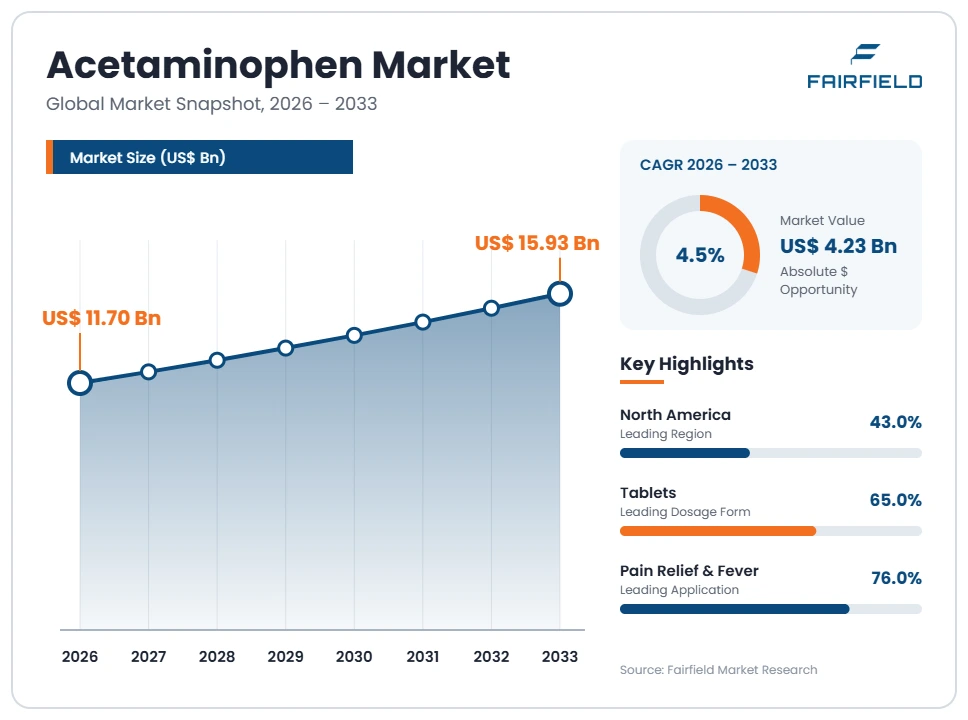
The global acetaminophen market size is expected to be valued at US$ 11.70 billion in 2026 and projected to reach US$ 15.93 billion by 2033, growing at a CAGR of 4.5% between 2026 and 2033.
Between 2020 and 2025, the market grew at a CAGR of about 4.1%, with a sharp spike in demand during the pandemic as people treated fever and aches at home, followed by steady growth as self-care and over-the-counter use remained strong. Acetaminophen, known as paracetamol outside North America, is one of the world’s most widely used medicines for pain relief and fever. It is sold in tablets, capsules, syrups, suppositories, and injections, alone or in combination with other drugs. Three factors now drive growth: the rising burden of headaches, arthritis, and other chronic pain, wider use of intravenous acetaminophen in hospitals to reduce opioid use after surgery, and growing access to medicines in Asia Pacific, Latin America, and Middle East & Africa. The market is shifting toward fast-acting and combination products, child-friendly formats, and online pharmacy sales. In November 2025, Kimberly-Clark agreed to acquire Kenvue, maker of Tylenol, in a deal valued at about US$ 48.7 billion.
Key Report Takeaways
- By Dosage Form: Tablets held 65.0% share in 2026, while Infusion Solutions are projected to expand at a 5.4% CAGR through 2033, driven by hospital use of intravenous acetaminophen for post-operative pain and opioid-sparing care.
- By Application: Pain Relief & Fever held 76.0% share in 2026, while Post-Operative Pain is projected to expand at a 5.3% CAGR through 2033, driven by enhanced recovery programs that combine non-opioid painkillers after surgery.
- By Distribution Channel: Retail Pharmacies held 44.0% share in 2026, while Online Pharmacies are projected to expand at a 5.2% CAGR through 2033, driven by e-pharmacy growth, home delivery, and digital health platforms.
- By Region: North America held 43.0% share in 2026, while Asia Pacific is projected to expand at a 5.6% CAGR through 2033, driven by rising healthcare access, self-medication, and large-scale paracetamol production in India and China.
Global Acetaminophen Market Trends and Insights
Drivers Impact Analysis
Two drivers carry the strongest influence on acetaminophen demand during the forecast period.
| Driver | Impact on CAGR Forecast | Geographic Relevance | Impact Timeline |
| High prevalence of pain and fever and self-care trends | High | Global | Long term (≥4 years) |
| Hospital use to reduce opioid consumption | Medium | North America, Europe | Medium term (2–4 years) |
Pain and Self-Care Are Driving the Acetaminophen Market
The high prevalence of pain and fever and the self-care trend are the strongest driver of the acetaminophen market. Acetaminophen is a first choice for everyday aches.
The mechanism is broad, everyday use. Headaches, back pain, toothaches, menstrual pain, arthritis, colds, and flu affect billions of people each year, and acetaminophen is recommended as a first-line treatment by many health authorities because it is gentle on the stomach compared with some other painkillers. It is widely used for children’s fevers. Ageing populations live with more chronic pain from osteoarthritis. Over-the-counter availability in pharmacies, supermarkets, and convenience stores makes it easy to buy. Strong brands such as Tylenol from Kenvue, Panadol from Haleon, and Doliprane from Opella have high consumer trust. Low prices for generics keep it accessible. These factors create steady, recurring demand worldwide.
Opioid-Sparing Care Is Expanding the Acetaminophen Market
Hospital use to reduce opioid consumption is expanding the acetaminophen market. Doctors want safer pain control after surgery.
The cause is the opioid crisis and new care practices. Opioid painkillers carry risks of addiction and overdose, so hospitals use multimodal pain management that combines acetaminophen with other non-opioid drugs to reduce opioid doses. Intravenous acetaminophen acts quickly and is used during and after surgery, in emergency rooms, and for patients who cannot take pills. Enhanced recovery after surgery programs include it as a standard part of care. B. Braun, Fresenius Kabi, and Mallinckrodt Pharmaceuticals supply injectable products. Combination products with ibuprofen are also gaining approval. These trends add hospital demand. Hospitals also use acetaminophen for fever control in intensive care and for patients with kidney problems who should avoid some other painkillers, which broadens its role across many departments.
Restraints Impact Analysis
Two restraints limit how quickly the acetaminophen market grows.
| Restraint | Impact on CAGR Forecast | Geographic Relevance | Impact Timeline |
| Safety concerns and regulatory scrutiny | Medium | North America, Europe | Medium term (2–4 years) |
| Low generic prices and supply chain dependence | Medium | Global | Long term (≥4 years) |
Safety Concerns Slow the Acetaminophen Market
Safety concerns and regulatory scrutiny slow the acetaminophen market. Acetaminophen is safe at normal doses but harmful in overdose.
The specific causes are liver risk and new debates. Taking too much acetaminophen, often by combining several products that contain it, can cause serious liver damage and is a leading cause of acute liver failure in some countries. Regulators limit pack sizes and require warnings. In September 2025, the U.S. Food and Drug Administration began a label change process on use during pregnancy, following claims by US officials about a possible link with autism, while noting that a causal relationship has not been established. Many medical societies disputed the claims. Texas sued Kenvue and Johnson & Johnson over the issue. These debates may affect consumer confidence and raise legal risks for makers.
Low Prices Restrict the Acetaminophen Market
Low generic prices and supply chain dependence restrict the acetaminophen market. Most acetaminophen is sold as cheap generics.
The underlying causes are intense competition and concentrated production. Acetaminophen has been off patent for decades, and many manufacturers sell it at very low prices, which limits revenue growth even when volumes rise. Most active ingredient is produced in India and China, so disruptions such as pandemic lockdowns, factory closures, or export limits can cause shortages, as seen in 2020 and 2022. Governments in Europe have encouraged local production to improve supply security. Raw material and energy price swings affect margins. These factors limit value growth. Government price controls on essential medicines in India and other countries cap retail prices, and large tenders by hospital buyers push prices down further. Brands must invest in marketing to justify premiums over generics.
Market Opportunities
Intravenous and Combination Products Open a Fast-Growth Revenue Pool
Intravenous acetaminophen and combination products open a fast-growth revenue pool in the acetaminophen market. Hospitals and patients want effective, non-opioid options.
Pharmaceutical companies can capture this opportunity. Ready-to-use IV bags and multi-dose vials make hospital use easier. Fixed-dose combinations with ibuprofen, such as Hyloris’ Maxigesic IV, offer stronger pain relief without opioids. Oral combinations for pain relief, colds, and flu add value over plain tablets. New formulations, such as fast-dissolving tablets and extended-release products, improve convenience. Regulatory approvals in more countries expand access. Companies with strong hospital relationships can grow. Day-surgery centers, which are expanding in North America and Europe, need fast-acting, non-opioid pain control that lets patients go home the same day. Pediatric hospitals also need accurately dosed IV and liquid forms for children.
Emerging Markets and Online Pharmacies Create an Access Revenue Pool
Emerging markets and online pharmacies create an access revenue pool in the acetaminophen market. More people are gaining access to basic medicines.
Generic makers and consumer health brands can capture this opportunity. Rising incomes, expanding pharmacy networks, and public health programs in India, Indonesia, Nigeria, and Brazil increase demand for over-the-counter medicines. Online pharmacies and quick-commerce apps deliver medicines to homes. Children’s syrups and drops serve large young populations. Local manufacturers in India produce large volumes for domestic use and export. Brands that combine affordability and trust can grow. Telemedicine apps that recommend common medicines and link to e-pharmacies are expanding fast in India and Indonesia. Packaging in smaller, cheaper sachets and strips helps reach low-income buyers in rural areas, where village pharmacies are the main source of medicines.
Segment Analysis
- By Dosage Form: Tablets Lead While Infusion Solutions Grow Fastest
Tablets held 65.0% share in 2026. Tablets and caplets are cheap, easy to store, and widely sold over-the-counter, making them the most common form. Kenvue, Haleon, Opella, and many generic makers sell tablets worldwide.
Infusion Solutions are the fastest-growing dosage form, expanding at a 5.4% CAGR through 2033. Intravenous acetaminophen is used in surgery, intensive care, and emergency medicine. Capsules, syrups, suspensions, and suppositories serve children and patients who cannot swallow tablets. For the market, infusion growth adds hospital value. Effervescent tablets and fast-dissolving forms are popular in Europe, while liquid suspensions and chewable tablets serve young children. Suppositories are widely used for infants with fever in several European countries and Latin America.
- By Application: Pain Relief & Fever Leads While Post-Operative Pain Grows Fastest
Pain Relief & Fever held 76.0% share in 2026. Headaches, body aches, toothaches, arthritis, and fever are the main reasons people take acetaminophen.
Post-Operative Pain is the fastest-growing application, expanding at a 5.3% CAGR through 2033. Hospitals use acetaminophen as a core part of multimodal, opioid-sparing pain management. Cold and flu, headache, and other uses make up the rest. For the market, surgical growth supports injectables. Combination cold and flu products that pair acetaminophen with decongestants and antihistamines are major sellers during winter seasons, and their sales rise sharply in strong flu years. Headache products often combine acetaminophen with caffeine to speed relief. Chronic conditions such as osteoarthritis create long-term daily use among older adults.
- By Distribution Channel: Retail Pharmacies Lead While Online Pharmacies Grow Fastest
Retail Pharmacies held 44.0% share in 2026. Pharmacies sell both branded and generic acetaminophen and offer dosing advice to customers.
Online Pharmacies are the fastest-growing channel, expanding at a 5.2% CAGR through 2033. E-pharmacies offer convenience, home delivery, subscriptions, and easy price comparison. Hospital pharmacies, supermarkets, and drug stores are other channels. For the market, online growth expands reach. Hospital pharmacies are the main channel for injectable products and buy through tenders and group purchasing contracts. Supermarkets and convenience stores sell small packs in many countries, though rules in the United Kingdom and some other markets limit pack sizes outside pharmacies to reduce overdose risk. Private-label products from retailers compete strongly on price in all channels.
Geography Analysis
- Which Region Is Leading the Acetaminophen Market?
North America is leading the acetaminophen market with a 43.0% share in 2026. The United States has high per-person use of over-the-counter pain medicines, strong brands such as Tylenol, and wide hospital use of intravenous acetaminophen. Kenvue, Mallinckrodt Pharmaceuticals, and B. Braun are key industry players. Canada adds steady demand. Retailers sell large volumes of private-label acetaminophen at low prices. Key barriers include legal and safety debates over use in pregnancy and the risk of liver injury from overdose. One change shaping the region is consolidation, with Kimberly-Clark buying Kenvue.
- Europe Builds the Acetaminophen Market Through High Consumption
Europe is a major acetaminophen market. France, the United Kingdom, Germany, Italy, and Spain use paracetamol widely, with Doliprane from Opella a leading brand in France. Haleon is based in the United Kingdom. Health systems in the region recommend paracetamol as the first choice for mild to moderate pain and fever. The European Medicines Agency reviews safety data, and several countries limit sale outside pharmacies. Governments have encouraged domestic production after shortages, and some active ingredient production has returned to France. Key barriers include pack size limits and price controls. One opportunity is local production that improves supply security.
- Which Region Is Growing Fastest in the Acetaminophen Market?
Asia Pacific is growing fastest in the acetaminophen market at a 5.6% CAGR through 2033. India and China are the largest producers of active ingredient, and Granules India is a major manufacturer. Japan, Australia, and Indonesia have strong consumer demand. IOL Chemicals and Pharmaceuticals and other Indian firms supply active ingredient to global markets, while China remains a major exporter. Rising healthcare spending and large populations support volume growth. Key barriers include price competition and government price controls. One change shaping the region is e-pharmacy, which brings medicines to more homes in India and Indonesia.
- Latin America Grows the Acetaminophen Market Through Pharmacy Expansion
Latin America is a growing acetaminophen market. Brazil and Mexico have large and expanding pharmacy chains and strong self-medication habits, and many shoppers buy pain relievers without seeing a doctor. Acetaminophen is widely sold over-the-counter in drugstore chains, and children’s syrups are common household products. Dengue fever outbreaks in Brazil and other countries drive demand, because health authorities recommend acetaminophen rather than some other painkillers for dengue. Argentina and Colombia have strong local generic industries. Key barriers include currency swings and high import costs for active ingredients. One opportunity is generics produced locally for public health systems.
- Middle East & Africa Expands the Acetaminophen Market Through Access
Middle East & Africa is an emerging acetaminophen market. Saudi Arabia, the United Arab Emirates, Nigeria, and South Africa have growing demand from expanding pharmacy networks, private clinics, and hospital systems. Public health programs in Nigeria, Kenya, and Ethiopia use acetaminophen for malaria-related fever and general pain, and it is on national essential medicine lists across the region. Egypt and Saudi Arabia have growing local pharmaceutical manufacturing supported by government localization programs. Key barriers include limited access in rural areas, counterfeit and substandard medicines, and high price sensitivity. One opportunity is affordable generics produced locally.
Competitive Landscape
The acetaminophen market is fragmented. Kenvue, Haleon, and Opella lead in branded consumer products, while Mallinckrodt Pharmaceuticals, B. Braun, and Fresenius Kabi lead in injectables. Granules India, IOL Chemicals and Pharmaceuticals, Teva, Sun Pharmaceutical, and Aurobindo Pharma supply generics and active ingredients.
Companies compete on brand trust, price, formulation, distribution, and supply reliability. Brands command premiums because consumers trust familiar names, especially for children’s products. Generic makers compete through low costs, large-scale production, and contracts with retailers and hospitals. Active ingredient production is concentrated in India and China, giving those producers strong influence over global supply and prices. Injectable makers compete on formulation, packaging, and hospital contracts. Legal and regulatory events increasingly affect brand reputations.
Strategic moves show how competition is changing. In September 2025, the U.S. Food and Drug Administration began a label change process. Texas then sued Kenvue and Johnson & Johnson. In November 2025, Kimberly-Clark agreed to acquire Kenvue for about US$ 48.7 billion. These moves show competition shifting toward consolidation in consumer health and stronger legal and regulatory pressure on leading brands, which may change how companies label, market, and defend their acetaminophen products in the United States.
Three themes shape vendor strategy. First, companies are consolidating consumer health portfolios. Second, they are developing combination products. Third, they are securing supply through local and diversified production. Vendors that combine trusted brands, reliable supply, and innovative formulations are best placed to win share.
Recent Industry Developments
- November 2025: Kimberly-Clark agreed to acquire Kenvue, maker of Tylenol, in a deal valued at about US$ 48.7 billion – creates a larger consumer health group.
- October 2025: Texas sued Kenvue and Johnson & Johnson, alleging they misled consumers about risks of prenatal Tylenol use – raises legal risks for brands.
- September 2025: The U.S. Food and Drug Administration initiated a safety label change process for acetaminophen use in pregnancy, while stating a causal link has not been established – increases regulatory scrutiny.
Companies Covered in the Report
- Kenvue
- Haleon
- Opella
- Granules India
- Mallinckrodt Pharmaceuticals
- B. Braun
- Fresenius Kabi
- IOL Chemicals and Pharmaceuticals
- Teva Pharmaceutical
- Sun Pharmaceutical
- Aurobindo Pharma
- Hyloris Pharmaceuticals
Acetaminophen Market Report Scope
| Metric | Value |
| Study Period | 2020–2033 |
| Market Size 2026 | US$ 11.70 Billion |
| Market Size 2033 | US$ 15.93 Billion |
| CAGR 2026–2033 | 4.5% |
| Absolute Dollar Opportunity | US$ 4.23 Billion |
| Largest Market | North America |
| Fastest-Growing Market | Asia Pacific |
| Market Concentration | Fragmented |
| Major Players | Kenvue, Haleon, Opella, Granules India, Mallinckrodt Pharmaceuticals |
Acetaminophen Market Segmentation
Dosage Form
- Tablets
- Capsules
- Syrups & Suspensions
- Suppositories
- Infusion Solutions
Application
- Pain Relief & Fever
- Post-Operative Pain
- Cold & Flu
- Headache
- Others
Distribution Channel
- Retail Pharmacies
- Hospital Pharmacies
- Online Pharmacies
- Others
Regions
- North America
- Europe
- Asia Pacific
- Latin America
- Middle East & Africa
- Executive Summary
- Global Acetaminophen Market Snapshot
- Future Projections
- Key Report Takeaways
- Regional Snapshot
- Market Overview
- Market Definition and Report Scope
- Historical Trends 2020–2025
- Market Dynamics
- Drivers
- Pain and Self-Care Are Driving the Acetaminophen Market
- Opioid-Sparing Care Is Expanding the Acetaminophen Market
- Restraints
- Safety Concerns Slow the Acetaminophen Market
- Low Prices Restrict the Acetaminophen Market
- Market Opportunities
- Intravenous and Combination Products Open a Fast-Growth Revenue Pool
- Emerging Markets and Online Pharmacies Create an Access Revenue Pool
- Drivers
- Global Acetaminophen Market Outlook, 2020-2033
- Global Acetaminophen Market Outlook, by Dosage Form, Value (US$ Billion), 2020-2033
- Tablets
- Capsules
- Syrups & Suspensions
- Suppositories
- Infusion Solutions
- Global Acetaminophen Market Outlook, by Application, Value (US$ Billion), 2020-2033
- Pain Relief & Fever
- Post-Operative Pain
- Cold & Flu
- Headache
- Others
- Global Acetaminophen Market Outlook, by Distribution Channel, Value (US$ Billion), 2020-2033
- Retail Pharmacies
- Hospital Pharmacies
- Online Pharmacies
- Others
- Global Acetaminophen Market Outlook, by Region, Value (US$ Billion), 2020-2033
- North America
- Europe
- Asia Pacific
- Latin America
- Middle East & Africa
- Global Acetaminophen Market Outlook, by Dosage Form, Value (US$ Billion), 2020-2033
- North America Acetaminophen Market Outlook, 2020-2033
- North America Acetaminophen Market Outlook, by Dosage Form, Value (US$ Billion), 2020-2033
- Tablets
- Capsules
- Syrups & Suspensions
- Suppositories
- Infusion Solutions
- North America Acetaminophen Market Outlook, by Application, Value (US$ Billion), 2020-2033
- Pain Relief & Fever
- Post-Operative Pain
- Cold & Flu
- Headache
- Others
- North America Acetaminophen Market Outlook, by Distribution Channel, Value (US$ Billion), 2020-2033
- Retail Pharmacies
- Hospital Pharmacies
- Online Pharmacies
- Others
- North America Acetaminophen Market Outlook, by Country, Value (US$ Billion), 2020-2033
- United States Acetaminophen Market Outlook, by Dosage Form, 2020-2033
- United States Acetaminophen Market Outlook, by Application, 2020-2033
- United States Acetaminophen Market Outlook, by Distribution Channel, 2020-2033
- Canada Acetaminophen Market Outlook, by Dosage Form, 2020-2033
- Canada Acetaminophen Market Outlook, by Application, 2020-2033
- Canada Acetaminophen Market Outlook, by Distribution Channel, 2020-2033
- North America Acetaminophen Market Outlook, by Dosage Form, Value (US$ Billion), 2020-2033
- Europe Acetaminophen Market Outlook, 2020-2033
- Europe Acetaminophen Market Outlook, by Dosage Form, Value (US$ Billion), 2020-2033
- Tablets
- Capsules
- Syrups & Suspensions
- Suppositories
- Infusion Solutions
- Europe Acetaminophen Market Outlook, by Application, Value (US$ Billion), 2020-2033
- Pain Relief & Fever
- Post-Operative Pain
- Cold & Flu
- Headache
- Others
- Europe Acetaminophen Market Outlook, by Distribution Channel, Value (US$ Billion), 2020-2033
- Retail Pharmacies
- Hospital Pharmacies
- Online Pharmacies
- Others
- Europe Acetaminophen Market Outlook, by Country, Value (US$ Billion), 2020-2033
- France Acetaminophen Market Outlook, by Dosage Form, 2020-2033
- France Acetaminophen Market Outlook, by Application, 2020-2033
- France Acetaminophen Market Outlook, by Distribution Channel, 2020-2033
- United Kingdom Acetaminophen Market Outlook, by Dosage Form, 2020-2033
- United Kingdom Acetaminophen Market Outlook, by Application, 2020-2033
- United Kingdom Acetaminophen Market Outlook, by Distribution Channel, 2020-2033
- Germany Acetaminophen Market Outlook, by Dosage Form, 2020-2033
- Germany Acetaminophen Market Outlook, by Application, 2020-2033
- Germany Acetaminophen Market Outlook, by Distribution Channel, 2020-2033
- Italy Acetaminophen Market Outlook, by Dosage Form, 2020-2033
- Italy Acetaminophen Market Outlook, by Application, 2020-2033
- Italy Acetaminophen Market Outlook, by Distribution Channel, 2020-2033
- Spain Acetaminophen Market Outlook, by Dosage Form, 2020-2033
- Spain Acetaminophen Market Outlook, by Application, 2020-2033
- Spain Acetaminophen Market Outlook, by Distribution Channel, 2020-2033
- Europe Acetaminophen Market Outlook, by Dosage Form, Value (US$ Billion), 2020-2033
- Asia Pacific Acetaminophen Market Outlook, 2020-2033
- Asia Pacific Acetaminophen Market Outlook, by Dosage Form, Value (US$ Billion), 2020-2033
- Tablets
- Capsules
- Syrups & Suspensions
- Suppositories
- Infusion Solutions
- Asia Pacific Acetaminophen Market Outlook, by Application, Value (US$ Billion), 2020-2033
- Pain Relief & Fever
- Post-Operative Pain
- Cold & Flu
- Headache
- Others
- Asia Pacific Acetaminophen Market Outlook, by Distribution Channel, Value (US$ Billion), 2020-2033
- Retail Pharmacies
- Hospital Pharmacies
- Online Pharmacies
- Others
- Asia Pacific Acetaminophen Market Outlook, by Country, Value (US$ Billion), 2020-2033
- India Acetaminophen Market Outlook, by Dosage Form, 2020-2033
- India Acetaminophen Market Outlook, by Application, 2020-2033
- India Acetaminophen Market Outlook, by Distribution Channel, 2020-2033
- China Acetaminophen Market Outlook, by Dosage Form, 2020-2033
- China Acetaminophen Market Outlook, by Application, 2020-2033
- China Acetaminophen Market Outlook, by Distribution Channel, 2020-2033
- Japan Acetaminophen Market Outlook, by Dosage Form, 2020-2033
- Japan Acetaminophen Market Outlook, by Application, 2020-2033
- Japan Acetaminophen Market Outlook, by Distribution Channel, 2020-2033
- Australia Acetaminophen Market Outlook, by Dosage Form, 2020-2033
- Australia Acetaminophen Market Outlook, by Application, 2020-2033
- Australia Acetaminophen Market Outlook, by Distribution Channel, 2020-2033
- Indonesia Acetaminophen Market Outlook, by Dosage Form, 2020-2033
- Indonesia Acetaminophen Market Outlook, by Application, 2020-2033
- Indonesia Acetaminophen Market Outlook, by Distribution Channel, 2020-2033
- Asia Pacific Acetaminophen Market Outlook, by Dosage Form, Value (US$ Billion), 2020-2033
- Latin America Acetaminophen Market Outlook, 2020-2033
- Latin America Acetaminophen Market Outlook, by Dosage Form, Value (US$ Billion), 2020-2033
- Tablets
- Capsules
- Syrups & Suspensions
- Suppositories
- Infusion Solutions
- Latin America Acetaminophen Market Outlook, by Application, Value (US$ Billion), 2020-2033
- Pain Relief & Fever
- Post-Operative Pain
- Cold & Flu
- Headache
- Others
- Latin America Acetaminophen Market Outlook, by Distribution Channel, Value (US$ Billion), 2020-2033
- Retail Pharmacies
- Hospital Pharmacies
- Online Pharmacies
- Others
- Latin America Acetaminophen Market Outlook, by Country, Value (US$ Billion), 2020-2033
- Brazil Acetaminophen Market Outlook, by Dosage Form, 2020-2033
- Brazil Acetaminophen Market Outlook, by Application, 2020-2033
- Brazil Acetaminophen Market Outlook, by Distribution Channel, 2020-2033
- Mexico Acetaminophen Market Outlook, by Dosage Form, 2020-2033
- Mexico Acetaminophen Market Outlook, by Application, 2020-2033
- Mexico Acetaminophen Market Outlook, by Distribution Channel, 2020-2033
- Argentina Acetaminophen Market Outlook, by Dosage Form, 2020-2033
- Argentina Acetaminophen Market Outlook, by Application, 2020-2033
- Argentina Acetaminophen Market Outlook, by Distribution Channel, 2020-2033
- Colombia Acetaminophen Market Outlook, by Dosage Form, 2020-2033
- Colombia Acetaminophen Market Outlook, by Application, 2020-2033
- Colombia Acetaminophen Market Outlook, by Distribution Channel, 2020-2033
- Latin America Acetaminophen Market Outlook, by Dosage Form, Value (US$ Billion), 2020-2033
- Middle East & Africa Acetaminophen Market Outlook, 2020-2033
- Middle East & Africa Acetaminophen Market Outlook, by Dosage Form, Value (US$ Billion), 2020-2033
- Tablets
- Capsules
- Syrups & Suspensions
- Suppositories
- Infusion Solutions
- Middle East & Africa Acetaminophen Market Outlook, by Application, Value (US$ Billion), 2020-2033
- Pain Relief & Fever
- Post-Operative Pain
- Cold & Flu
- Headache
- Others
- Middle East & Africa Acetaminophen Market Outlook, by Distribution Channel, Value (US$ Billion), 2020-2033
- Retail Pharmacies
- Hospital Pharmacies
- Online Pharmacies
- Others
- Middle East & Africa Acetaminophen Market Outlook, by Country, Value (US$ Billion), 2020-2033
- Saudi Arabia Acetaminophen Market Outlook, by Dosage Form, 2020-2033
- Saudi Arabia Acetaminophen Market Outlook, by Application, 2020-2033
- Saudi Arabia Acetaminophen Market Outlook, by Distribution Channel, 2020-2033
- United Arab Emirates Acetaminophen Market Outlook, by Dosage Form, 2020-2033
- United Arab Emirates Acetaminophen Market Outlook, by Application, 2020-2033
- United Arab Emirates Acetaminophen Market Outlook, by Distribution Channel, 2020-2033
- Nigeria Acetaminophen Market Outlook, by Dosage Form, 2020-2033
- Nigeria Acetaminophen Market Outlook, by Application, 2020-2033
- Nigeria Acetaminophen Market Outlook, by Distribution Channel, 2020-2033
- South Africa Acetaminophen Market Outlook, by Dosage Form, 2020-2033
- South Africa Acetaminophen Market Outlook, by Application, 2020-2033
- South Africa Acetaminophen Market Outlook, by Distribution Channel, 2020-2033
- Kenya Acetaminophen Market Outlook, by Dosage Form, 2020-2033
- Kenya Acetaminophen Market Outlook, by Application, 2020-2033
- Kenya Acetaminophen Market Outlook, by Distribution Channel, 2020-2033
- Ethiopia Acetaminophen Market Outlook, by Dosage Form, 2020-2033
- Ethiopia Acetaminophen Market Outlook, by Application, 2020-2033
- Ethiopia Acetaminophen Market Outlook, by Distribution Channel, 2020-2033
- Egypt Acetaminophen Market Outlook, by Dosage Form, 2020-2033
- Egypt Acetaminophen Market Outlook, by Application, 2020-2033
- Egypt Acetaminophen Market Outlook, by Distribution Channel, 2020-2033
- Middle East & Africa Acetaminophen Market Outlook, by Dosage Form, Value (US$ Billion), 2020-2033
- Competitive Landscape
- Market Concentration and Industry Leaders
- Competitive Differentiation
- Strategic Moves and Market Direction
- Recent Industry Developments
- Company Profiles
- Kenvue
- Haleon
- Opella
- Granules India
- Mallinckrodt Pharmaceuticals
- B. Braun
- Fresenius Kabi
- IOL Chemicals and Pharmaceuticals
- Teva Pharmaceutical
- Sun Pharmaceutical
- Aurobindo Pharma
- Hyloris Pharmaceuticals
- Appendix
- Research Methodology
- Report Assumptions
- Acronyms and Abbreviations
Dosage Form
- Tablets
- Capsules
- Syrups & Suspensions
- Suppositories
- Infusion Solutions
Application
- Pain Relief & Fever
- Post-Operative Pain
- Cold & Flu
- Headache
- Others
Distribution Channel
- Retail Pharmacies
- Hospital Pharmacies
- Online Pharmacies
- Others
Regions
- North America
- Europe
- Asia Pacific
- Latin America
- Middle East & Africa
Our Research Methodology
Considering the volatility of business today, traditional approaches to strategizing a game plan can be unfruitful if not detrimental. True ambiguity is no way to determine a forecast. A myriad of predetermined factors must be accounted for such as the degree of risk involved, the magnitude of circumstances, as well as conditions or consequences that are not known or unpredictable. To circumvent binary views that cast uncertainty, the application of market research intelligence to strategically posture, move, and enable actionable outcomes is necessary.
View Methodology
Quality Assured
Rigorous Validation Process

Confidentiality Assured
End-to-end Data Security

Custom Research Services
Tailored To Your Objectives
FAQs
The acetaminophen market is valued at US$ 11.70 billion in 2026, led by tablets and North America, its largest market.
The market is projected to reach US$ 15.93 billion by 2033, growing at a 4.5% CAGR and adding US$ 4.23 billion.
Infusion solutions are growing fastest at a 5.4% CAGR through 2033, driven by hospital use for post-operative pain management.
Asia Pacific is growing fastest at a 5.6% CAGR through 2033, driven by healthcare access and large production in India and China.
North America holds the largest share at 43.0% in 2026, supported by high over-the-counter use and strong brands.
Related Reports
Allergy Diagnostics and Therapeutics Market Size, Share, Insights, Competitive Landscape, and Forecast 2026 to 2033
The global allergy diagnostics and therapeutics market is valued at US$41.50 billion in 2026, reaching US$88.30 billion by 2033, growing at an 11.4% CAGR
Homeopathic Products Market Size, Share, Insights, Competitive Landscape, and Forecast 2026 to 2033
The global homeopathic products market is valued at US$59.45 billion in 2026, reaching US$169.21 billion by 2033, growing at a 16.1% CAGR
Nanoparticle Formulation Market Size, Share, Insights, Competitive Landscape, and Forecast 2026 to 2033
The nanoparticle formulation market is projected to grow from US$6.80 billion in 2026 to US$12.67 billion by 2033, at a 9.3% CAGR, driven by RNA therapies.
Renal Biomarkers Market Size, Share, Insights, Competitive Landscape, and Forecast 2026 to 2033
The renal biomarkers market is projected to grow from US$1.73 billion in 2026 to US$2.87 billion by 2033, at a 7.5% CAGR, driven by early kidney testing.
Gene Switch Market Size, Share, Insights, Competitive Landscape, and Forecast 2026 to 2033
The gene switch market is projected to grow from US$899.0 million in 2026 to US$1,979.4 million by 2033, at an 11.9% CAGR, driven by cell and gene therapies.
Omics-Based Clinical Trials Market Size, Share, Insights, Competitive Landscape, and Forecast 2026 to 2033
Omics-based clinical trials market to grow from US$38.32 Bn in 2026 to US$65.67 Bn by 2033 at 8.0% CAGR. Explore trial phases, indications and regions.