



Homeopathic Products Market
Homeopathic Products Market Size, Share, Insights, Competitive Landscape, and Forecast 2026 to 2033
Homeopathic Products Market Size and Trend Analysis
How Fast Is the Homeopathic Products Market Growing?
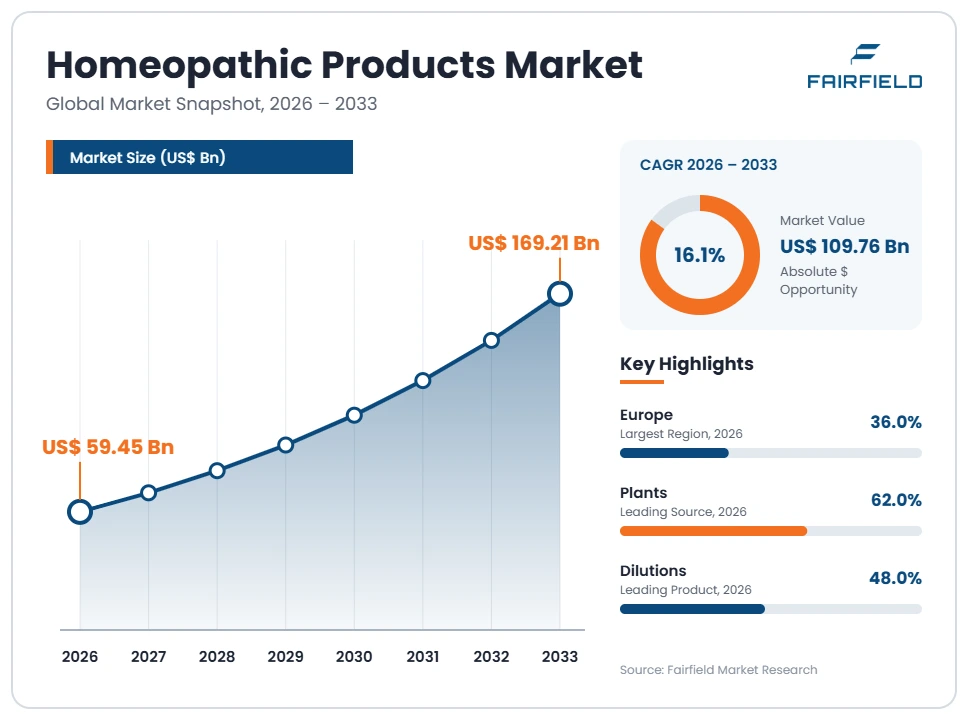
The global homeopathic products market size is expected to be valued at US$ 59.45 billion in 2026 and projected to reach US$ 169.21 billion by 2033, growing at a CAGR of 16.1% between 2026 and 2033.
Between 2020 and 2025, the market grew at a CAGR of about 14.5%, as interest in self-care and natural remedies rose during the pandemic, government support expanded in India, and online pharmacies made products easier to buy. Homeopathic products are highly diluted preparations made from plant, animal, and mineral sources and sold as dilutions, tinctures, tablets, globules, creams, and drops. Three factors now drive growth: consumer demand for gentle, over-the-counter remedies for minor conditions, strong government backing for homeopathy in India, and e-commerce sales of homeopathic medicines. The market is shifting toward branded combination remedies, child-friendly formats, and online and direct-to-consumer channels. Scientific reviews have not found effects beyond placebo, and regulators in several countries have tightened rules. In April 2025, India’s Ministry of Ayush hosted its largest homeopathy scientific convention for World Homoeopathy Day, highlighting the country’s policy support.
Key Report Takeaways
- By Product: Dilutions held 48.0% share in 2026, while Tablets are projected to expand at a 17.4% CAGR through 2033, driven by convenient branded combination tablets and globules sold over the counter and online.
- By Application: Analgesic & Antipyretic held 31.0% share in 2026, while Neurology is projected to expand at a 17.2% CAGR through 2033, driven by consumer demand for remedies marketed for stress, sleep, and anxiety.
- By Source: Plants held 62.0% share in 2026, while Minerals are projected to expand at a 16.8% CAGR through 2033, driven by wider use of mineral-based tissue salts and combination remedies.
- By Region: Europe held 36.0% share in 2026, while Asia Pacific is projected to expand at an 18.6% CAGR through 2033, driven by government support, large practitioner networks, and manufacturing capacity in India.
Global Homeopathic Products Market Trends and Insights
Drivers Impact Analysis
Two drivers carry the strongest influence on homeopathic products demand during the forecast period.
| Driver | Impact on CAGR Forecast | Geographic Relevance | Impact Timeline |
| Consumer demand for natural self-care remedies | High | Europe, North America, Asia Pacific | Long term (≥4 years) |
| Government support and practitioner networks in India | High | Asia Pacific | Long term (≥4 years) |
Natural Self-Care Demand Is Driving the Homeopathic Products Market
Consumer demand for natural self-care remedies is the strongest driver of the homeopathic products market. Many people look for gentle options for minor health problems.
The mechanism is consumer preference rather than clinical evidence. Many buyers see homeopathic products as natural, low in side effects, and safe for children, older adults, and pregnant women, and they use them for colds, coughs, teething, bruises, allergies, and sleep. Concerns about side effects of conventional drugs and antibiotic overuse push some consumers toward natural remedies. Products are widely available over-the-counter in pharmacies in France, Germany, and the United States, and online pharmacies and marketplaces have widened access. Brand loyalty is strong, and families often pass on usage habits across generations. Wellness influencers and holistic practitioners also promote these products. Low prices encourage repeat purchases. This demand keeps sales growing even as scientific criticism continues.
Government Support in India Is Expanding the Homeopathic Products Market
Government support and large practitioner networks in India are expanding the homeopathic products market. India treats homeopathy as part of its national health system.
The cause is official policy. India’s Ministry of Ayush funds homeopathy research, education, hospitals, and public health programs. The country has about 3.45 lakh registered homeopathic doctors and 384 licensed manufacturers, according to government figures, and many people use homeopathy as a low-cost first option. Public dispensaries and wellness centers offer homeopathic care. Companies such as SBL, Dr. Willmar Schwabe India, Bakson, and Dabur sell large volumes through chemists and online platforms. The government promotes exports of homeopathic medicines to other countries. Insurance coverage for AYUSH treatments has also expanded. These policies create a large and growing domestic market for local manufacturers.
Restraints Impact Analysis
Two restraints limit how quickly the homeopathic products market grows.
| Restraint | Impact on CAGR Forecast | Geographic Relevance | Impact Timeline |
| Lack of scientific evidence and reimbursement cuts | High | Europe, North America | Long term (≥4 years) |
| Tightening regulation and product withdrawals | Medium | Europe, North America | Medium term (2–4 years) |
Lack of Scientific Evidence Slows the Homeopathic Products Market
The lack of scientific evidence and reimbursement cuts slow the homeopathic products market. Major health bodies say homeopathy does not work beyond placebo.
The specific causes are research findings and policy changes. A major review by Australia’s National Health and Medical Research Council found no reliable evidence that homeopathy is effective for any health condition, and systematic reviews have reached similar conclusions. The National Health Service in England stopped funding homeopathic remedies in 2017. France ended health insurance reimbursement for homeopathy in 2021, which reduced sales and led Boiron to cut jobs and close sites. Doctors and pharmacist groups increasingly advise against these products. Media coverage of the evidence affects consumer trust. These factors limit growth in mature markets and push companies to focus on self-pay consumers and emerging markets.
Tightening Regulation Restricts the Homeopathic Products Market
Tightening regulation and product withdrawals restrict the homeopathic products market. Regulators are applying stricter rules to quality, safety, and labeling.
The underlying causes are safety concerns and consumer protection. The U.S. Food and Drug Administration adopted a risk-based enforcement approach in 2022 and has acted against some products, including homeopathic eye drops, due to contamination and safety risks. Courts and consumer groups have challenged marketing claims. In Spain, the Spanish Agency of Medicines and Medical Devices required homeopathic products to be registered, and hundreds of products were withdrawn by their makers. Registration in Europe requires quality data, which is costly for small makers. Label rules limit health claims on packaging. These rules raise costs and reduce the number of products on shelves, especially single remedies with low sales.
Market Opportunities
Online and Direct-to-Consumer Sales Open a Fast-Growth Revenue Pool
Online and direct-to-consumer sales open a fast-growth revenue pool in the homeopathic products market. Consumers increasingly buy health products online.
Brands with strong online presence can capture this opportunity. E-pharmacies and marketplaces in India, the United States, and Europe offer wide ranges of homeopathic medicines with home delivery. Online consultations with homeopathic practitioners create direct prescriptions. Brands use social media, subscriptions, and loyalty programs to build repeat sales. Data from online sales helps companies understand demand. Smaller brands can reach national audiences without large retail budgets. Clear, accurate product information builds trust with shoppers who compare products online. Platforms in India such as large e-pharmacies list thousands of homeopathic dilutions and tablets. Brands must also follow advertising rules that limit health claims online.
Emerging Markets Create a Geographic Revenue Pool
Emerging markets create a geographic revenue pool in the homeopathic products market. Use is rising in countries with growing middle classes.
Manufacturers with low-cost production and export networks can capture this opportunity. Indian companies export homeopathic dilutions and mother tincture to markets in Latin America, Middle East & Africa, and Asia Pacific. Brazil recognizes homeopathy as a medical specialty and includes it in its public health system. Mexico, Pakistan, and Bangladesh have large practitioner bases. Rising incomes allow more spending on self-care. Partnerships with local distributors and pharmacies speed market entry. Meeting local registration rules is essential for growth. Certified manufacturing under good manufacturing practice helps exporters win approvals and build trust with distributors, pharmacies, and practitioners in new markets.
Segment Analysis
- By Product: Dilutions Lead While Tablets Grow Fastest
Dilutions held 48.0% share in 2026. Homeopathic dilutions are liquid preparations made by repeated dilution and shaking, sold in many potencies and used by practitioners to prescribe individual remedies. Boiron, Dr. Willmar Schwabe, SBL, and Bakson produce thousands of single remedies for pharmacies, clinics, and practitioners.
Tablets are the fastest-growing product, expanding at a 17.4% CAGR through 2033. Tablets and globules are easy to take, carry, store, and dose, and branded combination tablets target specific complaints such as colds, sleep, and teething. Mother tincture, made from plant extracts, serves as a base for dilutions and is also sold directly. For the market, tablet growth supports branded over-the-counter products with higher margins.
- By Application: Analgesic & Antipyretic Leads While Neurology Grows Fastest
Analgesic & Antipyretic held 31.0% share in 2026. Consumers use homeopathic products for pain, bruises, muscle aches, fever, and flu symptoms. Arnica-based creams and tablets are among the best-known products in this group.
Neurology is the fastest-growing application, expanding at a 17.2% CAGR through 2033. Products marketed for stress, anxiety, sleep, and headaches attract consumers seeking natural remedies for everyday wellbeing. Respiratory products for coughs, colds, and allergies are another large group, along with dermatology, digestive, and immunology uses. For the market, neurology growth follows wider interest in sleep and mental wellbeing products. Respiratory products sell strongly in winter, and children’s remedies for teething and colic remain popular with parents in Europe and North America.
- By Source: Plants Lead While Minerals Grow Fastest
Plants held 62.0% share in 2026. Most homeopathic remedies use plant sources such as arnica, belladonna, calendula, chamomile, and echinacea. Mother tincture production depends on reliable supplies of high-quality plants, often grown or wild-collected in Europe and India.
Minerals are the fastest-growing source, expanding at a 16.8% CAGR through 2033. Mineral-based remedies, including tissue salts and preparations from sulphur, calcium, and silica, are used widely in combination products. Animal sources, such as bee venom and cuttlefish ink, make up a smaller share. For the market, source diversity supports broad product ranges. Makers must secure raw materials of consistent quality and meet pharmacopoeia standards. Supply of wild-collected plants can be affected by weather, overharvesting, and conservation rules.
Geography Analysis
- North America Builds the Homeopathic Products Market Through Over-the-Counter Sales
North America is a major homeopathic products market. The United States sells homeopathic products widely over-the-counter in pharmacies, grocery stores, and online, with Hyland’s and Boiron USA among the leading brands. Canada licenses homeopathic products as natural health products under federal rules, with product licence numbers on labels. Many consumers buy combination products for colds, allergies, pain, and sleep, and natural food stores carry wide ranges. Key barriers include FDA enforcement, lawsuits over marketing claims, and proposed legislation that could change oversight. One opportunity is online sales through marketplaces and brand websites, which reach consumers seeking natural remedies.
- Which Region Is Leading the Homeopathic Products Market?
Europe is leading the homeopathic products market with a 36.0% share in 2026. France, Germany, Switzerland, Italy, and the United Kingdom have long traditions of homeopathy, with homeopathic medicines sold in most pharmacies. Boiron in France, Dr. Willmar Schwabe and Heel in Germany, and Weleda in Switzerland are major makers. Germany still allows reimbursement through some insurers, while France ended public reimbursement in 2021. Key barriers include scientific criticism and stricter regulation. One change shaping the region is a shift to self-pay consumers who buy branded over-the-counter products in pharmacies.
- Which Region Is Growing Fastest in the Homeopathic Products Market?
Asia Pacific is growing fastest in the homeopathic products market at an 18.6% CAGR through 2033. India is the world’s largest homeopathy user by number of people, with strong government support, hundreds of manufacturers, and a large network of practitioners. SBL, Dr. Willmar Schwabe India, Bakson, and Dabur serve this market. Pakistan and Bangladesh also have large user bases. Australia has seen falling use after its national evidence review. Key barriers include quality control among small makers and uneven regulation. One change shaping the region is online sales of homeopathic medicines through e-pharmacies, which reach smaller towns.
- Latin America Grows the Homeopathic Products Market Through Public Health Recognition
Latin America is a growing homeopathic products market. Brazil recognizes homeopathy as a medical specialty and offers it in its public health system, and Mexico has homeopathic hospitals, schools, and a national homeopathic pharmacopoeia. Argentina, Colombia, and Chile have established users, practitioners, and specialist pharmacies. Homeopathic pharmacies in Brazil prepare remedies on prescription, and public clinics offer consultations. Rising interest in natural remedies among urban consumers supports demand, while imports from India and Europe supply many products. Key barriers include limited regulation in some countries, scientific criticism, and economic volatility. One opportunity is pharmacy distribution of branded combination products.
- Middle East & Africa Expands the Homeopathic Products Market Through Imports
Middle East & Africa is an emerging homeopathic products market. The United Arab Emirates and Saudi Arabia license homeopathic practitioners, and South Africa regulates homeopathy as a profession. Products are mostly imported from India and Europe. Indian makers sell to communities with ties to India in the United Arab Emirates, Saudi Arabia, and South Africa. Egypt, Nigeria, and Kenya have small practitioner groups. Wellness centers and private clinics offer homeopathic care in major cities. Key barriers include limited awareness, strict drug registration rules, and scientific criticism. One opportunity is export partnerships with local distributors and pharmacies.
Competitive Landscape
The homeopathic products market is fragmented. Boiron and Dr. Willmar Schwabe are the largest global players, while Hyland’s, Heel, Weleda, and Nelsons hold strong positions in North America and Europe. Indian companies such as SBL, Bakson, Dabur, Hahnemann Laboratories, and Lupin lead in Asia Pacific, alongside thousands of small local makers.
Companies compete on brand trust, product range, quality certification, pharmacy relationships, price, and online presence. Large players benefit from long histories, wide distribution, and recognized brands. Indian makers compete on low prices and large practitioner networks. Smaller firms focus on niche remedies, specialty pharmacies, and online sales. Quality certification and compliance with pharmacopoeia standards are increasingly important as regulators tighten rules.
Strategic moves show how competition is changing. In April 2025, India’s Ministry of Ayush held a major homeopathy convention for World Homoeopathy Day. In August 2025, press reports showed hundreds of homeopathic products, mostly from Boiron, had been withdrawn in Spain. In June 2026, a bill was introduced in the U.S. Senate on homeopathic drug regulation. These moves show competition shaped by tighter regulation in North America and Europe and by rapid growth in India, where policy support and practitioner networks favor domestic makers.
Three themes shape vendor strategy. First, companies are growing in India. Second, they are expanding online. Third, they are adapting to stricter rules by trimming product ranges and strengthening quality data. Vendors that combine trusted brands, compliant products, and strong distribution are best placed to hold share.
Recent Industry Developments
- June 2026: Members of the U.S. Senate introduced the Homeopathic Drug Product Safety, Quality, and Transparency Act, which would withdraw the FDA 2022 enforcement guidance – could reshape oversight of homeopathic medicines in the United States.
- August 2025: Reports showed the Spanish Agency of Medicines and Medical Devices had removed 314 homeopathic products from its registry, about 97% from Boiron, mostly withdrawn for commercial reasons – narrows product ranges in Spain.
- April 2025: India’s Ministry of Ayush held its largest homeopathy scientific convention in Gandhinagar for World Homoeopathy Day – reinforces government support in the fastest-growing market.
Companies Covered in the Report
- Boiron
- Dr. Willmar Schwabe
- Hyland’s
- Heel
- SBL
- Weleda
- Nelsons
- Bakson
- Dabur
- Hahnemann Laboratories
- Lupin
- Helios Homoeopathy
Homeopathic Products Market Report Scope
| Metric | Value |
| Study Period | 2020–2033 |
| Market Size 2026 | US$ 59.45 Billion |
| Market Size 2033 | US$ 169.21 Billion |
| CAGR 2026–2033 | 16.1% |
| Absolute Dollar Opportunity | US$ 109.76 Billion |
| Largest Market | Europe |
| Fastest-Growing Market | Asia Pacific |
| Market Concentration | Fragmented |
| Major Players | Boiron, Dr. Willmar Schwabe, Hyland’s, Heel, SBL |
Homeopathic Products Market Segmentation
Product
- Dilutions
- Tincture
- Tablets
- Others
Application
- Analgesic & Antipyretic
- Respiratory
- Neurology
- Immunology
- Gastroenterology
- Dermatology
- Others
Source
- Plants
- Animals
- Minerals
Regions
- North America
- Europe
- Asia Pacific
- Latin America
- Middle East & Africa
- Executive Summary
- Global Homeopathic Products Market Snapshot
- Future Projections
- Key Report Takeaways
- Regional Snapshot
- Market Overview
- Market Definition and Report Scope
- Historical Trends 2020–2025
- Market Dynamics
- Drivers
- Natural Self-Care Demand Is Driving the Homeopathic Products Market
- Government Support in India Is Expanding the Homeopathic Products Market
- Restraints
- Lack of Scientific Evidence Slows the Homeopathic Products Market
- Tightening Regulation Restricts the Homeopathic Products Market
- Market Opportunities
- Online and Direct-to-Consumer Sales Open a Fast-Growth Revenue Pool
- Emerging Markets Create a Geographic Revenue Pool
- Drivers
- Global Homeopathic Products Market Outlook, 2020-2033
- Global Homeopathic Products Market Outlook, by Product, Value (US$ Billion), 2020-2033
- Dilutions
- Tincture
- Tablets
- Others
- Global Homeopathic Products Market Outlook, by Application, Value (US$ Billion), 2020-2033
- Analgesic & Antipyretic
- Respiratory
- Neurology
- Immunology
- Gastroenterology
- Dermatology
- Others
- Global Homeopathic Products Market Outlook, by Source, Value (US$ Billion), 2020-2033
- Plants
- Animals
- Minerals
- Global Homeopathic Products Market Outlook, by Region, Value (US$ Billion), 2020-2033
- North America
- Europe
- Asia Pacific
- Latin America
- Middle East & Africa
- Global Homeopathic Products Market Outlook, by Product, Value (US$ Billion), 2020-2033
- North America Homeopathic Products Market Outlook, 2020-2033
- North America Homeopathic Products Market Outlook, by Product, Value (US$ Billion), 2020-2033
- Dilutions
- Tincture
- Tablets
- Others
- North America Homeopathic Products Market Outlook, by Application, Value (US$ Billion), 2020-2033
- Analgesic & Antipyretic
- Respiratory
- Neurology
- Immunology
- Gastroenterology
- Dermatology
- Others
- North America Homeopathic Products Market Outlook, by Source, Value (US$ Billion), 2020-2033
- Plants
- Animals
- Minerals
- North America Homeopathic Products Market Outlook, by Country, Value (US$ Billion), 2020-2033
- United States Homeopathic Products Market Outlook, by Product, 2020-2033
- United States Homeopathic Products Market Outlook, by Application, 2020-2033
- United States Homeopathic Products Market Outlook, by Source, 2020-2033
- Canada Homeopathic Products Market Outlook, by Product, 2020-2033
- Canada Homeopathic Products Market Outlook, by Application, 2020-2033
- Canada Homeopathic Products Market Outlook, by Source, 2020-2033
- North America Homeopathic Products Market Outlook, by Product, Value (US$ Billion), 2020-2033
- Europe Homeopathic Products Market Outlook, 2020-2033
- Europe Homeopathic Products Market Outlook, by Product, Value (US$ Billion), 2020-2033
- Dilutions
- Tincture
- Tablets
- Others
- Europe Homeopathic Products Market Outlook, by Application, Value (US$ Billion), 2020-2033
- Analgesic & Antipyretic
- Respiratory
- Neurology
- Immunology
- Gastroenterology
- Dermatology
- Others
- Europe Homeopathic Products Market Outlook, by Source, Value (US$ Billion), 2020-2033
- Plants
- Animals
- Minerals
- Europe Homeopathic Products Market Outlook, by Country, Value (US$ Billion), 2020-2033
- France Homeopathic Products Market Outlook, by Product, 2020-2033
- France Homeopathic Products Market Outlook, by Application, 2020-2033
- France Homeopathic Products Market Outlook, by Source, 2020-2033
- Germany Homeopathic Products Market Outlook, by Product, 2020-2033
- Germany Homeopathic Products Market Outlook, by Application, 2020-2033
- Germany Homeopathic Products Market Outlook, by Source, 2020-2033
- Switzerland Homeopathic Products Market Outlook, by Product, 2020-2033
- Switzerland Homeopathic Products Market Outlook, by Application, 2020-2033
- Switzerland Homeopathic Products Market Outlook, by Source, 2020-2033
- Italy Homeopathic Products Market Outlook, by Product, 2020-2033
- Italy Homeopathic Products Market Outlook, by Application, 2020-2033
- Italy Homeopathic Products Market Outlook, by Source, 2020-2033
- United Kingdom Homeopathic Products Market Outlook, by Product, 2020-2033
- United Kingdom Homeopathic Products Market Outlook, by Application, 2020-2033
- United Kingdom Homeopathic Products Market Outlook, by Source, 2020-2033
- Europe Homeopathic Products Market Outlook, by Product, Value (US$ Billion), 2020-2033
- Asia Pacific Homeopathic Products Market Outlook, 2020-2033
- Asia Pacific Homeopathic Products Market Outlook, by Product, Value (US$ Billion), 2020-2033
- Dilutions
- Tincture
- Tablets
- Others
- Asia Pacific Homeopathic Products Market Outlook, by Application, Value (US$ Billion), 2020-2033
- Analgesic & Antipyretic
- Respiratory
- Neurology
- Immunology
- Gastroenterology
- Dermatology
- Others
- Asia Pacific Homeopathic Products Market Outlook, by Source, Value (US$ Billion), 2020-2033
- Plants
- Animals
- Minerals
- Asia Pacific Homeopathic Products Market Outlook, by Country, Value (US$ Billion), 2020-2033
- India Homeopathic Products Market Outlook, by Product, 2020-2033
- India Homeopathic Products Market Outlook, by Application, 2020-2033
- India Homeopathic Products Market Outlook, by Source, 2020-2033
- Pakistan Homeopathic Products Market Outlook, by Product, 2020-2033
- Pakistan Homeopathic Products Market Outlook, by Application, 2020-2033
- Pakistan Homeopathic Products Market Outlook, by Source, 2020-2033
- Bangladesh Homeopathic Products Market Outlook, by Product, 2020-2033
- Bangladesh Homeopathic Products Market Outlook, by Application, 2020-2033
- Bangladesh Homeopathic Products Market Outlook, by Source, 2020-2033
- Australia Homeopathic Products Market Outlook, by Product, 2020-2033
- Australia Homeopathic Products Market Outlook, by Application, 2020-2033
- Australia Homeopathic Products Market Outlook, by Source, 2020-2033
- Asia Pacific Homeopathic Products Market Outlook, by Product, Value (US$ Billion), 2020-2033
- Latin America Homeopathic Products Market Outlook, 2020-2033
- Latin America Homeopathic Products Market Outlook, by Product, Value (US$ Billion), 2020-2033
- Dilutions
- Tincture
- Tablets
- Others
- Latin America Homeopathic Products Market Outlook, by Application, Value (US$ Billion), 2020-2033
- Analgesic & Antipyretic
- Respiratory
- Neurology
- Immunology
- Gastroenterology
- Dermatology
- Others
- Latin America Homeopathic Products Market Outlook, by Source, Value (US$ Billion), 2020-2033
- Plants
- Animals
- Minerals
- Latin America Homeopathic Products Market Outlook, by Country, Value (US$ Billion), 2020-2033
- Brazil Homeopathic Products Market Outlook, by Product, 2020-2033
- Brazil Homeopathic Products Market Outlook, by Application, 2020-2033
- Brazil Homeopathic Products Market Outlook, by Source, 2020-2033
- Mexico Homeopathic Products Market Outlook, by Product, 2020-2033
- Mexico Homeopathic Products Market Outlook, by Application, 2020-2033
- Mexico Homeopathic Products Market Outlook, by Source, 2020-2033
- Argentina Homeopathic Products Market Outlook, by Product, 2020-2033
- Argentina Homeopathic Products Market Outlook, by Application, 2020-2033
- Argentina Homeopathic Products Market Outlook, by Source, 2020-2033
- Colombia Homeopathic Products Market Outlook, by Product, 2020-2033
- Colombia Homeopathic Products Market Outlook, by Application, 2020-2033
- Colombia Homeopathic Products Market Outlook, by Source, 2020-2033
- Chile Homeopathic Products Market Outlook, by Product, 2020-2033
- Chile Homeopathic Products Market Outlook, by Application, 2020-2033
- Chile Homeopathic Products Market Outlook, by Source, 2020-2033
- Latin America Homeopathic Products Market Outlook, by Product, Value (US$ Billion), 2020-2033
- Middle East & Africa Homeopathic Products Market Outlook, 2020-2033
- Middle East & Africa Homeopathic Products Market Outlook, by Product, Value (US$ Billion), 2020-2033
- Dilutions
- Tincture
- Tablets
- Others
- Middle East & Africa Homeopathic Products Market Outlook, by Application, Value (US$ Billion), 2020-2033
- Analgesic & Antipyretic
- Respiratory
- Neurology
- Immunology
- Gastroenterology
- Dermatology
- Others
- Middle East & Africa Homeopathic Products Market Outlook, by Source, Value (US$ Billion), 2020-2033
- Plants
- Animals
- Minerals
- Middle East & Africa Homeopathic Products Market Outlook, by Country, Value (US$ Billion), 2020-2033
- United Arab Emirates Homeopathic Products Market Outlook, by Product, 2020-2033
- United Arab Emirates Homeopathic Products Market Outlook, by Application, 2020-2033
- United Arab Emirates Homeopathic Products Market Outlook, by Source, 2020-2033
- Saudi Arabia Homeopathic Products Market Outlook, by Product, 2020-2033
- Saudi Arabia Homeopathic Products Market Outlook, by Application, 2020-2033
- Saudi Arabia Homeopathic Products Market Outlook, by Source, 2020-2033
- South Africa Homeopathic Products Market Outlook, by Product, 2020-2033
- South Africa Homeopathic Products Market Outlook, by Application, 2020-2033
- South Africa Homeopathic Products Market Outlook, by Source, 2020-2033
- Egypt Homeopathic Products Market Outlook, by Product, 2020-2033
- Egypt Homeopathic Products Market Outlook, by Application, 2020-2033
- Egypt Homeopathic Products Market Outlook, by Source, 2020-2033
- Nigeria Homeopathic Products Market Outlook, by Product, 2020-2033
- Nigeria Homeopathic Products Market Outlook, by Application, 2020-2033
- Nigeria Homeopathic Products Market Outlook, by Source, 2020-2033
- Kenya Homeopathic Products Market Outlook, by Product, 2020-2033
- Kenya Homeopathic Products Market Outlook, by Application, 2020-2033
- Kenya Homeopathic Products Market Outlook, by Source, 2020-2033
- Middle East & Africa Homeopathic Products Market Outlook, by Product, Value (US$ Billion), 2020-2033
- Competitive Landscape
- Market Concentration and Industry Leaders
- Competitive Differentiation
- Strategic Moves and Market Direction
- Recent Industry Developments
- Company Profiles
- Boiron
- Dr. Willmar Schwabe
- Hyland's
- Heel
- SBL
- Weleda
- Nelsons
- Bakson
- Dabur
- Hahnemann Laboratories
- Lupin
- Helios Homoeopathy
- Appendix
- Research Methodology
- Report Assumptions
- Acronyms and Abbreviations
Product
- Dilutions
- Tincture
- Tablets
- Others
Application
- Analgesic & Antipyretic
- Respiratory
- Neurology
- Immunology
- Gastroenterology
- Dermatology
- Others
Source
- Plants
- Animals
- Minerals
Regions
- North America
- Europe
- Asia Pacific
- Latin America
- Middle East & Africa
Our Research Methodology
Considering the volatility of business today, traditional approaches to strategizing a game plan can be unfruitful if not detrimental. True ambiguity is no way to determine a forecast. A myriad of predetermined factors must be accounted for such as the degree of risk involved, the magnitude of circumstances, as well as conditions or consequences that are not known or unpredictable. To circumvent binary views that cast uncertainty, the application of market research intelligence to strategically posture, move, and enable actionable outcomes is necessary.
View Methodology
Quality Assured
Rigorous Validation Process

Confidentiality Assured
End-to-end Data Security

Custom Research Services
Tailored To Your Objectives
FAQs
The homeopathic products market is valued at US$ 59.45 billion in 2026, led by dilutions and Europe, its largest regional market.
The market is projected to reach US$ 169.21 billion by 2033, growing at a 16.1% CAGR and adding US$ 109.76 billion.
Tablets are growing fastest at a 17.4% CAGR through 2033, driven by convenient branded combination remedies sold over the counter.
Asia Pacific is growing fastest at an 18.6% CAGR through 2033, driven by government support and manufacturing in India.
Europe holds the largest share at 36.0% in 2026, supported by long traditions of homeopathy in France and Germany.
Related Reports
Immune Checkpoint Inhibitors Market Size, Share, Insights, Competitive Landscape, and Forecast 2026 to 2033
The global immune checkpoint inhibitors market is valued at US$52.0 billion in 2026, reaching US$68.0 billion by 2033, growing at a 3.91% CAGR
Geriatric Medicines Market Size, Share, Insights, Competitive Landscape, and Forecast 2026 to 2033
The global geriatric medicines market is valued at US$412.0 billion in 2026, reaching US$538.0 billion by 2033, growing at a 3.9% CAGR
Pharmaceutical Temperature Controlled Packaging Solutions Market Size, Share, Insights, Competitive Landscape, and Forecast 2026 to 2033
Pharmaceutical temperature controlled packaging solutions market to grow from US$ 6.86 billion in 2026 to US$ 13.98 billion by 2033 at a 10.7% CAGR.
Dermatology CRO Market Size, Share, Insights, Competitive Landscape, and Forecast 2026 to 2033
Explore the dermatology CRO market, projected to reach US$ 9.7 billion by 2033 at a 6.6% CAGR, with service, indication and regional insights.
Acetaminophen Market Size, Share, Insights, Competitive Landscape, and Forecast 2026 to 2033
The global acetaminophen market is valued at US$11.70 billion in 2026, reaching US$15.93 billion by 2033, growing at a 4.5% CAGR
Allergy Diagnostics and Therapeutics Market Size, Share, Insights, Competitive Landscape, and Forecast 2026 to 2033
The global allergy diagnostics and therapeutics market is valued at US$41.50 billion in 2026, reaching US$88.30 billion by 2033, growing at an 11.4% CAGR