



Omics-Based Clinical Trials Market
Omics-Based Clinical Trials Market Size, Share, Insights, Competitive Landscape, and Forecast 2026 to 2033
Omics-Based Clinical Trials Market Analysis, 2026–2033
Omics-Based Clinical Trials Market
Omics-Based Clinical Trials Market Size, Share, Insights, Competitive Landscape, and Forecast 2026 to 2033
Omics-Based Clinical Trials Market Size and Trend Analysis
How Fast Is the Omics-Based Clinical Trials Market Growing?
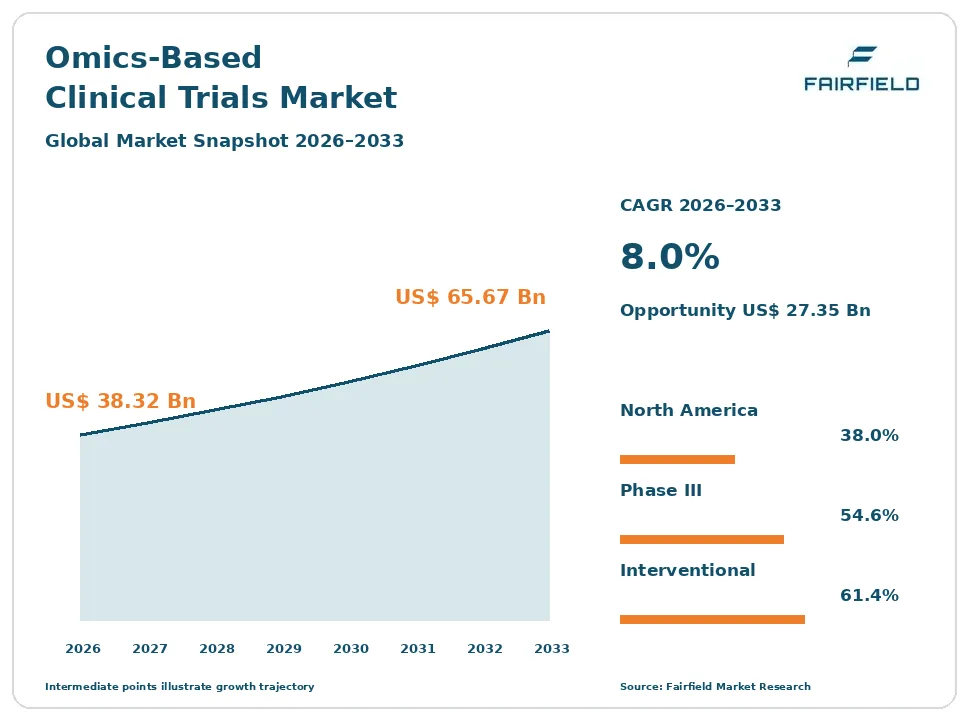
The global omics-based clinical trials market size is expected to be valued at US$ 38.32 billion in 2026 and projected to reach US$ 65.67 billion by 2033, growing at a CAGR of 8.0% between 2026 and 2033.
Between 2020 and 2025, the market grew at a CAGR of about 7.6%, as drug developers expanded targeted cancer programs and pandemic trials used genomics for variant tracking. Three factors now drive growth: the shift to precision medicine, where drugs are matched to patients by molecular profile, falling costs of next-generation sequencing, and wider use of proteomics, transcriptomics, and metabolomics for biomarker discovery. The market is shifting from single-gene tests toward multi-omics profiling combined with AI to select patients, predict response, and design smaller, faster trials. Liquid biopsy, single-cell sequencing, and spatial biology are moving from research into trial protocols. Regulators increasingly expect biomarker data to support approvals of targeted therapies.
Key Report Takeaways
- By Phase: Phase III held 54.6% share in 2026, while Phase I is projected to expand at a 9.6% CAGR through 2033, driven by early biomarker-guided dose finding and patient selection.
- By Study Design: Interventional held 61.4% share in 2026, while Observational is projected to expand at a 9.2% CAGR through 2033, driven by real-world genomic registries and long-term biomarker cohorts.
- By Indication: Oncology held 41.5% share in 2026, while Inflammation & Autoimmune is projected to expand at a 10.1% CAGR through 2033, driven by molecular subtyping of immune diseases.
- By Region: North America held 38.0% share in 2026, while Asia Pacific is projected to expand at a 9.8% CAGR through 2033, driven by genomic trial capacity in China, Japan, and Singapore.
Global Omics-Based Clinical Trials Market Trends and Insights
Drivers Impact Analysis
| Driver | Impact on CAGR Forecast | Geographic Relevance | Impact Timeline |
| Growth of precision medicine and targeted therapies | High | North America, Europe, Asia Pacific | Long term (≥4 years) |
| Falling sequencing costs and AI analytics | High | Global | Medium term (2-4 years) |
Two drivers carry the strongest influence on omics-based clinical trials demand during the forecast period.
Precision Medicine Is Driving the Omics-Based Clinical Trials Market
The growth of precision medicine and targeted therapies is the strongest driver of the omics-based clinical trials market. Drug developers increasingly design treatments for patients with specific molecular features.
The mechanism is better success rates for biomarker-selected trials. Studies show that drug programs using patient selection biomarkers have higher chances of approval than those without. Oncology drugs targeting EGFR, ALK, HER2, KRAS, and other alterations require genomics testing to enroll the right patients. Antibody-drug conjugates, cell therapies, and gene therapies also depend on molecular profiling. A large share of new cancer drug approvals now come with companion diagnostics. Basket and umbrella trials test drugs across tumor types based on mutations rather than organ of origin. These designs depend on omics testing at screening. These factors keep drug sponsors spending on omics services.
Lower Sequencing Costs and AI Are Expanding the Omics-Based Clinical Trials Market
Falling sequencing costs and AI analytics are expanding the omics-based clinical trials market. Generating and interpreting molecular data has become far cheaper and faster.
The cause is technology progress in next-generation sequencing, proteomics, and computing. Whole-genome sequencing now costs a few hundred dollars per sample, down from many thousands a decade ago. High-throughput proteomics platforms can measure thousands of proteins from a small blood sample. AI models combine genomic, imaging, pathology, and clinical data to find biomarkers and predict responses. Tempus, AstraZeneca, and Pathos agreed in 2025 to build a large multimodal oncology foundation model. Cloud platforms make large datasets easier to share and analyze. Liquid biopsy tests now track tumor DNA in blood over time, reducing the need for repeat tissue biopsies. These advances allow sponsors to add omics endpoints to more trials.
Restraints Impact Analysis
| Restraint | Impact on CAGR Forecast | Geographic Relevance | Impact Timeline |
| High costs and data complexity | High | Global | Short term (≤2 years) |
| Data privacy and regulatory hurdles | Medium | Europe, Asia Pacific | Medium term (2-4 years) |
Two restraints limit how quickly the omics-based clinical trials market grows.
High Costs and Data Complexity Slow the Omics-Based Clinical Trials Market
High costs and data complexity slow the omics-based clinical trials market. Multi-omics studies require expensive testing, storage, and expert analysis.
The specific causes are testing costs, sample logistics, and a shortage of bioinformatics skills. Adding sequencing, proteomics, and other assays to every patient visit can raise trial budgets significantly. Samples need careful collection, processing, and shipping to central labs. Each patient can generate terabytes of data, requiring secure storage and powerful computing. Bioinformaticians and computational biologists are in short supply and highly paid. Different platforms and labs may produce results that are hard to compare. Smaller biotech companies with limited funding often skip extensive omics work. Biotech funding declines in 2022 and 2023 reduced some trial starts. These factors slow adoption in cost-sensitive programs.
Data Privacy Concerns Restrict the Omics-Based Clinical Trials Market
Data privacy and regulatory hurdles restrict the omics-based clinical trials market. Genetic data is highly sensitive and tightly regulated.
The underlying causes are privacy laws and cross-border data limits. The European Union General Data Protection Regulation sets strict rules for processing genetic data. China restricts the export of human genetic resources and requires approvals for foreign-sponsored genomic studies. The United States has new rules limiting the transfer of sensitive genomic data to some countries. Patients may worry about how their genetic data will be used, lowering consent rates. Regulators require validation of biomarker assays and companion diagnostics, which adds time. Rules on returning genetic findings to participants differ between countries. Federated data systems that keep data local can help, but add technical work. These factors complicate global multi-site omics trials.
Market Opportunities
Multi-Omics and AI-Driven Trial Design Open a Premium Revenue Pool
Multi-omics and AI-driven trial design open a premium revenue pool in the omics-based clinical trials market. Sponsors want better patient selection and fewer failed trials.
Contract research organizations, labs, and technology firms with integrated platforms can capture this opportunity. Combining genomics, proteomics, transcriptomics, and imaging gives a fuller picture of disease and drug response. Illumina completed its acquisition of SomaLogic in 2026 to add high-plex proteomics to its sequencing platforms. AI can identify responder subgroups and synthetic control arms, reducing trial size. Single-cell and spatial technologies reveal how tumors and immune cells interact. Sponsors pay premium prices for these services. Data partnerships also create recurring revenue, as de-identified multi-omics datasets can be licensed to several sponsors. Platforms that support biomarker discovery across therapy areas attract long-term pharma contracts. Regulators are also more open to adaptive designs that use biomarkers.
Asia Pacific Trial Capacity Creates a Volume Revenue Pool
Expanding clinical trial capacity in Asia Pacific creates a volume revenue pool in the omics-based clinical trials market. The region offers large patient populations and fast enrollment.
Contract research organizations and genomic service providers with regional labs can capture this opportunity. China is now one of the largest sources of new drug trials, with strong domestic sequencing companies such as BGI and Novogene. Japan and South Korea have national precision oncology programs that profile cancer patients. Singapore is building genomic infrastructure, including a laboratory opened by Macrogen and PacBio in 2024. India offers diverse populations and lower trial costs. Regional biobanks support biomarker discovery, and regulators in China and Japan have shortened trial approval times. Lower costs per patient attract global sponsors, and diverse Asian populations improve the relevance of findings for global drug labels.
Segment Analysis
By Phase: Phase III Leads While Phase I Grows Fastest
Phase III held 54.6% share in 2026. Phase III trials enroll hundreds to thousands of patients and run for years, making them the largest spending phase. Omics testing in these trials confirms biomarker-defined populations, supports companion diagnostic approvals, and tracks response and resistance. Large global studies by Roche, AstraZeneca, Merck & Co., and Pfizer use central genomic labs. Phase II trials are also important for confirming biomarker hypotheses.
Phase I is the fastest-growing phase, expanding at a 9.6% CAGR through 2033. Early trials increasingly use genomics and proteomics to select patients, understand drug mechanisms, and choose doses. Biomarker-rich first-in-human studies help companies decide quickly whether to continue programs. Biotech start-ups with targeted drugs drive much of this activity. For the market, early-phase growth expands omics demand.
By Study Design: Interventional Leads While Observational Grows Fastest
Interventional held 61.4% share in 2026. Interventional trials test drugs, biologics, or devices in assigned patients, with omics used for screening, stratification, and response monitoring. Targeted oncology trials and gene therapy studies are the main users. Sponsors work with contract research organizations and central laboratories to manage testing, sample logistics, and data reporting across many countries.
Observational is the fastest-growing study design, expanding at a 9.2% CAGR through 2033. Observational studies follow patients in real-world settings and use genomic registries, biobanks, and electronic health records to find biomarkers and natural history data. Precision medicine programs such as national biobanks support these studies. Regulators increasingly accept real-world evidence to support label expansions. For the market, observational growth adds real-world evidence.
By Indication: Oncology Leads While Inflammation & Autoimmune Grows Fastest
Oncology held 41.5% share in 2026. Cancer is driven by genetic changes, so tumor sequencing, liquid biopsy, and gene expression profiling are standard in cancer trials. Targeted therapies, immunotherapies, and antibody-drug conjugates need biomarkers for patient selection. Next-generation sequencing panels from Foundation Medicine, Guardant Health, and Tempus are widely used.
Inflammation & Autoimmune is the fastest-growing indication, expanding at a 10.1% CAGR through 2033. Diseases such as lupus, rheumatoid arthritis, inflammatory bowel disease, and atopic dermatitis vary greatly between patients. Omics helps divide patients into molecular subtypes for targeted treatment. Cell therapies for autoimmune disease also need profiling. Neurology and cardiovascular trials are also adding genetic risk scores and protein biomarkers. For the market, immune disease growth broadens demand beyond cancer.
Geography Analysis
Which Region Is Leading the Omics-Based Clinical Trials Market?
North America is leading the omics-based clinical trials market with a 38.0% share in 2026. The United States has the largest pharmaceutical and biotech industry, the most clinical trials, and leading genomic companies such as Illumina, Thermo Fisher Scientific, Tempus, and Guardant Health. The Food and Drug Administration provides guidance on biomarkers and companion diagnostics. Programs such as All of Us build large genomic datasets. Canada adds strong research hospitals and cancer genomics networks. Large venture funding supports omics and AI start-ups. One change shaping the region is AI-driven multi-omics analysis.
Europe Advances the Omics-Based Clinical Trials Market Through Biobanks
Europe is a major omics-based clinical trials market. The United Kingdom has the UK Biobank and Genomics England, which support large-scale genetic research and trials. Germany, France, the Netherlands, and Denmark have strong academic centers and pharmaceutical companies. The European Union Clinical Trials Regulation simplifies multi-country trials through a single submission portal. Roche, Novartis, and AstraZeneca run large biomarker-driven programs from the region and invest heavily in companion diagnostics. Switzerland and Belgium host major trial sites and labs. Key barriers include strict data privacy rules. One opportunity is cross-border genomic data spaces.
Which Region Is Growing Fastest in the Omics-Based Clinical Trials Market?
Asia Pacific is growing fastest in the omics-based clinical trials market at a 9.8% CAGR through 2033. China is the fastest-growing country, with many new drug trials and large sequencing companies such as BGI. Japan has a national cancer genomic profiling program covered by insurance. South Korea and Australia have strong clinical research systems, and Australia offers tax incentives for early-phase trials. Singapore hosts regional genomic laboratories. India offers large, diverse patient pools and lower costs, and its sequencing capacity is growing. Faster regulatory reviews attract global sponsors. One opportunity is regional central laboratory networks.
Latin America Grows the Omics-Based Clinical Trials Market Through Trial Sites
Latin America is a growing omics-based clinical trials market. Brazil, Mexico, and Argentina have large patient populations, fast enrollment, and experienced trial sites that attract global oncology and immunology sponsors. Genetic diversity in the region is valuable for biomarker research and helps sponsors meet diversity goals for global trials. Local genomic labs in São Paulo and Mexico City are expanding, but many samples are still sent abroad for testing. Colombia, Chile, and Peru add growing trial activity. Key barriers include regulatory delays and sample export rules. One opportunity is building regional sequencing and central laboratory capacity.
Middle East & Africa Builds the Omics-Based Clinical Trials Market
Middle East & Africa is an emerging omics-based clinical trials market. Saudi Arabia and the United Arab Emirates run national genome programs and are investing in clinical research centers. Qatar has a population genomics program, and Saudi Arabia has high rates of inherited diseases that support genetic research. South Africa has experienced trial sites and genomic research on diverse African populations, which carry the greatest human genetic diversity. Nigeria and Kenya are building genomic initiatives with international partners. Key barriers include limited infrastructure, funding, and trained staff in many countries. One opportunity is linking national genome programs to trials.
Competitive Landscape
The omics-based clinical trials market is moderately concentrated. Large contract research organizations such as IQVIA, Thermo Fisher Scientific through PPD, ICON, Labcorp, Parexel, Syneos Health, Medpace, and Charles River Laboratories run trials and central lab testing. Technology and data companies such as Illumina, QIAGEN, Tempus, Guardant Health, Foundation Medicine, Eurofins Scientific, BGI, and SOPHiA GENETICS provide omics platforms, assays, and analytics.
Companies compete on assay breadth, data quality, turnaround time, global lab networks, bioinformatics, regulatory expertise, and price. Integrated providers that combine trial management with omics testing and AI analytics win larger contracts. Specialty labs compete on novel assays such as single-cell, spatial, and high-plex proteomics, while large central labs compete on scale and validated workflows. Partnerships between contract research organizations and technology companies are common, and acquisitions are adding new capabilities.
Strategic moves show how competition is changing. In October 2024, Macrogen and PacBio announced a genomics laboratory in Singapore. In April 2025, Tempus signed expanded agreements with AstraZeneca and Pathos to build a multimodal oncology foundation model. In January 2026, Illumina completed its acquisition of SomaLogic, and QIAGEN expanded its multi-omics workflow portfolio. These moves show competition shifting toward multi-omics and AI.
Three themes shape vendor strategy. First, companies are integrating multi-omics into single workflows. Second, they are building AI models for patient selection. Third, they are expanding lab networks in Asia Pacific.
Omics-Based Clinical Trials Market Industry Leaders
- IQVIA
- Thermo Fisher Scientific (PPD)
- ICON
- Labcorp
- Parexel
Recent Industry Developments
- January 2026: Illumina completed its acquisition of SomaLogic - adds high-plex proteomics to sequencing for multi-omics studies.
- January 2026: QIAGEN expanded its digital PCR and sequencing workflows with sample preparation and bioinformatics for multi-omics - supports trial biomarker testing.
- April 2025: Tempus signed expanded agreements with AstraZeneca and Pathos worth about US$ 200 million to build a multimodal oncology foundation model - advances AI-driven trial design.
- October 2024: Macrogen and PacBio announced a new genomics laboratory in Singapore - expands long-read sequencing capacity in Asia Pacific.
Companies Covered in the Report
- IQVIA
- Thermo Fisher Scientific (PPD)
- ICON
- Labcorp
- Parexel
- Syneos Health
- Medpace
- Charles River Laboratories
- Illumina
- QIAGEN
- Tempus AI
- Eurofins Scientific
Omics-Based Clinical Trials Market Report Scope
This report covers clinical trials that use omics technologies, including genomics, transcriptomics, proteomics, metabolomics, and multi-omics, across Phase I to Phase IV, in interventional, observational, and expanded access designs, for oncology, inflammation and autoimmune, cardiovascular, neurology, infectious, and other diseases. It excludes research-only omics studies without a clinical trial component. The base year is 2025, and the forecast period runs from 2026 to 2033. All values are expressed in US$ Billion.
Phase
- Phase I
- Phase II
- Phase III
- Phase IV
Study Design
- Interventional
- Observational
- Expanded Access
Indication
- Oncology
- Inflammation & Autoimmune
- Cardiovascular
- Neurology
- Infectious Diseases
- Others
Regions
- North America
- Europe
- Asia Pacific
- Latin America
- Middle East & Africa
Key Questions Answered in the Report
How big is the omics-based clinical trials market in 2026?
The omics-based clinical trials market is valued at US$ 38.32 billion in 2026, led by Phase III oncology trials in North America.
What is the omics-based clinical trials market forecast to 2033?
The market is projected to reach US$ 65.67 billion by 2033, growing at an 8.0% CAGR and adding US$ 27.35 billion.
Which phase is growing fastest in omics-based clinical trials?
Phase I is growing fastest at a 9.6% CAGR through 2033, driven by biomarker-guided dose finding and early patient selection.
Which region is growing fastest in the omics-based clinical trials market?
Asia Pacific is growing fastest at a 9.8% CAGR through 2033, driven by trial capacity and sequencing companies in China and Japan.
Which region holds the largest omics-based clinical trials market share?
North America holds the largest share at 38.0% in 2026, supported by leading biotech companies, genomic firms, and trial volumes.
1. Executive Summary
1.1. Global Omics-Based Clinical Trials Market Snapshot
1.2. Future Projections
1.3. Key Report Takeaways
1.4. Regional Snapshot
2. Market Overview
2.1. Market Definition and Report Scope
2.2. Historical Trends 2020–2025
2.3. Market Dynamics
2.3.1. Drivers
2.3.1.1. Precision Medicine Is Driving the Omics-Based Clinical Trials Market
2.3.1.2. Lower Sequencing Costs and AI Are Expanding the Omics-Based Clinical Trials Market
2.3.2. Restraints
2.3.2.1. High Costs and Data Complexity Slow the Omics-Based Clinical Trials Market
2.3.2.2. Data Privacy Concerns Restrict the Omics-Based Clinical Trials Market
2.3.3. Market Opportunities
2.3.3.1. Multi-Omics and AI-Driven Trial Design Open a Premium Revenue Pool
2.3.3.2. Asia Pacific Trial Capacity Creates a Volume Revenue Pool
3. Global Omics-Based Clinical Trials Market Outlook, 2020-2033
3.1. Global Omics-Based Clinical Trials Market Outlook, by Phase, Value (US$ Billion), 2020-2033
3.1.1. Phase I
3.1.2. Phase II
3.1.3. Phase III
3.1.4. Phase IV
3.2. Global Omics-Based Clinical Trials Market Outlook, by Study Design, Value (US$ Billion), 2020-2033
3.2.1. Interventional
3.2.2. Observational
3.2.3. Expanded Access
3.3. Global Omics-Based Clinical Trials Market Outlook, by Indication, Value (US$ Billion), 2020-2033
3.3.1. Oncology
3.3.2. Inflammation & Autoimmune
3.3.3. Cardiovascular
3.3.4. Neurology
3.3.5. Infectious Diseases
3.3.6. Others
3.4. Global Omics-Based Clinical Trials Market Outlook, by Region, Value (US$ Billion), 2020-2033
3.4.1. North America
3.4.2. Europe
3.4.3. Asia Pacific
3.4.4. Latin America
3.4.5. Middle East & Africa
4. North America Omics-Based Clinical Trials Market Outlook, 2020-2033
4.1. North America Omics-Based Clinical Trials Market Outlook, by Phase, Value (US$ Billion), 2020-2033
4.1.1. Phase I
4.1.2. Phase II
4.1.3. Phase III
4.1.4. Phase IV
4.2. North America Omics-Based Clinical Trials Market Outlook, by Study Design, Value (US$ Billion), 2020-2033
4.2.1. Interventional
4.2.2. Observational
4.2.3. Expanded Access
4.3. North America Omics-Based Clinical Trials Market Outlook, by Indication, Value (US$ Billion), 2020-2033
4.3.1. Oncology
4.3.2. Inflammation & Autoimmune
4.3.3. Cardiovascular
4.3.4. Neurology
4.3.5. Infectious Diseases
4.3.6. Others
4.4. North America Omics-Based Clinical Trials Market Outlook, by Country, Value (US$ Billion), 2020-2033
4.4.1. United States Omics-Based Clinical Trials Market Outlook, by Phase, 2020-2033
4.4.2. United States Omics-Based Clinical Trials Market Outlook, by Study Design, 2020-2033
4.4.3. United States Omics-Based Clinical Trials Market Outlook, by Indication, 2020-2033
4.4.4. Canada Omics-Based Clinical Trials Market Outlook, by Phase, 2020-2033
4.4.5. Canada Omics-Based Clinical Trials Market Outlook, by Study Design, 2020-2033
4.4.6. Canada Omics-Based Clinical Trials Market Outlook, by Indication, 2020-2033
5. Europe Omics-Based Clinical Trials Market Outlook, 2020-2033
5.1. Europe Omics-Based Clinical Trials Market Outlook, by Phase, Value (US$ Billion), 2020-2033
5.1.1. Phase I
5.1.2. Phase II
5.1.3. Phase III
5.1.4. Phase IV
5.2. Europe Omics-Based Clinical Trials Market Outlook, by Study Design, Value (US$ Billion), 2020-2033
5.2.1. Interventional
5.2.2. Observational
5.2.3. Expanded Access
5.3. Europe Omics-Based Clinical Trials Market Outlook, by Indication, Value (US$ Billion), 2020-2033
5.3.1. Oncology
5.3.2. Inflammation & Autoimmune
5.3.3. Cardiovascular
5.3.4. Neurology
5.3.5. Infectious Diseases
5.3.6. Others
5.4. Europe Omics-Based Clinical Trials Market Outlook, by Country, Value (US$ Billion), 2020-2033
5.4.1. United Kingdom Omics-Based Clinical Trials Market Outlook, by Phase, 2020-2033
5.4.2. United Kingdom Omics-Based Clinical Trials Market Outlook, by Study Design, 2020-2033
5.4.3. United Kingdom Omics-Based Clinical Trials Market Outlook, by Indication, 2020-2033
5.4.4. Germany Omics-Based Clinical Trials Market Outlook, by Phase, 2020-2033
5.4.5. Germany Omics-Based Clinical Trials Market Outlook, by Study Design, 2020-2033
5.4.6. Germany Omics-Based Clinical Trials Market Outlook, by Indication, 2020-2033
5.4.7. France Omics-Based Clinical Trials Market Outlook, by Phase, 2020-2033
5.4.8. France Omics-Based Clinical Trials Market Outlook, by Study Design, 2020-2033
5.4.9. France Omics-Based Clinical Trials Market Outlook, by Indication, 2020-2033
5.4.10. Netherlands Omics-Based Clinical Trials Market Outlook, by Phase, 2020-2033
5.4.11. Netherlands Omics-Based Clinical Trials Market Outlook, by Study Design, 2020-2033
5.4.12. Netherlands Omics-Based Clinical Trials Market Outlook, by Indication, 2020-2033
5.4.13. Denmark Omics-Based Clinical Trials Market Outlook, by Phase, 2020-2033
5.4.14. Denmark Omics-Based Clinical Trials Market Outlook, by Study Design, 2020-2033
5.4.15. Denmark Omics-Based Clinical Trials Market Outlook, by Indication, 2020-2033
5.4.16. Switzerland Omics-Based Clinical Trials Market Outlook, by Phase, 2020-2033
5.4.17. Switzerland Omics-Based Clinical Trials Market Outlook, by Study Design, 2020-2033
5.4.18. Switzerland Omics-Based Clinical Trials Market Outlook, by Indication, 2020-2033
5.4.19. Belgium Omics-Based Clinical Trials Market Outlook, by Phase, 2020-2033
5.4.20. Belgium Omics-Based Clinical Trials Market Outlook, by Study Design, 2020-2033
5.4.21. Belgium Omics-Based Clinical Trials Market Outlook, by Indication, 2020-2033
6. Asia Pacific Omics-Based Clinical Trials Market Outlook, 2020-2033
6.1. Asia Pacific Omics-Based Clinical Trials Market Outlook, by Phase, Value (US$ Billion), 2020-2033
6.1.1. Phase I
6.1.2. Phase II
6.1.3. Phase III
6.1.4. Phase IV
6.2. Asia Pacific Omics-Based Clinical Trials Market Outlook, by Study Design, Value (US$ Billion), 2020-2033
6.2.1. Interventional
6.2.2. Observational
6.2.3. Expanded Access
6.3. Asia Pacific Omics-Based Clinical Trials Market Outlook, by Indication, Value (US$ Billion), 2020-2033
6.3.1. Oncology
6.3.2. Inflammation & Autoimmune
6.3.3. Cardiovascular
6.3.4. Neurology
6.3.5. Infectious Diseases
6.3.6. Others
6.4. Asia Pacific Omics-Based Clinical Trials Market Outlook, by Country, Value (US$ Billion), 2020-2033
6.4.1. China Omics-Based Clinical Trials Market Outlook, by Phase, 2020-2033
6.4.2. China Omics-Based Clinical Trials Market Outlook, by Study Design, 2020-2033
6.4.3. China Omics-Based Clinical Trials Market Outlook, by Indication, 2020-2033
6.4.4. Japan Omics-Based Clinical Trials Market Outlook, by Phase, 2020-2033
6.4.5. Japan Omics-Based Clinical Trials Market Outlook, by Study Design, 2020-2033
6.4.6. Japan Omics-Based Clinical Trials Market Outlook, by Indication, 2020-2033
6.4.7. South Korea Omics-Based Clinical Trials Market Outlook, by Phase, 2020-2033
6.4.8. South Korea Omics-Based Clinical Trials Market Outlook, by Study Design, 2020-2033
6.4.9. South Korea Omics-Based Clinical Trials Market Outlook, by Indication, 2020-2033
6.4.10. Australia Omics-Based Clinical Trials Market Outlook, by Phase, 2020-2033
6.4.11. Australia Omics-Based Clinical Trials Market Outlook, by Study Design, 2020-2033
6.4.12. Australia Omics-Based Clinical Trials Market Outlook, by Indication, 2020-2033
6.4.13. Singapore Omics-Based Clinical Trials Market Outlook, by Phase, 2020-2033
6.4.14. Singapore Omics-Based Clinical Trials Market Outlook, by Study Design, 2020-2033
6.4.15. Singapore Omics-Based Clinical Trials Market Outlook, by Indication, 2020-2033
6.4.16. India Omics-Based Clinical Trials Market Outlook, by Phase, 2020-2033
6.4.17. India Omics-Based Clinical Trials Market Outlook, by Study Design, 2020-2033
6.4.18. India Omics-Based Clinical Trials Market Outlook, by Indication, 2020-2033
7. Latin America Omics-Based Clinical Trials Market Outlook, 2020-2033
7.1. Latin America Omics-Based Clinical Trials Market Outlook, by Phase, Value (US$ Billion), 2020-2033
7.1.1. Phase I
7.1.2. Phase II
7.1.3. Phase III
7.1.4. Phase IV
7.2. Latin America Omics-Based Clinical Trials Market Outlook, by Study Design, Value (US$ Billion), 2020-2033
7.2.1. Interventional
7.2.2. Observational
7.2.3. Expanded Access
7.3. Latin America Omics-Based Clinical Trials Market Outlook, by Indication, Value (US$ Billion), 2020-2033
7.3.1. Oncology
7.3.2. Inflammation & Autoimmune
7.3.3. Cardiovascular
7.3.4. Neurology
7.3.5. Infectious Diseases
7.3.6. Others
7.4. Latin America Omics-Based Clinical Trials Market Outlook, by Country, Value (US$ Billion), 2020-2033
7.4.1. Brazil Omics-Based Clinical Trials Market Outlook, by Phase, 2020-2033
7.4.2. Brazil Omics-Based Clinical Trials Market Outlook, by Study Design, 2020-2033
7.4.3. Brazil Omics-Based Clinical Trials Market Outlook, by Indication, 2020-2033
7.4.4. Mexico Omics-Based Clinical Trials Market Outlook, by Phase, 2020-2033
7.4.5. Mexico Omics-Based Clinical Trials Market Outlook, by Study Design, 2020-2033
7.4.6. Mexico Omics-Based Clinical Trials Market Outlook, by Indication, 2020-2033
7.4.7. Argentina Omics-Based Clinical Trials Market Outlook, by Phase, 2020-2033
7.4.8. Argentina Omics-Based Clinical Trials Market Outlook, by Study Design, 2020-2033
7.4.9. Argentina Omics-Based Clinical Trials Market Outlook, by Indication, 2020-2033
7.4.10. Colombia Omics-Based Clinical Trials Market Outlook, by Phase, 2020-2033
7.4.11. Colombia Omics-Based Clinical Trials Market Outlook, by Study Design, 2020-2033
7.4.12. Colombia Omics-Based Clinical Trials Market Outlook, by Indication, 2020-2033
7.4.13. Chile Omics-Based Clinical Trials Market Outlook, by Phase, 2020-2033
7.4.14. Chile Omics-Based Clinical Trials Market Outlook, by Study Design, 2020-2033
7.4.15. Chile Omics-Based Clinical Trials Market Outlook, by Indication, 2020-2033
7.4.16. Peru Omics-Based Clinical Trials Market Outlook, by Phase, 2020-2033
7.4.17. Peru Omics-Based Clinical Trials Market Outlook, by Study Design, 2020-2033
7.4.18. Peru Omics-Based Clinical Trials Market Outlook, by Indication, 2020-2033
8. Middle East & Africa Omics-Based Clinical Trials Market Outlook, 2020-2033
8.1. Middle East & Africa Omics-Based Clinical Trials Market Outlook, by Phase, Value (US$ Billion), 2020-2033
8.1.1. Phase I
8.1.2. Phase II
8.1.3. Phase III
8.1.4. Phase IV
8.2. Middle East & Africa Omics-Based Clinical Trials Market Outlook, by Study Design, Value (US$ Billion), 2020-2033
8.2.1. Interventional
8.2.2. Observational
8.2.3. Expanded Access
8.3. Middle East & Africa Omics-Based Clinical Trials Market Outlook, by Indication, Value (US$ Billion), 2020-2033
8.3.1. Oncology
8.3.2. Inflammation & Autoimmune
8.3.3. Cardiovascular
8.3.4. Neurology
8.3.5. Infectious Diseases
8.3.6. Others
8.4. Middle East & Africa Omics-Based Clinical Trials Market Outlook, by Country, Value (US$ Billion), 2020-2033
8.4.1. Saudi Arabia Omics-Based Clinical Trials Market Outlook, by Phase, 2020-2033
8.4.2. Saudi Arabia Omics-Based Clinical Trials Market Outlook, by Study Design, 2020-2033
8.4.3. Saudi Arabia Omics-Based Clinical Trials Market Outlook, by Indication, 2020-2033
8.4.4. United Arab Emirates Omics-Based Clinical Trials Market Outlook, by Phase, 2020-2033
8.4.5. United Arab Emirates Omics-Based Clinical Trials Market Outlook, by Study Design, 2020-2033
8.4.6. United Arab Emirates Omics-Based Clinical Trials Market Outlook, by Indication, 2020-2033
8.4.7. Qatar Omics-Based Clinical Trials Market Outlook, by Phase, 2020-2033
8.4.8. Qatar Omics-Based Clinical Trials Market Outlook, by Study Design, 2020-2033
8.4.9. Qatar Omics-Based Clinical Trials Market Outlook, by Indication, 2020-2033
8.4.10. South Africa Omics-Based Clinical Trials Market Outlook, by Phase, 2020-2033
8.4.11. South Africa Omics-Based Clinical Trials Market Outlook, by Study Design, 2020-2033
8.4.12. South Africa Omics-Based Clinical Trials Market Outlook, by Indication, 2020-2033
8.4.13. Nigeria Omics-Based Clinical Trials Market Outlook, by Phase, 2020-2033
8.4.14. Nigeria Omics-Based Clinical Trials Market Outlook, by Study Design, 2020-2033
8.4.15. Nigeria Omics-Based Clinical Trials Market Outlook, by Indication, 2020-2033
8.4.16. Kenya Omics-Based Clinical Trials Market Outlook, by Phase, 2020-2033
8.4.17. Kenya Omics-Based Clinical Trials Market Outlook, by Study Design, 2020-2033
8.4.18. Kenya Omics-Based Clinical Trials Market Outlook, by Indication, 2020-2033
9. Competitive Landscape
9.1. Market Concentration and Industry Leaders
9.2. Competitive Differentiation
9.3. Strategic Moves and Market Direction
9.4. Recent Industry Developments
9.5. Company Profiles
9.5.1. IQVIA
9.5.2. Thermo Fisher Scientific (PPD)
9.5.3. ICON
9.5.4. Labcorp
9.5.5. Parexel
9.5.6. Syneos Health
9.5.7. Medpace
9.5.8. Charles River Laboratories
9.5.9. Illumina
9.5.10. QIAGEN
9.5.11. Tempus AI
9.5.12. Eurofins Scientific
10. Appendix
10.1. Research Methodology
10.2. Report Assumptions
10.3. Acronyms and Abbreviations
| Phase | Phase I, Phase II, Phase III, Phase IV |
| Study Design | Interventional, Observational, Expanded Access |
| Indication | Oncology, Inflammation & Autoimmune, Cardiovascular, Neurology, Infectious Diseases, Others |
| Regions | North America, Europe, Asia Pacific, Latin America, Middle East & Africa |
Our Research Methodology
Considering the volatility of business today, traditional approaches to strategizing a game plan can be unfruitful if not detrimental. True ambiguity is no way to determine a forecast. A myriad of predetermined factors must be accounted for such as the degree of risk involved, the magnitude of circumstances, as well as conditions or consequences that are not known or unpredictable. To circumvent binary views that cast uncertainty, the application of market research intelligence to strategically posture, move, and enable actionable outcomes is necessary.
View Methodology
Quality Assured
Rigorous Validation Process

Confidentiality Assured
End-to-end Data Security

Custom Research Services
Tailored To Your Objectives
FAQs
The omics-based clinical trials market is valued at US$ 38.32 billion in 2026, led by Phase III oncology trials in North America.
The market is projected to reach US$ 65.67 billion by 2033, growing at an 8.0% CAGR and adding US$ 27.35 billion.
Phase I is growing fastest at a 9.6% CAGR through 2033, driven by biomarker-guided dose finding and early patient selection.
Asia Pacific is growing fastest at a 9.8% CAGR through 2033, driven by trial capacity and sequencing companies in China and Japan.
North America holds the largest share at 38.0% in 2026, supported by leading biotech companies, genomic firms, and trial volumes.
Related Reports
Ocular Hypertension Market Size, Share, Insights, Competitive Landscape, and Forecast 2026 to 2033
Ocular hypertension market to reach US$ 8.05 billion by 2033 at an 8.2% CAGR. Explore drug classes, delivery modes, pharmacy channels and regional trends.
Obesity GLP-1 Market Size, Share, Insights, Competitive Landscape, and Forecast 2026 to 2033
Obesity GLP-1 market to reach US$ 65.20 billion by 2033 at a 13.1% CAGR. Explore drugs, administration routes, pharmacy channels and regional trends.
Upstream Bioprocessing Market Size, Share, Insights, Competitive Landscape, and Forecast 2026 to 2033
Upstream bioprocessing market to reach US$ 92.23 billion by 2033 at a 14.3% CAGR. Explore products, use types, manufacturing modes and regional trends.
Personalized Cancer Vaccine Market Size, Share, Insights, Competitive Landscape, and Forecast 2026 to 2033
Personalized cancer vaccine market to reach US$ 16.57 billion by 2033 at an 18.7% CAGR. Explore vaccine types, cancer types and regional trends.
PEGylated Proteins Market Size, Share, Insights, Competitive Landscape, and Forecast 2026 to 2033
PEGylated proteins market to reach US$ 4.58 billion by 2033 at a 10.9% CAGR. Explore products, protein types, applications and regional trends.
Oligonucleotide Synthesis Market Size, Share, Insights, Competitive Landscape, and Forecast 2026 to 2033
Oligonucleotide synthesis market to reach US$ 10.90 billion by 2033 at a 15.0% CAGR. Explore products, applications and regional trends.