



Obesity GLP-1 Market
Obesity GLP-1 Market Size, Share, Insights, Competitive Landscape, and Forecast 2026 to 2033
Obesity GLP-1 Market Analysis, 2026–2033
Obesity GLP-1 Market
Obesity GLP-1 Market Size, Share, Insights, Competitive Landscape, and Forecast 2026 to 2033
Obesity GLP-1 Market Size and Trend Analysis
How Fast Is the Obesity GLP-1 Market Growing?
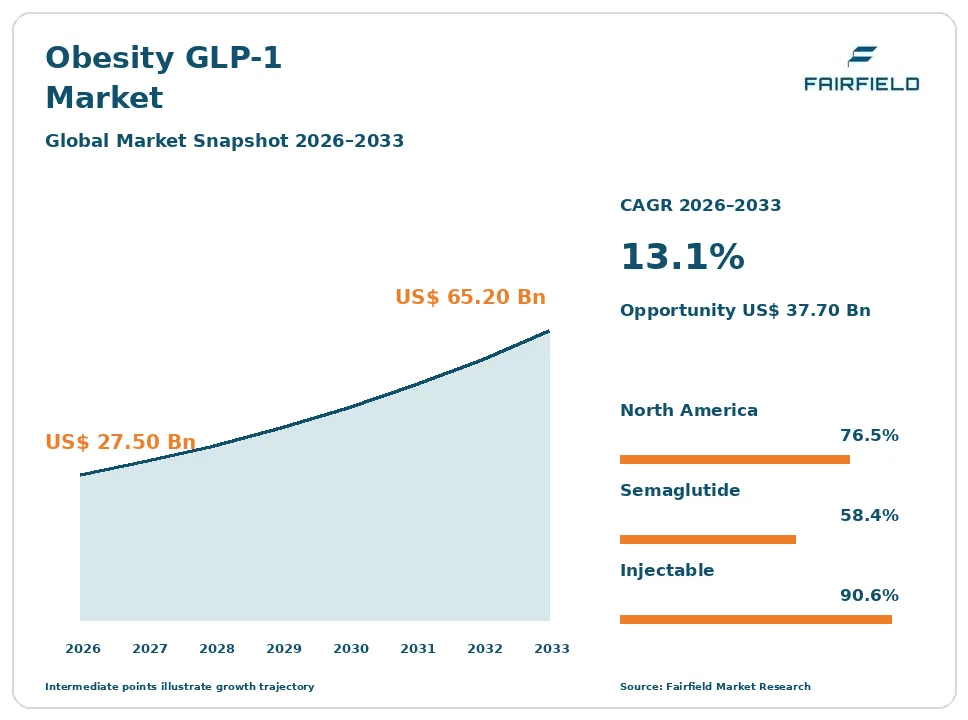
The global obesity GLP-1 market size is expected to be valued at US$ 27.50 billion in 2026 and projected to reach US$ 65.20 billion by 2033, growing at a CAGR of 13.1% between 2026 and 2033.
Between 2020 and 2025, the market grew at a CAGR of more than 60%, as Wegovy launched in 2021 and Zepbound in 2023, despite supply shortages in 2022 to 2024. Three factors now drive growth: rising obesity rates, strong clinical data showing 15% to more than 20% weight loss with semaglutide and tirzepatide, and wider insurance coverage after cardiovascular and sleep apnea approvals. The market is shifting toward oral GLP-1 pills, lower cash prices, and next-generation dual and triple agonists. Generic semaglutide in India, China, Canada, and Brazil from 2026 will lower prices but expand access to anti-obesity medications for millions of patients seeking long-term weight management.
Key Report Takeaways
- By Drug: Semaglutide held 58.4% share in 2026, while Tirzepatide is projected to expand at a 15.6% CAGR through 2033, driven by greater weight loss, strong demand, and new indications.
- By Route of Administration: Injectable held 90.6% share in 2026, while Oral is projected to expand at a 27.4% CAGR through 2033, driven by approvals of oral Wegovy and Foundayo and patient preference for pills.
- By Distribution Channel: Retail Pharmacies held 54.2% share in 2026, while Online & Mail-Order Pharmacies are projected to expand at a 16.3% CAGR through 2033, driven by direct-to-consumer cash-pay programs.
- By Region: North America held 76.5% share in 2026, while Asia Pacific is projected to expand at an 18.8% CAGR through 2033, driven by generic semaglutide launches in India and rising obesity in China.
Global Obesity GLP-1 Market Trends and Insights
Drivers Impact Analysis
Two drivers carry the strongest influence on obesity GLP-1 demand during the forecast period.
| Driver | Impact on CAGR Forecast | Geographic Relevance | Impact Timeline |
| Rising obesity prevalence and strong efficacy | High | Global | Long term (≥4 years) |
| Expanding indications and reimbursement | High | North America, Europe | Medium term (2-4 years) |
Rising Obesity and Strong Efficacy Are Driving the Obesity GLP-1 Market
Rising obesity prevalence and strong clinical efficacy are the strongest driver of the obesity GLP-1 market. More than 1 billion people worldwide live with obesity.
The mechanism is a large unmet need meeting highly effective drugs. Obesity rates exceed 40% of adults in the United States and are rising quickly in China, India, Mexico, and Saudi Arabia. Obesity raises the risk of type 2 diabetes, heart disease, stroke, sleep apnea, fatty liver disease, and some cancers. Older anti-obesity medications produced modest weight loss, but semaglutide delivers about 15% and tirzepatide about 20% to 22% weight loss in trials. GLP-1 drugs reduce appetite and slow stomach emptying, helping patients eat less. Doctors increasingly view obesity as a chronic disease needing long-term treatment. These factors drive rapid uptake of GLP-1 therapies.
Expanding Indications and Coverage Are Expanding the Obesity GLP-1 Market
Expanding indications and reimbursement are expanding the obesity GLP-1 market. New approvals beyond weight loss make insurers more willing to pay.
The cause is outcome data showing benefits for heart, kidney, and sleep health. Wegovy was approved to reduce major cardiovascular events in adults with obesity and heart disease, and Zepbound was approved for obstructive sleep apnea. Trials are testing GLP-1 drugs in heart failure, kidney disease, fatty liver disease, osteoarthritis, and addiction. These indications allow coverage under Medicare and other plans that previously excluded weight loss drugs. Employers and insurers in Europe, Japan, and Canada are expanding coverage for patients at high risk. Pricing deals with the United States government in 2025 aim to lower costs for public programs. These trends widen access to weight management drugs.
Restraints Impact Analysis
Two restraints limit how quickly the obesity GLP-1 market grows.
| Restraint | Impact on CAGR Forecast | Geographic Relevance | Impact Timeline |
| High costs and pricing pressure | High | Global | Short term (≤2 years) |
| Side effects and treatment discontinuation | Medium | Global | Medium term (2-4 years) |
High Costs and Price Pressure Slow the Obesity GLP-1 Market
High costs and pricing pressure slow the obesity GLP-1 market. List prices for injectable GLP-1 drugs exceed US$ 1,000 per month in the United States.
The specific causes are limited insurance coverage, budget concerns, and falling prices. Many private insurers and public programs restrict coverage because of the large number of eligible patients and the need for long-term treatment. Payers worry about the total cost to health systems. Price cuts, cash-pay programs at about US$ 149 to US$ 499 per month, and government pricing agreements are lowering revenue per patient. Generic semaglutide launched in India in March 2026 at a fraction of branded prices, and generics are coming to China, Canada, and Brazil. Compounded versions sold during shortages also competed for patients. These factors limit value growth even as patient numbers rise.
Side Effects and Discontinuation Restrict the Obesity GLP-1 Market
Side effects and high treatment discontinuation restrict the obesity GLP-1 market. Many patients stop treatment within a year.
The underlying causes are tolerability, cost, and weight regain. Common side effects include nausea, vomiting, diarrhea, and constipation, especially when doses rise. Rare risks include pancreatitis, gallbladder disease, and possible eye problems, which regulators continue to monitor. Studies show many patients stop treatment within 12 months because of side effects, cost, or supply issues. Patients often regain much of their lost weight after stopping. Loss of muscle mass during rapid weight loss has raised concerns, especially for older adults. Some patients also report hair thinning, fatigue, and changes in taste. Health systems need nutrition and exercise support alongside drugs, which adds cost. These issues reduce long-term use and revenue per patient.
Market Opportunities
Oral and Next-Generation Agonists Open a High-Growth Revenue Pool
Oral GLP-1 pills and next-generation agonists open a high-growth revenue pool in the obesity GLP-1 market. Patients and doctors want easier, more effective options.
Companies with oral, longer-acting, or multi-target drugs can capture this opportunity. The Food and Drug Administration approved oral Wegovy in December 2025 and Eli Lilly’s Foundayo (orforglipron) in April 2026. Pills avoid injections, need no cold storage, and are easier to manufacture at scale. Triple agonists such as retatrutide have shown weight loss above 25% in trials. Pfizer acquired Metsera in 2025 for monthly injectable and oral candidates. Amylin combinations and muscle-preserving therapies could improve outcomes. These products can command premium prices, especially if they show better weight loss, muscle preservation, or fewer side effects. Fixed-dose combinations and maintenance doses after weight loss also offer new revenue.
Asia Pacific and Emerging Markets Create a Volume Revenue Pool
Rising obesity and generic access in Asia Pacific and other emerging markets create a volume revenue pool in the obesity GLP-1 market. Hundreds of millions of people in these regions have obesity or overweight.
Generic and branded manufacturers can capture this opportunity. India saw more than 50 generic semaglutide brands lined up after patent expiry in March 2026, with Sun Pharma, Dr. Reddy’s, Zydus, and Mankind Pharma among the first movers. China has fast-rising obesity and local developers such as Innovent Biologics with mazdutide. Brazil and Mexico have high obesity rates and growing private pay markets. Lower prices can reach middle-class patients. Local manufacturing and digital health platforms support access, while new peptide plants reduce supply limits. Partnerships between global originators and local firms help reach smaller cities.
Segment Analysis
By Drug: Semaglutide Leads While Tirzepatide Grows Fastest
Semaglutide held 58.4% share in 2026. Novo Nordisk sells semaglutide as Wegovy injection and pill for obesity, with Ozempic used for diabetes and off-label weight loss. It was the first highly effective GLP-1 for obesity and has cardiovascular approval. Generic entry in several countries from 2026 expands access but lowers prices outside the United States and Europe. Liraglutide (Saxenda) and other GLP-1 drugs form smaller segments.
Tirzepatide is the fastest-growing drug, expanding at a 15.6% CAGR through 2033. Eli Lilly’s tirzepatide, sold as Zepbound for obesity and Mounjaro for diabetes, targets both GIP and GLP-1 receptors and delivers greater average weight loss than semaglutide. Approval for sleep apnea and strong demand have made it a market leader in the United States. For the market, tirzepatide growth raises the efficacy standard.
By Route of Administration: Injectable Leads While Oral Grows Fastest
Injectable held 90.6% share in 2026. Weekly injections using pre-filled pens are the standard form of Wegovy, Zepbound, and most pipeline drugs. Injections offer high efficacy and convenient once-weekly dosing. Eli Lilly also sells Zepbound in vials at lower cash prices. Monthly injectables in development could improve adherence.
Oral is the fastest-growing route, expanding at a 27.4% CAGR through 2033. Oral Wegovy was approved in December 2025 and quickly gained hundreds of thousands of United States prescriptions. Foundayo (orforglipron) is a small-molecule oral GLP-1 that does not require food restrictions and can be made at large scale. Pills appeal to people who fear needles and to patients in countries with weak cold chains. Lower production costs also support cheaper prices. For the market, oral growth widens the patient base.
By Distribution Channel: Retail Pharmacies Lead While Online & Mail-Order Grow Fastest
Retail Pharmacies held 54.2% share in 2026. Patients fill prescriptions for Wegovy, Zepbound, and other drugs at chain and independent pharmacies, often with insurance coverage. Pharmacies also provide counseling on dosing and side effects. Hospital pharmacies serve patients in specialist obesity and diabetes clinics.
Online & Mail-Order Pharmacies are the fastest-growing channel, expanding at a 16.3% CAGR through 2033. LillyDirect, NovoCare Pharmacy, telehealth firms such as Hims & Hers and Ro, and online pharmacies deliver anti-obesity medications directly to patients at cash prices. Telehealth visits make prescribing faster and more convenient. Employers and digital health programs also send prescriptions to mail-order partners. For the market, online growth supports self-pay access.
Geography Analysis
Which Region Is Leading the Obesity GLP-1 Market?
North America is leading the obesity GLP-1 market with a 76.5% share in 2026. The United States is the largest country market, with high obesity rates, high drug prices, and strong demand for Wegovy, Zepbound, oral Wegovy, and Foundayo. Eli Lilly and Novo Nordisk have invested billions in United States manufacturing. Medicare coverage for cardiovascular and sleep apnea indications is expanding access. Canada has growing use, with generic semaglutide expected in 2026. Direct-to-consumer cash programs and telehealth are widening access. One change shaping the region is falling prices from government deals and competition.
Europe Advances the Obesity GLP-1 Market Through Expanding Coverage
Europe is a major obesity GLP-1 market. The United Kingdom, Germany, Denmark, France, Spain, and Italy have growing use of Wegovy and Mounjaro. The National Health Service in England is rolling out tirzepatide to eligible patients through primary care. Novo Nordisk is based in Denmark and runs major production sites there. Many countries limit reimbursement to high-risk patients, so private pay plays a large role. Poland, the Netherlands, and Sweden add strong private demand. Key barriers include budget limits and strict eligibility rules. One opportunity is coverage for cardiovascular prevention.
Which Region Is Growing Fastest in the Obesity GLP-1 Market?
Asia Pacific is growing fastest in the obesity GLP-1 market at an 18.8% CAGR through 2033. India launched generic semaglutide from many companies in March 2026, cutting prices sharply and expanding access. China has fast-rising obesity, approved Wegovy and tirzepatide, and local developers such as Innovent Biologics with mazdutide. Japan approved Wegovy with insurance coverage for high-risk patients. South Korea and Australia have strong private demand and fast-growing telehealth prescribing. Indonesia, Thailand, and Vietnam are emerging markets with rising urban obesity. One opportunity is low-cost generics for middle-income patients.
Latin America Grows the Obesity GLP-1 Market Through Private Pay Demand
Latin America is a growing obesity GLP-1 market. Brazil and Mexico have high obesity rates and growing middle-class demand for Wegovy and Mounjaro. Semaglutide patent expiry in Brazil in 2026 is opening the market to local generics from producers such as EMS and Biomm. Argentina, Colombia, and Chile add private pay demand from urban middle-class patients. Public health systems have limited coverage, so most patients pay out of pocket through private pharmacies. Telehealth services are growing in large cities. Key barriers include high prices and currency swings. One opportunity is affordable generic access.
Middle East & Africa Builds the Obesity GLP-1 Market
Middle East & Africa is an emerging obesity GLP-1 market. Saudi Arabia, the United Arab Emirates, Kuwait, and Qatar have some of the highest obesity rates in the world and strong private demand for Wegovy and Mounjaro. Governments in the region fund obesity programs and approve new therapies quickly. South Africa and Egypt have growing urban obesity, and private clinics are adding medical weight loss programs. Diabetes rates in the region are also high, supporting demand for GLP-1 drugs. Key barriers include cost and limited insurance in lower-income countries. One opportunity is government obesity programs.
Competitive Landscape
The obesity GLP-1 market is highly concentrated. Novo Nordisk and Eli Lilly hold most of the market through Wegovy, Saxenda, Zepbound, and Foundayo. Pfizer, Amgen, Roche, AstraZeneca, Boehringer Ingelheim, Zealand Pharma, Viking Therapeutics, Structure Therapeutics, and Innovent Biologics are developing new agonists, while generic makers such as Sun Pharma, Dr. Reddy’s, Zydus, and Biocon enter markets where semaglutide patents have expired.
Companies compete on weight loss efficacy, tolerability, dosing convenience, outcome data, manufacturing capacity, and price. Large-scale supply is critical after shortages in 2022 to 2024, so leaders have invested heavily in new plants. Direct-to-consumer cash programs and telehealth partnerships are reshaping access. Pipeline breadth matters, as investors and partners reward companies with oral, monthly, and multi-agonist candidates. Large acquisitions and licensing deals for Chinese-developed molecules are common, as companies race to secure next-generation assets.
Strategic moves show how competition is changing. In November 2025, Pfizer completed its acquisition of Metsera. In December 2025, the Food and Drug Administration approved oral Wegovy. In March 2026, Indian drugmakers launched generic semaglutide after patent expiry. In April 2026, the Food and Drug Administration approved Eli Lilly’s Foundayo. These moves show competition shifting toward oral drugs, new entrants, and generics.
Three themes shape vendor strategy. First, companies are developing oral and monthly options to improve convenience. Second, they are pursuing multi-agonists for greater weight loss. Third, they are lowering prices to widen access.
Obesity GLP-1 Market Industry Leaders
Novo Nordisk Eli Lilly Pfizer Amgen Roche
Recent Industry Developments
- April 2026: The Food and Drug Administration approved Eli Lilly’s Foundayo (orforglipron), an oral GLP-1 for obesity, with cash prices from US$ 149 per month - expands pill-based treatment.
- March 2026: Sun Pharma, Dr. Reddy’s, Zydus, and Mankind Pharma launched generic semaglutide in India after patent expiry - cuts prices and widens access.
- December 2025: The Food and Drug Administration approved oral Wegovy for chronic weight management - introduces the first oral GLP-1 for obesity.
- November 2025: Pfizer completed its acquisition of Metsera for up to US$ 10 billion - brings monthly injectable and oral obesity candidates.
Companies Covered in the Report
- Novo Nordisk
- Eli Lilly
- Pfizer
- Amgen
- Roche
- AstraZeneca
- Boehringer Ingelheim
- Zealand Pharma
- Viking Therapeutics
- Structure Therapeutics
- Innovent Biologics
- Sun Pharmaceutical Industries
Obesity GLP-1 Market Report Scope
This report covers GLP-1 receptor agonists and GLP-1-based multi-agonists used for chronic weight management in obesity and overweight, including semaglutide, tirzepatide, liraglutide, orforglipron, and pipeline drugs, in injectable and oral forms, sold through retail, hospital, and online or mail-order pharmacies. It excludes diabetes-only GLP-1 use and compounded products. The base year is 2025, and the forecast period runs from 2026 to 2033. All values are expressed in US$ Billion.
Drug
- Semaglutide
- Tirzepatide
- Liraglutide
- Orforglipron & Others
Route of Administration
- Injectable
- Oral
Distribution Channel
- Retail Pharmacies
- Hospital Pharmacies
- Online & Mail-Order Pharmacies
Regions
- North America
- Europe
- Asia Pacific
- Latin America
- Middle East & Africa
Key Questions Answered in the Report
How big is the obesity GLP-1 market in 2026?
The obesity GLP-1 market is valued at US$ 27.50 billion in 2026, led by injectable semaglutide and tirzepatide in North America.
What is the obesity GLP-1 market forecast to 2033?
The market is projected to reach US$ 65.20 billion by 2033, growing at a 13.1% CAGR and adding US$ 37.70 billion.
Which route of administration is growing fastest in obesity GLP-1?
Oral GLP-1 drugs are growing fastest at a 27.4% CAGR through 2033, driven by approvals of oral Wegovy and Foundayo.
Which region is growing fastest in the obesity GLP-1 market?
Asia Pacific is growing fastest at an 18.8% CAGR through 2033, driven by generic semaglutide in India and rising obesity in China.
Which region holds the largest obesity GLP-1 market share?
North America holds the largest share at 76.5% in 2026, supported by high obesity rates, drug prices, and strong United States demand.
1. Executive Summary
1.1. Global Obesity GLP-1 Market Snapshot
1.2. Future Projections
1.3. Key Report Takeaways
1.4. Regional Snapshot
2. Market Overview
2.1. Market Definition and Report Scope
2.2. Historical Trends 2020–2025
2.3. Market Dynamics
2.3.1. Drivers
2.3.1.1. Rising Obesity and Strong Efficacy Are Driving the Obesity GLP-1 Market
2.3.1.2. Expanding Indications and Coverage Are Expanding the Obesity GLP-1 Market
2.3.2. Restraints
2.3.2.1. High Costs and Price Pressure Slow the Obesity GLP-1 Market
2.3.2.2. Side Effects and Discontinuation Restrict the Obesity GLP-1 Market
2.3.3. Market Opportunities
2.3.3.1. Oral and Next-Generation Agonists Open a High-Growth Revenue Pool
2.3.3.2. Asia Pacific and Emerging Markets Create a Volume Revenue Pool
3. Global Obesity GLP-1 Market Outlook, 2020-2033
3.1. Global Obesity GLP-1 Market Outlook, by Drug, Value (US$ Billion), 2020-2033
3.1.1. Semaglutide
3.1.2. Tirzepatide
3.1.3. Liraglutide
3.1.4. Orforglipron & Others
3.2. Global Obesity GLP-1 Market Outlook, by Route of Administration, Value (US$ Billion), 2020-2033
3.2.1. Injectable
3.2.2. Oral
3.3. Global Obesity GLP-1 Market Outlook, by Distribution Channel, Value (US$ Billion), 2020-2033
3.3.1. Retail Pharmacies
3.3.2. Hospital Pharmacies
3.3.3. Online & Mail-Order Pharmacies
3.4. Global Obesity GLP-1 Market Outlook, by Region, Value (US$ Billion), 2020-2033
3.4.1. North America
3.4.2. Europe
3.4.3. Asia Pacific
3.4.4. Latin America
3.4.5. Middle East & Africa
4. North America Obesity GLP-1 Market Outlook, 2020-2033
4.1. North America Obesity GLP-1 Market Outlook, by Drug, Value (US$ Billion), 2020-2033
4.1.1. Semaglutide
4.1.2. Tirzepatide
4.1.3. Liraglutide
4.1.4. Orforglipron & Others
4.2. North America Obesity GLP-1 Market Outlook, by Route of Administration, Value (US$ Billion), 2020-2033
4.2.1. Injectable
4.2.2. Oral
4.3. North America Obesity GLP-1 Market Outlook, by Distribution Channel, Value (US$ Billion), 2020-2033
4.3.1. Retail Pharmacies
4.3.2. Hospital Pharmacies
4.3.3. Online & Mail-Order Pharmacies
4.4. North America Obesity GLP-1 Market Outlook, by Country, Value (US$ Billion), 2020-2033
4.4.1. United States Obesity GLP-1 Market Outlook, by Drug, 2020-2033
4.4.2. United States Obesity GLP-1 Market Outlook, by Route of Administration, 2020-2033
4.4.3. United States Obesity GLP-1 Market Outlook, by Distribution Channel, 2020-2033
4.4.4. Canada Obesity GLP-1 Market Outlook, by Drug, 2020-2033
4.4.5. Canada Obesity GLP-1 Market Outlook, by Route of Administration, 2020-2033
4.4.6. Canada Obesity GLP-1 Market Outlook, by Distribution Channel, 2020-2033
5. Europe Obesity GLP-1 Market Outlook, 2020-2033
5.1. Europe Obesity GLP-1 Market Outlook, by Drug, Value (US$ Billion), 2020-2033
5.1.1. Semaglutide
5.1.2. Tirzepatide
5.1.3. Liraglutide
5.1.4. Orforglipron & Others
5.2. Europe Obesity GLP-1 Market Outlook, by Route of Administration, Value (US$ Billion), 2020-2033
5.2.1. Injectable
5.2.2. Oral
5.3. Europe Obesity GLP-1 Market Outlook, by Distribution Channel, Value (US$ Billion), 2020-2033
5.3.1. Retail Pharmacies
5.3.2. Hospital Pharmacies
5.3.3. Online & Mail-Order Pharmacies
5.4. Europe Obesity GLP-1 Market Outlook, by Country, Value (US$ Billion), 2020-2033
5.4.1. United Kingdom Obesity GLP-1 Market Outlook, by Drug, 2020-2033
5.4.2. United Kingdom Obesity GLP-1 Market Outlook, by Route of Administration, 2020-2033
5.4.3. United Kingdom Obesity GLP-1 Market Outlook, by Distribution Channel, 2020-2033
5.4.4. Germany Obesity GLP-1 Market Outlook, by Drug, 2020-2033
5.4.5. Germany Obesity GLP-1 Market Outlook, by Route of Administration, 2020-2033
5.4.6. Germany Obesity GLP-1 Market Outlook, by Distribution Channel, 2020-2033
5.4.7. Denmark Obesity GLP-1 Market Outlook, by Drug, 2020-2033
5.4.8. Denmark Obesity GLP-1 Market Outlook, by Route of Administration, 2020-2033
5.4.9. Denmark Obesity GLP-1 Market Outlook, by Distribution Channel, 2020-2033
5.4.10. France Obesity GLP-1 Market Outlook, by Drug, 2020-2033
5.4.11. France Obesity GLP-1 Market Outlook, by Route of Administration, 2020-2033
5.4.12. France Obesity GLP-1 Market Outlook, by Distribution Channel, 2020-2033
5.4.13. Spain Obesity GLP-1 Market Outlook, by Drug, 2020-2033
5.4.14. Spain Obesity GLP-1 Market Outlook, by Route of Administration, 2020-2033
5.4.15. Spain Obesity GLP-1 Market Outlook, by Distribution Channel, 2020-2033
5.4.16. Italy Obesity GLP-1 Market Outlook, by Drug, 2020-2033
5.4.17. Italy Obesity GLP-1 Market Outlook, by Route of Administration, 2020-2033
5.4.18. Italy Obesity GLP-1 Market Outlook, by Distribution Channel, 2020-2033
5.4.19. Poland Obesity GLP-1 Market Outlook, by Drug, 2020-2033
5.4.20. Poland Obesity GLP-1 Market Outlook, by Route of Administration, 2020-2033
5.4.21. Poland Obesity GLP-1 Market Outlook, by Distribution Channel, 2020-2033
5.4.22. Netherlands Obesity GLP-1 Market Outlook, by Drug, 2020-2033
5.4.23. Netherlands Obesity GLP-1 Market Outlook, by Route of Administration, 2020-2033
5.4.24. Netherlands Obesity GLP-1 Market Outlook, by Distribution Channel, 2020-2033
5.4.25. Sweden Obesity GLP-1 Market Outlook, by Drug, 2020-2033
5.4.26. Sweden Obesity GLP-1 Market Outlook, by Route of Administration, 2020-2033
5.4.27. Sweden Obesity GLP-1 Market Outlook, by Distribution Channel, 2020-2033
6. Asia Pacific Obesity GLP-1 Market Outlook, 2020-2033
6.1. Asia Pacific Obesity GLP-1 Market Outlook, by Drug, Value (US$ Billion), 2020-2033
6.1.1. Semaglutide
6.1.2. Tirzepatide
6.1.3. Liraglutide
6.1.4. Orforglipron & Others
6.2. Asia Pacific Obesity GLP-1 Market Outlook, by Route of Administration, Value (US$ Billion), 2020-2033
6.2.1. Injectable
6.2.2. Oral
6.3. Asia Pacific Obesity GLP-1 Market Outlook, by Distribution Channel, Value (US$ Billion), 2020-2033
6.3.1. Retail Pharmacies
6.3.2. Hospital Pharmacies
6.3.3. Online & Mail-Order Pharmacies
6.4. Asia Pacific Obesity GLP-1 Market Outlook, by Country, Value (US$ Billion), 2020-2033
6.4.1. India Obesity GLP-1 Market Outlook, by Drug, 2020-2033
6.4.2. India Obesity GLP-1 Market Outlook, by Route of Administration, 2020-2033
6.4.3. India Obesity GLP-1 Market Outlook, by Distribution Channel, 2020-2033
6.4.4. China Obesity GLP-1 Market Outlook, by Drug, 2020-2033
6.4.5. China Obesity GLP-1 Market Outlook, by Route of Administration, 2020-2033
6.4.6. China Obesity GLP-1 Market Outlook, by Distribution Channel, 2020-2033
6.4.7. Japan Obesity GLP-1 Market Outlook, by Drug, 2020-2033
6.4.8. Japan Obesity GLP-1 Market Outlook, by Route of Administration, 2020-2033
6.4.9. Japan Obesity GLP-1 Market Outlook, by Distribution Channel, 2020-2033
6.4.10. South Korea Obesity GLP-1 Market Outlook, by Drug, 2020-2033
6.4.11. South Korea Obesity GLP-1 Market Outlook, by Route of Administration, 2020-2033
6.4.12. South Korea Obesity GLP-1 Market Outlook, by Distribution Channel, 2020-2033
6.4.13. Australia Obesity GLP-1 Market Outlook, by Drug, 2020-2033
6.4.14. Australia Obesity GLP-1 Market Outlook, by Route of Administration, 2020-2033
6.4.15. Australia Obesity GLP-1 Market Outlook, by Distribution Channel, 2020-2033
6.4.16. Indonesia Obesity GLP-1 Market Outlook, by Drug, 2020-2033
6.4.17. Indonesia Obesity GLP-1 Market Outlook, by Route of Administration, 2020-2033
6.4.18. Indonesia Obesity GLP-1 Market Outlook, by Distribution Channel, 2020-2033
6.4.19. Thailand Obesity GLP-1 Market Outlook, by Drug, 2020-2033
6.4.20. Thailand Obesity GLP-1 Market Outlook, by Route of Administration, 2020-2033
6.4.21. Thailand Obesity GLP-1 Market Outlook, by Distribution Channel, 2020-2033
6.4.22. Vietnam Obesity GLP-1 Market Outlook, by Drug, 2020-2033
6.4.23. Vietnam Obesity GLP-1 Market Outlook, by Route of Administration, 2020-2033
6.4.24. Vietnam Obesity GLP-1 Market Outlook, by Distribution Channel, 2020-2033
7. Latin America Obesity GLP-1 Market Outlook, 2020-2033
7.1. Latin America Obesity GLP-1 Market Outlook, by Drug, Value (US$ Billion), 2020-2033
7.1.1. Semaglutide
7.1.2. Tirzepatide
7.1.3. Liraglutide
7.1.4. Orforglipron & Others
7.2. Latin America Obesity GLP-1 Market Outlook, by Route of Administration, Value (US$ Billion), 2020-2033
7.2.1. Injectable
7.2.2. Oral
7.3. Latin America Obesity GLP-1 Market Outlook, by Distribution Channel, Value (US$ Billion), 2020-2033
7.3.1. Retail Pharmacies
7.3.2. Hospital Pharmacies
7.3.3. Online & Mail-Order Pharmacies
7.4. Latin America Obesity GLP-1 Market Outlook, by Country, Value (US$ Billion), 2020-2033
7.4.1. Brazil Obesity GLP-1 Market Outlook, by Drug, 2020-2033
7.4.2. Brazil Obesity GLP-1 Market Outlook, by Route of Administration, 2020-2033
7.4.3. Brazil Obesity GLP-1 Market Outlook, by Distribution Channel, 2020-2033
7.4.4. Mexico Obesity GLP-1 Market Outlook, by Drug, 2020-2033
7.4.5. Mexico Obesity GLP-1 Market Outlook, by Route of Administration, 2020-2033
7.4.6. Mexico Obesity GLP-1 Market Outlook, by Distribution Channel, 2020-2033
7.4.7. Argentina Obesity GLP-1 Market Outlook, by Drug, 2020-2033
7.4.8. Argentina Obesity GLP-1 Market Outlook, by Route of Administration, 2020-2033
7.4.9. Argentina Obesity GLP-1 Market Outlook, by Distribution Channel, 2020-2033
7.4.10. Colombia Obesity GLP-1 Market Outlook, by Drug, 2020-2033
7.4.11. Colombia Obesity GLP-1 Market Outlook, by Route of Administration, 2020-2033
7.4.12. Colombia Obesity GLP-1 Market Outlook, by Distribution Channel, 2020-2033
7.4.13. Chile Obesity GLP-1 Market Outlook, by Drug, 2020-2033
7.4.14. Chile Obesity GLP-1 Market Outlook, by Route of Administration, 2020-2033
7.4.15. Chile Obesity GLP-1 Market Outlook, by Distribution Channel, 2020-2033
8. Middle East & Africa Obesity GLP-1 Market Outlook, 2020-2033
8.1. Middle East & Africa Obesity GLP-1 Market Outlook, by Drug, Value (US$ Billion), 2020-2033
8.1.1. Semaglutide
8.1.2. Tirzepatide
8.1.3. Liraglutide
8.1.4. Orforglipron & Others
8.2. Middle East & Africa Obesity GLP-1 Market Outlook, by Route of Administration, Value (US$ Billion), 2020-2033
8.2.1. Injectable
8.2.2. Oral
8.3. Middle East & Africa Obesity GLP-1 Market Outlook, by Distribution Channel, Value (US$ Billion), 2020-2033
8.3.1. Retail Pharmacies
8.3.2. Hospital Pharmacies
8.3.3. Online & Mail-Order Pharmacies
8.4. Middle East & Africa Obesity GLP-1 Market Outlook, by Country, Value (US$ Billion), 2020-2033
8.4.1. Saudi Arabia Obesity GLP-1 Market Outlook, by Drug, 2020-2033
8.4.2. Saudi Arabia Obesity GLP-1 Market Outlook, by Route of Administration, 2020-2033
8.4.3. Saudi Arabia Obesity GLP-1 Market Outlook, by Distribution Channel, 2020-2033
8.4.4. United Arab Emirates Obesity GLP-1 Market Outlook, by Drug, 2020-2033
8.4.5. United Arab Emirates Obesity GLP-1 Market Outlook, by Route of Administration, 2020-2033
8.4.6. United Arab Emirates Obesity GLP-1 Market Outlook, by Distribution Channel, 2020-2033
8.4.7. Kuwait Obesity GLP-1 Market Outlook, by Drug, 2020-2033
8.4.8. Kuwait Obesity GLP-1 Market Outlook, by Route of Administration, 2020-2033
8.4.9. Kuwait Obesity GLP-1 Market Outlook, by Distribution Channel, 2020-2033
8.4.10. Qatar Obesity GLP-1 Market Outlook, by Drug, 2020-2033
8.4.11. Qatar Obesity GLP-1 Market Outlook, by Route of Administration, 2020-2033
8.4.12. Qatar Obesity GLP-1 Market Outlook, by Distribution Channel, 2020-2033
8.4.13. South Africa Obesity GLP-1 Market Outlook, by Drug, 2020-2033
8.4.14. South Africa Obesity GLP-1 Market Outlook, by Route of Administration, 2020-2033
8.4.15. South Africa Obesity GLP-1 Market Outlook, by Distribution Channel, 2020-2033
8.4.16. Egypt Obesity GLP-1 Market Outlook, by Drug, 2020-2033
8.4.17. Egypt Obesity GLP-1 Market Outlook, by Route of Administration, 2020-2033
8.4.18. Egypt Obesity GLP-1 Market Outlook, by Distribution Channel, 2020-2033
9. Competitive Landscape
9.1. Market Concentration and Industry Leaders
9.2. Competitive Differentiation
9.3. Strategic Moves and Market Direction
9.4. Recent Industry Developments
9.5. Company Profiles
9.5.1. Novo Nordisk
9.5.2. Eli Lilly
9.5.3. Pfizer
9.5.4. Amgen
9.5.5. Roche
9.5.6. AstraZeneca
9.5.7. Boehringer Ingelheim
9.5.8. Zealand Pharma
9.5.9. Viking Therapeutics
9.5.10. Structure Therapeutics
9.5.11. Innovent Biologics
9.5.12. Sun Pharmaceutical Industries
10. Appendix
10.1. Research Methodology
10.2. Report Assumptions
10.3. Acronyms and Abbreviations
| Drug | Semaglutide, Tirzepatide, Liraglutide, Orforglipron & Others |
| Route of Administration | Injectable, Oral |
| Distribution Channel | Retail Pharmacies, Hospital Pharmacies, Online & Mail-Order Pharmacies |
| Regions | North America, Europe, Asia Pacific, Latin America, Middle East & Africa |
Our Research Methodology
Considering the volatility of business today, traditional approaches to strategizing a game plan can be unfruitful if not detrimental. True ambiguity is no way to determine a forecast. A myriad of predetermined factors must be accounted for such as the degree of risk involved, the magnitude of circumstances, as well as conditions or consequences that are not known or unpredictable. To circumvent binary views that cast uncertainty, the application of market research intelligence to strategically posture, move, and enable actionable outcomes is necessary.
View Methodology
Quality Assured
Rigorous Validation Process

Confidentiality Assured
End-to-end Data Security

Custom Research Services
Tailored To Your Objectives
FAQs
The obesity GLP-1 market is valued at US$ 27.50 billion in 2026, led by injectable semaglutide and tirzepatide in North America.
The market is projected to reach US$ 65.20 billion by 2033, growing at a 13.1% CAGR and adding US$ 37.70 billion.
Oral GLP-1 drugs are growing fastest at a 27.4% CAGR through 2033, driven by approvals of oral Wegovy and Foundayo.
Asia Pacific is growing fastest at an 18.8% CAGR through 2033, driven by generic semaglutide in India and rising obesity in China.
North America holds the largest share at 76.5% in 2026, supported by high obesity rates, drug prices, and strong United States demand.
Related Reports
Ocular Hypertension Market Size, Share, Insights, Competitive Landscape, and Forecast 2026 to 2033
Ocular hypertension market to reach US$ 8.05 billion by 2033 at an 8.2% CAGR. Explore drug classes, delivery modes, pharmacy channels and regional trends.
Upstream Bioprocessing Market Size, Share, Insights, Competitive Landscape, and Forecast 2026 to 2033
Upstream bioprocessing market to reach US$ 92.23 billion by 2033 at a 14.3% CAGR. Explore products, use types, manufacturing modes and regional trends.
Personalized Cancer Vaccine Market Size, Share, Insights, Competitive Landscape, and Forecast 2026 to 2033
Personalized cancer vaccine market to reach US$ 16.57 billion by 2033 at an 18.7% CAGR. Explore vaccine types, cancer types and regional trends.
PEGylated Proteins Market Size, Share, Insights, Competitive Landscape, and Forecast 2026 to 2033
PEGylated proteins market to reach US$ 4.58 billion by 2033 at a 10.9% CAGR. Explore products, protein types, applications and regional trends.
Oligonucleotide Synthesis Market Size, Share, Insights, Competitive Landscape, and Forecast 2026 to 2033
Oligonucleotide synthesis market to reach US$ 10.90 billion by 2033 at a 15.0% CAGR. Explore products, applications and regional trends.
In Situ Hybridization Market Size, Share, Insights, Competitive Landscape, and Forecast 2026 to 2033
In situ hybridization market to reach US$ 3.34 billion by 2033 at a 7.5% CAGR. Explore techniques, applications and regional trends.