



Oligonucleotide Synthesis Market
Oligonucleotide Synthesis Market Size, Share, Insights, Competitive Landscape, and Forecast 2026 to 2033
Oligonucleotide Synthesis Market Analysis, 2026–2033
Oligonucleotide Synthesis Market
Oligonucleotide Synthesis Market Size, Share, Insights, Competitive Landscape, and Forecast 2026 to 2033
Oligonucleotide Synthesis Market Size and Trend Analysis
How Fast Is the Oligonucleotide Synthesis Market Growing?
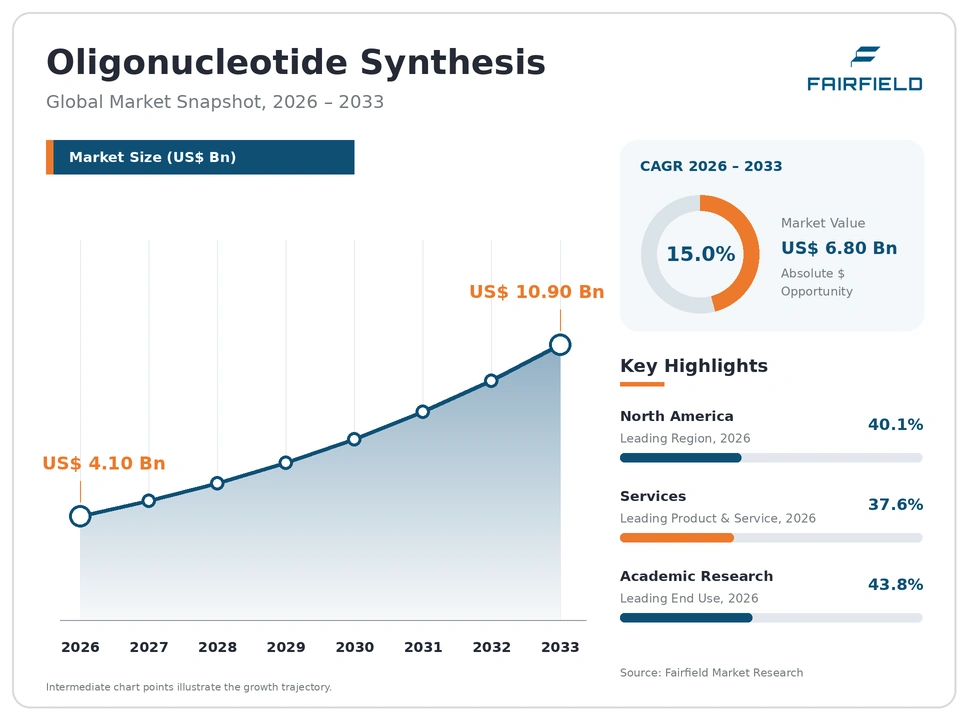
The global oligonucleotide synthesis market size is expected to be valued at US$ 4.10 billion in 2026 and projected to reach US$ 10.90 billion by 2033, growing at a CAGR of 15.0% between 2026 and 2033.
Between 2020 and 2025, the market grew at a CAGR of about 11.2%, as COVID-19 testing created a surge in demand for primers and probes in 2020 and 2021, followed by a shift toward genomics research and therapeutic oligonucleotides. Three factors now drive growth: the rising number of approved antisense oligonucleotides and siRNA drugs, wider use of custom oligos in next-generation sequencing, CRISPR, and diagnostics, and large investments in manufacturing capacity. The market is shifting from small research-scale synthesis using phosphoramidite chemistry toward large-scale therapeutic production and new methods such as enzymatic DNA synthesis.
Key Report Takeaways
- By Product & Service: Services held 37.6% share in 2026, while Synthesized Oligonucleotides are projected to expand at a 16.4% CAGR through 2033, driven by therapeutic and diagnostic demand for modified oligos.
- By Application: PCR Primers held 20.2% share in 2026, while Therapeutics is projected to expand at a 18.4% CAGR through 2033, driven by new antisense and siRNA drug approvals.
- By End Use: Academic Research Institutes held 43.8% share in 2026, while Pharmaceutical & Biotechnology Companies are projected to expand at a 16.9% CAGR through 2033, driven by RNA drug pipelines.
- By Region: North America held 40.1% share in 2026, while Asia Pacific is projected to expand at a 17.9% CAGR through 2033, driven by CDMO capacity in China and genomics growth in India and Japan.
Global Oligonucleotide Synthesis Market Trends and Insights
Drivers Impact Analysis
Two drivers carry the strongest influence on oligonucleotide synthesis demand during the forecast period.
| Driver | Impact on CAGR Forecast | Geographic Relevance | Impact Timeline |
| Growth of oligonucleotide therapeutics | High | North America, Europe, Asia Pacific | Long term (≥4 years) |
| Genomics, sequencing, and diagnostics demand | High | North America, Asia Pacific, Europe | Medium term (2-4 years) |
Oligonucleotide Therapeutics Are Driving the Oligonucleotide Synthesis Market
The growth of oligonucleotide therapeutics is the strongest driver of the oligonucleotide synthesis market. Drugs made from short chains of DNA or RNA can switch off disease-causing genes, opening new treatments for rare and common diseases.
The mechanism is a growing number of approved drugs and larger patient populations. Antisense oligonucleotides and siRNA drugs from companies such as Ionis Pharmaceuticals, Alnylam Pharmaceuticals, and Novartis treat conditions including spinal muscular atrophy, amyloidosis, and high cholesterol. Drugs for common diseases, such as Novartis’ Leqvio for cholesterol, require tons of material rather than grams. Hundreds of oligonucleotide drugs are in clinical trials. Large companies such as Eli Lilly have signed deals with oligonucleotide developers. These products need large-scale, high-purity synthesis under strict quality rules, driving demand for manufacturing services, reagents, and equipment.
Genomics and Diagnostics Are Expanding the Oligonucleotide Synthesis Market
Genomics, sequencing, and diagnostics demand is expanding the oligonucleotide synthesis market. Nearly every molecular biology experiment and genetic test uses custom oligos.
The cause is the spread of genetic tools in research and medicine. PCR primers and probes are used in infectious disease testing, cancer diagnostics, and food safety. Next-generation sequencing requires adapters, barcodes, and target capture probes, and falling sequencing costs increase test volumes. CRISPR gene editing uses synthetic guide RNAs. Synthetic biology and DNA data storage need long oligonucleotide pools. Academic institutes, hospitals, and diagnostic companies order millions of oligos each year from suppliers such as Integrated DNA Technologies, Thermo Fisher Scientific, and Merck KGaA. Online ordering, standard catalogs, and fast delivery make custom oligos easy to buy. These trends support steady growth in research and diagnostic demand.
Restraints Impact Analysis
Two restraints limit how quickly the oligonucleotide synthesis market grows.
| Restraint | Impact on CAGR Forecast | Geographic Relevance | Impact Timeline |
| High production costs and manufacturing complexity | High | Global | Medium term (2-4 years) |
| Solvent waste, raw material supply, and regulatory hurdles | Medium | Europe, North America | Medium term (2-4 years) |
High Costs and Complexity Slow the Oligonucleotide Synthesis Market
High production costs and manufacturing complexity slow the oligonucleotide synthesis market. Making therapeutic oligonucleotides at scale remains difficult and expensive.
The specific causes are chemical limits and purification needs. Phosphoramidite chemistry adds one building block at a time, and small losses at each step reduce yield for longer sequences. Chemical modifications that make drugs stable in the body add more steps and costs. Purification by chromatography is slow and uses large amounts of solvent. Large-scale plants require major investment, specialized equipment, and skilled staff, and few facilities can produce at commercial scale. Smaller biotech companies face long waiting times and high prices for manufacturing slots, which can delay clinical trials. Analytical testing for impurities adds further time and cost. These factors limit how quickly new oligonucleotide drugs can be developed and supplied.
Solvent Waste and Supply Issues Restrict the Oligonucleotide Synthesis Market
Solvent waste, raw material supply, and regulatory hurdles restrict the oligonucleotide synthesis market. Large-scale production creates environmental and supply challenges.
The underlying causes are inefficient chemistry and concentrated supply. Producing 1 kilogram of an oligonucleotide drug can generate thousands of kilograms of solvent and chemical waste, mostly acetonitrile, raising costs and environmental concerns. Supplies of phosphoramidites, solid supports, and specialty reagents come from a limited number of manufacturers. Regulators such as the U.S. Food and Drug Administration and European Medicines Agency require strict control of impurities, which raises testing costs. Trade tensions and proposals such as the BIOSECURE Act in the United States create uncertainty for companies that rely on Chinese suppliers. These factors push the industry toward greener processes, solvent recovery systems, and diversified supply chains across several regions.
Market Opportunities
Large-scale Therapeutic Manufacturing Opens a CDMO Revenue Pool
Large-scale therapeutic manufacturing opens a contract development and manufacturing revenue pool in the oligonucleotide synthesis market. Drug developers need partners with commercial-scale capacity.
CDMOs and large suppliers can capture this opportunity. Bachem opened a new large-scale production building in Bubendorf, Switzerland, in April 2026, while Agilent Technologies, Nitto Avecia, and WuXi STA have expanded capacity. WuXi AppTec is building new oligonucleotide plants in China and Singapore expected to open in 2027. Long-term supply contracts for drugs treating common diseases can fill large plants for years. Services such as process development, analytical testing, and regulatory filing support add value and deepen customer relationships. Suppliers with proven quality records and capacity can win multi-year agreements with large pharmaceutical companies seeking secure supply.
Enzymatic and Green Synthesis Create a Technology Revenue Pool
Enzymatic DNA synthesis and greener chemical processes create a technology revenue pool in the oligonucleotide synthesis market. New methods promise longer sequences, less waste, and lower costs.
Technology developers and established suppliers can capture this opportunity. Enzymatic methods use enzymes rather than harsh chemicals to build DNA and RNA, reducing solvent use and enabling longer sequences for synthetic biology and gene therapy. Maravai LifeSciences acquired the intellectual property and assets of Molecular Assemblies in January 2025 to strengthen enzymatic synthesis at TriLink BioTechnologies. Liquid-phase synthesis, continuous processing, and solvent recycling cut waste in large-scale production. Benchtop synthesizers let laboratories make oligos on demand. Companies that combine lower costs, longer sequences, and sustainability can win customers in research, gene therapy, and drug manufacturing, and may license their technology to larger suppliers.
Segment Analysis
By Product & Service: Services Lead While Synthesized Oligonucleotides Grow Fastest
Services held 37.6% share in 2026. Custom synthesis, contract manufacturing, purification, modification, and quality testing services let researchers and drug developers outsource complex work. CDMOs such as Agilent Technologies, Nitto Avecia, and Bachem produce therapeutic oligonucleotides under good manufacturing practice, while research suppliers offer fast turnaround for custom oligos.
Synthesized Oligonucleotides are the fastest-growing product segment, expanding at a 16.4% CAGR through 2033. Demand is rising for modified primers, probes, guide RNAs, siRNA and antisense sequences, and long oligo pools for sequencing and synthetic biology. Chemically modified oligos for therapeutics and diagnostics command higher prices and margins. Reagents, such as phosphoramidites and solid supports, and synthesizer equipment form other segments. For the market, oligonucleotide growth reflects rising use in research, diagnostics, and medicine.
By Application: PCR Primers Lead While Therapeutics Grow Fastest
PCR Primers held 20.2% share in 2026. Primers are short sequences that start DNA copying in PCR tests used for research, infectious disease diagnosis, cancer testing, and forensics. Huge numbers of primers are ordered daily by laboratories worldwide, usually in small amounts with fast delivery. qPCR probes and sequencing adapters form related applications.
Therapeutics is the fastest-growing application, expanding at a 18.4% CAGR through 2033. Antisense oligonucleotides, siRNA, aptamers, and CRISPR guide RNAs are used to develop drugs for rare genetic diseases, cardiovascular disease, neurology, and cancer. Approvals for common diseases require large production volumes. DNA and RNA probes, sequencing, and synthetic biology form other applications. For the market, therapeutic growth shifts value toward high-purity, large-scale synthesis under strict quality rules.
By End Use: Academic Research Institutes Lead While Pharmaceutical & Biotechnology Companies Grow Fastest
Academic Research Institutes held 43.8% share in 2026. Universities and research centers use oligonucleotides daily in genetics, molecular biology, and biomedical research. Government funding from bodies such as the National Institutes of Health supports large research volumes. Suppliers offer online ordering, fast shipping, and discounts for academic users. Core facilities at universities also run their own synthesizers.
Pharmaceutical & Biotechnology Companies are the fastest-growing end user, expanding at a 16.9% CAGR through 2033. Drug developers need oligonucleotides for target discovery, drug development, and commercial manufacturing of RNA-based drugs. Partnerships such as Eli Lilly’s deals with oligonucleotide developers increase demand. Diagnostic laboratories and contract research organizations form other end users, using oligos for tests and outsourced studies. For the market, pharmaceutical growth brings larger, higher-value orders.
Geography Analysis
Which Region Is Leading the Oligonucleotide Synthesis Market?
North America is leading the oligonucleotide synthesis market with a 40.1% share in 2026. The United States is home to oligonucleotide drug leaders such as Ionis Pharmaceuticals and Alnylam Pharmaceuticals, and major suppliers such as Integrated DNA Technologies, Thermo Fisher Scientific, Agilent Technologies, and Twist Bioscience. Strong funding from the National Institutes of Health and venture capital supports research. Oligo Factory added low-scale synthesis in Massachusetts in May 2025. Canada has a growing biotech sector. Many oligonucleotide drug trials take place in the region. One change shaping the region is onshoring of drug substance manufacturing.
Europe Advances the Oligonucleotide Synthesis Market Through CDMO Capacity
Europe is a major oligonucleotide synthesis market with strong research and manufacturing. Switzerland hosts Bachem, which opened a large new production building in 2026, while Germany hosts Merck KGaA and the United Kingdom hosts LGC Biosearch Technologies. Belgium is home to Kaneka Eurogentec, and Sweden and Denmark have strong biotech clusters. France and Italy have strong academic research and diagnostic sectors. Strict environmental rules encourage solvent reduction and recycling in large plants, and the European Medicines Agency sets high quality standards. Biotech start-ups in the Netherlands develop RNA drugs. One opportunity is CDMO services for global drug developers seeking supply outside Asia Pacific.
Which Region Is Growing Fastest in the Oligonucleotide Synthesis Market?
Asia Pacific is growing fastest in the oligonucleotide synthesis market at a 17.9% CAGR through 2033. China is the largest market in the region, with large research output and CDMOs such as WuXi STA, part of WuXi AppTec, building new oligonucleotide plants. Japan hosts Nitto Denko and strong RNA research at universities and drug companies. India is expanding genomics and diagnostics, and a new oligonucleotide synthesis facility opened in Ranoli in December 2024. South Korea and Singapore are investing in biomanufacturing. One challenge is trade policy uncertainty affecting Chinese suppliers. One opportunity is lower-cost manufacturing for global drug developers.
Latin America Grows the Oligonucleotide Synthesis Market Through Research and Diagnostics
Latin America is a developing oligonucleotide synthesis market. Brazil and Mexico have growing genomics research programs, agricultural biotech, and diagnostic laboratories that use PCR primers and probes. Argentina, Chile, and Colombia have active research universities and growing biotech start-ups. Most oligonucleotides are imported from North America and Europe through local distributors. Public health laboratories used large volumes of primers and probes during the COVID-19 pandemic and continue testing for dengue, Zika, and other infections. Key barriers include long delivery times, import duties, and currency swings. One opportunity is local distribution and synthesis services for diagnostics and research universities.
Middle East & Africa Builds the Oligonucleotide Synthesis Market Through Genomics Programs
Middle East & Africa is an emerging oligonucleotide synthesis market. Saudi Arabia, the United Arab Emirates, and Qatar run large national genome programs that use sequencing and genetic testing. Israel has a strong biotech sector and active genetics research. In Africa, South Africa and Kenya have infectious disease research centers that use PCR testing. Research centers in Egypt and Nigeria are building genomics capacity. Key barriers include limited local production, long delivery times, and limited research funding in many African countries. Gulf countries are investing in biotech hubs. One opportunity is supply for genome programs and precision medicine initiatives.
Competitive Landscape
The oligonucleotide synthesis market is moderately concentrated. Thermo Fisher Scientific, Merck KGaA, Danaher, through Integrated DNA Technologies, Agilent Technologies, and LGC Biosearch Technologies lead research and reagent supply, while CDMOs such as Nitto Avecia, Bachem, and WuXi STA lead therapeutic manufacturing.
Companies compete on quality, purity, turnaround time, price, scale, chemical modification options, and regulatory compliance. Research suppliers compete on fast delivery, easy online ordering, and low prices, while therapeutic manufacturers compete on capacity, quality records, and regulatory experience. Long-term contracts for commercial drugs create stable revenue for CDMOs. Chinese CDMOs compete on cost and speed, while Western suppliers emphasize supply security.
Suppliers also compete on chemical modification options, such as locked nucleic acids and fluorescent labels, which serve advanced research and diagnostic needs.
Strategic moves show how competition is changing across the market. In January 2025, Maravai LifeSciences acquired Molecular Assemblies’ enzymatic synthesis assets. In May 2025, Oligo Factory added low-scale synthesis at its Holliston facility. In April 2026, Bachem inaugurated a new large-scale production building in Bubendorf. These moves show competition shifting toward capacity and new synthesis technologies, as demand for commercial drug supply grows.
Three themes shape vendor strategy. First, companies are expanding large-scale capacity for commercial drug supply. Second, they are developing enzymatic and greener methods that reduce solvent waste. Third, they are diversifying supply chains and manufacturing locations across North America, Europe, and Asia Pacific to reduce geopolitical risk.
Oligonucleotide Synthesis Market Industry Leaders
- Thermo Fisher Scientific
- Merck KGaA
- Danaher (IDT)
- Agilent Technologies
- LGC Biosearch Technologies
Recent Industry Developments
- April 2026: Bachem inaugurated Building K, a new large-scale production facility in Bubendorf - expands capacity for oligonucleotide and peptide drugs.
- May 2025: Oligo Factory added low-scale synthesis at its Holliston, Massachusetts facility - broadens services for early research.
- January 2025: Maravai LifeSciences acquired Molecular Assemblies’ intellectual property and assets - strengthens enzymatic DNA synthesis at TriLink BioTechnologies.
- December 2024: Co-Diagnostics and CoSara Diagnostics opened an oligonucleotide synthesis facility in Ranoli, India - adds local production for diagnostics.
Companies Covered in the Report
- Thermo Fisher Scientific
- Merck KGaA
- Danaher (IDT)
- Agilent Technologies
- LGC Biosearch Technologies
- Kaneka Eurogentec
- Twist Bioscience
- Nitto Avecia
- Bachem
- WuXi STA
- Maravai LifeSciences
- Bio-Synthesis
Oligonucleotide Synthesis Market Report Scope
This report covers oligonucleotide synthesis, including synthesized oligonucleotides, reagents, equipment, and services, used for PCR primers, qPCR probes, sequencing, DNA and RNA probes, synthetic biology, and therapeutics, by academic research institutes, pharmaceutical and biotechnology companies, and diagnostic laboratories. It excludes mRNA and plasmid DNA manufacturing. The base year is 2025, and the forecast period runs from 2026 to 2033. All values are expressed in US$ Billion.
Product & Service
- Synthesized Oligonucleotides
- Reagents
- Equipment
- Services
Application
- PCR Primers
- qPCR Probes
- Sequencing
- DNA & RNA Probes
- Therapeutics
- Others
End Use
- Academic Research Institutes
- Pharmaceutical & Biotechnology Companies
- Diagnostic Laboratories
Regions
- North America
- Europe
- Asia Pacific
- Latin America
- Middle East & Africa
Key Questions Answered in the Report
How big is the oligonucleotide synthesis market in 2026?
The oligonucleotide synthesis market is valued at US$ 4.10 billion in 2026, led by synthesis services for research and drug development.
What is the oligonucleotide synthesis market forecast to 2033?
The market is projected to reach US$ 10.90 billion by 2033, growing at a 15.0% CAGR and adding US$ 6.80 billion.
Which application is growing fastest in oligonucleotide synthesis?
Therapeutics is growing fastest at a 18.4% CAGR through 2033, driven by new antisense and siRNA drug approvals worldwide.
Which region is growing fastest in the oligonucleotide synthesis market?
Asia Pacific is growing fastest at a 17.9% CAGR through 2033, driven by CDMO capacity in China and genomics growth.
Which region holds the largest oligonucleotide synthesis market share?
North America holds the largest share at 40.1% in 2026, supported by leading drug developers and suppliers in the United States.
1. Executive Summary
1.1. Global Oligonucleotide Synthesis Market Snapshot
1.2. Future Projections
1.3. Key Report Takeaways
1.4. Regional Snapshot
2. Market Overview
2.1. Market Definition and Report Scope
2.2. Historical Trends 2020–2025
2.3. Market Dynamics
2.3.1. Drivers
2.3.1.1. Oligonucleotide Therapeutics Are Driving the Oligonucleotide Synthesis Market
2.3.1.2. Genomics and Diagnostics Are Expanding the Oligonucleotide Synthesis Market
2.3.2. Restraints
2.3.2.1. High Costs and Complexity Slow the Oligonucleotide Synthesis Market
2.3.2.2. Solvent Waste and Supply Issues Restrict the Oligonucleotide Synthesis Market
2.3.3. Market Opportunities
2.3.3.1. Large-scale Therapeutic Manufacturing Opens a CDMO Revenue Pool
2.3.3.2. Enzymatic and Green Synthesis Create a Technology Revenue Pool
3. Global Oligonucleotide Synthesis Market Outlook, 2020-2033
3.1. Global Oligonucleotide Synthesis Market Outlook, by Product & Service, Value (US$ Billion), 2020-2033
3.1.1. Synthesized Oligonucleotides
3.1.2. Reagents
3.1.3. Equipment
3.1.4. Services
3.2. Global Oligonucleotide Synthesis Market Outlook, by Application, Value (US$ Billion), 2020-2033
3.2.1. PCR Primers
3.2.2. qPCR Probes
3.2.3. Sequencing
3.2.4. DNA & RNA Probes
3.2.5. Therapeutics
3.2.6. Others
3.3. Global Oligonucleotide Synthesis Market Outlook, by End Use, Value (US$ Billion), 2020-2033
3.3.1. Academic Research Institutes
3.3.2. Pharmaceutical & Biotechnology Companies
3.3.3. Diagnostic Laboratories
3.4. Global Oligonucleotide Synthesis Market Outlook, by Region, Value (US$ Billion), 2020-2033
3.4.1. North America
3.4.2. Europe
3.4.3. Asia Pacific
3.4.4. Latin America
3.4.5. Middle East & Africa
4. North America Oligonucleotide Synthesis Market Outlook, 2020-2033
4.1. North America Oligonucleotide Synthesis Market Outlook, by Product & Service, Value (US$ Billion), 2020-2033
4.1.1. Synthesized Oligonucleotides
4.1.2. Reagents
4.1.3. Equipment
4.1.4. Services
4.2. North America Oligonucleotide Synthesis Market Outlook, by Application, Value (US$ Billion), 2020-2033
4.2.1. PCR Primers
4.2.2. qPCR Probes
4.2.3. Sequencing
4.2.4. DNA & RNA Probes
4.2.5. Therapeutics
4.2.6. Others
4.3. North America Oligonucleotide Synthesis Market Outlook, by End Use, Value (US$ Billion), 2020-2033
4.3.1. Academic Research Institutes
4.3.2. Pharmaceutical & Biotechnology Companies
4.3.3. Diagnostic Laboratories
4.4. North America Oligonucleotide Synthesis Market Outlook, by Country, Value (US$ Billion), 2020-2033
4.4.1. United States Oligonucleotide Synthesis Market Outlook, by Product & Service, 2020-2033
4.4.2. United States Oligonucleotide Synthesis Market Outlook, by Application, 2020-2033
4.4.3. United States Oligonucleotide Synthesis Market Outlook, by End Use, 2020-2033
4.4.4. Canada Oligonucleotide Synthesis Market Outlook, by Product & Service, 2020-2033
4.4.5. Canada Oligonucleotide Synthesis Market Outlook, by Application, 2020-2033
4.4.6. Canada Oligonucleotide Synthesis Market Outlook, by End Use, 2020-2033
5. Europe Oligonucleotide Synthesis Market Outlook, 2020-2033
5.1. Europe Oligonucleotide Synthesis Market Outlook, by Product & Service, Value (US$ Billion), 2020-2033
5.1.1. Synthesized Oligonucleotides
5.1.2. Reagents
5.1.3. Equipment
5.1.4. Services
5.2. Europe Oligonucleotide Synthesis Market Outlook, by Application, Value (US$ Billion), 2020-2033
5.2.1. PCR Primers
5.2.2. qPCR Probes
5.2.3. Sequencing
5.2.4. DNA & RNA Probes
5.2.5. Therapeutics
5.2.6. Others
5.3. Europe Oligonucleotide Synthesis Market Outlook, by End Use, Value (US$ Billion), 2020-2033
5.3.1. Academic Research Institutes
5.3.2. Pharmaceutical & Biotechnology Companies
5.3.3. Diagnostic Laboratories
5.4. Europe Oligonucleotide Synthesis Market Outlook, by Country, Value (US$ Billion), 2020-2033
5.4.1. Switzerland Oligonucleotide Synthesis Market Outlook, by Product & Service, 2020-2033
5.4.2. Switzerland Oligonucleotide Synthesis Market Outlook, by Application, 2020-2033
5.4.3. Switzerland Oligonucleotide Synthesis Market Outlook, by End Use, 2020-2033
5.4.4. Germany Oligonucleotide Synthesis Market Outlook, by Product & Service, 2020-2033
5.4.5. Germany Oligonucleotide Synthesis Market Outlook, by Application, 2020-2033
5.4.6. Germany Oligonucleotide Synthesis Market Outlook, by End Use, 2020-2033
5.4.7. United Kingdom Oligonucleotide Synthesis Market Outlook, by Product & Service, 2020-2033
5.4.8. United Kingdom Oligonucleotide Synthesis Market Outlook, by Application, 2020-2033
5.4.9. United Kingdom Oligonucleotide Synthesis Market Outlook, by End Use, 2020-2033
5.4.10. Belgium Oligonucleotide Synthesis Market Outlook, by Product & Service, 2020-2033
5.4.11. Belgium Oligonucleotide Synthesis Market Outlook, by Application, 2020-2033
5.4.12. Belgium Oligonucleotide Synthesis Market Outlook, by End Use, 2020-2033
5.4.13. Sweden Oligonucleotide Synthesis Market Outlook, by Product & Service, 2020-2033
5.4.14. Sweden Oligonucleotide Synthesis Market Outlook, by Application, 2020-2033
5.4.15. Sweden Oligonucleotide Synthesis Market Outlook, by End Use, 2020-2033
5.4.16. Denmark Oligonucleotide Synthesis Market Outlook, by Product & Service, 2020-2033
5.4.17. Denmark Oligonucleotide Synthesis Market Outlook, by Application, 2020-2033
5.4.18. Denmark Oligonucleotide Synthesis Market Outlook, by End Use, 2020-2033
5.4.19. France Oligonucleotide Synthesis Market Outlook, by Product & Service, 2020-2033
5.4.20. France Oligonucleotide Synthesis Market Outlook, by Application, 2020-2033
5.4.21. France Oligonucleotide Synthesis Market Outlook, by End Use, 2020-2033
5.4.22. Italy Oligonucleotide Synthesis Market Outlook, by Product & Service, 2020-2033
5.4.23. Italy Oligonucleotide Synthesis Market Outlook, by Application, 2020-2033
5.4.24. Italy Oligonucleotide Synthesis Market Outlook, by End Use, 2020-2033
5.4.25. Netherlands Oligonucleotide Synthesis Market Outlook, by Product & Service, 2020-2033
5.4.26. Netherlands Oligonucleotide Synthesis Market Outlook, by Application, 2020-2033
5.4.27. Netherlands Oligonucleotide Synthesis Market Outlook, by End Use, 2020-2033
6. Asia Pacific Oligonucleotide Synthesis Market Outlook, 2020-2033
6.1. Asia Pacific Oligonucleotide Synthesis Market Outlook, by Product & Service, Value (US$ Billion), 2020-2033
6.1.1. Synthesized Oligonucleotides
6.1.2. Reagents
6.1.3. Equipment
6.1.4. Services
6.2. Asia Pacific Oligonucleotide Synthesis Market Outlook, by Application, Value (US$ Billion), 2020-2033
6.2.1. PCR Primers
6.2.2. qPCR Probes
6.2.3. Sequencing
6.2.4. DNA & RNA Probes
6.2.5. Therapeutics
6.2.6. Others
6.3. Asia Pacific Oligonucleotide Synthesis Market Outlook, by End Use, Value (US$ Billion), 2020-2033
6.3.1. Academic Research Institutes
6.3.2. Pharmaceutical & Biotechnology Companies
6.3.3. Diagnostic Laboratories
6.4. Asia Pacific Oligonucleotide Synthesis Market Outlook, by Country, Value (US$ Billion), 2020-2033
6.4.1. China Oligonucleotide Synthesis Market Outlook, by Product & Service, 2020-2033
6.4.2. China Oligonucleotide Synthesis Market Outlook, by Application, 2020-2033
6.4.3. China Oligonucleotide Synthesis Market Outlook, by End Use, 2020-2033
6.4.4. Japan Oligonucleotide Synthesis Market Outlook, by Product & Service, 2020-2033
6.4.5. Japan Oligonucleotide Synthesis Market Outlook, by Application, 2020-2033
6.4.6. Japan Oligonucleotide Synthesis Market Outlook, by End Use, 2020-2033
6.4.7. India Oligonucleotide Synthesis Market Outlook, by Product & Service, 2020-2033
6.4.8. India Oligonucleotide Synthesis Market Outlook, by Application, 2020-2033
6.4.9. India Oligonucleotide Synthesis Market Outlook, by End Use, 2020-2033
6.4.10. South Korea Oligonucleotide Synthesis Market Outlook, by Product & Service, 2020-2033
6.4.11. South Korea Oligonucleotide Synthesis Market Outlook, by Application, 2020-2033
6.4.12. South Korea Oligonucleotide Synthesis Market Outlook, by End Use, 2020-2033
6.4.13. Singapore Oligonucleotide Synthesis Market Outlook, by Product & Service, 2020-2033
6.4.14. Singapore Oligonucleotide Synthesis Market Outlook, by Application, 2020-2033
6.4.15. Singapore Oligonucleotide Synthesis Market Outlook, by End Use, 2020-2033
7. Latin America Oligonucleotide Synthesis Market Outlook, 2020-2033
7.1. Latin America Oligonucleotide Synthesis Market Outlook, by Product & Service, Value (US$ Billion), 2020-2033
7.1.1. Synthesized Oligonucleotides
7.1.2. Reagents
7.1.3. Equipment
7.1.4. Services
7.2. Latin America Oligonucleotide Synthesis Market Outlook, by Application, Value (US$ Billion), 2020-2033
7.2.1. PCR Primers
7.2.2. qPCR Probes
7.2.3. Sequencing
7.2.4. DNA & RNA Probes
7.2.5. Therapeutics
7.2.6. Others
7.3. Latin America Oligonucleotide Synthesis Market Outlook, by End Use, Value (US$ Billion), 2020-2033
7.3.1. Academic Research Institutes
7.3.2. Pharmaceutical & Biotechnology Companies
7.3.3. Diagnostic Laboratories
7.4. Latin America Oligonucleotide Synthesis Market Outlook, by Country, Value (US$ Billion), 2020-2033
7.4.1. Brazil Oligonucleotide Synthesis Market Outlook, by Product & Service, 2020-2033
7.4.2. Brazil Oligonucleotide Synthesis Market Outlook, by Application, 2020-2033
7.4.3. Brazil Oligonucleotide Synthesis Market Outlook, by End Use, 2020-2033
7.4.4. Mexico Oligonucleotide Synthesis Market Outlook, by Product & Service, 2020-2033
7.4.5. Mexico Oligonucleotide Synthesis Market Outlook, by Application, 2020-2033
7.4.6. Mexico Oligonucleotide Synthesis Market Outlook, by End Use, 2020-2033
7.4.7. Argentina Oligonucleotide Synthesis Market Outlook, by Product & Service, 2020-2033
7.4.8. Argentina Oligonucleotide Synthesis Market Outlook, by Application, 2020-2033
7.4.9. Argentina Oligonucleotide Synthesis Market Outlook, by End Use, 2020-2033
7.4.10. Chile Oligonucleotide Synthesis Market Outlook, by Product & Service, 2020-2033
7.4.11. Chile Oligonucleotide Synthesis Market Outlook, by Application, 2020-2033
7.4.12. Chile Oligonucleotide Synthesis Market Outlook, by End Use, 2020-2033
7.4.13. Colombia Oligonucleotide Synthesis Market Outlook, by Product & Service, 2020-2033
7.4.14. Colombia Oligonucleotide Synthesis Market Outlook, by Application, 2020-2033
7.4.15. Colombia Oligonucleotide Synthesis Market Outlook, by End Use, 2020-2033
8. Middle East & Africa Oligonucleotide Synthesis Market Outlook, 2020-2033
8.1. Middle East & Africa Oligonucleotide Synthesis Market Outlook, by Product & Service, Value (US$ Billion), 2020-2033
8.1.1. Synthesized Oligonucleotides
8.1.2. Reagents
8.1.3. Equipment
8.1.4. Services
8.2. Middle East & Africa Oligonucleotide Synthesis Market Outlook, by Application, Value (US$ Billion), 2020-2033
8.2.1. PCR Primers
8.2.2. qPCR Probes
8.2.3. Sequencing
8.2.4. DNA & RNA Probes
8.2.5. Therapeutics
8.2.6. Others
8.3. Middle East & Africa Oligonucleotide Synthesis Market Outlook, by End Use, Value (US$ Billion), 2020-2033
8.3.1. Academic Research Institutes
8.3.2. Pharmaceutical & Biotechnology Companies
8.3.3. Diagnostic Laboratories
8.4. Middle East & Africa Oligonucleotide Synthesis Market Outlook, by Country, Value (US$ Billion), 2020-2033
8.4.1. Saudi Arabia Oligonucleotide Synthesis Market Outlook, by Product & Service, 2020-2033
8.4.2. Saudi Arabia Oligonucleotide Synthesis Market Outlook, by Application, 2020-2033
8.4.3. Saudi Arabia Oligonucleotide Synthesis Market Outlook, by End Use, 2020-2033
8.4.4. United Arab Emirates Oligonucleotide Synthesis Market Outlook, by Product & Service, 2020-2033
8.4.5. United Arab Emirates Oligonucleotide Synthesis Market Outlook, by Application, 2020-2033
8.4.6. United Arab Emirates Oligonucleotide Synthesis Market Outlook, by End Use, 2020-2033
8.4.7. Qatar Oligonucleotide Synthesis Market Outlook, by Product & Service, 2020-2033
8.4.8. Qatar Oligonucleotide Synthesis Market Outlook, by Application, 2020-2033
8.4.9. Qatar Oligonucleotide Synthesis Market Outlook, by End Use, 2020-2033
8.4.10. Israel Oligonucleotide Synthesis Market Outlook, by Product & Service, 2020-2033
8.4.11. Israel Oligonucleotide Synthesis Market Outlook, by Application, 2020-2033
8.4.12. Israel Oligonucleotide Synthesis Market Outlook, by End Use, 2020-2033
8.4.13. South Africa Oligonucleotide Synthesis Market Outlook, by Product & Service, 2020-2033
8.4.14. South Africa Oligonucleotide Synthesis Market Outlook, by Application, 2020-2033
8.4.15. South Africa Oligonucleotide Synthesis Market Outlook, by End Use, 2020-2033
8.4.16. Kenya Oligonucleotide Synthesis Market Outlook, by Product & Service, 2020-2033
8.4.17. Kenya Oligonucleotide Synthesis Market Outlook, by Application, 2020-2033
8.4.18. Kenya Oligonucleotide Synthesis Market Outlook, by End Use, 2020-2033
8.4.19. Egypt Oligonucleotide Synthesis Market Outlook, by Product & Service, 2020-2033
8.4.20. Egypt Oligonucleotide Synthesis Market Outlook, by Application, 2020-2033
8.4.21. Egypt Oligonucleotide Synthesis Market Outlook, by End Use, 2020-2033
8.4.22. Nigeria Oligonucleotide Synthesis Market Outlook, by Product & Service, 2020-2033
8.4.23. Nigeria Oligonucleotide Synthesis Market Outlook, by Application, 2020-2033
8.4.24. Nigeria Oligonucleotide Synthesis Market Outlook, by End Use, 2020-2033
9. Competitive Landscape
9.1. Market Concentration and Industry Leaders
9.2. Competitive Differentiation
9.3. Strategic Moves and Market Direction
9.4. Recent Industry Developments
9.5. Company Profiles
9.5.1. Thermo Fisher Scientific
9.5.2. Merck KGaA
9.5.3. Danaher (IDT)
9.5.4. Agilent Technologies
9.5.5. LGC Biosearch Technologies
9.5.6. Kaneka Eurogentec
9.5.7. Twist Bioscience
9.5.8. Nitto Avecia
9.5.9. Bachem
9.5.10. WuXi STA
9.5.11. Maravai LifeSciences
9.5.12. Bio-Synthesis
10. Appendix
10.1. Research Methodology
10.2. Report Assumptions
10.3. Acronyms and Abbreviations
| Segment | Categories |
|---|---|
| Product & Service | Synthesized Oligonucleotides, Reagents, Equipment, Services |
| Application | PCR Primers, qPCR Probes, Sequencing, DNA & RNA Probes, Therapeutics, Others |
| End Use | Academic Research Institutes, Pharmaceutical & Biotechnology Companies, Diagnostic Laboratories |
| Regions | North America, Europe, Asia Pacific, Latin America, Middle East & Africa |
Our Research Methodology
Considering the volatility of business today, traditional approaches to strategizing a game plan can be unfruitful if not detrimental. True ambiguity is no way to determine a forecast. A myriad of predetermined factors must be accounted for such as the degree of risk involved, the magnitude of circumstances, as well as conditions or consequences that are not known or unpredictable. To circumvent binary views that cast uncertainty, the application of market research intelligence to strategically posture, move, and enable actionable outcomes is necessary.
View Methodology
Quality Assured
Rigorous Validation Process

Confidentiality Assured
End-to-end Data Security

Custom Research Services
Tailored To Your Objectives
FAQs
The oligonucleotide synthesis market is valued at US$ 4.10 billion in 2026, led by synthesis services for research and drug development.
The market is projected to reach US$ 10.90 billion by 2033, growing at a 15.0% CAGR and adding US$ 6.80 billion.
Therapeutics is growing fastest at a 18.4% CAGR through 2033, driven by new antisense and siRNA drug approvals worldwide.
Asia Pacific is growing fastest at a 17.9% CAGR through 2033, driven by CDMO capacity in China and genomics growth.
North America holds the largest share at 40.1% in 2026, supported by leading drug developers and suppliers in the United States.
Related Reports
Upstream Bioprocessing Market Size, Share, Insights, Competitive Landscape, and Forecast 2026 to 2033
Upstream bioprocessing market to reach US$ 92.23 billion by 2033 at a 14.3% CAGR. Explore products, use types, manufacturing modes and regional trends.
Personalized Cancer Vaccine Market Size, Share, Insights, Competitive Landscape, and Forecast 2026 to 2033
Personalized cancer vaccine market to reach US$ 16.57 billion by 2033 at an 18.7% CAGR. Explore vaccine types, cancer types and regional trends.
PEGylated Proteins Market Size, Share, Insights, Competitive Landscape, and Forecast 2026 to 2033
PEGylated proteins market to reach US$ 4.58 billion by 2033 at a 10.9% CAGR. Explore products, protein types, applications and regional trends.
In Situ Hybridization Market Size, Share, Insights, Competitive Landscape, and Forecast 2026 to 2033
In situ hybridization market to reach US$ 3.34 billion by 2033 at a 7.5% CAGR. Explore techniques, applications and regional trends.
HER2-Targeted Therapy Market Size, Share, Insights, Competitive Landscape, and Forecast 2026 to 2033
HER2-targeted therapy market to reach US$ 18.67 billion by 2033 at a 9.0% CAGR. Explore drug classes, indications and regional trends.
Extractables and Leachables Testing Market Size, Share, Insights, Competitive Landscape, and Forecast 2026 to 2033
Extractables and leachables testing market to reach US$ 3.57 billion by 2033 at a 14.9% CAGR. Explore products, applications and regions.