



Personalized Cancer Vaccine Market
Personalized Cancer Vaccine Market Size, Share, Insights, Competitive Landscape, and Forecast 2026 to 2033
Personalized Cancer Vaccine Market Analysis, 2026–2033
Personalized Cancer Vaccine Market
Personalized Cancer Vaccine Market Size, Share, Insights, Competitive Landscape, and Forecast 2026 to 2033
Personalized Cancer Vaccine Market Size and Trend Analysis
How Fast Is the Personalized Cancer Vaccine Market Growing?
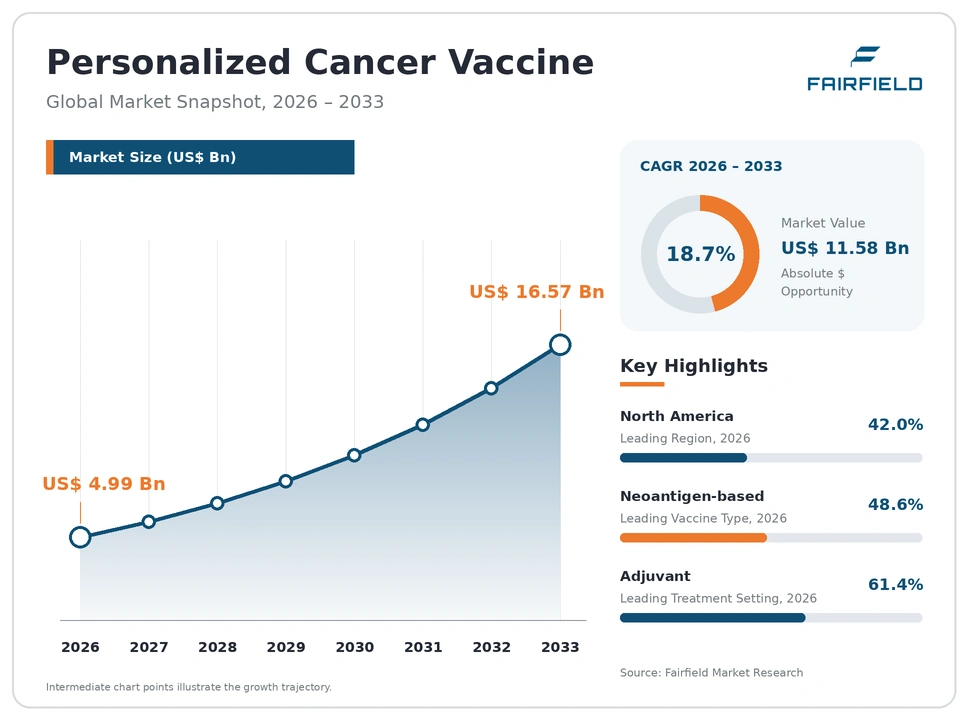
The global personalized cancer vaccine market size is expected to be valued at US$ 4.99 billion in 2026 and projected to reach US$ 16.57 billion by 2033, growing at a CAGR of 18.7% between 2026 and 2033.
Between 2020 and 2025, the market grew at a CAGR of about 14.6%, as mRNA technology proven during the COVID-19 pandemic was redirected to cancer, and early trials of neoantigen vaccines showed encouraging results. Revenue came mainly from dendritic cell vaccines, clinical trial supply, and services. Three factors now drive growth: late-stage success of mRNA cancer vaccines, cheaper and faster tumor sequencing, and combination use with immune checkpoint inhibitors. The market is shifting from research toward the first regulatory approvals of individualized neoantigen therapy in melanoma and lung cancer.
Key Report Takeaways
- By Vaccine Type: Neoantigen-based held 48.6% share in 2026 and is projected to expand at a 21.4% CAGR through 2033, driven by late-stage mRNA trial success and faster tumor sequencing.
- By Cancer Type: Melanoma held 26.2% share in 2026, while Lung Cancer is projected to expand at a 22.6% CAGR through 2033, driven by Phase 3 trials in non-small cell lung cancer.
- By Treatment Setting: Adjuvant held 61.4% share in 2026, while Metastatic is projected to expand at a 20.3% CAGR through 2033, driven by combination trials with checkpoint inhibitors in advanced disease.
- By Region: North America held 42.0% share in 2026, while Asia Pacific is projected to expand at a 21.2% CAGR through 2033, driven by trials and local development in China, Japan, and South Korea.
Global Personalized Cancer Vaccine Market Trends and Insights
Drivers Impact Analysis
Two drivers carry the strongest influence on personalized cancer vaccine demand during the forecast period.
| Driver | Impact on CAGR Forecast | Geographic Relevance | Impact Timeline |
| Late-stage clinical success of mRNA neoantigen vaccines | High | North America, Europe | Medium term (2-4 years) |
| Falling sequencing costs and AI-based neoantigen prediction | High | North America, Europe, Asia Pacific | Long term (≥4 years) |
Clinical Success of mRNA Vaccines Is Driving the Personalized Cancer Vaccine Market
The late-stage clinical success of mRNA cancer vaccines is the strongest driver of the personalized cancer vaccine market. Each vaccine is designed from the mutations in a patient’s own tumor, teaching the immune system to attack cancer cells.
The mechanism is strong trial data and regulatory momentum. In August 2026, Merck & Co. and Moderna reported that intismeran autogene plus Keytruda met both its primary and key secondary endpoints in the Phase 3 INTerpath-001 trial in melanoma after surgery. The earlier Phase 2b trial had shown a 49% lower risk of recurrence or death. BioNTech and Genentech are testing autogene cevumeran in pancreatic, colorectal, and bladder cancers. Regulators including the U.S. Food and Drug Administration and the European Medicines Agency have granted special designations that speed review. Positive results attract investment and drive demand for manufacturing, sequencing, and clinical services.
Sequencing and AI Are Expanding the Personalized Cancer Vaccine Market
Falling sequencing costs and AI-based neoantigen prediction are expanding the personalized cancer vaccine market. Personalized vaccines depend on reading each tumor’s DNA and choosing the best targets quickly.
The cause is technology progress. The cost of sequencing a tumor and normal tissue has fallen sharply, making personalized design more affordable. AI and machine learning tools predict which mutations will trigger strong immune responses, improving vaccine effectiveness. Companies such as Evaxion Biotech use AI platforms to select targets. Automated manufacturing has cut the time from biopsy to vaccine to about six weeks or less. The NHS Cancer Vaccine Launch Pad in England connects patients to personalized vaccine trials, building patient access. Cloud computing allows secure sharing of genetic data between hospitals and manufacturers. These advances make individualized treatment practical at larger scale and support wider clinical use.
Restraints Impact Analysis
Two restraints limit how quickly the personalized cancer vaccine market grows.
| Restraint | Impact on CAGR Forecast | Geographic Relevance | Impact Timeline |
| High manufacturing costs and complex logistics | High | Global | Medium term (2-4 years) |
| Mixed clinical results and regulatory uncertainty | Medium | North America, Europe | Short term (≤2 years) |
High Costs and Complex Logistics Slow the Personalized Cancer Vaccine Market
High manufacturing costs and complex logistics slow the personalized cancer vaccine market. Each vaccine is a batch of one, made for a single patient.
The specific causes are individualized production and tight timelines. Every vaccine requires tumor biopsy, sequencing, computer analysis, custom manufacturing, quality testing, and shipping back to the hospital within weeks. This process costs much more than mass-produced drugs. Manufacturing facilities must run many small batches under strict quality rules. Tumor samples may be too small or of poor quality for sequencing. Delays can let cancer progress before treatment begins. Health systems and insurers will need to decide how to pay for expensive individualized treatments. Hospitals also need trained staff to coordinate samples and treatment schedules. These factors limit how many patients can be treated and raise prices.
Mixed Results and Regulatory Uncertainty Restrict the Personalized Cancer Vaccine Market
Mixed clinical results and regulatory uncertainty restrict the personalized cancer vaccine market. Not all personalized vaccines have succeeded in trials.
The underlying causes are tumor complexity and new regulatory pathways. Some cancers have few mutations, making it hard to find good targets, and tumors can hide from the immune system. Earlier cancer vaccines failed in large trials, and some personalized vaccine programs have reported disappointing results or been stopped. Gritstone Bio filed for bankruptcy in 2024. Regulators must decide how to approve a product whose exact formula differs for each patient, including how to test quality and potency. Guidance from the U.S. Food and Drug Administration, the European Medicines Agency, and the United Kingdom’s MHRA is still developing. These factors create uncertainty for investors and can slow funding for smaller developers with only early-stage data.
Market Opportunities
Expansion to Lung and Other Common Cancers Opens a Large Revenue Pool
Expansion to lung and other common cancers opens a large revenue pool in the personalized cancer vaccine market. Lung, colorectal, pancreatic, and bladder cancers affect far more patients than melanoma.
Vaccine developers with late-stage programs can capture this opportunity. Merck & Co. and Moderna are running Phase 3 trials of intismeran autogene in non-small cell lung cancer, while BioNTech tests autogene cevumeran in colorectal and pancreatic cancer. Use after surgery to prevent relapse could become standard for high-risk patients. Combination with immune checkpoint inhibitors such as Keytruda extends the value of existing drugs. Success in common cancers would multiply the number of treated patients. Companies that build large-scale individualized manufacturing will gain a strong lead, and early approvals in melanoma will help build physician confidence for other cancers.
Manufacturing, Sequencing, and AI Services Create a Platform Revenue Pool
Manufacturing, sequencing, and AI services create a platform revenue pool in the personalized cancer vaccine market. Every personalized vaccine needs a chain of specialized services.
Service providers and technology companies can capture this opportunity. Contract manufacturers that can make many small mRNA, peptide, or DNA batches quickly will be in demand. Sequencing companies such as Illumina and genomic laboratories provide tumor analysis. AI developers offer neoantigen selection software. Lipid nanoparticle suppliers, cold-chain logistics firms, and quality testing laboratories add further value. Automation, robotics, and digital tracking reduce turnaround times and costs. Partnerships with hospitals help manage sample collection and treatment scheduling. Companies offering end-to-end platforms can win long-term contracts with vaccine developers, hospitals, and cancer research networks. Data generated from each patient also improves future target selection.
Segment Analysis
By Vaccine Type: Neoantigen-based Leads and Grows Fastest
Neoantigen-based held 48.6% share in 2026. Neoantigen vaccines target mutations found only in a patient’s tumor, so they can trigger strong immune responses without harming normal tissue. Moderna, Merck & Co., BioNTech, and Genentech lead development, and late-stage trials in melanoma and lung cancer support high investment. Dendritic cell vaccines, which use a patient’s own immune cells, form the second-largest segment, including Dendreon’s Provenge for prostate cancer.
Neoantigen-based vaccines are also the fastest-growing type, expanding at a 21.4% CAGR through 2033. The first regulatory approvals are expected after positive Phase 3 data, and the approval of NEOONCOVAC in Russia in 2025 shows growing acceptance. Tumor cell and viral vector vaccines form other segments. For the market, neoantigen growth shifts value toward mRNA and individualized platforms.
By Cancer Type: Melanoma Leads While Lung Cancer Grows Fastest
Melanoma held 26.2% share in 2026. Melanoma has many mutations, which makes it easier to find neoantigen targets, and it responds well to immunotherapy. The most advanced trials, including INTerpath-001, focus on melanoma after surgery. Breast, prostate, and colorectal cancers form other important segments.
Lung Cancer is the fastest-growing cancer type, expanding at a 22.6% CAGR through 2033. Non-small cell lung cancer is one of the most common and deadly cancers, with many patients at high risk of relapse after surgery. Phase 3 trials of intismeran autogene in lung cancer could lead to approval. Pancreatic, colorectal, and bladder cancers are also targets in mid-stage trials. For the market, lung cancer growth greatly enlarges the eligible population.
By Treatment Setting: Adjuvant Leads While Metastatic Grows Fastest
Adjuvant held 61.4% share in 2026. Vaccines given after surgery aim to stop cancer from returning by clearing remaining cancer cells. Patients in this setting have healthier immune systems and less tumor, so vaccines work better. Most late-stage personalized vaccine trials, including those in melanoma and lung cancer, focus on this setting.
Metastatic is the fastest-growing treatment setting, expanding at a 20.3% CAGR through 2033. Researchers are testing personalized vaccines with immune checkpoint inhibitors and other drugs in patients with advanced disease. NEOONCOVAC in Russia is approved for inoperable or metastatic melanoma alongside immunotherapy. Better combinations could help more patients respond, including those whose cancer has stopped responding to immunotherapy. For the market, metastatic growth expands use beyond early-stage disease.
Geography Analysis
Which Region Is Leading the Personalized Cancer Vaccine Market?
North America is leading the personalized cancer vaccine market with a 42.0% share in 2026. The United States is home to leading developers Moderna, Merck & Co., Genentech, and Dendreon, and to top cancer centers such as Memorial Sloan Kettering Cancer Center and Dana-Farber Cancer Institute. Strong venture capital, government research funding, and advanced sequencing infrastructure support development. The U.S. Food and Drug Administration has granted breakthrough therapy designation to intismeran autogene. Canada participates in trials. Insurers and hospitals are preparing payment and delivery models for individualized treatments. One change shaping the region is preparation for the first approvals.
Europe Advances the Personalized Cancer Vaccine Market Through Trial Access
Europe is a major personalized cancer vaccine market supported by strong research and public health systems. Germany hosts BioNTech and CureVac, while France hosts Transgene and OSE Immunotherapeutics. The United Kingdom launched the NHS Cancer Vaccine Launch Pad with BioNTech to give patients access to personalized trials. Denmark hosts Evaxion Biotech, and Italy hosts Nouscom. Switzerland and the Netherlands have strong cancer research centers taking part in trials. Pricing and reimbursement for individualized treatments remain uncertain, and health technology assessment bodies will need new evaluation methods. One opportunity is early access programs for patients at high risk of relapse.
Which Region Is Growing Fastest in the Personalized Cancer Vaccine Market?
Asia Pacific is growing fastest in the personalized cancer vaccine market at a 21.2% CAGR through 2033. China has many biotech companies developing mRNA and neoantigen vaccines and runs large clinical trials. Japan and South Korea have strong cancer research and are participating in global trials. Australia has advanced cancer care and high melanoma rates, making it an important trial location. Singapore and India are investing in genomic medicine and biotech hubs. One challenge is high cost, which limits access in many countries. One opportunity is local manufacturing and sequencing that cuts turnaround time and costs for patients across the region.
Latin America Develops the Personalized Cancer Vaccine Market Through Trials
Latin America is an early-stage personalized cancer vaccine market. Brazil, Mexico, and Argentina take part in global cancer trials and have growing private and public oncology centers. Cuba has a long history of developing cancer vaccines, including CIMAvax-EGF for lung cancer, and runs active immunotherapy research. Chile and Colombia have growing oncology research networks. Key barriers include high costs, limited sequencing capacity, and long distances between cancer centers and manufacturing sites. Regulators in Brazil and Mexico are developing new frameworks for advanced therapies. One opportunity is trial participation, which gives patients early access to new vaccines.
Middle East & Africa Explores the Personalized Cancer Vaccine Market
Middle East & Africa is an emerging personalized cancer vaccine market. Israel has strong cancer research, genomic databases, and biotech companies, while Saudi Arabia and the United Arab Emirates invest heavily in genomic medicine, biobanks, and specialist cancer centers. National genome programs in Saudi Arabia and Qatar create the sequencing base needed for personalized treatment. South Africa, Egypt, and Morocco have cancer trial sites with experienced investigators. Key barriers include high costs, limited sequencing infrastructure in many African countries, and the need to ship samples abroad. One opportunity is genomic programs that link sequencing with new cancer treatments.
Competitive Landscape
The personalized cancer vaccine market is highly concentrated. Moderna, Merck & Co., BioNTech, Genentech, and Dendreon lead, while CureVac, Transgene, Evaxion Biotech, Nouscom, OSE Immunotherapeutics, and Geneos Therapeutics develop next-generation candidates.
Companies compete on clinical results, speed from biopsy to vaccine, manufacturing capacity, cost, and partnerships with large drug companies. Patents on neoantigen selection methods and delivery technologies also protect market positions. Combining vaccines with checkpoint inhibitors gives partners such as Merck & Co. a strong position, since their existing drugs are part of the treatment. Partnerships between biotech developers and large pharmaceutical companies provide funding, trial networks, and commercial reach. Smaller developers focus on new platforms, such as DNA or peptide vaccines, and AI-based target selection, often seeking licensing deals with larger partners to fund late-stage trials.
Strategic moves show how competition is changing. In July 2025, Dana-Farber Cancer Institute researchers reported an updated formula of the NeoVax vaccine. In November 2025, Russia approved NEOONCOVAC for clinical use in melanoma. In August 2026, Merck & Co. and Moderna reported positive Phase 3 results for intismeran autogene. These moves show competition shifting toward commercialization and preparing for the first regulatory approvals in North America and Europe.
Three themes shape vendor strategy. First, companies are completing Phase 3 trials and preparing regulatory filings. Second, they are scaling individualized manufacturing. Third, they are expanding into common cancers such as lung, colorectal, bladder, and pancreatic cancer.
Personalized Cancer Vaccine Market Industry Leaders
- Moderna
- Merck & Co.
- BioNTech
- Genentech (Roche)
- Dendreon
Recent Industry Developments
- August 2026: Merck & Co. and Moderna reported that intismeran autogene plus Keytruda met its primary and key secondary endpoints in the Phase 3 INTerpath-001 melanoma trial - supports regulatory discussions.
- November 2025: The Gamaleya Center and National Medical Research Radiological Centre announced approval of NEOONCOVAC for clinical use in melanoma - the first approved personalized mRNA cancer vaccine in Russia.
- July 2025: Dana-Farber Cancer Institute researchers reported NeoVaxMI, an updated personalized vaccine formula tested in melanoma - improves delivery of neoantigen vaccines.
Companies Covered in the Report
- Moderna
- Merck & Co.
- BioNTech
- Genentech (Roche)
- Dendreon
- CureVac
- Transgene
- Evaxion Biotech
- Nouscom
- OSE Immunotherapeutics
- Geneos Therapeutics
- Nykode Therapeutics
Personalized Cancer Vaccine Market Report Scope
This report covers personalized cancer vaccines, including neoantigen-based, dendritic cell, tumor cell, and viral vector vaccines made with mRNA, DNA, peptide, and cell-based platforms, for melanoma, lung, and other cancers in adjuvant and metastatic settings. It excludes preventive vaccines such as HPV and hepatitis B vaccines and off-the-shelf shared-antigen vaccines. The base year is 2025, and the forecast period runs from 2026 to 2033. All values are expressed in US$ Billion.
Vaccine Type
- Neoantigen-based
- Dendritic Cell
- Tumor Cell
- Viral Vector-based
Cancer Type
- Melanoma
- Lung Cancer
- Breast Cancer
- Prostate Cancer
- Colorectal Cancer
- Others
Treatment Setting
- Adjuvant
- Metastatic
Regions
- North America
- Europe
- Asia Pacific
- Latin America
- Middle East & Africa
Key Questions Answered in the Report
How big is the personalized cancer vaccine market in 2026?
The personalized cancer vaccine market is valued at US$ 4.99 billion in 2026, led by neoantigen-based vaccines for melanoma and lung cancer.
What is the personalized cancer vaccine market forecast to 2033?
The market is projected to reach US$ 16.57 billion by 2033, growing at a 18.7% CAGR and adding US$ 11.58 billion.
Which cancer type is growing fastest for personalized cancer vaccines?
Lung Cancer is growing fastest at a 22.6% CAGR through 2033, driven by Phase 3 trials in non-small cell lung cancer.
Which region is growing fastest in the personalized cancer vaccine market?
Asia Pacific is growing fastest at a 21.2% CAGR through 2033, driven by trials and local development in China and Japan.
Which region holds the largest personalized cancer vaccine market share?
North America holds the largest share at 42.0% in 2026, supported by leading developers and cancer centers in the United States.
1. Executive Summary
1.1. Global Personalized Cancer Vaccine Market Snapshot
1.2. Future Projections
1.3. Key Report Takeaways
1.4. Regional Snapshot
2. Market Overview
2.1. Market Definition and Report Scope
2.2. Historical Trends 2020–2025
2.3. Market Dynamics
2.3.1. Drivers
2.3.1.1. Clinical Success of mRNA Vaccines Is Driving the Personalized Cancer Vaccine Market
2.3.1.2. Sequencing and AI Are Expanding the Personalized Cancer Vaccine Market
2.3.2. Restraints
2.3.2.1. High Costs and Complex Logistics Slow the Personalized Cancer Vaccine Market
2.3.2.2. Mixed Results and Regulatory Uncertainty Restrict the Personalized Cancer Vaccine Market
2.3.3. Market Opportunities
2.3.3.1. Expansion to Lung and Other Common Cancers Opens a Large Revenue Pool
2.3.3.2. Manufacturing, Sequencing, and AI Services Create a Platform Revenue Pool
3. Global Personalized Cancer Vaccine Market Outlook, 2020-2033
3.1. Global Personalized Cancer Vaccine Market Outlook, by Vaccine Type, Value (US$ Billion), 2020-2033
3.1.1. Neoantigen-based
3.1.2. Dendritic Cell
3.1.3. Tumor Cell
3.1.4. Viral Vector-based
3.2. Global Personalized Cancer Vaccine Market Outlook, by Cancer Type, Value (US$ Billion), 2020-2033
3.2.1. Melanoma
3.2.2. Lung Cancer
3.2.3. Breast Cancer
3.2.4. Prostate Cancer
3.2.5. Colorectal Cancer
3.2.6. Others
3.3. Global Personalized Cancer Vaccine Market Outlook, by Treatment Setting, Value (US$ Billion), 2020-2033
3.3.1. Adjuvant
3.3.2. Metastatic
3.4. Global Personalized Cancer Vaccine Market Outlook, by Region, Value (US$ Billion), 2020-2033
3.4.1. North America
3.4.2. Europe
3.4.3. Asia Pacific
3.4.4. Latin America
3.4.5. Middle East & Africa
4. North America Personalized Cancer Vaccine Market Outlook, 2020-2033
4.1. North America Personalized Cancer Vaccine Market Outlook, by Vaccine Type, Value (US$ Billion), 2020-2033
4.1.1. Neoantigen-based
4.1.2. Dendritic Cell
4.1.3. Tumor Cell
4.1.4. Viral Vector-based
4.2. North America Personalized Cancer Vaccine Market Outlook, by Cancer Type, Value (US$ Billion), 2020-2033
4.2.1. Melanoma
4.2.2. Lung Cancer
4.2.3. Breast Cancer
4.2.4. Prostate Cancer
4.2.5. Colorectal Cancer
4.2.6. Others
4.3. North America Personalized Cancer Vaccine Market Outlook, by Treatment Setting, Value (US$ Billion), 2020-2033
4.3.1. Adjuvant
4.3.2. Metastatic
4.4. North America Personalized Cancer Vaccine Market Outlook, by Country, Value (US$ Billion), 2020-2033
4.4.1. United States Personalized Cancer Vaccine Market Outlook, by Vaccine Type, 2020-2033
4.4.2. United States Personalized Cancer Vaccine Market Outlook, by Cancer Type, 2020-2033
4.4.3. United States Personalized Cancer Vaccine Market Outlook, by Treatment Setting, 2020-2033
4.4.4. Canada Personalized Cancer Vaccine Market Outlook, by Vaccine Type, 2020-2033
4.4.5. Canada Personalized Cancer Vaccine Market Outlook, by Cancer Type, 2020-2033
4.4.6. Canada Personalized Cancer Vaccine Market Outlook, by Treatment Setting, 2020-2033
5. Europe Personalized Cancer Vaccine Market Outlook, 2020-2033
5.1. Europe Personalized Cancer Vaccine Market Outlook, by Vaccine Type, Value (US$ Billion), 2020-2033
5.1.1. Neoantigen-based
5.1.2. Dendritic Cell
5.1.3. Tumor Cell
5.1.4. Viral Vector-based
5.2. Europe Personalized Cancer Vaccine Market Outlook, by Cancer Type, Value (US$ Billion), 2020-2033
5.2.1. Melanoma
5.2.2. Lung Cancer
5.2.3. Breast Cancer
5.2.4. Prostate Cancer
5.2.5. Colorectal Cancer
5.2.6. Others
5.3. Europe Personalized Cancer Vaccine Market Outlook, by Treatment Setting, Value (US$ Billion), 2020-2033
5.3.1. Adjuvant
5.3.2. Metastatic
5.4. Europe Personalized Cancer Vaccine Market Outlook, by Country, Value (US$ Billion), 2020-2033
5.4.1. Germany Personalized Cancer Vaccine Market Outlook, by Vaccine Type, 2020-2033
5.4.2. Germany Personalized Cancer Vaccine Market Outlook, by Cancer Type, 2020-2033
5.4.3. Germany Personalized Cancer Vaccine Market Outlook, by Treatment Setting, 2020-2033
5.4.4. France Personalized Cancer Vaccine Market Outlook, by Vaccine Type, 2020-2033
5.4.5. France Personalized Cancer Vaccine Market Outlook, by Cancer Type, 2020-2033
5.4.6. France Personalized Cancer Vaccine Market Outlook, by Treatment Setting, 2020-2033
5.4.7. United Kingdom Personalized Cancer Vaccine Market Outlook, by Vaccine Type, 2020-2033
5.4.8. United Kingdom Personalized Cancer Vaccine Market Outlook, by Cancer Type, 2020-2033
5.4.9. United Kingdom Personalized Cancer Vaccine Market Outlook, by Treatment Setting, 2020-2033
5.4.10. Denmark Personalized Cancer Vaccine Market Outlook, by Vaccine Type, 2020-2033
5.4.11. Denmark Personalized Cancer Vaccine Market Outlook, by Cancer Type, 2020-2033
5.4.12. Denmark Personalized Cancer Vaccine Market Outlook, by Treatment Setting, 2020-2033
5.4.13. Italy Personalized Cancer Vaccine Market Outlook, by Vaccine Type, 2020-2033
5.4.14. Italy Personalized Cancer Vaccine Market Outlook, by Cancer Type, 2020-2033
5.4.15. Italy Personalized Cancer Vaccine Market Outlook, by Treatment Setting, 2020-2033
5.4.16. Switzerland Personalized Cancer Vaccine Market Outlook, by Vaccine Type, 2020-2033
5.4.17. Switzerland Personalized Cancer Vaccine Market Outlook, by Cancer Type, 2020-2033
5.4.18. Switzerland Personalized Cancer Vaccine Market Outlook, by Treatment Setting, 2020-2033
5.4.19. Netherlands Personalized Cancer Vaccine Market Outlook, by Vaccine Type, 2020-2033
5.4.20. Netherlands Personalized Cancer Vaccine Market Outlook, by Cancer Type, 2020-2033
5.4.21. Netherlands Personalized Cancer Vaccine Market Outlook, by Treatment Setting, 2020-2033
6. Asia Pacific Personalized Cancer Vaccine Market Outlook, 2020-2033
6.1. Asia Pacific Personalized Cancer Vaccine Market Outlook, by Vaccine Type, Value (US$ Billion), 2020-2033
6.1.1. Neoantigen-based
6.1.2. Dendritic Cell
6.1.3. Tumor Cell
6.1.4. Viral Vector-based
6.2. Asia Pacific Personalized Cancer Vaccine Market Outlook, by Cancer Type, Value (US$ Billion), 2020-2033
6.2.1. Melanoma
6.2.2. Lung Cancer
6.2.3. Breast Cancer
6.2.4. Prostate Cancer
6.2.5. Colorectal Cancer
6.2.6. Others
6.3. Asia Pacific Personalized Cancer Vaccine Market Outlook, by Treatment Setting, Value (US$ Billion), 2020-2033
6.3.1. Adjuvant
6.3.2. Metastatic
6.4. Asia Pacific Personalized Cancer Vaccine Market Outlook, by Country, Value (US$ Billion), 2020-2033
6.4.1. China Personalized Cancer Vaccine Market Outlook, by Vaccine Type, 2020-2033
6.4.2. China Personalized Cancer Vaccine Market Outlook, by Cancer Type, 2020-2033
6.4.3. China Personalized Cancer Vaccine Market Outlook, by Treatment Setting, 2020-2033
6.4.4. Japan Personalized Cancer Vaccine Market Outlook, by Vaccine Type, 2020-2033
6.4.5. Japan Personalized Cancer Vaccine Market Outlook, by Cancer Type, 2020-2033
6.4.6. Japan Personalized Cancer Vaccine Market Outlook, by Treatment Setting, 2020-2033
6.4.7. South Korea Personalized Cancer Vaccine Market Outlook, by Vaccine Type, 2020-2033
6.4.8. South Korea Personalized Cancer Vaccine Market Outlook, by Cancer Type, 2020-2033
6.4.9. South Korea Personalized Cancer Vaccine Market Outlook, by Treatment Setting, 2020-2033
6.4.10. Australia Personalized Cancer Vaccine Market Outlook, by Vaccine Type, 2020-2033
6.4.11. Australia Personalized Cancer Vaccine Market Outlook, by Cancer Type, 2020-2033
6.4.12. Australia Personalized Cancer Vaccine Market Outlook, by Treatment Setting, 2020-2033
6.4.13. Singapore Personalized Cancer Vaccine Market Outlook, by Vaccine Type, 2020-2033
6.4.14. Singapore Personalized Cancer Vaccine Market Outlook, by Cancer Type, 2020-2033
6.4.15. Singapore Personalized Cancer Vaccine Market Outlook, by Treatment Setting, 2020-2033
6.4.16. India Personalized Cancer Vaccine Market Outlook, by Vaccine Type, 2020-2033
6.4.17. India Personalized Cancer Vaccine Market Outlook, by Cancer Type, 2020-2033
6.4.18. India Personalized Cancer Vaccine Market Outlook, by Treatment Setting, 2020-2033
7. Latin America Personalized Cancer Vaccine Market Outlook, 2020-2033
7.1. Latin America Personalized Cancer Vaccine Market Outlook, by Vaccine Type, Value (US$ Billion), 2020-2033
7.1.1. Neoantigen-based
7.1.2. Dendritic Cell
7.1.3. Tumor Cell
7.1.4. Viral Vector-based
7.2. Latin America Personalized Cancer Vaccine Market Outlook, by Cancer Type, Value (US$ Billion), 2020-2033
7.2.1. Melanoma
7.2.2. Lung Cancer
7.2.3. Breast Cancer
7.2.4. Prostate Cancer
7.2.5. Colorectal Cancer
7.2.6. Others
7.3. Latin America Personalized Cancer Vaccine Market Outlook, by Treatment Setting, Value (US$ Billion), 2020-2033
7.3.1. Adjuvant
7.3.2. Metastatic
7.4. Latin America Personalized Cancer Vaccine Market Outlook, by Country, Value (US$ Billion), 2020-2033
7.4.1. Brazil Personalized Cancer Vaccine Market Outlook, by Vaccine Type, 2020-2033
7.4.2. Brazil Personalized Cancer Vaccine Market Outlook, by Cancer Type, 2020-2033
7.4.3. Brazil Personalized Cancer Vaccine Market Outlook, by Treatment Setting, 2020-2033
7.4.4. Mexico Personalized Cancer Vaccine Market Outlook, by Vaccine Type, 2020-2033
7.4.5. Mexico Personalized Cancer Vaccine Market Outlook, by Cancer Type, 2020-2033
7.4.6. Mexico Personalized Cancer Vaccine Market Outlook, by Treatment Setting, 2020-2033
7.4.7. Argentina Personalized Cancer Vaccine Market Outlook, by Vaccine Type, 2020-2033
7.4.8. Argentina Personalized Cancer Vaccine Market Outlook, by Cancer Type, 2020-2033
7.4.9. Argentina Personalized Cancer Vaccine Market Outlook, by Treatment Setting, 2020-2033
7.4.10. Cuba Personalized Cancer Vaccine Market Outlook, by Vaccine Type, 2020-2033
7.4.11. Cuba Personalized Cancer Vaccine Market Outlook, by Cancer Type, 2020-2033
7.4.12. Cuba Personalized Cancer Vaccine Market Outlook, by Treatment Setting, 2020-2033
7.4.13. Chile Personalized Cancer Vaccine Market Outlook, by Vaccine Type, 2020-2033
7.4.14. Chile Personalized Cancer Vaccine Market Outlook, by Cancer Type, 2020-2033
7.4.15. Chile Personalized Cancer Vaccine Market Outlook, by Treatment Setting, 2020-2033
7.4.16. Colombia Personalized Cancer Vaccine Market Outlook, by Vaccine Type, 2020-2033
7.4.17. Colombia Personalized Cancer Vaccine Market Outlook, by Cancer Type, 2020-2033
7.4.18. Colombia Personalized Cancer Vaccine Market Outlook, by Treatment Setting, 2020-2033
8. Middle East & Africa Personalized Cancer Vaccine Market Outlook, 2020-2033
8.1. Middle East & Africa Personalized Cancer Vaccine Market Outlook, by Vaccine Type, Value (US$ Billion), 2020-2033
8.1.1. Neoantigen-based
8.1.2. Dendritic Cell
8.1.3. Tumor Cell
8.1.4. Viral Vector-based
8.2. Middle East & Africa Personalized Cancer Vaccine Market Outlook, by Cancer Type, Value (US$ Billion), 2020-2033
8.2.1. Melanoma
8.2.2. Lung Cancer
8.2.3. Breast Cancer
8.2.4. Prostate Cancer
8.2.5. Colorectal Cancer
8.2.6. Others
8.3. Middle East & Africa Personalized Cancer Vaccine Market Outlook, by Treatment Setting, Value (US$ Billion), 2020-2033
8.3.1. Adjuvant
8.3.2. Metastatic
8.4. Middle East & Africa Personalized Cancer Vaccine Market Outlook, by Country, Value (US$ Billion), 2020-2033
8.4.1. Israel Personalized Cancer Vaccine Market Outlook, by Vaccine Type, 2020-2033
8.4.2. Israel Personalized Cancer Vaccine Market Outlook, by Cancer Type, 2020-2033
8.4.3. Israel Personalized Cancer Vaccine Market Outlook, by Treatment Setting, 2020-2033
8.4.4. Saudi Arabia Personalized Cancer Vaccine Market Outlook, by Vaccine Type, 2020-2033
8.4.5. Saudi Arabia Personalized Cancer Vaccine Market Outlook, by Cancer Type, 2020-2033
8.4.6. Saudi Arabia Personalized Cancer Vaccine Market Outlook, by Treatment Setting, 2020-2033
8.4.7. United Arab Emirates Personalized Cancer Vaccine Market Outlook, by Vaccine Type, 2020-2033
8.4.8. United Arab Emirates Personalized Cancer Vaccine Market Outlook, by Cancer Type, 2020-2033
8.4.9. United Arab Emirates Personalized Cancer Vaccine Market Outlook, by Treatment Setting, 2020-2033
8.4.10. Qatar Personalized Cancer Vaccine Market Outlook, by Vaccine Type, 2020-2033
8.4.11. Qatar Personalized Cancer Vaccine Market Outlook, by Cancer Type, 2020-2033
8.4.12. Qatar Personalized Cancer Vaccine Market Outlook, by Treatment Setting, 2020-2033
8.4.13. South Africa Personalized Cancer Vaccine Market Outlook, by Vaccine Type, 2020-2033
8.4.14. South Africa Personalized Cancer Vaccine Market Outlook, by Cancer Type, 2020-2033
8.4.15. South Africa Personalized Cancer Vaccine Market Outlook, by Treatment Setting, 2020-2033
8.4.16. Egypt Personalized Cancer Vaccine Market Outlook, by Vaccine Type, 2020-2033
8.4.17. Egypt Personalized Cancer Vaccine Market Outlook, by Cancer Type, 2020-2033
8.4.18. Egypt Personalized Cancer Vaccine Market Outlook, by Treatment Setting, 2020-2033
8.4.19. Morocco Personalized Cancer Vaccine Market Outlook, by Vaccine Type, 2020-2033
8.4.20. Morocco Personalized Cancer Vaccine Market Outlook, by Cancer Type, 2020-2033
8.4.21. Morocco Personalized Cancer Vaccine Market Outlook, by Treatment Setting, 2020-2033
9. Competitive Landscape
9.1. Market Concentration and Industry Leaders
9.2. Competitive Differentiation
9.3. Strategic Moves and Market Direction
9.4. Recent Industry Developments
9.5. Company Profiles
9.5.1. Moderna
9.5.2. Merck & Co.
9.5.3. BioNTech
9.5.4. Genentech (Roche)
9.5.5. Dendreon
9.5.6. CureVac
9.5.7. Transgene
9.5.8. Evaxion Biotech
9.5.9. Nouscom
9.5.10. OSE Immunotherapeutics
9.5.11. Geneos Therapeutics
9.5.12. Nykode Therapeutics
10. Appendix
10.1. Research Methodology
10.2. Report Assumptions
10.3. Acronyms and Abbreviations
| Segment | Categories |
|---|---|
| Vaccine Type | Neoantigen-based, Dendritic Cell, Tumor Cell, Viral Vector-based |
| Cancer Type | Melanoma, Lung Cancer, Breast Cancer, Prostate Cancer, Colorectal Cancer, Others |
| Treatment Setting | Adjuvant, Metastatic |
| Regions | North America, Europe, Asia Pacific, Latin America, Middle East & Africa |
Our Research Methodology
Considering the volatility of business today, traditional approaches to strategizing a game plan can be unfruitful if not detrimental. True ambiguity is no way to determine a forecast. A myriad of predetermined factors must be accounted for such as the degree of risk involved, the magnitude of circumstances, as well as conditions or consequences that are not known or unpredictable. To circumvent binary views that cast uncertainty, the application of market research intelligence to strategically posture, move, and enable actionable outcomes is necessary.
View Methodology
Quality Assured
Rigorous Validation Process

Confidentiality Assured
End-to-end Data Security

Custom Research Services
Tailored To Your Objectives
FAQs
The personalized cancer vaccine market is valued at US$ 4.99 billion in 2026, led by neoantigen-based vaccines for melanoma and lung cancer.
The market is projected to reach US$ 16.57 billion by 2033, growing at a 18.7% CAGR and adding US$ 11.58 billion.
Lung Cancer is growing fastest at a 22.6% CAGR through 2033, driven by Phase 3 trials in non-small cell lung cancer.
Asia Pacific is growing fastest at a 21.2% CAGR through 2033, driven by trials and local development in China and Japan.
North America holds the largest share at 42.0% in 2026, supported by leading developers and cancer centers in the United States.
Related Reports
Upstream Bioprocessing Market Size, Share, Insights, Competitive Landscape, and Forecast 2026 to 2033
Upstream bioprocessing market to reach US$ 92.23 billion by 2033 at a 14.3% CAGR. Explore products, use types, manufacturing modes and regional trends.
PEGylated Proteins Market Size, Share, Insights, Competitive Landscape, and Forecast 2026 to 2033
PEGylated proteins market to reach US$ 4.58 billion by 2033 at a 10.9% CAGR. Explore products, protein types, applications and regional trends.
Oligonucleotide Synthesis Market Size, Share, Insights, Competitive Landscape, and Forecast 2026 to 2033
Oligonucleotide synthesis market to reach US$ 10.90 billion by 2033 at a 15.0% CAGR. Explore products, applications and regional trends.
In Situ Hybridization Market Size, Share, Insights, Competitive Landscape, and Forecast 2026 to 2033
In situ hybridization market to reach US$ 3.34 billion by 2033 at a 7.5% CAGR. Explore techniques, applications and regional trends.
HER2-Targeted Therapy Market Size, Share, Insights, Competitive Landscape, and Forecast 2026 to 2033
HER2-targeted therapy market to reach US$ 18.67 billion by 2033 at a 9.0% CAGR. Explore drug classes, indications and regional trends.
Extractables and Leachables Testing Market Size, Share, Insights, Competitive Landscape, and Forecast 2026 to 2033
Extractables and leachables testing market to reach US$ 3.57 billion by 2033 at a 14.9% CAGR. Explore products, applications and regions.