



PEGylated Proteins Market
PEGylated Proteins Market Size, Share, Insights, Competitive Landscape, and Forecast 2026 to 2033
PEGylated Proteins Market Analysis, 2026–2033
PEGylated Proteins Market
PEGylated Proteins Market Size, Share, Insights, Competitive Landscape, and Forecast 2026 to 2033
PEGylated Proteins Market Size and Trend Analysis
How Fast Is the PEGylated Proteins Market Growing?
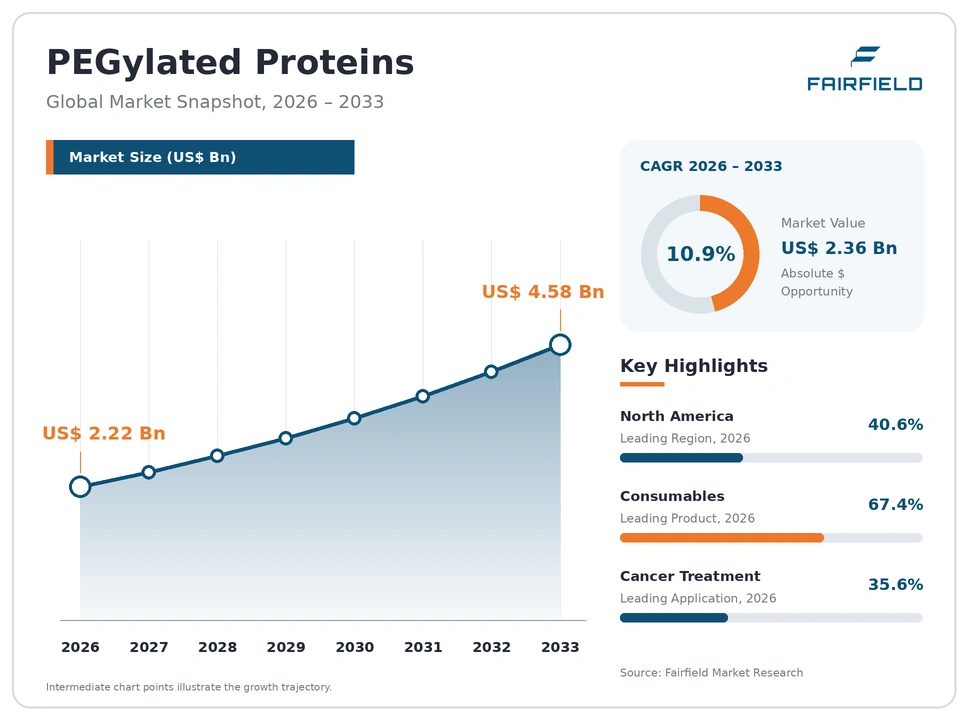
The global PEGylated proteins market size is expected to be valued at US$ 2.22 billion in 2026 and projected to reach US$ 4.58 billion by 2033, growing at a CAGR of 10.9% between 2026 and 2033.
Between 2020 and 2025, the market grew at a CAGR of about 8.7%, as demand for PEGylation reagents and services rose with biologic drug development, and the use of PEG lipids in COVID-19 mRNA vaccines lifted the wider PEG supply chain. Three factors now drive growth: the need for half-life extension in protein drugs, the growing number of pegfilgrastim biosimilars and other PEGylated biosimilars, and new uses of PEG linkers in antibody-drug conjugates and gene therapies. The market is shifting toward high-purity, site-specific PEGylation and discrete PEG products that improve biologics drug delivery and reduce variability.
Key Report Takeaways
- By Product: Consumables held 67.4% share in 2026, while Services are projected to expand at a 12.3% CAGR through 2033, driven by outsourcing of PEGylation process development and GMP manufacturing.
- By Protein Type: Colony-Stimulating Factors held 34.8% share in 2026, while Enzymes are projected to expand at a 12.7% CAGR through 2033, driven by PEGylated enzyme therapies for rare metabolic diseases.
- By Application: Cancer Treatment held 35.6% share in 2026, while Rare & Genetic Diseases is projected to expand at a 12.9% CAGR through 2033, driven by long-acting enzyme and protein replacement therapies.
- By Region: North America held 40.6% share in 2026, while China is projected to expand at a 13.4% CAGR through 2033, driven by local PEG reagent makers and biosimilar production.
Global PEGylated Proteins Market Trends and Insights
Drivers Impact Analysis
Two drivers carry the strongest influence on PEGylated protein demand during the forecast period.
| Driver | Impact on CAGR Forecast | Geographic Relevance | Impact Timeline |
| Demand for longer-acting biologic drugs | High | North America, Europe, Asia Pacific | Long term (≥4 years) |
| Growth of PEGylated biosimilars | High | North America, Asia Pacific, Europe | Medium term (2-4 years) |
Longer-acting Biologics Are Driving the PEGylated Proteins Market
Demand for longer-acting biologic drugs is the strongest driver of the PEGylated proteins market. PEGylation attaches polyethylene glycol chains to proteins, helping drugs stay in the body longer and reducing immune reactions.
The mechanism is improved dosing and patient convenience. Half-life extension allows weekly or monthly dosing instead of daily injections, improving compliance and quality of life. Established PEGylated drugs include pegfilgrastim for chemotherapy-induced neutropenia, peginterferon for hepatitis, pegloticase for gout, and pegvaliase for phenylketonuria. Newer PEGylated proteins and peptides target rare diseases, eye diseases, and metabolic disorders. Drug developers use PEGylation to improve solubility and stability, supporting biologics drug delivery. The growing pipeline of biologics creates steady demand for PEGylation reagents, process development services, and analytical testing. These trends support steady long-term growth.
PEGylated Biosimilars Are Expanding the PEGylated Proteins Market
The growth of PEGylated biosimilars is expanding the PEGylated proteins market. Biosimilar versions of PEGylated drugs need large volumes of high-quality PEG reagents.
The cause is patent expiries and payer pressure for lower costs. Amgen’s Neulasta now faces at least eight pegfilgrastim biosimilars approved in the United States, including Lupin’s Armlupeg, approved in December 2025, and Accord BioPharma’s Ennumo, approved in May 2026. Biosimilar makers in India, China, and South Korea produce PEGylated filgrastim and interferon for global markets. Each biosimilar requires validated PEG supply, analytical methods, and regulatory documentation. Lower prices increase patient access and treatment volumes. These factors support growing demand for GMP-grade PEG reagents and PEGylation services, offsetting some price erosion in branded drugs and older products.
Restraints Impact Analysis
Two restraints limit how quickly the PEGylated proteins market grows.
| Restraint | Impact on CAGR Forecast | Geographic Relevance | Impact Timeline |
| Anti-PEG antibodies and safety concerns | Medium | North America, Europe | Medium term (2-4 years) |
| Competition from alternative half-life technologies and biosimilar price erosion | High | Global | Short term (≤2 years) |
Anti-PEG Antibodies Slow the PEGylated Proteins Market
Anti-PEG antibodies and safety concerns slow the PEGylated proteins market. Some patients develop immune responses to PEG that reduce drug effectiveness or cause reactions.
The specific causes are widespread PEG exposure and immune reactions. PEG is common in cosmetics, foods, and medicines, and many people already have antibodies against it. Exposure through COVID-19 mRNA vaccines, which use PEG lipids, may have increased these antibodies. Anti-PEG antibodies can speed drug clearance and cause allergic reactions, as seen with some PEGylated drugs that required risk management programs. PEG chains can also build up in tissues with long-term use, raising regulatory questions. Developers must test for these effects, adding time and cost. Regulators may ask for more data on long-term safety in children and chronic users. These concerns lead some companies to explore alternatives or lower-molecular-weight PEGs.
Alternative Technologies Restrict the PEGylated Proteins Market
Competition from alternative half-life technologies and biosimilar price erosion restricts the PEGylated proteins market. Developers now have several other ways to extend drug action.
The underlying causes are new technologies and pricing pressure. Fc fusion, albumin binding, polysarcosine, XTEN, and lipidation offer alternatives to PEGylation, and some drug developers prefer them to avoid PEG-related immune issues. Long-acting formulations and gene therapies may replace frequent protein injections. GLP-1 drugs such as semaglutide use fatty acid chains rather than PEG. Biosimilar competition has cut prices for pegfilgrastim and peginterferon, lowering the value of each dose. Reagent suppliers face price pressure from low-cost producers in China. Some developers that once used PEG have moved to newer platforms for next-generation products. These factors limit growth in some segments and push suppliers to specialize.
Market Opportunities
PEGylation Services and GMP Manufacturing Open an Outsourcing Revenue Pool
PEGylation services and GMP manufacturing open an outsourcing revenue pool in the PEGylated proteins market. Drug developers increasingly outsource conjugation chemistry and manufacturing.
CDMOs and specialty chemical suppliers can capture this opportunity. Small biotech companies often lack the expertise and facilities for PEGylation, purification, and analysis. Services include custom PEG synthesis, conjugation development, scale-up, analytical testing, and regulatory support. Gannet BioChem, backed by Ampersand Capital Partners, acquired Laysan Bio in January 2026 to expand activated polymer and bioconjugation capabilities. Merck KGaA, NOF Corporation, and JenKem Technology supply GMP-grade PEG reagents. Long-term supply contracts for commercial drugs provide stable revenue for several years. Suppliers offering end-to-end services from early development to commercial supply can win larger contracts and long-term customer relationships.
PEG Linkers for ADCs and Advanced Therapies Create a High-value Revenue Pool
PEG linkers for antibody-drug conjugates and advanced therapies create a high-value revenue pool in the PEGylated proteins market. PEG chains are used to improve the solubility and stability of complex drugs.
Specialty reagent makers can capture this opportunity. Antibody-drug conjugates use PEG-based linkers to connect antibodies with drug payloads, and the number of conjugates in development has grown rapidly. Discrete PEG products with exact lengths, such as those developed by Quanta BioDesign, now part of Vector Laboratories, improve consistency and regulatory approval. PEG lipids are essential in lipid nanoparticles for mRNA and gene therapies. Peptide drugs and protein degraders also use PEG to improve properties. These high-value uses command premium prices and strict quality requirements, supporting margins for specialized suppliers with strong analytical capabilities.
Segment Analysis
By Product: Consumables Lead While Services Grow Fastest
Consumables held 67.4% share in 2026. Consumables include PEGylation reagents, activated PEG derivatives, PEGylation kits, and PEG linkers used in research, development, and manufacturing. Demand comes from drug developers, biosimilar makers, and academic laboratories. NOF Corporation, JenKem Technology, Merck KGaA, and Thermo Fisher Scientific are leading suppliers, offering research-grade and GMP-grade products.
Services are the fastest-growing product segment, expanding at a 12.3% CAGR through 2033. Drug developers outsource PEGylation process development, conjugation, purification, analytical testing, and GMP manufacturing to specialized providers. Biotech companies with limited facilities rely on these services to move products into clinical trials. CDMOs such as Gannet BioChem and Aurigene Pharmaceutical Services offer integrated services. For the market, services growth adds higher-value revenue.
By Protein Type: Colony-Stimulating Factors Lead While Enzymes Grow Fastest
Colony-Stimulating Factors held 34.8% share in 2026. PEGylated granulocyte colony-stimulating factors, such as pegfilgrastim, help cancer patients recover white blood cells after chemotherapy. Amgen’s Neulasta and many pegfilgrastim biosimilars make this the largest segment. Interferons, erythropoietin, growth hormone, and other hormones form other segments.
Enzymes are the fastest-growing protein type, expanding at a 12.7% CAGR through 2033. PEGylated enzymes treat rare metabolic and genetic diseases, such as phenylketonuria with pegvaliase, gout with pegloticase, and Fabry disease with pegunigalsidase alfa. PEGylation reduces immune reactions and extends enzyme activity, allowing less frequent dosing. Rare disease drug approvals and orphan drug incentives support growth. Monoclonal antibody fragments and peptides form other growing segments. For the market, enzyme growth adds high-value products.
By Application: Cancer Treatment Leads While Rare & Genetic Diseases Grow Fastest
Cancer Treatment held 35.6% share in 2026. PEGylated proteins support cancer care by preventing infections during chemotherapy, and PEGylated asparaginase treats acute lymphoblastic leukemia. Rising cancer incidence and chemotherapy use support demand. Hepatitis, autoimmune diseases, and kidney disease form other applications, with PEGylated erythropoietin used for anemia in kidney disease.
Rare & Genetic Diseases is the fastest-growing application, expanding at a 12.9% CAGR through 2033. PEGylated enzyme and protein replacement therapies offer long-acting treatment for patients with rare metabolic disorders. Orphan drug incentives in the United States, Europe, and Japan encourage development. Eye diseases, such as geographic atrophy treated with pegcetacoplan, also use PEGylated drugs. For the market, rare disease growth adds premium-priced products.
Geography Analysis
Which Region Is Leading the PEGylated Proteins Market?
North America is leading the PEGylated proteins market with a 40.6% share in 2026. The United States is the largest market for PEGylated drugs, with leading developers such as Amgen, Apellis Pharmaceuticals, and BioMarin. The U.S. Food and Drug Administration has approved eight pegfilgrastim biosimilars. PEG reagent and CDMO suppliers such as Gannet BioChem, Thermo Fisher Scientific, and Vector Laboratories are based in the region. Canada adds demand. Rare disease drug developers are active users of PEGylation services, and venture funding supports new biologics. One change shaping the region is biosimilar growth, which raises volumes but lowers prices for pegfilgrastim.
Europe Advances the PEGylated Proteins Market Through Biosimilars and Rare Disease Drugs
Europe is a major PEGylated proteins market with strong biosimilar adoption and rare disease research. Germany hosts Merck KGaA and Iris Biotech, while Switzerland and the United Kingdom have strong biotech sectors. Sweden is home to Swedish Orphan Biovitrum. The European Medicines Agency approved several pegfilgrastim biosimilars early, and biosimilars now hold a large share of use. Italy, France, and Spain have large biosimilar markets supported by public tenders. Price pressure from public health systems remains strong, and strict quality rules raise the bar for PEG suppliers. One opportunity is rare disease therapies, supported by orphan drug incentives.
Asia Pacific Drives the PEGylated Proteins Market Through China
Asia Pacific is a fast-growing PEGylated proteins market. Japan hosts NOF Corporation, a leading PEG reagent producer that supplies GMP-grade PEG for many approved drugs worldwide. India has biosimilar makers such as Lupin, Intas, Biocon Biologics, and Dr. Reddy’s Laboratories that produce pegfilgrastim for global markets. South Korea has strong biosimilar developers and contract manufacturers such as Samsung Biologics, which support global biologics supply. China is growing fastest, as detailed below. Australia has strong biotech research and clinical trials. One change shaping the region is biosimilar exports to North America, Europe, and emerging markets.
Which Country Is Growing Fastest in the PEGylated Proteins Market?
China is growing fastest in the PEGylated proteins market at a 13.4% CAGR through 2033. Local PEG reagent makers such as JenKem Technology and Biopharma PEG Scientific supply global customers at competitive prices and are expanding GMP production. Chinese drug makers have developed PEGylated filgrastim, interferon, growth hormone, and long-acting insulin candidates, and Xiamen Amoytop Biotech partnered with Aligos Therapeutics in 2024 on a PEGylated interferon. Government support for biotech and large hospital networks increase domestic demand. Price cuts from national volume-based buying programs remain a challenge. One opportunity is export of PEG reagents and biosimilars to emerging markets.
Latin America Grows the PEGylated Proteins Market Through Biosimilar Access
Latin America is a growing PEGylated proteins market. Brazil and Mexico have large and growing public health systems that buy biosimilar pegfilgrastim through tenders to support cancer treatment for more patients. Argentina has local biotech producers such as mAbxience, which make biosimilars for regional and global markets. Colombia, Chile, and Peru are expanding cancer care and biosimilar use in public and private hospitals. Key barriers include currency swings, slow regulatory approvals, limited local manufacturing, and reliance on imported reagents and drugs. One opportunity is lower-cost biosimilars made through technology transfer partnerships with Indian and Chinese producers.
Middle East & Africa Builds the PEGylated Proteins Market
Middle East & Africa is an emerging PEGylated proteins market. Saudi Arabia and the United Arab Emirates have well-funded hospitals that use PEGylated drugs for cancer and hepatitis. Egypt used peginterferon widely in its national hepatitis C program before newer oral drugs became available. South Africa has a growing biosimilar market supported by private hospitals and medical schemes. Key barriers include cost, limited local manufacturing, and reliance on imports. The Saudi Arabia government supports local pharmaceutical production under Vision 2030, and the United Arab Emirates is building biotech hubs. One opportunity is local biosimilar production for regional markets.
Competitive Landscape
The PEGylated proteins market is moderately concentrated. Merck KGaA, Thermo Fisher Scientific, NOF Corporation, and JenKem Technology together hold about 40% of the market, while Gannet BioChem, Creative PEGWorks, Biopharma PEG Scientific, Iris Biotech, Vector Laboratories, and Aurigene Pharmaceutical Services compete in reagents and services.
Companies compete on purity, consistency, GMP compliance, product range, price, delivery reliability, regulatory documentation, and technical support. Long qualification processes make drug developers reluctant to change PEG suppliers, so established suppliers enjoy stable relationships. Japanese and European suppliers compete on quality and regulatory records, while Chinese suppliers compete on price and speed. CDMOs compete on technical expertise, capacity, and ability to support products from early research to commercial manufacturing. Consolidation through acquisitions is creating larger specialist providers that can offer reagents, conjugation, and analytical testing under one contract, which simplifies supply for drug developers.
Strategic moves show how competition is changing. In December 2025, the U.S. Food and Drug Administration approved Lupin’s Armlupeg. In January 2026, Gannet BioChem acquired Laysan Bio. In May 2026, the FDA approved Accord BioPharma’s Ennumo. These moves show competition shifting toward consolidation and biosimilar supply, as pegfilgrastim becomes a crowded and price-driven market.
Three themes shape vendor strategy. First, companies are consolidating reagent and CDMO capabilities through acquisitions. Second, they are developing discrete PEG products with exact chain lengths. Third, they are expanding into linkers for antibody-drug conjugates and lipids for gene therapies.
PEGylated Proteins Market Industry Leaders
- Merck KGaA
- Thermo Fisher Scientific
- NOF Corporation
- JenKem Technology
- Gannet BioChem
Recent Industry Developments
- May 2026: Accord BioPharma received U.S. FDA approval for Ennumo (pegfilgrastim-pccg) - becomes one of eight approved Neulasta biosimilars.
- January 2026: Gannet BioChem acquired Laysan Bio, a maker of activated PEG reagents - expands bioconjugation and GMP capabilities.
- December 2025: Lupin received U.S. FDA approval for Armlupeg (pegfilgrastim-unne) - adds further competition in pegfilgrastim.
- July 2024: Aligos Therapeutics partnered with Xiamen Amoytop Biotech to test a PEGylated interferon with its hepatitis B drug - supports new uses for PEGylated proteins.
Companies Covered in the Report
- Merck KGaA
- Thermo Fisher Scientific
- NOF Corporation
- JenKem Technology
- Gannet BioChem
- Creative PEGWorks
- Biopharma PEG Scientific
- Iris Biotech
- Vector Laboratories
- Aurigene Pharmaceutical Services
- Abcam
- Profacgen
PEGylated Proteins Market Report Scope
This report covers PEGylated protein consumables and services, including PEGylation reagents, kits, PEG linkers, and process development and manufacturing services, for colony-stimulating factors, interferons, erythropoietin, enzymes, antibodies, and other proteins used in cancer, hepatitis, rare diseases, and other conditions. It excludes sales of finished PEGylated drugs. The base year is 2025, and the forecast period runs from 2026 to 2033. All values are expressed in US$ Billion.
Product
- Consumables
- Services
Protein Type
- Colony-Stimulating Factors
- Interferons
- Erythropoietin
- Enzymes
- Monoclonal Antibodies & Fragments
- Others
Application
- Cancer Treatment
- Hepatitis
- Rare & Genetic Diseases
- Autoimmune Diseases
- Others
Regions
- North America
- Europe
- Asia Pacific
- Latin America
- Middle East & Africa
Key Questions Answered in the Report
How big is the PEGylated proteins market in 2026?
The PEGylated proteins market is valued at US$ 2.22 billion in 2026, led by consumables such as PEGylation reagents and kits.
What is the PEGylated proteins market forecast to 2033?
The market is projected to reach US$ 4.58 billion by 2033, growing at a 10.9% CAGR and adding US$ 2.36 billion.
Which protein type is growing fastest in the PEGylated proteins market?
Enzymes are growing fastest at a 12.7% CAGR through 2033, driven by PEGylated enzyme therapies for rare metabolic diseases.
Which country is growing fastest in the PEGylated proteins market?
China is growing fastest at a 13.4% CAGR through 2033, driven by local PEG reagent makers and biosimilar production.
Which region holds the largest PEGylated proteins market share?
North America holds the largest share at 40.6% in 2026, supported by leading drug developers and biosimilars in the United States.
1. Executive Summary
1.1. Global PEGylated Proteins Market Snapshot
1.2. Future Projections
1.3. Key Report Takeaways
1.4. Regional Snapshot
2. Market Overview
2.1. Market Definition and Report Scope
2.2. Historical Trends 2020–2025
2.3. Market Dynamics
2.3.1. Drivers
2.3.1.1. Longer-acting Biologics Are Driving the PEGylated Proteins Market
2.3.1.2. PEGylated Biosimilars Are Expanding the PEGylated Proteins Market
2.3.2. Restraints
2.3.2.1. Anti-PEG Antibodies Slow the PEGylated Proteins Market
2.3.2.2. Alternative Technologies Restrict the PEGylated Proteins Market
2.3.3. Market Opportunities
2.3.3.1. PEGylation Services and GMP Manufacturing Open an Outsourcing Revenue Pool
2.3.3.2. PEG Linkers for ADCs and Advanced Therapies Create a High-value Revenue Pool
3. Global PEGylated Proteins Market Outlook, 2020-2033
3.1. Global PEGylated Proteins Market Outlook, by Product, Value (US$ Billion), 2020-2033
3.1.1. Consumables
3.1.2. Services
3.2. Global PEGylated Proteins Market Outlook, by Protein Type, Value (US$ Billion), 2020-2033
3.2.1. Colony-Stimulating Factors
3.2.2. Interferons
3.2.3. Erythropoietin
3.2.4. Enzymes
3.2.5. Monoclonal Antibodies & Fragments
3.2.6. Others
3.3. Global PEGylated Proteins Market Outlook, by Application, Value (US$ Billion), 2020-2033
3.3.1. Cancer Treatment
3.3.2. Hepatitis
3.3.3. Rare & Genetic Diseases
3.3.4. Autoimmune Diseases
3.3.5. Others
3.4. Global PEGylated Proteins Market Outlook, by Region, Value (US$ Billion), 2020-2033
3.4.1. North America
3.4.2. Europe
3.4.3. Asia Pacific
3.4.4. Latin America
3.4.5. Middle East & Africa
4. North America PEGylated Proteins Market Outlook, 2020-2033
4.1. North America PEGylated Proteins Market Outlook, by Product, Value (US$ Billion), 2020-2033
4.1.1. Consumables
4.1.2. Services
4.2. North America PEGylated Proteins Market Outlook, by Protein Type, Value (US$ Billion), 2020-2033
4.2.1. Colony-Stimulating Factors
4.2.2. Interferons
4.2.3. Erythropoietin
4.2.4. Enzymes
4.2.5. Monoclonal Antibodies & Fragments
4.2.6. Others
4.3. North America PEGylated Proteins Market Outlook, by Application, Value (US$ Billion), 2020-2033
4.3.1. Cancer Treatment
4.3.2. Hepatitis
4.3.3. Rare & Genetic Diseases
4.3.4. Autoimmune Diseases
4.3.5. Others
4.4. North America PEGylated Proteins Market Outlook, by Country, Value (US$ Billion), 2020-2033
4.4.1. United States PEGylated Proteins Market Outlook, by Product, 2020-2033
4.4.2. United States PEGylated Proteins Market Outlook, by Protein Type, 2020-2033
4.4.3. United States PEGylated Proteins Market Outlook, by Application, 2020-2033
4.4.4. Canada PEGylated Proteins Market Outlook, by Product, 2020-2033
4.4.5. Canada PEGylated Proteins Market Outlook, by Protein Type, 2020-2033
4.4.6. Canada PEGylated Proteins Market Outlook, by Application, 2020-2033
5. Europe PEGylated Proteins Market Outlook, 2020-2033
5.1. Europe PEGylated Proteins Market Outlook, by Product, Value (US$ Billion), 2020-2033
5.1.1. Consumables
5.1.2. Services
5.2. Europe PEGylated Proteins Market Outlook, by Protein Type, Value (US$ Billion), 2020-2033
5.2.1. Colony-Stimulating Factors
5.2.2. Interferons
5.2.3. Erythropoietin
5.2.4. Enzymes
5.2.5. Monoclonal Antibodies & Fragments
5.2.6. Others
5.3. Europe PEGylated Proteins Market Outlook, by Application, Value (US$ Billion), 2020-2033
5.3.1. Cancer Treatment
5.3.2. Hepatitis
5.3.3. Rare & Genetic Diseases
5.3.4. Autoimmune Diseases
5.3.5. Others
5.4. Europe PEGylated Proteins Market Outlook, by Country, Value (US$ Billion), 2020-2033
5.4.1. Germany PEGylated Proteins Market Outlook, by Product, 2020-2033
5.4.2. Germany PEGylated Proteins Market Outlook, by Protein Type, 2020-2033
5.4.3. Germany PEGylated Proteins Market Outlook, by Application, 2020-2033
5.4.4. Switzerland PEGylated Proteins Market Outlook, by Product, 2020-2033
5.4.5. Switzerland PEGylated Proteins Market Outlook, by Protein Type, 2020-2033
5.4.6. Switzerland PEGylated Proteins Market Outlook, by Application, 2020-2033
5.4.7. United Kingdom PEGylated Proteins Market Outlook, by Product, 2020-2033
5.4.8. United Kingdom PEGylated Proteins Market Outlook, by Protein Type, 2020-2033
5.4.9. United Kingdom PEGylated Proteins Market Outlook, by Application, 2020-2033
5.4.10. Sweden PEGylated Proteins Market Outlook, by Product, 2020-2033
5.4.11. Sweden PEGylated Proteins Market Outlook, by Protein Type, 2020-2033
5.4.12. Sweden PEGylated Proteins Market Outlook, by Application, 2020-2033
5.4.13. Italy PEGylated Proteins Market Outlook, by Product, 2020-2033
5.4.14. Italy PEGylated Proteins Market Outlook, by Protein Type, 2020-2033
5.4.15. Italy PEGylated Proteins Market Outlook, by Application, 2020-2033
5.4.16. France PEGylated Proteins Market Outlook, by Product, 2020-2033
5.4.17. France PEGylated Proteins Market Outlook, by Protein Type, 2020-2033
5.4.18. France PEGylated Proteins Market Outlook, by Application, 2020-2033
5.4.19. Spain PEGylated Proteins Market Outlook, by Product, 2020-2033
5.4.20. Spain PEGylated Proteins Market Outlook, by Protein Type, 2020-2033
5.4.21. Spain PEGylated Proteins Market Outlook, by Application, 2020-2033
6. Asia Pacific PEGylated Proteins Market Outlook, 2020-2033
6.1. Asia Pacific PEGylated Proteins Market Outlook, by Product, Value (US$ Billion), 2020-2033
6.1.1. Consumables
6.1.2. Services
6.2. Asia Pacific PEGylated Proteins Market Outlook, by Protein Type, Value (US$ Billion), 2020-2033
6.2.1. Colony-Stimulating Factors
6.2.2. Interferons
6.2.3. Erythropoietin
6.2.4. Enzymes
6.2.5. Monoclonal Antibodies & Fragments
6.2.6. Others
6.3. Asia Pacific PEGylated Proteins Market Outlook, by Application, Value (US$ Billion), 2020-2033
6.3.1. Cancer Treatment
6.3.2. Hepatitis
6.3.3. Rare & Genetic Diseases
6.3.4. Autoimmune Diseases
6.3.5. Others
6.4. Asia Pacific PEGylated Proteins Market Outlook, by Country, Value (US$ Billion), 2020-2033
6.4.1. Japan PEGylated Proteins Market Outlook, by Product, 2020-2033
6.4.2. Japan PEGylated Proteins Market Outlook, by Protein Type, 2020-2033
6.4.3. Japan PEGylated Proteins Market Outlook, by Application, 2020-2033
6.4.4. India PEGylated Proteins Market Outlook, by Product, 2020-2033
6.4.5. India PEGylated Proteins Market Outlook, by Protein Type, 2020-2033
6.4.6. India PEGylated Proteins Market Outlook, by Application, 2020-2033
6.4.7. South Korea PEGylated Proteins Market Outlook, by Product, 2020-2033
6.4.8. South Korea PEGylated Proteins Market Outlook, by Protein Type, 2020-2033
6.4.9. South Korea PEGylated Proteins Market Outlook, by Application, 2020-2033
6.4.10. China PEGylated Proteins Market Outlook, by Product, 2020-2033
6.4.11. China PEGylated Proteins Market Outlook, by Protein Type, 2020-2033
6.4.12. China PEGylated Proteins Market Outlook, by Application, 2020-2033
6.4.13. Australia PEGylated Proteins Market Outlook, by Product, 2020-2033
6.4.14. Australia PEGylated Proteins Market Outlook, by Protein Type, 2020-2033
6.4.15. Australia PEGylated Proteins Market Outlook, by Application, 2020-2033
7. Latin America PEGylated Proteins Market Outlook, 2020-2033
7.1. Latin America PEGylated Proteins Market Outlook, by Product, Value (US$ Billion), 2020-2033
7.1.1. Consumables
7.1.2. Services
7.2. Latin America PEGylated Proteins Market Outlook, by Protein Type, Value (US$ Billion), 2020-2033
7.2.1. Colony-Stimulating Factors
7.2.2. Interferons
7.2.3. Erythropoietin
7.2.4. Enzymes
7.2.5. Monoclonal Antibodies & Fragments
7.2.6. Others
7.3. Latin America PEGylated Proteins Market Outlook, by Application, Value (US$ Billion), 2020-2033
7.3.1. Cancer Treatment
7.3.2. Hepatitis
7.3.3. Rare & Genetic Diseases
7.3.4. Autoimmune Diseases
7.3.5. Others
7.4. Latin America PEGylated Proteins Market Outlook, by Country, Value (US$ Billion), 2020-2033
7.4.1. Brazil PEGylated Proteins Market Outlook, by Product, 2020-2033
7.4.2. Brazil PEGylated Proteins Market Outlook, by Protein Type, 2020-2033
7.4.3. Brazil PEGylated Proteins Market Outlook, by Application, 2020-2033
7.4.4. Mexico PEGylated Proteins Market Outlook, by Product, 2020-2033
7.4.5. Mexico PEGylated Proteins Market Outlook, by Protein Type, 2020-2033
7.4.6. Mexico PEGylated Proteins Market Outlook, by Application, 2020-2033
7.4.7. Argentina PEGylated Proteins Market Outlook, by Product, 2020-2033
7.4.8. Argentina PEGylated Proteins Market Outlook, by Protein Type, 2020-2033
7.4.9. Argentina PEGylated Proteins Market Outlook, by Application, 2020-2033
7.4.10. Colombia PEGylated Proteins Market Outlook, by Product, 2020-2033
7.4.11. Colombia PEGylated Proteins Market Outlook, by Protein Type, 2020-2033
7.4.12. Colombia PEGylated Proteins Market Outlook, by Application, 2020-2033
7.4.13. Chile PEGylated Proteins Market Outlook, by Product, 2020-2033
7.4.14. Chile PEGylated Proteins Market Outlook, by Protein Type, 2020-2033
7.4.15. Chile PEGylated Proteins Market Outlook, by Application, 2020-2033
7.4.16. Peru PEGylated Proteins Market Outlook, by Product, 2020-2033
7.4.17. Peru PEGylated Proteins Market Outlook, by Protein Type, 2020-2033
7.4.18. Peru PEGylated Proteins Market Outlook, by Application, 2020-2033
8. Middle East & Africa PEGylated Proteins Market Outlook, 2020-2033
8.1. Middle East & Africa PEGylated Proteins Market Outlook, by Product, Value (US$ Billion), 2020-2033
8.1.1. Consumables
8.1.2. Services
8.2. Middle East & Africa PEGylated Proteins Market Outlook, by Protein Type, Value (US$ Billion), 2020-2033
8.2.1. Colony-Stimulating Factors
8.2.2. Interferons
8.2.3. Erythropoietin
8.2.4. Enzymes
8.2.5. Monoclonal Antibodies & Fragments
8.2.6. Others
8.3. Middle East & Africa PEGylated Proteins Market Outlook, by Application, Value (US$ Billion), 2020-2033
8.3.1. Cancer Treatment
8.3.2. Hepatitis
8.3.3. Rare & Genetic Diseases
8.3.4. Autoimmune Diseases
8.3.5. Others
8.4. Middle East & Africa PEGylated Proteins Market Outlook, by Country, Value (US$ Billion), 2020-2033
8.4.1. Saudi Arabia PEGylated Proteins Market Outlook, by Product, 2020-2033
8.4.2. Saudi Arabia PEGylated Proteins Market Outlook, by Protein Type, 2020-2033
8.4.3. Saudi Arabia PEGylated Proteins Market Outlook, by Application, 2020-2033
8.4.4. United Arab Emirates PEGylated Proteins Market Outlook, by Product, 2020-2033
8.4.5. United Arab Emirates PEGylated Proteins Market Outlook, by Protein Type, 2020-2033
8.4.6. United Arab Emirates PEGylated Proteins Market Outlook, by Application, 2020-2033
8.4.7. Egypt PEGylated Proteins Market Outlook, by Product, 2020-2033
8.4.8. Egypt PEGylated Proteins Market Outlook, by Protein Type, 2020-2033
8.4.9. Egypt PEGylated Proteins Market Outlook, by Application, 2020-2033
8.4.10. South Africa PEGylated Proteins Market Outlook, by Product, 2020-2033
8.4.11. South Africa PEGylated Proteins Market Outlook, by Protein Type, 2020-2033
8.4.12. South Africa PEGylated Proteins Market Outlook, by Application, 2020-2033
9. Competitive Landscape
9.1. Market Concentration and Industry Leaders
9.2. Competitive Differentiation
9.3. Strategic Moves and Market Direction
9.4. Recent Industry Developments
9.5. Company Profiles
9.5.1. Merck KGaA
9.5.2. Thermo Fisher Scientific
9.5.3. NOF Corporation
9.5.4. JenKem Technology
9.5.5. Gannet BioChem
9.5.6. Creative PEGWorks
9.5.7. Biopharma PEG Scientific
9.5.8. Iris Biotech
9.5.9. Vector Laboratories
9.5.10. Aurigene Pharmaceutical Services
9.5.11. Abcam
9.5.12. Profacgen
10. Appendix
10.1. Research Methodology
10.2. Report Assumptions
10.3. Acronyms and Abbreviations
| Segment | Categories |
|---|---|
| Product | Consumables, Services |
| Protein Type | Colony-Stimulating Factors, Interferons, Erythropoietin, Enzymes, Monoclonal Antibodies & Fragments, Others |
| Application | Cancer Treatment, Hepatitis, Rare & Genetic Diseases, Autoimmune Diseases, Others |
| Regions | North America, Europe, Asia Pacific, Latin America, Middle East & Africa |
Our Research Methodology
Considering the volatility of business today, traditional approaches to strategizing a game plan can be unfruitful if not detrimental. True ambiguity is no way to determine a forecast. A myriad of predetermined factors must be accounted for such as the degree of risk involved, the magnitude of circumstances, as well as conditions or consequences that are not known or unpredictable. To circumvent binary views that cast uncertainty, the application of market research intelligence to strategically posture, move, and enable actionable outcomes is necessary.
View Methodology
Quality Assured
Rigorous Validation Process

Confidentiality Assured
End-to-end Data Security

Custom Research Services
Tailored To Your Objectives
FAQs
The PEGylated proteins market is valued at US$ 2.22 billion in 2026, led by consumables such as PEGylation reagents and kits.
The market is projected to reach US$ 4.58 billion by 2033, growing at a 10.9% CAGR and adding US$ 2.36 billion.
Enzymes are growing fastest at a 12.7% CAGR through 2033, driven by PEGylated enzyme therapies for rare metabolic diseases.
China is growing fastest at a 13.4% CAGR through 2033, driven by local PEG reagent makers and biosimilar production.
North America holds the largest share at 40.6% in 2026, supported by leading drug developers and biosimilars in the United States.
Related Reports
Upstream Bioprocessing Market Size, Share, Insights, Competitive Landscape, and Forecast 2026 to 2033
Upstream bioprocessing market to reach US$ 92.23 billion by 2033 at a 14.3% CAGR. Explore products, use types, manufacturing modes and regional trends.
Personalized Cancer Vaccine Market Size, Share, Insights, Competitive Landscape, and Forecast 2026 to 2033
Personalized cancer vaccine market to reach US$ 16.57 billion by 2033 at an 18.7% CAGR. Explore vaccine types, cancer types and regional trends.
Oligonucleotide Synthesis Market Size, Share, Insights, Competitive Landscape, and Forecast 2026 to 2033
Oligonucleotide synthesis market to reach US$ 10.90 billion by 2033 at a 15.0% CAGR. Explore products, applications and regional trends.
In Situ Hybridization Market Size, Share, Insights, Competitive Landscape, and Forecast 2026 to 2033
In situ hybridization market to reach US$ 3.34 billion by 2033 at a 7.5% CAGR. Explore techniques, applications and regional trends.
HER2-Targeted Therapy Market Size, Share, Insights, Competitive Landscape, and Forecast 2026 to 2033
HER2-targeted therapy market to reach US$ 18.67 billion by 2033 at a 9.0% CAGR. Explore drug classes, indications and regional trends.
Extractables and Leachables Testing Market Size, Share, Insights, Competitive Landscape, and Forecast 2026 to 2033
Extractables and leachables testing market to reach US$ 3.57 billion by 2033 at a 14.9% CAGR. Explore products, applications and regions.