



Extractables and Leachables Testing Market
Extractables and Leachables Testing Market Size, Share, Insights, Competitive Landscape, and Forecast 2026 to 2033
Extractables and Leachables Testing Market Analysis, 2026–2033
Extractables and Leachables Testing Market
Extractables and Leachables Testing Market Size, Share, Insights, Competitive Landscape, and Forecast 2026 to 2033
Extractables and Leachables Testing Market Size and Trend Analysis
How Fast Is the Extractables and Leachables Testing Market Growing?
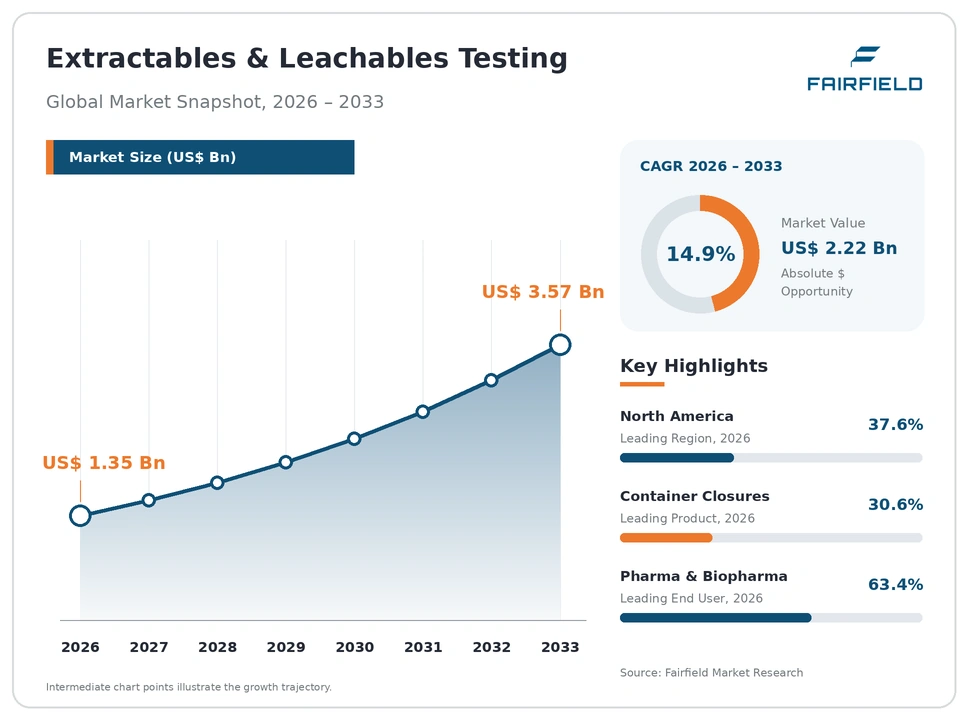
The global extractables and leachables testing market size is expected to be valued at US$ 1.35 billion in 2026 and projected to reach US$ 3.57 billion by 2033, growing at a CAGR of 14.9% between 2026 and 2033.
Between 2020 and 2025, the market grew at a CAGR of about 11.6%, as COVID-19 vaccine production increased the use of single-use systems and prefilled syringes, and regulators asked for more data on chemicals that can move from packaging and equipment into drugs. Three factors now drive growth: new global guidance such as ICH Q3E, the rapid growth of biologics and combination products, and more outsourcing of testing to specialist laboratories. The market is shifting toward risk-based study design, toxicological risk assessment, and testing of manufacturing components as well as container closure systems.
Key Report Takeaways
- By Product Type: Container Closure Systems held 30.6% share in 2026, while Single-use Systems are projected to expand at a 17.6% CAGR through 2033, driven by single-use bioprocessing in biologics and cell and gene therapy production.
- By Application: Orally Inhaled and Nasal Drug Products held 41.2% share in 2026, while Parenteral Drug Products are projected to expand at a 16.8% CAGR through 2033, driven by injectable biologics and prefilled syringes.
- By End User: Pharmaceutical & Biopharmaceutical Companies held 63.4% share in 2026, while Medical Device Manufacturers are projected to expand at a 16.2% CAGR through 2033, driven by stricter device biocompatibility rules.
- By Region: North America held 37.6% share in 2026, while Asia Pacific is projected to expand at a 18.1% CAGR through 2033, driven by biologics manufacturing in China, India, and South Korea.
Global Extractables and Leachables Testing Market Trends and Insights
Drivers Impact Analysis
Two drivers carry the strongest influence on extractables and leachables testing demand during the forecast period.
| Driver | Impact on CAGR Forecast | Geographic Relevance | Impact Timeline |
| New and harmonized regulatory guidance | High | Global | Medium term (2-4 years) |
| Growth of biologics, single-use systems, and combination products | High | North America, Europe, Asia Pacific | Long term (≥4 years) |
New Regulatory Guidance Is Driving the Extractables and Leachables Testing Market
New and harmonized regulatory guidance is the strongest driver of the extractables and leachables testing market. Regulators require drug makers to show that chemicals from packaging, devices, and manufacturing equipment do not harm patients.
The mechanism is clearer and broader testing rules. The International Council for Harmonisation published its draft ICH Q3E guideline on extractables and leachables in 2025, the first global standard covering all dosage forms. The United States Pharmacopeia is expanding its <1664> chapter series, including a draft on oral drug products published in September 2026. National rules, such as new Korean Pharmacopoeia requirements, add further demand. The U.S. Food and Drug Administration and European Medicines Agency expect E&L data in new drug and biosimilar filings. Harmonized rules will make testing a standard requirement for more products worldwide, increasing test volumes.
Biologics and Single-use Systems Are Expanding the Extractables and Leachables Testing Market
The growth of biologics, single-use systems, and combination products is expanding the extractables and leachables testing market. These products are especially sensitive to chemical contamination.
The cause is changing drug formats and manufacturing methods. Biologics such as monoclonal antibodies can be damaged by leachables, which may affect stability and immune responses. Biomanufacturers increasingly use plastic bags, tubing, and filters instead of steel equipment, and each component must be assessed. Prefilled syringes, autoinjectors, and wearable injectors combine drugs with devices, requiring testing of both. GLP-1 drugs for diabetes and obesity, sold in pens, have increased demand for device testing. Cell and gene therapies use complex single-use systems with many plastic parts. Every new product, supplier change, and packaging change triggers new studies, creating recurring demand for laboratories.
Restraints Impact Analysis
Two restraints limit how quickly the extractables and leachables testing market grows.
| Restraint | Impact on CAGR Forecast | Geographic Relevance | Impact Timeline |
| High testing costs and long study timelines | High | Global | Short term (≤2 years) |
| Shortage of skilled analysts and toxicologists | Medium | North America, Europe | Medium term (2-4 years) |
High Costs and Long Timelines Slow the Extractables and Leachables Testing Market
High testing costs and long study timelines slow the extractables and leachables testing market. Full E&L programs are complex and expensive.
The specific causes are advanced analysis and long stability studies. Studies use mass spectrometry, gas chromatography, and inductively coupled plasma techniques to detect trace chemicals, requiring costly instruments. Leachables studies often run alongside product stability programs for months or years. Each study needs expert data interpretation and toxicological risk assessment by qualified scientists. Small biotech and device companies may struggle to afford comprehensive programs, especially before clinical success. Differences between regulatory expectations in various countries can require repeat testing. Regulators may ask for extra data if studies are incomplete, adding delays to approvals. These factors cause some companies to delay studies or limit their scope, especially in early development.
Skill Shortages Restrict the Extractables and Leachables Testing Market
A shortage of skilled analysts and toxicologists restricts the extractables and leachables testing market. E&L work requires specialized knowledge that few people have.
The underlying causes are technical complexity and limited training programs. Identifying unknown chemicals from mass spectrometry data requires experienced analytical chemists, and setting safety limits requires trained toxicologists. Demand for these experts has grown faster than supply, raising salaries and turnover at laboratories. Many universities do not offer specific training in E&L science or analytical toxicology. Laboratory capacity is limited, so lead times can stretch to months during peaks in demand. Inconsistent data interpretation between laboratories can cause regulatory questions. Laboratories are investing in training programs, automation, and software for data analysis to address the gap. These factors restrict how quickly laboratories can expand and serve new clients.
Market Opportunities
Risk-based Testing Under ICH Q3E Opens a Consulting Revenue Pool
Risk-based testing under ICH Q3E opens a consulting revenue pool in the extractables and leachables testing market. Drug makers need help designing studies that meet the new global guideline.
Testing laboratories and consultants can capture this opportunity. ICH Q3E encourages a risk-based approach, combining material knowledge, supplier data, and targeted testing. Companies will need gap assessments of existing products, study design advice, toxicological risk assessment, and regulatory writing. Laboratories that offer integrated services from planning to submission can win larger, multi-product contracts. Shared databases of known extractables and standardized protocols reduce costs and speed studies. Training services and workshops for pharmaceutical quality staff add further revenue for laboratories. Early adopters of the new guideline can build long-term client relationships and become preferred partners for global drug makers.
Medical Devices and Emerging Markets Create a Growth Revenue Pool
Medical devices and emerging markets create a growth revenue pool in the extractables and leachables testing market. Both segments are adding testing needs rapidly.
Laboratories with device expertise and regional presence can capture this opportunity. ISO 10993-18 requires chemical characterization of medical devices, and the European Union Medical Device Regulation has increased testing demand. Combination products and drug delivery devices need both drug and device testing under separate rules. In Asia Pacific, biologics and biosimilar makers in China, India, and South Korea must meet global standards to export. Intertek launched E&L services for new Korean Pharmacopoeia requirements in 2025. Local laboratories with international accreditation can win clients that want faster results. Expanding in high-growth regions supports long-term growth and reduces reliance on mature markets.
Segment Analysis
By Product Type: Container Closure Systems Lead While Single-use Systems Grow Fastest
Container Closure Systems held 30.6% share in 2026. Container closure systems include vials, stoppers, syringes, cartridges, bottles, and seals that hold drugs during storage. Every drug product must be tested for chemicals that can leach from its packaging over its shelf life. Suppliers such as West Pharmaceutical Services provide extractables data for their components.
Single-use Systems are the fastest-growing product type, expanding at a 17.6% CAGR through 2033. Single-use systems such as bioprocess bags, tubing, connectors, and filters are used widely in biologics manufacturing and must be assessed for extractables. Biologics, vaccines, and cell and gene therapies rely heavily on these components. Industry groups such as the BioPhorum Operations Group have published standardized testing protocols. Drug delivery devices and manufacturing equipment form other segments. For the market, single-use growth adds new testing needs.
By Application: Orally Inhaled and Nasal Drug Products Lead While Parenteral Drug Products Grow Fastest
Orally Inhaled and Nasal Drug Products held 41.2% share in 2026. Orally inhaled and nasal drug products, such as inhalers and nasal sprays, deliver drugs directly to sensitive lung and nasal tissues, so regulators set strict leachable limits. Plastic and rubber components in inhalers can release chemicals into the drug. These products have the longest history of E&L testing.
Parenteral Drug Products are the fastest-growing application, expanding at a 16.8% CAGR through 2033. Injectable drugs enter the bloodstream directly, making leachables a serious safety concern. Growth of biologics, prefilled syringes, autoinjectors, and GLP-1 pens drives testing demand. Ophthalmic, oral, and transdermal products form other applications, with new United States Pharmacopeia chapters covering more dosage forms. For the market, parenteral growth adds large test volumes.
By End User: Pharmaceutical & Biopharmaceutical Companies Lead While Medical Device Manufacturers Grow Fastest
Pharmaceutical & Biopharmaceutical Companies held 63.4% share in 2026. Drug makers need E&L data for new drug filings, biosimilars, and packaging changes. Large companies have in-house laboratories but outsource complex or overflow work. Biotech companies outsource almost all testing to specialist laboratories, since building in-house capability is costly. Packaging changes for marketed products also require new studies.
Medical Device Manufacturers are the fastest-growing end user, expanding at a 16.2% CAGR through 2033. Chemical characterization under ISO 10993-18 and stricter rules under the European Union Medical Device Regulation require more testing for implants, catheters, and drug delivery devices. Combination product makers need integrated drug and device testing. Packaging suppliers and contract manufacturers form other end users. For the market, device growth broadens the customer base.
Geography Analysis
Which Region Is Leading the Extractables and Leachables Testing Market?
North America is leading the extractables and leachables testing market with a 37.6% share in 2026. The United States has the largest pharmaceutical and biotech industry and strict U.S. Food and Drug Administration expectations for E&L data. Major laboratories such as Nelson Labs, part of Sotera Health, Eurofins, and Pacific BioLabs serve the region. SGS gained ISO 17025 accreditation for E&L testing at a Canadian laboratory in 2025. Biotech hubs in Massachusetts, California, and North Carolina create steady demand for outsourced studies. Medical device makers also need chemical characterization data for FDA submissions. One change shaping the region is the shift to risk-based testing under new guidance.
Europe Advances the Extractables and Leachables Testing Market Through Strict Rules
Europe is a major extractables and leachables testing market shaped by strict drug and device regulations. Germany, Switzerland, Ireland, the United Kingdom, and France have large pharmaceutical and device industries. SGS, Intertek, and Eurofins have major E&L laboratories in the region. Denmark, Belgium, and Italy have large biologics and inhaler industries. The Medical Device Regulation has increased device testing, and many devices needed new chemical data to keep their approvals. The European Medicines Agency expects E&L data in marketing applications. One opportunity is integrated drug and device testing for combination products such as autoinjectors and prefilled pens.
Which Region Is Growing Fastest in the Extractables and Leachables Testing Market?
Asia Pacific is growing fastest in the extractables and leachables testing market at a 18.1% CAGR through 2033. China has a large biologics industry and laboratories such as WuXi AppTec. India is a major generic drug exporter that must meet U.S. and European standards. South Korea introduced new Korean Pharmacopoeia E&L requirements, and Japan has strict standards. Singapore and Australia have strong regulatory systems and growing biologics production. Biosimilar exports from India and South Korea require full E&L packages that meet U.S. and European expectations. One challenge is limited local expertise in toxicology and unknown compound identification. One opportunity is local accredited laboratories that offer faster turnaround and lower costs than overseas testing.
Latin America Grows the Extractables and Leachables Testing Market Through Regulation
Latin America is a developing extractables and leachables testing market. Brazil’s regulator ANVISA and Mexico’s COFEPRIS are aligning with international standards. Local drug makers in Brazil, Mexico, and Argentina are adding biosimilars and injectable products, which require E&L studies. Multinational companies with plants in the region also need testing for local and export filings. Key barriers include limited local laboratory capacity, high instrument costs, and a shortage of trained analysts. Many companies still send samples to laboratories in North America or Europe, which increases cost and time. One opportunity is regional testing hubs with international accreditation.
Middle East & Africa Builds the Extractables and Leachables Testing Market
Middle East & Africa is an emerging extractables and leachables testing market. Saudi Arabia and the United Arab Emirates are building pharmaceutical and biologics manufacturing under national industrial strategies, and regulators are aligning with international guidance. South Africa and Egypt have generic drug industries that export to other African markets. Israel has a strong medical device sector that needs chemical characterization for exports to the United States and Europe. Growing hospital spending raises demand for injectable drugs. Key barriers include limited specialized laboratories and reliance on overseas testing. One opportunity is outsourced testing through global laboratories with regional offices.
Competitive Landscape
The extractables and leachables testing market is moderately concentrated. Eurofins Scientific, SGS, Intertek, Sotera Health, through Nelson Labs, and WuXi AppTec lead, while West Pharmaceutical Services, Merck KGaA, Pacific BioLabs, Boston Analytical, and Medical Engineering Technologies compete in specific segments.
Companies compete on scientific expertise, regulatory knowledge, turnaround time, accreditation, global reach, data quality, and price. Toxicology support is a key differentiator, since clients want both reliable data and clear safety conclusions. Large laboratory networks offer global capacity, shared expertise, and consistent methods, while smaller specialists compete on expertise in specific products, such as inhalers or single-use systems. Component suppliers such as West Pharmaceutical Services provide extractables data to help customers reduce testing. Investments in high-resolution mass spectrometry and chemical databases help laboratories identify unknown compounds faster and more reliably, which shortens study times and improves regulatory acceptance.
Strategic moves show how competition is changing. In May 2025, SGS gained accreditation for E&L testing in Canada. In 2025, the International Council for Harmonisation released draft ICH Q3E. In October 2025, Intertek launched E&L services for Korean Pharmacopoeia requirements. These moves show competition shifting toward global, regulation-led testing services, as laboratories prepare clients for new harmonized expectations.
Three themes shape vendor strategy. First, companies are expanding laboratory capacity and instruments. Second, they are adding toxicology and regulatory consulting services. Third, they are entering new regions such as Asia Pacific to support growing biologics production.
Extractables and Leachables Testing Market Industry Leaders
- Eurofins Scientific
- SGS
- Intertek
- Sotera Health (Nelson Labs)
- WuXi AppTec
Recent Industry Developments
- September 2026: The United States Pharmacopeia published draft chapter <1664.5> on leachables in oral drug products - extends E&L expectations to tablets, capsules, and oral liquids.
- October 2025: Intertek launched E&L testing services for new Korean Pharmacopoeia requirements - supports drug makers selling in South Korea.
- July 2025: The International Council for Harmonisation released the draft ICH Q3E guideline for public consultation - the first global E&L standard.
- May 2025: SGS received ISO 17025 accreditation for E&L testing at its Canadian pharmaceutical laboratory - expands North American capacity.
Companies Covered in the Report
- Eurofins Scientific
- SGS
- Intertek
- Sotera Health (Nelson Labs)
- WuXi AppTec
- West Pharmaceutical Services
- Merck KGaA
- Pacific BioLabs
- Boston Analytical
- Medical Engineering Technologies
- Element Materials Technology
- Jordi Labs (RQM+)
Extractables and Leachables Testing Market Report Scope
This report covers extractables and leachables testing services for container closure systems, single-use systems, drug delivery devices, and manufacturing components, used for orally inhaled and nasal, parenteral, ophthalmic, oral, and transdermal products by pharmaceutical, biopharmaceutical, and medical device companies. It excludes general stability and microbiology testing. The base year is 2025, and the forecast period runs from 2026 to 2033. All values are expressed in US$ Billion.
Product Type
- Container Closure Systems
- Single-use Systems
- Drug Delivery Devices
- Manufacturing Components
Application
- Orally Inhaled and Nasal Drug Products
- Parenteral Drug Products
- Ophthalmic Drug Products
- Oral & Transdermal Products
End User
- Pharmaceutical & Biopharmaceutical Companies
- Medical Device Manufacturers
- Others
Regions
- North America
- Europe
- Asia Pacific
- Latin America
- Middle East & Africa
Key Questions Answered in the Report
How big is the extractables and leachables testing market in 2026?
The extractables and leachables testing market is valued at US$ 1.35 billion in 2026, led by container closure system testing.
What is the extractables and leachables testing market forecast to 2033?
The market is projected to reach US$ 3.57 billion by 2033, growing at a 14.9% CAGR and adding US$ 2.22 billion.
Which application is growing fastest in E&L testing?
Parenteral Drug Products are growing fastest at a 16.8% CAGR through 2033, driven by injectable biologics and prefilled syringes.
Which region is growing fastest in the extractables and leachables testing market?
Asia Pacific is growing fastest at a 18.1% CAGR through 2033, driven by biologics manufacturing in China and India.
Which region holds the largest extractables and leachables testing market share?
North America holds the largest share at 37.6% in 2026, supported by strict regulatory expectations in the United States.
1. Executive Summary
1.1. Global Extractables and Leachables Testing Market Snapshot
1.2. Future Projections
1.3. Key Report Takeaways
1.4. Regional Snapshot
2. Market Overview
2.1. Market Definition and Report Scope
2.2. Historical Trends 2020–2025
2.3. Market Dynamics
2.3.1. Drivers
2.3.1.1. New Regulatory Guidance Is Driving the Extractables and Leachables Testing Market
2.3.1.2. Biologics and Single-use Systems Are Expanding the Extractables and Leachables Testing Market
2.3.2. Restraints
2.3.2.1. High Costs and Long Timelines Slow the Extractables and Leachables Testing Market
2.3.2.2. Skill Shortages Restrict the Extractables and Leachables Testing Market
2.3.3. Market Opportunities
2.3.3.1. Risk-based Testing Under ICH Q3E Opens a Consulting Revenue Pool
2.3.3.2. Medical Devices and Emerging Markets Create a Growth Revenue Pool
3. Global Extractables and Leachables Testing Market Outlook, 2020-2033
3.1. Global Extractables and Leachables Testing Market Outlook, by Product Type, Value (US$ Billion), 2020-2033
3.1.1. Container Closure Systems
3.1.2. Single-use Systems
3.1.3. Drug Delivery Devices
3.1.4. Manufacturing Components
3.2. Global Extractables and Leachables Testing Market Outlook, by Application, Value (US$ Billion), 2020-2033
3.2.1. Orally Inhaled and Nasal Drug Products
3.2.2. Parenteral Drug Products
3.2.3. Ophthalmic Drug Products
3.2.4. Oral & Transdermal Products
3.3. Global Extractables and Leachables Testing Market Outlook, by End User, Value (US$ Billion), 2020-2033
3.3.1. Pharmaceutical & Biopharmaceutical Companies
3.3.2. Medical Device Manufacturers
3.3.3. Others
3.4. Global Extractables and Leachables Testing Market Outlook, by Region, Value (US$ Billion), 2020-2033
3.4.1. North America
3.4.2. Europe
3.4.3. Asia Pacific
3.4.4. Latin America
3.4.5. Middle East & Africa
4. North America Extractables and Leachables Testing Market Outlook, 2020-2033
4.1. North America Extractables and Leachables Testing Market Outlook, by Product Type, Value (US$ Billion), 2020-2033
4.1.1. Container Closure Systems
4.1.2. Single-use Systems
4.1.3. Drug Delivery Devices
4.1.4. Manufacturing Components
4.2. North America Extractables and Leachables Testing Market Outlook, by Application, Value (US$ Billion), 2020-2033
4.2.1. Orally Inhaled and Nasal Drug Products
4.2.2. Parenteral Drug Products
4.2.3. Ophthalmic Drug Products
4.2.4. Oral & Transdermal Products
4.3. North America Extractables and Leachables Testing Market Outlook, by End User, Value (US$ Billion), 2020-2033
4.3.1. Pharmaceutical & Biopharmaceutical Companies
4.3.2. Medical Device Manufacturers
4.3.3. Others
4.4. North America Extractables and Leachables Testing Market Outlook, by Country, Value (US$ Billion), 2020-2033
4.4.1. United States Extractables and Leachables Testing Market Outlook, by Product Type, 2020-2033
4.4.2. United States Extractables and Leachables Testing Market Outlook, by Application, 2020-2033
4.4.3. United States Extractables and Leachables Testing Market Outlook, by End User, 2020-2033
4.4.4. Canada Extractables and Leachables Testing Market Outlook, by Product Type, 2020-2033
4.4.5. Canada Extractables and Leachables Testing Market Outlook, by Application, 2020-2033
4.4.6. Canada Extractables and Leachables Testing Market Outlook, by End User, 2020-2033
5. Europe Extractables and Leachables Testing Market Outlook, 2020-2033
5.1. Europe Extractables and Leachables Testing Market Outlook, by Product Type, Value (US$ Billion), 2020-2033
5.1.1. Container Closure Systems
5.1.2. Single-use Systems
5.1.3. Drug Delivery Devices
5.1.4. Manufacturing Components
5.2. Europe Extractables and Leachables Testing Market Outlook, by Application, Value (US$ Billion), 2020-2033
5.2.1. Orally Inhaled and Nasal Drug Products
5.2.2. Parenteral Drug Products
5.2.3. Ophthalmic Drug Products
5.2.4. Oral & Transdermal Products
5.3. Europe Extractables and Leachables Testing Market Outlook, by End User, Value (US$ Billion), 2020-2033
5.3.1. Pharmaceutical & Biopharmaceutical Companies
5.3.2. Medical Device Manufacturers
5.3.3. Others
5.4. Europe Extractables and Leachables Testing Market Outlook, by Country, Value (US$ Billion), 2020-2033
5.4.1. Germany Extractables and Leachables Testing Market Outlook, by Product Type, 2020-2033
5.4.2. Germany Extractables and Leachables Testing Market Outlook, by Application, 2020-2033
5.4.3. Germany Extractables and Leachables Testing Market Outlook, by End User, 2020-2033
5.4.4. Switzerland Extractables and Leachables Testing Market Outlook, by Product Type, 2020-2033
5.4.5. Switzerland Extractables and Leachables Testing Market Outlook, by Application, 2020-2033
5.4.6. Switzerland Extractables and Leachables Testing Market Outlook, by End User, 2020-2033
5.4.7. Ireland Extractables and Leachables Testing Market Outlook, by Product Type, 2020-2033
5.4.8. Ireland Extractables and Leachables Testing Market Outlook, by Application, 2020-2033
5.4.9. Ireland Extractables and Leachables Testing Market Outlook, by End User, 2020-2033
5.4.10. United Kingdom Extractables and Leachables Testing Market Outlook, by Product Type, 2020-2033
5.4.11. United Kingdom Extractables and Leachables Testing Market Outlook, by Application, 2020-2033
5.4.12. United Kingdom Extractables and Leachables Testing Market Outlook, by End User, 2020-2033
5.4.13. France Extractables and Leachables Testing Market Outlook, by Product Type, 2020-2033
5.4.14. France Extractables and Leachables Testing Market Outlook, by Application, 2020-2033
5.4.15. France Extractables and Leachables Testing Market Outlook, by End User, 2020-2033
5.4.16. Denmark Extractables and Leachables Testing Market Outlook, by Product Type, 2020-2033
5.4.17. Denmark Extractables and Leachables Testing Market Outlook, by Application, 2020-2033
5.4.18. Denmark Extractables and Leachables Testing Market Outlook, by End User, 2020-2033
5.4.19. Belgium Extractables and Leachables Testing Market Outlook, by Product Type, 2020-2033
5.4.20. Belgium Extractables and Leachables Testing Market Outlook, by Application, 2020-2033
5.4.21. Belgium Extractables and Leachables Testing Market Outlook, by End User, 2020-2033
5.4.22. Italy Extractables and Leachables Testing Market Outlook, by Product Type, 2020-2033
5.4.23. Italy Extractables and Leachables Testing Market Outlook, by Application, 2020-2033
5.4.24. Italy Extractables and Leachables Testing Market Outlook, by End User, 2020-2033
6. Asia Pacific Extractables and Leachables Testing Market Outlook, 2020-2033
6.1. Asia Pacific Extractables and Leachables Testing Market Outlook, by Product Type, Value (US$ Billion), 2020-2033
6.1.1. Container Closure Systems
6.1.2. Single-use Systems
6.1.3. Drug Delivery Devices
6.1.4. Manufacturing Components
6.2. Asia Pacific Extractables and Leachables Testing Market Outlook, by Application, Value (US$ Billion), 2020-2033
6.2.1. Orally Inhaled and Nasal Drug Products
6.2.2. Parenteral Drug Products
6.2.3. Ophthalmic Drug Products
6.2.4. Oral & Transdermal Products
6.3. Asia Pacific Extractables and Leachables Testing Market Outlook, by End User, Value (US$ Billion), 2020-2033
6.3.1. Pharmaceutical & Biopharmaceutical Companies
6.3.2. Medical Device Manufacturers
6.3.3. Others
6.4. Asia Pacific Extractables and Leachables Testing Market Outlook, by Country, Value (US$ Billion), 2020-2033
6.4.1. China Extractables and Leachables Testing Market Outlook, by Product Type, 2020-2033
6.4.2. China Extractables and Leachables Testing Market Outlook, by Application, 2020-2033
6.4.3. China Extractables and Leachables Testing Market Outlook, by End User, 2020-2033
6.4.4. India Extractables and Leachables Testing Market Outlook, by Product Type, 2020-2033
6.4.5. India Extractables and Leachables Testing Market Outlook, by Application, 2020-2033
6.4.6. India Extractables and Leachables Testing Market Outlook, by End User, 2020-2033
6.4.7. South Korea Extractables and Leachables Testing Market Outlook, by Product Type, 2020-2033
6.4.8. South Korea Extractables and Leachables Testing Market Outlook, by Application, 2020-2033
6.4.9. South Korea Extractables and Leachables Testing Market Outlook, by End User, 2020-2033
6.4.10. Japan Extractables and Leachables Testing Market Outlook, by Product Type, 2020-2033
6.4.11. Japan Extractables and Leachables Testing Market Outlook, by Application, 2020-2033
6.4.12. Japan Extractables and Leachables Testing Market Outlook, by End User, 2020-2033
6.4.13. Singapore Extractables and Leachables Testing Market Outlook, by Product Type, 2020-2033
6.4.14. Singapore Extractables and Leachables Testing Market Outlook, by Application, 2020-2033
6.4.15. Singapore Extractables and Leachables Testing Market Outlook, by End User, 2020-2033
6.4.16. Australia Extractables and Leachables Testing Market Outlook, by Product Type, 2020-2033
6.4.17. Australia Extractables and Leachables Testing Market Outlook, by Application, 2020-2033
6.4.18. Australia Extractables and Leachables Testing Market Outlook, by End User, 2020-2033
7. Latin America Extractables and Leachables Testing Market Outlook, 2020-2033
7.1. Latin America Extractables and Leachables Testing Market Outlook, by Product Type, Value (US$ Billion), 2020-2033
7.1.1. Container Closure Systems
7.1.2. Single-use Systems
7.1.3. Drug Delivery Devices
7.1.4. Manufacturing Components
7.2. Latin America Extractables and Leachables Testing Market Outlook, by Application, Value (US$ Billion), 2020-2033
7.2.1. Orally Inhaled and Nasal Drug Products
7.2.2. Parenteral Drug Products
7.2.3. Ophthalmic Drug Products
7.2.4. Oral & Transdermal Products
7.3. Latin America Extractables and Leachables Testing Market Outlook, by End User, Value (US$ Billion), 2020-2033
7.3.1. Pharmaceutical & Biopharmaceutical Companies
7.3.2. Medical Device Manufacturers
7.3.3. Others
7.4. Latin America Extractables and Leachables Testing Market Outlook, by Country, Value (US$ Billion), 2020-2033
7.4.1. Brazil Extractables and Leachables Testing Market Outlook, by Product Type, 2020-2033
7.4.2. Brazil Extractables and Leachables Testing Market Outlook, by Application, 2020-2033
7.4.3. Brazil Extractables and Leachables Testing Market Outlook, by End User, 2020-2033
7.4.4. Mexico Extractables and Leachables Testing Market Outlook, by Product Type, 2020-2033
7.4.5. Mexico Extractables and Leachables Testing Market Outlook, by Application, 2020-2033
7.4.6. Mexico Extractables and Leachables Testing Market Outlook, by End User, 2020-2033
7.4.7. Argentina Extractables and Leachables Testing Market Outlook, by Product Type, 2020-2033
7.4.8. Argentina Extractables and Leachables Testing Market Outlook, by Application, 2020-2033
7.4.9. Argentina Extractables and Leachables Testing Market Outlook, by End User, 2020-2033
8. Middle East & Africa Extractables and Leachables Testing Market Outlook, 2020-2033
8.1. Middle East & Africa Extractables and Leachables Testing Market Outlook, by Product Type, Value (US$ Billion), 2020-2033
8.1.1. Container Closure Systems
8.1.2. Single-use Systems
8.1.3. Drug Delivery Devices
8.1.4. Manufacturing Components
8.2. Middle East & Africa Extractables and Leachables Testing Market Outlook, by Application, Value (US$ Billion), 2020-2033
8.2.1. Orally Inhaled and Nasal Drug Products
8.2.2. Parenteral Drug Products
8.2.3. Ophthalmic Drug Products
8.2.4. Oral & Transdermal Products
8.3. Middle East & Africa Extractables and Leachables Testing Market Outlook, by End User, Value (US$ Billion), 2020-2033
8.3.1. Pharmaceutical & Biopharmaceutical Companies
8.3.2. Medical Device Manufacturers
8.3.3. Others
8.4. Middle East & Africa Extractables and Leachables Testing Market Outlook, by Country, Value (US$ Billion), 2020-2033
8.4.1. Saudi Arabia Extractables and Leachables Testing Market Outlook, by Product Type, 2020-2033
8.4.2. Saudi Arabia Extractables and Leachables Testing Market Outlook, by Application, 2020-2033
8.4.3. Saudi Arabia Extractables and Leachables Testing Market Outlook, by End User, 2020-2033
8.4.4. United Arab Emirates Extractables and Leachables Testing Market Outlook, by Product Type, 2020-2033
8.4.5. United Arab Emirates Extractables and Leachables Testing Market Outlook, by Application, 2020-2033
8.4.6. United Arab Emirates Extractables and Leachables Testing Market Outlook, by End User, 2020-2033
8.4.7. South Africa Extractables and Leachables Testing Market Outlook, by Product Type, 2020-2033
8.4.8. South Africa Extractables and Leachables Testing Market Outlook, by Application, 2020-2033
8.4.9. South Africa Extractables and Leachables Testing Market Outlook, by End User, 2020-2033
8.4.10. Egypt Extractables and Leachables Testing Market Outlook, by Product Type, 2020-2033
8.4.11. Egypt Extractables and Leachables Testing Market Outlook, by Application, 2020-2033
8.4.12. Egypt Extractables and Leachables Testing Market Outlook, by End User, 2020-2033
8.4.13. Israel Extractables and Leachables Testing Market Outlook, by Product Type, 2020-2033
8.4.14. Israel Extractables and Leachables Testing Market Outlook, by Application, 2020-2033
8.4.15. Israel Extractables and Leachables Testing Market Outlook, by End User, 2020-2033
9. Competitive Landscape
9.1. Market Concentration and Industry Leaders
9.2. Competitive Differentiation
9.3. Strategic Moves and Market Direction
9.4. Recent Industry Developments
9.5. Company Profiles
9.5.1. Eurofins Scientific
9.5.2. SGS
9.5.3. Intertek
9.5.4. Sotera Health (Nelson Labs)
9.5.5. WuXi AppTec
9.5.6. West Pharmaceutical Services
9.5.7. Merck KGaA
9.5.8. Pacific BioLabs
9.5.9. Boston Analytical
9.5.10. Medical Engineering Technologies
9.5.11. Element Materials Technology
9.5.12. Jordi Labs (RQM+)
10. Appendix
10.1. Research Methodology
10.2. Report Assumptions
10.3. Acronyms and Abbreviations
| Segment | Categories |
|---|---|
| Product Type | Container Closure Systems, Single-use Systems, Drug Delivery Devices, Manufacturing Components |
| Application | Orally Inhaled and Nasal Drug Products, Parenteral Drug Products, Ophthalmic Drug Products, Oral & Transdermal Products |
| End User | Pharmaceutical & Biopharmaceutical Companies, Medical Device Manufacturers, Others |
| Regions | North America, Europe, Asia Pacific, Latin America, Middle East & Africa |
Our Research Methodology
Considering the volatility of business today, traditional approaches to strategizing a game plan can be unfruitful if not detrimental. True ambiguity is no way to determine a forecast. A myriad of predetermined factors must be accounted for such as the degree of risk involved, the magnitude of circumstances, as well as conditions or consequences that are not known or unpredictable. To circumvent binary views that cast uncertainty, the application of market research intelligence to strategically posture, move, and enable actionable outcomes is necessary.
View Methodology
Quality Assured
Rigorous Validation Process

Confidentiality Assured
End-to-end Data Security

Custom Research Services
Tailored To Your Objectives
FAQs
The extractables and leachables testing market is valued at US$ 1.35 billion in 2026, led by container closure system testing.
The market is projected to reach US$ 3.57 billion by 2033, growing at a 14.9% CAGR and adding US$ 2.22 billion.
Parenteral Drug Products are growing fastest at a 16.8% CAGR through 2033, driven by injectable biologics and prefilled syringes.
Asia Pacific is growing fastest at a 18.1% CAGR through 2033, driven by biologics manufacturing in China and India.
North America holds the largest share at 37.6% in 2026, supported by strict regulatory expectations in the United States.
Related Reports
In Situ Hybridization Market Size, Share, Insights, Competitive Landscape, and Forecast 2026 to 2033
In situ hybridization market to reach US$ 3.34 billion by 2033 at a 7.5% CAGR. Explore techniques, applications and regional trends.
HER2-Targeted Therapy Market Size, Share, Insights, Competitive Landscape, and Forecast 2026 to 2033
HER2-targeted therapy market to reach US$ 18.67 billion by 2033 at a 9.0% CAGR. Explore drug classes, indications and regional trends.
Next-Generation Sequencing Technologies Market Size, Share, Insights, Competitive Landscape, and Forecast 2026 to 2033
NGS technologies market grows from US$13.81Bn in 2026 to US$35.63Bn by 2033 at 14.5% CAGR. Explore trends, segments and leading companies.
Next-generation Sequencing Library Preparation Market Size, Share, Insights, Competitive Landscape, and Forecast 2026 to 2033
NGS library preparation market grows from US$2.18Bn in 2026 to US$5.30Bn by 2033 at 13.5% CAGR. Explore trends, segments and key players.
Next-Generation RNA Therapeutics Market Size, Share, Insights, Competitive Landscape, and Forecast 2026 to 2033
Next-generation RNA therapeutics market to reach US$ 24.37 billion by 2033 at 15.7% CAGR. Explore molecules, delivery platforms and regional insights.
Mammalian Cell Fermentation Technology Market Size, Share, Insights, Competitive Landscape, and Forecast 2026 to 2033
Explore mammalian cell fermentation technology, reaching US$ 47.6 billion by 2033 at 10.4% CAGR, with product, process and regional insights.