



Ocular Hypertension Market
Ocular Hypertension Market Size, Share, Insights, Competitive Landscape, and Forecast 2026 to 2033
Ocular Hypertension Market Analysis, 2026–2033
Ocular Hypertension Market
Ocular Hypertension Market Size, Share, Insights, Competitive Landscape, and Forecast 2026 to 2033
Ocular Hypertension Market Size and Trend Analysis
How Fast Is the Ocular Hypertension Market Growing?
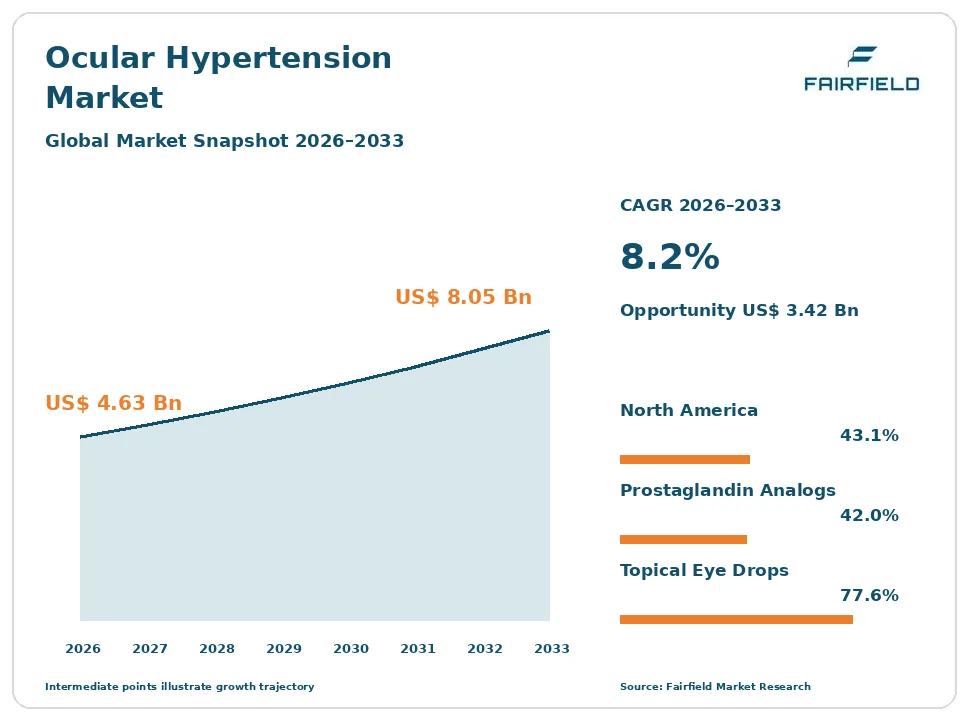
The global ocular hypertension market size is expected to be valued at US$ 4.63 billion in 2026 and projected to reach US$ 8.05 billion by 2033, growing at a CAGR of 8.2% between 2026 and 2033.
Between 2020 and 2025, the market grew at a CAGR of about 5.6%, as eye clinic visits recovered after the pandemic while generic competition held back prices. Three factors now drive growth: an aging population at higher risk of raised intraocular pressure, better screening for glaucoma and ocular hypertension, and the arrival of sustained-release implants that reduce dependence on daily drops. The market is shifting from simple eye drops toward preservative-free formulations, fixed combinations, and drug-delivery implants placed during office or surgical procedures. Prostaglandin analogs remain the first-line treatment, but new mechanisms such as nitric oxide donors and rho kinase inhibitors are expanding options for patients who need more pressure lowering.
Key Report Takeaways
- By Drug Class: Prostaglandin Analogs held 42.0% share in 2026, while Rho Kinase Inhibitors & Novel Agents are projected to expand at an 11.8% CAGR through 2033, driven by new mechanisms that improve outflow and pressure control.
- By Delivery Mode: Topical Eye Drops held 77.6% share in 2026, while Sustained-Release Implants are projected to expand at a 21.5% CAGR through 2033, driven by poor adherence to drops and procedural reimbursement.
- By Distribution Channel: Retail Pharmacies held 42.8% share in 2026, while Online Pharmacies are projected to expand at a 10.9% CAGR through 2033, driven by home delivery and refill convenience for chronic users.
- By Region: North America held 43.1% share in 2026, while Asia Pacific is projected to expand at a 10.0% CAGR through 2033, driven by aging populations and better screening in China, Japan, and India.
Global Ocular Hypertension Market Trends and Insights
Drivers Impact Analysis
Two drivers carry the strongest influence on ocular hypertension demand during the forecast period.
| Driver | Impact on CAGR Forecast | Geographic Relevance | Impact Timeline |
| Aging population and rising glaucoma risk | High | Global | Long term (≥4 years) |
| New drug delivery and novel mechanisms | High | North America, Europe, Asia Pacific | Medium term (2-4 years) |
Aging Populations Are Driving the Ocular Hypertension Market
Aging populations and rising glaucoma risk are the strongest driver of the ocular hypertension market. Elevated intraocular pressure is the main modifiable risk factor for glaucoma, a leading cause of irreversible blindness.
The mechanism is a growing number of older adults who need long-term pressure control. Ocular hypertension affects about 4% to 10% of people over 40, and risk rises with age. The number of people aged 65 and older is growing fast in Japan, China, Europe, and the United States. Glaucoma affects about 80 million people worldwide, and many more have raised pressure without nerve damage. Treating ocular hypertension reduces the chance of progressing to glaucoma by about half, according to major clinical studies. Patients often need daily therapy for decades. Diabetes, myopia, and family history add further risk. These factors create steady, long-term demand.
Drug Delivery Innovation Is Expanding the Ocular Hypertension Market
New drug delivery systems and novel mechanisms are expanding the ocular hypertension market. Many patients struggle with daily eye drops.
The cause is poor adherence and side effects with traditional drops. Studies show up to half of patients do not use drops as prescribed, leading to uncontrolled pressure and vision loss. Sustained-release implants such as Glaukos’s iDose TR and AbbVie’s Durysta release medication inside the eye for months. iDose TR generated about US$ 136 million in 2025, and the Food and Drug Administration allowed repeat administration in 2026. New drugs include Nicox’s NCX 470, a nitric oxide-donating bimatoprost submitted for approval in 2026. Preservative-free formulations reduce eye surface irritation. Laser and minimally invasive procedures also help some patients avoid lifelong drops. These innovations raise treatment value and improve outcomes.
Restraints Impact Analysis
Two restraints limit how quickly the ocular hypertension market grows.
| Restraint | Impact on CAGR Forecast | Geographic Relevance | Impact Timeline |
| Generic competition and price erosion | High | North America, Europe | Short term (≤2 years) |
| Underdiagnosis and poor treatment adherence | Medium | Global | Long term (≥4 years) |
Generic Competition Slows the Ocular Hypertension Market
Generic competition and price erosion slow the ocular hypertension market. Most widely used drugs are now available as low-cost generics.
The specific causes are patent expiries and payer pressure. Latanoprost, timolol, brimonidine, dorzolamide, bimatoprost, and travoprost are all generic, and prices for some fell by more than 80% after generic entry. Gland Pharma won approval in 2025 for a generic version of latanoprostene bunod, which had about US$ 171 million in annual United States sales. Insurers and pharmacy benefit managers favor generics through step therapy, requiring patients to try older drugs first. National health systems in Europe tightly control prices. Many patients stay on cheap generic prostaglandin analogs for years. Generic eye drops from India and China add further price pressure in emerging markets. These factors limit value growth for branded drugs.
Underdiagnosis Restricts the Ocular Hypertension Market
Underdiagnosis and poor adherence restrict the ocular hypertension market. Many people with high eye pressure do not know they have it.
The underlying causes are a lack of symptoms and limited access to eye care. Ocular hypertension causes no pain or vision changes, so people often find out only during routine eye exams. In Asia Pacific, Latin America, and Middle East & Africa, many people never have their eye pressure checked. Rural areas lack ophthalmologists and optometrists. Even after diagnosis, patients forget drops, have trouble instilling them, or stop because of red eyes, stinging, or cost. Some doctors choose to monitor low-risk patients rather than treat. Elderly patients with arthritis or poor eyesight often struggle to place drops correctly. These factors reduce the number of patients on therapy and limit market growth.
Market Opportunities
Sustained-Release Implants Open a Premium Revenue Pool
Sustained-release implants and procedural therapies open a premium revenue pool in the ocular hypertension market. These products shift treatment from daily drops to periodic procedures.
Companies with implant and delivery technologies can capture this opportunity. iDose TR and Durysta deliver drugs for months after a single procedure, and repeat dosing approvals extend their use. Ocular Therapeutix is developing a travoprost intracameral implant. Implants can be combined with cataract surgery or done in the office. Procedure-based reimbursement offers higher revenue per patient than generic drops. Minimally invasive glaucoma surgery devices add related demand. Real-world data on adherence and outcomes will help win broader payer coverage. Training more surgeons to place implants and adding them to cataract surgery workflows can speed adoption. Implants also reduce the burden on caregivers for elderly patients.
Asia Pacific Screening and Access Create a Volume Revenue Pool
Better screening and access in Asia Pacific create a volume revenue pool in the ocular hypertension market. The region has the largest number of people with glaucoma.
Pharmaceutical companies and generic makers can capture this opportunity. China and India have large aging populations and many undiagnosed patients. Japan has high rates of normal-tension glaucoma and an established market led by Santen Pharmaceutical. AI-based retinal and optic nerve screening programs can find at-risk patients in primary care. Nicox completed enrollment of its NCX 470 trial in China. Affordable generic eye drops from India support access across the region. Government eye care programs in China and India aim to reduce preventable blindness. Teleophthalmology links rural patients with specialists, and local partnerships help global firms reach smaller cities.
Segment Analysis
By Drug Class: Prostaglandin Analogs Lead While Rho Kinase Inhibitors & Novel Agents Grow Fastest
Prostaglandin Analogs held 42.0% share in 2026. Prostaglandin analogs such as latanoprost, bimatoprost, travoprost, and tafluprost lower intraocular pressure by increasing fluid outflow and need only one drop a day. They are the first-line treatment worldwide. Branded versions include Xalatan, Lumigan, Travatan Z, and Vyzulta, with many generics. Beta-blockers, alpha agonists, and carbonic anhydrase inhibitors are used as second-line or add-on therapy.
Rho Kinase Inhibitors & Novel Agents are the fastest-growing drug class, expanding at an 11.8% CAGR through 2033. Netarsudil (Rhopressa, Rocklatan) from Alcon improves outflow through the trabecular meshwork. Nitric oxide-donating drugs such as NCX 470 and new prostaglandin derivatives such as sepetaprost offer additional pressure lowering. For the market, novel agents add branded value.
By Delivery Mode: Topical Eye Drops Lead While Sustained-Release Implants Grow Fastest
Topical Eye Drops held 77.6% share in 2026. Eye drops are the standard treatment for ocular hypertension, available as single drugs, fixed combinations, and preservative-free versions. They are low cost, widely available, and familiar to doctors and patients. Preservative-free drops reduce irritation for long-term users. Oral carbonic anhydrase inhibitors serve a small group of patients.
Sustained-Release Implants are the fastest-growing delivery mode, expanding at a 21.5% CAGR through 2033. Implants placed inside the eye release drug steadily for months, removing the need for daily dosing and reducing adherence problems. Glaukos and AbbVie lead this segment, and Ocular Therapeutix is developing new options. Surgeons often place implants during cataract surgery, adding convenience. For the market, implant growth adds high-value procedures.
By Distribution Channel: Retail Pharmacies Lead While Online Pharmacies Grow Fastest
Retail Pharmacies held 42.8% share in 2026. Patients fill monthly prescriptions for eye drops at chain and independent pharmacies, often with insurance coverage. Pharmacists advise on instillation technique and side effects, and many pharmacies offer refill reminders that support adherence. Hospitals and clinics dispense implants and treat patients during eye surgery, and their share grows as procedural therapies expand.
Online Pharmacies are the fastest-growing channel, expanding at a 10.9% CAGR through 2033. Chronic patients use mail-order and online pharmacies for automatic refills and home delivery. Insurers encourage mail-order for maintenance drugs. E-pharmacies are growing fast in India and China. Lower prices and discounts online attract cash-paying patients. For the market, online growth supports adherence and steady refills.
Geography Analysis
Which Region Is Leading the Ocular Hypertension Market?
North America is leading the ocular hypertension market with a 43.1% share in 2026. The United States has a large aging population, regular eye exams, and high use of branded drugs and implants. AbbVie, Alcon, Bausch + Lomb, and Glaukos have strong positions, and iDose TR sales grew rapidly in 2025. Medicare covers many glaucoma treatments and procedures. Canada adds demand through provincial drug plans and private insurance. Generic competition and pharmacy benefit manager policies pressure prices. Optometrists in many states can prescribe glaucoma drugs, widening access. One change shaping the region is wider use of implants.
Europe Advances the Ocular Hypertension Market Through Preservative-Free Drops
Europe is a major ocular hypertension market. Germany, France, the United Kingdom, Italy, and Spain have aging populations and established glaucoma care. Doctors in the region widely prescribe preservative-free drops, and Santen Pharmaceutical, Théa, and Alcon are major suppliers. National health systems control prices tightly and favor generics. Nicox is based in France, and Santen Pharmaceutical runs its European operations from Finland. Poland, Sweden, and the Netherlands add growing demand. Key barriers include strict price controls and slow reimbursement for new therapies. One opportunity is implants for patients with poor adherence.
Which Region Is Growing Fastest in the Ocular Hypertension Market?
Asia Pacific is growing fastest in the ocular hypertension market at a 10.0% CAGR through 2033. China has the world’s largest number of people with glaucoma and is expanding eye screening, hospital capacity, and insurance coverage. Japan has a rapidly aging population and is home to Santen Pharmaceutical and Kowa. India has many undiagnosed patients and a strong generic eye drop industry. South Korea and Australia have advanced eye care and high use of branded drugs. Hospital capacity and insurance coverage are expanding in Indonesia and Vietnam. One opportunity is AI-based screening to find untreated patients.
Latin America Grows the Ocular Hypertension Market Through Expanding Eye Care
Latin America is a growing ocular hypertension market. Brazil and Mexico have aging populations, large private eye clinic networks, and public health programs that cover glaucoma drugs. Argentina, Colombia, Peru, and Chile add demand from both public and private eye care providers. Local generic producers supply low-cost drops, and international firms sell branded combinations in private clinics. Many patients remain undiagnosed, especially in rural areas, and public waiting lists can delay specialist visits. Key barriers include limited access to specialists, high out-of-pocket costs, and currency swings. One opportunity is screening programs in primary care.
Middle East & Africa Builds the Ocular Hypertension Market
Middle East & Africa is an emerging ocular hypertension market. Saudi Arabia and the United Arab Emirates have modern eye hospitals, high diabetes rates, and growing aging populations. People of African descent have higher rates of glaucoma, which often appears earlier and progresses faster, making South Africa, Nigeria, and Ghana important for screening and early treatment. Many patients lack access to eye care and affordable drops, and Egypt and Kenya are expanding public eye health programs with support from international charities. Key barriers include few ophthalmologists, long travel distances, and low awareness. One opportunity is community outreach screening programs.
Competitive Landscape
The ocular hypertension market is moderately concentrated. AbbVie, Alcon, Bausch + Lomb, Santen Pharmaceutical, and Viatris hold large positions in branded and generic eye drops, while Glaukos leads in drug-delivery implants. Nicox, Kowa, Ocular Therapeutix, Qlaris Bio, and Théa develop and sell newer therapies, and generic makers such as Sun Pharma, Gland Pharma, Alembic, and Sandoz compete on price.
Companies compete on efficacy, tolerability, dosing convenience, preservative-free options, delivery technology, and price. Brand owners defend share with new combinations and formulations, while generic firms win volume through low prices. Relationships with ophthalmologists, optometrists, and surgeons shape prescribing, and implant makers invest in training and reimbursement support. Licensing deals help smaller developers reach global markets.
Strategic moves show how competition is changing. In May 2025, Gland Pharma received Food and Drug Administration approval for generic latanoprostene bunod. In August 2025, Nicox reported positive topline results from its Denali Phase 3 trial of NCX 470. In January 2026, the Food and Drug Administration approved a label update allowing repeat administration of iDose TR. In July 2026, Kowa submitted the US new drug application for NCX 470. These moves show competition shifting toward implants and novel mechanisms.
Three themes shape vendor strategy. First, companies are developing longer-acting delivery to fix adherence. Second, they are adding new mechanisms for patients who need extra pressure lowering. Third, they are expanding in Asia Pacific.
Ocular Hypertension Market Industry Leaders
AbbVie Alcon Bausch + Lomb Santen Pharmaceutical Glaukos
Recent Industry Developments
- July 2026: Kowa submitted a new drug application to the Food and Drug Administration for Nicox’s NCX 470 - could add a nitric oxide-donating option by 2027.
- January 2026: The Food and Drug Administration approved a label supplement allowing repeat administration of Glaukos’s iDose TR - extends implant use over time.
- August 2025: Nicox reported positive topline results from the Denali Phase 3 trial of NCX 470 - supports regulatory filings in the United States and China.
- May 2025: Gland Pharma received approval for generic latanoprostene bunod 0.024% with first-to-file exclusivity - increases generic competition for a branded drop.
Companies Covered in the Report
- AbbVie
- Alcon
- Bausch + Lomb
- Santen Pharmaceutical
- Glaukos
- Viatris
- Nicox
- Kowa
- Ocular Therapeutix
- Théa
- Sun Pharmaceutical Industries
- Gland Pharma
Ocular Hypertension Market Report Scope
This report covers drugs and drug-delivery products for ocular hypertension, including prostaglandin analogs, beta-blockers, alpha agonists, carbonic anhydrase inhibitors, rho kinase inhibitors, combinations, and novel agents, delivered as topical eye drops, oral drugs, or sustained-release implants through retail, hospital, and online pharmacies. It excludes glaucoma surgery devices and diagnostic equipment. The base year is 2025, and the forecast period runs from 2026 to 2033. All values are expressed in US$ Billion.
Drug Class
- Prostaglandin Analogs
- Beta-Blockers
- Alpha Agonists
- Carbonic Anhydrase Inhibitors
- Rho Kinase Inhibitors & Novel Agents
- Combination Drugs
Delivery Mode
- Topical Eye Drops
- Sustained-Release Implants
- Oral
Distribution Channel
- Retail Pharmacies
- Hospital & Clinic Pharmacies
- Online Pharmacies
Regions
- North America
- Europe
- Asia Pacific
- Latin America
- Middle East & Africa
Key Questions Answered in the Report
How big is the ocular hypertension market in 2026?
The ocular hypertension market is valued at US$ 4.63 billion in 2026, led by prostaglandin analog eye drops used once daily.
What is the ocular hypertension market forecast to 2033?
The ocular hypertension market is projected to reach US$ 8.05 billion by 2033, growing at an 8.2% CAGR and adding US$ 3.42 billion.
Which delivery mode is growing fastest in the ocular hypertension market?
Sustained-release implants are growing fastest at a 21.5% CAGR through 2033, driven by poor drop adherence and procedure reimbursement.
Which region is growing fastest in the ocular hypertension market?
Asia Pacific is growing fastest at a 10.0% CAGR through 2033, driven by aging populations and better screening in China and Japan.
Which region holds the largest ocular hypertension market share?
North America holds the largest share at 43.1% in 2026, supported by an aging population, regular eye exams, and implant use.
1. Executive Summary
1.1. Global Ocular Hypertension Market Snapshot
1.2. Future Projections
1.3. Key Report Takeaways
1.4. Regional Snapshot
2. Market Overview
2.1. Market Definition and Report Scope
2.2. Historical Trends 2020–2025
2.3. Market Dynamics
2.3.1. Drivers
2.3.1.1. Aging Populations Are Driving the Ocular Hypertension Market
2.3.1.2. Drug Delivery Innovation Is Expanding the Ocular Hypertension Market
2.3.2. Restraints
2.3.2.1. Generic Competition Slows the Ocular Hypertension Market
2.3.2.2. Underdiagnosis Restricts the Ocular Hypertension Market
2.3.3. Market Opportunities
2.3.3.1. Sustained-Release Implants Open a Premium Revenue Pool
2.3.3.2. Asia Pacific Screening and Access Create a Volume Revenue Pool
3. Global Ocular Hypertension Market Outlook, 2020-2033
3.1. Global Ocular Hypertension Market Outlook, by Drug Class, Value (US$ Billion), 2020-2033
3.1.1. Prostaglandin Analogs
3.1.2. Beta-Blockers
3.1.3. Alpha Agonists
3.1.4. Carbonic Anhydrase Inhibitors
3.1.5. Rho Kinase Inhibitors & Novel Agents
3.1.6. Combination Drugs
3.2. Global Ocular Hypertension Market Outlook, by Delivery Mode, Value (US$ Billion), 2020-2033
3.2.1. Topical Eye Drops
3.2.2. Sustained-Release Implants
3.2.3. Oral
3.3. Global Ocular Hypertension Market Outlook, by Distribution Channel, Value (US$ Billion), 2020-2033
3.3.1. Retail Pharmacies
3.3.2. Hospital & Clinic Pharmacies
3.3.3. Online Pharmacies
3.4. Global Ocular Hypertension Market Outlook, by Region, Value (US$ Billion), 2020-2033
3.4.1. North America
3.4.2. Europe
3.4.3. Asia Pacific
3.4.4. Latin America
3.4.5. Middle East & Africa
4. North America Ocular Hypertension Market Outlook, 2020-2033
4.1. North America Ocular Hypertension Market Outlook, by Drug Class, Value (US$ Billion), 2020-2033
4.1.1. Prostaglandin Analogs
4.1.2. Beta-Blockers
4.1.3. Alpha Agonists
4.1.4. Carbonic Anhydrase Inhibitors
4.1.5. Rho Kinase Inhibitors & Novel Agents
4.1.6. Combination Drugs
4.2. North America Ocular Hypertension Market Outlook, by Delivery Mode, Value (US$ Billion), 2020-2033
4.2.1. Topical Eye Drops
4.2.2. Sustained-Release Implants
4.2.3. Oral
4.3. North America Ocular Hypertension Market Outlook, by Distribution Channel, Value (US$ Billion), 2020-2033
4.3.1. Retail Pharmacies
4.3.2. Hospital & Clinic Pharmacies
4.3.3. Online Pharmacies
4.4. North America Ocular Hypertension Market Outlook, by Country, Value (US$ Billion), 2020-2033
4.4.1. United States Ocular Hypertension Market Outlook, by Drug Class, 2020-2033
4.4.2. United States Ocular Hypertension Market Outlook, by Delivery Mode, 2020-2033
4.4.3. United States Ocular Hypertension Market Outlook, by Distribution Channel, 2020-2033
4.4.4. Canada Ocular Hypertension Market Outlook, by Drug Class, 2020-2033
4.4.5. Canada Ocular Hypertension Market Outlook, by Delivery Mode, 2020-2033
4.4.6. Canada Ocular Hypertension Market Outlook, by Distribution Channel, 2020-2033
5. Europe Ocular Hypertension Market Outlook, 2020-2033
5.1. Europe Ocular Hypertension Market Outlook, by Drug Class, Value (US$ Billion), 2020-2033
5.1.1. Prostaglandin Analogs
5.1.2. Beta-Blockers
5.1.3. Alpha Agonists
5.1.4. Carbonic Anhydrase Inhibitors
5.1.5. Rho Kinase Inhibitors & Novel Agents
5.1.6. Combination Drugs
5.2. Europe Ocular Hypertension Market Outlook, by Delivery Mode, Value (US$ Billion), 2020-2033
5.2.1. Topical Eye Drops
5.2.2. Sustained-Release Implants
5.2.3. Oral
5.3. Europe Ocular Hypertension Market Outlook, by Distribution Channel, Value (US$ Billion), 2020-2033
5.3.1. Retail Pharmacies
5.3.2. Hospital & Clinic Pharmacies
5.3.3. Online Pharmacies
5.4. Europe Ocular Hypertension Market Outlook, by Country, Value (US$ Billion), 2020-2033
5.4.1. Germany Ocular Hypertension Market Outlook, by Drug Class, 2020-2033
5.4.2. Germany Ocular Hypertension Market Outlook, by Delivery Mode, 2020-2033
5.4.3. Germany Ocular Hypertension Market Outlook, by Distribution Channel, 2020-2033
5.4.4. France Ocular Hypertension Market Outlook, by Drug Class, 2020-2033
5.4.5. France Ocular Hypertension Market Outlook, by Delivery Mode, 2020-2033
5.4.6. France Ocular Hypertension Market Outlook, by Distribution Channel, 2020-2033
5.4.7. United Kingdom Ocular Hypertension Market Outlook, by Drug Class, 2020-2033
5.4.8. United Kingdom Ocular Hypertension Market Outlook, by Delivery Mode, 2020-2033
5.4.9. United Kingdom Ocular Hypertension Market Outlook, by Distribution Channel, 2020-2033
5.4.10. Italy Ocular Hypertension Market Outlook, by Drug Class, 2020-2033
5.4.11. Italy Ocular Hypertension Market Outlook, by Delivery Mode, 2020-2033
5.4.12. Italy Ocular Hypertension Market Outlook, by Distribution Channel, 2020-2033
5.4.13. Spain Ocular Hypertension Market Outlook, by Drug Class, 2020-2033
5.4.14. Spain Ocular Hypertension Market Outlook, by Delivery Mode, 2020-2033
5.4.15. Spain Ocular Hypertension Market Outlook, by Distribution Channel, 2020-2033
5.4.16. Finland Ocular Hypertension Market Outlook, by Drug Class, 2020-2033
5.4.17. Finland Ocular Hypertension Market Outlook, by Delivery Mode, 2020-2033
5.4.18. Finland Ocular Hypertension Market Outlook, by Distribution Channel, 2020-2033
5.4.19. Poland Ocular Hypertension Market Outlook, by Drug Class, 2020-2033
5.4.20. Poland Ocular Hypertension Market Outlook, by Delivery Mode, 2020-2033
5.4.21. Poland Ocular Hypertension Market Outlook, by Distribution Channel, 2020-2033
5.4.22. Sweden Ocular Hypertension Market Outlook, by Drug Class, 2020-2033
5.4.23. Sweden Ocular Hypertension Market Outlook, by Delivery Mode, 2020-2033
5.4.24. Sweden Ocular Hypertension Market Outlook, by Distribution Channel, 2020-2033
5.4.25. Netherlands Ocular Hypertension Market Outlook, by Drug Class, 2020-2033
5.4.26. Netherlands Ocular Hypertension Market Outlook, by Delivery Mode, 2020-2033
5.4.27. Netherlands Ocular Hypertension Market Outlook, by Distribution Channel, 2020-2033
6. Asia Pacific Ocular Hypertension Market Outlook, 2020-2033
6.1. Asia Pacific Ocular Hypertension Market Outlook, by Drug Class, Value (US$ Billion), 2020-2033
6.1.1. Prostaglandin Analogs
6.1.2. Beta-Blockers
6.1.3. Alpha Agonists
6.1.4. Carbonic Anhydrase Inhibitors
6.1.5. Rho Kinase Inhibitors & Novel Agents
6.1.6. Combination Drugs
6.2. Asia Pacific Ocular Hypertension Market Outlook, by Delivery Mode, Value (US$ Billion), 2020-2033
6.2.1. Topical Eye Drops
6.2.2. Sustained-Release Implants
6.2.3. Oral
6.3. Asia Pacific Ocular Hypertension Market Outlook, by Distribution Channel, Value (US$ Billion), 2020-2033
6.3.1. Retail Pharmacies
6.3.2. Hospital & Clinic Pharmacies
6.3.3. Online Pharmacies
6.4. Asia Pacific Ocular Hypertension Market Outlook, by Country, Value (US$ Billion), 2020-2033
6.4.1. China Ocular Hypertension Market Outlook, by Drug Class, 2020-2033
6.4.2. China Ocular Hypertension Market Outlook, by Delivery Mode, 2020-2033
6.4.3. China Ocular Hypertension Market Outlook, by Distribution Channel, 2020-2033
6.4.4. Japan Ocular Hypertension Market Outlook, by Drug Class, 2020-2033
6.4.5. Japan Ocular Hypertension Market Outlook, by Delivery Mode, 2020-2033
6.4.6. Japan Ocular Hypertension Market Outlook, by Distribution Channel, 2020-2033
6.4.7. India Ocular Hypertension Market Outlook, by Drug Class, 2020-2033
6.4.8. India Ocular Hypertension Market Outlook, by Delivery Mode, 2020-2033
6.4.9. India Ocular Hypertension Market Outlook, by Distribution Channel, 2020-2033
6.4.10. South Korea Ocular Hypertension Market Outlook, by Drug Class, 2020-2033
6.4.11. South Korea Ocular Hypertension Market Outlook, by Delivery Mode, 2020-2033
6.4.12. South Korea Ocular Hypertension Market Outlook, by Distribution Channel, 2020-2033
6.4.13. Australia Ocular Hypertension Market Outlook, by Drug Class, 2020-2033
6.4.14. Australia Ocular Hypertension Market Outlook, by Delivery Mode, 2020-2033
6.4.15. Australia Ocular Hypertension Market Outlook, by Distribution Channel, 2020-2033
6.4.16. Indonesia Ocular Hypertension Market Outlook, by Drug Class, 2020-2033
6.4.17. Indonesia Ocular Hypertension Market Outlook, by Delivery Mode, 2020-2033
6.4.18. Indonesia Ocular Hypertension Market Outlook, by Distribution Channel, 2020-2033
6.4.19. Vietnam Ocular Hypertension Market Outlook, by Drug Class, 2020-2033
6.4.20. Vietnam Ocular Hypertension Market Outlook, by Delivery Mode, 2020-2033
6.4.21. Vietnam Ocular Hypertension Market Outlook, by Distribution Channel, 2020-2033
7. Latin America Ocular Hypertension Market Outlook, 2020-2033
7.1. Latin America Ocular Hypertension Market Outlook, by Drug Class, Value (US$ Billion), 2020-2033
7.1.1. Prostaglandin Analogs
7.1.2. Beta-Blockers
7.1.3. Alpha Agonists
7.1.4. Carbonic Anhydrase Inhibitors
7.1.5. Rho Kinase Inhibitors & Novel Agents
7.1.6. Combination Drugs
7.2. Latin America Ocular Hypertension Market Outlook, by Delivery Mode, Value (US$ Billion), 2020-2033
7.2.1. Topical Eye Drops
7.2.2. Sustained-Release Implants
7.2.3. Oral
7.3. Latin America Ocular Hypertension Market Outlook, by Distribution Channel, Value (US$ Billion), 2020-2033
7.3.1. Retail Pharmacies
7.3.2. Hospital & Clinic Pharmacies
7.3.3. Online Pharmacies
7.4. Latin America Ocular Hypertension Market Outlook, by Country, Value (US$ Billion), 2020-2033
7.4.1. Brazil Ocular Hypertension Market Outlook, by Drug Class, 2020-2033
7.4.2. Brazil Ocular Hypertension Market Outlook, by Delivery Mode, 2020-2033
7.4.3. Brazil Ocular Hypertension Market Outlook, by Distribution Channel, 2020-2033
7.4.4. Mexico Ocular Hypertension Market Outlook, by Drug Class, 2020-2033
7.4.5. Mexico Ocular Hypertension Market Outlook, by Delivery Mode, 2020-2033
7.4.6. Mexico Ocular Hypertension Market Outlook, by Distribution Channel, 2020-2033
7.4.7. Argentina Ocular Hypertension Market Outlook, by Drug Class, 2020-2033
7.4.8. Argentina Ocular Hypertension Market Outlook, by Delivery Mode, 2020-2033
7.4.9. Argentina Ocular Hypertension Market Outlook, by Distribution Channel, 2020-2033
7.4.10. Colombia Ocular Hypertension Market Outlook, by Drug Class, 2020-2033
7.4.11. Colombia Ocular Hypertension Market Outlook, by Delivery Mode, 2020-2033
7.4.12. Colombia Ocular Hypertension Market Outlook, by Distribution Channel, 2020-2033
7.4.13. Peru Ocular Hypertension Market Outlook, by Drug Class, 2020-2033
7.4.14. Peru Ocular Hypertension Market Outlook, by Delivery Mode, 2020-2033
7.4.15. Peru Ocular Hypertension Market Outlook, by Distribution Channel, 2020-2033
7.4.16. Chile Ocular Hypertension Market Outlook, by Drug Class, 2020-2033
7.4.17. Chile Ocular Hypertension Market Outlook, by Delivery Mode, 2020-2033
7.4.18. Chile Ocular Hypertension Market Outlook, by Distribution Channel, 2020-2033
8. Middle East & Africa Ocular Hypertension Market Outlook, 2020-2033
8.1. Middle East & Africa Ocular Hypertension Market Outlook, by Drug Class, Value (US$ Billion), 2020-2033
8.1.1. Prostaglandin Analogs
8.1.2. Beta-Blockers
8.1.3. Alpha Agonists
8.1.4. Carbonic Anhydrase Inhibitors
8.1.5. Rho Kinase Inhibitors & Novel Agents
8.1.6. Combination Drugs
8.2. Middle East & Africa Ocular Hypertension Market Outlook, by Delivery Mode, Value (US$ Billion), 2020-2033
8.2.1. Topical Eye Drops
8.2.2. Sustained-Release Implants
8.2.3. Oral
8.3. Middle East & Africa Ocular Hypertension Market Outlook, by Distribution Channel, Value (US$ Billion), 2020-2033
8.3.1. Retail Pharmacies
8.3.2. Hospital & Clinic Pharmacies
8.3.3. Online Pharmacies
8.4. Middle East & Africa Ocular Hypertension Market Outlook, by Country, Value (US$ Billion), 2020-2033
8.4.1. Saudi Arabia Ocular Hypertension Market Outlook, by Drug Class, 2020-2033
8.4.2. Saudi Arabia Ocular Hypertension Market Outlook, by Delivery Mode, 2020-2033
8.4.3. Saudi Arabia Ocular Hypertension Market Outlook, by Distribution Channel, 2020-2033
8.4.4. United Arab Emirates Ocular Hypertension Market Outlook, by Drug Class, 2020-2033
8.4.5. United Arab Emirates Ocular Hypertension Market Outlook, by Delivery Mode, 2020-2033
8.4.6. United Arab Emirates Ocular Hypertension Market Outlook, by Distribution Channel, 2020-2033
8.4.7. South Africa Ocular Hypertension Market Outlook, by Drug Class, 2020-2033
8.4.8. South Africa Ocular Hypertension Market Outlook, by Delivery Mode, 2020-2033
8.4.9. South Africa Ocular Hypertension Market Outlook, by Distribution Channel, 2020-2033
8.4.10. Nigeria Ocular Hypertension Market Outlook, by Drug Class, 2020-2033
8.4.11. Nigeria Ocular Hypertension Market Outlook, by Delivery Mode, 2020-2033
8.4.12. Nigeria Ocular Hypertension Market Outlook, by Distribution Channel, 2020-2033
8.4.13. Ghana Ocular Hypertension Market Outlook, by Drug Class, 2020-2033
8.4.14. Ghana Ocular Hypertension Market Outlook, by Delivery Mode, 2020-2033
8.4.15. Ghana Ocular Hypertension Market Outlook, by Distribution Channel, 2020-2033
8.4.16. Egypt Ocular Hypertension Market Outlook, by Drug Class, 2020-2033
8.4.17. Egypt Ocular Hypertension Market Outlook, by Delivery Mode, 2020-2033
8.4.18. Egypt Ocular Hypertension Market Outlook, by Distribution Channel, 2020-2033
8.4.19. Kenya Ocular Hypertension Market Outlook, by Drug Class, 2020-2033
8.4.20. Kenya Ocular Hypertension Market Outlook, by Delivery Mode, 2020-2033
8.4.21. Kenya Ocular Hypertension Market Outlook, by Distribution Channel, 2020-2033
9. Competitive Landscape
9.1. Market Concentration and Industry Leaders
9.2. Competitive Differentiation
9.3. Strategic Moves and Market Direction
9.4. Recent Industry Developments
9.5. Company Profiles
9.5.1. AbbVie
9.5.2. Alcon
9.5.3. Bausch + Lomb
9.5.4. Santen Pharmaceutical
9.5.5. Glaukos
9.5.6. Viatris
9.5.7. Nicox
9.5.8. Kowa
9.5.9. Ocular Therapeutix
9.5.10. Théa
9.5.11. Sun Pharmaceutical Industries
9.5.12. Gland Pharma
10. Appendix
10.1. Research Methodology
10.2. Report Assumptions
10.3. Acronyms and Abbreviations
| Drug Class | Prostaglandin Analogs, Beta-Blockers, Alpha Agonists, Carbonic Anhydrase Inhibitors, Rho Kinase Inhibitors & Novel Agents, Combination Drugs |
| Delivery Mode | Topical Eye Drops, Sustained-Release Implants, Oral |
| Distribution Channel | Retail Pharmacies, Hospital & Clinic Pharmacies, Online Pharmacies |
| Regions | North America, Europe, Asia Pacific, Latin America, Middle East & Africa |
Our Research Methodology
Considering the volatility of business today, traditional approaches to strategizing a game plan can be unfruitful if not detrimental. True ambiguity is no way to determine a forecast. A myriad of predetermined factors must be accounted for such as the degree of risk involved, the magnitude of circumstances, as well as conditions or consequences that are not known or unpredictable. To circumvent binary views that cast uncertainty, the application of market research intelligence to strategically posture, move, and enable actionable outcomes is necessary.
View Methodology
Quality Assured
Rigorous Validation Process

Confidentiality Assured
End-to-end Data Security

Custom Research Services
Tailored To Your Objectives
FAQs
The ocular hypertension market is valued at US$ 4.63 billion in 2026, led by prostaglandin analog eye drops used once daily.
The ocular hypertension market is projected to reach US$ 8.05 billion by 2033, growing at an 8.2% CAGR and adding US$ 3.42 billion.
Sustained-release implants are growing fastest at a 21.5% CAGR through 2033, driven by poor drop adherence and procedure reimbursement.
Asia Pacific is growing fastest at a 10.0% CAGR through 2033, driven by aging populations and better screening in China and Japan.
North America holds the largest share at 43.1% in 2026, supported by an aging population, regular eye exams, and implant use.
Related Reports
Obesity GLP-1 Market Size, Share, Insights, Competitive Landscape, and Forecast 2026 to 2033
Obesity GLP-1 market to reach US$ 65.20 billion by 2033 at a 13.1% CAGR. Explore drugs, administration routes, pharmacy channels and regional trends.
Upstream Bioprocessing Market Size, Share, Insights, Competitive Landscape, and Forecast 2026 to 2033
Upstream bioprocessing market to reach US$ 92.23 billion by 2033 at a 14.3% CAGR. Explore products, use types, manufacturing modes and regional trends.
Personalized Cancer Vaccine Market Size, Share, Insights, Competitive Landscape, and Forecast 2026 to 2033
Personalized cancer vaccine market to reach US$ 16.57 billion by 2033 at an 18.7% CAGR. Explore vaccine types, cancer types and regional trends.
PEGylated Proteins Market Size, Share, Insights, Competitive Landscape, and Forecast 2026 to 2033
PEGylated proteins market to reach US$ 4.58 billion by 2033 at a 10.9% CAGR. Explore products, protein types, applications and regional trends.
Oligonucleotide Synthesis Market Size, Share, Insights, Competitive Landscape, and Forecast 2026 to 2033
Oligonucleotide synthesis market to reach US$ 10.90 billion by 2033 at a 15.0% CAGR. Explore products, applications and regional trends.
In Situ Hybridization Market Size, Share, Insights, Competitive Landscape, and Forecast 2026 to 2033
In situ hybridization market to reach US$ 3.34 billion by 2033 at a 7.5% CAGR. Explore techniques, applications and regional trends.