



Retail Pharmacy Market
Retail Pharmacy Market Insights, Competitive Landscape, and Market Forecast - 2033
The Retail Pharmacy Market is valued at USD 686.8 Bn in 2026 and is projected to reach USD 1128.2 Bn, growing at a CAGR of 7% by 2033.
Quick Report Digest
A Look Back and a Look Forward - Comparative Analysis
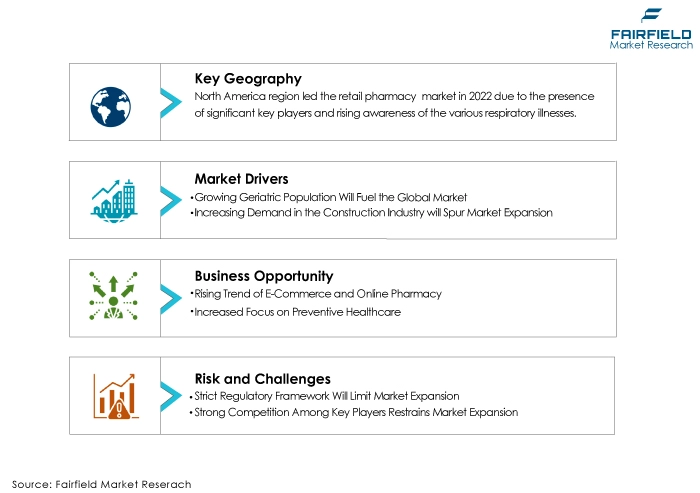
The drivers that will expand the pharmacy retail industry includes the growing number of people with diseases, rising healthcare costs, evolving illness profiles, creative marketing tactics, an increase in the construction of wellness centres and hospital pharmacies, and rising government support.
Throughout the historical period of 2019-2024, the market had staggered growth. The main factors that influenced the retail pharmacy market are the aging population, and the rising number of prescriptions. Moreover, the retail pharmaceutical market was significantly impacted by the COVID-19 pandemic. The crucial services that pharmacies offered during the crisis, such as COVID-19 testing and immunisation, were crucial in the response. Thus, this influenced the market growth.
In the future years, rising e-commerce site demand will present profitable chances for the pharmacy retail market. Furthermore, a lucrative opportunity for pharmacy retail outlets to meet the rising demand for speciality medications is also provided by the rising prevalence of certain disorders and the development of specialist drugs.
Key Growth Determinants
- Growing Geriatric Population
The retail pharmacy sector is significantly influenced by the aging population, which has a wide-ranging effect. Older people frequently need more medication since they are more likely to have chronic illnesses such diabetes, hypertension, arthritis, and heart disease. An ongoing need for prescription medications results from this increased medication use.
Additionally, because retail pharmacies are frequently conveniently positioned in communities, older folks can receive their drugs with less hassle and without having to drive far. Seniors who may have mobility challenges may benefit greatly from this accessibility.
Furthermore, the cost of their prescription drugs is frequently covered by health insurance policies, such as Medicare. To provide seniors affordable options, retail pharmacies closely coordinate with various insurance plans.
- The Chronic Disease Epidemic
Due to its enormous effects on the demand for medicines, healthcare products, and services, the chronic disease epidemic is a significant market driver in the retail pharmacy sector. Continual prescription medication management is necessary for the treatment of chronic disorders such diabetes, hypertension, heart disease, and respiratory ailments.
Increased demand for prescription medications owing to these illnesses' rising prevalence is propelling retail pharmacies' sales. Additionally, to manage symptoms and prevent complications, many chronic diseases necessitate strict adherence to prescription regimens. Retail pharmacies are essential for informing patients about their prescriptions, coordinating prescriptions, and providing reminders to improve adherence.
- Rising Healthcare Costs
The retail pharmacy sector is significantly influenced by rising healthcare costs. Increasing healthcare spending frequently results in greater use of medical services, including prescription drugs. Patients may be more likely to seek medical attention, which would increase the number of prescriptions written and the sales of over-the-counter (OTC) drugs.
Retail pharmacies directly benefit from the rising demand for prescription drugs. Additionally, pharmacists predict increasing income as healthcare spending rises, particularly from the sale of prescription drugs. Prescription filling accounts for a large amount of retail pharmacies' revenue, and rising healthcare costs support their financial stability and expansion.
Moreover, the management of prescription drug benefits for health insurance plans is increasingly influenced by PBMs as healthcare spending rises. They bargain medicine pricing with pharmacies and pharmaceutical firms, which impacts the success and efficiency of retail pharmacies.
Major Growth Barriers
- Strict Regulatory Framework
Health authorities and licensing agencies impose strict restrictions and compliance requirements on the pharmacy retail business, creating a challenging regulatory environment. Market participants may face difficulties adhering to these requirements due to increased expenses, drawn-out procedures, and potential legal and reputational risks.
- Strong Competition
The pharmacy retail sector is very competitive, with many local and international competitors. Competing with existing pharmacy chains, internet merchants, and other healthcare providers can be a challenge to newcomers or smaller participants in the industry. In this competitive environment, differentiating themselves, sustaining client loyalty, and assuring competitive pricing are essential problems.
Key Trends and Opportunities to Look at
The retail pharmacy sector has a lot of prospects due to the rising popularity of e-commerce and online pharmacies. Online drug and health store shopping is becoming more and more popular with consumers, creating new development and expansion opportunities.
- Growing Advancement in Technology
- Increased Focus on Preventive Healthcare
Rapid technological improvements present prospects for streamlining pharmacy operations and improving patient care, such as electronic health records, automated dispensing systems, and tele-pharmacy services. Adopting these technology advancements can boost productivity, consumer satisfaction, and market expansion in general.
The demand for over-the-counter goods, vitamins, supplements, and health monitoring gadgets is boosted by consumers' increasing emphasis on wellness and preventive healthcare. Taking advantage of the growing consumer interest in self-care and preventative health measures, retail pharmacies play a crucial role in the provision of these wellness items.
How Does the Regulatory Scenario Shape this Industry?
The retail pharmacy market is significantly impacted by the regulatory environment. The market's functioning is influenced by rules established by governmental organisations and healthcare authorities, which shape the market's structure, services, and level of competition. Regulatory agencies set licensing and accreditation requirements on retail pharmacies. These criteria make sure that pharmacies adhere to strict standards for people, infrastructure, and security.
Furthermore, regulatory organisations frequently have a say in how much drugs cost and how much insurance will pay out. Retail pharmacies must comply with these rules to make sure they are paid fairly for their services and follow set pricing policies. Additionally, health information about patients must adhere to strong privacy and security laws, such as those set forth by HIPAA in the US. Retail pharmacies managing patient data must adhere to these rules.
Fairfield’s Ranking Board
Top Segments
In 2022, the generic medications category dominated the market, and it is predicted to grow significantly over the course of the forecast period. Generic medications cost less and provide the same active ingredients as their brand-name counterparts. Generic medications are gaining popularity in the retail pharmacy industry due to their accessibility, which raises their availability and utilisation and, eventually, lowers the cost to customers.
Furthermore, the OTC medications category is expected to expand significantly. These medicines can be acquired OTC and do not require a prescription. OTC products are becoming more and more popular in the retail pharmacy industry because of their accessibility and convenience. Retail pharmacies are expanding their offering of OTC medications to accommodate the growing customer demand for OTC treatments for self-care and minor ailments.
- Drug Retail Category Continues to Dominate over Health Products
- Healthcare Facilities Remain the Key End Use Area
- Physical Stores Maintain the Lead Despite Online’s Surge
The drug retail segment dominated the market in 2022. Drug retail includes the direct distribution and sale of both prescription and OTC medications to consumers. When purchasing necessary medications and medical treatments from traditional brick-and-mortar pharmacies or internet stores, people may use this application category as their primary method.
The health products retail category is expected to grow significantly over the forecast period. Among the health and wellness products sold by health products shops include vitamins, supplements, personal care items, and medical equipment. This application category caters to the self-care and preventive healthcare solutions that customers are increasingly looking for.
In 2022, the market was dominated by healthcare facilities. Retail pharmacies are a part of this market segment where healthcare facilities including hospitals, clinics, and nursing homes can acquire supplies and medications for patients. The need for healthcare facilities is a significant source of income for the retail pharmacy industry and it ensures effective patient care.
Over the forecast period, a large increase in the category of consumer/patients is anticipated. This end-use group includes individuals who buy prescription drugs from retail pharmacies for their own use. They are primarily responsible for driving demand for prescription and over-the-counter medications, healthcare products, and medical equipment.
The offline category held most of the market share. Offline retail pharmacies offer physical premises where customers can purchase medications and medical supplies. The retail pharmacy industry trend indicates that if conventional brick-and-mortar pharmacies are to compete with the rising popularity of online pharmacies and evolving consumer preferences for digital convenience, they will need to innovate and adapt.
During the forecasted years, the online category is projected to grow at the fastest rate. Online retail pharmacies give customers the convenience of ordering prescription medications and medical supplies online. The old offline brick-and-mortar pharmacy model is being challenged by the quickly growing online pharmacy industry, thanks to tech-savvy customers seeking convenience, lower pricing, and a greater selection of items.
Regional Frontrunners
North America Boasts the Largest Retail Pharmacy Market
The market is dominated by North America because of the presence of significant key players, growing public awareness of respiratory conditions like asthma and chronic obstructive pulmonary disease, and a paradigm shift among consumers toward organised players that will offer high-quality medications in this field.
As a result of technological improvements and the demand for practical and easily available healthcare solutions, North America is also seeing a growing trend in tele-pharmacy and remote healthcare services. Retail pharmacies in this area are utilising digital platforms to provide teleconsultations, drug delivery, and prescription services, improving client convenience and safety.
Asia Pacific Develops a Highly Lucrative Market
Asia Pacific is expected to grow in the retail pharmacy market over the projected period because of increased research and development activities, rising healthcare spending, and expanding government support. Additionally, the Asia Pacific region has a long history of using traditional medicine, which includes herbal cures, and exclusive Chinese drugs.
As more people look for alternative and holistic healthcare options, retail pharmacies in this region are seeing a rise in demand for conventional healthcare products. Furthermore, pharmacies are placed carefully in these areas to close the healthcare gap and improve healthcare equity in the area.
Fairfield’s Competitive Landscape Analysis
The retail pharmacy business is very competitive, with firms fighting not only for the lowest prices but also for the best service, convenience, and patient care. Businesses must adjust to shifting consumer demands and developing technologies as the sector changes to remain competitive and address the healthcare requirements of their communities. Additionally, some pharmacy chains are vertically integrated, owning or working in conjunction with healthcare providers, insurers, or other healthcare organisations to provide complete healthcare services.
Who are the Leaders in Global Retail pharmacy Space?
- Walgreens Boots Alliance Inc.
- CVS Health Corporation
- Rite Aid Corporation
- Walmart Inc.
- Wal-Mart de México, S.A.B. de C.V.
- Costco Wholesale Corporation
- Kroger Co.
- McKesson Corporation
- Cardinal Health Inc.
- AmerisourceBergen Corporation
- Albertsons Companies
- Dirk Rossmann GmbH
- The Jean Coutu Group (PJC) Inc.
- Loblaws Inc.
- Ahold Delhaize
An Expert’s Eye
Demand and Future Growth
The demand for retail pharmacy services is still strong, supported by several reasons that guarantee its continued expansion. The demand for prescription drugs and healthcare products is expected to remain strong due to the aging of the population, the incidence of chronic diseases, and rising healthcare spending.
Additionally, people continue to visit retail pharmacies for services like vaccines, health screenings, and individualised health consultations in addition to their prescription needs due to increasing consumer preferences for accessible, one-stop healthcare solutions.
Supply Side of the Market
According to our analysis, the US is a substantial exporter of pharmaceutical goods and has a sizable impact on the worldwide retail pharmacy business. A sizable number of pharmaceutical firms, both big and small, are based in the US. It is a significant manufacturer of healthcare products, medical gadgets, and prescription and over-the-counter drugs.
The US is a world leader in pharmaceutical R&D as well. American pharmaceutical corporations make significant investments in the search for and development of novel medications and treatments, adding to the availability of pharmaceuticals worldwide. Additionally, the US has developed trade and distribution networks that make it easier to export pharmaceutical items to several nations and areas worldwide.
Global Retail Pharmacy Market is Segmented as Below:
By Type
- Generic Medications
- Over the Counter (OTC) Medications
- Patented or Brand-name Medications
By Application
- Drug Retail
- Health Products Retail
- Equipment Retail
By End Use
- Consumer/Patients
- Healthcare Facilities
- Traditional Medicine Practitioners
By Channel
- Online
- Offline
By Geographic Coverage:
- North America
- Europe
- Asia Pacific
- Latin America
- Middle East & Africa
- Executive Summary
- Global Retail Pharmacy Market Snapshot
- Future Projections
- Key Market Trends
- Regional Snapshot, by Value, 2026
- Analyst Recommendations
- Market Overview
- Market Definitions and Segmentations
- Market Dynamics
- Drivers
- Restraints
- Market Opportunities
- Value Chain Analysis
- COVID-19 Impact Analysis
- Porter's Five Forces Analysis
- Impact of Russia-Ukraine Conflict
- PESTLE Analysis
- Regulatory Analysis
- Price Trend Analysis
- Current Prices and Future Projections, 2025-2033
- Price Impact Factors
- Global Retail Pharmacy Market Outlook, 2020 - 2033
- Global Retail Pharmacy Market Outlook, by Type, Value (US$ Mn), 2020-2033
- Generic Medications
- Over the Counter (OTC) Medications
- Patented or Brand-name Medications
- Global Retail Pharmacy Market Outlook, by Application, Value (US$ Mn), 2020-2033
- Drug Retail
- Health Products Retail
- Equipment Retail
- Global Retail Pharmacy Market Outlook, by End Use, Value (US$ Mn), 2020-2033
- Consumer/Patients
- Healthcare Facilities
- Traditional Medicine Practitioners
- Global Retail Pharmacy Market Outlook, by Channel, Value (US$ Mn), 2020-2033
- Online
- Offline
- Global Retail Pharmacy Market Outlook, by Region, Value (US$ Mn), 2020-2033
- North America
- Europe
- Asia Pacific
- Latin America
- Middle East & Africa
- Global Retail Pharmacy Market Outlook, by Type, Value (US$ Mn), 2020-2033
- North America Retail Pharmacy Market Outlook, 2020 - 2033
- North America Retail Pharmacy Market Outlook, by Type, Value (US$ Mn), 2020-2033
- Generic Medications
- Over the Counter (OTC) Medications
- Patented or Brand-name Medications
- North America Retail Pharmacy Market Outlook, by Application, Value (US$ Mn), 2020-2033
- Drug Retail
- Health Products Retail
- Equipment Retail
- North America Retail Pharmacy Market Outlook, by End Use, Value (US$ Mn), 2020-2033
- Consumer/Patients
- Healthcare Facilities
- Traditional Medicine Practitioners
- North America Retail Pharmacy Market Outlook, by Channel, Value (US$ Mn), 2020-2033
- Online
- Offline
- North America Retail Pharmacy Market Outlook, by Country, Value (US$ Mn), 2020-2033
- U.S. Retail Pharmacy Market Outlook, by Type, 2020-2033
- U.S. Retail Pharmacy Market Outlook, by Application, 2020-2033
- U.S. Retail Pharmacy Market Outlook, by End Use, 2020-2033
- U.S. Retail Pharmacy Market Outlook, by Channel, 2020-2033
- Canada Retail Pharmacy Market Outlook, by Type, 2020-2033
- Canada Retail Pharmacy Market Outlook, by Application, 2020-2033
- Canada Retail Pharmacy Market Outlook, by End Use, 2020-2033
- Canada Retail Pharmacy Market Outlook, by Channel, 2020-2033
- BPS Analysis/Market Attractiveness Analysis
- North America Retail Pharmacy Market Outlook, by Type, Value (US$ Mn), 2020-2033
- Europe Retail Pharmacy Market Outlook, 2020 - 2033
- Europe Retail Pharmacy Market Outlook, by Type, Value (US$ Mn), 2020-2033
- Generic Medications
- Over the Counter (OTC) Medications
- Patented or Brand-name Medications
- Europe Retail Pharmacy Market Outlook, by Application, Value (US$ Mn), 2020-2033
- Drug Retail
- Health Products Retail
- Equipment Retail
- Europe Retail Pharmacy Market Outlook, by End Use, Value (US$ Mn), 2020-2033
- Consumer/Patients
- Healthcare Facilities
- Traditional Medicine Practitioners
- Europe Retail Pharmacy Market Outlook, by Channel, Value (US$ Mn), 2020-2033
- Online
- Offline
- Europe Retail Pharmacy Market Outlook, by Country, Value (US$ Mn), 2020-2033
- Germany Retail Pharmacy Market Outlook, by Type, 2020-2033
- Germany Retail Pharmacy Market Outlook, by Application, 2020-2033
- Germany Retail Pharmacy Market Outlook, by End Use, 2020-2033
- Germany Retail Pharmacy Market Outlook, by Channel, 2020-2033
- Italy Retail Pharmacy Market Outlook, by Type, 2020-2033
- Italy Retail Pharmacy Market Outlook, by Application, 2020-2033
- Italy Retail Pharmacy Market Outlook, by End Use, 2020-2033
- Italy Retail Pharmacy Market Outlook, by Channel, 2020-2033
- France Retail Pharmacy Market Outlook, by Type, 2020-2033
- France Retail Pharmacy Market Outlook, by Application, 2020-2033
- France Retail Pharmacy Market Outlook, by End Use, 2020-2033
- France Retail Pharmacy Market Outlook, by Channel, 2020-2033
- U.K. Retail Pharmacy Market Outlook, by Type, 2020-2033
- U.K. Retail Pharmacy Market Outlook, by Application, 2020-2033
- U.K. Retail Pharmacy Market Outlook, by End Use, 2020-2033
- U.K. Retail Pharmacy Market Outlook, by Channel, 2020-2033
- Spain Retail Pharmacy Market Outlook, by Type, 2020-2033
- Spain Retail Pharmacy Market Outlook, by Application, 2020-2033
- Spain Retail Pharmacy Market Outlook, by End Use, 2020-2033
- Spain Retail Pharmacy Market Outlook, by Channel, 2020-2033
- Russia Retail Pharmacy Market Outlook, by Type, 2020-2033
- Russia Retail Pharmacy Market Outlook, by Application, 2020-2033
- Russia Retail Pharmacy Market Outlook, by End Use, 2020-2033
- Russia Retail Pharmacy Market Outlook, by Channel, 2020-2033
- Rest of Europe Retail Pharmacy Market Outlook, by Type, 2020-2033
- Rest of Europe Retail Pharmacy Market Outlook, by Application, 2020-2033
- Rest of Europe Retail Pharmacy Market Outlook, by End Use, 2020-2033
- Rest of Europe Retail Pharmacy Market Outlook, by Channel, 2020-2033
- BPS Analysis/Market Attractiveness Analysis
- Europe Retail Pharmacy Market Outlook, by Type, Value (US$ Mn), 2020-2033
- Asia Pacific Retail Pharmacy Market Outlook, 2020 - 2033
- Asia Pacific Retail Pharmacy Market Outlook, by Type, Value (US$ Mn), 2020-2033
- Generic Medications
- Over the Counter (OTC) Medications
- Patented or Brand-name Medications
- Asia Pacific Retail Pharmacy Market Outlook, by Application, Value (US$ Mn), 2020-2033
- Drug Retail
- Health Products Retail
- Equipment Retail
- Asia Pacific Retail Pharmacy Market Outlook, by End Use, Value (US$ Mn), 2020-2033
- Consumer/Patients
- Healthcare Facilities
- Traditional Medicine Practitioners
- Asia Pacific Retail Pharmacy Market Outlook, by Channel, Value (US$ Mn), 2020-2033
- Online
- Offline
- Asia Pacific Retail Pharmacy Market Outlook, by Country, Value (US$ Mn), 2020-2033
- China Retail Pharmacy Market Outlook, by Type, 2020-2033
- China Retail Pharmacy Market Outlook, by Application, 2020-2033
- China Retail Pharmacy Market Outlook, by End Use, 2020-2033
- China Retail Pharmacy Market Outlook, by Channel, 2020-2033
- Japan Retail Pharmacy Market Outlook, by Type, 2020-2033
- Japan Retail Pharmacy Market Outlook, by Application, 2020-2033
- Japan Retail Pharmacy Market Outlook, by End Use, 2020-2033
- Japan Retail Pharmacy Market Outlook, by Channel, 2020-2033
- South Korea Retail Pharmacy Market Outlook, by Type, 2020-2033
- South Korea Retail Pharmacy Market Outlook, by Application, 2020-2033
- South Korea Retail Pharmacy Market Outlook, by End Use, 2020-2033
- South Korea Retail Pharmacy Market Outlook, by Channel, 2020-2033
- India Retail Pharmacy Market Outlook, by Type, 2020-2033
- India Retail Pharmacy Market Outlook, by Application, 2020-2033
- India Retail Pharmacy Market Outlook, by End Use, 2020-2033
- India Retail Pharmacy Market Outlook, by Channel, 2020-2033
- Southeast Asia Retail Pharmacy Market Outlook, by Type, 2020-2033
- Southeast Asia Retail Pharmacy Market Outlook, by Application, 2020-2033
- Southeast Asia Retail Pharmacy Market Outlook, by End Use, 2020-2033
- Southeast Asia Retail Pharmacy Market Outlook, by Channel, 2020-2033
- Rest of SAO Retail Pharmacy Market Outlook, by Type, 2020-2033
- Rest of SAO Retail Pharmacy Market Outlook, by Application, 2020-2033
- Rest of SAO Retail Pharmacy Market Outlook, by End Use, 2020-2033
- Rest of SAO Retail Pharmacy Market Outlook, by Channel, 2020-2033
- BPS Analysis/Market Attractiveness Analysis
- Asia Pacific Retail Pharmacy Market Outlook, by Type, Value (US$ Mn), 2020-2033
- Latin America Retail Pharmacy Market Outlook, 2020 - 2033
- Latin America Retail Pharmacy Market Outlook, by Type, Value (US$ Mn), 2020-2033
- Generic Medications
- Over the Counter (OTC) Medications
- Patented or Brand-name Medications
- Latin America Retail Pharmacy Market Outlook, by Application, Value (US$ Mn), 2020-2033
- Drug Retail
- Health Products Retail
- Equipment Retail
- Latin America Retail Pharmacy Market Outlook, by End Use, Value (US$ Mn), 2020-2033
- Consumer/Patients
- Healthcare Facilities
- Traditional Medicine Practitioners
- Latin America Retail Pharmacy Market Outlook, by Channel, Value (US$ Mn), 2020-2033
- Online
- Offline
- Latin America Retail Pharmacy Market Outlook, by Country, Value (US$ Mn), 2020-2033
- Brazil Retail Pharmacy Market Outlook, by Type, 2020-2033
- Brazil Retail Pharmacy Market Outlook, by Application, 2020-2033
- Brazil Retail Pharmacy Market Outlook, by End Use, 2020-2033
- Brazil Retail Pharmacy Market Outlook, by Channel, 2020-2033
- Mexico Retail Pharmacy Market Outlook, by Type, 2020-2033
- Mexico Retail Pharmacy Market Outlook, by Application, 2020-2033
- Mexico Retail Pharmacy Market Outlook, by End Use, 2020-2033
- Mexico Retail Pharmacy Market Outlook, by Channel, 2020-2033
- Argentina Retail Pharmacy Market Outlook, by Type, 2020-2033
- Argentina Retail Pharmacy Market Outlook, by Application, 2020-2033
- Argentina Retail Pharmacy Market Outlook, by End Use, 2020-2033
- Argentina Retail Pharmacy Market Outlook, by Channel, 2020-2033
- Rest of LATAM Retail Pharmacy Market Outlook, by Type, 2020-2033
- Rest of LATAM Retail Pharmacy Market Outlook, by Application, 2020-2033
- Rest of LATAM Retail Pharmacy Market Outlook, by End Use, 2020-2033
- Rest of LATAM Retail Pharmacy Market Outlook, by Channel, 2020-2033
- BPS Analysis/Market Attractiveness Analysis
- Latin America Retail Pharmacy Market Outlook, by Type, Value (US$ Mn), 2020-2033
- Middle East & Africa Retail Pharmacy Market Outlook, 2020 - 2033
- Middle East & Africa Retail Pharmacy Market Outlook, by Type, Value (US$ Mn), 2020-2033
- Generic Medications
- Over the Counter (OTC) Medications
- Patented or Brand-name Medications
- Middle East & Africa Retail Pharmacy Market Outlook, by Application, Value (US$ Mn), 2020-2033
- Drug Retail
- Health Products Retail
- Equipment Retail
- Middle East & Africa Retail Pharmacy Market Outlook, by End Use, Value (US$ Mn), 2020-2033
- Consumer/Patients
- Healthcare Facilities
- Traditional Medicine Practitioners
- Middle East & Africa Retail Pharmacy Market Outlook, by Channel, Value (US$ Mn), 2020-2033
- Online
- Offline
- Middle East & Africa Retail Pharmacy Market Outlook, by Country, Value (US$ Mn), 2020-2033
- GCC Retail Pharmacy Market Outlook, by Type, 2020-2033
- GCC Retail Pharmacy Market Outlook, by Application, 2020-2033
- GCC Retail Pharmacy Market Outlook, by End Use, 2020-2033
- GCC Retail Pharmacy Market Outlook, by Channel, 2020-2033
- South Africa Retail Pharmacy Market Outlook, by Type, 2020-2033
- South Africa Retail Pharmacy Market Outlook, by Application, 2020-2033
- South Africa Retail Pharmacy Market Outlook, by End Use, 2020-2033
- South Africa Retail Pharmacy Market Outlook, by Channel, 2020-2033
- Egypt Retail Pharmacy Market Outlook, by Type, 2020-2033
- Egypt Retail Pharmacy Market Outlook, by Application, 2020-2033
- Egypt Retail Pharmacy Market Outlook, by End Use, 2020-2033
- Egypt Retail Pharmacy Market Outlook, by Channel, 2020-2033
- Nigeria Retail Pharmacy Market Outlook, by Type, 2020-2033
- Nigeria Retail Pharmacy Market Outlook, by Application, 2020-2033
- Nigeria Retail Pharmacy Market Outlook, by End Use, 2020-2033
- Nigeria Retail Pharmacy Market Outlook, by Channel, 2020-2033
- Rest of Middle East Retail Pharmacy Market Outlook, by Type, 2020-2033
- Rest of Middle East Retail Pharmacy Market Outlook, by Application, 2020-2033
- Rest of Middle East Retail Pharmacy Market Outlook, by End Use, 2020-2033
- Rest of Middle East Retail Pharmacy Market Outlook, by Channel, 2020-2033
- BPS Analysis/Market Attractiveness Analysis
- Middle East & Africa Retail Pharmacy Market Outlook, by Type, Value (US$ Mn), 2020-2033
- Competitive Landscape
- Company Vs Segment Heatmap
- Company Market Share Analysis, 2025
- Competitive Dashboard
- Company Profiles
- Walgreens Boots Alliance Inc.
- Company Overview
- Product Portfolio
- Financial Overview
- Business Strategies and Developments
- CVS Health Corporation
- Rite Aid Corporation
- Walmart Inc.
- Costco Wholesale Corporation
- Kroger Co.
- McKesson Corporation
- Cardinal Health Inc.
- AmerisourceBergen Corporation
- Albertsons Companies
- Walgreens Boots Alliance Inc.
- Appendix
- Research Methodology
- Report Assumptions
- Acronyms and Abbreviations
|
BASE YEAR |
HISTORICAL DATA |
FORECAST PERIOD |
UNITS |
|||
 |
2025 |
 |
2019 - 2024 |
 |
2026 - 2036 |
Value: US$ Billion |
|
REPORT FEATURES |
DETAILS |
|
Type Coverage |
|
|
Application Coverage |
|
|
End Use Coverage |
|
|
Channel Coverage |
|
|
Geographical Coverage |
|
|
Leading Companies |
|
|
Report Highlights |
Key Market Indicators, Macro-micro economic impact analysis, Technological Roadmap, Key Trends, Driver, Restraints, and Future Opportunities & Revenue Pockets, Porter’s 5 Forces Analysis, Historical Trend (2019-2021), Market Estimates and Forecast, Market Dynamics, Industry Trends, Competition Landscape, Category, Region, Country-wise Trends & Analysis, COVID-19 Impact Analysis (Demand and Supply Chain) |
Our Research Methodology
Considering the volatility of business today, traditional approaches to strategizing a game plan can be unfruitful if not detrimental. True ambiguity is no way to determine a forecast. A myriad of predetermined factors must be accounted for such as the degree of risk involved, the magnitude of circumstances, as well as conditions or consequences that are not known or unpredictable. To circumvent binary views that cast uncertainty, the application of market research intelligence to strategically posture, move, and enable actionable outcomes is necessary.
View Methodology
Quality Assured
Rigorous Validation Process

Confidentiality Assured
End-to-end Data Security

Custom Research Services
Tailored To Your Objectives
FAQs
The market is adapting by integrating digital platforms and offering online prescription services to enhance convenience for customers.
Factors such as the ageing population, expanding healthcare coverage, and growing demand for over-the-counter medications are driving market growth.
Regulatory policies ensure quality control, patient safety, and adherence to standards, but varying regulations across regions pose challenges for international expansion.
Pharmacies are implementing technologies like automation for prescription filling, digital health records for personalised services, and mobile apps for convenient access to medication information and refills.
Trends such as personalised medicine, telemedicine integration, and holistic healthcare services present opportunities for pharmacies to diversify their offerings and provide value-added services to customers.
Related Reports
Active Pharmaceutical Ingredients Market Insights, Competitive Landscape, and Market Forecast 2033
Dementia Care Market Analysis Market Insights, Competitive Landscape, and Market Forecast 2033
Dementia Care Market to reach US$46.60 Mn by 2033, growing at 5.9% CAGR, driven by ageing populations, home care, and specialized dementia services.
Drug Repurposing Market Insights, Competitive Landscape, and Market Forecast 2026–2033
Drug Repurposing Market to reach US$47.75 billion by 2033, growing at 4.2% CAGR, driven by AI-assisted screening, R&D investment, and clinical trials.
Precision Medicine Market Insights, Competitive Landscape, and Market Forecast 2033
Precision Medicine Market is projected to reach US$405.17 billion by 2033, driven by genomics, companion diagnostics, oncology, and personalized therapies.
Hollow Fiber Filtration Market Insights, Competitive Landscape, and Market Forecast 2026–2033
The hollow fiber filtration market will grow from US$1.10 Bn in 2026 to US$2.80 Bn by 2033 at a 14.3% CAGR, driven by biologics & single-use bioprocessing.
Orthopedic Biomaterials Market Insights, Competitive Landscape, and Market Forecast 2026–2033
The orthopedic biomaterials market will grow from US$28.50 Bn in 2026 to US$48.21 Bn by 2033 at a 7.8% CAGR, driven by rising musculoskeletal disorders.