



Dermatology CRO Market
Dermatology CRO Market Size, Share, Insights, Competitive Landscape, and Forecast 2026 to 2033
Dermatology CRO Market Size, Share, Insights, Competitive Landscape, and Forecast 2026 to 2033
How Fast Is the Dermatology CRO Market Growing?
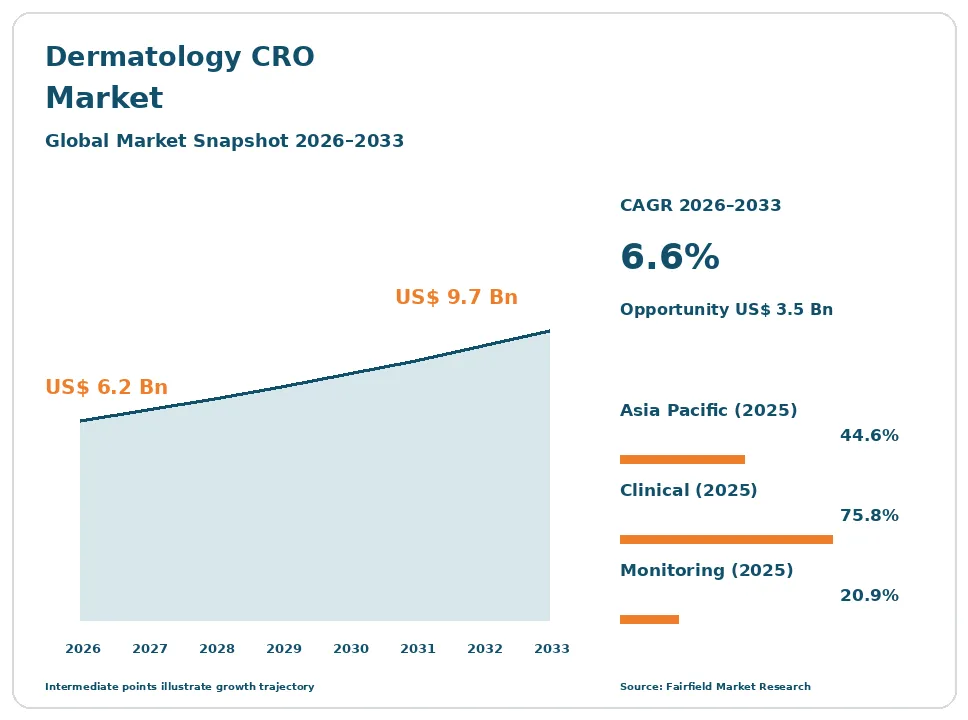
The global dermatology CRO market size is expected to be valued at US$ 6.2 billion in 2026 and projected to reach US$ 9.7 billion by 2033, growing at a CAGR of 6.6% between 2026 and 2033.
Between 2020 and 2025, the market grew at a CAGR of about 6.0%, as sponsors restarted trials paused during the pandemic and invested heavily in new treatments for psoriasis, atopic dermatitis, alopecia, vitiligo, hidradenitis suppurativa, and skin cancers. A dermatology CRO is a contract research organization that runs research for drug, biologic, device, and cosmetic companies in skin, hair, and nail conditions. Services include study design, site selection, patient recruitment, clinical monitoring, imaging, data management, biostatistics, and regulatory support. Dermatology clinical trials need specialist investigators, standardized photography, and validated scoring tools to measure changes in the skin. Growth comes from a rich biologic and small-molecule pipeline, more outsourcing by small biotech firms, and rising demand for evidence behind aesthetic and cosmetic claims. The market is shifting toward decentralized and AI-supported trials. In March 2025, Jeeva Clinical Trials launched a partnership program giving CROs access to its unified trial platform.
Key Report Takeaways
- By Type: Clinical held 75.8% share in 2025, while Preclinical is projected to expand at a 7.5% CAGR through 2033, driven by new topical, biologic, and gene-based skin therapies that need early toxicology, skin irritation, and formulation testing.
- By Service: Clinical Monitoring held 20.9% share in 2025 and is projected to expand at the fastest 7.4% CAGR through 2033, driven by complex biologic trials, remote monitoring tools, and strict data quality requirements from regulators.
- By Indication: Psoriasis & Atopic Dermatitis held 38.0% share in 2025, while Skin Cancer is projected to expand at a 8.0% CAGR through 2033, driven by immunotherapy trials for melanoma and non-melanoma skin cancers.
- By Region: Asia Pacific held 44.6% share in 2025, while Middle East & Africa is projected to expand at a 7.9% CAGR through 2033, driven by new research centers, faster approvals, and growing trial participation in Saudi Arabia, the United Arab Emirates, and South Africa.
Global Dermatology CRO Market Trends and Insights
Drivers Impact Analysis
| Driver | Impact on CAGR Forecast | Geographic Relevance | Impact Timeline |
| Strong dermatology drug pipeline | High | Global | Long term (≥4 years) |
| Rising outsourcing by small and mid-sized sponsors | High | North America, Europe, Asia Pacific | Medium term (2-4 years) |
Two drivers carry the strongest influence on dermatology CRO demand during the forecast period.
Strong Dermatology Pipeline Is Driving the Dermatology CRO Market
A strong dermatology drug pipeline is the strongest driver of the dermatology CRO market. More skin therapies are in development than ever.
The mechanism is investment in new treatment classes. Biologics targeting interleukins, JAK inhibitors, TYK2 inhibitors, and new topical agents have transformed care for psoriasis and atopic dermatitis, and sponsors are now testing these and newer drugs in alopecia areata, vitiligo, hidradenitis suppurativa, prurigo nodularis, and chronic hand eczema. Each program needs multiple trials across phases, age groups, and regions, including long-term safety and head-to-head studies. Skin cancer immunotherapies and targeted therapies add oncology trials. Large companies such as LEO Pharma, Almirall, AbbVie, Sanofi, and Eli Lilly partner with CROs to run these studies. Specialist skin clinical research expertise is critical because outcomes depend on visual scoring and photography. These trends create a steady and growing flow of outsourced studies.
Rising Outsourcing Is Expanding the Dermatology CRO Market
Rising outsourcing by small and mid-sized sponsors is expanding the dermatology CRO market. Many developers do not have internal trial teams.
The cause is the growth of biotech startups and specialty pharma companies in dermatology. These firms often have one or two drug candidates and rely on CROs for everything from protocol design to regulatory submissions. Large pharmaceutical companies also outsource to control fixed costs and access global patient networks. Cosmetic and consumer health companies use CROs to test claims such as hydration, anti-aging, and sensitivity. Specialist providers such as Innovaderm, Symbio Proinnovera, and Bioskin compete with global CROs. Lindus Health launched an all-in-one dermatology CRO service in August 2024. Global CROs also offer functional services, such as data management only, to sponsors with partial in-house teams. These outsourcing trends broaden and diversify demand.
Restraints Impact Analysis
| Restraint | Impact on CAGR Forecast | Geographic Relevance | Impact Timeline |
| Patient recruitment and retention challenges | High | Global | Medium term (2-4 years) |
| Biotech funding cycles and pricing pressure | Medium | North America, Europe | Medium term (2-4 years) |
Two restraints limit how quickly the dermatology CRO market grows.
Recruitment Challenges Slow the Dermatology CRO Market
Patient recruitment and retention challenges slow the dermatology CRO market. Finding the right patients is difficult.
The specific causes are competition for patients and strict eligibility. Many trials target the same moderate-to-severe psoriasis and atopic dermatitis populations, and many eligible patients are already treated with effective biologics, which makes them less willing to join placebo-controlled studies. Washout periods and frequent visits discourage participation. Rare conditions have small patient pools spread across many countries. Trials must include diverse skin types to meet regulatory expectations, which requires broader site networks. Dermatology investigators are in high demand and limited supply, and busy clinics may lack research staff. Seasonal effects on skin conditions can also complicate study timing. Recruitment campaigns through social media and patient groups help but add cost. These challenges extend timelines, raise costs, and can delay revenue for CROs.
Funding Cycles Restrict the Dermatology CRO Market
Biotech funding cycles and pricing pressure restrict the dermatology CRO market. Sponsor budgets can shrink quickly.
The underlying causes are capital market conditions and cost control. Small biotech companies depend on venture funding and public markets, and when funding slows, as it did after 2022, they delay, shrink, or cancel trials. Large sponsors negotiate hard on price, consolidate vendor lists, and move some work in-house. Late-stage trial failures or portfolio reviews can remove expected work suddenly, leaving CROs with idle staff and unused capacity. Competition among global and specialist CROs presses margins, especially for standard monitoring and data services. Currency swings and wage inflation in key research hubs add cost pressure. These factors together create uneven demand and make revenue harder to predict for providers of all sizes.
Market Opportunities
Decentralized and Digital Trials Open a Fast-Growth Revenue Pool
Decentralized and digital trials open a fast-growth revenue pool in the dermatology CRO market. Skin conditions are visible and suit remote assessment.
CROs and technology providers can capture this opportunity. Patients can submit standardized photos from home, and AI tools can measure lesion area, redness, and severity more consistently than manual scoring by different investigators. Telemedicine visits, electronic diaries, and home delivery of study drugs reduce travel and improve retention, which is a major problem in long dermatology studies. Wearable sensors can track scratching and sleep in itch studies. Jeeva Clinical Trials offers a unified platform for CRO partners, and many CROs are building their own digital tools. Regulators are increasingly open to remote data collection. Companies that combine dermatology expertise with digital tools can speed recruitment and win sponsor contracts.
Emerging Regions and Aesthetic Research Create a Diversified Revenue Pool
Emerging regions and aesthetic research create a diversified revenue pool in the dermatology CRO market. New sites and new study types are growing.
CROs can capture this opportunity by expanding site networks in Asia Pacific, Latin America, central parts of Europe, and Middle East & Africa, where patient pools are large, many patients are not yet on biologics, and costs are lower. Diverse populations also help sponsors meet regulator requests for trials that include a wider range of skin types. Aesthetic dermatology, including injectables, fillers, lasers, energy devices, and skincare, requires clinical evidence for approvals and marketing claims. Cosmetic brands need consumer-use and safety testing. Companies that build regional networks and cosmetic testing capabilities can diversify revenue and reduce dependence on a few large drug sponsors.
Segment Analysis
By Type: Clinical Leads While Preclinical Grows Fastest
Clinical held 75.8% share in 2025. Phase I to IV trials, including large global Phase III studies for psoriasis, atopic dermatitis, and alopecia, account for most spending because they involve many sites, patients, and years of follow-up. Long-term extension and post-marketing studies add steady work after approval. IQVIA, ICON, Parexel, and Syneos Health run many large dermatology programs.
Preclinical is the fastest-growing type, expanding at a 7.5% CAGR through 2033. Topical formulations, skin penetration studies, irritation and sensitization testing, and toxicology support early programs, and new modalities such as gene therapies and topical biologics need specialized models. Charles River Laboratories, WuXi AppTec, and Pharmaron provide preclinical services. For the market, preclinical growth reflects a deeper early-stage pipeline.
By Service: Clinical Monitoring Leads and Grows Fastest
Clinical Monitoring held 20.9% share in 2025 and is the fastest-growing service, expanding at a 7.4% CAGR through 2033. Monitors check data quality, protocol compliance, photography standards, scoring consistency, and patient safety at sites. Remote, centralized, and risk-based monitoring are expanding quickly, using central data review to focus visits on sites with problems. Biologic trials with injection schedules, safety labs, and infection monitoring need close oversight.
Regulatory and medical affairs, project management, data management, biostatistics, and medical writing form other services. Regulatory support is growing as sponsors seek approvals in more countries at once, and medical writing demand rises with each new filing and publication. For the market, monitoring growth reflects increasing trial complexity and regulatory scrutiny.
By Indication: Psoriasis & Atopic Dermatitis Lead While Skin Cancer Grows Fastest
Psoriasis & Atopic Dermatitis held 38.0% share in 2025. These large chronic inflammatory conditions affect many millions of children and adults worldwide and attract many biologic, oral, and topical drug trials, including pediatric, long-term safety, and head-to-head studies. New mechanisms continue to enter testing.
Skin Cancer is the fastest-growing indication by value, expanding at a 8.0% CAGR through 2033. Melanoma and non-melanoma skin cancer immunotherapy, targeted therapy, and cancer vaccine trials are rising, and these studies are complex and high value. Acne, rosacea, alopecia, vitiligo, hidradenitis suppurativa, and rare genetic diseases form other indications, with alopecia and vitiligo trials growing after recent approvals. For the market, oncology growth adds complex, high-value studies.
Geography Analysis
North America Expands the Dermatology CRO Market Through Biotech Innovation
North America is a major dermatology CRO market. The United States hosts many dermatology biotech companies, leading academic centers, and large CROs such as IQVIA, Thermo Fisher Scientific (PPD), Labcorp Drug Development, Medpace, and Syneos Health. The U.S. Food and Drug Administration is a key regulator for global approvals, so many pivotal trials include U.S. sites. Specialist dermatology research sites and site networks are well developed. Canada hosts Innovaderm in Montreal, a dermatology-focused CRO. Key barriers include high trial costs and competition for patients. One change shaping the region is the growth of decentralized and hybrid trials.
Europe Advances the Dermatology CRO Market Through Specialist Providers
Europe is a major dermatology CRO market. Germany, France, Spain, Poland, and the United Kingdom have strong dermatology research networks, and LEO Pharma and Almirall are major sponsors focused on skin diseases. Symbio Proinnovera and Bioskin are specialist providers, and Palleos Healthcare and OCT Global announced a merger in May 2024. The European Union Clinical Trials Regulation has created a single submission process for multinational studies, although adoption has been slow. Key barriers include regulatory complexity, data privacy rules, and rising site costs. One opportunity is expanding sites in Poland and other lower-cost countries.
Which Region Is Leading the Dermatology CRO Market?
Asia Pacific is leading the dermatology CRO market with a 44.6% share in 2025. China leads the region, with fast-growing domestic biotech companies developing biologics and biosimilars for psoriasis and atopic dermatitis, and large patient populations that speed recruitment. Japan, South Korea, Australia, and India host many global trials, and Australia offers fast early-phase approvals. WuXi AppTec and Pharmaron provide preclinical services. Local regulators have shortened review times, making the region more attractive for global sponsors. Key barriers include regulatory differences between countries and data transfer rules. One change shaping the region is the rise of domestic biologics.
Latin America Grows the Dermatology CRO Market Through Patient Access
Latin America is a growing dermatology CRO market. Brazil, Mexico, Argentina, and Colombia offer large, diverse patient populations, experienced investigators, and many patients who have not yet received advanced therapies, which helps recruitment. Global CROs and regional providers run trials for psoriasis, atopic dermatitis, acne, and vitiligo. Costs are lower than in North America, and several countries have streamlined ethics reviews. Sponsors value the region for fast enrollment in competitive indications. Key barriers include regulatory approval timelines, import permits for study drugs, and currency volatility. One opportunity is studies that include diverse skin types and ancestries.
Which Region Is Growing Fastest in the Dermatology CRO Market?
Middle East & Africa is growing fastest in the dermatology CRO market at a 7.9% CAGR through 2033. Saudi Arabia and the United Arab Emirates are building research hospitals and clinical trial frameworks as part of health sector reforms, while Israel has strong biotech and dermatology research. South Africa and Egypt offer large patient pools and experienced sites, and global CROs are adding partners in the region. Governments are offering incentives to attract international trials and build local research skills. Key barriers include limited site capacity and investigator experience. One change shaping the region is government investment in clinical research.
Competitive Landscape
The dermatology CRO market is moderately fragmented. IQVIA, ICON, Parexel, Thermo Fisher Scientific (PPD), and Syneos Health are leading players, while Labcorp Drug Development, Medpace, Charles River Laboratories, Innovaderm, Symbio Proinnovera, Bioskin, and TFS HealthScience compete strongly. Many small specialist CROs and site networks focus only on dermatology, often owned by dermatologists or private equity investors. Technology vendors offering imaging, AI scoring, and decentralized trial platforms partner with CROs or sell directly to sponsors.
Companies compete on dermatology expertise, investigator relationships, site networks, recruitment speed, imaging and scoring quality, regulatory knowledge, and cost. Large CROs win global programs from big pharma, while specialists win biotech and mid-size sponsor work by offering focused teams and flexible service. Partnerships with sponsors such as LEO Pharma give CROs long-term pipelines. Private equity investors have backed specialist dermatology CROs to build scale across countries and services.
Strategic moves show how competition is changing. In May 2024, Palleos Healthcare and OCT Global announced a merger. In August 2024, Lindus Health launched an all-in-one dermatology CRO service. In March 2025, Jeeva Clinical Trials launched its CRO partnership program. These moves show competition shifting toward specialization, consolidation, and digital platforms.
Three themes shape vendor strategy. First, companies are building specialist dermatology teams and acquiring niche providers. Second, they are adopting digital tools such as remote photography and AI scoring. Third, they are expanding site networks in emerging regions to speed recruitment.
Dermatology CRO Market Industry Leaders
- IQVIA
- ICON
- Parexel
- Thermo Fisher Scientific (PPD)
- Syneos Health
Recent Industry Developments
- March 2025: Jeeva Clinical Trials launched its CRO Partnership Program, giving contract research organizations access to its unified clinical trial management platform - supports digital dermatology clinical trials.
- August 2024: Lindus Health introduced its All-in-One Dermatology CRO service for trials in the United States, the United Kingdom, and Europe - adds a specialist dermatology CRO option.
- May 2024: Palleos Healthcare and OCT Global announced a merger combining German clinical research with site networks in central parts of Europe - strengthens skin clinical research capacity in Europe.
Companies Covered in the Report
- IQVIA
- ICON
- Parexel
- Thermo Fisher Scientific (PPD)
- Syneos Health
- Labcorp Drug Development
- Medpace
- Charles River Laboratories
- Innovaderm
- Symbio Proinnovera
- Bioskin
- TFS HealthScience
Dermatology CRO Market Report Scope
This report covers dermatology contract research services, including preclinical and clinical research, with services such as clinical monitoring, regulatory and medical affairs, project management, data management, biostatistics, and medical writing, across psoriasis, atopic dermatitis, skin cancer, acne, alopecia, and other indications. The base year is 2025, and the forecast period runs from 2026 to 2033. All values are expressed in US$ Billion.
Type
- Preclinical
- Clinical
Service
- Clinical Monitoring
- Regulatory & Medical Affairs
- Project Management
- Data Management & Biostatistics
- Medical Writing
- Others
Indication
- Psoriasis & Atopic Dermatitis
- Skin Cancer
- Acne
- Alopecia & Vitiligo
- Others
Regions
- North America
- Europe
- Asia Pacific
- Latin America
- Middle East & Africa
Key Questions Answered in the Report
How big is the dermatology CRO market in 2026?
The dermatology CRO market is valued at US$ 6.2 billion in 2026, led by clinical research and Asia Pacific.
What is the dermatology CRO market forecast to 2033?
The market is projected to reach US$ 9.7 billion by 2033, growing at a 6.6% CAGR and adding US$ 3.5 billion.
Which indication is growing fastest in the dermatology CRO market?
Skin cancer is growing fastest at an 8.0% CAGR through 2033, driven by immunotherapy trials for melanoma and other skin cancers.
Which region is growing fastest in the dermatology CRO market?
Middle East & Africa is growing fastest at a 7.9% CAGR through 2033, driven by new research centers in Saudi Arabia.
Which region holds the largest dermatology CRO market share?
Asia Pacific holds the largest share at 44.6% in 2025, supported by large patient populations and fast-growing biotech in China.
1. Executive Summary
1.1. Global Dermatology CRO Market Snapshot
1.2. Future Projections, 2026-2033
1.3. Key Market Trends
1.4. Regional Snapshot
2. Market Overview
2.1. Market Definition and Report Scope
2.2. Historical Market Trends, 2020-2025
2.3. Market Dynamics
2.3.1. Drivers Impact Analysis
2.3.1.1. Strong Dermatology Pipeline Is Driving the Dermatology CRO Market
2.3.1.2. Rising Outsourcing Is Expanding the Dermatology CRO Market
2.3.2. Restraints Impact Analysis
2.3.2.1. Recruitment Challenges Slow the Dermatology CRO Market
2.3.2.2. Funding Cycles Restrict the Dermatology CRO Market
2.3.3. Market Opportunities
2.3.3.1. Decentralized and Digital Trials Open a Fast-Growth Revenue Pool
2.3.3.2. Emerging Regions and Aesthetic Research Create a Diversified Revenue Pool
3. Global Dermatology CRO Market Outlook, 2020-2033
3.1. Global Dermatology CRO Market Outlook, by Type, Value (US$ Billion), 2020-2033
3.1.1. Preclinical
3.1.2. Clinical
3.2. Global Dermatology CRO Market Outlook, by Service, Value (US$ Billion), 2020-2033
3.2.1. Clinical Monitoring
3.2.2. Regulatory & Medical Affairs
3.2.3. Project Management
3.2.4. Data Management & Biostatistics
3.2.5. Medical Writing
3.2.6. Others
3.3. Global Dermatology CRO Market Outlook, by Indication, Value (US$ Billion), 2020-2033
3.3.1. Psoriasis & Atopic Dermatitis
3.3.2. Skin Cancer
3.3.3. Acne
3.3.4. Alopecia & Vitiligo
3.3.5. Others
3.4. Global Dermatology CRO Market Outlook, by Region, Value (US$ Billion), 2020-2033
3.4.1. North America
3.4.2. Europe
3.4.3. Asia Pacific
3.4.4. Latin America
3.4.5. Middle East & Africa
4. North America Dermatology CRO Market Outlook, 2020-2033
4.1. North America Dermatology CRO Market Outlook, by Type, Value (US$ Billion), 2020-2033
4.1.1. Preclinical
4.1.2. Clinical
4.2. North America Dermatology CRO Market Outlook, by Service, Value (US$ Billion), 2020-2033
4.2.1. Clinical Monitoring
4.2.2. Regulatory & Medical Affairs
4.2.3. Project Management
4.2.4. Data Management & Biostatistics
4.2.5. Medical Writing
4.2.6. Others
4.3. North America Dermatology CRO Market Outlook, by Indication, Value (US$ Billion), 2020-2033
4.3.1. Psoriasis & Atopic Dermatitis
4.3.2. Skin Cancer
4.3.3. Acne
4.3.4. Alopecia & Vitiligo
4.3.5. Others
4.4. North America Dermatology CRO Market Outlook, by Country, Value (US$ Billion), 2020-2033
4.4.1. United States Dermatology CRO Market Outlook, by Type, 2020-2033
4.4.2. United States Dermatology CRO Market Outlook, by Service, 2020-2033
4.4.3. United States Dermatology CRO Market Outlook, by Indication, 2020-2033
4.4.4. Canada Dermatology CRO Market Outlook, by Type, 2020-2033
4.4.5. Canada Dermatology CRO Market Outlook, by Service, 2020-2033
4.4.6. Canada Dermatology CRO Market Outlook, by Indication, 2020-2033
5. Europe Dermatology CRO Market Outlook, 2020-2033
5.1. Europe Dermatology CRO Market Outlook, by Type, Value (US$ Billion), 2020-2033
5.1.1. Preclinical
5.1.2. Clinical
5.2. Europe Dermatology CRO Market Outlook, by Service, Value (US$ Billion), 2020-2033
5.2.1. Clinical Monitoring
5.2.2. Regulatory & Medical Affairs
5.2.3. Project Management
5.2.4. Data Management & Biostatistics
5.2.5. Medical Writing
5.2.6. Others
5.3. Europe Dermatology CRO Market Outlook, by Indication, Value (US$ Billion), 2020-2033
5.3.1. Psoriasis & Atopic Dermatitis
5.3.2. Skin Cancer
5.3.3. Acne
5.3.4. Alopecia & Vitiligo
5.3.5. Others
5.4. Europe Dermatology CRO Market Outlook, by Country, Value (US$ Billion), 2020-2033
5.4.1. Germany Dermatology CRO Market Outlook, by Type, 2020-2033
5.4.2. Germany Dermatology CRO Market Outlook, by Service, 2020-2033
5.4.3. Germany Dermatology CRO Market Outlook, by Indication, 2020-2033
5.4.4. France Dermatology CRO Market Outlook, by Type, 2020-2033
5.4.5. France Dermatology CRO Market Outlook, by Service, 2020-2033
5.4.6. France Dermatology CRO Market Outlook, by Indication, 2020-2033
5.4.7. Spain Dermatology CRO Market Outlook, by Type, 2020-2033
5.4.8. Spain Dermatology CRO Market Outlook, by Service, 2020-2033
5.4.9. Spain Dermatology CRO Market Outlook, by Indication, 2020-2033
5.4.10. Poland Dermatology CRO Market Outlook, by Type, 2020-2033
5.4.11. Poland Dermatology CRO Market Outlook, by Service, 2020-2033
5.4.12. Poland Dermatology CRO Market Outlook, by Indication, 2020-2033
5.4.13. United Kingdom Dermatology CRO Market Outlook, by Type, 2020-2033
5.4.14. United Kingdom Dermatology CRO Market Outlook, by Service, 2020-2033
5.4.15. United Kingdom Dermatology CRO Market Outlook, by Indication, 2020-2033
6. Asia Pacific Dermatology CRO Market Outlook, 2020-2033
6.1. Asia Pacific Dermatology CRO Market Outlook, by Type, Value (US$ Billion), 2020-2033
6.1.1. Preclinical
6.1.2. Clinical
6.2. Asia Pacific Dermatology CRO Market Outlook, by Service, Value (US$ Billion), 2020-2033
6.2.1. Clinical Monitoring
6.2.2. Regulatory & Medical Affairs
6.2.3. Project Management
6.2.4. Data Management & Biostatistics
6.2.5. Medical Writing
6.2.6. Others
6.3. Asia Pacific Dermatology CRO Market Outlook, by Indication, Value (US$ Billion), 2020-2033
6.3.1. Psoriasis & Atopic Dermatitis
6.3.2. Skin Cancer
6.3.3. Acne
6.3.4. Alopecia & Vitiligo
6.3.5. Others
6.4. Asia Pacific Dermatology CRO Market Outlook, by Country, Value (US$ Billion), 2020-2033
6.4.1. China Dermatology CRO Market Outlook, by Type, 2020-2033
6.4.2. China Dermatology CRO Market Outlook, by Service, 2020-2033
6.4.3. China Dermatology CRO Market Outlook, by Indication, 2020-2033
6.4.4. Japan Dermatology CRO Market Outlook, by Type, 2020-2033
6.4.5. Japan Dermatology CRO Market Outlook, by Service, 2020-2033
6.4.6. Japan Dermatology CRO Market Outlook, by Indication, 2020-2033
6.4.7. South Korea Dermatology CRO Market Outlook, by Type, 2020-2033
6.4.8. South Korea Dermatology CRO Market Outlook, by Service, 2020-2033
6.4.9. South Korea Dermatology CRO Market Outlook, by Indication, 2020-2033
6.4.10. Australia Dermatology CRO Market Outlook, by Type, 2020-2033
6.4.11. Australia Dermatology CRO Market Outlook, by Service, 2020-2033
6.4.12. Australia Dermatology CRO Market Outlook, by Indication, 2020-2033
6.4.13. India Dermatology CRO Market Outlook, by Type, 2020-2033
6.4.14. India Dermatology CRO Market Outlook, by Service, 2020-2033
6.4.15. India Dermatology CRO Market Outlook, by Indication, 2020-2033
7. Latin America Dermatology CRO Market Outlook, 2020-2033
7.1. Latin America Dermatology CRO Market Outlook, by Type, Value (US$ Billion), 2020-2033
7.1.1. Preclinical
7.1.2. Clinical
7.2. Latin America Dermatology CRO Market Outlook, by Service, Value (US$ Billion), 2020-2033
7.2.1. Clinical Monitoring
7.2.2. Regulatory & Medical Affairs
7.2.3. Project Management
7.2.4. Data Management & Biostatistics
7.2.5. Medical Writing
7.2.6. Others
7.3. Latin America Dermatology CRO Market Outlook, by Indication, Value (US$ Billion), 2020-2033
7.3.1. Psoriasis & Atopic Dermatitis
7.3.2. Skin Cancer
7.3.3. Acne
7.3.4. Alopecia & Vitiligo
7.3.5. Others
7.4. Latin America Dermatology CRO Market Outlook, by Country, Value (US$ Billion), 2020-2033
7.4.1. Brazil Dermatology CRO Market Outlook, by Type, 2020-2033
7.4.2. Brazil Dermatology CRO Market Outlook, by Service, 2020-2033
7.4.3. Brazil Dermatology CRO Market Outlook, by Indication, 2020-2033
7.4.4. Mexico Dermatology CRO Market Outlook, by Type, 2020-2033
7.4.5. Mexico Dermatology CRO Market Outlook, by Service, 2020-2033
7.4.6. Mexico Dermatology CRO Market Outlook, by Indication, 2020-2033
7.4.7. Argentina Dermatology CRO Market Outlook, by Type, 2020-2033
7.4.8. Argentina Dermatology CRO Market Outlook, by Service, 2020-2033
7.4.9. Argentina Dermatology CRO Market Outlook, by Indication, 2020-2033
7.4.10. Colombia Dermatology CRO Market Outlook, by Type, 2020-2033
7.4.11. Colombia Dermatology CRO Market Outlook, by Service, 2020-2033
7.4.12. Colombia Dermatology CRO Market Outlook, by Indication, 2020-2033
8. Middle East & Africa Dermatology CRO Market Outlook, 2020-2033
8.1. Middle East & Africa Dermatology CRO Market Outlook, by Type, Value (US$ Billion), 2020-2033
8.1.1. Preclinical
8.1.2. Clinical
8.2. Middle East & Africa Dermatology CRO Market Outlook, by Service, Value (US$ Billion), 2020-2033
8.2.1. Clinical Monitoring
8.2.2. Regulatory & Medical Affairs
8.2.3. Project Management
8.2.4. Data Management & Biostatistics
8.2.5. Medical Writing
8.2.6. Others
8.3. Middle East & Africa Dermatology CRO Market Outlook, by Indication, Value (US$ Billion), 2020-2033
8.3.1. Psoriasis & Atopic Dermatitis
8.3.2. Skin Cancer
8.3.3. Acne
8.3.4. Alopecia & Vitiligo
8.3.5. Others
8.4. Middle East & Africa Dermatology CRO Market Outlook, by Country, Value (US$ Billion), 2020-2033
8.4.1. Saudi Arabia Dermatology CRO Market Outlook, by Type, 2020-2033
8.4.2. Saudi Arabia Dermatology CRO Market Outlook, by Service, 2020-2033
8.4.3. Saudi Arabia Dermatology CRO Market Outlook, by Indication, 2020-2033
8.4.4. United Arab Emirates Dermatology CRO Market Outlook, by Type, 2020-2033
8.4.5. United Arab Emirates Dermatology CRO Market Outlook, by Service, 2020-2033
8.4.6. United Arab Emirates Dermatology CRO Market Outlook, by Indication, 2020-2033
8.4.7. Israel Dermatology CRO Market Outlook, by Type, 2020-2033
8.4.8. Israel Dermatology CRO Market Outlook, by Service, 2020-2033
8.4.9. Israel Dermatology CRO Market Outlook, by Indication, 2020-2033
8.4.10. South Africa Dermatology CRO Market Outlook, by Type, 2020-2033
8.4.11. South Africa Dermatology CRO Market Outlook, by Service, 2020-2033
8.4.12. South Africa Dermatology CRO Market Outlook, by Indication, 2020-2033
8.4.13. Egypt Dermatology CRO Market Outlook, by Type, 2020-2033
8.4.14. Egypt Dermatology CRO Market Outlook, by Service, 2020-2033
8.4.15. Egypt Dermatology CRO Market Outlook, by Indication, 2020-2033
9. Competitive Landscape
9.1. Market Concentration and Industry Leaders
9.2. Competitive Differentiation
9.3. Strategic Initiatives
9.4. Recent Industry Developments
9.5. Company Profiles
9.5.1. IQVIA
9.5.2. ICON
9.5.3. Parexel
9.5.4. Thermo Fisher Scientific (PPD)
9.5.5. Syneos Health
9.5.6. Labcorp Drug Development
9.5.7. Medpace
9.5.8. Charles River Laboratories
9.5.9. Innovaderm
9.5.10. Symbio Proinnovera
9.5.11. Bioskin
9.5.12. TFS HealthScience
10. Appendix
10.1. Research Methodology
10.2. Report Assumptions
10.3. Acronyms and Abbreviations
| Type | Preclinical, Clinical |
| Service | Clinical Monitoring, Regulatory & Medical Affairs, Project Management, Data Management & Biostatistics, Medical Writing, Others |
| Indication | Psoriasis & Atopic Dermatitis, Skin Cancer, Acne, Alopecia & Vitiligo, Others |
| Regions | North America, Europe, Asia Pacific, Latin America, Middle East & Africa |
Our Research Methodology
Considering the volatility of business today, traditional approaches to strategizing a game plan can be unfruitful if not detrimental. True ambiguity is no way to determine a forecast. A myriad of predetermined factors must be accounted for such as the degree of risk involved, the magnitude of circumstances, as well as conditions or consequences that are not known or unpredictable. To circumvent binary views that cast uncertainty, the application of market research intelligence to strategically posture, move, and enable actionable outcomes is necessary.
View Methodology
Quality Assured
Rigorous Validation Process

Confidentiality Assured
End-to-end Data Security

Custom Research Services
Tailored To Your Objectives
FAQs
The dermatology CRO market is valued at US$ 6.2 billion in 2026, led by clinical research and Asia Pacific.
The market is projected to reach US$ 9.7 billion by 2033, growing at a 6.6% CAGR and adding US$ 3.5 billion.
Skin cancer is growing fastest at an 8.0% CAGR through 2033, driven by immunotherapy trials for melanoma and other skin cancers.
Middle East & Africa is growing fastest at a 7.9% CAGR through 2033, driven by new research centers in Saudi Arabia.
Asia Pacific holds the largest share at 44.6% in 2025, supported by large patient populations and fast-growing biotech in China.
Related Reports
Acetaminophen Market Size, Share, Insights, Competitive Landscape, and Forecast 2026 to 2033
The global acetaminophen market is valued at US$11.70 billion in 2026, reaching US$15.93 billion by 2033, growing at a 4.5% CAGR
Allergy Diagnostics and Therapeutics Market Size, Share, Insights, Competitive Landscape, and Forecast 2026 to 2033
The global allergy diagnostics and therapeutics market is valued at US$41.50 billion in 2026, reaching US$88.30 billion by 2033, growing at an 11.4% CAGR
Homeopathic Products Market Size, Share, Insights, Competitive Landscape, and Forecast 2026 to 2033
The global homeopathic products market is valued at US$59.45 billion in 2026, reaching US$169.21 billion by 2033, growing at a 16.1% CAGR
Nanoparticle Formulation Market Size, Share, Insights, Competitive Landscape, and Forecast 2026 to 2033
The nanoparticle formulation market is projected to grow from US$6.80 billion in 2026 to US$12.67 billion by 2033, at a 9.3% CAGR, driven by RNA therapies.
Renal Biomarkers Market Size, Share, Insights, Competitive Landscape, and Forecast 2026 to 2033
The renal biomarkers market is projected to grow from US$1.73 billion in 2026 to US$2.87 billion by 2033, at a 7.5% CAGR, driven by early kidney testing.
Gene Switch Market Size, Share, Insights, Competitive Landscape, and Forecast 2026 to 2033
The gene switch market is projected to grow from US$899.0 million in 2026 to US$1,979.4 million by 2033, at an 11.9% CAGR, driven by cell and gene therapies.