



Pharmaceutical Temperature Controlled Packaging Solutions Market
Pharmaceutical Temperature Controlled Packaging Solutions Market Size, Share, Insights, Competitive Landscape, and Forecast 2026 to 2033
Pharmaceutical Temperature Controlled Packaging Solutions Market Size, Share, Insights, Competitive Landscape, and Forecast 2026 to 2033
How Fast Is the Pharmaceutical Temperature Controlled Packaging Solutions Market Growing?
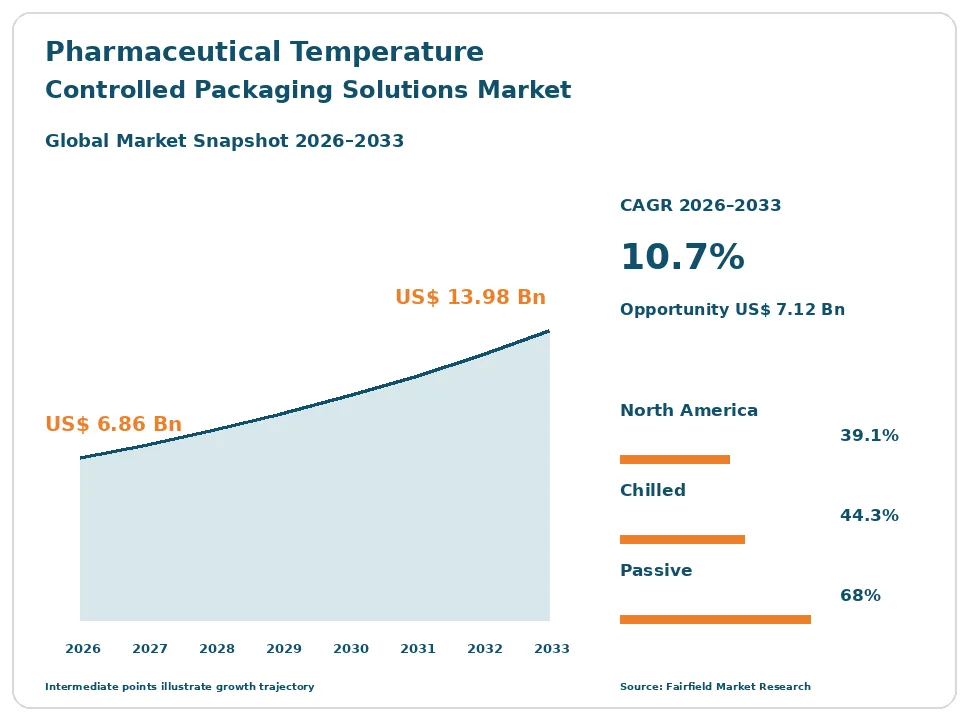
The global pharmaceutical temperature controlled packaging solutions market size is expected to be valued at US$ 6.86 billion in 2026 and projected to reach US$ 13.98 billion by 2033, growing at a CAGR of 10.7% between 2026 and 2033.
Between 2020 and 2025, the market grew at a CAGR of about 9.6%, boosted by the global rollout of COVID-19 vaccines that needed frozen and ultra-cold shipping, and then supported by rising volumes of biologics, cell and gene therapies, and clinical trial materials. Temperature controlled packaging keeps medicines within a required range, such as 2°C to 8°C chilled, frozen, or controlled room temperature, during storage and transport. Solutions include passive insulated shippers with phase change materials or dry ice, vacuum insulated panels, and active containers with powered heating and cooling. These products are a critical part of the pharmaceutical cold chain, because temperature excursions can destroy expensive drugs and endanger patients. Growth comes from biologics, personalized medicines, direct-to-patient delivery, and stricter good distribution practice rules. The market is shifting toward reusable systems, real-time monitoring, and greener materials. In April 2026, SkyCell launched its 6500X multi-pallet container.
Key Report Takeaways
- By Application: Chilled held 44.3% share in 2026, while Frozen is projected to expand at a 11.9% CAGR through 2033, driven by cell and gene therapies, mRNA products, and clinical samples that require frozen, dry ice, or cryogenic shipping.
- By System Type: Passive held 68.0% share in 2026, while Active is projected to expand at a 12.1% CAGR through 2033, driven by high-value biologics shipped by air that need powered temperature control over long, complex routes.
- By Usability: Single Use held 58.0% share in 2026, while Reusable is projected to expand at a 12.4% CAGR through 2033, driven by sustainability targets, rental pooling models, and lower cost per trip for high-volume shipping lanes.
- By Region: North America held 39.1% share in 2026, while Asia Pacific is projected to expand at a 12.6% CAGR through 2033, driven by biologics manufacturing, clinical trial growth, and vaccine distribution in China, India, Singapore, and South Korea.
Global Pharmaceutical Temperature Controlled Packaging Solutions Market Trends and Insights
Drivers Impact Analysis
| Driver | Impact on CAGR Forecast | Geographic Relevance | Impact Timeline |
| Growth of biologics and temperature-sensitive drugs | High | Global | Long term (≥4 years) |
| Stricter good distribution practice and quality rules | Medium | North America, Europe, Asia Pacific | Medium term (2-4 years) |
Two drivers carry the strongest influence on pharmaceutical temperature controlled packaging solutions demand during the forecast period.
Biologics Growth Is Driving the Pharmaceutical Temperature Controlled Packaging Solutions Market
Growth of biologics and temperature-sensitive drugs is the strongest driver of the pharmaceutical temperature controlled packaging solutions market. More medicines must stay cold.
The mechanism is a shift in the drug pipeline. Monoclonal antibodies, vaccines, insulin, GLP-1 drugs, blood products, and other biologics now make up a large and growing share of pharmaceutical sales, and most need 2°C to 8°C storage. Cell and gene therapies often require frozen or cryogenic conditions down to minus 150°C or lower and are shipped one patient at a time. These products are extremely valuable, so a single temperature failure can cost hundreds of thousands of dollars. Clinical trials ship investigational drugs and biological samples to sites worldwide. Specialty pharmacies and home infusion services deliver medicines directly to patients’ homes. Each of these flows requires validated cold chain packaging. These trends create steady demand for insulated shippers, active containers, and monitoring services.
Stricter Quality Rules Are Expanding the Pharmaceutical Temperature Controlled Packaging Solutions Market
Stricter good distribution practice and quality rules are expanding the pharmaceutical temperature controlled packaging solutions market. Regulators expect proof of temperature control.
The cause is tighter guidance on drug storage and transport. Good distribution practice guidelines in Europe, the United States Pharmacopeia chapters, and World Health Organization standards require manufacturers and distributors to validate packaging, monitor temperatures, and document every shipment. Controlled room temperature products, once shipped without special packaging, now often need qualified solutions. Auditors and customers demand data loggers and traceable records. Packaging providers such as Softbox have added live tracking and compliant data logging. Pharmaceutical companies increasingly select fewer, qualified suppliers that can document performance across many lanes and seasons. Thermal testing labs that simulate summer and winter profiles are now a standard part of supplier offerings. These rules raise the standard for packaging and support premium products and services.
Restraints Impact Analysis
| Restraint | Impact on CAGR Forecast | Geographic Relevance | Impact Timeline |
| High cost of advanced and active solutions | High | Global | Long term (≥4 years) |
| Environmental concerns over single-use materials | Medium | Europe, North America | Medium term (2-4 years) |
Two restraints limit how quickly the pharmaceutical temperature controlled packaging solutions market grows.
High Costs Slow the Pharmaceutical Temperature Controlled Packaging Solutions Market
High cost of advanced and active solutions slows the pharmaceutical temperature controlled packaging solutions market. Premium cold chain systems are expensive.
The specific causes are materials, technology, and logistics. Vacuum insulated panels, high-performance phase change materials, and active containers with batteries and compressors cost far more than basic foam boxes. Active container rental and return logistics add expense, especially on long international routes. Real-time monitoring devices and software subscriptions raise costs further. Generic drug makers and distributors in price-sensitive markets often choose cheaper options that offer less protection. Qualification and validation testing for each new shipper and lane takes time and money. Freight costs also rise with box size and weight, so bulky insulation adds to shipping bills. These cost barriers slow adoption of advanced solutions outside high-value biologics.
Environmental Concerns Restrict the Pharmaceutical Temperature Controlled Packaging Solutions Market
Environmental concerns over single-use materials restrict the pharmaceutical temperature controlled packaging solutions market. Many shippers end up as waste.
The underlying causes are materials and disposal. Expanded polystyrene boxes, gel packs, and plastic liners are bulky and hard to recycle, and millions are discarded each year. Regulations in Europe and corporate sustainability targets push pharmaceutical companies to cut packaging waste and carbon emissions. Switching to recyclable or reusable systems requires new validation, process changes, and return logistics. Dry ice use adds emissions and handling rules. Hospitals and patients receiving home deliveries often have no easy way to recycle or return packaging, and some countries charge fees for packaging waste. Customers increasingly ask suppliers for life cycle assessments and carbon data. These pressures slow purchases of traditional products and force suppliers to redesign their portfolios.
Market Opportunities
Reusable and Sustainable Systems Open a Fast-Growth Revenue Pool
Reusable and sustainable systems open a fast-growth revenue pool in the pharmaceutical temperature controlled packaging solutions market. Customers want lower waste and cost per trip.
Packaging providers and logistics partners can capture this opportunity. Reusable shippers and containers, managed through rental and pooling programs, can make dozens or hundreds of trips, cutting waste and lowering long-term costs. Fully recyclable paper-based insulated shippers, such as those added by Sonoco ThermoSafe for 2°C to 8°C shipments, replace foam. Envirotainer gained global rights to Swiss Airtainer solar-powered containers in August 2025. Return logistics networks, cleaning, and service centers support reuse across countries. Lightweight designs also cut air freight emissions and costs. Companies that combine sustainable designs with strong lane coverage can win long-term contracts with large drug makers.
Digital Monitoring and Cell and Gene Therapy Logistics Create a Premium Revenue Pool
Digital monitoring and cell and gene therapy logistics create a premium revenue pool in the pharmaceutical temperature controlled packaging solutions market. High-value shipments need visibility.
Technology and specialty providers can capture this opportunity. IoT sensors in shippers report temperature, location, light, and shock in real time, allowing teams to intervene before a drug is lost. CSafe Global added real-time alerts and predictive analytics to its AI-powered monitoring platform. Cell and gene therapies need cryogenic dry shippers, chain-of-identity tracking, and white-glove courier services. Courier partners and specialty logistics providers bundle packaging with handling and customs support. Data from shipments helps companies improve lane design, choose better packaging, and prove compliance during audits. Companies that offer integrated packaging, data, and logistics services can capture premium pricing and long-term contracts.
Segment Analysis
By Application: Chilled Leads While Frozen Grows Fastest
Chilled held 44.3% share in 2026. Most vaccines, insulin, monoclonal antibodies, and GLP-1 drugs require 2°C to 8°C storage, making chilled shipping the largest application. Passive insulated shippers with phase change materials dominate parcel shipments, while active containers carry large air freight loads. The rapid growth of GLP-1 weight-loss drugs has added large chilled volumes, including home deliveries.
Frozen is the fastest-growing application, expanding at a 11.9% CAGR through 2033. Cell and gene therapies, mRNA vaccines, plasma products, and clinical samples need frozen, dry ice, or liquid nitrogen shipping. Ambient, or controlled room temperature, shipping held 27.3% share and is growing as more products require temperature evidence. For the market, frozen growth adds specialized, high-value solutions.
By System Type: Passive Leads While Active Grows Fastest
Passive held 68.0% share in 2026. Passive systems use insulation and refrigerants without power, making them simple, lightweight, and cost-effective for parcels and pallets. Sonoco ThermoSafe, Cold Chain Technologies, Pelican BioThermal, Softbox, and Cryopak are leading suppliers.
Active is the fastest-growing system type, expanding at a 12.1% CAGR through 2033. Active containers use batteries, compressors, or heating elements to hold set temperatures during long air shipments. Envirotainer, CSafe Global, and SkyCell lead active and hybrid containers, which are leased per shipment and approved by many airlines. Hybrid containers combine passive insulation with smart monitoring and limited power to cut weight and cost. For the market, active growth reflects rising high-value biologics shipments by air.
By Usability: Single Use Leads While Reusable Grows Fastest
Single Use held 58.0% share in 2026. One-way shippers are convenient for parcel, specialty pharmacy, and direct-to-patient shipments where collecting boxes is difficult. They require no return logistics, cleaning, or tracking, and they are widely validated for many products and lanes. Paper-based and recyclable single-use designs are replacing foam to reduce waste.
Reusable is the fastest-growing usability type, expanding at a 12.4% CAGR through 2033. Pooling and rental programs collect, inspect, recondition, and redeploy shippers and containers, so the same unit makes many trips. Large pharmaceutical companies with steady, high-volume lanes save money and meet sustainability targets this way. Pelican BioThermal, Envirotainer, SkyCell, and CSafe Global run global reuse networks. For the market, reusable growth supports sustainability and recurring service revenue.
Geography Analysis
Which Region Is Leading the Pharmaceutical Temperature Controlled Packaging Solutions Market?
North America is leading the pharmaceutical temperature controlled packaging solutions market with a 39.1% share in 2026. The United States is the world’s largest pharmaceutical market and a leader in biologics, GLP-1 drugs, cell and gene therapies, and clinical trials, all of which need validated cold chain shipping. Sonoco ThermoSafe, Cold Chain Technologies, Pelican BioThermal, and CSafe Global are based in the region, and specialty pharmacies ship large volumes directly to patients. Canada adds demand, with Cryopak a key supplier. Key barriers include high costs and packaging waste concerns. One change shaping the region is the rapid growth of direct-to-patient delivery.
Europe Advances the Pharmaceutical Temperature Controlled Packaging Solutions Market Through Sustainability
Europe is the second-largest pharmaceutical temperature controlled packaging solutions market. Germany, Switzerland, the United Kingdom, Ireland, and Belgium host major pharmaceutical exporters and air cargo hubs that ship biologics worldwide. Envirotainer, SkyCell, Softbox, Sofrigam, and Tempack are leading suppliers, and Envirotainer integrated va-Q-tec’s pharma business in March 2025. Strict good distribution practice rules and packaging waste regulations push reusable and recyclable designs across the region. Key barriers include strict waste rules, high labor costs, and validation costs. One opportunity is reusable pooled systems on high-volume lanes.
Which Region Is Growing Fastest in the Pharmaceutical Temperature Controlled Packaging Solutions Market?
Asia Pacific is growing fastest in the pharmaceutical temperature controlled packaging solutions market at a 12.6% CAGR through 2033. China, India, Singapore, South Korea, and Japan are expanding biologics, biosimilars, and vaccine production, and contract manufacturers export to global markets. Clinical trial activity in the region is rising quickly. Pelican BioThermal opened new service centers in the region in February 2025. Governments are funding cold chain upgrades for immunization programs. Key barriers include cold chain infrastructure gaps in rural areas and hot climates. One change shaping the region is the growth of biologics manufacturing.
Latin America Grows the Pharmaceutical Temperature Controlled Packaging Solutions Market Through Vaccine Access
Latin America is a growing pharmaceutical temperature controlled packaging solutions market. Brazil and Mexico lead, with large public vaccination programs, growing biologics use, and local pharmaceutical production. Argentina, Colombia, and Chile add demand from hospitals and clinical trials. Long road routes and hot weather make strong insulation essential, and imports of biologics from North America and Europe need validated air freight packaging. Local distributors are investing in temperature-controlled warehouses and refrigerated trucks. Key barriers include heat, long routes, customs delays, and budget limits. One opportunity is cold chain packaging for vaccines and biologics in public health programs.
Middle East & Africa Develops the Pharmaceutical Temperature Controlled Packaging Solutions Market Through Health Investment
Middle East & Africa is a developing pharmaceutical temperature controlled packaging solutions market. Saudi Arabia and the United Arab Emirates are building pharmaceutical manufacturing and logistics hubs, with Dubai serving as a cold chain gateway. South Africa, Egypt, and Nigeria need cold chain packaging for vaccines, insulin, and biologics, often supported by global health programs that fund cold chain equipment and solar-powered refrigerators. Growing local insulin and vaccine production in Egypt, Morocco, and South Africa will add domestic demand for validated shippers. Key barriers include extreme heat and limited infrastructure. One change shaping the region is local vaccine and drug manufacturing.
Competitive Landscape
The pharmaceutical temperature controlled packaging solutions market is moderately consolidated. Sonoco ThermoSafe, Envirotainer, Pelican BioThermal, Cold Chain Technologies, and CSafe Global are leading players, while SkyCell, Softbox, Sofrigam, Cryopak, Intelsius, Tempack, and Inmark compete strongly. Logistics companies, freight forwarders, and airlines are important partners, and some, such as IAG Cargo, integrate container offerings into their own specialist services. Specialist couriers serving clinical trials also bundle packaging with handling services.
Companies compete on thermal performance, qualification data, lane coverage, sustainability, monitoring technology, price, and service. Active container providers depend on airline approvals and global service stations, while passive suppliers compete on design, weight, and validation for specific temperature ranges. Long-term supply agreements with large pharmaceutical companies are valuable, and consolidation has created stronger full-range providers. Smaller regional firms compete on price, local service, and fast delivery of standard shippers. Innovation in materials, such as vacuum insulated panels and bio-based insulation, is a key differentiator.
Strategic moves show how competition is changing. In March 2025, Envirotainer integrated va-Q-tec’s pharma business. In August 2025, Envirotainer invested in Swiss Airtainer. In April 2026, SkyCell launched its 6500X container. These moves show competition shifting toward active, hybrid, and reusable systems with wider airline and lane coverage.
Three themes shape vendor strategy. First, companies are consolidating to offer passive and active solutions together. Second, they are adding real-time monitoring and analytics. Third, they are developing reusable, recyclable, and low-emission designs.
Pharmaceutical Temperature Controlled Packaging Solutions Market Industry Leaders
- Sonoco ThermoSafe
- Envirotainer
- Pelican BioThermal
- Cold Chain Technologies
- CSafe Global
Recent Industry Developments
- April 2026: SkyCell launched the 6500X multi-pallet container for large pharmaceutical air shipments - expands active and hybrid temperature controlled packaging capacity.
- September 2025: IAG Cargo added SkyCell’s 1500X hybrid containers to its Constant Climate service - widens access to pharmaceutical cold chain containers on airline networks.
- August 2025: Envirotainer announced a strategic investment in Swiss Airtainer, gaining exclusive global rights to its solar-powered containers - supports sustainable active cold chain packaging.
- March 2025: Envirotainer integrated va-Q-tec’s pharma business into its portfolio - combines active containers with passive vacuum insulated solutions.
Companies Covered in the Report
- Sonoco ThermoSafe
- Envirotainer
- Pelican BioThermal
- Cold Chain Technologies
- CSafe Global
- SkyCell
- Softbox
- Sofrigam
- Cryopak
- Intelsius
- Tempack
- Inmark
Pharmaceutical Temperature Controlled Packaging Solutions Market Report Scope
This report covers pharmaceutical temperature controlled packaging solutions, including insulated shippers, insulated containers, refrigerants, and active containers, in passive and active systems, single-use and reusable formats, for chilled, frozen, and ambient applications, serving pharmaceutical, biotechnology, clinical trial, and distribution end users. The base year is 2025, and the forecast period runs from 2026 to 2033. All values are expressed in US$ Billion.
Application
- Chilled
- Frozen
- Ambient
System Type
- Passive
- Active
Usability
- Single Use
- Reusable
Regions
- North America
- Europe
- Asia Pacific
- Latin America
- Middle East & Africa
Key Questions Answered in the Report
How big is the pharmaceutical temperature controlled packaging solutions market in 2026?
The pharmaceutical temperature controlled packaging solutions market is valued at US$ 6.86 billion in 2026, led by chilled applications and North America.
What is the pharmaceutical temperature controlled packaging solutions market forecast to 2033?
The market is projected to reach US$ 13.98 billion by 2033, growing at a 10.7% CAGR and adding US$ 7.12 billion.
Which usability type is growing fastest in this market?
Reusable solutions are growing fastest at a 12.4% CAGR through 2033, driven by sustainability targets and rental pooling programs.
Which region is growing fastest in this market?
Asia Pacific is growing fastest at a 12.6% CAGR through 2033, driven by biologics manufacturing and clinical trials in China and India.
Which region holds the largest share of this market?
North America holds the largest share at 39.1% in 2026, supported by leadership in biologics, cell and gene therapies, and clinical trials.
1. Executive Summary
1.1. Global Pharmaceutical Temperature Controlled Packaging Solutions Market Snapshot
1.2. Future Projections, 2026-2033
1.3. Key Market Trends
1.4. Regional Snapshot
2. Market Overview
2.1. Market Definition and Report Scope
2.2. Historical Market Trends, 2020-2025
2.3. Market Dynamics
2.3.1. Drivers Impact Analysis
2.3.1.1. Biologics Growth Is Driving the Pharmaceutical Temperature Controlled Packaging Solutions Market
2.3.1.2. Stricter Quality Rules Are Expanding the Pharmaceutical Temperature Controlled Packaging Solutions Market
2.3.2. Restraints Impact Analysis
2.3.2.1. High Costs Slow the Pharmaceutical Temperature Controlled Packaging Solutions Market
2.3.2.2. Environmental Concerns Restrict the Pharmaceutical Temperature Controlled Packaging Solutions Market
2.3.3. Market Opportunities
2.3.3.1. Reusable and Sustainable Systems Open a Fast-Growth Revenue Pool
2.3.3.2. Digital Monitoring and Cell and Gene Therapy Logistics Create a Premium Revenue Pool
3. Global Pharmaceutical Temperature Controlled Packaging Solutions Market Outlook, 2020-2033
3.1. Global Pharmaceutical Temperature Controlled Packaging Solutions Market Outlook, by Application, Value (US$ Billion), 2020-2033
3.1.1. Chilled
3.1.2. Frozen
3.1.3. Ambient
3.2. Global Pharmaceutical Temperature Controlled Packaging Solutions Market Outlook, by System Type, Value (US$ Billion), 2020-2033
3.2.1. Passive
3.2.2. Active
3.3. Global Pharmaceutical Temperature Controlled Packaging Solutions Market Outlook, by Usability, Value (US$ Billion), 2020-2033
3.3.1. Single Use
3.3.2. Reusable
3.4. Global Pharmaceutical Temperature Controlled Packaging Solutions Market Outlook, by Region, Value (US$ Billion), 2020-2033
3.4.1. North America
3.4.2. Europe
3.4.3. Asia Pacific
3.4.4. Latin America
3.4.5. Middle East & Africa
4. North America Pharmaceutical Temperature Controlled Packaging Solutions Market Outlook, 2020-2033
4.1. North America Pharmaceutical Temperature Controlled Packaging Solutions Market Outlook, by Application, Value (US$ Billion), 2020-2033
4.1.1. Chilled
4.1.2. Frozen
4.1.3. Ambient
4.2. North America Pharmaceutical Temperature Controlled Packaging Solutions Market Outlook, by System Type, Value (US$ Billion), 2020-2033
4.2.1. Passive
4.2.2. Active
4.3. North America Pharmaceutical Temperature Controlled Packaging Solutions Market Outlook, by Usability, Value (US$ Billion), 2020-2033
4.3.1. Single Use
4.3.2. Reusable
4.4. North America Pharmaceutical Temperature Controlled Packaging Solutions Market Outlook, by Country, Value (US$ Billion), 2020-2033
4.4.1. United States Pharmaceutical Temperature Controlled Packaging Solutions Market Outlook, by Application, 2020-2033
4.4.2. United States Pharmaceutical Temperature Controlled Packaging Solutions Market Outlook, by System Type, 2020-2033
4.4.3. United States Pharmaceutical Temperature Controlled Packaging Solutions Market Outlook, by Usability, 2020-2033
4.4.4. Canada Pharmaceutical Temperature Controlled Packaging Solutions Market Outlook, by Application, 2020-2033
4.4.5. Canada Pharmaceutical Temperature Controlled Packaging Solutions Market Outlook, by System Type, 2020-2033
4.4.6. Canada Pharmaceutical Temperature Controlled Packaging Solutions Market Outlook, by Usability, 2020-2033
5. Europe Pharmaceutical Temperature Controlled Packaging Solutions Market Outlook, 2020-2033
5.1. Europe Pharmaceutical Temperature Controlled Packaging Solutions Market Outlook, by Application, Value (US$ Billion), 2020-2033
5.1.1. Chilled
5.1.2. Frozen
5.1.3. Ambient
5.2. Europe Pharmaceutical Temperature Controlled Packaging Solutions Market Outlook, by System Type, Value (US$ Billion), 2020-2033
5.2.1. Passive
5.2.2. Active
5.3. Europe Pharmaceutical Temperature Controlled Packaging Solutions Market Outlook, by Usability, Value (US$ Billion), 2020-2033
5.3.1. Single Use
5.3.2. Reusable
5.4. Europe Pharmaceutical Temperature Controlled Packaging Solutions Market Outlook, by Country, Value (US$ Billion), 2020-2033
5.4.1. Germany Pharmaceutical Temperature Controlled Packaging Solutions Market Outlook, by Application, 2020-2033
5.4.2. Germany Pharmaceutical Temperature Controlled Packaging Solutions Market Outlook, by System Type, 2020-2033
5.4.3. Germany Pharmaceutical Temperature Controlled Packaging Solutions Market Outlook, by Usability, 2020-2033
5.4.4. Switzerland Pharmaceutical Temperature Controlled Packaging Solutions Market Outlook, by Application, 2020-2033
5.4.5. Switzerland Pharmaceutical Temperature Controlled Packaging Solutions Market Outlook, by System Type, 2020-2033
5.4.6. Switzerland Pharmaceutical Temperature Controlled Packaging Solutions Market Outlook, by Usability, 2020-2033
5.4.7. United Kingdom Pharmaceutical Temperature Controlled Packaging Solutions Market Outlook, by Application, 2020-2033
5.4.8. United Kingdom Pharmaceutical Temperature Controlled Packaging Solutions Market Outlook, by System Type, 2020-2033
5.4.9. United Kingdom Pharmaceutical Temperature Controlled Packaging Solutions Market Outlook, by Usability, 2020-2033
5.4.10. Ireland Pharmaceutical Temperature Controlled Packaging Solutions Market Outlook, by Application, 2020-2033
5.4.11. Ireland Pharmaceutical Temperature Controlled Packaging Solutions Market Outlook, by System Type, 2020-2033
5.4.12. Ireland Pharmaceutical Temperature Controlled Packaging Solutions Market Outlook, by Usability, 2020-2033
5.4.13. Belgium Pharmaceutical Temperature Controlled Packaging Solutions Market Outlook, by Application, 2020-2033
5.4.14. Belgium Pharmaceutical Temperature Controlled Packaging Solutions Market Outlook, by System Type, 2020-2033
5.4.15. Belgium Pharmaceutical Temperature Controlled Packaging Solutions Market Outlook, by Usability, 2020-2033
6. Asia Pacific Pharmaceutical Temperature Controlled Packaging Solutions Market Outlook, 2020-2033
6.1. Asia Pacific Pharmaceutical Temperature Controlled Packaging Solutions Market Outlook, by Application, Value (US$ Billion), 2020-2033
6.1.1. Chilled
6.1.2. Frozen
6.1.3. Ambient
6.2. Asia Pacific Pharmaceutical Temperature Controlled Packaging Solutions Market Outlook, by System Type, Value (US$ Billion), 2020-2033
6.2.1. Passive
6.2.2. Active
6.3. Asia Pacific Pharmaceutical Temperature Controlled Packaging Solutions Market Outlook, by Usability, Value (US$ Billion), 2020-2033
6.3.1. Single Use
6.3.2. Reusable
6.4. Asia Pacific Pharmaceutical Temperature Controlled Packaging Solutions Market Outlook, by Country, Value (US$ Billion), 2020-2033
6.4.1. China Pharmaceutical Temperature Controlled Packaging Solutions Market Outlook, by Application, 2020-2033
6.4.2. China Pharmaceutical Temperature Controlled Packaging Solutions Market Outlook, by System Type, 2020-2033
6.4.3. China Pharmaceutical Temperature Controlled Packaging Solutions Market Outlook, by Usability, 2020-2033
6.4.4. India Pharmaceutical Temperature Controlled Packaging Solutions Market Outlook, by Application, 2020-2033
6.4.5. India Pharmaceutical Temperature Controlled Packaging Solutions Market Outlook, by System Type, 2020-2033
6.4.6. India Pharmaceutical Temperature Controlled Packaging Solutions Market Outlook, by Usability, 2020-2033
6.4.7. Singapore Pharmaceutical Temperature Controlled Packaging Solutions Market Outlook, by Application, 2020-2033
6.4.8. Singapore Pharmaceutical Temperature Controlled Packaging Solutions Market Outlook, by System Type, 2020-2033
6.4.9. Singapore Pharmaceutical Temperature Controlled Packaging Solutions Market Outlook, by Usability, 2020-2033
6.4.10. South Korea Pharmaceutical Temperature Controlled Packaging Solutions Market Outlook, by Application, 2020-2033
6.4.11. South Korea Pharmaceutical Temperature Controlled Packaging Solutions Market Outlook, by System Type, 2020-2033
6.4.12. South Korea Pharmaceutical Temperature Controlled Packaging Solutions Market Outlook, by Usability, 2020-2033
6.4.13. Japan Pharmaceutical Temperature Controlled Packaging Solutions Market Outlook, by Application, 2020-2033
6.4.14. Japan Pharmaceutical Temperature Controlled Packaging Solutions Market Outlook, by System Type, 2020-2033
6.4.15. Japan Pharmaceutical Temperature Controlled Packaging Solutions Market Outlook, by Usability, 2020-2033
7. Latin America Pharmaceutical Temperature Controlled Packaging Solutions Market Outlook, 2020-2033
7.1. Latin America Pharmaceutical Temperature Controlled Packaging Solutions Market Outlook, by Application, Value (US$ Billion), 2020-2033
7.1.1. Chilled
7.1.2. Frozen
7.1.3. Ambient
7.2. Latin America Pharmaceutical Temperature Controlled Packaging Solutions Market Outlook, by System Type, Value (US$ Billion), 2020-2033
7.2.1. Passive
7.2.2. Active
7.3. Latin America Pharmaceutical Temperature Controlled Packaging Solutions Market Outlook, by Usability, Value (US$ Billion), 2020-2033
7.3.1. Single Use
7.3.2. Reusable
7.4. Latin America Pharmaceutical Temperature Controlled Packaging Solutions Market Outlook, by Country, Value (US$ Billion), 2020-2033
7.4.1. Brazil Pharmaceutical Temperature Controlled Packaging Solutions Market Outlook, by Application, 2020-2033
7.4.2. Brazil Pharmaceutical Temperature Controlled Packaging Solutions Market Outlook, by System Type, 2020-2033
7.4.3. Brazil Pharmaceutical Temperature Controlled Packaging Solutions Market Outlook, by Usability, 2020-2033
7.4.4. Mexico Pharmaceutical Temperature Controlled Packaging Solutions Market Outlook, by Application, 2020-2033
7.4.5. Mexico Pharmaceutical Temperature Controlled Packaging Solutions Market Outlook, by System Type, 2020-2033
7.4.6. Mexico Pharmaceutical Temperature Controlled Packaging Solutions Market Outlook, by Usability, 2020-2033
7.4.7. Argentina Pharmaceutical Temperature Controlled Packaging Solutions Market Outlook, by Application, 2020-2033
7.4.8. Argentina Pharmaceutical Temperature Controlled Packaging Solutions Market Outlook, by System Type, 2020-2033
7.4.9. Argentina Pharmaceutical Temperature Controlled Packaging Solutions Market Outlook, by Usability, 2020-2033
7.4.10. Colombia Pharmaceutical Temperature Controlled Packaging Solutions Market Outlook, by Application, 2020-2033
7.4.11. Colombia Pharmaceutical Temperature Controlled Packaging Solutions Market Outlook, by System Type, 2020-2033
7.4.12. Colombia Pharmaceutical Temperature Controlled Packaging Solutions Market Outlook, by Usability, 2020-2033
7.4.13. Chile Pharmaceutical Temperature Controlled Packaging Solutions Market Outlook, by Application, 2020-2033
7.4.14. Chile Pharmaceutical Temperature Controlled Packaging Solutions Market Outlook, by System Type, 2020-2033
7.4.15. Chile Pharmaceutical Temperature Controlled Packaging Solutions Market Outlook, by Usability, 2020-2033
8. Middle East & Africa Pharmaceutical Temperature Controlled Packaging Solutions Market Outlook, 2020-2033
8.1. Middle East & Africa Pharmaceutical Temperature Controlled Packaging Solutions Market Outlook, by Application, Value (US$ Billion), 2020-2033
8.1.1. Chilled
8.1.2. Frozen
8.1.3. Ambient
8.2. Middle East & Africa Pharmaceutical Temperature Controlled Packaging Solutions Market Outlook, by System Type, Value (US$ Billion), 2020-2033
8.2.1. Passive
8.2.2. Active
8.3. Middle East & Africa Pharmaceutical Temperature Controlled Packaging Solutions Market Outlook, by Usability, Value (US$ Billion), 2020-2033
8.3.1. Single Use
8.3.2. Reusable
8.4. Middle East & Africa Pharmaceutical Temperature Controlled Packaging Solutions Market Outlook, by Country, Value (US$ Billion), 2020-2033
8.4.1. Saudi Arabia Pharmaceutical Temperature Controlled Packaging Solutions Market Outlook, by Application, 2020-2033
8.4.2. Saudi Arabia Pharmaceutical Temperature Controlled Packaging Solutions Market Outlook, by System Type, 2020-2033
8.4.3. Saudi Arabia Pharmaceutical Temperature Controlled Packaging Solutions Market Outlook, by Usability, 2020-2033
8.4.4. United Arab Emirates Pharmaceutical Temperature Controlled Packaging Solutions Market Outlook, by Application, 2020-2033
8.4.5. United Arab Emirates Pharmaceutical Temperature Controlled Packaging Solutions Market Outlook, by System Type, 2020-2033
8.4.6. United Arab Emirates Pharmaceutical Temperature Controlled Packaging Solutions Market Outlook, by Usability, 2020-2033
8.4.7. South Africa Pharmaceutical Temperature Controlled Packaging Solutions Market Outlook, by Application, 2020-2033
8.4.8. South Africa Pharmaceutical Temperature Controlled Packaging Solutions Market Outlook, by System Type, 2020-2033
8.4.9. South Africa Pharmaceutical Temperature Controlled Packaging Solutions Market Outlook, by Usability, 2020-2033
8.4.10. Egypt Pharmaceutical Temperature Controlled Packaging Solutions Market Outlook, by Application, 2020-2033
8.4.11. Egypt Pharmaceutical Temperature Controlled Packaging Solutions Market Outlook, by System Type, 2020-2033
8.4.12. Egypt Pharmaceutical Temperature Controlled Packaging Solutions Market Outlook, by Usability, 2020-2033
8.4.13. Nigeria Pharmaceutical Temperature Controlled Packaging Solutions Market Outlook, by Application, 2020-2033
8.4.14. Nigeria Pharmaceutical Temperature Controlled Packaging Solutions Market Outlook, by System Type, 2020-2033
8.4.15. Nigeria Pharmaceutical Temperature Controlled Packaging Solutions Market Outlook, by Usability, 2020-2033
8.4.16. Morocco Pharmaceutical Temperature Controlled Packaging Solutions Market Outlook, by Application, 2020-2033
8.4.17. Morocco Pharmaceutical Temperature Controlled Packaging Solutions Market Outlook, by System Type, 2020-2033
8.4.18. Morocco Pharmaceutical Temperature Controlled Packaging Solutions Market Outlook, by Usability, 2020-2033
9. Competitive Landscape
9.1. Market Concentration and Industry Leaders
9.2. Competitive Differentiation
9.3. Strategic Initiatives
9.4. Recent Industry Developments
9.5. Company Profiles
9.5.1. Sonoco ThermoSafe
9.5.2. Envirotainer
9.5.3. Pelican BioThermal
9.5.4. Cold Chain Technologies
9.5.5. CSafe Global
9.5.6. SkyCell
9.5.7. Softbox
9.5.8. Sofrigam
9.5.9. Cryopak
9.5.10. Intelsius
9.5.11. Tempack
9.5.12. Inmark
10. Appendix
10.1. Research Methodology
10.2. Report Assumptions
10.3. Acronyms and Abbreviations
| Application | Chilled, Frozen, Ambient |
| System Type | Passive, Active |
| Usability | Single Use, Reusable |
| Regions | North America, Europe, Asia Pacific, Latin America, Middle East & Africa |
Our Research Methodology
Considering the volatility of business today, traditional approaches to strategizing a game plan can be unfruitful if not detrimental. True ambiguity is no way to determine a forecast. A myriad of predetermined factors must be accounted for such as the degree of risk involved, the magnitude of circumstances, as well as conditions or consequences that are not known or unpredictable. To circumvent binary views that cast uncertainty, the application of market research intelligence to strategically posture, move, and enable actionable outcomes is necessary.
View Methodology
Quality Assured
Rigorous Validation Process

Confidentiality Assured
End-to-end Data Security

Custom Research Services
Tailored To Your Objectives
FAQs
The pharmaceutical temperature controlled packaging solutions market is valued at US$ 6.86 billion in 2026, led by chilled applications and North America.
The market is projected to reach US$ 13.98 billion by 2033, growing at a 10.7% CAGR and adding US$ 7.12 billion.
Reusable solutions are growing fastest at a 12.4% CAGR through 2033, driven by sustainability targets and rental pooling programs.
Asia Pacific is growing fastest at a 12.6% CAGR through 2033, driven by biologics manufacturing and clinical trials in China and India.
North America holds the largest share at 39.1% in 2026, supported by leadership in biologics, cell and gene therapies, and clinical trials.
Related Reports
Dermatology CRO Market Size, Share, Insights, Competitive Landscape, and Forecast 2026 to 2033
Explore the dermatology CRO market, projected to reach US$ 9.7 billion by 2033 at a 6.6% CAGR, with service, indication and regional insights.
Acetaminophen Market Size, Share, Insights, Competitive Landscape, and Forecast 2026 to 2033
The global acetaminophen market is valued at US$11.70 billion in 2026, reaching US$15.93 billion by 2033, growing at a 4.5% CAGR
Allergy Diagnostics and Therapeutics Market Size, Share, Insights, Competitive Landscape, and Forecast 2026 to 2033
The global allergy diagnostics and therapeutics market is valued at US$41.50 billion in 2026, reaching US$88.30 billion by 2033, growing at an 11.4% CAGR
Homeopathic Products Market Size, Share, Insights, Competitive Landscape, and Forecast 2026 to 2033
The global homeopathic products market is valued at US$59.45 billion in 2026, reaching US$169.21 billion by 2033, growing at a 16.1% CAGR
Nanoparticle Formulation Market Size, Share, Insights, Competitive Landscape, and Forecast 2026 to 2033
The nanoparticle formulation market is projected to grow from US$6.80 billion in 2026 to US$12.67 billion by 2033, at a 9.3% CAGR, driven by RNA therapies.
Renal Biomarkers Market Size, Share, Insights, Competitive Landscape, and Forecast 2026 to 2033
The renal biomarkers market is projected to grow from US$1.73 billion in 2026 to US$2.87 billion by 2033, at a 7.5% CAGR, driven by early kidney testing.