



CBD Hemp Products Market
CBD Hemp Products Market Size, Share, Insights, Competitive Landscape, and Forecast 2026 to 2033
CBD Hemp Products Market Size and Trend Analysis
What Is the Growth Outlook for CBD Hemp Products?
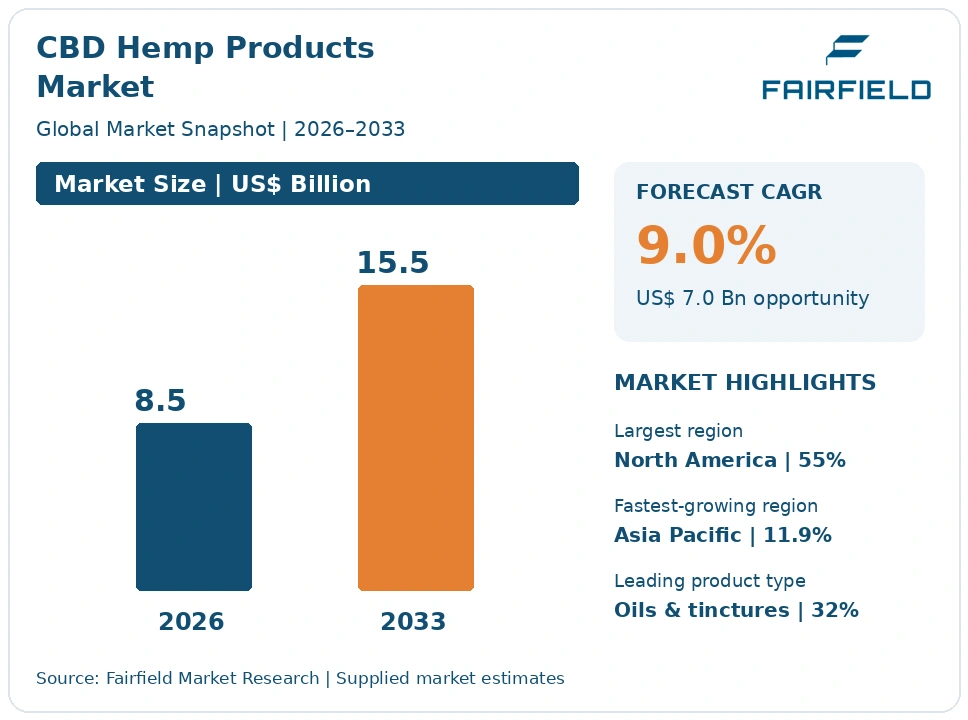
The global CBD hemp products market size is expected to be valued at US$ 8.5 billion in 2026 and projected to reach US$ 15.5 billion by 2033, growing at a CAGR of 9.0% between 2026 and 2033.
Headline growth of roughly 11% between 2020 and 2025 conceals two different periods. An early boom produced heavy cultivation and extraction overcapacity, after which bulk prices fell steeply and many brands exited. The market reached about US$ 7.8 billion in 2025 on a consolidated base. Three factors shape the forecast: incremental regulatory clarity in several jurisdictions, migration of sales into pharmacy, cosmetic and pet channels that accept documented ingredients, and continued price deflation in bulk isolate. The direction is steadier and more regulated than in the boom years, with volume growth outpacing value growth in the ingredient tier.
Key Report Takeaways
- By Product Type: Oils and tinctures held 32% share in 2026, while topicals and cosmetics are projected to expand at an 11.2% CAGR through 2033, because cosmetic ingredient rules give topical formats a clearer compliance route than ingestibles.
- By Extract Type: CBD isolate held 41% share in 2026, while broad-spectrum distillate is projected to expand at a 10.3% CAGR through 2033, as brands seek differentiation without the residual THC content that complicates export documentation.
- By Distribution Channel: Specialty and independent retail held 36% share in 2026, while pharmacies and drugstores are projected to expand at an 11.9% CAGR through 2033, reflecting channel preference for products with verified certificates of analysis.
- By Application: Nutraceutical and supplement formats held 34% share in 2026, while pet and animal care is projected to expand at an 11.6% CAGR through 2033, supported by a comparatively less contested regulatory treatment in several markets.
- By Geography: North America held 55% share in 2026, while Asia Pacific is projected to expand at an 11.9% CAGR through 2033, following statutory changes in Japan and permissive frameworks in Thailand and Australia.
Global CBD Hemp Products Market Trends and Insights
Drivers Impact Analysis
Two forces explain most of the growth available to compliant operators over the forecast period.
| Driver | Impact on CAGR Forecast | Geographic Relevance | Impact Timeline |
| Incremental regulatory clarity opening defined legal channels | High | Europe, Asia Pacific, North America | Medium term 2–4 years |
| Migration of demand into pharmacy, cosmetic and pet channels | Medium | North America, Europe | Short term ≤2 years |
Defined Legal Channels Replace Grey-Market Volume in CBD Hemp Product Sales
Each jurisdiction that defines a lawful route adds measurable, bankable volume. Where a channel is formally specified, operators gain payment processing, insurance, shelf space and advertising access that grey-market sellers cannot obtain. The effect is visible in markets that have published validated product lists or explicit cosmetic and food supplement rules, where retail distribution widens quickly once compliance criteria are known.
The mechanism is administrative rather than commercial. The 2018 Farm Bill in the United States removed hemp containing not more than 0.3% delta-9 THC on a dry weight basis from the controlled substances schedule, creating a lawful agricultural commodity. The United Nations Commission on Narcotic Drugs subsequently adjusted cannabis scheduling under the international conventions. In the United Kingdom, the Food Standards Agency validated-application list converted an undefined category into an administrable one, and retailers responded by restocking.
Pharmacy, Cosmetic and Pet Channels Absorb Demand That Mainstream Grocery Still Refuses
Channel migration is adding revenue without requiring any change in consumer numbers. Pharmacies, cosmetic retailers and pet specialists have accepted CBD products where mainstream grocery and large general retailers have not, because these channels already handle ingredient documentation and batch testing as routine practice. Average selling prices in these outlets hold up better than in discount and online channels.
The cause lies in how each product form is regulated. Topical cosmetic products are assessed under cosmetic ingredient rules, which are separate from food and supplement frameworks, so a compliant formulation path exists. Pet products sit under animal feed and veterinary rules that differ again by jurisdiction. Pharmacy buyers require certificates of analysis, contaminant testing and stable supply, conditions that favour consolidated suppliers with laboratory relationships and documented extraction processes.
Restraints Impact Analysis
Regulatory uncertainty, not consumer demand, is the binding constraint on this market.
| Restraint | Impact on CAGR Forecast | Geographic Relevance | Impact Timeline |
| Unsettled and inconsistent legal status across and within jurisdictions | High | Global | Long term ≥4 years |
| Intoxicating hemp-derived cannabinoids inviting collateral restriction | Medium | North America, Europe | Short term ≤2 years |
Unsettled Legal Status Caps Mainstream Retail and Banking Access for CBD Hemp Products
The single largest limit on this market is that lawful status remains unsettled and inconsistent, both between countries and between states or regions within them. In the United States the Food and Drug Administration has maintained that cannabidiol may not lawfully be marketed as a dietary supplement or added to conventional food under the drug exclusion rule, and has said a new pathway is needed from Congress. The practical result is a market operating under enforcement discretion rather than settled legality.
The costs are concrete. National retailers and large grocery chains decline the category on legal advice, payment processors apply elevated fees or refuse accounts, and insurers restrict cover. In the European Union, extracts are treated as a novel food requiring authorisation, applications remain under assessment, and national positions differ, so a single compliant formulation cannot be sold uniformly across member states.
Intoxicating Hemp-Derived Cannabinoids Risk Collateral Restriction on Compliant CBD Products
Products made from intoxicating hemp-derived cannabinoids have become the most urgent policy problem in the category, and they endanger compliant CBD suppliers who have no part in them. Delta-8 THC and similar converted cannabinoids are sold in some markets under the same hemp definitions, and legislators responding to them frequently propose rules written broadly enough to capture cannabidiol as well.
The cause is definitional. Legal frameworks were drafted around delta-9 THC concentration on a dry weight basis, not around total intoxicating potential, so chemically converted cannabinoids fall outside the original drafting. Several states and national authorities have responded with total-THC limits, age restrictions, outright bans or licensing regimes. Each change forces reformulation, relabelling and separate inventory, and the resulting compliance overhead falls hardest on smaller brands without regulatory staff.
Market Opportunities
Two revenue pools remain largely uncontested by the brands that dominated the boom years.
Regulated Cosmetic and Pharmacy Channels Open a Premium Pool for Documented CBD Suppliers
The clearest untapped revenue pool is supply into channels that demand documentation, because the brands built for unregulated online retail cannot serve them. Cosmetic manufacturers, pharmacy chains and private-label programmes need consistent cannabinoid assay, contaminant testing, batch traceability and reliable volumes. Suppliers able to meet those conditions sell at ingredient margins that have held steady while bulk isolate prices have fallen.
Extractors with laboratory accreditation, contract manufacturers and vertically integrated brands are positioned to capture this pool. The demand originates with cosmetic houses, private-label programme owners and pharmacy category buyers rather than with consumers directly, and purchase decisions turn almost entirely on the quality of compliance files rather than on brand recognition. The United Kingdom validated-application list and the cosmetic ingredient rules that treat topical use separately from ingestible use are the specific developments that make this channel addressable today.
Beverage and Pet Formats in Permissive Jurisdictions Create New Ingredient Demand
Beverages and pet products form a second pool, concentrated in jurisdictions that have written workable rules. These formats need low-dose, water-compatible or palatable ingredient systems rather than bulk oil, which shifts value toward emulsion technology, encapsulation and stability work. Ingredient suppliers can therefore sell formulation capability rather than commodity extract.
Beverage producers, pet food manufacturers and specialist ingredient houses are best placed to capture it, usually in partnership rather than alone. Demand is strongest where regulators have set explicit conditions, including several Canadian provincial and United States state frameworks, Thailand, and markets that permit animal applications under existing feed and veterinary rules. Statutory change in Japan, which moved its cannabis control framework toward a part-based and residual-limit approach, has opened a further addressable base for compliant ingredient supply into finished formats.
Segment Analysis
By Product Type: Oils and Tinctures Lead as Topicals and Cosmetics Scale Fastest
Oils and tinctures held 32% of product revenue in 2026, the largest share, because they were the original format and remain the simplest to manufacture, label and ship. Capsules and softgels, edibles and beverages, vapes and pet products divide most of the remainder. Oil formats also carry the lowest formulation cost, which has helped them survive the price correction that followed oversupply.
Topicals and cosmetics are the fastest-growing type at an 11.2% CAGR through 2033. The reason is regulatory rather than preference: cosmetic ingredient rules provide a defined assessment route for topical application, separate from the contested treatment of ingestible products, so retailers and manufacturers face less legal uncertainty. Vape formats face the most restrictive outlook as flavour and device rules tighten. The implication is that format growth tracks compliance clarity more closely than it tracks consumer novelty.
By Extract Type: Isolate Holds Volume Leadership While Broad-Spectrum Distillate Grows Quicker
CBD isolate accounted for 41% of extract volume in 2026, leading because it is the easiest material to assay, label and move across borders. Isolate contains no measurable THC, which simplifies customs documentation and retailer acceptance. That same commoditisation has made it the segment with the steepest price deflation, so volume leadership does not translate into margin leadership.
Broad-spectrum distillate is expanding fastest at a 10.3% CAGR through 2033. Brands use it to differentiate finished products while avoiding the residual THC content of full-spectrum material, which creates testing and export complications. Full-spectrum distillate retains a loyal base in permissive jurisdictions. The business implication is that extraction companies are competing on purification precision and analytical documentation, since the ability to hit a specified cannabinoid profile reliably is now the differentiator.
By Distribution Channel: Specialty Retail Leads While Pharmacies Record the Quickest Gains
Specialty and independent retail held 36% share in 2026, the leading channel, because dedicated stores and smoke or wellness shops accepted the category when mainstream grocery would not. Online direct-to-consumer follows closely and remains important for subscription purchasing, though customer acquisition costs have risen as advertising platforms restrict the category.
Pharmacies and drugstores are the fastest-growing channel at an 11.9% CAGR through 2033. Pharmacy buyers require certificates of analysis, contaminant screening and consistent supply, conditions that consolidated suppliers can now meet. Mass grocery and convenience remain largely closed in jurisdictions where legal status is unsettled, which is the clearest evidence that regulation rather than demand sets the channel ceiling. For brands, the implication is that distribution gains now depend on compliance investment rather than on marketing spend.
By Application: Supplement Formats Lead While Pet and Animal Care Expands Fastest
Nutraceutical and supplement formats represented 34% of applications in 2026, the largest group, reflecting the formats that built the category. This position persists despite the regulatory contest over ingestible products, because established brands and repeat purchasing concentrate here. Food and beverage, personal care and cosmetics, and pharmaceutical ingredient development account for the balance.
Pet and animal care is growing fastest at an 11.6% CAGR through 2033. The application sits under animal feed and veterinary frameworks that differ from human food rules, and several jurisdictions have treated it with fewer restrictions, giving manufacturers a workable route to retail. Pet specialty chains have also proved willing stockists. The implication is that growth accrues to applications with the least contested regulatory classification, which is an unusual pattern for a consumer category and one that rewards regulatory expertise over brand building.
Geography Analysis
Which Region Is Leading the CBD Hemp Products Market?
North America leads the CBD hemp products market with a 55% share in 2026, almost entirely because of the United States, with Canada contributing a smaller regulated volume. The 2018 Farm Bill created a lawful hemp commodity, and an extensive retail and online infrastructure formed around it faster than in any other region.
The position is not a sign of regulatory comfort. The Food and Drug Administration has maintained that cannabidiol may not be marketed as a dietary supplement or added to conventional food, so national grocery chains and many payment processors remain absent. State-level rules diverge sharply, and several states have restricted or banned converted cannabinoids. The change to watch is federal legislative action, which is the only mechanism that could convert enforcement discretion into settled legality and unlock mainstream retail.
Europe Advances Slowly Because Novel Food Authorisation Remains Unresolved
Europe held 27% of the market in 2026, led by the United Kingdom, Germany, Switzerland, Poland and Spain. The region has the most developed cosmetic and food supplement infrastructure, but its growth is paced by an unresolved authorisation question rather than by demand.
In the European Union, cannabidiol extracts are treated as a novel food requiring authorisation, applications have been under assessment, and national competent authorities differ in how they handle products in the meantime. That divergence prevents a single compliant product from being sold uniformly across member states. The United Kingdom took a different route, operating a validated-application list that gives retailers a reference point for which products may remain on sale. Switzerland permits certain categories under its own framework. The opportunity lies in cosmetics, where the assessment basis is separate and clearer.
Which Region Is Growing Fastest in the CBD Hemp Products Market?
Asia Pacific is growing fastest in the CBD hemp products market at an 11.9% CAGR between 2026 and 2033, expanding from an 11% base share in 2026. Japan, Thailand, Australia and South Korea account for most of the movement, with China important as a cultivation and extraction base rather than a consumer market.
Statutory change is the cause. Japan revised its cannabis control framework toward a parts-and-residual-limit approach, which clarified what may lawfully be imported and sold. Thailand adopted a comparatively permissive hemp framework, although its policy settings have been revised repeatedly. Australia regulates cannabidiol through its therapeutic goods framework, which restricts general retail but creates a defined pharmacy route. The opportunity is ingredient supply to local manufacturers who need documented material to satisfy these newly specified national conditions.
Latin America Builds a Regulated Base Around Pharmacy and Import Authorisation
Latin America accounted for 4% of the market in 2026, with Brazil, Colombia, Mexico, Uruguay and Argentina the active markets. Colombia and Uruguay developed cultivation and export capability early, while Brazil channels most lawful product through pharmacy and authorised import routes rather than general retail.
The barriers are structural. Import authorisation is often product-specific and administratively slow, currency volatility raises the cost of imported extract, and the division between hemp-derived consumer products and medical cannabis regimes is unclear in several countries. Informal retail competes on price with compliant product, which suppresses margins. The change shaping the region is the gradual formalisation of pharmacy distribution, which gives compliant suppliers a defensible channel and makes contaminant testing and documentation a commercial asset rather than a cost.
Middle East & Africa Remains the Smallest Market Under Restrictive Cannabis Frameworks
Middle East & Africa represented 3% of global sales in 2026, the smallest regional share by a wide margin, and most of that activity sits in South Africa and Israel. Across much of the region, national law treats cannabis-derived substances restrictively and makes consumer CBD products unlawful or commercially impractical.
The barriers are legal before they are commercial. Several countries apply strict controlled-substance rules with severe penalties, so retailers and distributors avoid the category entirely. Customs enforcement is unpredictable even where a product would be compliant at destination, and banking access is limited. South Africa has a defined regulatory position that permits certain low-dose products, and Lesotho and Morocco have developed licensed cultivation for export. The change worth tracking is export-oriented cultivation, which connects the region to demand elsewhere rather than creating domestic consumption.
Competitive Landscape
The CBD hemp products market is highly fragmented, with low concentration and no participant holding a dominant global position. Thousands of brands entered during the boom, and although consolidation and failure have removed many, the surviving field remains wide and regionally divided. Fragmentation persists because regulation is national or even sub-national, so scale earned in one jurisdiction transfers poorly to the next. The bulk ingredient tier has consolidated faster than the brand tier, since extraction is capital-intensive and price deflation in isolate has forced smaller processors to exit or convert to contract work.
Competition now turns on compliance capability and channel access rather than on product claims. Vendors compete on certificate-of-analysis quality, contaminant and potency testing, consistency of cannabinoid profile, supply reliability and the ability to document provenance from cultivation forward. Retail and pharmacy buyers increasingly audit these files before listing. Private-label manufacturing has become a significant route to volume for processors, because brands that lack extraction assets need reliable supply. New entrants are concentrated in beverage emulsions, cosmetic ingredient systems and pet formats rather than in general wellness oils, where the field is crowded and margins have compressed.
Strategic activity has been dominated by restructuring rather than expansion. Operators have written down cultivation and extraction assets, closed excess capacity, consolidated brand portfolios and shifted toward asset-light models. Several cannabis groups have reorganised their hemp-derived divisions to focus on jurisdictions with defined rules, and distribution agreements with pharmacy and specialty retail chains have replaced broad retail pushes as the preferred growth mechanism.
Strategic direction across the field is converging on three themes: concentrating investment in jurisdictions with written rules, moving up the value chain from bulk extract into formulated ingredient systems, and building regulatory affairs capability as a core function rather than an overhead.
CBD Hemp Products Industry Leaders
- Charlotte’s Web Holdings, Inc.
- cbdMD, Inc.
- CV Sciences, Inc.
- Canopy Growth Corporation
- Tilray Brands, Inc.
Recent Industry Developments
December 2018: The United States enacted the 2018 Farm Bill, removing hemp containing not more than 0.3% delta-9 THC on a dry weight basis from the controlled substances schedule – this created the lawful agricultural commodity on which the entire category rests.
November 2020: The Court of Justice of the European Union ruled that a member state could not prohibit the marketing of cannabidiol lawfully produced in another member state on free movement grounds – the judgment weakened national narcotic classifications of CBD.
December 2020: The United Nations Commission on Narcotic Drugs voted to remove cannabis and cannabis resin from Schedule IV of the 1961 Single Convention, following World Health Organization Expert Committee on Drug Dependence recommendations – this reduced the international legal barrier to domestic reform.
March 2021: The Food Standards Agency in the United Kingdom closed its novel food application window, after which only products linked to a validated application could remain on sale – this gave United Kingdom retailers their first administrable compliance test.
January 2023: The Food and Drug Administration announced that existing regulatory frameworks are not appropriate for cannabidiol and that a new pathway is needed from Congress, declining to initiate dietary supplement rulemaking – this confirmed that the United States market would continue operating under enforcement discretion.
CBD Hemp Products Market Report Scope
| Metric | Value |
| Study Period | 2020–2033 |
| Market Size 2026 | US$ 8.5 Billion |
| Market Size 2033 | US$ 15.5 Billion |
| CAGR 2026–2033 | 9.0% |
| Absolute Dollar Opportunity | US$ 7.0 Billion |
| Largest Market | North America — 55% share in 2026 |
| Fastest-Growing Market | Asia Pacific — 11.9% CAGR |
| Market Concentration | Low |
| Major Players | Charlotte’s Web Holdings, Inc., cbdMD, Inc., CV Sciences, Inc., Canopy Growth Corporation, Tilray Brands, Inc. |
This report covers consumer and ingredient products containing cannabidiol derived from hemp: oils and tinctures, capsules and softgels, edibles and beverages, topicals and cosmetics, vapes and pet products, together with bulk isolate, broad-spectrum and full-spectrum distillate sold as ingredients. Marijuana-derived and prescription cannabinoid medicines are excluded. The base year is 2025, the forecast period runs from 2026 to 2033, and values are reported in US$ Billion.
CBD Hemp Products Market Segmentation
Product Type
- Oils and Tinctures
- Capsules and Softgels
- Edibles and Beverages
- Topicals and Cosmetics
- Vapes
- Pet Products
Extract Type
- CBD Isolate
- Broad-Spectrum Distillate
- Full-Spectrum Distillate
Distribution Channel
- Specialty and Independent Retail
- Online Direct-to-Consumer
- Pharmacies and Drugstores
- Mass Grocery and Convenience
Application
- Nutraceutical and Supplement Formats
- Food and Beverage
- Personal Care and Cosmetics
- Pet and Animal Care
- Pharmaceutical Ingredient Development
Regions
- North America
- Europe
- Asia Pacific
- Latin America
- Middle East & Africa
- Executive Summary
- Global CBD Hemp Products Market Snapshot
- Future Projections
- Key Report Takeaways
- Regional Snapshot
- Market Overview
- Market Definition and Report Scope
- Historical Trends 2020–2025
- Market Dynamics
- Drivers
- Defined Legal Channels Replace Grey-Market Volume in CBD Hemp Product Sales
- Pharmacy, Cosmetic and Pet Channels Absorb Demand That Mainstream Grocery Still Refuses
- Restraints
- Unsettled Legal Status Caps Mainstream Retail and Banking Access for CBD Hemp Products
- Intoxicating Hemp-Derived Cannabinoids Risk Collateral Restriction on Compliant CBD Products
- Market Opportunities
- Regulated Cosmetic and Pharmacy Channels Open a Premium Pool for Documented CBD Suppliers
- Beverage and Pet Formats in Permissive Jurisdictions Create New Ingredient Demand
- Drivers
- Global CBD Hemp Products Market Outlook, 2020–2033
- Global CBD Hemp Products Market Outlook, by Product Type, Value (US$ Billion), 2020–2033
- Oils and Tinctures
- Capsules and Softgels
- Edibles and Beverages
- Topicals and Cosmetics
- Vapes
- Pet Products
- Global CBD Hemp Products Market Outlook, by Extract Type, Value (US$ Billion), 2020–2033
- CBD Isolate
- Broad-Spectrum Distillate
- Full-Spectrum Distillate
- Global CBD Hemp Products Market Outlook, by Distribution Channel, Value (US$ Billion), 2020–2033
- Specialty and Independent Retail
- Online Direct-to-Consumer
- Pharmacies and Drugstores
- Mass Grocery and Convenience
- Global CBD Hemp Products Market Outlook, by Application, Value (US$ Billion), 2020–2033
- Nutraceutical and Supplement Formats
- Food and Beverage
- Personal Care and Cosmetics
- Pet and Animal Care
- Pharmaceutical Ingredient Development
- Global CBD Hemp Products Market Outlook, by Region, Value (US$ Billion), 2020–2033
- North America
- Europe
- Asia Pacific
- Latin America
- Middle East & Africa
- Global CBD Hemp Products Market Outlook, by Product Type, Value (US$ Billion), 2020–2033
- North America CBD Hemp Products Market Outlook, 2020–2033
- North America CBD Hemp Products Market Outlook, by Product Type, Value (US$ Billion), 2020–2033
- Oils and Tinctures
- Capsules and Softgels
- Edibles and Beverages
- Topicals and Cosmetics
- Vapes
- Pet Products
- North America CBD Hemp Products Market Outlook, by Extract Type, Value (US$ Billion), 2020–2033
- CBD Isolate
- Broad-Spectrum Distillate
- Full-Spectrum Distillate
- North America CBD Hemp Products Market Outlook, by Distribution Channel, Value (US$ Billion), 2020–2033
- Specialty and Independent Retail
- Online Direct-to-Consumer
- Pharmacies and Drugstores
- Mass Grocery and Convenience
- North America CBD Hemp Products Market Outlook, by Application, Value (US$ Billion), 2020–2033
- Nutraceutical and Supplement Formats
- Food and Beverage
- Personal Care and Cosmetics
- Pet and Animal Care
- Pharmaceutical Ingredient Development
- North America CBD Hemp Products Market Outlook, by Country, Value (US$ Billion), 2020–2033
- United States CBD Hemp Products Market Outlook, by Product Type, 2020–2033
- United States CBD Hemp Products Market Outlook, by Extract Type, 2020–2033
- United States CBD Hemp Products Market Outlook, by Distribution Channel, 2020–2033
- United States CBD Hemp Products Market Outlook, by Application, 2020–2033
- Canada CBD Hemp Products Market Outlook, by Product Type, 2020–2033
- Canada CBD Hemp Products Market Outlook, by Extract Type, 2020–2033
- Canada CBD Hemp Products Market Outlook, by Distribution Channel, 2020–2033
- Canada CBD Hemp Products Market Outlook, by Application, 2020–2033
- North America CBD Hemp Products Market Outlook, by Product Type, Value (US$ Billion), 2020–2033
- Europe CBD Hemp Products Market Outlook, 2020–2033
- Europe CBD Hemp Products Market Outlook, by Product Type, Value (US$ Billion), 2020–2033
- Oils and Tinctures
- Capsules and Softgels
- Edibles and Beverages
- Topicals and Cosmetics
- Vapes
- Pet Products
- Europe CBD Hemp Products Market Outlook, by Extract Type, Value (US$ Billion), 2020–2033
- CBD Isolate
- Broad-Spectrum Distillate
- Full-Spectrum Distillate
- Europe CBD Hemp Products Market Outlook, by Distribution Channel, Value (US$ Billion), 2020–2033
- Specialty and Independent Retail
- Online Direct-to-Consumer
- Pharmacies and Drugstores
- Mass Grocery and Convenience
- Europe CBD Hemp Products Market Outlook, by Application, Value (US$ Billion), 2020–2033
- Nutraceutical and Supplement Formats
- Food and Beverage
- Personal Care and Cosmetics
- Pet and Animal Care
- Pharmaceutical Ingredient Development
- Europe CBD Hemp Products Market Outlook, by Country, Value (US$ Billion), 2020–2033
- United Kingdom CBD Hemp Products Market Outlook, by Product Type, 2020–2033
- United Kingdom CBD Hemp Products Market Outlook, by Extract Type, 2020–2033
- United Kingdom CBD Hemp Products Market Outlook, by Distribution Channel, 2020–2033
- United Kingdom CBD Hemp Products Market Outlook, by Application, 2020–2033
- Germany CBD Hemp Products Market Outlook, by Product Type, 2020–2033
- Germany CBD Hemp Products Market Outlook, by Extract Type, 2020–2033
- Germany CBD Hemp Products Market Outlook, by Distribution Channel, 2020–2033
- Germany CBD Hemp Products Market Outlook, by Application, 2020–2033
- Switzerland CBD Hemp Products Market Outlook, by Product Type, 2020–2033
- Switzerland CBD Hemp Products Market Outlook, by Extract Type, 2020–2033
- Switzerland CBD Hemp Products Market Outlook, by Distribution Channel, 2020–2033
- Switzerland CBD Hemp Products Market Outlook, by Application, 2020–2033
- Poland CBD Hemp Products Market Outlook, by Product Type, 2020–2033
- Poland CBD Hemp Products Market Outlook, by Extract Type, 2020–2033
- Poland CBD Hemp Products Market Outlook, by Distribution Channel, 2020–2033
- Poland CBD Hemp Products Market Outlook, by Application, 2020–2033
- Spain CBD Hemp Products Market Outlook, by Product Type, 2020–2033
- Spain CBD Hemp Products Market Outlook, by Extract Type, 2020–2033
- Spain CBD Hemp Products Market Outlook, by Distribution Channel, 2020–2033
- Spain CBD Hemp Products Market Outlook, by Application, 2020–2033
- Europe CBD Hemp Products Market Outlook, by Product Type, Value (US$ Billion), 2020–2033
- Asia Pacific CBD Hemp Products Market Outlook, 2020–2033
- Asia Pacific CBD Hemp Products Market Outlook, by Product Type, Value (US$ Billion), 2020–2033
- Oils and Tinctures
- Capsules and Softgels
- Edibles and Beverages
- Topicals and Cosmetics
- Vapes
- Pet Products
- Asia Pacific CBD Hemp Products Market Outlook, by Extract Type, Value (US$ Billion), 2020–2033
- CBD Isolate
- Broad-Spectrum Distillate
- Full-Spectrum Distillate
- Asia Pacific CBD Hemp Products Market Outlook, by Distribution Channel, Value (US$ Billion), 2020–2033
- Specialty and Independent Retail
- Online Direct-to-Consumer
- Pharmacies and Drugstores
- Mass Grocery and Convenience
- Asia Pacific CBD Hemp Products Market Outlook, by Application, Value (US$ Billion), 2020–2033
- Nutraceutical and Supplement Formats
- Food and Beverage
- Personal Care and Cosmetics
- Pet and Animal Care
- Pharmaceutical Ingredient Development
- Asia Pacific CBD Hemp Products Market Outlook, by Country, Value (US$ Billion), 2020–2033
- Japan CBD Hemp Products Market Outlook, by Product Type, 2020–2033
- Japan CBD Hemp Products Market Outlook, by Extract Type, 2020–2033
- Japan CBD Hemp Products Market Outlook, by Distribution Channel, 2020–2033
- Japan CBD Hemp Products Market Outlook, by Application, 2020–2033
- Thailand CBD Hemp Products Market Outlook, by Product Type, 2020–2033
- Thailand CBD Hemp Products Market Outlook, by Extract Type, 2020–2033
- Thailand CBD Hemp Products Market Outlook, by Distribution Channel, 2020–2033
- Thailand CBD Hemp Products Market Outlook, by Application, 2020–2033
- Australia CBD Hemp Products Market Outlook, by Product Type, 2020–2033
- Australia CBD Hemp Products Market Outlook, by Extract Type, 2020–2033
- Australia CBD Hemp Products Market Outlook, by Distribution Channel, 2020–2033
- Australia CBD Hemp Products Market Outlook, by Application, 2020–2033
- South Korea CBD Hemp Products Market Outlook, by Product Type, 2020–2033
- South Korea CBD Hemp Products Market Outlook, by Extract Type, 2020–2033
- South Korea CBD Hemp Products Market Outlook, by Distribution Channel, 2020–2033
- South Korea CBD Hemp Products Market Outlook, by Application, 2020–2033
- China CBD Hemp Products Market Outlook, by Product Type, 2020–2033
- China CBD Hemp Products Market Outlook, by Extract Type, 2020–2033
- China CBD Hemp Products Market Outlook, by Distribution Channel, 2020–2033
- China CBD Hemp Products Market Outlook, by Application, 2020–2033
- Asia Pacific CBD Hemp Products Market Outlook, by Product Type, Value (US$ Billion), 2020–2033
- Latin America CBD Hemp Products Market Outlook, 2020–2033
- Latin America CBD Hemp Products Market Outlook, by Product Type, Value (US$ Billion), 2020–2033
- Oils and Tinctures
- Capsules and Softgels
- Edibles and Beverages
- Topicals and Cosmetics
- Vapes
- Pet Products
- Latin America CBD Hemp Products Market Outlook, by Extract Type, Value (US$ Billion), 2020–2033
- CBD Isolate
- Broad-Spectrum Distillate
- Full-Spectrum Distillate
- Latin America CBD Hemp Products Market Outlook, by Distribution Channel, Value (US$ Billion), 2020–2033
- Specialty and Independent Retail
- Online Direct-to-Consumer
- Pharmacies and Drugstores
- Mass Grocery and Convenience
- Latin America CBD Hemp Products Market Outlook, by Application, Value (US$ Billion), 2020–2033
- Nutraceutical and Supplement Formats
- Food and Beverage
- Personal Care and Cosmetics
- Pet and Animal Care
- Pharmaceutical Ingredient Development
- Latin America CBD Hemp Products Market Outlook, by Country, Value (US$ Billion), 2020–2033
- Brazil CBD Hemp Products Market Outlook, by Product Type, 2020–2033
- Brazil CBD Hemp Products Market Outlook, by Extract Type, 2020–2033
- Brazil CBD Hemp Products Market Outlook, by Distribution Channel, 2020–2033
- Brazil CBD Hemp Products Market Outlook, by Application, 2020–2033
- Colombia CBD Hemp Products Market Outlook, by Product Type, 2020–2033
- Colombia CBD Hemp Products Market Outlook, by Extract Type, 2020–2033
- Colombia CBD Hemp Products Market Outlook, by Distribution Channel, 2020–2033
- Colombia CBD Hemp Products Market Outlook, by Application, 2020–2033
- Mexico CBD Hemp Products Market Outlook, by Product Type, 2020–2033
- Mexico CBD Hemp Products Market Outlook, by Extract Type, 2020–2033
- Mexico CBD Hemp Products Market Outlook, by Distribution Channel, 2020–2033
- Mexico CBD Hemp Products Market Outlook, by Application, 2020–2033
- Uruguay CBD Hemp Products Market Outlook, by Product Type, 2020–2033
- Uruguay CBD Hemp Products Market Outlook, by Extract Type, 2020–2033
- Uruguay CBD Hemp Products Market Outlook, by Distribution Channel, 2020–2033
- Uruguay CBD Hemp Products Market Outlook, by Application, 2020–2033
- Argentina CBD Hemp Products Market Outlook, by Product Type, 2020–2033
- Argentina CBD Hemp Products Market Outlook, by Extract Type, 2020–2033
- Argentina CBD Hemp Products Market Outlook, by Distribution Channel, 2020–2033
- Argentina CBD Hemp Products Market Outlook, by Application, 2020–2033
- Latin America CBD Hemp Products Market Outlook, by Product Type, Value (US$ Billion), 2020–2033
- Middle East & Africa CBD Hemp Products Market Outlook, 2020–2033
- Middle East & Africa CBD Hemp Products Market Outlook, by Product Type, Value (US$ Billion), 2020–2033
- Oils and Tinctures
- Capsules and Softgels
- Edibles and Beverages
- Topicals and Cosmetics
- Vapes
- Pet Products
- Middle East & Africa CBD Hemp Products Market Outlook, by Extract Type, Value (US$ Billion), 2020–2033
- CBD Isolate
- Broad-Spectrum Distillate
- Full-Spectrum Distillate
- Middle East & Africa CBD Hemp Products Market Outlook, by Distribution Channel, Value (US$ Billion), 2020–2033
- Specialty and Independent Retail
- Online Direct-to-Consumer
- Pharmacies and Drugstores
- Mass Grocery and Convenience
- Middle East & Africa CBD Hemp Products Market Outlook, by Application, Value (US$ Billion), 2020–2033
- Nutraceutical and Supplement Formats
- Food and Beverage
- Personal Care and Cosmetics
- Pet and Animal Care
- Pharmaceutical Ingredient Development
- Middle East & Africa CBD Hemp Products Market Outlook, by Country, Value (US$ Billion), 2020–2033
- South Africa CBD Hemp Products Market Outlook, by Product Type, 2020–2033
- South Africa CBD Hemp Products Market Outlook, by Extract Type, 2020–2033
- South Africa CBD Hemp Products Market Outlook, by Distribution Channel, 2020–2033
- South Africa CBD Hemp Products Market Outlook, by Application, 2020–2033
- Israel CBD Hemp Products Market Outlook, by Product Type, 2020–2033
- Israel CBD Hemp Products Market Outlook, by Extract Type, 2020–2033
- Israel CBD Hemp Products Market Outlook, by Distribution Channel, 2020–2033
- Israel CBD Hemp Products Market Outlook, by Application, 2020–2033
- Lesotho CBD Hemp Products Market Outlook, by Product Type, 2020–2033
- Lesotho CBD Hemp Products Market Outlook, by Extract Type, 2020–2033
- Lesotho CBD Hemp Products Market Outlook, by Distribution Channel, 2020–2033
- Lesotho CBD Hemp Products Market Outlook, by Application, 2020–2033
- Morocco CBD Hemp Products Market Outlook, by Product Type, 2020–2033
- Morocco CBD Hemp Products Market Outlook, by Extract Type, 2020–2033
- Morocco CBD Hemp Products Market Outlook, by Distribution Channel, 2020–2033
- Morocco CBD Hemp Products Market Outlook, by Application, 2020–2033
- Middle East & Africa CBD Hemp Products Market Outlook, by Product Type, Value (US$ Billion), 2020–2033
- Competitive Landscape
- Market Concentration and Industry Leaders
- Competitive Differentiation
- Strategic Moves and Market Direction
- Recent Industry Developments
- Company Profiles
- Charlotte's Web Holdings, Inc.
- cbdMD, Inc.
- CV Sciences, Inc.
- Canopy Growth Corporation
- Tilray Brands, Inc.
- Curaleaf Holdings, Inc.
- Medterra CBD
- Green Roads
- Joy Organics
- Lazarus Naturals
- Endoca
- Elixinol Wellness Limited
- Mile High Labs
- Appendix
- Research Methodology
- Report Assumptions
- Acronyms and Abbreviations
Product Type
- Oils and Tinctures
- Capsules and Softgels
- Edibles and Beverages
- Topicals and Cosmetics
- Vapes
- Pet Products
Extract Type
- CBD Isolate
- Broad-Spectrum Distillate
- Full-Spectrum Distillate
Distribution Channel
- Specialty and Independent Retail
- Online Direct-to-Consumer
- Pharmacies and Drugstores
- Mass Grocery and Convenience
Application
- Nutraceutical and Supplement Formats
- Food and Beverage
- Personal Care and Cosmetics
- Pet and Animal Care
- Pharmaceutical Ingredient Development
Regions
- North America
- Europe
- Asia Pacific
- Latin America
- Middle East & Africa
Our Research Methodology
Considering the volatility of business today, traditional approaches to strategizing a game plan can be unfruitful if not detrimental. True ambiguity is no way to determine a forecast. A myriad of predetermined factors must be accounted for such as the degree of risk involved, the magnitude of circumstances, as well as conditions or consequences that are not known or unpredictable. To circumvent binary views that cast uncertainty, the application of market research intelligence to strategically posture, move, and enable actionable outcomes is necessary.
View Methodology
Quality Assured
Rigorous Validation Process

Confidentiality Assured
End-to-end Data Security

Custom Research Services
Tailored To Your Objectives
FAQs
The market is valued at US$ 8.5 billion in 2026, covering consumer finished products and bulk cannabidiol sold as an ingredient to manufacturers.
The market is projected to reach US$ 15.5 billion by 2033, growing at a 9.0% CAGR and adding US$ 7.0 billion across the forecast period.
Oils and tinctures lead with 32% share in 2026, since they remain the simplest format to manufacture, label and distribute across jurisdictions.
Pharmacies and drugstores grow fastest among channels at an 11.9% CAGR, matching Asia Pacific, the fastest-growing region at 11.9% through 2033.
Concentration is low and the field is fragmented, because national and sub-national rules differ so widely that scale rarely transfers between jurisdictions.
Related Reports
Omics-Based Clinical Trials Market Size, Share, Insights, Competitive Landscape, and Forecast 2026 to 2033
Omics-based clinical trials market to grow from US$38.32 Bn in 2026 to US$65.67 Bn by 2033 at 8.0% CAGR. Explore trial phases, indications and regions.
Ocular Hypertension Market Size, Share, Insights, Competitive Landscape, and Forecast 2026 to 2033
Ocular hypertension market to reach US$ 8.05 billion by 2033 at an 8.2% CAGR. Explore drug classes, delivery modes, pharmacy channels and regional trends.
Obesity GLP-1 Market Size, Share, Insights, Competitive Landscape, and Forecast 2026 to 2033
Obesity GLP-1 market to reach US$ 65.20 billion by 2033 at a 13.1% CAGR. Explore drugs, administration routes, pharmacy channels and regional trends.
Upstream Bioprocessing Market Size, Share, Insights, Competitive Landscape, and Forecast 2026 to 2033
Upstream bioprocessing market to reach US$ 92.23 billion by 2033 at a 14.3% CAGR. Explore products, use types, manufacturing modes and regional trends.
Personalized Cancer Vaccine Market Size, Share, Insights, Competitive Landscape, and Forecast 2026 to 2033
Personalized cancer vaccine market to reach US$ 16.57 billion by 2033 at an 18.7% CAGR. Explore vaccine types, cancer types and regional trends.
PEGylated Proteins Market Size, Share, Insights, Competitive Landscape, and Forecast 2026 to 2033
PEGylated proteins market to reach US$ 4.58 billion by 2033 at a 10.9% CAGR. Explore products, protein types, applications and regional trends.