



Vaccine Adjuvants Market
Vaccine Adjuvants Market Insights, Competitive Landscape, and Market Forecast - 2033
Global Vaccine Adjuvants Market Forecast
- The vaccine adjuvants market is projected to reach USD 4.3 billion by 2033 from USD 2.6 billion estimated in 2026.
- The vaccine adjuvants market is set to witness a CAGR of 6% from 2026 to 2033.
Vaccine Adjuvants Market Insights
- Rising prevalence of infectious diseases like COVID-19 and malaria is boosting demand for unique vaccine adjuvants.
- New adjuvant technologies, including lipid nanoparticles and immune modulators, enhance vaccine efficacy and safety.
- mRNA vaccine technology, which relies heavily on novel adjuvants, is driving growth in the market.
- Government funding and immunization programs are accelerating the development and adoption of novel vaccine adjuvants.
- Pharmaceutical companies are investing significantly in developing new adjuvants to combat emerging pathogens.
- Regulatory bodies like the FDA provide approval pathways for new adjuvants, boosting market growth.
- Shift toward personalized vaccines presents new opportunities for tailored adjuvants in specific patient groups.
- North America leads the global market with its cutting-edge healthcare infrastructure.
- Human vaccines dominate the vaccine type segmentation, with 70% of the market share in 2025.
- Adjuvant emulsions lead the product type segmentation with a 30% share in 2025.
- Rising Prevalence of Infectious Diseases like Influenza
- In 2024, over 14 million dengue cases and more than 10,000 dengue-related deaths were reported globally.
- Vector-borne diseases, such as malaria and dengue, account for more than 17% of all infectious diseases, causing over 700,000 deaths annually.
- Government Immunization Programs and Funding Initiatives
- Safety Concerns and Regulatory Challenges to Hinder Market Growth
- Development of Novel Adjuvants for Enhanced Vaccine Efficacy
- Expansion of mRNA Vaccine Technology
- Adjuvant Emulsions Lead Amid Enhancement of Immune Response
- Human Vaccines Dominate with Surging Cases of Infectious Diseases
- North America to Lead due to Presence of Robust Healthcare Infrastructure
- Asia Pacific is a Rapidly Developing Powerhouse in the Market
- Pfizer Inc.
- GlaxoSmithKline plc
- AstraZeneca
- 3M
- Merck KGaA
- Adjuvatis
- Croda International Plc
- Novavax, Inc.
- InvivoGen
- Phibro Animal Health Corporation
- SEPPIC
- Agenus Inc.
- Adjuvant Emulsions
- Particulate Adjuvants
- Combination Adjuvants
- Pathogen Components
- Carbohydrate Adjuvants
- Liposome Adjuvants
- Alum
- Others
- Intramuscular Route
- Intranasal Route
- Intradermal Route
- Oral Route
- Subcutaneous Route
- Others
- Cancer
- Infectious Diseases
- Others
- Commercial Application
- Research Application
- Human Vaccine
- Veterinary Vaccine
- Adults
- Pediatric
- Others
- North America
- Europe
- Asia Pacific
- Latin America
- Middle East and Africa
Key Growth Determinants
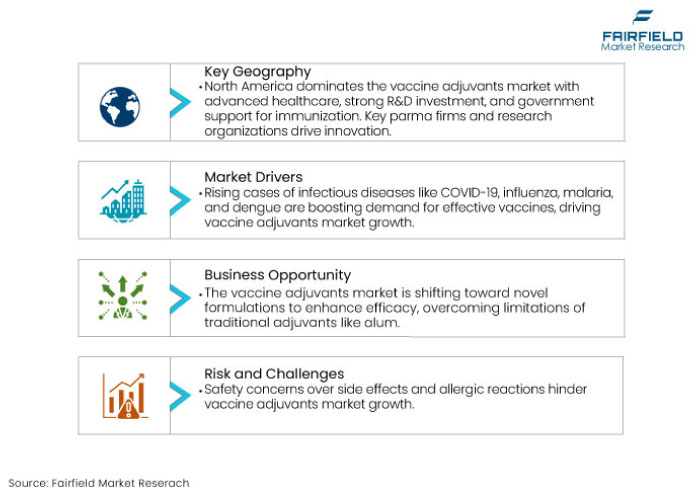
Increasing prevalence of infectious diseases, including COVID-19, influenza, malaria, and dengue, is driving demand for more effective vaccines, fueling growth of the vaccine adjuvants market. For example,
Vaccine adjuvants strengthen the immune response, ensuring vaccines provide long-lasting and comprehensive protection. In recent years, global health crises like the COVID-19 pandemic have highlighted the importance of advanced adjuvant technologies to improve vaccine efficacy and scalability.
Governments worldwide are intensifying efforts to combat preventable diseases through immunization programs, significantly boosting the vaccine adjuvants market. Large-scale vaccination campaigns, often supported by organizations like WHO, UNICEF, and Gavi, aim to increase vaccine coverage, especially in underserved regions.
Initiatives such as Gavi and the Vaccine Alliance have played a pivotal role in delivering vaccines to low-income countries, creating a rising demand for innovative adjuvants. Governments are also increasing public health budgets and providing grants to pharmaceutical companies to encourage vaccine research and production.
Key Growth Barriers
One leading restraint in the vaccine adjuvants market is the safety concerns associated with their use. Adjuvants are added to vaccines to enhance immune responses, but their inclusion may sometimes lead to unexpected side effects or adverse reactions. The potential for increased inflammation or allergic responses raises concern among healthcare providers and regulators.
Regulatory agencies like the FDA and EMA are often cautious in approving new adjuvants, which can result in lengthy approval processes. This stringent regulatory environment can slow the introduction of innovative adjuvants, affecting market growth.
Vaccine Adjuvants Market Trends and Opportunities
A prominent trend in the vaccine adjuvants market is the increasing focus on developing novel adjuvants to improve vaccine efficacy. Traditional adjuvants, like alum, have been used for decades, but their limitations have led to significant research into new adjuvant formulations.
Vaccine manufacturers are exploring various unique adjuvants, such as lipid nanoparticles, liposomes, and immune modulators, to enhance immune responses more effectively. Developing these innovative adjuvants is crucial, particularly for tackling emerging infectious diseases and viral mutations. As the need for more effective vaccines increases, particularly against challenging pathogens like HIV, malaria, and influenza, demand for novel adjuvants is expected to rise.
One of the most transformative opportunities in the vaccine adjuvants market lies in expanding mRNA vaccine technology. The success of mRNA vaccines during the COVID-19 pandemic has opened the door for future vaccines targeting various infectious diseases, including influenza, Zika virus, and cancer.
mRNA vaccines often rely on novel adjuvants, such as lipid nanoparticles (LNPs), to deliver the mRNA effectively and stimulate a robust immune response. As mRNA technology continues to evolve, demand for innovative adjuvants to enhance the efficacy and stability of these vaccines is set to rise. In 2024, the U.S. federal government allocated an additional US$ 590 Mn to Moderna to expedite the approval of its mRNA-based H5N1 avian influenza vaccine.
Segments Covered in the Report
In the ever-evolving vaccine adjuvants market, adjuvant emulsions are the leading product type, holding an impressive share of over 30% in 2025. These emulsions are highly regarded for significantly boosting the immune response, making vaccines more effective across a wide range of diseases.
Adjuvant emulsions are crucial in improving vaccine efficacy, from combating infectious illnesses to advancing cancer immunotherapy. Their dominance can be attributed to their proven track record, versatility, and increased use in human and veterinary vaccines.
In the vaccine adjuvants market, human vaccines dominate the vaccine type segmentation with a remarkable share of over 70% in 2025. This dominance is fueled by the rising prevalence of infectious diseases and a growing emphasis on global immunization initiatives.
Human vaccines benefit from extensive research and development efforts, novel technologies, and increasing investments in vaccine development to tackle emerging health challenges like COVID-19 and influenza. The critical role of human vaccines in safeguarding public health has made them a cornerstone of the market.
Regional Analysis
North America leads the vaccine adjuvants market with its cutting-edge healthcare infrastructure and robust vaccine research and development investment. The region is driven by increasing government funding, a strong focus on immunization programs, and a proactive approach to combating infectious diseases. Key pharmaceutical companies and research organizations strengthen North America's position as the global hub for vaccine innovation.
High adoption of unique adjuvant technologies and growing demand for vaccines against emerging diseases like COVID-19 have propelled market growth. With continued emphasis on public health initiatives and collaborations between private and public sectors, North America is expected to maintain its leadership in the global market.
Asia Pacific is the fastest-growing region in the vaccine adjuvants market, with countries like China, India, and Japan at the forefront of this growth. Government-led vaccination programs, rising healthcare expenditures, and increasing awareness about immunization benefits are key factors driving this region's expansion.
The region's booming pharmaceutical and biotechnology sectors are also contributing to the development of innovative vaccines and adjuvant technologies. Rising prevalence of infectious diseases and initiatives to combat them have created a strong demand for vaccines. Asia Pacific's large population base and improving healthcare infrastructure make it a critical region for future growth in the vaccine adjuvants market.
Fairfield’s Competitive Landscape Analysis
The competitive landscape of the vaccine adjuvants market is dynamic and rapidly evolving, driven by key players focused on innovation and expanding their product portfolios. Leading companies like GlaxoSmithKline, Novavax, and Merck are at the forefront, investing heavily in research to develop next-generation adjuvants that enhance vaccine efficacy. Several of these firms are exploring unique technologies such as lipid nanoparticles, liposomes, and immune modulators to create more robust vaccines.
Key Market Companies
Global Vaccine Adjuvants Market is Segmented as-
By Product Type
By Route of Administration
By Disease Type
By Application
By Vaccine Type
By End User
By Region
- Executive Summary
- Global Vaccine Adjuvants Market Snapshot
- Future Projections
- Key Market Trends
- Regional Snapshot, by Value, 2026
- Analyst Recommendations
- Market Overview
- Market Definitions and Segmentations
- Market Dynamics
- Drivers
- Restraints
- Market Opportunities
- Value Chain Analysis
- COVID-19 Impact Analysis
- Porter's Five Forces Analysis
- Impact of Russia-Ukraine Conflict
- PESTLE Analysis
- Regulatory Analysis
- Price Trend Analysis
- Current Prices and Future Projections, 2025-2033
- Price Impact Factors
- Global Vaccine Adjuvants Market Outlook, 2020 - 2033
- Global Vaccine Adjuvants Market Outlook, by Product Type, Value (US$ Mn), 2020-2033
- Adjuvant Emulsions
- Particulate Adjuvants
- Combination Adjuvants
- Pathogen Components
- Carbohydrate Adjuvants
- Liposome Adjuvants
- Alum
- Others
- Global Vaccine Adjuvants Market Outlook, by Route of Administration, Value (US$ Mn), 2020-2033
- Intramuscular Route
- Intranasal Route
- Intradermal Route
- Oral Route
- Subcutaneous Route
- Others
- Global Vaccine Adjuvants Market Outlook, by Disease Type, Value (US$ Mn), 2020-2033
- Cancer
- Infectious Diseases
- Others
- Global Vaccine Adjuvants Market Outlook, by Application, Value (US$ Mn), 2020-2033
- Commercial Application
- Research Application
- Global Vaccine Adjuvants Market Outlook, by Vaccine Type, Value (US$ Mn), 2020-2033
- Human Vaccine
- Veterinary Vaccine
- Global Vaccine Adjuvants Market Outlook, by Region, Value (US$ Mn), 2020-2033
- North America
- Europe
- Asia Pacific
- Latin America
- Middle East & Africa
- Global Vaccine Adjuvants Market Outlook, by Product Type, Value (US$ Mn), 2020-2033
- North America Vaccine Adjuvants Market Outlook, 2020 - 2033
- North America Vaccine Adjuvants Market Outlook, by Product Type, Value (US$ Mn), 2020-2033
- Adjuvant Emulsions
- Particulate Adjuvants
- Combination Adjuvants
- Pathogen Components
- Carbohydrate Adjuvants
- Liposome Adjuvants
- Alum
- Others
- North America Vaccine Adjuvants Market Outlook, by Route of Administration, Value (US$ Mn), 2020-2033
- Intramuscular Route
- Intranasal Route
- Intradermal Route
- Oral Route
- Subcutaneous Route
- Others
- North America Vaccine Adjuvants Market Outlook, by Disease Type, Value (US$ Mn), 2020-2033
- Cancer
- Infectious Diseases
- Others
- North America Vaccine Adjuvants Market Outlook, by Application, Value (US$ Mn), 2020-2033
- Commercial Application
- Research Application
- North America Vaccine Adjuvants Market Outlook, by Vaccine Type, Value (US$ Mn), 2020-2033
- Human Vaccine
- Veterinary Vaccine
- North America Vaccine Adjuvants Market Outlook, by Country, Value (US$ Mn), 2020-2033
- U.S. Vaccine Adjuvants Market Outlook, by Product Type, 2020-2033
- U.S. Vaccine Adjuvants Market Outlook, by Route of Administration, 2020-2033
- U.S. Vaccine Adjuvants Market Outlook, by Disease Type, 2020-2033
- U.S. Vaccine Adjuvants Market Outlook, by Application, 2020-2033
- U.S. Vaccine Adjuvants Market Outlook, by Vaccine Type, 2020-2033
- Canada Vaccine Adjuvants Market Outlook, by Product Type, 2020-2033
- Canada Vaccine Adjuvants Market Outlook, by Route of Administration, 2020-2033
- Canada Vaccine Adjuvants Market Outlook, by Disease Type, 2020-2033
- Canada Vaccine Adjuvants Market Outlook, by Application, 2020-2033
- Canada Vaccine Adjuvants Market Outlook, by Vaccine Type, 2020-2033
- BPS Analysis/Market Attractiveness Analysis
- North America Vaccine Adjuvants Market Outlook, by Product Type, Value (US$ Mn), 2020-2033
- Europe Vaccine Adjuvants Market Outlook, 2020 - 2033
- Europe Vaccine Adjuvants Market Outlook, by Product Type, Value (US$ Mn), 2020-2033
- Adjuvant Emulsions
- Particulate Adjuvants
- Combination Adjuvants
- Pathogen Components
- Carbohydrate Adjuvants
- Liposome Adjuvants
- Alum
- Others
- Europe Vaccine Adjuvants Market Outlook, by Route of Administration, Value (US$ Mn), 2020-2033
- Intramuscular Route
- Intranasal Route
- Intradermal Route
- Oral Route
- Subcutaneous Route
- Others
- Europe Vaccine Adjuvants Market Outlook, by Disease Type, Value (US$ Mn), 2020-2033
- Cancer
- Infectious Diseases
- Others
- Europe Vaccine Adjuvants Market Outlook, by Application, Value (US$ Mn), 2020-2033
- Commercial Application
- Research Application
- Europe Vaccine Adjuvants Market Outlook, by Vaccine Type, Value (US$ Mn), 2020-2033
- Human Vaccine
- Veterinary Vaccine
- Europe Vaccine Adjuvants Market Outlook, by Country, Value (US$ Mn), 2020-2033
- Germany Vaccine Adjuvants Market Outlook, by Product Type, 2020-2033
- Germany Vaccine Adjuvants Market Outlook, by Route of Administration, 2020-2033
- Germany Vaccine Adjuvants Market Outlook, by Disease Type, 2020-2033
- Germany Vaccine Adjuvants Market Outlook, by Application, 2020-2033
- Germany Vaccine Adjuvants Market Outlook, by Vaccine Type, 2020-2033
- Italy Vaccine Adjuvants Market Outlook, by Product Type, 2020-2033
- Italy Vaccine Adjuvants Market Outlook, by Route of Administration, 2020-2033
- Italy Vaccine Adjuvants Market Outlook, by Disease Type, 2020-2033
- Italy Vaccine Adjuvants Market Outlook, by Application, 2020-2033
- Italy Vaccine Adjuvants Market Outlook, by Vaccine Type, 2020-2033
- France Vaccine Adjuvants Market Outlook, by Product Type, 2020-2033
- France Vaccine Adjuvants Market Outlook, by Route of Administration, 2020-2033
- France Vaccine Adjuvants Market Outlook, by Disease Type, 2020-2033
- France Vaccine Adjuvants Market Outlook, by Application, 2020-2033
- France Vaccine Adjuvants Market Outlook, by Vaccine Type, 2020-2033
- U.K. Vaccine Adjuvants Market Outlook, by Product Type, 2020-2033
- U.K. Vaccine Adjuvants Market Outlook, by Route of Administration, 2020-2033
- U.K. Vaccine Adjuvants Market Outlook, by Disease Type, 2020-2033
- U.K. Vaccine Adjuvants Market Outlook, by Application, 2020-2033
- U.K. Vaccine Adjuvants Market Outlook, by Vaccine Type, 2020-2033
- Spain Vaccine Adjuvants Market Outlook, by Product Type, 2020-2033
- Spain Vaccine Adjuvants Market Outlook, by Route of Administration, 2020-2033
- Spain Vaccine Adjuvants Market Outlook, by Disease Type, 2020-2033
- Spain Vaccine Adjuvants Market Outlook, by Application, 2020-2033
- Spain Vaccine Adjuvants Market Outlook, by Vaccine Type, 2020-2033
- Russia Vaccine Adjuvants Market Outlook, by Product Type, 2020-2033
- Russia Vaccine Adjuvants Market Outlook, by Route of Administration, 2020-2033
- Russia Vaccine Adjuvants Market Outlook, by Disease Type, 2020-2033
- Russia Vaccine Adjuvants Market Outlook, by Application, 2020-2033
- Russia Vaccine Adjuvants Market Outlook, by Vaccine Type, 2020-2033
- Rest of Europe Vaccine Adjuvants Market Outlook, by Product Type, 2020-2033
- Rest of Europe Vaccine Adjuvants Market Outlook, by Route of Administration, 2020-2033
- Rest of Europe Vaccine Adjuvants Market Outlook, by Disease Type, 2020-2033
- Rest of Europe Vaccine Adjuvants Market Outlook, by Application, 2020-2033
- Rest of Europe Vaccine Adjuvants Market Outlook, by Vaccine Type, 2020-2033
- BPS Analysis/Market Attractiveness Analysis
- Europe Vaccine Adjuvants Market Outlook, by Product Type, Value (US$ Mn), 2020-2033
- Asia Pacific Vaccine Adjuvants Market Outlook, 2020 - 2033
- Asia Pacific Vaccine Adjuvants Market Outlook, by Product Type, Value (US$ Mn), 2020-2033
- Adjuvant Emulsions
- Particulate Adjuvants
- Combination Adjuvants
- Pathogen Components
- Carbohydrate Adjuvants
- Liposome Adjuvants
- Alum
- Others
- Asia Pacific Vaccine Adjuvants Market Outlook, by Route of Administration, Value (US$ Mn), 2020-2033
- Intramuscular Route
- Intranasal Route
- Intradermal Route
- Oral Route
- Subcutaneous Route
- Others
- Asia Pacific Vaccine Adjuvants Market Outlook, by Disease Type, Value (US$ Mn), 2020-2033
- Cancer
- Infectious Diseases
- Others
- Asia Pacific Vaccine Adjuvants Market Outlook, by Application, Value (US$ Mn), 2020-2033
- Commercial Application
- Research Application
- Asia Pacific Vaccine Adjuvants Market Outlook, by Vaccine Type, Value (US$ Mn), 2020-2033
- Human Vaccine
- Veterinary Vaccine
- Asia Pacific Vaccine Adjuvants Market Outlook, by Country, Value (US$ Mn), 2020-2033
- China Vaccine Adjuvants Market Outlook, by Product Type, 2020-2033
- China Vaccine Adjuvants Market Outlook, by Route of Administration, 2020-2033
- China Vaccine Adjuvants Market Outlook, by Disease Type, 2020-2033
- China Vaccine Adjuvants Market Outlook, by Application, 2020-2033
- China Vaccine Adjuvants Market Outlook, by Vaccine Type, 2020-2033
- Japan Vaccine Adjuvants Market Outlook, by Product Type, 2020-2033
- Japan Vaccine Adjuvants Market Outlook, by Route of Administration, 2020-2033
- Japan Vaccine Adjuvants Market Outlook, by Disease Type, 2020-2033
- Japan Vaccine Adjuvants Market Outlook, by Application, 2020-2033
- Japan Vaccine Adjuvants Market Outlook, by Vaccine Type, 2020-2033
- South Korea Vaccine Adjuvants Market Outlook, by Product Type, 2020-2033
- South Korea Vaccine Adjuvants Market Outlook, by Route of Administration, 2020-2033
- South Korea Vaccine Adjuvants Market Outlook, by Disease Type, 2020-2033
- South Korea Vaccine Adjuvants Market Outlook, by Application, 2020-2033
- South Korea Vaccine Adjuvants Market Outlook, by Vaccine Type, 2020-2033
- India Vaccine Adjuvants Market Outlook, by Product Type, 2020-2033
- India Vaccine Adjuvants Market Outlook, by Route of Administration, 2020-2033
- India Vaccine Adjuvants Market Outlook, by Disease Type, 2020-2033
- India Vaccine Adjuvants Market Outlook, by Application, 2020-2033
- India Vaccine Adjuvants Market Outlook, by Vaccine Type, 2020-2033
- Southeast Asia Vaccine Adjuvants Market Outlook, by Product Type, 2020-2033
- Southeast Asia Vaccine Adjuvants Market Outlook, by Route of Administration, 2020-2033
- Southeast Asia Vaccine Adjuvants Market Outlook, by Disease Type, 2020-2033
- Southeast Asia Vaccine Adjuvants Market Outlook, by Application, 2020-2033
- Southeast Asia Vaccine Adjuvants Market Outlook, by Vaccine Type, 2020-2033
- Rest of SAO Vaccine Adjuvants Market Outlook, by Product Type, 2020-2033
- Rest of SAO Vaccine Adjuvants Market Outlook, by Route of Administration, 2020-2033
- Rest of SAO Vaccine Adjuvants Market Outlook, by Disease Type, 2020-2033
- Rest of SAO Vaccine Adjuvants Market Outlook, by Application, 2020-2033
- Rest of SAO Vaccine Adjuvants Market Outlook, by Vaccine Type, 2020-2033
- BPS Analysis/Market Attractiveness Analysis
- Asia Pacific Vaccine Adjuvants Market Outlook, by Product Type, Value (US$ Mn), 2020-2033
- Latin America Vaccine Adjuvants Market Outlook, 2020 - 2033
- Latin America Vaccine Adjuvants Market Outlook, by Product Type, Value (US$ Mn), 2020-2033
- Adjuvant Emulsions
- Particulate Adjuvants
- Combination Adjuvants
- Pathogen Components
- Carbohydrate Adjuvants
- Liposome Adjuvants
- Alum
- Others
- Latin America Vaccine Adjuvants Market Outlook, by Route of Administration, Value (US$ Mn), 2020-2033
- Intramuscular Route
- Intranasal Route
- Intradermal Route
- Oral Route
- Subcutaneous Route
- Others
- Latin America Vaccine Adjuvants Market Outlook, by Disease Type, Value (US$ Mn), 2020-2033
- Cancer
- Infectious Diseases
- Others
- Latin America Vaccine Adjuvants Market Outlook, by Application, Value (US$ Mn), 2020-2033
- Commercial Application
- Research Application
- Latin America Vaccine Adjuvants Market Outlook, by Vaccine Type, Value (US$ Mn), 2020-2033
- Human Vaccine
- Veterinary Vaccine
- Latin America Vaccine Adjuvants Market Outlook, by Country, Value (US$ Mn), 2020-2033
- Brazil Vaccine Adjuvants Market Outlook, by Product Type, 2020-2033
- Brazil Vaccine Adjuvants Market Outlook, by Route of Administration, 2020-2033
- Brazil Vaccine Adjuvants Market Outlook, by Disease Type, 2020-2033
- Brazil Vaccine Adjuvants Market Outlook, by Application, 2020-2033
- Brazil Vaccine Adjuvants Market Outlook, by Vaccine Type, 2020-2033
- Mexico Vaccine Adjuvants Market Outlook, by Product Type, 2020-2033
- Mexico Vaccine Adjuvants Market Outlook, by Route of Administration, 2020-2033
- Mexico Vaccine Adjuvants Market Outlook, by Disease Type, 2020-2033
- Mexico Vaccine Adjuvants Market Outlook, by Application, 2020-2033
- Mexico Vaccine Adjuvants Market Outlook, by Vaccine Type, 2020-2033
- Argentina Vaccine Adjuvants Market Outlook, by Product Type, 2020-2033
- Argentina Vaccine Adjuvants Market Outlook, by Route of Administration, 2020-2033
- Argentina Vaccine Adjuvants Market Outlook, by Disease Type, 2020-2033
- Argentina Vaccine Adjuvants Market Outlook, by Application, 2020-2033
- Argentina Vaccine Adjuvants Market Outlook, by Vaccine Type, 2020-2033
- Rest of LATAM Vaccine Adjuvants Market Outlook, by Product Type, 2020-2033
- Rest of LATAM Vaccine Adjuvants Market Outlook, by Route of Administration, 2020-2033
- Rest of LATAM Vaccine Adjuvants Market Outlook, by Disease Type, 2020-2033
- Rest of LATAM Vaccine Adjuvants Market Outlook, by Application, 2020-2033
- Rest of LATAM Vaccine Adjuvants Market Outlook, by Vaccine Type, 2020-2033
- BPS Analysis/Market Attractiveness Analysis
- Latin America Vaccine Adjuvants Market Outlook, by Product Type, Value (US$ Mn), 2020-2033
- Middle East & Africa Vaccine Adjuvants Market Outlook, 2020 - 2033
- Middle East & Africa Vaccine Adjuvants Market Outlook, by Product Type, Value (US$ Mn), 2020-2033
- Adjuvant Emulsions
- Particulate Adjuvants
- Combination Adjuvants
- Pathogen Components
- Carbohydrate Adjuvants
- Liposome Adjuvants
- Alum
- Others
- Middle East & Africa Vaccine Adjuvants Market Outlook, by Route of Administration, Value (US$ Mn), 2020-2033
- Intramuscular Route
- Intranasal Route
- Intradermal Route
- Oral Route
- Subcutaneous Route
- Others
- Middle East & Africa Vaccine Adjuvants Market Outlook, by Disease Type, Value (US$ Mn), 2020-2033
- Cancer
- Infectious Diseases
- Others
- Middle East & Africa Vaccine Adjuvants Market Outlook, by Application, Value (US$ Mn), 2020-2033
- Commercial Application
- Research Application
- Middle East & Africa Vaccine Adjuvants Market Outlook, by Vaccine Type, Value (US$ Mn), 2020-2033
- Human Vaccine
- Veterinary Vaccine
- Middle East & Africa Vaccine Adjuvants Market Outlook, by Country, Value (US$ Mn), 2020-2033
- GCC Vaccine Adjuvants Market Outlook, by Product Type, 2020-2033
- GCC Vaccine Adjuvants Market Outlook, by Route of Administration, 2020-2033
- GCC Vaccine Adjuvants Market Outlook, by Disease Type, 2020-2033
- GCC Vaccine Adjuvants Market Outlook, by Application, 2020-2033
- GCC Vaccine Adjuvants Market Outlook, by Vaccine Type, 2020-2033
- South Africa Vaccine Adjuvants Market Outlook, by Product Type, 2020-2033
- South Africa Vaccine Adjuvants Market Outlook, by Route of Administration, 2020-2033
- South Africa Vaccine Adjuvants Market Outlook, by Disease Type, 2020-2033
- South Africa Vaccine Adjuvants Market Outlook, by Application, 2020-2033
- South Africa Vaccine Adjuvants Market Outlook, by Vaccine Type, 2020-2033
- Egypt Vaccine Adjuvants Market Outlook, by Product Type, 2020-2033
- Egypt Vaccine Adjuvants Market Outlook, by Route of Administration, 2020-2033
- Egypt Vaccine Adjuvants Market Outlook, by Disease Type, 2020-2033
- Egypt Vaccine Adjuvants Market Outlook, by Application, 2020-2033
- Egypt Vaccine Adjuvants Market Outlook, by Vaccine Type, 2020-2033
- Nigeria Vaccine Adjuvants Market Outlook, by Product Type, 2020-2033
- Nigeria Vaccine Adjuvants Market Outlook, by Route of Administration, 2020-2033
- Nigeria Vaccine Adjuvants Market Outlook, by Disease Type, 2020-2033
- Nigeria Vaccine Adjuvants Market Outlook, by Application, 2020-2033
- Nigeria Vaccine Adjuvants Market Outlook, by Vaccine Type, 2020-2033
- Rest of Middle East Vaccine Adjuvants Market Outlook, by Product Type, 2020-2033
- Rest of Middle East Vaccine Adjuvants Market Outlook, by Route of Administration, 2020-2033
- Rest of Middle East Vaccine Adjuvants Market Outlook, by Disease Type, 2020-2033
- Rest of Middle East Vaccine Adjuvants Market Outlook, by Application, 2020-2033
- Rest of Middle East Vaccine Adjuvants Market Outlook, by Vaccine Type, 2020-2033
- BPS Analysis/Market Attractiveness Analysis
- Middle East & Africa Vaccine Adjuvants Market Outlook, by Product Type, Value (US$ Mn), 2020-2033
- Competitive Landscape
- Company Vs Segment Heatmap
- Company Market Share Analysis, 2025
- Competitive Dashboard
- Company Profiles
- Pfizer Inc.
- Company Overview
- Product Portfolio
- Financial Overview
- Business Strategies and Developments
- GlaxoSmithKline plc
- AstraZeneca
- 3M
- Merck KGaA
- Adjuvatis
- Croda International Plc
- Novavax, Inc.
- InvivoGen
- Phibro Animal Health Corporation
- Pfizer Inc.
- Appendix
- Research Methodology
- Report Assumptions
- Acronyms and Abbreviations
|
BASE YEAR |
HISTORICAL DATA |
FORECAST PERIOD |
UNITS |
|||
 |
2025 |
 |
2019 - 2025 |
 |
2026 - 2033 |
Value: US$ Billion |
|
REPORT FEATURES |
DETAILS |
|
Product Type Coverage |
|
|
Route of Administration Coverage |
|
|
Disease Type Coverage |
|
|
Application Coverage |
|
|
Vaccine Type Coverage |
|
|
End User Coverage |
|
|
Geographical Coverage |
|
|
Leading Companies |
|
|
Report Highlights |
Key Market Indicators, Macro-micro economic impact analysis, Technological Roadmap, Key Trends, Driver, Restraints, and Future Opportunities & Revenue Pockets, Porter’s 5 Forces Analysis, Historical Trend (2019-2023), Market Estimates and Forecast, Market Dynamics, Industry Trends, Competition Landscape, Category, Region, Country-wise Trends & Analysis, COVID-19 Impact Analysis (Demand and Supply Chain) |
Our Research Methodology
Considering the volatility of business today, traditional approaches to strategizing a game plan can be unfruitful if not detrimental. True ambiguity is no way to determine a forecast. A myriad of predetermined factors must be accounted for such as the degree of risk involved, the magnitude of circumstances, as well as conditions or consequences that are not known or unpredictable. To circumvent binary views that cast uncertainty, the application of market research intelligence to strategically posture, move, and enable actionable outcomes is necessary.
View Methodology
Quality Assured
Rigorous Validation Process

Confidentiality Assured
End-to-end Data Security

Custom Research Services
Tailored To Your Objectives
FAQs
The vaccine adjuvants industry is estimated to be valued at USD 2.6 Billion in 2026.
North America is projected to account for the largest market share in 2025.
The industry is estimated to rise at a CAGR of 6% from 2026 to 2033.
Pfizer Inc., GlaxoSmithKline plc, and AstraZeneca are few of the key contributors.
Rising prevalence of influenza and government investments in healthcare are key enablers.
Related Reports
3D Cell Culture Market Size, Share, Insights, Competitive Landscape, and Forecast 2026 to 2033
The global 3D cell culture market is valued at US$2.42 billion in 2026, reaching US$6.05 billion by 2033, growing at a 13.99% CAGR
Western Blotting Market Size, Share, Insights, Competitive Landscape, and Forecast 2026 to 2033
The global western blotting market is valued at US$1.1 billion in 2026, reaching US$1.5 billion by 2033, growing at a 4.5% CAGR
Cold and Flu Supplements Market Size, Share, Insights, Competitive Landscape, and Forecast 2026 to 2033
The global cold and flu supplements market is valued at US$24.65 billion in 2026, reaching US$54.60 billion by 2033, growing at a 12.0% CAGR
Cell Isolation Market Size, Share, Insights, Competitive Landscape, and Forecast 2026 to 2033
The global cell isolation market is valued at US$4.39 billion in 2026, reaching US$10.14 billion by 2033, growing at a 12.7% CAGR
Cell & Gene Therapy Bioanalytical Testing Services Market Size, Share, Insights, Competitive Landscape, and Forecast 2026 to 2033
The cell & gene therapy bioanalytical testing services market is valued at US$0.633 billion in 2026, reaching US$1.041 billion by 2033, at 7.4% CAGR
AI in Pharmaceutical Market Size, Share, Insights, Competitive Landscape, and Forecast 2026 to 2033
The global AI in pharmaceutical market is valued at US$1.94 billion in 2026, reaching US$13.93 billion by 2033, growing at a 32.5% CAGR