



Additive-Free Dairy Powders Market
Additive-Free Dairy Powders Market Size, Share, Insights, Competitive Landscape, and Forecast 2026 to 2033
Additive-Free Dairy Powders Market Size and Trend Analysis
What Shapes the Additive-Free Dairy Powders Growth Outlook?
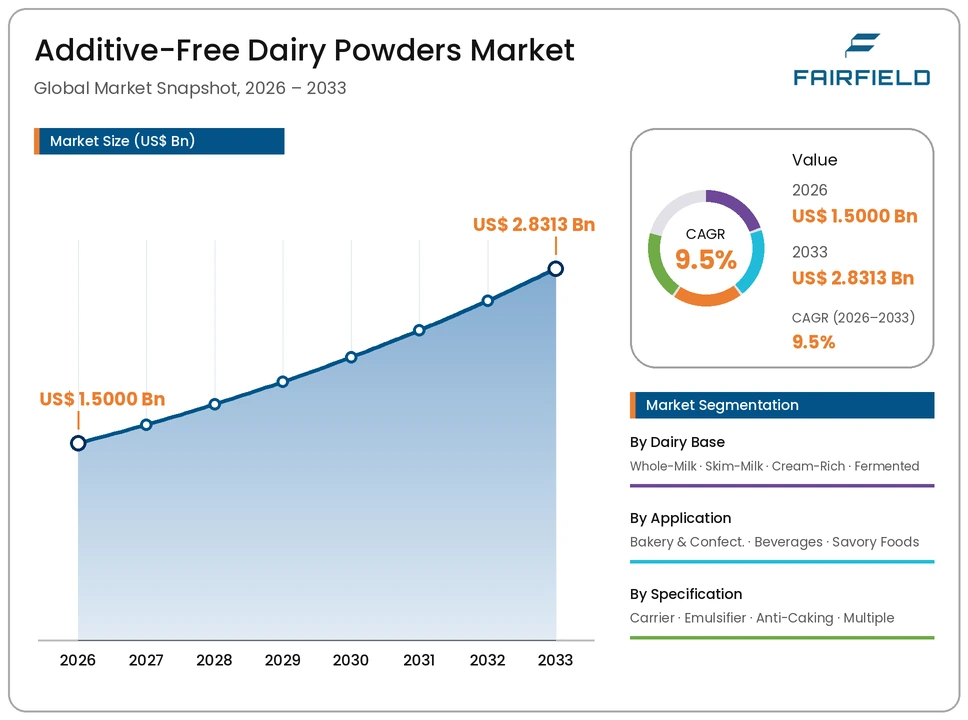
The global additive-free dairy powders market size is expected to be valued at US$1.5000 billion in 2026 and projected to reach US$2.8313 billion by 2033, growing at a CAGR of 9.5% between 2026 and 2033. The outlook applies the published benchmark growth rate to the requested forecast window. The calculated endpoint represents a constant-growth projection, rather than a separately published estimate for that year.
The 2025 benchmark is US$1.3000 billion; a consistent historical CAGR for 2020–2025 is not established. The market covers food-grade dairy powders purchased with documented exclusions of specified carriers, emulsifiers, preservatives, or anti-caking ingredients. Its direction reflects shorter ingredient declarations support reformulation and dry recipe integration supports repeat purchasing. For bakery, confectionery, and prepared-food manufacturers, the investment case depends on ingredient declarations, moisture management, and performance during mixing and heating. Supply capability and practical qualification remain important as the category develops.
Key Report Takeaways
- By Dairy Base: Whole-Milk Powders combine dairy solids and fat, while Skim-Milk Powders emphasize nonfat components. Comparable revenue shares and forecast growth rankings remain unassigned; the purchasing decision depends on the actual function, qualification requirements, and the support included in the selected offer.
- By Application: Bakery and Confectionery use dry dairy for flavor and composition. Comparable revenue shares and forecast growth rankings remain unassigned; the purchasing decision depends on the actual function, qualification requirements, and the support included in the selected offer.
- By Specification: Carrier Exclusion addresses bulking or support ingredients. Comparable revenue shares and forecast growth rankings remain unassigned; the purchasing decision depends on the actual function, qualification requirements, and the support included in the selected offer.
- By Supply Model: Standard Catalog Grades offer repeatable specifications and an established purchasing route. Comparable revenue shares and forecast growth rankings remain unassigned; the purchasing decision depends on the actual function, qualification requirements, and the support included in the selected offer.
- By Geography: North America, Europe, Asia Pacific, Latin America, and Middle East & Africa require separate commercial assessment. Comparable regional shares and growth rankings are not established; specific customer needs, local availability, and dependable delivery determine practical opportunities.
Drivers Impact Analysis
Impact ratings are qualitative assessments of commercial relevance; they do not quantify additional CAGR contributions.
| Driver | Impact on CAGR Forecast | Geographic Relevance | Impact Timeline |
| Shorter Ingredient Declarations Support Reformulation | High | All regions; relevance varies by application | Medium term 2–4 years |
| Dry Recipe Integration Supports Repeat Purchasing | Medium | All regions; relevance varies by application | Long term ≥4 years |
Additive-Free Dairy Powders: Shorter Ingredient Declarations Support Reformulation
Shorter ingredient declarations create demand for dairy powders that provide milk solids without separately listed carriers. Manufacturers can consolidate dairy flavor, protein, and fat into a familiar input. The commercial requirement is not simply removing a name from the label: the resulting dough, filling, or sauce still needs reproducible behavior during processing. Clean-label milk powders therefore compete on documented composition and practical functionality. For a purchasing decision, the relevant benefit is the problem removed from the customer's existing workflow.
Fonterra / NZMP offers regular whole milk powders alongside instant and fortified alternatives. This distinction matters because the broad milk-powder portfolio does not make every grade additive-free. Formulators must select the actual grade against the intended exclusion claim. Supplier specifications, rather than a corporate sustainability message, establish whether the input fits the product brief.
Additive-Free Dairy Powders: Dry Recipe Integration Supports Repeat Purchasing
Powder integration supports demand where bakery and confectionery operations already weigh dry ingredients. Spray-dried milk solids can contribute dairy flavor and composition without adding the same quantity of process water as liquid milk. Procurement follows recipe performance, handling consistency, and shelf-life requirements. A successful production trial can create repeat purchasing across successive batches rather than a one-time novelty ingredient sale. The effect on demand depends on whether the customer can incorporate the offering into an established routine.
Lactalis Ingredients identifies whole milk powder applications in chocolate manufacturing. That application illustrates why taste, dairy fat, and controlled composition matter commercially. Customers should evaluate the powder in the actual mixing and refining process. Benefits depend on the finished recipe; a powder that performs well in chocolate may require different preparation in a beverage or baked filling.
Restraints Impact Analysis
Impact ratings are qualitative assessments of commercial relevance; they do not quantify additional CAGR contributions.
| Restraint | Impact on CAGR Forecast | Geographic Relevance | Impact Timeline |
| Caking Control Constrains Additive Removal | Medium | All regions; relevance varies by application | Medium term 2–4 years |
| Recipe Requalification Adds Development Expense | Medium | All regions; relevance varies by application | Long term ≥4 years |
Additive-Free Dairy Powders: Caking Control Constrains Additive Removal
Removing anti-caking inputs can transfer a processing function into moisture control, packaging, and warehouse management. Powder flow affects dosing precision and line stoppages. A bag that cakes after transport can erase the apparent simplicity gained from a shorter declaration. Buyers therefore need defined storage conditions and representative tests, especially when distribution crosses humid environments or involves repeated warehouse handling. This limitation can extend the interval between first interest and a repeatable commercial relationship.
The cost source includes barrier packaging, humidity management, product losses, and manual intervention when powder does not flow. Particle properties and handling conditions interact, so a laboratory result cannot establish every logistics outcome. Suppliers should separate powder composition from the operational controls needed to preserve it. Dairy powder functionality must remain adequate throughout the customer’s replenishment cycle.
Additive-Free Dairy Powders: Recipe Requalification Adds Development Expense
Ingredient substitution can require new mixing settings, hydration steps, and finished-product checks. Removing an emulsifier or carrier may change dispersibility without changing the nominal dairy content. Development expense arises from pilot batches, sensory comparisons, and rejected trials. Customers with limited application staff may retain an existing grade until the replacement works consistently on their own production equipment. The commercial consequence is a more selective purchasing process. Customers may defer adoption, narrow the intended use, or retain an alternative until the complete operating requirements are understood.
Carrier-free dairy ingredients are purchased as a complete functional input. Buyers should record powder consumption, mixing effort, and the finished texture under matched conditions. An additive-free specification creates commercial value only when the full recipe remains reproducible and the manufacturer can explain the claim accurately.
Market Opportunities
Impact ratings are qualitative assessments of commercial relevance; they do not quantify additional CAGR contributions.
| Opportunity | Impact on CAGR Forecast | Geographic Relevance | Impact Timeline |
| Application Grades Open Bakery Supply Programs | Medium | All regions; relevance varies by application | Medium term 2–4 years |
| Traceable Specifications Support Private-Label Contracts | Medium | All regions; relevance varies by application | Long term ≥4 years |
Additive-Free Dairy Powders: Application Grades Open Bakery Supply Programs
Bakery-specific grades create an opportunity to sell an ingredient together with application guidance. Customers need predictable dairy flavor, browning, and dough behavior across production runs. A bounded supply program can include grade selection, sampling, and handling recommendations. This revenue pool is distinct from general powder demand because it addresses the effort needed to qualify an additive-free input in a particular recipe. The attractive customer is one with a clearly defined unmet requirement and the resources to implement the solution.
Fonterra / NZMP and Lactalis Ingredients provide dairy powder portfolios that support application-based conversations. Suppliers can capture the opportunity through technical assistance and dependable replenishment. A proposal should identify the actual exclusion specification and supported process conditions. EPI Ingredients represents another dairy ingredient route, although buyers must verify individual formulations before assigning an additive-free claim to any selected product.
Additive-Free Dairy Powders: Traceable Specifications Support Private-Label Contracts
Private-label food contracts create opportunities for consistent powder documentation across multiple plants. A customer may need the same dairy identity and exclusion declaration despite different local purchasing teams. Suppliers can offer controlled specifications, traceable lots, and change notifications. The value comes from reducing repeated approval work and maintaining a defensible ingredient statement across products and replenishment cycles. This opportunity differs from general category expansion because it involves a new way to package technical or professional capability.
Arla Foods Ingredients announced a Valley Queen manufacturing agreement in March 2025 for protein-enriched dairy. The development is adjacent supply evidence, not proof that every resulting ingredient is additive-free. It nevertheless illustrates the commercial importance of manufacturing partnerships. Suppliers targeting additive-free food formulation should define qualifying grades separately from their broader dairy protein or processing capabilities.
Segment Analysis
By Dairy Base: Clean-Label Milk Powders Requires Application Fit
Whole-Milk Powders combine dairy solids and fat, while Skim-Milk Powders emphasize nonfat components. Cream-Rich Powders serve richer recipes. Fermented Dairy Powders introduce cultured flavor and require a distinct application assessment. Classification follows the dairy base rather than the brand name. Whole-milk portfolios demonstrate commercial availability without establishing comparable revenue leadership.
Selecting a base changes more than richness. Protein, lactose, and fat influence browning, flavor, and hydration. Bakery and beverage developers should evaluate these effects against the complete recipe. Ingredient lists must be checked at grade level, since fortified or instant variants may introduce components outside the purchasing brief. The purchasing implication is to compare solutions against the required function. A larger specification or broader portfolio does not establish better fit.
By Application: Carrier-Free Dairy Ingredients Requires Application Fit
Bakery and Confectionery use dry dairy for flavor and composition. Beverages require reliable hydration and dispersibility. Savory and Prepared Foods use milk solids in sauces, soups, and convenience recipes. These applications represent different qualification pathways; a common powder base does not mean identical performance or purchasing priorities.
Chocolate use favors taste and compositional consistency, while a beverage can expose sedimentation or incomplete dissolution. Prepared-food buyers need stability through heating and storage. Suppliers should align sample preparation and trial conditions with the customer’s finished product rather than present a single generic mixing result. The same offering can serve several tasks, but sales should be allocated consistently to avoid double counting. Buyers need a clear connection between the proposed capability and their required output.
By Specification: Spray-Dried Milk Solids Requires Application Fit
Carrier Exclusion addresses bulking or support ingredients. Emulsifier Exclusion changes the formulation brief for dispersibility and fat handling. Anti-Caking Exclusion increases the importance of storage and powder flow. Multiple Additive Exclusions require the actual grade to meet several declared conditions. These are separate specifications rather than interchangeable clean-label messages.
Claims can overlap within one powder. Revenue classification should therefore use the principal contracted specification, with secondary attributes recorded separately. A formulation change should trigger a review of all promised exclusions. Clear documentation is more useful to purchasing teams than an undefined additive-free statement that different customers interpret differently. The business implication is a differentiated sales and support model. Purchasing decisions can involve different budgets, approval processes, and expectations for ongoing assistance.
By Supply Model: Dairy Powder Functionality Requires Application Fit
Standard Catalog Grades offer repeatable specifications and an established purchasing route. Customer-Specific Grades address a particular recipe or exclusion brief. Contract-Manufactured Grades depend on agreed manufacturing responsibilities and quality controls. These models create different development costs and lead times without demonstrating a universal preference across food manufacturers.
Catalog selection can shorten qualification, but a custom grade may reduce downstream processing adjustments. Contract manufacturing requires explicit control of ingredient sourcing and change approval. The commercial comparison should include minimum order requirements, continuity of documentation, and the support available when a powder behaves differently in production. Commercial positioning should follow the customer's operating requirement rather than a generalized ranking. Buyers need transparent specifications, appropriate evidence, and a practical implementation route. Suppliers can compete by making those elements easier to assess.
Geography Analysis
Which Region Leads the Additive-Free Dairy Powders Market?
Comparable evidence does not establish a largest region; North America has identifiable customer and supplier activity. North America offers demand from bakery, chocolate, and prepared-food developers. The United States has identifiable dairy ingredient manufacturing activity, while Canada adds food processing customers. Arla Foods Ingredients’ Valley Queen agreement demonstrates a supply partnership in the United States. That activity does not establish regional share or verify all grades as additive-free. The regional sales approach should distinguish established customer requirements from prospective expansion. A useful entry proposal identifies the customer group, the delivery responsibilities, and the conditions under which the offering can remain dependable.
Europe: Additive-Free Dairy Powders Depends on Local Delivery
Europe combines established dairy processing with food manufacturers seeking precise ingredient declarations. France and Germany provide relevant supplier and customer contexts; the United Kingdom adds branded and private-label food development. Lactalis Ingredients and EPI Ingredients illustrate the regional supply base. Adoption depends on matching the powder specification to local recipes and purchasing requirements. For additive-free food formulation, local support and clear documentation are practical priorities. A product or service available in one jurisdiction does not establish identical eligibility elsewhere. Suppliers can improve commercial fit through appropriate documentation, local application support, and a clear explanation of the functions included in the purchasing relationship.
Which Region Grows Fastest in Additive-Free Dairy Powders?
Comparable evidence does not establish the fastest-growing region; Asia Pacific needs country-specific commercial assessment. Asia Pacific includes different dairy supply and food manufacturing conditions in Japan, China, India, Australia, and New Zealand. Fonterra / NZMP provides a New Zealand ingredient route. Product developers must distinguish imported powder performance from locally available alternatives. Climate, transport, and water quality can change the practical requirements for storage and reconstitution. The region should be evaluated through specific countries and customer groups rather than population size alone. Partners should confirm the implementation requirements and the capacity to sustain support before translating a promising development project into a wider market commitment.
Latin America: Additive-Free Dairy Powders Depends on Local Delivery
Latin America presents bakery, confectionery, and prepared-food applications in Brazil and Mexico. Potential adoption depends on dependable distribution and technical support rather than population alone. Humidity, import lead times, and currency exposure can complicate powder replenishment. A supplier can begin with a defined recipe application and validate storage behavior across the actual distribution route. A workable regional strategy begins with a defined application and realistic ownership or service costs. Local partners can help with commissioning, communication, and replenishment, but responsibilities need to be explicit. Buyers should assess the whole operating proposition, including support continuity, instead of assuming that a low initial quotation resolves adoption barriers.
Middle East & Africa: Additive-Free Dairy Powders Depends on Local Delivery
Middle East & Africa offers dry-dairy applications where manufacturers need shelf-stable inputs and consistent replenishment. Saudi Arabia, the United Arab Emirates, and South Africa require separate commercial assessments. Heat and humidity make packaging and warehouse controls important. Suppliers should confirm which additive exclusions matter to the customer before investing in a wider distribution program. Market development should be tied to functioning local delivery arrangements. Technical or professional support, suitable documentation, and reliable supply can determine whether initial interest becomes sustained use. Partners should begin with a bounded customer requirement and evaluate performance before expanding the offer across countries with different operating conditions.
Competitive Landscape
Competition includes Fonterra / NZMP, Lactalis Ingredients, EPI Ingredients, and Arla Foods Ingredients. Their broader dairy portfolios are not equivalent to verified additive-free sales. Buyers should compare individual grades, exclusions, and application evidence. Manufacturing scale supports supply continuity, while technical assistance can determine whether a powder qualifies for a customer’s particular food recipe.
The competitive structure cannot be assigned a reliable concentration score without comparable revenue data for the defined boundary. A large corporate portfolio does not establish category leadership because reported sales can include unrelated products or services. Customers should compare the actual offering and its commercial support. Suppliers with broader capabilities may provide useful coordination, but the relevant advantage must be demonstrated for the specific application rather than inferred from company size.
Competition centers on the combination of performance, usable implementation, and ongoing cost. Buyers need evidence under representative conditions and a clear explanation of what the supplier provides. Digital interfaces, technical documentation, or service packages can influence selection when they reduce practical friction. These features should be evaluated against the customer's requirements. An extensive feature list offers limited value if the core product or service cannot be delivered consistently within the agreed operating conditions.
Strategic direction favors clearer application boundaries and accountable delivery. Documented developments provide evidence of activity, while planned launches or partnerships remain different from completed commercialization. Suppliers can strengthen customer relationships through dependable support, transparent specifications, and communication that remains accurate as offerings change. Buyers should examine the resources behind those commitments.
Recent Industry Developments
- March 2025: Arla Foods Ingredients signed a Valley Queen manufacturing agreement for protein-enriched dairy — adjacent dairy supply capability, rather than a verified additive-free grade launch.
Companies Covered in the Report
- Fonterra / NZMP
- Lactalis Ingredients
- EPI Ingredients
- Arla Foods Ingredients
Additive-Free Dairy Powders Market Report Scope
| Metric | Value |
| Study Period | 2020–2033 |
| Market Size 2026 | US$1.5000 billion — published estimate |
| Market Size 2033 | US$2.8313 billion — calculated projection |
| CAGR 2026–2033 | 9.5%, applied compound-growth assumption |
| Absolute Dollar Opportunity | US$1.3313 billion |
| Largest Market (region) | Comparable regional revenue leadership not established |
| Fastest-Growing Market (region or country) | Comparative ranking for 2026–2033 not established |
| Market Concentration | Specialized participants; concentration not quantified |
| Major Players | Fonterra / NZMP, Lactalis Ingredients, EPI Ingredients, Arla Foods Ingredients |
Additive-Free Dairy Powders Market Segmentation
Dairy Base
- Whole-Milk Powders
- Skim-Milk Powders
- Cream-Rich Powders
- Fermented Dairy Powders
Application
- Bakery and Confectionery
- Beverages
- Savory and Prepared Foods
Specification
- Carrier Exclusion
- Emulsifier Exclusion
- Anti-Caking Exclusion
- Multiple Additive Exclusions
Supply Model
- Standard Catalog Grades
- Customer-Specific Grades
- Contract-Manufactured Grades
Regions
- North America
- Europe
- Asia Pacific
- Latin America
- Middle East & Africa
- Executive Summary
- Global Market Snapshot
- Market Size and Trend Analysis 2020–2033
- Base Year Benchmark 2025
- Key Report Takeaways
- Market Overview
- Market Definition and Report Scope
- Market Dynamics
- Drivers Impact Analysis
- Shorter Ingredient Declarations Support Reformulation
- Dry Recipe Integration Supports Repeat Purchasing
- Restraints Impact Analysis
- Caking Control Constrains Additive Removal
- Recipe Requalification Adds Development Expense
- Market Opportunities
- Application Grades Open Bakery Supply Programs
- Traceable Specifications Support Private-Label Contracts
- Drivers Impact Analysis
- Segment Analysis
- By Dairy Base
- By Application
- By Specification
- By Supply Model
- Global Additive-Free Dairy Powders Market Outlook 2026–2033
- Global Additive-Free Dairy Powders Market Outlook, by Dairy Base, Value (US$ Billion), 2026–2033
- Whole-Milk Powders
- Skim-Milk Powders
- Cream-Rich Powders
- Fermented Dairy Powders
- Global Additive-Free Dairy Powders Market Outlook, by Application, Value (US$ Billion), 2026–2033
- Bakery and Confectionery
- Beverages
- Savory and Prepared Foods
- Global Additive-Free Dairy Powders Market Outlook, by Specification, Value (US$ Billion), 2026–2033
- Carrier Exclusion
- Emulsifier Exclusion
- Anti-Caking Exclusion
- Multiple Additive Exclusions
- Global Additive-Free Dairy Powders Market Outlook, by Supply Model, Value (US$ Billion), 2026–2033
- Standard Catalog Grades
- Customer-Specific Grades
- Contract-Manufactured Grades
- Global Additive-Free Dairy Powders Market Outlook, by Region, Value (US$ Billion), 2026–2033
- North America
- Europe
- Asia Pacific
- Latin America
- Middle East & Africa
- Global Additive-Free Dairy Powders Market Outlook, by Dairy Base, Value (US$ Billion), 2026–2033
- North America Additive-Free Dairy Powders Market Outlook 2026–2033
- North America Market Activity and Implementation Conditions
- North America Additive-Free Dairy Powders Market Outlook, by Dairy Base, Value (US$ Billion), 2026–2033
- Whole-Milk Powders
- Skim-Milk Powders
- Cream-Rich Powders
- Fermented Dairy Powders
- North America Additive-Free Dairy Powders Market Outlook, by Application, Value (US$ Billion), 2026–2033
- Bakery and Confectionery
- Beverages
- Savory and Prepared Foods
- North America Additive-Free Dairy Powders Market Outlook, by Specification, Value (US$ Billion), 2026–2033
- Carrier Exclusion
- Emulsifier Exclusion
- Anti-Caking Exclusion
- Multiple Additive Exclusions
- North America Additive-Free Dairy Powders Market Outlook, by Supply Model, Value (US$ Billion), 2026–2033
- Standard Catalog Grades
- Customer-Specific Grades
- Contract-Manufactured Grades
- North America Additive-Free Dairy Powders Market Outlook, by Country, 2026–2033
- United States Additive-Free Dairy Powders Market Outlook, by Dairy Base, 2026–2033
- United States Additive-Free Dairy Powders Market Outlook, by Application, 2026–2033
- United States Additive-Free Dairy Powders Market Outlook, by Specification, 2026–2033
- United States Additive-Free Dairy Powders Market Outlook, by Supply Model, 2026–2033
- Canada Additive-Free Dairy Powders Market Outlook, by Dairy Base, 2026–2033
- Canada Additive-Free Dairy Powders Market Outlook, by Application, 2026–2033
- Canada Additive-Free Dairy Powders Market Outlook, by Specification, 2026–2033
- Canada Additive-Free Dairy Powders Market Outlook, by Supply Model, 2026–2033
- Europe Additive-Free Dairy Powders Market Outlook 2026–2033
- Europe Market Activity and Implementation Conditions
- Europe Additive-Free Dairy Powders Market Outlook, by Dairy Base, Value (US$ Billion), 2026–2033
- Whole-Milk Powders
- Skim-Milk Powders
- Cream-Rich Powders
- Fermented Dairy Powders
- Europe Additive-Free Dairy Powders Market Outlook, by Application, Value (US$ Billion), 2026–2033
- Bakery and Confectionery
- Beverages
- Savory and Prepared Foods
- Europe Additive-Free Dairy Powders Market Outlook, by Specification, Value (US$ Billion), 2026–2033
- Carrier Exclusion
- Emulsifier Exclusion
- Anti-Caking Exclusion
- Multiple Additive Exclusions
- Europe Additive-Free Dairy Powders Market Outlook, by Supply Model, Value (US$ Billion), 2026–2033
- Standard Catalog Grades
- Customer-Specific Grades
- Contract-Manufactured Grades
- Europe Additive-Free Dairy Powders Market Outlook, by Country, 2026–2033
- France Additive-Free Dairy Powders Market Outlook, by Dairy Base, 2026–2033
- France Additive-Free Dairy Powders Market Outlook, by Application, 2026–2033
- France Additive-Free Dairy Powders Market Outlook, by Specification, 2026–2033
- France Additive-Free Dairy Powders Market Outlook, by Supply Model, 2026–2033
- Germany Additive-Free Dairy Powders Market Outlook, by Dairy Base, 2026–2033
- Germany Additive-Free Dairy Powders Market Outlook, by Application, 2026–2033
- Germany Additive-Free Dairy Powders Market Outlook, by Specification, 2026–2033
- Germany Additive-Free Dairy Powders Market Outlook, by Supply Model, 2026–2033
- United Kingdom Additive-Free Dairy Powders Market Outlook, by Dairy Base, 2026–2033
- United Kingdom Additive-Free Dairy Powders Market Outlook, by Application, 2026–2033
- United Kingdom Additive-Free Dairy Powders Market Outlook, by Specification, 2026–2033
- United Kingdom Additive-Free Dairy Powders Market Outlook, by Supply Model, 2026–2033
- Asia Pacific Additive-Free Dairy Powders Market Outlook 2026–2033
- Asia Pacific Market Activity and Implementation Conditions
- Asia Pacific Additive-Free Dairy Powders Market Outlook, by Dairy Base, Value (US$ Billion), 2026–2033
- Whole-Milk Powders
- Skim-Milk Powders
- Cream-Rich Powders
- Fermented Dairy Powders
- Asia Pacific Additive-Free Dairy Powders Market Outlook, by Application, Value (US$ Billion), 2026–2033
- Bakery and Confectionery
- Beverages
- Savory and Prepared Foods
- Asia Pacific Additive-Free Dairy Powders Market Outlook, by Specification, Value (US$ Billion), 2026–2033
- Carrier Exclusion
- Emulsifier Exclusion
- Anti-Caking Exclusion
- Multiple Additive Exclusions
- Asia Pacific Additive-Free Dairy Powders Market Outlook, by Supply Model, Value (US$ Billion), 2026–2033
- Standard Catalog Grades
- Customer-Specific Grades
- Contract-Manufactured Grades
- Asia Pacific Additive-Free Dairy Powders Market Outlook, by Country, 2026–2033
- Japan Additive-Free Dairy Powders Market Outlook, by Dairy Base, 2026–2033
- Japan Additive-Free Dairy Powders Market Outlook, by Application, 2026–2033
- Japan Additive-Free Dairy Powders Market Outlook, by Specification, 2026–2033
- Japan Additive-Free Dairy Powders Market Outlook, by Supply Model, 2026–2033
- China Additive-Free Dairy Powders Market Outlook, by Dairy Base, 2026–2033
- China Additive-Free Dairy Powders Market Outlook, by Application, 2026–2033
- China Additive-Free Dairy Powders Market Outlook, by Specification, 2026–2033
- China Additive-Free Dairy Powders Market Outlook, by Supply Model, 2026–2033
- India Additive-Free Dairy Powders Market Outlook, by Dairy Base, 2026–2033
- India Additive-Free Dairy Powders Market Outlook, by Application, 2026–2033
- India Additive-Free Dairy Powders Market Outlook, by Specification, 2026–2033
- India Additive-Free Dairy Powders Market Outlook, by Supply Model, 2026–2033
- Australia Additive-Free Dairy Powders Market Outlook, by Dairy Base, 2026–2033
- Australia Additive-Free Dairy Powders Market Outlook, by Application, 2026–2033
- Australia Additive-Free Dairy Powders Market Outlook, by Specification, 2026–2033
- Australia Additive-Free Dairy Powders Market Outlook, by Supply Model, 2026–2033
- New Zealand Additive-Free Dairy Powders Market Outlook, by Dairy Base, 2026–2033
- New Zealand Additive-Free Dairy Powders Market Outlook, by Application, 2026–2033
- New Zealand Additive-Free Dairy Powders Market Outlook, by Specification, 2026–2033
- New Zealand Additive-Free Dairy Powders Market Outlook, by Supply Model, 2026–2033
- Latin America Additive-Free Dairy Powders Market Outlook 2026–2033
- Latin America Market Activity and Implementation Conditions
- Latin America Additive-Free Dairy Powders Market Outlook, by Dairy Base, Value (US$ Billion), 2026–2033
- Whole-Milk Powders
- Skim-Milk Powders
- Cream-Rich Powders
- Fermented Dairy Powders
- Latin America Additive-Free Dairy Powders Market Outlook, by Application, Value (US$ Billion), 2026–2033
- Bakery and Confectionery
- Beverages
- Savory and Prepared Foods
- Latin America Additive-Free Dairy Powders Market Outlook, by Specification, Value (US$ Billion), 2026–2033
- Carrier Exclusion
- Emulsifier Exclusion
- Anti-Caking Exclusion
- Multiple Additive Exclusions
- Latin America Additive-Free Dairy Powders Market Outlook, by Supply Model, Value (US$ Billion), 2026–2033
- Standard Catalog Grades
- Customer-Specific Grades
- Contract-Manufactured Grades
- Latin America Additive-Free Dairy Powders Market Outlook, by Country, 2026–2033
- Brazil Additive-Free Dairy Powders Market Outlook, by Dairy Base, 2026–2033
- Brazil Additive-Free Dairy Powders Market Outlook, by Application, 2026–2033
- Brazil Additive-Free Dairy Powders Market Outlook, by Specification, 2026–2033
- Brazil Additive-Free Dairy Powders Market Outlook, by Supply Model, 2026–2033
- Mexico Additive-Free Dairy Powders Market Outlook, by Dairy Base, 2026–2033
- Mexico Additive-Free Dairy Powders Market Outlook, by Application, 2026–2033
- Mexico Additive-Free Dairy Powders Market Outlook, by Specification, 2026–2033
- Mexico Additive-Free Dairy Powders Market Outlook, by Supply Model, 2026–2033
- Middle East & Africa Additive-Free Dairy Powders Market Outlook 2026–2033
- Middle East & Africa Market Activity and Implementation Conditions
- Middle East & Africa Additive-Free Dairy Powders Market Outlook, by Dairy Base, Value (US$ Billion), 2026–2033
- Whole-Milk Powders
- Skim-Milk Powders
- Cream-Rich Powders
- Fermented Dairy Powders
- Middle East & Africa Additive-Free Dairy Powders Market Outlook, by Application, Value (US$ Billion), 2026–2033
- Bakery and Confectionery
- Beverages
- Savory and Prepared Foods
- Middle East & Africa Additive-Free Dairy Powders Market Outlook, by Specification, Value (US$ Billion), 2026–2033
- Carrier Exclusion
- Emulsifier Exclusion
- Anti-Caking Exclusion
- Multiple Additive Exclusions
- Middle East & Africa Additive-Free Dairy Powders Market Outlook, by Supply Model, Value (US$ Billion), 2026–2033
- Standard Catalog Grades
- Customer-Specific Grades
- Contract-Manufactured Grades
- Middle East & Africa Additive-Free Dairy Powders Market Outlook, by Country, 2026–2033
- Saudi Arabia Additive-Free Dairy Powders Market Outlook, by Dairy Base, 2026–2033
- Saudi Arabia Additive-Free Dairy Powders Market Outlook, by Application, 2026–2033
- Saudi Arabia Additive-Free Dairy Powders Market Outlook, by Specification, 2026–2033
- Saudi Arabia Additive-Free Dairy Powders Market Outlook, by Supply Model, 2026–2033
- United Arab Emirates Additive-Free Dairy Powders Market Outlook, by Dairy Base, 2026–2033
- United Arab Emirates Additive-Free Dairy Powders Market Outlook, by Application, 2026–2033
- United Arab Emirates Additive-Free Dairy Powders Market Outlook, by Specification, 2026–2033
- United Arab Emirates Additive-Free Dairy Powders Market Outlook, by Supply Model, 2026–2033
- South Africa Additive-Free Dairy Powders Market Outlook, by Dairy Base, 2026–2033
- South Africa Additive-Free Dairy Powders Market Outlook, by Application, 2026–2033
- South Africa Additive-Free Dairy Powders Market Outlook, by Specification, 2026–2033
- South Africa Additive-Free Dairy Powders Market Outlook, by Supply Model, 2026–2033
- Competitive Landscape
- Industry Participation and Category Boundaries
- Competitive Factors and Vendor Strategies
- Recent Industry Developments
- Company Profiles
- Fonterra / NZMP
- Lactalis Ingredients
- EPI Ingredients
- Arla Foods Ingredients
- Appendix
- Research Methodology
- Report Assumptions
- Acronyms and Abbreviations
Dairy Base
- Whole-Milk Powders
- Skim-Milk Powders
- Cream-Rich Powders
- Fermented Dairy Powders
Application
- Bakery and Confectionery
- Beverages
- Savory and Prepared Foods
Specification
- Carrier Exclusion
- Emulsifier Exclusion
- Anti-Caking Exclusion
- Multiple Additive Exclusions
Supply Model
- Standard Catalog Grades
- Customer-Specific Grades
- Contract-Manufactured Grades
Regions
- North America
- Europe
- Asia Pacific
- Latin America
- Middle East & Africa
Our Research Methodology
Considering the volatility of business today, traditional approaches to strategizing a game plan can be unfruitful if not detrimental. True ambiguity is no way to determine a forecast. A myriad of predetermined factors must be accounted for such as the degree of risk involved, the magnitude of circumstances, as well as conditions or consequences that are not known or unpredictable. To circumvent binary views that cast uncertainty, the application of market research intelligence to strategically posture, move, and enable actionable outcomes is necessary.
View Methodology
Quality Assured
Rigorous Validation Process

Confidentiality Assured
End-to-end Data Security

Custom Research Services
Tailored To Your Objectives
FAQs
The 2026 estimate is US$1.5000 billion, based on the published benchmark for the defined market; broader adjacent industry revenues remain excluded.
The calculated 2033 value is US$2.8313 billion, using 9.5% annual compound growth across the requested forecast window; this endpoint is a projection.
Segment leadership is not established from comparable revenue evidence; the report compares actual purchasing functions, operating requirements, and qualification differences between defined alternatives.
Comparative growth leadership is not established for the requested period; opportunities depend on customer requirements, local delivery capability, and verified application fit instead.
Competition depends on usable performance, appropriate product scope, transparent specifications, and dependable delivery; the report does not assign unverified supplier shares or rankings.
Related Reports
Kombucha Market Size, Share, Insights, Competitive Landscape, and Forecast 2026 to 2033
The Kombucha Market is projected to grow from US$ 3.2 billion in 2026 to US$ 4.8 billion by 2033 at a 6.0% CAGR. Explore trends and leading segments.
Insect Protein Market Size, Share, Insights, Competitive Landscape, and Forecast 2026 to 2033
Insect Protein Market is projected to grow from US$ 1.03 billion in 2026 to US$ 3.17 billion by 2033 at a 17.4% CAGR. Explore trends and key segments.
Functional Mushroom Market Size, Share, Insights, Competitive Landscape, and Forecast 2026 to 2033
Explore the Functional Mushroom Market, projected to grow from US$ 2.6 billion in 2026 to US$ 4.4 billion by 2033 at a 7.8% CAGR. See trends and segments.
Food Preservatives Market Size, Share, Insights, Competitive Landscape, and Forecast 2026 to 2033
The food preservatives market is valued at US$ 3.67 billion in 2026 and projected to reach US$ 4.97 billion by 2033 at a CAGR of 4.4%.
Beeswax Market Size, Share, Insights, Competitive Landscape, and Forecast 2026 to 2033
The beeswax market is valued at US$ 0.7 billion in 2026 and projected to reach US$ 1.0 billion by 2033 at a CAGR of 5.2%.
Adaptogens Market Size, Share, Insights, Competitive Landscape, and Forecast 2026 to 2033
The adaptogens market is valued at US$ 17.09 billion in 2026 and projected to reach US$ 29.08 billion by 2033, growing at a CAGR of 7.9%.