



Almond Flour Market
Almond Flour Market Insights, Competitive Landscape, and Market Forecast - 2033
Almond Flour Market Size and Trend Analysis
How Fast Will the Almond Flour Market Grow by 2033?
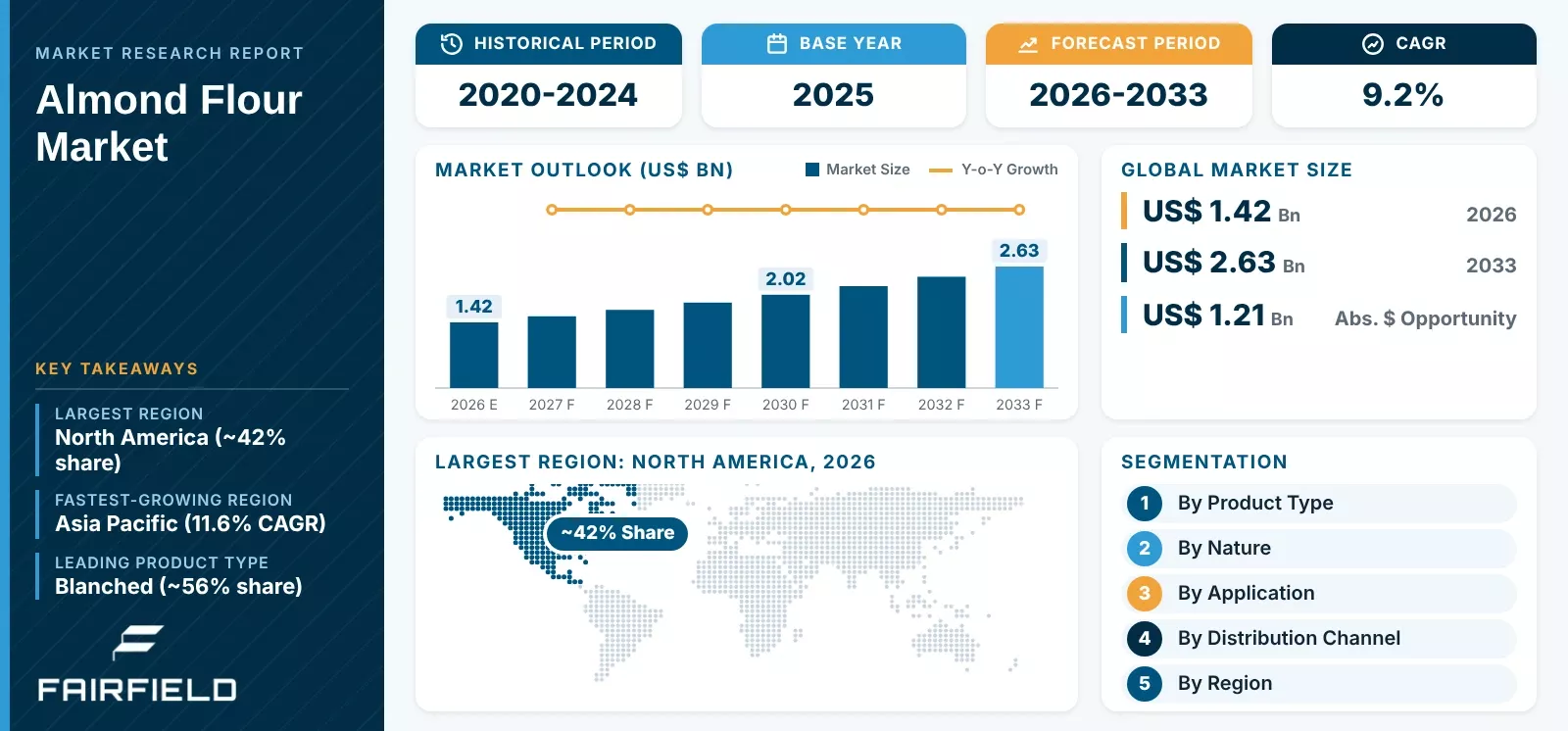
The global Almond Flour market size is expected to be valued at US$ 1.42 billion in 2026 and projected to reach US$ 2.63 billion by 2033, growing at a CAGR of 9.2% between 2026 and 2033. The forecast implies an absolute dollar opportunity of US$ 1.21 billion, ahead of a historical CAGR of 7.8% recorded between 2020 and 2025. Growth is anchored in gluten-free and low-carbohydrate product positioning across packaged bakery, in wider industrial milling capacity within California, and in steadier kernel supply that lets manufacturers plan ingredient cost with more confidence. Retail private label and dairy alternative formats are adding volume well beyond the specialty baking aisle.
Key Report Takeaways
- By Product Type: Blanched almond flour led with 56% share in 2026, while defatted almond flour is projected to expand at an 11.4% CAGR through 2033, driven by protein bar and powdered beverage recipes that need better dry-blend dispersibility.
- By Nature: Conventional almond flour held 74% share in 2026, while organic almond flour is set to grow at an 11.0% CAGR through 2033, driven by retailer private-label ranges that require certified orchard sourcing and residue testing.
- By Application: Bakery products accounted for 38% share in 2026, while dairy alternatives and beverages are forecast to rise at an 11.8% CAGR through 2033, driven by cultured, frozen and ready-to-drink formats that use almond solids for body.
- By Distribution Channel: Business-to-business ingredient supply captured 62% share in 2026, while online retail is projected to advance at a 12.3% CAGR through 2033, driven by direct-to-consumer baking brands selling larger pack sizes on subscription.
- By Region: North America led with 42% share in 2026, while Asia Pacific is expected to record an 11.6% CAGR through 2033, driven by bakery premiumisation and deeper cold-chain distribution across China, Japan, India and Australia.
Global Almond Flour Market Trends and Insights
Market Growth Drivers
Gluten-Free and Low-Carbohydrate Bakery Positioning Widens Ingredient Demand
Gluten-free and low-carbohydrate positioning has moved almond flour from a specialty item into mainstream bakery procurement. Packaged goods companies use it to build cracker, cookie, muffin and pizza-base lines that carry a gluten-free claim on front-of-pack. That positioning is commercial rather than clinical, but it changes purchasing behaviour, because a bakery committing to a gluten-free line needs dedicated flour supply at consistent particle size and fat content.
The underlying trend is retailer-led. Supermarket chains have widened free-from aisles and private-label ranges, which pulls almond flour into contract volumes rather than one-off orders. Certification schemes for gluten-free labelling, together with allergen control audits, push buyers toward mills that can document their process end to end. Suppliers have responded with fine, extra-fine and coarse meal grades so formulators can match crumb structure without rebuilding existing production lines.
Scaled California Milling Capacity Lowers Industrial Flour Cost
Industrial milling capacity in California has grown alongside almond processing, and that has lowered the delivered cost of food-grade almond flour. Hullers and shellers that once sold only kernels now run blanching, slicing and grinding lines, so flour is produced from the same intake rather than bought in. Lower conversion cost makes almond flour viable in mid-priced snacks and biscuits, not only in premium niches.
Capacity has also improved quality consistency. Controlled blanching, chilled grinding and tight sieving keep oil release low, which prevents clumping and protects shelf life for buyers. Mills increasingly run allergen-segregated lines and retain pasteurisation records, giving manufacturers the documentation their own audits require. Because flour can be milled from kernels that fail cosmetic grades for snacking, processors also capture value from natural sizing variation across each crop.
Restraints Impact Analysis of Market
Tree Nut Allergen Status Limits Shared-Line Production
Almonds are a tree nut and a major declared allergen, which limits where almond flour can be used. Manufacturers running shared bakery lines must add cleaning validation, separate storage and dedicated handling, or accept precautionary labelling that narrows retail placement. Schools, airlines, hospitals and many institutional caterers restrict tree nut ingredients outright, removing channels that wheat and oat flours reach without any difficulty.
Labelling frameworks in the United States and the European Union require tree nuts to be declared clearly on packaging, and enforcement has tightened through recall activity across the wider food industry. Compliance cost falls hardest on small and mid-sized bakeries, which often lack floor space for segregated lines. The result is slower adoption in co-manufacturing environments, where capacity is shared across many customers and one allergen introduction can disrupt several accounts.
Kernel Price Volatility and Water Constraints in the Supply Base
Raw kernel cost sets most of the finished price of almond flour, so buyers face margin risk whenever the crop moves. Weather during bloom, pollination conditions and harvest timing all shift available supply, and flour grades compete for the same kernels as snacking and nut butter applications. Food manufacturers with fixed retail price points therefore hesitate to design high-inclusion recipes around an ingredient they cannot hedge easily.
Water availability in the California growing base adds a second layer of uncertainty. Almond orchards are permanent plantings that need irrigation every season, and state groundwater management rules have changed how districts allocate supply. Growers have responded with micro-irrigation, soil moisture sensing and orchard removal in weaker districts, while industry programmes track water use per unit of output. The supply base is adapting, but with less flexibility than annual row crops.
Market Opportunities
Dairy Alternative and Protein Snack Formats Open New Volume
Dairy alternative and protein snack formats create ingredient volume that bakery alone cannot supply. Almond flour and partially defatted almond protein are used in bars, extruded snacks, frozen desserts and cultured almond-based products, where they add body and a mild nut flavour. These formats run at far larger batch sizes than specialty bakery, so a single approved supplier can gain meaningful recurring tonnage quickly.
The trend is supported by processing advances. Defatting almond flour after oil extraction raises protein concentration and improves dispersibility in liquid systems, which previously limited nut flours in beverages. Co-products from almond oil pressing now feed directly into this grade, improving overall crop economics. Brand owners also value a single-ingredient label, since almond flour replaces starch blends and gums in several recipes while keeping the declaration short and recognisable.
Organic and Traceable Grades Support Premium Private Label
Organic and fully traceable almond flour gives processors a premium tier that retail private label is willing to pay for. Grocery chains building their own free-from ranges want documented orchard sourcing, organic certification and residue testing, and they will commit to annual volumes to secure it. That combination converts a commodity grind into a contracted specification with far better margin stability for the mill.
Organic almond acreage remains small relative to conventional, which keeps the grade tight and supports pricing. Certification under national organic programmes, alongside non-GMO, kosher and halal attestations, is increasingly bundled into a single supplier dossier. Digital lot tracking from huller to mill lets buyers trace a pallet back to a growing district, which matters for recall readiness and sustainability reporting alike. Suppliers delivering this documentation are winning multi-year private-label work.
Segment Analysis
- Blanched Grades Hold Market Leadership While Defatted Flour Scales Fastest
Blanched almond flour held 56% of the global market in 2026, because skin removal gives the pale colour and fine crumb that commercial bakeries specify. Natural almond meal, which retains the skin, took 33%, serving rustic baking and coatings where colour matters less. Defatted almond flour accounted for the remaining 11% but is the fastest grower, at an 11.4% CAGR to 2033. Removing part of the oil raises protein concentration and improves flow in dry blending, which suits bars, extruded snacks and powdered beverages. Mills have added chilled grinding and tighter sieving to control particle size at each grade. For the wider market, the split means capital is moving toward flexible lines that can switch between blanched, natural and defatted output as customer mix changes.
- Conventional Supply Dominates as Organic Almond Flour Compounds Faster
Conventional almond flour supplied 74% of demand in 2026, reflecting the scale and cost position of mainstream California processing. Organic almond flour took 26% and is growing faster, at an 11.0% CAGR through 2033. Organic orchards remain a small share of total planted area, so certified kernels stay tight and command a clear premium. Demand comes mainly from retailer private-label free-from ranges and from premium bar and biscuit brands that want a short, certified ingredient list. Certification under national organic programmes, combined with residue testing and lot-level traceability, is now a routine supplier requirement rather than a differentiator. The practical implication is a two-tier market: conventional grades compete on landed cost and consistency, while organic competes on documentation, audit readiness and contracted annual volume.
- Which Application Consumes the Most Almond Flour?
Bakery products consume the most almond flour, at 38% of global market value in 2026. Cookies, muffins, crackers, tart shells, biscotti and pizza bases dominate that use, where gluten-free positioning is a commercial claim on pack rather than a nutrition promise. Confectionery followed with 21%, led by marzipan, praline fillings and macaron production. Snacks and bars held 18%, while other uses including breading and sauces took 10%. Dairy alternatives and beverages accounted for 13% but form the fastest-growing application at an 11.8% CAGR to 2033, as cultured, frozen and ready-to-drink formats use almond solids for body and mouthfeel. Because each of these categories must declare a tree nut, application growth is tied closely to a manufacturer’s ability to run allergen-segregated lines and to validate cleaning between production runs.
- Bulk Ingredient Supply Leads While Online Retail Grows Quickest
Business-to-business ingredient supply led distribution with 62% share in 2026, since most almond flour moves in bulk to bakeries, confectioners and contract manufacturers. Supermarkets and hypermarkets held 16%, specialty and health food stores 10%, convenience formats 3%, and online retail 9%. Online is the fastest-growing channel, at a 12.3% CAGR through 2033, helped by direct-to-consumer baking brands, subscription refills and marketplace listings that carry larger pack sizes than grocery shelves allow. Retail packs also give mills a higher-margin outlet for the same production run. The broader consequence is that processors are building two commercial capabilities at once: bulk technical sales with full specification and audit support, and branded or private-label packaging with digital merchandising and fulfilment capability behind it. Few mills currently do both well.
Geography Analysis
- Which Region Is Leading the Almond Flour Market?
North America leads the almond flour market with 42% share in 2026, growing at an 8.4% CAGR to 2033. California supplies most of the kernels milled worldwide, and the majority of blanching and grinding capacity sits within the same processing corridor, so flour is made close to the crop. The United States also has the deepest gluten-free retail assortment, giving domestic mills steady contract volume. Canada and Mexico add bakery and confectionery demand served largely from that base. Groundwater management rules in California shape planting decisions, and growers continue shifting toward micro-irrigation and orchard replacement where district allocations are weaker. Established allergen labelling practice also means manufacturers here are well equipped for tree nut segregation.
- European Confectionery Tradition Anchors Steady Regional Demand
Europe holds 27% share in 2026 and expands at an 8.9% CAGR to 2033. Spain, Italy and Portugal grow almonds and mill locally, while Germany, France and the United Kingdom consume the most finished flour. Confectionery traditions anchor demand, since marzipan, nougat and macaron production need consistent fine grinds. Spanish processors supply domestic and export markets and compete on varietal character as well as price. European allergen declaration rules are strict and uniformly applied, which favours suppliers with documented segregation. Organic certification is common across southern European supply, and widening retailer free-from ranges continue pulling almond flour into private-label specifications.
- Which Region Is Growing Fastest in the Almond Flour Market?
Asia Pacific is growing fastest in the almond flour market, at an 11.6% CAGR through 2033 from 19% share in 2026. Australia is the main regional producer and exporter, with large plantings along the Murray corridor and its own blanching and milling capacity. China, Japan, South Korea and India drive consumption, where Western-style bakery and premium confectionery are expanding quickly in urban retail. Improved cold chain and modern trade distribution let bakeries hold finer grades without quality loss. Import duties and labelling rules differ by country, so suppliers often work through regional distributors. Rising domestic almond processing in India also supports local meal production for traditional sweets.
- Latin American Growth Tracks Packaged Bakery Expansion
Latin America accounts for 7% share in 2026 and grows at a 9.5% CAGR to 2033. Brazil, Mexico, Chile and Argentina lead demand, mostly through industrial bakery and confectionery manufacturers serving urban retail. Chile has a small but established almond growing base that supplies regional processors and exports in counter-season windows. Most other volume arrives as imported kernels or finished flour, so currency movement and freight cost influence buying patterns strongly. Local certification and labelling requirements are tightening as free-from ranges enter the larger supermarket chains. Growth therefore depends far more on rising packaged bakery and confectionery output than on any expansion of local orchard production.
- Gulf Trade Hubs Shape Middle East & Africa Distribution
Middle East & Africa represents 5% share in 2026, expanding at a 9.1% CAGR through 2033. The Gulf states, led by the United Arab Emirates and Saudi Arabia, account for most consumption through hotel, bakery and confectionery demand, supported by established nut trading hubs that re-export across the region. South Africa, Morocco and Egypt add industrial bakery volume, and Morocco grows almonds for regional processing. Halal certification is a standard supplier requirement, and buyers increasingly request the same allergen documentation used in Europe. Limited local milling capacity means most fine grades are imported, so the depth of regional distribution networks sets the pace of adoption.
Competitive Landscape
The almond flour market is moderately fragmented. Blue Diamond Growers and other large California cooperatives and handlers hold strong positions in kernel supply, but milling into flour is spread across mid-sized processors, private-label packers and branded retail players. Vertical integration is the main dividing line. Companies controlling hulling, shelling, blanching and grinding can serve industrial buyers on specification, while asset-light brands compete in retail packaging. Consolidation has been gradual, concentrated among handlers adding downstream value rather than large cross-border mergers.
Product competition centres on particle size control, residual oil, microbiological safety and allergen segregation. Buyers compare mills on grind consistency, pasteurisation method and the completeness of their audit documentation. Chilled grinding, in-line sieving and metal detection are now expected rather than differentiating. Newer entrants focus on defatted and high-protein grades produced from almond oil co-products, which gives them a cost route into bars and beverages that traditional mills built around whole-kernel grinding do not automatically have.
Strategic activity follows the same logic. Processors add blanching and grinding lines to capture margin that previously left with the kernel, and they pursue organic, non-GMO and religious certifications to qualify for retailer private-label programmes. Partnerships with grower groups secure supply in a crop where water allocation affects planting decisions. Investment in traceability systems matters competitively because it shortens customer audits and reduces recall exposure.
The direction of competition is toward documented, flexible supply. Mills that can switch between blanched, natural and defatted grades, prove allergen control and report water and energy use per tonne are best placed with large manufacturers. Branded retail players, meanwhile, compete on packaging, shelf presence and direct digital channels rather than on bulk technical specification.
Industry Leaders
- Blue Diamond Growers
- ofi (Olam Food Ingredients)
- The Wonderful Company
- Treehouse California Almonds
- Harris Woolf California Almonds
- Borges Agricultural & Industrial Nuts
- Select Harvests Limited
- Almondco Australia Limited
Companies Covered in the Report
- Blue Diamond Growers
- ofi (Olam Food Ingredients)
- The Wonderful Company
- Treehouse California Almonds
- Harris Woolf California Almonds
- Borges Agricultural & Industrial Nuts
- Select Harvests Limited
- Almondco Australia Limited
- Bob’s Red Mill Natural Foods, Inc.
- John B. Sanfilippo & Son, Inc.
- Mariani Nut Company
- Hughson Nut, Inc.
- Campos Brothers Farms
- King Arthur Baking Company, Inc.
- NOW Health Group, Inc.
- Mandelin, Inc.
Almond Flour Market Report Scope
Almond Flour Market Segmentation
By Product Type
- Blanched Almond Flour
- Natural Almond Flour (Almond Meal)
- Defatted Almond Flour
By Nature
- Conventional
- Organic
By Application
- Bakery Products
- Confectionery
- Snacks and Bars
- Dairy Alternatives and Beverages
- Others
By Distribution Channel
- Business-to-Business (Food Processors and Foodservice)
- Supermarkets and Hypermarkets
- Specialty and Health Food Stores
- Online Retail
- Convenience Stores
By Region
- North America
- Europe
- Asia Pacific
- Latin America
- Middle East & Africa
Regions
- North America
- Europe
- Asia Pacific
- Latin America
- Middle East & Africa
- Almond Flour Market Table of Contents
- Executive Summary
- Almond Flour Market Snapshot
- Future Projections
- Key Market Trends
- Regional Snapshot
- Market Overview
- Market Definition and Report Scope
- Historical Market Trends
- Market Dynamics
- Drivers
- Gluten-Free and Low-Carbohydrate Bakery Positioning Widens Ingredient Demand
- Scaled California Milling Capacity Lowers Industrial Flour Cost
- Restraints
- Tree Nut Allergen Status Limits Shared-Line Production
- Kernel Price Volatility and Water Constraints in the Supply Base
- Market Opportunities
- Dairy Alternative and Protein Snack Formats Open New Volume
- Organic and Traceable Grades Support Premium Private Label
- Drivers
- Global Almond Flour Market Outlook, 2026–2033
- Global Almond Flour Market Outlook, by Product Type, Value (US$ Billion), 2026–2033
- Blanched Almond Flour
- Natural Almond Flour (Almond Meal)
- Defatted Almond Flour
- Global Almond Flour Market Outlook, by Nature, Value (US$ Billion), 2026–2033
- Conventional
- Organic
- Global Almond Flour Market Outlook, by Application, Value (US$ Billion), 2026–2033
- Bakery Products
- Confectionery
- Snacks and Bars
- Dairy Alternatives and Beverages
- Others
- Global Almond Flour Market Outlook, by Distribution Channel, Value (US$ Billion), 2026–2033
- Business-to-Business (Food Processors and Foodservice)
- Supermarkets and Hypermarkets
- Specialty and Health Food Stores
- Online Retail
- Convenience Stores
- Global Almond Flour Market Outlook, by Region, Value (US$ Billion), 2026–2033
- North America
- Europe
- Asia Pacific
- Latin America
- Middle East & Africa
- Global Almond Flour Market Outlook, by Product Type, Value (US$ Billion), 2026–2033
- North America Almond Flour Market Outlook, 2026–2033
- North America Almond Flour Market Outlook, by Product Type, Value (US$ Billion), 2026–2033
- Blanched Almond Flour
- Natural Almond Flour (Almond Meal)
- Defatted Almond Flour
- North America Almond Flour Market Outlook, by Nature, Value (US$ Billion), 2026–2033
- Conventional
- Organic
- North America Almond Flour Market Outlook, by Application, Value (US$ Billion), 2026–2033
- Bakery Products
- Confectionery
- Snacks and Bars
- Dairy Alternatives and Beverages
- Others
- North America Almond Flour Market Outlook, by Distribution Channel, Value (US$ Billion), 2026–2033
- Business-to-Business (Food Processors and Foodservice)
- Supermarkets and Hypermarkets
- Specialty and Health Food Stores
- Online Retail
- Convenience Stores
- North America Almond Flour Market Outlook, by Country, Value (US$ Billion), 2026–2033
- United States Almond Flour Market Outlook, by Product Type, 2026–2033
- United States Almond Flour Market Outlook, by Nature, 2026–2033
- United States Almond Flour Market Outlook, by Application, 2026–2033
- United States Almond Flour Market Outlook, by Distribution Channel, 2026–2033
- Canada Almond Flour Market Outlook, by Product Type, 2026–2033
- Canada Almond Flour Market Outlook, by Nature, 2026–2033
- Canada Almond Flour Market Outlook, by Application, 2026–2033
- Canada Almond Flour Market Outlook, by Distribution Channel, 2026–2033
- Mexico Almond Flour Market Outlook, by Product Type, 2026–2033
- Mexico Almond Flour Market Outlook, by Nature, 2026–2033
- Mexico Almond Flour Market Outlook, by Application, 2026–2033
- Mexico Almond Flour Market Outlook, by Distribution Channel, 2026–2033
- North America Almond Flour Market Outlook, by Product Type, Value (US$ Billion), 2026–2033
- Europe Almond Flour Market Outlook, 2026–2033
- Europe Almond Flour Market Outlook, by Product Type, Value (US$ Billion), 2026–2033
- Blanched Almond Flour
- Natural Almond Flour (Almond Meal)
- Defatted Almond Flour
- Europe Almond Flour Market Outlook, by Nature, Value (US$ Billion), 2026–2033
- Conventional
- Organic
- Europe Almond Flour Market Outlook, by Application, Value (US$ Billion), 2026–2033
- Bakery Products
- Confectionery
- Snacks and Bars
- Dairy Alternatives and Beverages
- Others
- Europe Almond Flour Market Outlook, by Distribution Channel, Value (US$ Billion), 2026–2033
- Business-to-Business (Food Processors and Foodservice)
- Supermarkets and Hypermarkets
- Specialty and Health Food Stores
- Online Retail
- Convenience Stores
- Europe Almond Flour Market Outlook, by Country, Value (US$ Billion), 2026–2033
- Spain Almond Flour Market Outlook, by Product Type, 2026–2033
- Spain Almond Flour Market Outlook, by Nature, 2026–2033
- Spain Almond Flour Market Outlook, by Application, 2026–2033
- Spain Almond Flour Market Outlook, by Distribution Channel, 2026–2033
- Italy Almond Flour Market Outlook, by Product Type, 2026–2033
- Italy Almond Flour Market Outlook, by Nature, 2026–2033
- Italy Almond Flour Market Outlook, by Application, 2026–2033
- Italy Almond Flour Market Outlook, by Distribution Channel, 2026–2033
- Portugal Almond Flour Market Outlook, by Product Type, 2026–2033
- Portugal Almond Flour Market Outlook, by Nature, 2026–2033
- Portugal Almond Flour Market Outlook, by Application, 2026–2033
- Portugal Almond Flour Market Outlook, by Distribution Channel, 2026–2033
- Germany Almond Flour Market Outlook, by Product Type, 2026–2033
- Germany Almond Flour Market Outlook, by Nature, 2026–2033
- Germany Almond Flour Market Outlook, by Application, 2026–2033
- Germany Almond Flour Market Outlook, by Distribution Channel, 2026–2033
- France Almond Flour Market Outlook, by Product Type, 2026–2033
- France Almond Flour Market Outlook, by Nature, 2026–2033
- France Almond Flour Market Outlook, by Application, 2026–2033
- France Almond Flour Market Outlook, by Distribution Channel, 2026–2033
- United Kingdom Almond Flour Market Outlook, by Product Type, 2026–2033
- United Kingdom Almond Flour Market Outlook, by Nature, 2026–2033
- United Kingdom Almond Flour Market Outlook, by Application, 2026–2033
- United Kingdom Almond Flour Market Outlook, by Distribution Channel, 2026–2033
- Europe Almond Flour Market Outlook, by Product Type, Value (US$ Billion), 2026–2033
- Asia Pacific Almond Flour Market Outlook, 2026–2033
- Asia Pacific Almond Flour Market Outlook, by Product Type, Value (US$ Billion), 2026–2033
- Blanched Almond Flour
- Natural Almond Flour (Almond Meal)
- Defatted Almond Flour
- Asia Pacific Almond Flour Market Outlook, by Nature, Value (US$ Billion), 2026–2033
- Conventional
- Organic
- Asia Pacific Almond Flour Market Outlook, by Application, Value (US$ Billion), 2026–2033
- Bakery Products
- Confectionery
- Snacks and Bars
- Dairy Alternatives and Beverages
- Others
- Asia Pacific Almond Flour Market Outlook, by Distribution Channel, Value (US$ Billion), 2026–2033
- Business-to-Business (Food Processors and Foodservice)
- Supermarkets and Hypermarkets
- Specialty and Health Food Stores
- Online Retail
- Convenience Stores
- Asia Pacific Almond Flour Market Outlook, by Country, Value (US$ Billion), 2026–2033
- Australia Almond Flour Market Outlook, by Product Type, 2026–2033
- Australia Almond Flour Market Outlook, by Nature, 2026–2033
- Australia Almond Flour Market Outlook, by Application, 2026–2033
- Australia Almond Flour Market Outlook, by Distribution Channel, 2026–2033
- China Almond Flour Market Outlook, by Product Type, 2026–2033
- China Almond Flour Market Outlook, by Nature, 2026–2033
- China Almond Flour Market Outlook, by Application, 2026–2033
- China Almond Flour Market Outlook, by Distribution Channel, 2026–2033
- Japan Almond Flour Market Outlook, by Product Type, 2026–2033
- Japan Almond Flour Market Outlook, by Nature, 2026–2033
- Japan Almond Flour Market Outlook, by Application, 2026–2033
- Japan Almond Flour Market Outlook, by Distribution Channel, 2026–2033
- South Korea Almond Flour Market Outlook, by Product Type, 2026–2033
- South Korea Almond Flour Market Outlook, by Nature, 2026–2033
- South Korea Almond Flour Market Outlook, by Application, 2026–2033
- South Korea Almond Flour Market Outlook, by Distribution Channel, 2026–2033
- India Almond Flour Market Outlook, by Product Type, 2026–2033
- India Almond Flour Market Outlook, by Nature, 2026–2033
- India Almond Flour Market Outlook, by Application, 2026–2033
- India Almond Flour Market Outlook, by Distribution Channel, 2026–2033
- Asia Pacific Almond Flour Market Outlook, by Product Type, Value (US$ Billion), 2026–2033
- Latin America Almond Flour Market Outlook, 2026–2033
- Latin America Almond Flour Market Outlook, by Product Type, Value (US$ Billion), 2026–2033
- Blanched Almond Flour
- Natural Almond Flour (Almond Meal)
- Defatted Almond Flour
- Latin America Almond Flour Market Outlook, by Nature, Value (US$ Billion), 2026–2033
- Conventional
- Organic
- Latin America Almond Flour Market Outlook, by Application, Value (US$ Billion), 2026–2033
- Bakery Products
- Confectionery
- Snacks and Bars
- Dairy Alternatives and Beverages
- Others
- Latin America Almond Flour Market Outlook, by Distribution Channel, Value (US$ Billion), 2026–2033
- Business-to-Business (Food Processors and Foodservice)
- Supermarkets and Hypermarkets
- Specialty and Health Food Stores
- Online Retail
- Convenience Stores
- Latin America Almond Flour Market Outlook, by Country, Value (US$ Billion), 2026–2033
- Brazil Almond Flour Market Outlook, by Product Type, 2026–2033
- Brazil Almond Flour Market Outlook, by Nature, 2026–2033
- Brazil Almond Flour Market Outlook, by Application, 2026–2033
- Brazil Almond Flour Market Outlook, by Distribution Channel, 2026–2033
- Mexico Almond Flour Market Outlook, by Product Type, 2026–2033
- Mexico Almond Flour Market Outlook, by Nature, 2026–2033
- Mexico Almond Flour Market Outlook, by Application, 2026–2033
- Mexico Almond Flour Market Outlook, by Distribution Channel, 2026–2033
- Chile Almond Flour Market Outlook, by Product Type, 2026–2033
- Chile Almond Flour Market Outlook, by Nature, 2026–2033
- Chile Almond Flour Market Outlook, by Application, 2026–2033
- Chile Almond Flour Market Outlook, by Distribution Channel, 2026–2033
- Argentina Almond Flour Market Outlook, by Product Type, 2026–2033
- Argentina Almond Flour Market Outlook, by Nature, 2026–2033
- Argentina Almond Flour Market Outlook, by Application, 2026–2033
- Argentina Almond Flour Market Outlook, by Distribution Channel, 2026–2033
- Latin America Almond Flour Market Outlook, by Product Type, Value (US$ Billion), 2026–2033
- Middle East & Africa Almond Flour Market Outlook, 2026–2033
- Middle East & Africa Almond Flour Market Outlook, by Product Type, Value (US$ Billion), 2026–2033
- Blanched Almond Flour
- Natural Almond Flour (Almond Meal)
- Defatted Almond Flour
- Middle East & Africa Almond Flour Market Outlook, by Nature, Value (US$ Billion), 2026–2033
- Conventional
- Organic
- Middle East & Africa Almond Flour Market Outlook, by Application, Value (US$ Billion), 2026–2033
- Bakery Products
- Confectionery
- Snacks and Bars
- Dairy Alternatives and Beverages
- Others
- Middle East & Africa Almond Flour Market Outlook, by Distribution Channel, Value (US$ Billion), 2026–2033
- Business-to-Business (Food Processors and Foodservice)
- Supermarkets and Hypermarkets
- Specialty and Health Food Stores
- Online Retail
- Convenience Stores
- Middle East & Africa Almond Flour Market Outlook, by Country and Subregion, Value (US$ Billion), 2026–2033
- Gulf states Almond Flour Market Outlook, by Product Type, 2026–2033
- Gulf states Almond Flour Market Outlook, by Nature, 2026–2033
- Gulf states Almond Flour Market Outlook, by Application, 2026–2033
- Gulf states Almond Flour Market Outlook, by Distribution Channel, 2026–2033
- United Arab Emirates Almond Flour Market Outlook, by Product Type, 2026–2033
- United Arab Emirates Almond Flour Market Outlook, by Nature, 2026–2033
- United Arab Emirates Almond Flour Market Outlook, by Application, 2026–2033
- United Arab Emirates Almond Flour Market Outlook, by Distribution Channel, 2026–2033
- Saudi Arabia Almond Flour Market Outlook, by Product Type, 2026–2033
- Saudi Arabia Almond Flour Market Outlook, by Nature, 2026–2033
- Saudi Arabia Almond Flour Market Outlook, by Application, 2026–2033
- Saudi Arabia Almond Flour Market Outlook, by Distribution Channel, 2026–2033
- South Africa Almond Flour Market Outlook, by Product Type, 2026–2033
- South Africa Almond Flour Market Outlook, by Nature, 2026–2033
- South Africa Almond Flour Market Outlook, by Application, 2026–2033
- South Africa Almond Flour Market Outlook, by Distribution Channel, 2026–2033
- Morocco Almond Flour Market Outlook, by Product Type, 2026–2033
- Morocco Almond Flour Market Outlook, by Nature, 2026–2033
- Morocco Almond Flour Market Outlook, by Application, 2026–2033
- Morocco Almond Flour Market Outlook, by Distribution Channel, 2026–2033
- Egypt Almond Flour Market Outlook, by Product Type, 2026–2033
- Egypt Almond Flour Market Outlook, by Nature, 2026–2033
- Egypt Almond Flour Market Outlook, by Application, 2026–2033
- Egypt Almond Flour Market Outlook, by Distribution Channel, 2026–2033
- Middle East & Africa Almond Flour Market Outlook, by Product Type, Value (US$ Billion), 2026–2033
- Competitive Landscape
- Industry Leaders
- Company Profiles
- Blue Diamond Growers
- ofi (Olam Food Ingredients)
- The Wonderful Company
- Treehouse California Almonds
- Harris Woolf California Almonds
- Borges Agricultural & Industrial Nuts
- Select Harvests Limited
- Almondco Australia Limited
- Bob's Red Mill Natural Foods, Inc.
- John B. Sanfilippo & Son, Inc.
- Mariani Nut Company
- Hughson Nut, Inc.
- Campos Brothers Farms
- King Arthur Baking Company, Inc.
- NOW Health Group, Inc.
- Mandelin, Inc.
- Appendix
- Research Methodology
- Report Assumptions
- Acronyms and Abbreviations
By Product Type
- Blanched Almond Flour
- Natural Almond Flour (Almond Meal)
- Defatted Almond Flour
By Nature
- Conventional
- Organic
By Application
- Bakery Products
- Confectionery
- Snacks and Bars
- Dairy Alternatives and Beverages
- Others
By Distribution Channel
- Business-to-Business (Food Processors and Foodservice)
- Supermarkets and Hypermarkets
- Specialty and Health Food Stores
- Online Retail
- Convenience Stores
By Region
- North America
- Europe
- Asia Pacific
- Latin America
- Middle East & Africa
Regions
- North America
- Europe
- Asia Pacific
- Latin America
- Middle East & Africa
Our Research Methodology
Considering the volatility of business today, traditional approaches to strategizing a game plan can be unfruitful if not detrimental. True ambiguity is no way to determine a forecast. A myriad of predetermined factors must be accounted for such as the degree of risk involved, the magnitude of circumstances, as well as conditions or consequences that are not known or unpredictable. To circumvent binary views that cast uncertainty, the application of market research intelligence to strategically posture, move, and enable actionable outcomes is necessary.
View Methodology
Quality Assured
Rigorous Validation Process

Confidentiality Assured
End-to-end Data Security

Custom Research Services
Tailored To Your Objectives
FAQs
The almond flour market size is USD 1.6 Bn in 2026.
The almond flour market is projected to grow at a CAGR of 8% by 2033.
The almond flour market growth drivers include rising plant-based diets, increasing gluten-free consumption, and growing demand for clean-label ingredients.
Europe is the dominating region for the almond flour market.
Blue Diamond Growers, Bob’s Red Mill Natural Foods, King Arthur Baking Company, Anthony’s Goods, and Arrowhead Mills are some leading industry players in the almond flour market.
Related Reports
Wine Vinegar Market Size, Share, Insights, Competitive Landscape, and Forecast 2026 to 2033
The wine vinegar market is projected to grow from US$1.70 billion in 2026 to US$2.06 billion by 2033, registering a CAGR of 2.8% during the forecast period.
Soy Based Foods Market Size, Share, Insights, Competitive Landscape, and Forecast 2026 to 2033
The soy based foods market is projected to grow from US$55.6 billion in 2026 to US$74.4 billion by 2033, registering a CAGR of 4.3% during the forecast period.
Plant Protein Ingredients Market Size, Share, Insights, Competitive Landscape, and Forecast 2026 to 2033
The plant protein ingredients market is projected to grow from US$15.2 billion in 2026 to US$24.9 billion by 2033, registering a CAGR of 7.3%.
Peanut Ingredients Market Size, Share, Insights, Competitive Landscape, and Forecast 2026 to 2033
The global peanut ingredients market is valued at US$35.5 billion in 2026, reaching US$52.2 billion by 2033, growing at a 5.7% CAGR
Bouillon Cubes Market Size, Share, Insights, Competitive Landscape, and Forecast 2026 to 2033
The bouillon cubes market is projected to grow from US$5.18 billion in 2026 to US$7.20 billion by 2033, registering a CAGR of 4.8% during the forecast period.
Alcoholic Ingredients Market Size, Share, Insights, Competitive Landscape, and Forecast 2026 to 2033
The alcoholic ingredients market is projected to grow from US$3.35 billion in 2026 to US$5.31 billion by 2033, registering a CAGR of 6.8% during the forecast period.