



Aloe Vera Gel Market
Aloe Vera Gel Market Insights, Competitive Landscape, and Market Forecast - 2033
The Aloe Vera Gel Market is valued at USD 378.4 Mn in 2026 and is projected to reach USD 584.2 Mn, growing at a CAGR of 6% by 2033.
Quick Report Digest
A Look Back and a Look Forward - Comparative Analysis
The main driver of the demand for aloe vera gel is ascribed to elements like the rising level of health consciousness among consumers. Additionally, the industry is expanding as customers increasingly turn away from products with chemical bases in favour of those with herbal or organic ingredients.
The market is expanding further due to the growing acceptance of aloe vera gel in the healthcare industry for the treatment of minor injuries and the reduction of skin inflammations.
Throughout the historical period of 2019-2024, the market had staggered growth. Aloe vera gel's advantages for skincare, wellbeing, and health continue to be better known to consumers. Aloe vera gel-based products were in high demand as a result of this awareness. This is projected to accelerate market expansion.
Aloe vera gel continued to be a well-liked ingredient in skincare and hair care products, which helped the market for personal care and beauty goods flourish. Additionally, the development of online retail and e-commerce platforms gave customers easy access to items made with aloe vera gel, which helped the market grow.
The market will expand as consumer awareness of aloe vera gel's advantages for skin and hair care grows. Additionally, producers are creating brand-new, cutting-edge goods like body washes, shampoos, and facial masks that contain aloe vera gel. In subsequent years, this will encourage marker expansion.
Moreover, growing consumer desire for natural and organic goods is a major factor driving market expansion. Due to its natural ingredients and extensive list of advantages, aloe vera gel is a popular option for consumers who are wanting more organic and natural products.
Key Growth Determinants
- Growing Boom Around Skin Care Products
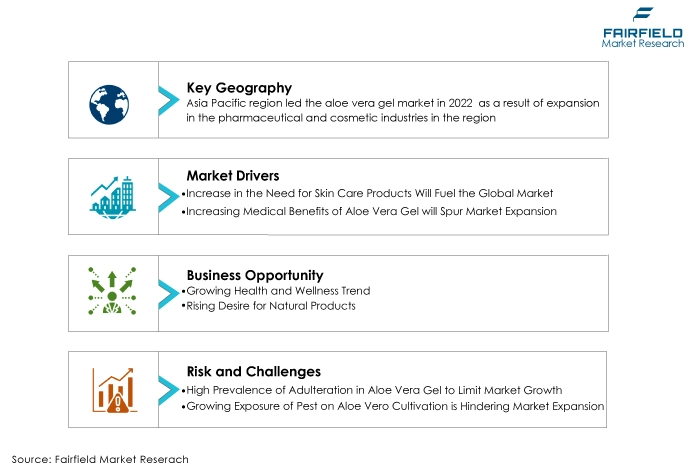
The market for aloe vera gel is being driven by an increase in the demand for skin care products. Additionally, the anti-inflammatory, acne-curing, anti-oxidant, herbal, and other health characteristics of aloe vera gel serve to expand the market for the product. Aloe vera gel is conveniently available at malls, pharmacies, and other places.
Like most people have started using natural ingredient-based cosmetics in recent years, most people are swiftly shifting their preferences toward a healthy lifestyle.
The market is driven by the gel's features, such as mannose polymers with different sugars, including glucose, vitamin, minerals, enzymes, proteins, and phytosterols.
- Medical Benefits of Aloe Vera Gel
According to a study by Herbal Medicines, aloe vera gel has 200 active ingredients, mostly vitamins, minerals, enzymes, and polysaccharides. Together, the elements above provide the intended outcome. A potent anti-inflammatory, aloe vera gel can be used to treat a variety of health concerns, such as constipation, colitis, and high blood pressure.
About half of all adults in the US have hypertension, yet only one-third of them take medication to manage it. According to a report from the National Center for Complementary & Integrative Health, aloe vera gel can also be used to treat fevers, gastrointestinal disorders, and cases of osteoarthritis. Because of these medical benefits, the market has the potential to expand dramatically.
- E-commerce Expansion
The dynamics and growth of the aloe vera gel industry are greatly influenced by the expansion of e-commerce and online retail platforms in the market. Global distribution of aloe vera gel goods is made possible through e-commerce platforms and online shopping. Due to the ease with which consumers from many locations may access and buy these products online, the market has become more global.
In addition, shoppers enjoy convenience when shopping online. The purchasing procedure is made more convenient because customers may browse and buy aloe vera gel goods using their smartphones while at home or on the road.
Online retail websites also include comprehensive product information and user testimonials. Customers who want to make educated buying selections can read about the advantages, components, and usage guidelines for aloe vera gel products.
Major Growth Barriers
- High Prevalence of Adulteration
There are more and more items on the market that are contaminated and lack the genuine qualities of pure aloe vera gel. Globally, there are many synthetic extracts made of hazardous substances that producers add for the aroma.
The main cause of this is the relatively reduced supply of pure aloe vera gels and, as a result, the high cost of these products due to increased demand. Thus, the high prevalence of adulteration in these items is the key growth inhibitor for the market's development.
- Growing Exposure of Pests on Aloe Vero Cultivation
Pests are one of the things that restrict aloe vera's growth. Mealybugs are one of the most prevalent mites that harm aloe-vera plants because they can pierce right through the tissues of the plant and suck up all the sap.
Furthermore, because it is a desert plant, the entire plot may get ruined by a brief period of high water. These factors have the potential to impede the market's growth.
Key Trends and Opportunities to Look at
Since a few years ago, particularly after the release of Covid-19, there has been an increase in interest among individuals of all ages in natural goods, such as aloe vera extracts. The main factor influencing this trend is customers' growing knowledge of these plant extracts' numerous health advantages.
As a result, more people are using aloe vera gels, whole leaf extracts, etc. for health reasons such as improving the texture of their skin and hair and preventing weight loss, which is driving the global aloe vera gel market.
- Growing Health and Wellness Trend
- Rising International Trade
The increasing health and wellness trend is a major force in the aloe vera gel market, affecting consumer preferences and reshaping the sector in numerous ways. Customers are actively looking for products that improve their general wellbeing as they become more health conscious.
Because of its possible health advantages, aloe vera gel is seen as a natural and advantageous substance that matches this trend. Additionally, a lot of consumers favour natural and plant-based remedies for their skincare and health problems.
International trade is an important market force in the aloe vera gel sector, influencing the development, dynamics, and accessibility of aloe vera gel products globally. Moving aloe vera gel items across borders is made easier by international trade.
As a result, suppliers and producers have easier access to a wider variety of resources such as aloe vera processing centres and distribution networks. Aloe vera is mostly farmed in a few places with adequate weather, like India, Mexico, and some areas of Africa.
How Does the Regulatory Scenario Shape this Industry?
Standards for aloe vera gel and related goods' quality and safety are established by regulations. By doing this, it is made sure that the products people obtain fulfill strict standards for purity, potency, and contamination-freeness. Market access and customer confidence depend heavily on compliance with these restrictions.
Additionally, regulatory bodies frequently regulate the statements that may be made in advertising and on product labels. Health, therapeutic, and cosmetic claims fall under this category. These rules must be followed by businesses to prevent consumer misinformation.
Furthermore, the rules might outline the permitted components and their corresponding concentrations in aloe vera gel products. This may affect the way manufacturers formulate their goods and choose where to get their ingredients.
Fairfield’s Ranking Board
Top Segments
The organic segment dominated the market in 2025. Aloe vera plants that have been grown without the use of artificial pesticides, herbicides, or genetically modified organisms (GMOs) produce organic aloe vera gel. Natural and environmentally friendly farming methods are used during the cultivation process.
Additionally, consumers who value goods that are seen as more natural, ecologically friendly, and devoid of synthetic additives favour organic aloe vera gel. Some people may view it as a healthier option.
The conventional category is expected to grow significantly over the forecast period. Traditional agricultural methods, which may include the use of artificial pesticides, herbicides, and fertilizers, are commonly used to manufacture conventional aloe vera gel. It does not follow the guidelines for organic production.
However, due to the utilisation of traditional farming practices and perhaps larger-scale production, the conventional aloe vera gel products are frequently more economically produced.
- Cosmetic and Personal Care Industry Records Maximum Uptake
- Online Sales Continue to Flourish
In 2025, the cosmetic and personal care industry dominated the market, and it is predicted to grow significantly over the course of the forecast period. This is due to the widespread use of aloe vera gel for many purposes, particularly those relating to the skin.
Aloe vera gel has been proven to be a fantastic skin healer and offers burn prevention. Aloe vera serves as a barrier for the skin and restores moisture to it. Australia and other places receive 15% more UV than Europeans while also receiving an additional 7% more UV intensity from the sun.
Furthermore, the pharmaceutical industry category is expected to expand significantly. The general nutritional properties are what enable a multifaceted use. The demand for items in the sector is being driven by an increase in the usage of herbal remedies for the treatment of various illnesses, including diabetes.
Furthermore, type II diabetes can be controlled by continuing to use such products. Around 490 million people worldwide have diabetes, according to the WHO.
The online category held the majority of the market share. It is because of steep discounts and more recent digital sales tactics that confidence is boosted and discounts are implemented at numerous checkpoints.
Additionally, celebrity codes and sponsorships help with positioning. Last but not least, because customers in different economies are often price-sensitive, online selling platforms can offer further options.
During the forecasted years, the supermarket & hypermarket category is growing at a substantial rate. The preferred selling strategies used to promote new products through supermarkets and hypermarkets are to blame.
Additionally, these goods have a longer shelf life, increasing the likelihood that the consumer will use them. By offering bulk discounts of up to 10-12%, offline merchants are attempting to correct old practices and boost sales of the newest products.
Regional Frontrunners
Asia Pacific Holds the Lion’s Share
The region with the biggest market share for aloe vera gel is expected to be Asia Pacific during that forecast period. The two main countries for aloe vera gel are China, and India, and both offer great profit margins for distributors and merchants. A 2,000-acre aloe vera farm might make a profit of about INR 4,72,000 due to increased product demand, according to a farmer's analysis.
Moreover, due to the expansion of the cosmetic and healthcare industries in the region, the rising population, and the growing purchasing power of consumers, emerging nations like China and India are also anticipated to be significant players in the regional market.
North America All Set for Significant Growth
The market for aloe vera gel is expanding at the fastest rate in North America, which presents a significant opportunity for the industry. It is because there is such a huge demand in the green beauty industry.
Additionally, consumers polled stated in a data report that they would be more eager to buy food or cosmetic products that were obtained responsibly, from nearby farms, and were organic in nature.
Furthermore, most of the leading market players for aloe vera gel are situated in North America, particularly in the US. Aloe vera gel sales are anticipated to increase over the next five years due to the high concentration of industry competitors in the area.
Fairfield’s Competitive Landscape Analysis
As per the Fairfields analysis, the leading players in the global market put a lot of effort into crucial market tactics like mergers, acquisitions, collaborations, and partnerships to grow their markets and hold onto their positions in an extremely competitive marketplace.
Additionally, since some players in the aloe vera gel market charge excessive costs for their products, competitors in the sector must provide products that are affordable in order to grow and survive in a market that is becoming more and more competitive.
Who are the Leaders in Global Aloe Vera Gel Space?
- Aloe Farms Inc.
- Aloe Vera Australia
- Pharmachem Laboratories Inc.
- Foodchem International Cooperation
- Terry Laboratories Inc.
- Patanjali Ayurved Ltd.
- Aloecorp Inc
- Aloe Laboratories Inc. (Harmony Green Co. Ltd.)
- Forever Living Products Inc.
- Herbalife International Inc.
- Lily of the Desert
- Natural Aloe Costa Rica S.A.
- NOW Health Group, Inc.
- Real Aloe Solutions, Inc.
- Lakewood Inc.
An Expert’s Eye
Demand and Future Growth
Skin care businesses have made significant investments to support market expansion. Aloe vera gell has miraculous skin advantages, including the ability to hydrate the skin and alleviate irritation.
Additionally, raising public awareness of the medical properties of aloe vera gel will accelerate market expansion. Furthermore, aloe vera gel use, whether through functional foods or supplements, has proven effective as a detoxifier, immune system booster, and promoter of healthy skin and hair.
Supply Side of the Market
According to our analysis, due to its ideal climate for the production of aloe vera, India has been a prominent producer and exporter of aloe vera gel and associated goods.
India has also adapted contemporary agricultural techniques and technology to effectively cultivate aloe vera. Aloe vera is a growing part of farmers' crop portfolios, which helps to explain why it is such a key provider.
Additionally, India has a thriving processing and production sector for aloe vera goods. These include cosmetics, juice, extracts, and gel from aloe vera. Aloe vera is extracted from plants, processed, and sold to a variety of foreign markets by numerous Indian businesses.
Global Aloe Vera Gel Market is Segmented as Below:
By Nature
- Conventional
- Organic
By End-use Industry
- Cosmetic and Personal Care Industry
- Food and Beverages Industry
- Pharmaceutical Industry
By Distribution Channel
- Institutional Sales
- Supermarkets and Hypermarkets
- Speciality Stores
- Online
- Others
By Geographic Coverage:
- North America
- Europe
- Asia Pacific
- Latin America
- Middle East & Africa
- Executive Summary
- Global Aloe Vera Gel Market Snapshot
- Future Projections
- Key Market Trends
- Regional Snapshot, by Value, 2026
- Analyst Recommendations
- Market Overview
- Market Definitions and Segmentations
- Market Dynamics
- Drivers
- Restraints
- Market Opportunities
- Value Chain Analysis
- COVID-19 Impact Analysis
- Porter's Five Forces Analysis
- Impact of Russia-Ukraine Conflict
- PESTLE Analysis
- Regulatory Analysis
- Price Trend Analysis
- Current Prices and Future Projections, 2025-2033
- Price Impact Factors
- Global Aloe Vera Gel Market Outlook, 2020 - 2033
- Global Aloe Vera Gel Market Outlook, by Nature, Value (US$ Mn), 2020-2033
- Conventional
- Organic
- Global Aloe Vera Gel Market Outlook, by End-use Industry, Value (US$ Mn), 2020-2033
- Cosmetic and Personal Care Industry
- Food and Beverages Industry
- Pharmaceutical Industry
- Global Aloe Vera Gel Market Outlook, by Distribution Channel, Value (US$ Mn), 2020-2033
- Institutional Sales
- Supermarkets and Hypermarkets
- Speciality Stores
- Online
- Others
- Global Aloe Vera Gel Market Outlook, by Region, Value (US$ Mn), 2020-2033
- North America
- Europe
- Asia Pacific
- Latin America
- Middle East & Africa
- Global Aloe Vera Gel Market Outlook, by Nature, Value (US$ Mn), 2020-2033
- North America Aloe Vera Gel Market Outlook, 2020 - 2033
- North America Aloe Vera Gel Market Outlook, by Nature, Value (US$ Mn), 2020-2033
- Conventional
- Organic
- North America Aloe Vera Gel Market Outlook, by End-use Industry, Value (US$ Mn), 2020-2033
- Cosmetic and Personal Care Industry
- Food and Beverages Industry
- Pharmaceutical Industry
- North America Aloe Vera Gel Market Outlook, by Distribution Channel, Value (US$ Mn), 2020-2033
- Institutional Sales
- Supermarkets and Hypermarkets
- Speciality Stores
- Online
- Others
- North America Aloe Vera Gel Market Outlook, by Country, Value (US$ Mn), 2020-2033
- U.S. Aloe Vera Gel Market Outlook, by Nature, 2020-2033
- U.S. Aloe Vera Gel Market Outlook, by End-use Industry, 2020-2033
- U.S. Aloe Vera Gel Market Outlook, by Distribution Channel, 2020-2033
- Canada Aloe Vera Gel Market Outlook, by Nature, 2020-2033
- Canada Aloe Vera Gel Market Outlook, by End-use Industry, 2020-2033
- Canada Aloe Vera Gel Market Outlook, by Distribution Channel, 2020-2033
- BPS Analysis/Market Attractiveness Analysis
- North America Aloe Vera Gel Market Outlook, by Nature, Value (US$ Mn), 2020-2033
- Europe Aloe Vera Gel Market Outlook, 2020 - 2033
- Europe Aloe Vera Gel Market Outlook, by Nature, Value (US$ Mn), 2020-2033
- Conventional
- Organic
- Europe Aloe Vera Gel Market Outlook, by End-use Industry, Value (US$ Mn), 2020-2033
- Cosmetic and Personal Care Industry
- Food and Beverages Industry
- Pharmaceutical Industry
- Europe Aloe Vera Gel Market Outlook, by Distribution Channel, Value (US$ Mn), 2020-2033
- Institutional Sales
- Supermarkets and Hypermarkets
- Speciality Stores
- Online
- Others
- Europe Aloe Vera Gel Market Outlook, by Country, Value (US$ Mn), 2020-2033
- Germany Aloe Vera Gel Market Outlook, by Nature, 2020-2033
- Germany Aloe Vera Gel Market Outlook, by End-use Industry, 2020-2033
- Germany Aloe Vera Gel Market Outlook, by Distribution Channel, 2020-2033
- Italy Aloe Vera Gel Market Outlook, by Nature, 2020-2033
- Italy Aloe Vera Gel Market Outlook, by End-use Industry, 2020-2033
- Italy Aloe Vera Gel Market Outlook, by Distribution Channel, 2020-2033
- France Aloe Vera Gel Market Outlook, by Nature, 2020-2033
- France Aloe Vera Gel Market Outlook, by End-use Industry, 2020-2033
- France Aloe Vera Gel Market Outlook, by Distribution Channel, 2020-2033
- U.K. Aloe Vera Gel Market Outlook, by Nature, 2020-2033
- U.K. Aloe Vera Gel Market Outlook, by End-use Industry, 2020-2033
- U.K. Aloe Vera Gel Market Outlook, by Distribution Channel, 2020-2033
- Spain Aloe Vera Gel Market Outlook, by Nature, 2020-2033
- Spain Aloe Vera Gel Market Outlook, by End-use Industry, 2020-2033
- Spain Aloe Vera Gel Market Outlook, by Distribution Channel, 2020-2033
- Russia Aloe Vera Gel Market Outlook, by Nature, 2020-2033
- Russia Aloe Vera Gel Market Outlook, by End-use Industry, 2020-2033
- Russia Aloe Vera Gel Market Outlook, by Distribution Channel, 2020-2033
- Rest of Europe Aloe Vera Gel Market Outlook, by Nature, 2020-2033
- Rest of Europe Aloe Vera Gel Market Outlook, by End-use Industry, 2020-2033
- Rest of Europe Aloe Vera Gel Market Outlook, by Distribution Channel, 2020-2033
- BPS Analysis/Market Attractiveness Analysis
- Europe Aloe Vera Gel Market Outlook, by Nature, Value (US$ Mn), 2020-2033
- Asia Pacific Aloe Vera Gel Market Outlook, 2020 - 2033
- Asia Pacific Aloe Vera Gel Market Outlook, by Nature, Value (US$ Mn), 2020-2033
- Conventional
- Organic
- Asia Pacific Aloe Vera Gel Market Outlook, by End-use Industry, Value (US$ Mn), 2020-2033
- Cosmetic and Personal Care Industry
- Food and Beverages Industry
- Pharmaceutical Industry
- Asia Pacific Aloe Vera Gel Market Outlook, by Distribution Channel, Value (US$ Mn), 2020-2033
- Institutional Sales
- Supermarkets and Hypermarkets
- Speciality Stores
- Online
- Others
- Asia Pacific Aloe Vera Gel Market Outlook, by Country, Value (US$ Mn), 2020-2033
- China Aloe Vera Gel Market Outlook, by Nature, 2020-2033
- China Aloe Vera Gel Market Outlook, by End-use Industry, 2020-2033
- China Aloe Vera Gel Market Outlook, by Distribution Channel, 2020-2033
- Japan Aloe Vera Gel Market Outlook, by Nature, 2020-2033
- Japan Aloe Vera Gel Market Outlook, by End-use Industry, 2020-2033
- Japan Aloe Vera Gel Market Outlook, by Distribution Channel, 2020-2033
- South Korea Aloe Vera Gel Market Outlook, by Nature, 2020-2033
- South Korea Aloe Vera Gel Market Outlook, by End-use Industry, 2020-2033
- South Korea Aloe Vera Gel Market Outlook, by Distribution Channel, 2020-2033
- India Aloe Vera Gel Market Outlook, by Nature, 2020-2033
- India Aloe Vera Gel Market Outlook, by End-use Industry, 2020-2033
- India Aloe Vera Gel Market Outlook, by Distribution Channel, 2020-2033
- Southeast Asia Aloe Vera Gel Market Outlook, by Nature, 2020-2033
- Southeast Asia Aloe Vera Gel Market Outlook, by End-use Industry, 2020-2033
- Southeast Asia Aloe Vera Gel Market Outlook, by Distribution Channel, 2020-2033
- Rest of SAO Aloe Vera Gel Market Outlook, by Nature, 2020-2033
- Rest of SAO Aloe Vera Gel Market Outlook, by End-use Industry, 2020-2033
- Rest of SAO Aloe Vera Gel Market Outlook, by Distribution Channel, 2020-2033
- BPS Analysis/Market Attractiveness Analysis
- Asia Pacific Aloe Vera Gel Market Outlook, by Nature, Value (US$ Mn), 2020-2033
- Latin America Aloe Vera Gel Market Outlook, 2020 - 2033
- Latin America Aloe Vera Gel Market Outlook, by Nature, Value (US$ Mn), 2020-2033
- Conventional
- Organic
- Latin America Aloe Vera Gel Market Outlook, by End-use Industry, Value (US$ Mn), 2020-2033
- Cosmetic and Personal Care Industry
- Food and Beverages Industry
- Pharmaceutical Industry
- Latin America Aloe Vera Gel Market Outlook, by Distribution Channel, Value (US$ Mn), 2020-2033
- Institutional Sales
- Supermarkets and Hypermarkets
- Speciality Stores
- Online
- Others
- Latin America Aloe Vera Gel Market Outlook, by Country, Value (US$ Mn), 2020-2033
- Brazil Aloe Vera Gel Market Outlook, by Nature, 2020-2033
- Brazil Aloe Vera Gel Market Outlook, by End-use Industry, 2020-2033
- Brazil Aloe Vera Gel Market Outlook, by Distribution Channel, 2020-2033
- Mexico Aloe Vera Gel Market Outlook, by Nature, 2020-2033
- Mexico Aloe Vera Gel Market Outlook, by End-use Industry, 2020-2033
- Mexico Aloe Vera Gel Market Outlook, by Distribution Channel, 2020-2033
- Argentina Aloe Vera Gel Market Outlook, by Nature, 2020-2033
- Argentina Aloe Vera Gel Market Outlook, by End-use Industry, 2020-2033
- Argentina Aloe Vera Gel Market Outlook, by Distribution Channel, 2020-2033
- Rest of LATAM Aloe Vera Gel Market Outlook, by Nature, 2020-2033
- Rest of LATAM Aloe Vera Gel Market Outlook, by End-use Industry, 2020-2033
- Rest of LATAM Aloe Vera Gel Market Outlook, by Distribution Channel, 2020-2033
- BPS Analysis/Market Attractiveness Analysis
- Latin America Aloe Vera Gel Market Outlook, by Nature, Value (US$ Mn), 2020-2033
- Middle East & Africa Aloe Vera Gel Market Outlook, 2020 - 2033
- Middle East & Africa Aloe Vera Gel Market Outlook, by Nature, Value (US$ Mn), 2020-2033
- Conventional
- Organic
- Middle East & Africa Aloe Vera Gel Market Outlook, by End-use Industry, Value (US$ Mn), 2020-2033
- Cosmetic and Personal Care Industry
- Food and Beverages Industry
- Pharmaceutical Industry
- Middle East & Africa Aloe Vera Gel Market Outlook, by Distribution Channel, Value (US$ Mn), 2020-2033
- Institutional Sales
- Supermarkets and Hypermarkets
- Speciality Stores
- Online
- Others
- Middle East & Africa Aloe Vera Gel Market Outlook, by Country, Value (US$ Mn), 2020-2033
- GCC Aloe Vera Gel Market Outlook, by Nature, 2020-2033
- GCC Aloe Vera Gel Market Outlook, by End-use Industry, 2020-2033
- GCC Aloe Vera Gel Market Outlook, by Distribution Channel, 2020-2033
- South Africa Aloe Vera Gel Market Outlook, by Nature, 2020-2033
- South Africa Aloe Vera Gel Market Outlook, by End-use Industry, 2020-2033
- South Africa Aloe Vera Gel Market Outlook, by Distribution Channel, 2020-2033
- Egypt Aloe Vera Gel Market Outlook, by Nature, 2020-2033
- Egypt Aloe Vera Gel Market Outlook, by End-use Industry, 2020-2033
- Egypt Aloe Vera Gel Market Outlook, by Distribution Channel, 2020-2033
- Nigeria Aloe Vera Gel Market Outlook, by Nature, 2020-2033
- Nigeria Aloe Vera Gel Market Outlook, by End-use Industry, 2020-2033
- Nigeria Aloe Vera Gel Market Outlook, by Distribution Channel, 2020-2033
- Rest of Middle East Aloe Vera Gel Market Outlook, by Nature, 2020-2033
- Rest of Middle East Aloe Vera Gel Market Outlook, by End-use Industry, 2020-2033
- Rest of Middle East Aloe Vera Gel Market Outlook, by Distribution Channel, 2020-2033
- BPS Analysis/Market Attractiveness Analysis
- Middle East & Africa Aloe Vera Gel Market Outlook, by Nature, Value (US$ Mn), 2020-2033
- Competitive Landscape
- Company Vs Segment Heatmap
- Company Market Share Analysis, 2025
- Competitive Dashboard
- Company Profiles
- Aloe Farms Inc.
- Company Overview
- Product Portfolio
- Financial Overview
- Business Strategies and Developments
- Aloe Vera Australia
- Pharmachem Laboratories Inc.
- Foodchem International Cooperation
- Terry Laboratories Inc.
- Patanjali Ayurved Ltd.
- Aloecorp Inc
- Aloe Laboratories Inc. (Harmony Green Co. Ltd.)
- Forever Living Products Inc.
- Herbalife International Inc.
- Aloe Farms Inc.
- Appendix
- Research Methodology
- Report Assumptions
- Acronyms and Abbreviations
|
BASE YEAR |
HISTORICAL DATA |
FORECAST PERIOD |
UNITS |
|||
 |
2025 |
 |
2019 - 2024 |
 |
2026 - 2033 |
Value: US$ Million |
|
REPORT FEATURES |
DETAILS |
|
Nature Coverage |
|
|
End-use Industry Coverage |
|
|
Distribution Channel Coverage |
|
|
Geographical Coverage |
|
|
Leading Companies |
|
|
Report Highlights |
Key Market Indicators, Macro-micro economic impact analysis, Technological Roadmap, Key Trends, Driver,Restraints, and Future Opportunities & Revenue Pockets,Porter’s 5 Forces Analysis, Historical Trend (2019-2021), Market Estimates and Forecast, Market Dynamics, Industry Trends, Competition Landscape, Category,Region, Country- wise Trends & Analysis, COVID-19 Impact Analysis (Demand and Supply Chain) |
Our Research Methodology
Considering the volatility of business today, traditional approaches to strategizing a game plan can be unfruitful if not detrimental. True ambiguity is no way to determine a forecast. A myriad of predetermined factors must be accounted for such as the degree of risk involved, the magnitude of circumstances, as well as conditions or consequences that are not known or unpredictable. To circumvent binary views that cast uncertainty, the application of market research intelligence to strategically posture, move, and enable actionable outcomes is necessary.
View Methodology
Quality Assured
Rigorous Validation Process

Confidentiality Assured
End-to-end Data Security

Custom Research Services
Tailored To Your Objectives
FAQs
The market for aloe vera gel is propelled by increasing consumer awareness of natural skincare, rising demand for organic products, and the versatile applications of aloe vera in cosmetics, and pharmaceuticals.
Regulatory complexities, fluctuations in aloe vera crop yields, and the need for sustainable sourcing pose challenges are all impacting the market stability and product availability.
Market players are increasingly emphasizing eco-friendly packaging, sustainable sourcing practices, and transparent labeling to align with consumer demand for environmentally conscious products.
Asia Pacific is a key growth region, driven by a surge in demand for natural skincare products, traditional use of aloe vera in Asian cultures, and a growing trend towards wellness and beauty. North America also exhibits substantial growth due to the rising popularity of aloe vera-infused health and beauty products.
Intense competition prevails, with key players focusing on product innovation, strategic partnerships, and geographical expansion to gain a competitive edge and capture a larger market share.
Related Reports
Earwax Removal Market
The global earwax removal market will reach US$ 1,416.74 Mn by 2033, growing at an 8.9% CAGR from 2026-2033, driven by rising demand for ear care solutions
Fashion Bag Market
The global fashion bag market will reach US$ 79.23 Bn by 2033, growing at a 6.2% CAGR from 2026-2033, driven by rising demand for fashionable accessories
Imitation Whipped Cream Market Insights, Competitive Landscape, and Market Forecast - 2033
The global imitation whipped cream market is valued at USD 2.40 billion in 2026 and is projected to reach USD 3.68 billion by 2033, growing at a CAGR of 6.3%.
Nocturnal Tourism Market Insights, Competitive Landscape, and Market Forecast - 2033
The global nocturnal tourism market is valued at USD 1.20 billion in 2026 and is projected to reach USD 2.89 billion by 2033, growing at a CAGR of 13.4%.
Nutraceutical Rigid Packaging Market Insights, Competitive Landscape, and Market Forecast 2033
The nutraceutical rigid packaging market reaches USD 8.90 Bn by 2033, growing at 7.4% CAGR from USD 5.40 Bn in 2026, driven by product safety globally
Plant Care Services Market Insights, Competitive Landscape, and Market Forecast 2033
The plant Care Services Market is valued at USD 4.20 Bn in 2026 and is projected to reach USD 7.98 Bn by 2033, expanding at a 9.6% CAGR through 2033