



Basic Chemicals Market
Basic Chemicals Market Insights, Competitive Landscape, and Market Forecast - 2033
The Basic Chemicals Market is valued at USD 670.3 Bn in 2026 and is projected to reach USD 900 Bn, growing at a CAGR of 4% by 2033.
Quick Report Digest
A Look Back and a Look Forward - Comparative Analysis
The basic chemicals market is growing due to several factors. Firstly, increasing industrialisation and urbanisation worldwide drive demand for basic chemicals in various industries such as construction, automotive, and consumer goods manufacturing. Additionally, advancements in production technologies enhance efficiency and reduce costs, making basic chemicals more accessible. Furthermore, growing awareness of sustainability encourages the use of basic chemicals in eco-friendly applications, further fueling market growth.
The growth of the basic chemicals market is primarily driven by applications in various sectors. These include the rising demand for fertilizers to support agricultural activities, the increasing need for basic chemicals in the manufacturing of plastics, and the expanding usage of chemicals in pharmaceuticals and personal care products. Additionally, the construction industry's reliance on basic chemicals for coatings, adhesives, and sealants further propels market growth.
The future of the basic chemicals market looks promising, with continued growth expected driven by increasing industrialisation, urbanisation, and demand for consumer goods worldwide. Additionally, advancements in production technologies and growing emphasis on sustainability are likely to shape the market landscape. Moreover, evolving regulations and shifting consumer preferences towards eco-friendly products are expected to drive innovation and investment in the Basic Chemicals sector, further fueling its growth.
Key Growth Determinants
- Growing Industrialisation, and Urbanisation
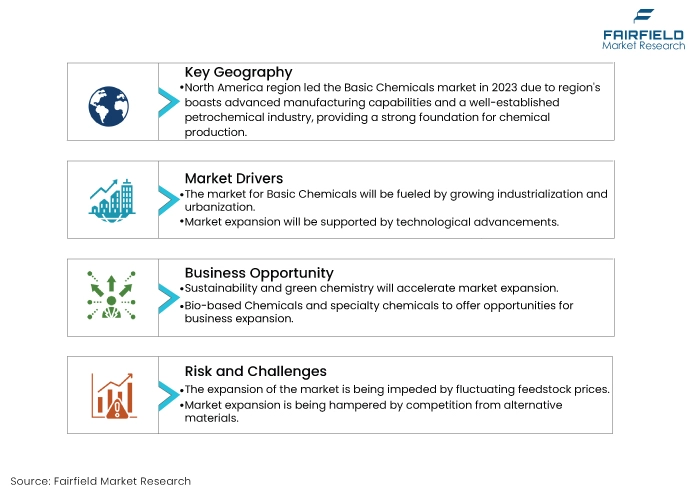
Industrialisation and urbanisation are expected to be significant drivers of the basic chemicals market. As countries undergo industrialisation, there is a surge in construction activities, infrastructure development, and manufacturing sectors, leading to increased demand for basic chemicals used in various applications such as adhesives, coatings, plastics, and fertilizers.
Additionally, rapid urbanisation results in the expansion of urban infrastructure, housing, and consumer goods industries, further driving demand for basic chemicals. Moreover, urbanisation leads to higher consumption of consumer goods, including personal care products, detergents, and plastics, all of which rely on basic chemicals as raw materials. As a result, the growth of industrialisation and urbanisation is expected to fuel sustained demand for basic chemicals globally, driving market growth in the coming years.
- Pacing Technological Advancements
Technological advancements drive significant growth in the basic chemicals market. Innovations in production processes, such as catalysis, process intensification, and renewable energy integration, enhance efficiency, reduce energy consumption, and minimise environmental impact. Furthermore, advancements in molecular engineering and materials science enable the development of novel chemicals with enhanced properties and functionalities, expanding their applications across various industries.
Moreover, digitalisation and automation technologies optimise production operations, improve supply chain management, and enable real-time monitoring and control, enhancing productivity and competitiveness. Additionally, breakthroughs in biotechnology and green chemistry facilitate the development of sustainable and eco-friendly alternatives to traditional chemical processes, addressing growing environmental concerns and regulatory requirements. Overall, technological advancements play a pivotal role in driving innovation, improving sustainability, and unlocking new growth opportunities in the basic chemicals market.
- Economic Growth
Economic growth is poised to drive the basic chemicals market through increased industrial activities and consumer spending. As economies expand, there is a surge in construction projects, automobile manufacturing, and infrastructure development, all of which rely heavily on basic chemicals for materials such as plastics, coatings, and adhesives.
Moreover, rising disposable income levels lead to greater demand for consumer goods, driving the need for basic chemicals in the production of items like packaging materials, textiles, and personal care products.
Furthermore, economic growth fosters agricultural advancements, increasing the demand for fertilizers and agrochemicals to support higher crop yields and improved agricultural practices. Additionally, as emerging markets continue to develop, the demand for basic chemicals used in various industrial processes is expected to rise, further propelling market growth.
Major Growth Barriers
- Competitive Pressures
Competitive pressures pose significant challenges in the basic chemicals market by exerting downward pressure on prices, limiting profit margins, and intensifying competition among manufacturers. In commoditised segments of the market, companies face challenges in maintaining market share and differentiation.
Additionally, aggressive pricing strategies and cost-cutting measures by competitors can further erode profitability. Moreover, the presence of numerous players vying for market share increases competitive intensity, making it challenging for companies to sustain growth and profitability.
- Shifts in Consumer Preferences
Shifts in consumer preferences present challenges in the basic chemicals market by necessitating adjustments to product offerings and manufacturing processes. Increasingly, consumers prefer eco-friendly and sustainable products, prompting manufacturers to invest in greener alternatives and modify existing production methods.
Meeting these evolving preferences requires significant investments in research and development, as well as changes to supply chain logistics. Failure to adapt to changing consumer demands can result in lost market share and diminished competitiveness in the industry.
Key Trends and Opportunities to Look at
In the basic chemicals market, sustainability and green chemistry initiatives focus on reducing environmental impact through the development of eco-friendly production processes, renewable feedstocks, and biodegradable products. Companies invest in sustainable practices to meet regulatory requirements, address consumer preferences, and enhance long-term competitiveness.
- Bio-Based Chemicals
- Specialty Chemicals
Bio-based chemicals are gaining traction in the basic chemicals market due to their renewable and sustainable nature. These chemicals, derived from biological feedstocks, offer eco-friendly alternatives to traditional petrochemical-based products, aligning with the growing demand for environmentally responsible solutions across various industries, including plastics, polymers, and specialty chemicals.
Specialty chemicals in the basic chemicals market refer to high-value, niche products designed for specific applications or industries. These chemicals offer unique properties, performance advantages, and customisation options, catering to diverse sectors such as electronics, pharmaceuticals, agriculture, and personal care, driving demand for specialised and tailored solutions.
How Does the Regulatory Scenario Shape this Industry?
The regulatory framework governing the basic chemicals market varies by region and includes legislation, standards, and guidelines aimed at ensuring product safety, environmental protection, and public health. Important regulatory entities include the Environmental Protection Agency (EPA) in the United States, the European Chemicals Agency (ECHA) in the European Union, and the Ministry of Environment (MoE) in various countries.
Key regulations impacting the basic chemicals market include Registration, Evaluation, Authorisation, and Restriction of Chemicals (REACH) in the EU, which mandates the registration and assessment of chemical substances, and the Toxic Substances Control Act (TSCA) in the US, which regulates the production and use of chemicals. Region-specific regulatory changes, such as stricter emission standards, bans on certain substances, and requirements for product labeling and safety data sheets, influence market dynamics and drive innovation towards more sustainable and compliant solutions.
Fairfield’s Ranking Board
Top Segments
The organic type captures the largest market share in the basic chemicals market due to its versatility and wide-ranging applications across various industries. Organic chemicals serve as key building blocks for manufacturing a diverse array of products, including plastics, pharmaceuticals, fertilizers, and cosmetics. Additionally, the growing demand for bio-based and environmentally friendly alternatives contributes to the prominence of organic chemicals, as they can be derived from renewable biomass sources, aligning with sustainability goals.
Inorganic chemicals are experiencing the highest CAGR in the basic chemicals market due to their extensive applications in diverse industries such as construction, electronics, and automotive. With increasing urbanisation and infrastructure development, the demand for inorganic chemicals like sulfuric acid, ammonia, and titanium dioxide is escalating. Additionally, these chemicals play a vital role in electronics manufacturing and water treatment, further propelling their market growth, leading to the highest CAGR in the sector.
- Agriculture to be the Top End-Use Industry
The agriculture end-use segment captures the largest market share in the basic chemicals market due to the extensive use of chemicals in agricultural practices. Basic chemicals such as fertilizers, pesticides, and herbicides are essential for enhancing crop yields, protecting crops from pests and diseases, and maintaining soil fertility. With increasing global food demand driven by population growth and changing dietary habits, the demand for agricultural chemicals remains robust, driving growth in this segment.
The automotive end-use segment is experiencing the highest CAGR in the basic chemicals market due to the expanding global automotive industry, which demands a wide array of chemicals for applications such as adhesives, coatings, and plastics. With the rise in vehicle production and the increasing need for lightweight materials and sustainable solutions, the demand for basic chemicals within the automotive sector is rapidly growing, contributing to its highest CAGR.
Regional Frontrunners
North America’s Revenue Contribution Remains Pivotal
The North America region captures the largest market share in the basic chemicals market due to several factors. The region boasts advanced manufacturing capabilities and a well-established petrochemical industry, providing a strong foundation for chemical production. Additionally, abundant shale gas reserves offer a cost-effective source of feedstock for chemical manufacturing, enhancing competitiveness.
Moreover, robust demand from key end-use industries such as automotive, construction, and consumer goods drives market growth. Furthermore, favourable regulatory policies and technological advancements further bolster the market in North America, attracting investments and fostering innovation. Overall, these factors contribute to the region's dominant position in the basic chemicals market.
Asia Pacific Poised to Demonstrate Rapid Expansion
The Asia Pacific basic chemicals market is on the brink of robust growh on the back of rapid industrialisation, urbanisation, and economic development that drive increased demand for basic chemicals across various industries. Additionally, favourable government policies, investments in infrastructure, and expanding manufacturing capabilities further fuel market growth. Moreover, the region's burgeoning population and rising disposable incomes contribute to robust consumption of consumer goods and industrial products, boosting demand for basic chemicals.
Fairfield’s Competitive Landscape Analysis
The competitive landscape of the basic chemicals market is characterised by the presence of several key players such as BASF SE, Dow Inc., SABIC, and ExxonMobil Chemical. These companies compete based on factors such as product quality, pricing, innovation, and market reach.
Additionally, mergers, acquisitions, and partnerships are common strategies employed by companies to strengthen their market position. The market is dynamic, with intense competition driving companies to continuously innovate and adapt to changing market dynamics.
Who are the Leaders in Global Basic Chemicals Space?
- BASF SE
- Dow, Inc.
- ExxonMobil Chemical
- SABIC
- INEOS Group
- LyondellBasell Industries
- Formosa Plastics Corporation
- Mitsubishi Chemical Corporation
- Sinopec
- AkzoNobel
- DuPont
- LG Chem
- Sumitomo Chemical Company
- Eastman Chemical Company
- Borealis AG
An Expert’s Eye
Demand and Future Growth
The basic chemicals market is experiencing demand driven by the expanding manufacturing, construction, and automotive sectors globally. Future growth is anticipated due to increasing urbanisation, industrialisation, and technological advancements. Moreover, the market is poised for expansion as emerging economies continue to develop, leading to greater demand for basic chemicals in various applications.
Additionally, the growing focus on sustainable and eco-friendly solutions is expected to fuel the demand for bio-based chemicals. Overall, the market's future growth is influenced by evolving consumer needs, technological innovation, and a shift towards environmentally conscious practices.
Supply Side of the Market
The demand-supply dynamics in the basic chemicals market are influenced by various factors. Increasing industrial activities and urbanisation drive demand, while advancements in production technologies enhance supply capabilities. The current pricing structure is shaped by factors such as raw material costs, market demand, and competitive dynamics. Pricing plays a crucial role in influencing long-term growth, as competitive pricing strategies can impact market share and profitability.
Major trends driving competition in the basic chemicals market include sustainability initiatives, technological advancements, and product innovation. Supply chain analysis is critical, with companies focusing on optimising logistics, ensuring raw material availability, and streamlining distribution channels to meet market demand efficiently. Collaboration along the supply chain, including partnerships with suppliers and distributors, helps enhance operational efficiency and ensure timely delivery of products to customers, contributing to market competitiveness.
Global Basic Chemicals Market is Segmented as Below:
By Type:
- Organic
- Inorganic
By End Use:
- Agriculture
- Automotive
- Construction
- Electronics
- Food & Beverage
- Healthcare & Pharmaceuticals
- Manufacturing
- Oil & Gas
- Packaging
- Textiles
By Geographic Coverage:
- North America
- Europe
- Asia Pacific
- Latin America
- Middle East & Africa
- Executive Summary
- Global Basic Chemicals Market Snapshot
- Future Projections
- Key Market Trends
- Regional Snapshot, by Value, 2026
- Analyst Recommendations
- Market Overview
- Market Definitions and Segmentations
- Market Dynamics
- Drivers
- Restraints
- Market Opportunities
- Value Chain Analysis
- COVID-19 Impact Analysis
- Porter's Five Forces Analysis
- Impact of Russia-Ukraine Conflict
- PESTLE Analysis
- Regulatory Analysis
- Price Trend Analysis
- Current Prices and Future Projections, 2025-2033
- Price Impact Factors
- Global Basic Chemicals Market Outlook, 2020 - 2033
- Global Basic Chemicals Market Outlook, by Type, Value (US$ Mn), 2020-2033
- Organic
- Inorganic
- Global Basic Chemicals Market Outlook, by End Use, Value (US$ Mn), 2020-2033
- Agriculture
- Automotive
- Construction
- Electronics
- Food & Beverage
- Healthcare & Pharmaceuticals
- Manufacturing
- Oil & Gas
- Packaging
- Textiles
- Global Basic Chemicals Market Outlook, by Region, Value (US$ Mn), 2020-2033
- North America
- Europe
- Asia Pacific
- Latin America
- Middle East & Africa
- Global Basic Chemicals Market Outlook, by Type, Value (US$ Mn), 2020-2033
- North America Basic Chemicals Market Outlook, 2020 - 2033
- North America Basic Chemicals Market Outlook, by Type, Value (US$ Mn), 2020-2033
- Organic
- Inorganic
- North America Basic Chemicals Market Outlook, by End Use, Value (US$ Mn), 2020-2033
- Agriculture
- Automotive
- Construction
- Electronics
- Food & Beverage
- Healthcare & Pharmaceuticals
- Manufacturing
- Oil & Gas
- Packaging
- Textiles
- North America Basic Chemicals Market Outlook, by Country, Value (US$ Mn), 2020-2033
- U.S. Basic Chemicals Market Outlook, by Type, 2020-2033
- U.S. Basic Chemicals Market Outlook, by End Use, 2020-2033
- Canada Basic Chemicals Market Outlook, by Type, 2020-2033
- Canada Basic Chemicals Market Outlook, by End Use, 2020-2033
- BPS Analysis/Market Attractiveness Analysis
- North America Basic Chemicals Market Outlook, by Type, Value (US$ Mn), 2020-2033
- Europe Basic Chemicals Market Outlook, 2020 - 2033
- Europe Basic Chemicals Market Outlook, by Type, Value (US$ Mn), 2020-2033
- Organic
- Inorganic
- Europe Basic Chemicals Market Outlook, by End Use, Value (US$ Mn), 2020-2033
- Agriculture
- Automotive
- Construction
- Electronics
- Food & Beverage
- Healthcare & Pharmaceuticals
- Manufacturing
- Oil & Gas
- Packaging
- Textiles
- Europe Basic Chemicals Market Outlook, by Country, Value (US$ Mn), 2020-2033
- Germany Basic Chemicals Market Outlook, by Type, 2020-2033
- Germany Basic Chemicals Market Outlook, by End Use, 2020-2033
- Italy Basic Chemicals Market Outlook, by Type, 2020-2033
- Italy Basic Chemicals Market Outlook, by End Use, 2020-2033
- France Basic Chemicals Market Outlook, by Type, 2020-2033
- France Basic Chemicals Market Outlook, by End Use, 2020-2033
- U.K. Basic Chemicals Market Outlook, by Type, 2020-2033
- U.K. Basic Chemicals Market Outlook, by End Use, 2020-2033
- Spain Basic Chemicals Market Outlook, by Type, 2020-2033
- Spain Basic Chemicals Market Outlook, by End Use, 2020-2033
- Russia Basic Chemicals Market Outlook, by Type, 2020-2033
- Russia Basic Chemicals Market Outlook, by End Use, 2020-2033
- Rest of Europe Basic Chemicals Market Outlook, by Type, 2020-2033
- Rest of Europe Basic Chemicals Market Outlook, by End Use, 2020-2033
- BPS Analysis/Market Attractiveness Analysis
- Europe Basic Chemicals Market Outlook, by Type, Value (US$ Mn), 2020-2033
- Asia Pacific Basic Chemicals Market Outlook, 2020 - 2033
- Asia Pacific Basic Chemicals Market Outlook, by Type, Value (US$ Mn), 2020-2033
- Organic
- Inorganic
- Asia Pacific Basic Chemicals Market Outlook, by End Use, Value (US$ Mn), 2020-2033
- Agriculture
- Automotive
- Construction
- Electronics
- Food & Beverage
- Healthcare & Pharmaceuticals
- Manufacturing
- Oil & Gas
- Packaging
- Textiles
- Asia Pacific Basic Chemicals Market Outlook, by Country, Value (US$ Mn), 2020-2033
- China Basic Chemicals Market Outlook, by Type, 2020-2033
- China Basic Chemicals Market Outlook, by End Use, 2020-2033
- Japan Basic Chemicals Market Outlook, by Type, 2020-2033
- Japan Basic Chemicals Market Outlook, by End Use, 2020-2033
- South Korea Basic Chemicals Market Outlook, by Type, 2020-2033
- South Korea Basic Chemicals Market Outlook, by End Use, 2020-2033
- India Basic Chemicals Market Outlook, by Type, 2020-2033
- India Basic Chemicals Market Outlook, by End Use, 2020-2033
- Southeast Asia Basic Chemicals Market Outlook, by Type, 2020-2033
- Southeast Asia Basic Chemicals Market Outlook, by End Use, 2020-2033
- Rest of SAO Basic Chemicals Market Outlook, by Type, 2020-2033
- Rest of SAO Basic Chemicals Market Outlook, by End Use, 2020-2033
- BPS Analysis/Market Attractiveness Analysis
- Asia Pacific Basic Chemicals Market Outlook, by Type, Value (US$ Mn), 2020-2033
- Latin America Basic Chemicals Market Outlook, 2020 - 2033
- Latin America Basic Chemicals Market Outlook, by Type, Value (US$ Mn), 2020-2033
- Organic
- Inorganic
- Latin America Basic Chemicals Market Outlook, by End Use, Value (US$ Mn), 2020-2033
- Agriculture
- Automotive
- Construction
- Electronics
- Food & Beverage
- Healthcare & Pharmaceuticals
- Manufacturing
- Oil & Gas
- Packaging
- Textiles
- Latin America Basic Chemicals Market Outlook, by Country, Value (US$ Mn), 2020-2033
- Brazil Basic Chemicals Market Outlook, by Type, 2020-2033
- Brazil Basic Chemicals Market Outlook, by End Use, 2020-2033
- Mexico Basic Chemicals Market Outlook, by Type, 2020-2033
- Mexico Basic Chemicals Market Outlook, by End Use, 2020-2033
- Argentina Basic Chemicals Market Outlook, by Type, 2020-2033
- Argentina Basic Chemicals Market Outlook, by End Use, 2020-2033
- Rest of LATAM Basic Chemicals Market Outlook, by Type, 2020-2033
- Rest of LATAM Basic Chemicals Market Outlook, by End Use, 2020-2033
- BPS Analysis/Market Attractiveness Analysis
- Latin America Basic Chemicals Market Outlook, by Type, Value (US$ Mn), 2020-2033
- Middle East & Africa Basic Chemicals Market Outlook, 2020 - 2033
- Middle East & Africa Basic Chemicals Market Outlook, by Type, Value (US$ Mn), 2020-2033
- Organic
- Inorganic
- Middle East & Africa Basic Chemicals Market Outlook, by End Use, Value (US$ Mn), 2020-2033
- Agriculture
- Automotive
- Construction
- Electronics
- Food & Beverage
- Healthcare & Pharmaceuticals
- Manufacturing
- Oil & Gas
- Packaging
- Textiles
- Middle East & Africa Basic Chemicals Market Outlook, by Country, Value (US$ Mn), 2020-2033
- GCC Basic Chemicals Market Outlook, by Type, 2020-2033
- GCC Basic Chemicals Market Outlook, by End Use, 2020-2033
- South Africa Basic Chemicals Market Outlook, by Type, 2020-2033
- South Africa Basic Chemicals Market Outlook, by End Use, 2020-2033
- Egypt Basic Chemicals Market Outlook, by Type, 2020-2033
- Egypt Basic Chemicals Market Outlook, by End Use, 2020-2033
- Nigeria Basic Chemicals Market Outlook, by Type, 2020-2033
- Nigeria Basic Chemicals Market Outlook, by End Use, 2020-2033
- Rest of Middle East Basic Chemicals Market Outlook, by Type, 2020-2033
- Rest of Middle East Basic Chemicals Market Outlook, by End Use, 2020-2033
- BPS Analysis/Market Attractiveness Analysis
- Middle East & Africa Basic Chemicals Market Outlook, by Type, Value (US$ Mn), 2020-2033
- Competitive Landscape
- Company Vs Segment Heatmap
- Company Market Share Analysis, 2025
- Competitive Dashboard
- Company Profiles
- BASF SE
- Company Overview
- Product Portfolio
- Financial Overview
- Business Strategies and Developments
- Dow, Inc.
- ExxonMobil Chemical
- SABIC
- INEOS Group
- LyondellBasell Industries
- Formosa Plastics Corporation
- Mitsubishi Chemical Corporation
- Sinopec
- AkzoNobel
- BASF SE
- Appendix
- Research Methodology
- Report Assumptions
- Acronyms and Abbreviations
|
BASE YEAR |
HISTORICAL DATA |
FORECAST PERIOD |
UNITS |
|||
 |
2025 |
 |
2019 - 2024 |
 |
2026 - 2033 |
Value: US$ Billion |
|
REPORT FEATURES |
DETAILS |
|
Type Coverage |
|
|
End Use Coverage |
|
|
Geographical Coverage |
|
|
Leading Companies |
|
|
Report Highlights |
Key Market Indicators, Macro-micro economic impact analysis, Technological Roadmap, Key Trends, Driver, Restraints, and Future Opportunities & Revenue Pockets, Porter’s 5 Forces Analysis, Historical Trend (2019-2021), Market Estimates and Forecast, Market Dynamics, Industry Trends, Competition Landscape, Category, Region, Country-wise Trends & Analysis, COVID-19 Impact Analysis (Demand and Supply Chain) |
Our Research Methodology
Considering the volatility of business today, traditional approaches to strategizing a game plan can be unfruitful if not detrimental. True ambiguity is no way to determine a forecast. A myriad of predetermined factors must be accounted for such as the degree of risk involved, the magnitude of circumstances, as well as conditions or consequences that are not known or unpredictable. To circumvent binary views that cast uncertainty, the application of market research intelligence to strategically posture, move, and enable actionable outcomes is necessary.
View Methodology
Quality Assured
Rigorous Validation Process

Confidentiality Assured
End-to-end Data Security

Custom Research Services
Tailored To Your Objectives
FAQs
The global basic chemicals market size was approximately USD 670.3 Bn in 2026.
North America holds the largest share of the global basic chemicals market.
The primary factor projected to drive the basic chemicals market expansion is the pace of industrialisation and urbanisation, and technological advancements.
In 2025, the organic category held a significant share in the global market.
The agriculture segment constitutes a major share of the global basic chemicals market.
Related Reports
Blue Light Blocking Glasses Market
The global blue light blocking glasses market will reach US$ 5.18 Bn by 2033, growing at a 9.2% CAGR, driven by rising screen exposure and eye-care awareness
Microalgae in Fertilizers Market Insights, Competitive Landscape, and Market Forecast - 2033
Microalgae in fertilizers market is valued at USD 480.00 million in 2026 and is projected to reach USD 1,171.92 million by 2033, growing at a CAGR of 13.6%.
Smart Seed Coatings Market Insights, Competitive Landscape, and Market Forecast 2033
The smart seed coatings market is valued at USD 1.50 billion in 2026 and is projected to reach USD 3.19 billion by 2033, growing at 11.4% CAGR
Vegan Clothing Market Insights, Competitive Landscape, and Market Forecast - 2033
The global vegan clothing market is valued at USD 4.80 billion in 2026 and is projected to reach USD 11.02 billion by 2033, at a CAGR of 12.6%.
Stain-Resistant Fabric Market
Stain-Resistant Fabric Market reaches USD 8.60 Billion in 2026, projected to hit USD 13.90 Billion by 2033 at a 7.1% CAGR.
Foam Glass Granulate Market
Foam Glass Granulate Market is valued at USD 380.00 Million in 2026 and projected to reach USD 677.05 Million by 2033, growing at 8.6% CAGR during 2026–2033