



Bio-Based Extrusion Aids Market
Bio-Based Extrusion Aids Market Size, Share, Insights, Competitive Landscape, and Forecast 2026 to 2033
Bio-Based Extrusion Aids Market Size and Trend Analysis
How Fast Is the Bio-Based Extrusion Aids Market Growing?
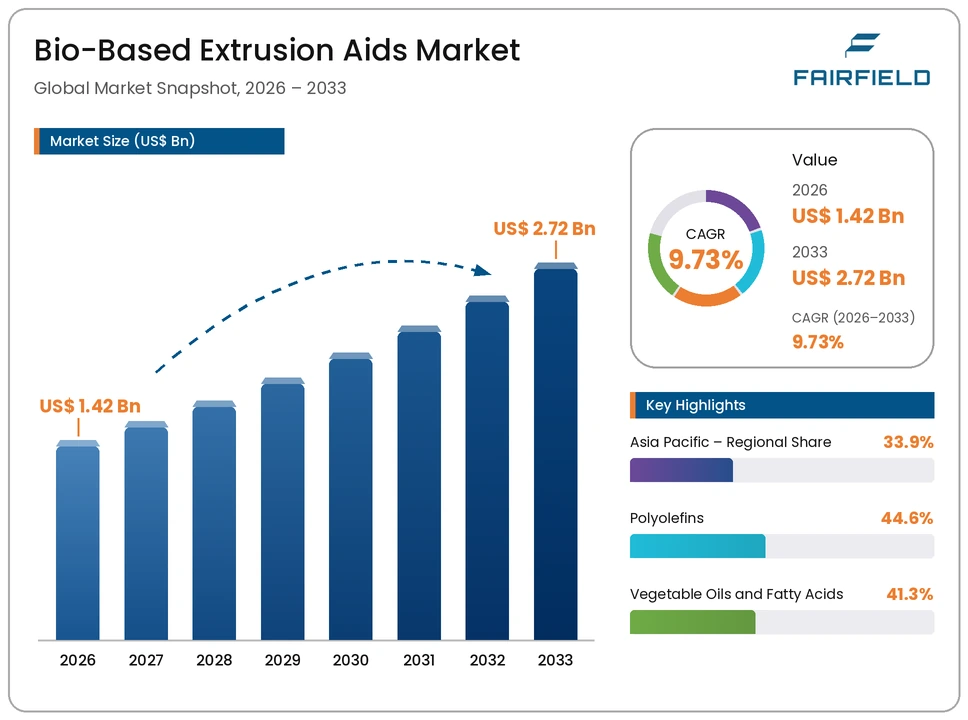
The global Bio-Based Extrusion Aids market size is expected to be valued at US$ 1.42 billion in 2026 and projected to reach US$ 2.72 billion by 2033, growing at a CAGR of 9.73% between 2026 and 2033.
Between 2020 and 2025 the market expanded at roughly a 7.4% CAGR, reaching about US$ 1.30 billion. Three forces explain the faster pace ahead. First, converters are pre-qualifying replacements for fluoropolymer additives while the universal restriction dossier on per- and polyfluoroalkyl substances sits with the European Chemicals Agency. Second, packaging brand owners now set renewable-carbon targets that reach past the resin into the additive package. Third, compostable and recycled polymer streams need lubricants and release agents that leave no persistent residue. Demand is moving from a niche of certified food-contact lubricants toward routine specification of renewable slip agents across film, pipe and profile extrusion.
Key Report Takeaways
- By Product Type: Lubricants and Release Agents held 28.4% share in 2026, while Polymer Processing Aids are projected to expand at a 12.4% CAGR through 2033, driven by anticipatory replacement of fluoropolymer die-coating additives in blown film lines.
- By Feedstock: Vegetable Oils and Fatty Acids held 41.3% share in 2026, while Tall Oil and Forestry Derivatives are projected to grow at a 12.9% CAGR through 2033, driven by buyer preference for feedstocks that avoid competition with food crops.
- By Polymer Processed: Polyolefins held 44.6% share in 2026, while Biopolymers are projected to grow at a 13.6% CAGR through 2033, driven by compostability certification rules that disqualify most petrochemical additive residues.
- By End Use: Flexible and Rigid Packaging held 36.2% share in 2026, while Agriculture Films are projected to grow at a 12.3% CAGR through 2033, driven by soil-biodegradable mulch standards adopted across European and Chinese farming regions.
- By Geography: Asia Pacific held 33.9% share in 2026, while Europe is projected to grow at an 11.5% CAGR through 2033, driven by chemical restriction work and packaging rules that force early reformulation.
Global Bio-Based Extrusion Aids Market Trends and Insights
Drivers Impact Analysis
Two regulatory currents account for most of the incremental pull on renewable melt-processing additives.
| Driver | Impact on CAGR Forecast | Geographic Relevance | Impact Timeline |
| Anticipatory substitution of fluoropolymer processing aids under European chemical restriction work | High | Europe, North America | Medium term (2–4 years) |
| Food-contact and packaging rules pushing renewable additive packages into film converting | High | Europe, Asia Pacific | Short term (≤2 years) |
- European Restriction Work on Fluorinated Additives Opens Film Lines to Renewable Processing Aids
Regulatory uncertainty around fluorinated chemistry is the strongest single pull on this market. Denmark, Germany, the Netherlands, Norway and Sweden registered a restriction intention with the European Chemicals Agency on 15 July 2021, and the agency ran its Annex XV consultation from 22 March 2023 to 25 September 2023. The dossier remains in opinion development, which leaves converters planning around an outcome they cannot yet date.
The mechanism is qualification lead time rather than any existing ban. Blown film plants need two to four years to validate an alternative across resin grades, so trials begin long before a legal deadline. Oleochemical esters, amide waxes and metal soaps are the practical candidates because they already hold food-contact clearances. Suppliers of PFAS-free processing additives therefore capture trial volume and specification positions well ahead of the restriction itself.
- Packaging and Food-Contact Rules Pull Renewable Slip Agents Into Converting Specifications
Packaging legislation has turned additive origin into a procurement variable. Regulation (EC) No 1935/2004 and Regulation (EU) No 10/2011 already govern which substances may migrate from plastic food-contact materials. Regulation (EU) 2025/40 of 19 December 2024 then added recyclability, minimisation and recycled-content duties that apply from 12 August 2026, forcing converters to reopen film formulations they had left untouched for years.
The causal chain runs through reformulation windows. Once a converter redesigns a laminate to meet recyclability grading, every additive in the structure is re-evaluated at the same time. Renewable slip and anti-block agents enter at that moment because they carry documented bio-based carbon content under ASTM D6866 and support brand-owner renewable-carbon reporting. Emery Oleochemicals added four pelargonic acid products to its USDA-certified biobased portfolio in October 2024, illustrating how suppliers package that evidence.
Restraints Impact Analysis
Two technical and commercial barriers continue to slow substitution even where regulatory direction is clear.
| Restraint | Impact on CAGR Forecast | Geographic Relevance | Impact Timeline |
| Narrow thermal stability window of oleochemical additives in high-temperature extrusion | High | Asia Pacific, North America | Medium term (2–4 years) |
| Agricultural feedstock price volatility and certification overhead | Medium | Europe, Latin America | Long term (≥4 years) |
- Thermal Degradation of Oleochemical Additives Blocks Use in Engineering Plastic Extrusion
Thermal stability is the main technical ceiling on renewable additive adoption. Fatty acid esters, amides and metal soaps begin to decompose well below the melt temperatures used for polyamides, polycarbonate and polyphenylene sulphide. Decomposition produces plate-out on dies, screw slippage and volatile breakdown products that fail workplace odour limits, so compounders keep petrochemical waxes in those grades.
The specific cost source is scrap and line stoppage rather than additive price. A profile line that must be shut down to clean die deposits loses several hours of saleable output and consumes purge compound. Smoke and odour generated during degradation also trigger ventilation upgrades and operator complaints in enclosed compounding halls. Because engineering plastics carry high resin value per kilogram, converters will not risk a batch of scrap to save a few cents on an oleochemical lubricant.
- Vegetable Oil Price Swings and Certification Overhead Squeeze Additive Supplier Margins
Input volatility compresses margins across the renewable additive chain. Palm, palm kernel, castor, rapeseed and soybean oil prices move with harvest conditions, biodiesel mandates and export policy, and those swings pass directly into stearates, erucamides and ester lubricants. Converters, by contrast, negotiate annual price agreements, leaving suppliers to absorb mid-year increases.
The underlying cause combines feedstock economics with documentation duty. Renewable diesel and sustainable aviation fuel programmes now bid for the same oils and waste fats, lifting the floor price of oleochemical raw material. On top of that, suppliers fund mass-balance chain-of-custody audits, deforestation-free sourcing evidence and radiocarbon testing under ASTM D6866 for each grade they certify. Those audit and testing costs are largely fixed for each product line, so they fall hardest on specialised additive grades that converters buy in low tonnage.
Market Opportunities
Two revenue pools sit outside the compliance-driven substitution business that dominates current sales.
- Compostable Polymer Compounding Creates a Certification-Protected Pool for Bio-Based Plasticisers
Compostable polymer compounding opens a revenue pool that petrochemical additive suppliers cannot enter. Polylactic acid, polyhydroxyalkanoate and starch blends process in narrow thermal windows and must retain certified compostability, which disqualifies most mineral-derived lubricants outright. Additive content therefore becomes a pass-or-fail gate rather than a cost line, and pricing follows performance instead of tonnage.
Oleochemical producers and masterbatch compounders with disintegration test data are best positioned to capture it. Demand originates with food-service packaging converters, coffee capsule producers and organic waste bag manufacturers, all of which must show certification to retain shelf listings. Emery Oleochemicals showcased its LOXIOL sustainable polymer additive range at Vinyltec 2024 in October 2024, signalling that established lubricant houses are repositioning portfolios toward these certification-led applications rather than chasing commodity lubricant volume on price alone.
- Non-Food Feedstock Routes Unlock Premium Supply to Renewable-Carbon Procurement Programmes
Non-food feedstock routes create a premium pool tied to corporate renewable-carbon accounting. Tall oil from kraft pulping, castor oil, used cooking oil and animal fat residues all deliver bio-based carbon without competing for edible crops. Brand owners that report renewable-content percentages will pay above commodity levels for additives carrying that provenance, because the claim survives external scrutiny.
Oleochemical refiners and specialty additive houses with mass-balance certification can serve this pool, often alongside pulp producers supplying residue streams. Demand comes from consumer goods companies, automotive interior suppliers and retailers that publish renewable-carbon targets and audit their converters against them. The USDA BioPreferred programme, which has designated 142 product categories with minimum biobased content requirements, gives federal and institutional buyers a parallel procurement hook that extends the same pool into public tenders.
Segment Analysis
- By Product Type: Lubricants and Release Agents Lead as Polymer Processing Aids Accelerate
Lubricants and Release Agents held 28.4% of the bio-based extrusion aids market in 2026, the largest product type. They lead because internal and external lubrication is required in nearly every extrusion, calendering and profile operation, and because oleochemical lubricants such as stearates, montan esters and amide waxes have been qualified in these roles for decades. Polymer Processing Aids form the fastest-growing type at a 12.4% CAGR through 2033, as film converters pre-qualify substitutes for fluorinated die-coating additives. Slip Agents remain the volume backbone of packaging film, where erucamide and oleamide control coefficient of friction. Anti-Block Agents, Bio-Based Plasticisers and Antistatic Agents fill out the portfolio. The commercial implication is that suppliers able to demonstrate melt-fracture suppression from a renewable chemistry can displace incumbents quickly, because the switching trigger is regulatory rather than economic.
- By Feedstock: Vegetable Oils Dominate Volume While Forestry Residues Gain Ground
Vegetable Oils and Fatty Acids accounted for 41.3% of value in 2026, the leading feedstock, because palm, palm kernel, rapeseed and soybean derivatives feed the established stearate and amide production base and already hold food-contact clearances. Tall Oil and Forestry Derivatives represent the fastest-growing source at a 12.9% CAGR through 2033, since crude tall oil is a kraft pulping residue and avoids the food-versus-fuel scrutiny that now follows edible oils. Castor Oil Derivatives serve specialised ricinoleate lubricants and bio-based plasticisers used in flexible polyvinyl chloride. Starch and Sugar Derivatives support fermentation-routed acids, while Animal and Waste Fats underpin lower-cost stearate grades. Buyers increasingly ask for feedstock disclosure alongside technical data, so traceable residue streams are becoming a selling point rather than a sustainability footnote.
- By Polymer Processed: Polyolefins Carry Consumption as Biopolymers Expand Quickest
Polyolefins represented 44.6% of consumption in 2026, the dominant polymer group, reflecting the tonnage of polyethylene and polypropylene converted into film, pipe and moulded goods, and the high processing-aid intensity of blown film where melt fracture limits line speed. Biopolymers are the fastest-growing polymer processed at a 13.6% CAGR through 2033, albeit from a modest base. Polylactic acid and polyhydroxyalkanoate compounds degrade easily and must hold compostability certification, which rules out persistent additive residues. Polyvinyl chloride remains a substantial consumer of calcium and zinc stearates and of bio-based plasticisers in flexible grades. Engineering Plastics show limited penetration because of thermal stability limits, and Elastomers contribute release agent demand. Growth is therefore concentrated where formulations are being rebuilt rather than merely maintained.
- By End Use: Packaging Anchors Demand While Agriculture Films Scale Fastest
Flexible and Rigid Packaging held 36.2% share in 2026, the leading end use, because film, sheet and container extrusion consume the largest tonnage of slip, anti-block and lubricant additives, and because food-contact approval already favours oleochemical chemistries. Agriculture Films are the fastest-growing end use at a 12.3% CAGR through 2033. Soil-biodegradable mulch films sold under the EN 17033 standard must disintegrate without leaving residues, so every additive in the compound is screened for ecotoxicity. Building and Construction consumes stearate lubricants in pipe and window profile. Automotive and Transportation applies renewable additives in interior parts facing odour and emission limits, while Wire and Cable and Consumer Goods add steady baseline demand. For suppliers, agricultural film customers accept a technical premium that commodity film converters resist.
Geography Analysis
North America Aligns Renewable Additive Demand With Federal Procurement and Brand Commitments
North America held 23.8% share in 2026 and is forecast to grow at an 8.4% CAGR to 2033. The United States drives most of that volume through a combination of brand-owner renewable-content pledges and public purchasing rules. The USDA BioPreferred programme requires federal agencies and their contractors to give preference to designated biobased products, with content verified by ASTM D6866 radiocarbon testing. Canada contributes through food packaging converters aligned with retailer specifications, and Mexico supplies automotive and appliance components built to customer global standards. The regional constraint is fragmented chemical regulation, which delays portfolio-wide reformulation decisions. The change underway is retailer screening, as large consumer goods buyers extend chemical and renewable-content criteria from finished articles back into the processing additives used to make them.
Which Region Is Growing Fastest in the Bio-Based Extrusion Aids Market?
Europe is growing fastest in the bio-based extrusion aids market at an 11.5% CAGR to 2033, from 27.4% share in 2026. Regulation sets the pace. The restriction dossier on per- and polyfluoroalkyl substances lodged with the European Chemicals Agency has already pushed converters to trial alternatives, while Regulation (EU) 2025/40 applies packaging recyclability and minimisation duties from 12 August 2026. Germany, Italy, France and the Netherlands concentrate the compounding and masterbatch capacity that reformulates first. Standards support the shift, with EN 16785 defining how bio-based content is determined and EN 16575 fixing the vocabulary used in claims. The regional barrier is flat underlying polymer demand, which limits tonnage growth. The opportunity lies in exporting qualified formulations, since approval packages travel well to multinational brand owners.
Which Region Is Leading the Bio-Based Extrusion Aids Market?
Asia Pacific leads the bio-based extrusion aids market with 33.9% share in 2026, growing at a 9.6% CAGR to 2033. The region holds this position because it converts most of the world's polyolefin tonnage and hosts the oleochemical refining base that supplies the raw material. Malaysia and Indonesia supply palm and palm kernel derivatives, India hosts specialised additive manufacturing, and China operates the largest concentration of film and pipe extrusion lines. Proximity between feedstock refining and additive production keeps delivered cost low. Japan and South Korea add demand through electronics and automotive compounds with tight odour specifications. The regional constraint is price competition, which caps premiums for certified grades. The change ahead is domestic policy, as plastic waste rules in China and India begin to reward compostable and reduced-additive formulations.
Latin America Builds Additive Demand on Agricultural Feedstock Strength
Latin America accounted for 8.2% share in 2026 and is forecast to grow at an 8.9% CAGR to 2033. Brazil anchors the region through sugarcane-derived chemistry, a substantial soybean crush base and a domestic bio-polyethylene industry that pairs naturally with renewable additive packages. Argentina supplies soybean and sunflower oil derivatives, while Colombia and Chile add packaging and agricultural film conversion. The principal barriers are currency volatility, import dependence for specialised additive grades and limited local testing infrastructure for compostability and migration studies. Logistics costs also discourage small converters from qualifying imported specialities. The shaping opportunity is backward integration, as regional oleochemical refiners move from exporting crude derivatives toward producing finished lubricants and slip agents for domestic and neighbouring converters.
Middle East & Africa Converts Petrochemical Strength Into Selective Renewable Adoption
Middle East & Africa held 6.7% share in 2026 and is forecast to grow at a 9.2% CAGR to 2033, the smallest regional base. Saudi Arabia and the United Arab Emirates drive demand as downstream conversion capacity expands beyond resin production into film, pipe and moulded goods aimed at export customers. South Africa contributes packaging and agricultural film volume, while Egypt and Morocco supply converters serving European retailers. The main barriers are abundant low-cost petrochemical feedstock, which weakens the economic case for renewable additives, and thin local certification capability. Export pull is the decisive change, because converters shipping into European retail must meet buyer specifications on additive origin, so renewable grades enter through contract requirements rather than domestic regulation.
Competitive Landscape
The bio-based extrusion aids market is moderately concentrated. A handful of oleochemical and specialty additive groups hold the qualified food-contact grades that converters actually buy, yet dozens of regional producers supply commodity stearates and amide waxes. Concentration is higher in certified and documented grades than in bulk lubricants, because chain-of-custody audits and migration dossiers take years to assemble. Vertically integrated players that own upstream oleochemical refining enjoy a structural cost position, while independent formulators compete through application service and speed of qualification.
Competition turns on four practical factors rather than list price. Converters evaluate thermal stability across the full processing window, plate-out behaviour on dies and rolls, availability of food-contact and compostability documentation, and consistency between batches of agriculturally sourced feedstock. New entrants arrive from two directions. Pulp and paper groups push tall oil derivatives into lubricant applications, and fermentation companies offer routes to specialty acids and esters that bypass vegetable oil supply entirely. Distributors also shape adoption by assembling multi-supplier additive packages for smaller compounders.
Strategic activity has centred on capability and certification rather than large acquisitions. Emery Oleochemicals expanded its USDA-certified biobased portfolio in October 2024 and disclosed work on a next-generation alternative to the polyamide plasticiser BBSA in May 2026, moving the business toward higher-value engineering applications. Croda International Plc opened a greenfield manufacturing site at Dahej in India in March 2026, adding Asian capacity close to converting customers. Each move strengthens a supplier's position where regulatory pressure is creating new specifications.
Vendor strategy is converging on three themes: proving renewable carbon content with recognised test methods, securing feedstock that avoids food-crop scrutiny, and shortening the qualification cycle for converters facing regulatory deadlines. Suppliers increasingly sell application support and documentation alongside the molecule itself.
Bio-Based Extrusion Aids Industry Leaders
- Croda International Plc
- Emery Oleochemicals
- Baerlocher GmbH
- Fine Organics Industries Limited
- Cargill, Incorporated
Recent Industry Developments
- October 2024: Emery Oleochemicals added four pelargonic acid products to its USDA-certified 100% biobased portfolio – strengthens documented renewable-carbon claims for buyers bound by federal procurement preference.
- October 2024: Emery Oleochemicals presented its LOXIOL sustainable polymer additive range at Vinyltec 2024 in Chicago – signals that established lubricant suppliers are repositioning toward certification-led polyvinyl chloride applications.
- March 2026: Croda International Plc opened a greenfield manufacturing facility at Dahej in India – places specialty ingredient capacity next to the region's fastest-expanding polymer converting base.
- May 2026: Emery Oleochemicals disclosed development of a next-generation alternative to BBSA, a plasticiser used in polyamide materials – targets an engineering-plastics niche where renewable additives have had limited access.
Companies Covered in the Report
- Croda International Plc
- Emery Oleochemicals
- Baerlocher GmbH
- Struktol Company of America
- Fine Organics Industries Limited
- Cargill, Incorporated
- Clariant AG
- Evonik Industries AG
- Stepan Company
- Oleon NV
- KLK OLEO
- Avient Corporation
- Dow Inc.
Bio-Based Extrusion Aids Market Report Scope
| Metric | Value |
| Study Period | 2020–2033 |
| Market Size 2026 | US$ 1.42 Billion |
| Market Size 2033 | US$ 2.72 Billion |
| CAGR 2026–2033 | 9.73% |
| Absolute Dollar Opportunity | US$ 1.30 Billion |
| Largest Market | Asia Pacific (33.9% share in 2026) |
| Fastest-Growing Market | Europe (11.5% CAGR) |
| Market Concentration | Medium |
| Major Players | Croda International Plc, Emery Oleochemicals, Baerlocher GmbH, Fine Organics Industries Limited, Cargill, Incorporated |
Bio-Based Extrusion Aids Market Report Segmentation
Product Type
- Lubricants and Release Agents
- Slip Agents
- Anti-Block Agents
- Polymer Processing Aids
- Bio-Based Plasticisers
- Antistatic Agents
Feedstock
- Vegetable Oils and Fatty Acids
- Castor Oil Derivatives
- Starch and Sugar Derivatives
- Tall Oil and Forestry Derivatives
- Animal and Waste Fats
Polymer Processed
- Polyolefins
- Polyvinyl Chloride
- Biopolymers
- Engineering Plastics
- Elastomers
End Use
- Flexible and Rigid Packaging
- Building and Construction
- Automotive and Transportation
- Agriculture Films
- Wire and Cable
- Consumer Goods
Regions
- North America
- Europe
- Asia Pacific
- Latin America
- Middle East & Africa
- Executive Summary
- Global Market Snapshot
- Market Size and Trend Analysis 2020–2033
- Historical Growth 2020–2025
- Base Year Benchmark 2025
- Key Report Takeaways
- Market Overview
- Market Definition and Report Scope
- Market Dynamics
- Drivers Impact Analysis
- European Restriction Work on Fluorinated Additives Opens Film Lines to Renewable Processing Aids
- Packaging and Food-Contact Rules Pull Renewable Slip Agents Into Converting Specifications
- Restraints Impact Analysis
- Thermal Degradation of Oleochemical Additives Blocks Use in Engineering Plastic Extrusion
- Vegetable Oil Price Swings and Certification Overhead Squeeze Additive Supplier Margins
- Market Opportunities
- Compostable Polymer Compounding Creates a Certification-Protected Pool for Bio-Based Plasticisers
- Non-Food Feedstock Routes Unlock Premium Supply to Renewable-Carbon Procurement Programmes
- Drivers Impact Analysis
- Segment Analysis
- By Product Type
- By Feedstock
- By Polymer Processed
- By End Use
- Global Bio-Based Extrusion Aids Market Outlook, 2026–2033
- Global Bio-Based Extrusion Aids Market Outlook, by Product Type, Value (US$ Billion), 2026–2033
- Lubricants and Release Agents
- Slip Agents
- Anti-Block Agents
- Polymer Processing Aids
- Bio-Based Plasticisers
- Antistatic Agents
- Global Bio-Based Extrusion Aids Market Outlook, by Feedstock, Value (US$ Billion), 2026–2033
- Vegetable Oils and Fatty Acids
- Castor Oil Derivatives
- Starch and Sugar Derivatives
- Tall Oil and Forestry Derivatives
- Animal and Waste Fats
- Global Bio-Based Extrusion Aids Market Outlook, by Polymer Processed, Value (US$ Billion), 2026–2033
- Polyolefins
- Polyvinyl Chloride
- Biopolymers
- Engineering Plastics
- Elastomers
- Global Bio-Based Extrusion Aids Market Outlook, by End Use, Value (US$ Billion), 2026–2033
- Flexible and Rigid Packaging
- Building and Construction
- Automotive and Transportation
- Agriculture Films
- Wire and Cable
- Consumer Goods
- Global Bio-Based Extrusion Aids Market Outlook, by Region, Value (US$ Billion), 2026–2033
- North America
- Europe
- Asia Pacific
- Latin America
- Middle East & Africa
- Global Bio-Based Extrusion Aids Market Outlook, by Product Type, Value (US$ Billion), 2026–2033
- North America Bio-Based Extrusion Aids Market Outlook, 2026–2033
- North America Market Trends and Growth Outlook
- North America Bio-Based Extrusion Aids Market Outlook, by Product Type, Value (US$ Billion), 2026–2033
- Lubricants and Release Agents
- Slip Agents
- Anti-Block Agents
- Polymer Processing Aids
- Bio-Based Plasticisers
- Antistatic Agents
- North America Bio-Based Extrusion Aids Market Outlook, by Feedstock, Value (US$ Billion), 2026–2033
- Vegetable Oils and Fatty Acids
- Castor Oil Derivatives
- Starch and Sugar Derivatives
- Tall Oil and Forestry Derivatives
- Animal and Waste Fats
- North America Bio-Based Extrusion Aids Market Outlook, by Polymer Processed, Value (US$ Billion), 2026–2033
- Polyolefins
- Polyvinyl Chloride
- Biopolymers
- Engineering Plastics
- Elastomers
- North America Bio-Based Extrusion Aids Market Outlook, by End Use, Value (US$ Billion), 2026–2033
- Flexible and Rigid Packaging
- Building and Construction
- Automotive and Transportation
- Agriculture Films
- Wire and Cable
- Consumer Goods
- North America Bio-Based Extrusion Aids Market Outlook, by Country, 2026–2033
- United States Bio-Based Extrusion Aids Market Outlook, by Product Type, 2026–2033
- United States Bio-Based Extrusion Aids Market Outlook, by Feedstock, 2026–2033
- United States Bio-Based Extrusion Aids Market Outlook, by Polymer Processed, 2026–2033
- United States Bio-Based Extrusion Aids Market Outlook, by End Use, 2026–2033
- Canada Bio-Based Extrusion Aids Market Outlook, by Product Type, 2026–2033
- Canada Bio-Based Extrusion Aids Market Outlook, by Feedstock, 2026–2033
- Canada Bio-Based Extrusion Aids Market Outlook, by Polymer Processed, 2026–2033
- Canada Bio-Based Extrusion Aids Market Outlook, by End Use, 2026–2033
- Mexico Bio-Based Extrusion Aids Market Outlook, by Product Type, 2026–2033
- Mexico Bio-Based Extrusion Aids Market Outlook, by Feedstock, 2026–2033
- Mexico Bio-Based Extrusion Aids Market Outlook, by Polymer Processed, 2026–2033
- Mexico Bio-Based Extrusion Aids Market Outlook, by End Use, 2026–2033
- Europe Bio-Based Extrusion Aids Market Outlook, 2026–2033
- Europe Market Trends and Growth Outlook
- Europe Bio-Based Extrusion Aids Market Outlook, by Product Type, Value (US$ Billion), 2026–2033
- Lubricants and Release Agents
- Slip Agents
- Anti-Block Agents
- Polymer Processing Aids
- Bio-Based Plasticisers
- Antistatic Agents
- Europe Bio-Based Extrusion Aids Market Outlook, by Feedstock, Value (US$ Billion), 2026–2033
- Vegetable Oils and Fatty Acids
- Castor Oil Derivatives
- Starch and Sugar Derivatives
- Tall Oil and Forestry Derivatives
- Animal and Waste Fats
- Europe Bio-Based Extrusion Aids Market Outlook, by Polymer Processed, Value (US$ Billion), 2026–2033
- Polyolefins
- Polyvinyl Chloride
- Biopolymers
- Engineering Plastics
- Elastomers
- Europe Bio-Based Extrusion Aids Market Outlook, by End Use, Value (US$ Billion), 2026–2033
- Flexible and Rigid Packaging
- Building and Construction
- Automotive and Transportation
- Agriculture Films
- Wire and Cable
- Consumer Goods
- Europe Bio-Based Extrusion Aids Market Outlook, by Country, 2026–2033
- Germany Bio-Based Extrusion Aids Market Outlook, by Product Type, 2026–2033
- Germany Bio-Based Extrusion Aids Market Outlook, by Feedstock, 2026–2033
- Germany Bio-Based Extrusion Aids Market Outlook, by Polymer Processed, 2026–2033
- Germany Bio-Based Extrusion Aids Market Outlook, by End Use, 2026–2033
- Italy Bio-Based Extrusion Aids Market Outlook, by Product Type, 2026–2033
- Italy Bio-Based Extrusion Aids Market Outlook, by Feedstock, 2026–2033
- Italy Bio-Based Extrusion Aids Market Outlook, by Polymer Processed, 2026–2033
- Italy Bio-Based Extrusion Aids Market Outlook, by End Use, 2026–2033
- France Bio-Based Extrusion Aids Market Outlook, by Product Type, 2026–2033
- France Bio-Based Extrusion Aids Market Outlook, by Feedstock, 2026–2033
- France Bio-Based Extrusion Aids Market Outlook, by Polymer Processed, 2026–2033
- France Bio-Based Extrusion Aids Market Outlook, by End Use, 2026–2033
- Netherlands Bio-Based Extrusion Aids Market Outlook, by Product Type, 2026–2033
- Netherlands Bio-Based Extrusion Aids Market Outlook, by Feedstock, 2026–2033
- Netherlands Bio-Based Extrusion Aids Market Outlook, by Polymer Processed, 2026–2033
- Netherlands Bio-Based Extrusion Aids Market Outlook, by End Use, 2026–2033
- Asia Pacific Bio-Based Extrusion Aids Market Outlook, 2026–2033
- Asia Pacific Market Trends and Growth Outlook
- Asia Pacific Bio-Based Extrusion Aids Market Outlook, by Product Type, Value (US$ Billion), 2026–2033
- Lubricants and Release Agents
- Slip Agents
- Anti-Block Agents
- Polymer Processing Aids
- Bio-Based Plasticisers
- Antistatic Agents
- Asia Pacific Bio-Based Extrusion Aids Market Outlook, by Feedstock, Value (US$ Billion), 2026–2033
- Vegetable Oils and Fatty Acids
- Castor Oil Derivatives
- Starch and Sugar Derivatives
- Tall Oil and Forestry Derivatives
- Animal and Waste Fats
- Asia Pacific Bio-Based Extrusion Aids Market Outlook, by Polymer Processed, Value (US$ Billion), 2026–2033
- Polyolefins
- Polyvinyl Chloride
- Biopolymers
- Engineering Plastics
- Elastomers
- Asia Pacific Bio-Based Extrusion Aids Market Outlook, by End Use, Value (US$ Billion), 2026–2033
- Flexible and Rigid Packaging
- Building and Construction
- Automotive and Transportation
- Agriculture Films
- Wire and Cable
- Consumer Goods
- Asia Pacific Bio-Based Extrusion Aids Market Outlook, by Country, 2026–2033
- Malaysia Bio-Based Extrusion Aids Market Outlook, by Product Type, 2026–2033
- Malaysia Bio-Based Extrusion Aids Market Outlook, by Feedstock, 2026–2033
- Malaysia Bio-Based Extrusion Aids Market Outlook, by Polymer Processed, 2026–2033
- Malaysia Bio-Based Extrusion Aids Market Outlook, by End Use, 2026–2033
- Indonesia Bio-Based Extrusion Aids Market Outlook, by Product Type, 2026–2033
- Indonesia Bio-Based Extrusion Aids Market Outlook, by Feedstock, 2026–2033
- Indonesia Bio-Based Extrusion Aids Market Outlook, by Polymer Processed, 2026–2033
- Indonesia Bio-Based Extrusion Aids Market Outlook, by End Use, 2026–2033
- India Bio-Based Extrusion Aids Market Outlook, by Product Type, 2026–2033
- India Bio-Based Extrusion Aids Market Outlook, by Feedstock, 2026–2033
- India Bio-Based Extrusion Aids Market Outlook, by Polymer Processed, 2026–2033
- India Bio-Based Extrusion Aids Market Outlook, by End Use, 2026–2033
- China Bio-Based Extrusion Aids Market Outlook, by Product Type, 2026–2033
- China Bio-Based Extrusion Aids Market Outlook, by Feedstock, 2026–2033
- China Bio-Based Extrusion Aids Market Outlook, by Polymer Processed, 2026–2033
- China Bio-Based Extrusion Aids Market Outlook, by End Use, 2026–2033
- Japan Bio-Based Extrusion Aids Market Outlook, by Product Type, 2026–2033
- Japan Bio-Based Extrusion Aids Market Outlook, by Feedstock, 2026–2033
- Japan Bio-Based Extrusion Aids Market Outlook, by Polymer Processed, 2026–2033
- Japan Bio-Based Extrusion Aids Market Outlook, by End Use, 2026–2033
- South Korea Bio-Based Extrusion Aids Market Outlook, by Product Type, 2026–2033
- South Korea Bio-Based Extrusion Aids Market Outlook, by Feedstock, 2026–2033
- South Korea Bio-Based Extrusion Aids Market Outlook, by Polymer Processed, 2026–2033
- South Korea Bio-Based Extrusion Aids Market Outlook, by End Use, 2026–2033
- Latin America Bio-Based Extrusion Aids Market Outlook, 2026–2033
- Latin America Market Trends and Growth Outlook
- Latin America Bio-Based Extrusion Aids Market Outlook, by Product Type, Value (US$ Billion), 2026–2033
- Lubricants and Release Agents
- Slip Agents
- Anti-Block Agents
- Polymer Processing Aids
- Bio-Based Plasticisers
- Antistatic Agents
- Latin America Bio-Based Extrusion Aids Market Outlook, by Feedstock, Value (US$ Billion), 2026–2033
- Vegetable Oils and Fatty Acids
- Castor Oil Derivatives
- Starch and Sugar Derivatives
- Tall Oil and Forestry Derivatives
- Animal and Waste Fats
- Latin America Bio-Based Extrusion Aids Market Outlook, by Polymer Processed, Value (US$ Billion), 2026–2033
- Polyolefins
- Polyvinyl Chloride
- Biopolymers
- Engineering Plastics
- Elastomers
- Latin America Bio-Based Extrusion Aids Market Outlook, by End Use, Value (US$ Billion), 2026–2033
- Flexible and Rigid Packaging
- Building and Construction
- Automotive and Transportation
- Agriculture Films
- Wire and Cable
- Consumer Goods
- Latin America Bio-Based Extrusion Aids Market Outlook, by Country, 2026–2033
- Brazil Bio-Based Extrusion Aids Market Outlook, by Product Type, 2026–2033
- Brazil Bio-Based Extrusion Aids Market Outlook, by Feedstock, 2026–2033
- Brazil Bio-Based Extrusion Aids Market Outlook, by Polymer Processed, 2026–2033
- Brazil Bio-Based Extrusion Aids Market Outlook, by End Use, 2026–2033
- Argentina Bio-Based Extrusion Aids Market Outlook, by Product Type, 2026–2033
- Argentina Bio-Based Extrusion Aids Market Outlook, by Feedstock, 2026–2033
- Argentina Bio-Based Extrusion Aids Market Outlook, by Polymer Processed, 2026–2033
- Argentina Bio-Based Extrusion Aids Market Outlook, by End Use, 2026–2033
- Colombia Bio-Based Extrusion Aids Market Outlook, by Product Type, 2026–2033
- Colombia Bio-Based Extrusion Aids Market Outlook, by Feedstock, 2026–2033
- Colombia Bio-Based Extrusion Aids Market Outlook, by Polymer Processed, 2026–2033
- Colombia Bio-Based Extrusion Aids Market Outlook, by End Use, 2026–2033
- Chile Bio-Based Extrusion Aids Market Outlook, by Product Type, 2026–2033
- Chile Bio-Based Extrusion Aids Market Outlook, by Feedstock, 2026–2033
- Chile Bio-Based Extrusion Aids Market Outlook, by Polymer Processed, 2026–2033
- Chile Bio-Based Extrusion Aids Market Outlook, by End Use, 2026–2033
- Middle East & Africa Bio-Based Extrusion Aids Market Outlook, 2026–2033
- Middle East & Africa Market Trends and Growth Outlook
- Middle East & Africa Bio-Based Extrusion Aids Market Outlook, by Product Type, Value (US$ Billion), 2026–2033
- Lubricants and Release Agents
- Slip Agents
- Anti-Block Agents
- Polymer Processing Aids
- Bio-Based Plasticisers
- Antistatic Agents
- Middle East & Africa Bio-Based Extrusion Aids Market Outlook, by Feedstock, Value (US$ Billion), 2026–2033
- Vegetable Oils and Fatty Acids
- Castor Oil Derivatives
- Starch and Sugar Derivatives
- Tall Oil and Forestry Derivatives
- Animal and Waste Fats
- Middle East & Africa Bio-Based Extrusion Aids Market Outlook, by Polymer Processed, Value (US$ Billion), 2026–2033
- Polyolefins
- Polyvinyl Chloride
- Biopolymers
- Engineering Plastics
- Elastomers
- Middle East & Africa Bio-Based Extrusion Aids Market Outlook, by End Use, Value (US$ Billion), 2026–2033
- Flexible and Rigid Packaging
- Building and Construction
- Automotive and Transportation
- Agriculture Films
- Wire and Cable
- Consumer Goods
- Middle East & Africa Bio-Based Extrusion Aids Market Outlook, by Country, 2026–2033
- Saudi Arabia Bio-Based Extrusion Aids Market Outlook, by Product Type, 2026–2033
- Saudi Arabia Bio-Based Extrusion Aids Market Outlook, by Feedstock, 2026–2033
- Saudi Arabia Bio-Based Extrusion Aids Market Outlook, by Polymer Processed, 2026–2033
- Saudi Arabia Bio-Based Extrusion Aids Market Outlook, by End Use, 2026–2033
- United Arab Emirates Bio-Based Extrusion Aids Market Outlook, by Product Type, 2026–2033
- United Arab Emirates Bio-Based Extrusion Aids Market Outlook, by Feedstock, 2026–2033
- United Arab Emirates Bio-Based Extrusion Aids Market Outlook, by Polymer Processed, 2026–2033
- United Arab Emirates Bio-Based Extrusion Aids Market Outlook, by End Use, 2026–2033
- South Africa Bio-Based Extrusion Aids Market Outlook, by Product Type, 2026–2033
- South Africa Bio-Based Extrusion Aids Market Outlook, by Feedstock, 2026–2033
- South Africa Bio-Based Extrusion Aids Market Outlook, by Polymer Processed, 2026–2033
- South Africa Bio-Based Extrusion Aids Market Outlook, by End Use, 2026–2033
- Egypt Bio-Based Extrusion Aids Market Outlook, by Product Type, 2026–2033
- Egypt Bio-Based Extrusion Aids Market Outlook, by Feedstock, 2026–2033
- Egypt Bio-Based Extrusion Aids Market Outlook, by Polymer Processed, 2026–2033
- Egypt Bio-Based Extrusion Aids Market Outlook, by End Use, 2026–2033
- Morocco Bio-Based Extrusion Aids Market Outlook, by Product Type, 2026–2033
- Morocco Bio-Based Extrusion Aids Market Outlook, by Feedstock, 2026–2033
- Morocco Bio-Based Extrusion Aids Market Outlook, by Polymer Processed, 2026–2033
- Morocco Bio-Based Extrusion Aids Market Outlook, by End Use, 2026–2033
- Competitive Landscape
- Market Concentration and Industry Participation
- Competitive Factors and Strategic Direction
- Recent Industry Developments
- Emery Oleochemicals USDA-Certified Portfolio Expansion October 2024
- Emery Oleochemicals LOXIOL Showcase at Vinyltec October 2024
- Croda International Plc Dahej Facility Opening March 2026
- Emery Oleochemicals BBSA Alternative Development May 2026
- Company Profiles
- Croda International Plc
- Emery Oleochemicals
- Baerlocher GmbH
- Struktol Company of America
- Fine Organics Industries Limited
- Cargill, Incorporated
- Clariant AG
- Evonik Industries AG
- Stepan Company
- Oleon NV
- KLK OLEO
- Avient Corporation
- Dow Inc.
- Appendix
- Research Methodology
- Report Assumptions
- Acronyms and Abbreviations
Product Type
- Lubricants and Release Agents
- Slip Agents
- Anti-Block Agents
- Polymer Processing Aids
- Bio-Based Plasticisers
- Antistatic Agents
Feedstock
- Vegetable Oils and Fatty Acids
- Castor Oil Derivatives
- Starch and Sugar Derivatives
- Tall Oil and Forestry Derivatives
- Animal and Waste Fats
Polymer Processed
- Polyolefins
- Polyvinyl Chloride
- Biopolymers
- Engineering Plastics
- Elastomers
End Use
- Flexible and Rigid Packaging
- Building and Construction
- Automotive and Transportation
- Agriculture Films
- Wire and Cable
- Consumer Goods
Regions
- North America
- Europe
- Asia Pacific
- Latin America
- Middle East & Africa
Our Research Methodology
Considering the volatility of business today, traditional approaches to strategizing a game plan can be unfruitful if not detrimental. True ambiguity is no way to determine a forecast. A myriad of predetermined factors must be accounted for such as the degree of risk involved, the magnitude of circumstances, as well as conditions or consequences that are not known or unpredictable. To circumvent binary views that cast uncertainty, the application of market research intelligence to strategically posture, move, and enable actionable outcomes is necessary.
View Methodology
Quality Assured
Rigorous Validation Process

Confidentiality Assured
End-to-end Data Security

Custom Research Services
Tailored To Your Objectives
FAQs
The market is valued at US$ 1.42 billion in 2026, covering renewable lubricants, slip agents, processing aids and plasticisers used during polymer melt extrusion worldwide.
The market is projected to reach US$ 2.72 billion by 2033, advancing at a 9.73% CAGR and adding US$ 1.30 billion in absolute value over the period.
Lubricants and Release Agents lead with 28.4% share in 2026, because oleochemical lubrication is required across nearly every extrusion, calendering and profile operation.
Biopolymers grow fastest among polymers at a 13.6% CAGR, while Europe is the fastest-expanding region at an 11.5% CAGR through 2033.
Asia Pacific holds 33.9% share in 2026, supported by concentrated polyolefin converting capacity and an oleochemical refining base close to additive producers.
Related Reports
Halogen-Free Process Aids Market Size, Share, Insights, Competitive Landscape, and Forecast 2026 to 2033
Halogen-Free Process Aids Market is valued at US$2.38 Bn in 2026 and projected to reach US$4.28 Bn by 2033, growing at a CAGR of 8.75%.
Particle-Engineered Probiotic Stabilizers Market Size, Share, Insights, Competitive Landscape, and Forecast 2026 to 2033
The global particle-engineered probiotic stabilizers market is projected to reach US$ 2.98 Billion by 2033, growing at an 11.4% CAGR during 2026–2033
Probiotic Stability Excipients Market Size, Share, Insights, Competitive Landscape, and Forecast 2026 to 2033
The global probiotic stability excipients market is projected to reach US$ 2.8 Bn by 2033, growing at an 11.6% CAGR , driven by stable probiotic formulations
GLP-1 Telehealth Platforms Market Size, Share, Insights, Competitive Landscape, and Forecast 2026 to 2033
GLP-1 Telehealth Platforms Market is valued at US$0.7638 Billion in 2026 and projected to reach US$2.1199 Billion by 2033, growing at 15.7% CAGR.
GLP-1 Nutrition Coaching Market Size, Share, Insights, Competitive Landscape, and Forecast 2026 to 2033
GLP-1 Nutrition Coaching Market is projected to reach US$0.4095 billion by 2033 from US$0.1248 billion in 2026, growing at a CAGR of 18.5%.
Laboratory Andrology Equipment Market Size, Share, Insights, Competitive Landscape, and Forecast 2026 to 2033
Laboratory Andrology Equipment Market to reach US$1.4165 Bn by 2033, growing at 5.1% CAGR, driven by sample handling, automation, and preservation.