



Halogen-Free Process Aids Market
Halogen-Free Process Aids Market Size, Share, Insights, Competitive Landscape, and Forecast 2026 to 2033
Halogen-Free Process Aids Market Size and Trend Analysis
Why Is Demand for Halogen-Free Process Aids Rising?
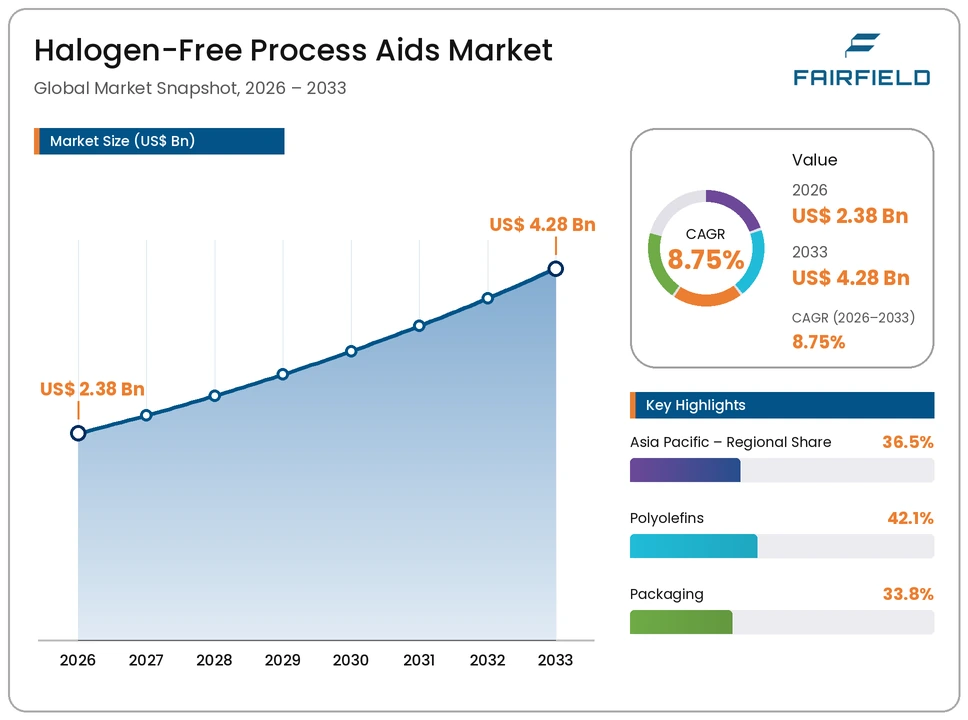
The global Halogen-Free Process Aids market size is expected to be valued at US$ 2.38 billion in 2026 and projected to reach US$ 4.28 billion by 2033, growing at a CAGR of 8.75% between 2026 and 2033.
The market grew at roughly a 6.5% CAGR between 2020 and 2025, reaching about US$ 2.19 billion. Three forces explain the faster trajectory ahead. First, the universal restriction proposal on per- and polyfluoroalkyl substances under REACH has put fluoropolymer processing aids under direct regulatory threat. Second, electronics and cable customers increasingly specify halogen-free bills of materials, backed by the IEC 61249-2-21 definition. Third, brand owners are extending halogen avoidance from flame retardants to the entire additive package. Demand is shifting from compliance-driven substitution in a few sectors toward broad reformulation across polyolefin and engineering plastics compounding.
Key Report Takeaways
- By Product Type: Lubricants and Dispersants held 31.6% share in 2026, while Polymer Processing Aids are projected to expand at a 10.9% CAGR through 2033, driven by substitution of fluoropolymer additives in polyolefin film extrusion lines.
- By Chemistry: Metal Stearates and Soaps held 29.4% share in 2026, while Silicone-Based chemistries are projected to grow at an 11.4% CAGR through 2033, driven by surface migration performance that matches fluoropolymer behaviour.
- By Polymer Type: Polyolefins held 42.1% share in 2026, while Biopolymers are projected to grow at a 12.1% CAGR through 2033, driven by compostable packaging mandates that demand additive packages free of persistent halogens.
- By End Use Industry: Packaging held 33.8% share in 2026, while Electrical and Electronics is projected to grow at an 11.7% CAGR through 2033, driven by halogen-free procurement specifications across connectors, enclosures and cable compounds.
- By Geography: Asia Pacific held 36.5% share in 2026, while Middle East & Africa is projected to grow at an 11.2% CAGR through 2033, driven by new downstream polymer conversion capacity in Saudi Arabia and the United Arab Emirates.
Global Halogen-Free Process Aids Market Trends and Insights
Drivers Impact Analysis
Two regulatory and procurement forces account for most of the incremental demand for non-halogenated polymer additives.
| Driver | Impact on CAGR Forecast | Geographic Relevance | Impact Timeline |
| Universal restriction proposal on per- and polyfluoroalkyl substances | High | Europe, North America | Medium term (2–4 years) |
| Halogen-free procurement specifications in electronics and cable | High | Asia Pacific, Europe | Short term (≤2 years) |
- European PFAS Restriction Work Forces Reformulation Away From Fluoropolymer Processing Aids
Regulatory risk is now the strongest single driver in this market. Denmark, Germany, the Netherlands, Norway and Sweden registered their intention for a universal per- and polyfluoroalkyl substances restriction with the European Chemicals Agency on 15 July 2021 and submitted the dossier on 13 January 2023. The Annex XV consultation ran from 22 March 2023 to 25 September 2023, and the proposal remains in opinion development with the agency's scientific committees.
The mechanism is anticipatory substitution rather than an existing ban. Converters qualify additive packages over two to four years, so they begin trials well before any legal deadline. Fluoropolymer processing aids used to suppress melt fracture in polyolefin film fall squarely within the proposed scope. Compounders therefore run parallel qualification of PFAS-free process additives, and additive suppliers gain trial volume long before the restriction is finalised.
- Electronics and Cable Buyers Write Halogen-Free Specifications Into Supply Contracts
Procurement specifications have become a second, independent source of demand. Electronics original equipment manufacturers and cable buyers increasingly require halogen-free declarations for every component of a compound, not only for the flame retardant. IEC 61249-2-21 supplies the operative definition, limiting chlorine and bromine to 900 parts per million each and total halogens to 1,500 parts per million. Once that limit applies to the whole formulation, halogenated lubricants and release agents must go.
The causal chain runs through end-of-life handling and fire safety. Directive 2011/65/EU, the European Union restriction of hazardous substances framework adopted in 2011, removed polybrominated biphenyls and diphenyl ethers from electrical equipment, and the European Union persistent organic pollutants rules under Regulation (EU) 2019/1021 extended controls to further brominated substances. Buyers then generalised the principle to the full additive package to simplify compliance auditing.
Restraints Impact Analysis
Two performance and cost barriers continue to slow substitution despite clear regulatory direction.
| Restraint | Impact on CAGR Forecast | Geographic Relevance | Impact Timeline |
| Performance gap against fluoropolymer processing aids in film extrusion | High | Asia Pacific, North America | Medium term (2–4 years) |
| Requalification cost across multi-grade compounding portfolios | Medium | Europe, North America | Long term (≥4 years) |
- Melt Fracture Performance Gaps Limit Substitution in High-Speed Film Extrusion
Technical performance remains the main obstacle to replacing fluoropolymer additives. Fluoropolymer processing aids coat the die surface and eliminate sharkskin melt fracture at very low loadings, allowing high line speeds and thin gauges. Non-halogenated alternatives generally require higher dose rates, longer conditioning time after a grade change, or both, which reduces effective output on blown film lines.
The specific cost source is lost throughput rather than additive price. A blown film line running below rated speed, or holding a longer purge between grades, loses saleable kilograms every hour. Interaction effects add further difficulty, because polymer processing aids must coexist with antiblock fillers, slip amides and pigments that can scavenge the additive from the die surface. Converters therefore demand full-scale line trials before switching, and trial slots on commercial equipment are scarce and expensive.
- Portfolio-Wide Requalification Costs Delay Adoption of Non-Halogenated Polymer Additives
Requalification economics slow adoption even where technical performance is proven. A compounder may hold several hundred commercial grades, each with a customer-approved specification. Changing a lubricant or release agent in one grade can trigger retesting of mechanical properties, colour, odour and food-contact or flame-retardancy approvals for every affected product.
The underlying cause is the structure of downstream approvals. Automotive interior parts, medical devices and food packaging carry customer or regulatory sign-offs that reference a specific formulation, so a substitution reopens documentation that took years to close. Testing laboratory capacity, long ageing protocols and customer audit schedules all sit outside the compounder's control. Inventory write-down of halogenated additive stock adds a direct cash cost, as does the engineering time absorbed by specification updates. Smaller compounders therefore defer changes until a customer or a regulator forces the issue on a named grade.
Market Opportunities
Two revenue pools lie outside the current compliance-driven substitution business.
- Silicone-Based Process Aids Open a High-Value Pool in Film and Release Applications
Silicone chemistry opens a premium revenue pool that conventional wax and stearate suppliers cannot address. Silicones migrate to surfaces in a way that reproduces much of the die-coating behaviour of fluoropolymers, and they also serve as release coatings, foam control agents and mould release systems. That breadth allows suppliers to sell one chemistry platform into several processing steps.
Silicone producers and compounders with masterbatch capability are best positioned to capture it. Demand comes from film converters seeking PFAS-free process additives and from label and liner producers needing release coatings with defined peel performance. Elkem launched a range of recycled silicones for the label industry in April 2025 and disclosed a mechanical recycling pathway for silicone rubber in September 2025, showing that circularity credentials now accompany technical performance in buyer evaluations.
- Bio-Based Lubricants Create a Revenue Pool in Compostable and Recycled Polymer Compounding
Bio-based and oleochemical lubricants create a distinct pool tied to compostable and recycled polymers. These materials process in narrow temperature windows and degrade easily, so they need additive packages that are both effective and free of persistent residues. Conventional halogenated and some mineral-derived aids disqualify a compound from compostability certification outright.
Oleochemical producers, specialty additive houses and masterbatch compounders can serve this pool together. Demand originates with flexible packaging converters facing recycled content targets and with brand owners committing to compostable formats in food service. The driver is certification rather than price, since a failed compostability test removes a product from the market entirely. Recyclers add a parallel requirement, because halogen-free lubricants simplify sorting and reduce corrosive by-products during reprocessing of mixed polyolefin streams. That makes oleochemical suppliers with food-contact approvals the natural first call for converters entering this pool.
Segment Analysis
- By Product Type: Lubricants and Dispersants Lead While Polymer Processing Aids Expand Fastest
Lubricants and Dispersants held 31.6% of the halogen-free process aids market in 2026, the largest product type. They lead because internal and external lubricants are consumed in almost every extrusion and calendering operation, and because non-halogenated stearate and ester chemistries have been standard in these roles for decades. Polymer Processing Aids are the fastest-growing type at a 10.9% CAGR through 2033, as converters replace fluoropolymer additives ahead of the European restriction process. Release Agents follow, helped by silicone formulations that serve both in-mould and surface-coating duty. Slip and Antiblock Additives and Coupling Agents provide steady baseline volume. The commercial implication is that suppliers able to offer a validated drop-in replacement for fluoropolymer process aids can win share rapidly, because the switching decision is being forced by regulation rather than by cost.
- By Chemistry: Metal Stearates Hold Volume While Silicone Chemistry Grows Quickest
Metal Stearates and Soaps accounted for 29.4% of value in 2026, the leading chemistry, because calcium and zinc stearates are inexpensive, widely approved for food contact and already embedded in polyvinyl chloride and polyolefin formulations. Silicone-Based chemistry is the fastest-growing category at an 11.4% CAGR through 2033, since silicone migration behaviour most closely reproduces the die-surface effect of fluoropolymer additives while meeting halogen-free lubricant requirements. Fatty Acid Esters and Amides remain important in slip and antistatic roles. Polyethylene and Montan Waxes serve pigment dispersion and engineering plastics. Ownership of silicone capacity is shifting, with Elkem agreeing in February 2026 to sell the majority of its Silicones division to Bluestar and completing the transaction in April 2026. Supply security has therefore become a procurement consideration alongside technical fit.
- By Polymer Type: Polyolefins Dominate Consumption as Biopolymers Accelerate
Polyolefins represented 42.1% of consumption in 2026, the dominant polymer type, reflecting the sheer volume of polyethylene and polypropylene processed into film, pipe and moulded goods. Processing aid intensity is also high in blown film, where melt fracture is a daily production constraint. Biopolymers are the fastest-growing polymer type at a 12.1% CAGR through 2033, albeit from a small base. Polylactic acid and polyhydroxyalkanoate compounds process within narrow thermal windows and must retain compostability certification, which rules out halogenated and persistent additives entirely. Polyvinyl chloride remains a large consumer of stearate lubricants, while Engineering Plastics demand flame-retardant-compatible additives that do not interfere with non-halogen flame retardant systems. Elastomers and Rubber add release agent volume. The implication is that growth is concentrated where formulations are being redesigned rather than merely maintained.
- By End Use Industry: Packaging Leads While Electrical and Electronics Grows Fastest
Packaging held 33.8% share in 2026, the leading end use, because film, sheet and rigid container production consumes the largest tonnage of lubricants, slip agents and processing aids, and because food-contact rules already favour non-halogenated chemistries. Electrical and Electronics is the fastest-growing end use at an 11.7% CAGR through 2033. Buyers in this sector apply the IEC 61249-2-21 halogen-free definition to complete formulations, which forces substitution in connector, enclosure and cable compounds alike. Wire and Cable demand is reinforced by low-smoke zero-halogen cable specifications in rail, tunnel and building projects. Automotive and Transportation contributes through interior parts facing emission and odour limits. Building and Construction remains price-sensitive. For suppliers, the practical consequence is that electronics customers will pay a technical premium that packaging converters will not.
Geography Analysis
North America Follows Brand Owner and State-Level Chemical Pressure
North America held 24.3% share in 2026 and is forecast to grow at a 7.1% CAGR to 2033. The United States drives demand through brand owner commitments and state chemical policy rather than a single federal restriction, with California Proposition 65 warning requirements and actions under the Toxic Substances Control Act shaping formulation choices. Wire and cable, medical device and electronics compounders substitute first, while commodity film converters move more slowly because fluoropolymer processing aids remain available. Canada and Mexico add demand through automotive and appliance supply chains that follow their customers' global specifications. The region's constraint is fragmented regulation, which delays portfolio-wide decisions. The notable change ahead is retailer specification, where large consumer goods buyers are extending chemical screening criteria from finished articles back into processing additives.
Europe Converts Chemical Regulation Into Early Additive Substitution
Europe held 29.1% share in 2026 and is forecast to grow at an 8.2% CAGR to 2033, with regulation setting the pace of substitution. Germany, France, Italy and the Netherlands host the compounding and masterbatch capacity that reformulates first, because the universal per- and polyfluoroalkyl substances restriction dossier originated with European Union member state authorities and the European Chemicals Agency. Persistent organic pollutant controls under Regulation (EU) 2019/1021 and the restriction of hazardous substances framework in Directive 2011/65/EU have already removed major brominated substances from electrical equipment. European converters therefore treat halogen avoidance as a settled direction rather than an open question. The barrier is weak underlying polymer demand, which limits volume growth. The opportunity lies in exporting qualified formulations, since European approval packages are widely accepted by multinational brand owners elsewhere.
Which Region Is Leading the Halogen-Free Process Aids Market?
Asia Pacific leads the halogen-free process aids market with 36.5% share in 2026 and a forecast 9.6% CAGR to 2033. China anchors the region through the world's largest polymer compounding and film conversion base, combined with electronics manufacturing that must meet halogen-free bills of materials for export customers. India adds fast-growing packaging and wire and cable demand, supported by domestic oleochemical additive producers. Japan and South Korea contribute high-specification volume in engineering plastics and electronic materials. The region leads because conversion capacity and electronics assembly sit in the same supply chains, so a single procurement rule propagates quickly through local additive demand. The main constraint is price competition among domestic suppliers, which compresses margins. The clearest regional change is the migration of halogen-free requirements from export goods into domestic specifications.
Latin America Builds Demand Around Packaging and Agricultural Film
Latin America held 5.6% share in 2026 and is forecast to grow at a 9.1% CAGR to 2033. Brazil leads through flexible packaging, agricultural film and resin compounding, supported by domestic vegetable oil feedstock that favours oleochemical lubricants. Mexico follows, pulled by electronics and automotive assembly plants that inherit halogen-free specifications from customers in the United States. Argentina and Colombia add smaller packaging volumes. The main barriers are currency volatility, which makes imported specialty additives expensive, and limited local testing capability for halogen content verification. Tariffs on specialty chemicals raise delivered cost further. The clearest opportunity is local production of fatty acid based lubricants, since the feedstock is regionally abundant. Export-oriented converters are the earliest adopters, because their customers audit formulations directly.
Which Region Is Growing Fastest in the Halogen-Free Process Aids Market?
Middle East & Africa is growing fastest in the halogen-free process aids market, at an 11.2% CAGR between 2026 and 2033 from 4.5% share in 2026. Saudi Arabia and the United Arab Emirates drive the increase as downstream diversification programmes add polymer conversion, compounding and packaging capacity next to existing petrochemical complexes. Because this capacity is new, plants specify current additive packages from commissioning and avoid the requalification burden that slows established regions. Egypt, Türkiye and South Africa contribute through packaging and cable production. The main barriers are a thin local additive supply base, long import lead times and limited analytical laboratory capacity for halogen verification. The defining opportunity is regional masterbatch production, which would let converters buy qualified non-halogenated polymer additives without extended import cycles.
Competitive Landscape
The halogen-free process aids market is moderately concentrated. A handful of specialty additive groups hold strong positions in individual chemistries, yet no supplier spans the full range from stearates and waxes through silicones to oleochemical esters. Fragmentation is greatest in lubricants, where regional oleochemical producers compete effectively on cost and feedstock access, and lowest in silicone-based aids, where capital intensity restricts the supplier set. Portfolio reshaping has been active, with divestment of silicone assets changing ownership of a chemistry that buyers increasingly depend on.
Competition rests on application development capability more than on molecule novelty. Suppliers win by running line trials, proving equivalence to fluoropolymer processing aids at realistic output rates, and supplying the documentation customers need for halogen-free declarations against IEC 61249-2-21. Regulatory dossier support is a second differentiator, since converters need help demonstrating absence of restricted substances. Food-contact and compostability approvals form a third. New entrants arrive mainly from oleochemical producers moving downstream into formulated additives and from masterbatch houses developing proprietary blends.
Strategic moves have concentrated on silicone chemistry and circularity. Elkem launched a range of recycled silicones for the label industry in April 2025, giving release coating customers a product with verified recycled content. In September 2025 it disclosed a mechanical recycling pathway for silicone rubber. The company then agreed in February 2026 to sell the majority of its Silicones division to Bluestar, completing the transaction in April 2026. These moves matter because they reset supply relationships for the fastest-growing chemistry in the market.
Strategic direction is converging on three themes: proving fluoropolymer-free equivalence on commercial lines, attaching recycled or bio-based content to additive claims, and building regional formulation support close to converters.
Halogen-Free Process Aids Industry Leaders
- Clariant AG
- Croda International Plc
- Evonik Industries AG
- Elkem ASA
- Baerlocher GmbH
Recent Industry Developments
- April 2026: Elkem completed the sale of its Silicones division to Bluestar – transfers a major silicone-based process aid and release coating platform to new ownership.
- February 2026: Elkem agreed to sell the majority of its Silicones division to Bluestar – signals portfolio refocusing among European suppliers of silicone processing and release chemistries.
- September 2025: Elkem disclosed a new mechanical recycling pathway for silicone rubber – strengthens circularity claims that buyers now weigh alongside halogen-free performance.
- April 2025: Elkem launched a range of recycled silicones for the label industry – brings verified recycled content into silicone release coatings used on liners and labels.
Companies Covered in the Report
- Clariant AG
- Croda International Plc
- Evonik Industries AG
- Dow Inc.
- Elkem ASA
- Arkema SA
- Baerlocher GmbH
- Struktol Company of America
- Fine Organic Industries Limited
- Emery Oleochemicals
- LANXESS AG
- Avient Corporation
- SI Group, Inc.
Halogen-Free Process Aids Market Report Scope
| Metric | Value |
| Study Period | 2020–2033 |
| Market Size 2026 | US$ 2.38 Billion |
| Market Size 2033 | US$ 4.28 Billion |
| CAGR 2026–2033 | 8.75% |
| Absolute Dollar Opportunity | US$ 1.90 Billion |
| Largest Market | Asia Pacific (36.5% share in 2026) |
| Fastest-Growing Market | Middle East & Africa (11.2% CAGR) |
| Market Concentration | Medium |
| Major Players | Clariant AG, Croda International Plc, Evonik Industries AG, Elkem ASA, Baerlocher GmbH |
Halogen-Free Process Aids Market Segmentation
Product Type
- Polymer Processing Aids
- Lubricants and Dispersants
- Release Agents
- Slip and Antiblock Additives
- Coupling and Compatibilizing Agents
Chemistry
- Metal Stearates and Soaps
- Silicone-Based
- Fatty Acid Esters and Amides
- Polyethylene and Montan Waxes
- Acrylic-Based
Polymer Type
- Polyolefins
- Polyvinyl Chloride
- Engineering Plastics
- Elastomers and Rubber
- Biopolymers
End Use Industry
- Packaging
- Wire and Cable
- Electrical and Electronics
- Automotive and Transportation
- Building and Construction
- Consumer Goods
Regions
- North America
- Europe
- Asia Pacific
- Latin America
- Middle East & Africa
- Executive Summary
- Global Market Snapshot
- Market Size and Trend Analysis 2020–2033
- Historical Growth 2020–2025
- Base Year Benchmark 2025
- Key Report Takeaways
- Market Overview
- Market Definition and Report Scope
- Market Dynamics
- Drivers Impact Analysis
- European PFAS Restriction Work Forces Reformulation Away From Fluoropolymer Processing Aids
- Electronics and Cable Buyers Write Halogen-Free Specifications Into Supply Contracts
- Restraints Impact Analysis
- Melt Fracture Performance Gaps Limit Substitution in High-Speed Film Extrusion
- Portfolio-Wide Requalification Costs Delay Adoption of Non-Halogenated Polymer Additives
- Market Opportunities
- Silicone-Based Process Aids Open a High-Value Pool in Film and Release Applications
- Bio-Based Lubricants Create a Revenue Pool in Compostable and Recycled Polymer Compounding
- Drivers Impact Analysis
- Segment Analysis
- By Product Type
- By Chemistry
- By Polymer Type
- By End Use Industry
- Global Halogen-Free Process Aids Market Outlook, 2026–2033
- Global Halogen-Free Process Aids Market Outlook, by Product Type, Value (US$ Billion), 2026–2033
- Polymer Processing Aids
- Lubricants and Dispersants
- Release Agents
- Slip and Antiblock Additives
- Coupling and Compatibilizing Agents
- Global Halogen-Free Process Aids Market Outlook, by Chemistry, Value (US$ Billion), 2026–2033
- Metal Stearates and Soaps
- Silicone-Based
- Fatty Acid Esters and Amides
- Polyethylene and Montan Waxes
- Acrylic-Based
- Global Halogen-Free Process Aids Market Outlook, by Polymer Type, Value (US$ Billion), 2026–2033
- Polyolefins
- Polyvinyl Chloride
- Engineering Plastics
- Elastomers and Rubber
- Biopolymers
- Global Halogen-Free Process Aids Market Outlook, by End Use Industry, Value (US$ Billion), 2026–2033
- Packaging
- Wire and Cable
- Electrical and Electronics
- Automotive and Transportation
- Building and Construction
- Consumer Goods
- Global Halogen-Free Process Aids Market Outlook, by Region, Value (US$ Billion), 2026–2033
- North America
- Europe
- Asia Pacific
- Latin America
- Middle East & Africa
- Global Halogen-Free Process Aids Market Outlook, by Product Type, Value (US$ Billion), 2026–2033
- North America Halogen-Free Process Aids Market Outlook, 2026–2033
- North America Market Trends and Growth Outlook
- North America Halogen-Free Process Aids Market Outlook, by Product Type, Value (US$ Billion), 2026–2033
- Polymer Processing Aids
- Lubricants and Dispersants
- Release Agents
- Slip and Antiblock Additives
- Coupling and Compatibilizing Agents
- North America Halogen-Free Process Aids Market Outlook, by Chemistry, Value (US$ Billion), 2026–2033
- Metal Stearates and Soaps
- Silicone-Based
- Fatty Acid Esters and Amides
- Polyethylene and Montan Waxes
- Acrylic-Based
- North America Halogen-Free Process Aids Market Outlook, by Polymer Type, Value (US$ Billion), 2026–2033
- Polyolefins
- Polyvinyl Chloride
- Engineering Plastics
- Elastomers and Rubber
- Biopolymers
- North America Halogen-Free Process Aids Market Outlook, by End Use Industry, Value (US$ Billion), 2026–2033
- Packaging
- Wire and Cable
- Electrical and Electronics
- Automotive and Transportation
- Building and Construction
- Consumer Goods
- North America Halogen-Free Process Aids Market Outlook, by Country, 2026–2033
- United States Halogen-Free Process Aids Market Outlook, by Product Type, 2026–2033
- United States Halogen-Free Process Aids Market Outlook, by Chemistry, 2026–2033
- United States Halogen-Free Process Aids Market Outlook, by Polymer Type, 2026–2033
- United States Halogen-Free Process Aids Market Outlook, by End Use Industry, 2026–2033
- Canada Halogen-Free Process Aids Market Outlook, by Product Type, 2026–2033
- Canada Halogen-Free Process Aids Market Outlook, by Chemistry, 2026–2033
- Canada Halogen-Free Process Aids Market Outlook, by Polymer Type, 2026–2033
- Canada Halogen-Free Process Aids Market Outlook, by End Use Industry, 2026–2033
- Europe Halogen-Free Process Aids Market Outlook, 2026–2033
- Europe Market Trends and Growth Outlook
- Europe Halogen-Free Process Aids Market Outlook, by Product Type, Value (US$ Billion), 2026–2033
- Polymer Processing Aids
- Lubricants and Dispersants
- Release Agents
- Slip and Antiblock Additives
- Coupling and Compatibilizing Agents
- Europe Halogen-Free Process Aids Market Outlook, by Chemistry, Value (US$ Billion), 2026–2033
- Metal Stearates and Soaps
- Silicone-Based
- Fatty Acid Esters and Amides
- Polyethylene and Montan Waxes
- Acrylic-Based
- Europe Halogen-Free Process Aids Market Outlook, by Polymer Type, Value (US$ Billion), 2026–2033
- Polyolefins
- Polyvinyl Chloride
- Engineering Plastics
- Elastomers and Rubber
- Biopolymers
- Europe Halogen-Free Process Aids Market Outlook, by End Use Industry, Value (US$ Billion), 2026–2033
- Packaging
- Wire and Cable
- Electrical and Electronics
- Automotive and Transportation
- Building and Construction
- Consumer Goods
- Europe Halogen-Free Process Aids Market Outlook, by Country, 2026–2033
- Germany Halogen-Free Process Aids Market Outlook, by Product Type, 2026–2033
- Germany Halogen-Free Process Aids Market Outlook, by Chemistry, 2026–2033
- Germany Halogen-Free Process Aids Market Outlook, by Polymer Type, 2026–2033
- Germany Halogen-Free Process Aids Market Outlook, by End Use Industry, 2026–2033
- France Halogen-Free Process Aids Market Outlook, by Product Type, 2026–2033
- France Halogen-Free Process Aids Market Outlook, by Chemistry, 2026–2033
- France Halogen-Free Process Aids Market Outlook, by Polymer Type, 2026–2033
- France Halogen-Free Process Aids Market Outlook, by End Use Industry, 2026–2033
- Italy Halogen-Free Process Aids Market Outlook, by Product Type, 2026–2033
- Italy Halogen-Free Process Aids Market Outlook, by Chemistry, 2026–2033
- Italy Halogen-Free Process Aids Market Outlook, by Polymer Type, 2026–2033
- Italy Halogen-Free Process Aids Market Outlook, by End Use Industry, 2026–2033
- Netherlands Halogen-Free Process Aids Market Outlook, by Product Type, 2026–2033
- Netherlands Halogen-Free Process Aids Market Outlook, by Chemistry, 2026–2033
- Netherlands Halogen-Free Process Aids Market Outlook, by Polymer Type, 2026–2033
- Netherlands Halogen-Free Process Aids Market Outlook, by End Use Industry, 2026–2033
- Asia Pacific Halogen-Free Process Aids Market Outlook, 2026–2033
- Asia Pacific Market Trends and Growth Outlook
- Asia Pacific Halogen-Free Process Aids Market Outlook, by Product Type, Value (US$ Billion), 2026–2033
- Polymer Processing Aids
- Lubricants and Dispersants
- Release Agents
- Slip and Antiblock Additives
- Coupling and Compatibilizing Agents
- Asia Pacific Halogen-Free Process Aids Market Outlook, by Chemistry, Value (US$ Billion), 2026–2033
- Metal Stearates and Soaps
- Silicone-Based
- Fatty Acid Esters and Amides
- Polyethylene and Montan Waxes
- Acrylic-Based
- Asia Pacific Halogen-Free Process Aids Market Outlook, by Polymer Type, Value (US$ Billion), 2026–2033
- Polyolefins
- Polyvinyl Chloride
- Engineering Plastics
- Elastomers and Rubber
- Biopolymers
- Asia Pacific Halogen-Free Process Aids Market Outlook, by End Use Industry, Value (US$ Billion), 2026–2033
- Packaging
- Wire and Cable
- Electrical and Electronics
- Automotive and Transportation
- Building and Construction
- Consumer Goods
- Asia Pacific Halogen-Free Process Aids Market Outlook, by Country, 2026–2033
- China Halogen-Free Process Aids Market Outlook, by Product Type, 2026–2033
- China Halogen-Free Process Aids Market Outlook, by Chemistry, 2026–2033
- China Halogen-Free Process Aids Market Outlook, by Polymer Type, 2026–2033
- China Halogen-Free Process Aids Market Outlook, by End Use Industry, 2026–2033
- India Halogen-Free Process Aids Market Outlook, by Product Type, 2026–2033
- India Halogen-Free Process Aids Market Outlook, by Chemistry, 2026–2033
- India Halogen-Free Process Aids Market Outlook, by Polymer Type, 2026–2033
- India Halogen-Free Process Aids Market Outlook, by End Use Industry, 2026–2033
- Japan Halogen-Free Process Aids Market Outlook, by Product Type, 2026–2033
- Japan Halogen-Free Process Aids Market Outlook, by Chemistry, 2026–2033
- Japan Halogen-Free Process Aids Market Outlook, by Polymer Type, 2026–2033
- Japan Halogen-Free Process Aids Market Outlook, by End Use Industry, 2026–2033
- South Korea Halogen-Free Process Aids Market Outlook, by Product Type, 2026–2033
- South Korea Halogen-Free Process Aids Market Outlook, by Chemistry, 2026–2033
- South Korea Halogen-Free Process Aids Market Outlook, by Polymer Type, 2026–2033
- South Korea Halogen-Free Process Aids Market Outlook, by End Use Industry, 2026–2033
- Latin America Halogen-Free Process Aids Market Outlook, 2026–2033
- Latin America Market Trends and Growth Outlook
- Latin America Halogen-Free Process Aids Market Outlook, by Product Type, Value (US$ Billion), 2026–2033
- Polymer Processing Aids
- Lubricants and Dispersants
- Release Agents
- Slip and Antiblock Additives
- Coupling and Compatibilizing Agents
- Latin America Halogen-Free Process Aids Market Outlook, by Chemistry, Value (US$ Billion), 2026–2033
- Metal Stearates and Soaps
- Silicone-Based
- Fatty Acid Esters and Amides
- Polyethylene and Montan Waxes
- Acrylic-Based
- Latin America Halogen-Free Process Aids Market Outlook, by Polymer Type, Value (US$ Billion), 2026–2033
- Polyolefins
- Polyvinyl Chloride
- Engineering Plastics
- Elastomers and Rubber
- Biopolymers
- Latin America Halogen-Free Process Aids Market Outlook, by End Use Industry, Value (US$ Billion), 2026–2033
- Packaging
- Wire and Cable
- Electrical and Electronics
- Automotive and Transportation
- Building and Construction
- Consumer Goods
- Latin America Halogen-Free Process Aids Market Outlook, by Country, 2026–2033
- Brazil Halogen-Free Process Aids Market Outlook, by Product Type, 2026–2033
- Brazil Halogen-Free Process Aids Market Outlook, by Chemistry, 2026–2033
- Brazil Halogen-Free Process Aids Market Outlook, by Polymer Type, 2026–2033
- Brazil Halogen-Free Process Aids Market Outlook, by End Use Industry, 2026–2033
- Mexico Halogen-Free Process Aids Market Outlook, by Product Type, 2026–2033
- Mexico Halogen-Free Process Aids Market Outlook, by Chemistry, 2026–2033
- Mexico Halogen-Free Process Aids Market Outlook, by Polymer Type, 2026–2033
- Mexico Halogen-Free Process Aids Market Outlook, by End Use Industry, 2026–2033
- Argentina Halogen-Free Process Aids Market Outlook, by Product Type, 2026–2033
- Argentina Halogen-Free Process Aids Market Outlook, by Chemistry, 2026–2033
- Argentina Halogen-Free Process Aids Market Outlook, by Polymer Type, 2026–2033
- Argentina Halogen-Free Process Aids Market Outlook, by End Use Industry, 2026–2033
- Colombia Halogen-Free Process Aids Market Outlook, by Product Type, 2026–2033
- Colombia Halogen-Free Process Aids Market Outlook, by Chemistry, 2026–2033
- Colombia Halogen-Free Process Aids Market Outlook, by Polymer Type, 2026–2033
- Colombia Halogen-Free Process Aids Market Outlook, by End Use Industry, 2026–2033
- Middle East & Africa Halogen-Free Process Aids Market Outlook, 2026–2033
- Middle East & Africa Market Trends and Growth Outlook
- Middle East & Africa Halogen-Free Process Aids Market Outlook, by Product Type, Value (US$ Billion), 2026–2033
- Polymer Processing Aids
- Lubricants and Dispersants
- Release Agents
- Slip and Antiblock Additives
- Coupling and Compatibilizing Agents
- Middle East & Africa Halogen-Free Process Aids Market Outlook, by Chemistry, Value (US$ Billion), 2026–2033
- Metal Stearates and Soaps
- Silicone-Based
- Fatty Acid Esters and Amides
- Polyethylene and Montan Waxes
- Acrylic-Based
- Middle East & Africa Halogen-Free Process Aids Market Outlook, by Polymer Type, Value (US$ Billion), 2026–2033
- Polyolefins
- Polyvinyl Chloride
- Engineering Plastics
- Elastomers and Rubber
- Biopolymers
- Middle East & Africa Halogen-Free Process Aids Market Outlook, by End Use Industry, Value (US$ Billion), 2026–2033
- Packaging
- Wire and Cable
- Electrical and Electronics
- Automotive and Transportation
- Building and Construction
- Consumer Goods
- Middle East & Africa Halogen-Free Process Aids Market Outlook, by Country, 2026–2033
- Saudi Arabia Halogen-Free Process Aids Market Outlook, by Product Type, 2026–2033
- Saudi Arabia Halogen-Free Process Aids Market Outlook, by Chemistry, 2026–2033
- Saudi Arabia Halogen-Free Process Aids Market Outlook, by Polymer Type, 2026–2033
- Saudi Arabia Halogen-Free Process Aids Market Outlook, by End Use Industry, 2026–2033
- United Arab Emirates Halogen-Free Process Aids Market Outlook, by Product Type, 2026–2033
- United Arab Emirates Halogen-Free Process Aids Market Outlook, by Chemistry, 2026–2033
- United Arab Emirates Halogen-Free Process Aids Market Outlook, by Polymer Type, 2026–2033
- United Arab Emirates Halogen-Free Process Aids Market Outlook, by End Use Industry, 2026–2033
- Egypt Halogen-Free Process Aids Market Outlook, by Product Type, 2026–2033
- Egypt Halogen-Free Process Aids Market Outlook, by Chemistry, 2026–2033
- Egypt Halogen-Free Process Aids Market Outlook, by Polymer Type, 2026–2033
- Egypt Halogen-Free Process Aids Market Outlook, by End Use Industry, 2026–2033
- Türkiye Halogen-Free Process Aids Market Outlook, by Product Type, 2026–2033
- Türkiye Halogen-Free Process Aids Market Outlook, by Chemistry, 2026–2033
- Türkiye Halogen-Free Process Aids Market Outlook, by Polymer Type, 2026–2033
- Türkiye Halogen-Free Process Aids Market Outlook, by End Use Industry, 2026–2033
- South Africa Halogen-Free Process Aids Market Outlook, by Product Type, 2026–2033
- South Africa Halogen-Free Process Aids Market Outlook, by Chemistry, 2026–2033
- South Africa Halogen-Free Process Aids Market Outlook, by Polymer Type, 2026–2033
- South Africa Halogen-Free Process Aids Market Outlook, by End Use Industry, 2026–2033
- Competitive Landscape
- Market Concentration and Industry Participation
- Competitive Factors and Strategic Direction
- Recent Industry Developments
- Elkem Silicones Division Sale Completion April 2026
- Elkem Silicones Division Sale Agreement February 2026
- Elkem Silicone Rubber Recycling Pathway September 2025
- Elkem Recycled Silicones Launch April 2025
- Company Profiles
- Clariant AG
- Croda International Plc
- Evonik Industries AG
- Dow Inc.
- Elkem ASA
- Arkema SA
- Baerlocher GmbH
- Struktol Company of America
- Fine Organic Industries Limited
- Emery Oleochemicals
- LANXESS AG
- Avient Corporation
- SI Group, Inc.
- Appendix
- Research Methodology
- Report Assumptions
- Acronyms and Abbreviations
Product Type
- Polymer Processing Aids
- Lubricants and Dispersants
- Release Agents
- Slip and Antiblock Additives
- Coupling and Compatibilizing Agents
Chemistry
- Metal Stearates and Soaps
- Silicone-Based
- Fatty Acid Esters and Amides
- Polyethylene and Montan Waxes
- Acrylic-Based
Polymer Type
- Polyolefins
- Polyvinyl Chloride
- Engineering Plastics
- Elastomers and Rubber
- Biopolymers
End Use Industry
- Packaging
- Wire and Cable
- Electrical and Electronics
- Automotive and Transportation
- Building and Construction
- Consumer Goods
Regions
- North America
- Europe
- Asia Pacific
- Latin America
- Middle East & Africa
Our Research Methodology
Considering the volatility of business today, traditional approaches to strategizing a game plan can be unfruitful if not detrimental. True ambiguity is no way to determine a forecast. A myriad of predetermined factors must be accounted for such as the degree of risk involved, the magnitude of circumstances, as well as conditions or consequences that are not known or unpredictable. To circumvent binary views that cast uncertainty, the application of market research intelligence to strategically posture, move, and enable actionable outcomes is necessary.
View Methodology
Quality Assured
Rigorous Validation Process

Confidentiality Assured
End-to-end Data Security

Custom Research Services
Tailored To Your Objectives
FAQs
The market is valued at US$ 2.38 billion in 2026, covering non-halogenated processing aids, lubricants, release agents and related additives for polymer conversion.
The market is projected to reach US$ 4.28 billion by 2033, growing at an 8.75% CAGR and adding US$ 1.90 billion in absolute value from 2026.
Lubricants and Dispersants lead with 31.6% share in 2026, because they are consumed in nearly every extrusion, moulding and calendering operation worldwide.
Middle East & Africa grows fastest at an 11.2% CAGR, as new polymer conversion capacity in Saudi Arabia and the United Arab Emirates specifies modern additive packages.
Asia Pacific holds 36.5% share in 2026, supported by the world's largest polymer compounding base and electronics manufacturing that requires halogen-free declarations.
Related Reports
Bio-Based Extrusion Aids Market Size, Share, Insights, Competitive Landscape, and Forecast 2026 to 2033
Bio-Based Extrusion Aids Market is valued at US$1.42 Bn in 2026 and projected to reach US$2.72 Bn by 2033, growing at a 9.73% CAGR.
Particle-Engineered Probiotic Stabilizers Market Size, Share, Insights, Competitive Landscape, and Forecast 2026 to 2033
The global particle-engineered probiotic stabilizers market is projected to reach US$ 2.98 Billion by 2033, growing at an 11.4% CAGR during 2026–2033
Probiotic Stability Excipients Market Size, Share, Insights, Competitive Landscape, and Forecast 2026 to 2033
The global probiotic stability excipients market is projected to reach US$ 2.8 Bn by 2033, growing at an 11.6% CAGR , driven by stable probiotic formulations
GLP-1 Telehealth Platforms Market Size, Share, Insights, Competitive Landscape, and Forecast 2026 to 2033
GLP-1 Telehealth Platforms Market is valued at US$0.7638 Billion in 2026 and projected to reach US$2.1199 Billion by 2033, growing at 15.7% CAGR.
GLP-1 Nutrition Coaching Market Size, Share, Insights, Competitive Landscape, and Forecast 2026 to 2033
GLP-1 Nutrition Coaching Market is projected to reach US$0.4095 billion by 2033 from US$0.1248 billion in 2026, growing at a CAGR of 18.5%.
Laboratory Andrology Equipment Market Size, Share, Insights, Competitive Landscape, and Forecast 2026 to 2033
Laboratory Andrology Equipment Market to reach US$1.4165 Bn by 2033, growing at 5.1% CAGR, driven by sample handling, automation, and preservation.