



Chemical Indicators Market
Chemical Indicators Market Insights, Competitive Landscape, and Market Forecast - 2033
Chemical Indicators Market Size, Share, and Growth Forecast 2026 – 2033
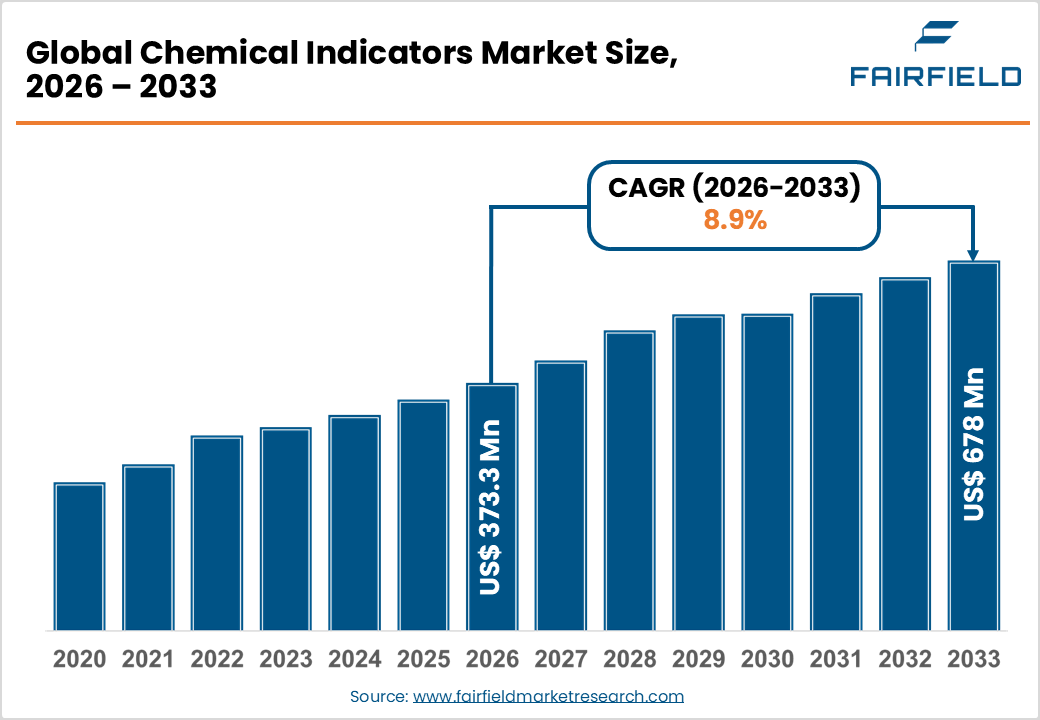
The global Chemical Indicators Market size is likely to be valued at US$ 373.3 Million in 2026 and is expected to reach US$ 678 Million by 2033, growing at a CAGR of 8.90% during the forecast period from 2026 to 2033.
Key Market Highlights
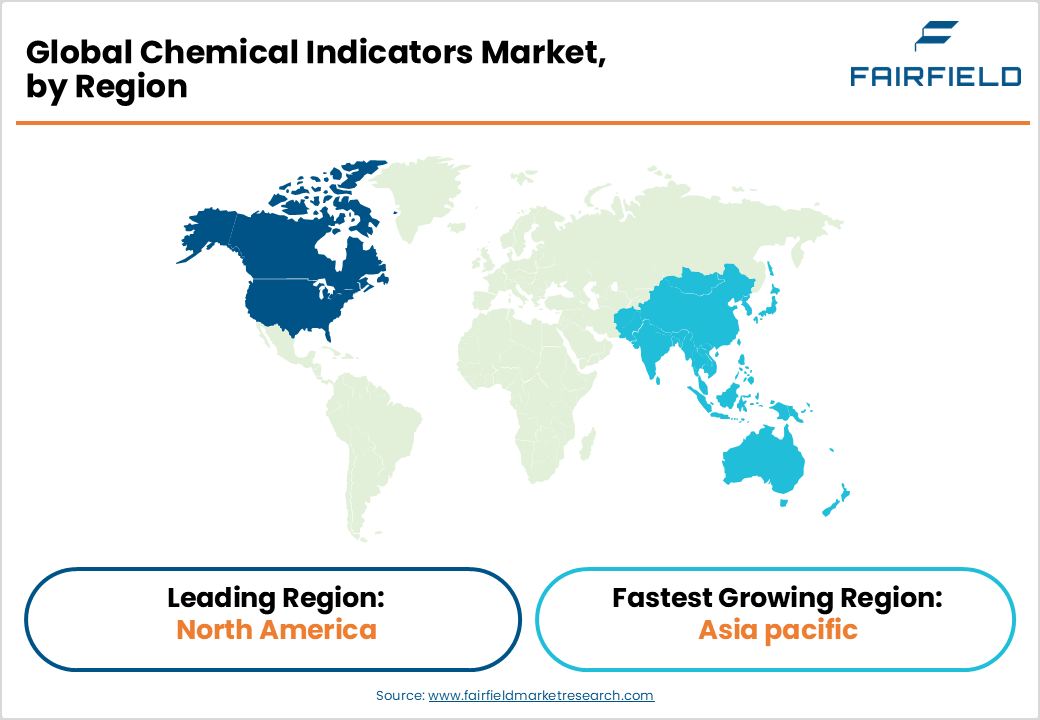
- North America leads the global chemical indicators market with approximately 38% share, driven by mandatory sterilization monitoring regulations enforced by the FDA, TJC accreditation requirements, and a dense network of hospitals and surgery centers.
- Asia Pacific is the fastest-growing regional market, propelled by China's hospital infrastructure expansion under the 14th Five-Year Plan, India's healthcare investment push, and a growing pharmaceutical manufacturing base demanding GMP-compliant sterilization monitoring.
- Hospitals & Clinics dominate the end-user segment with approximately 60% market share, driven by the WHO's estimate of over 313 million global surgical procedures annually and mandatory chemical indicator use under hospital accreditation standards including TJC requirements.
- Multi-Variable Indicators, particularly Class 5 integrating and Class 6 emulating types are the fastest-growing parameter segment, as hospitals and pharmaceutical manufacturers increasingly seek enhanced sterility assurance beyond single-parameter verification.
- Asia Pacific's expanding healthcare infrastructure and pharmaceutical manufacturing sectors offer the most compelling growth opportunity.
Market Dynamics
Market Growth Drivers
- Rising Global Standards for Infection Prevention and Sterilization Monitoring in Healthcare
Healthcare-associated infections (HAIs) represent one of the most significant patient safety threats globally. According to the World Health Organization (WHO), at any given time, approximately 1 in 10 patients in high-income countries and 1 in 4 patients in low- and middle-income countries acquire at least one HAI during hospital care. This alarming prevalence has compelled health ministries and hospital accreditation bodies worldwide to enforce rigorous sterilization monitoring protocols, directly driving demand for chemical indicators. Regulatory frameworks such as the U.S. As global healthcare facilities expand and upgrade sterilization infrastructure, chemical indicator adoption is accelerating consistently across hospital and clinic settings.
- Expanding Pharmaceutical and Medical Device Manufacturing Requiring Validated Sterilization
The pharmaceutical and medical device manufacturing sectors are experiencing robust global growth, creating substantial incremental demand for chemical indicators used in product sterilization validation processes. According to the International Federation of Pharmaceutical Manufacturers & Associations (IFPMA), global pharmaceutical production has been expanding steadily, with emerging markets in Asia and Latin America recording particularly strong output growth. Regulatory bodies including the FDA, the European Medicines Agency (EMA), and Japan's Pharmaceuticals and Medical Devices Agency (PMDA) mandate rigorous sterilization cycle monitoring for all parenteral drugs and sterile medical devices. Chemical indicators provide manufacturers with immediate, cost-effective process verification, making them indispensable in Good Manufacturing Practice (GMP) compliant production environments and driving consistent long-term demand growth in this end-user segment.
Market Restraints
- Lack of Regulatory Standardization and Enforcement in Developing Markets
Despite global progress in infection control awareness, inconsistent regulatory enforcement and the absence of harmonized sterilization monitoring standards across developing economies constrain chemical indicator market penetration. Many lower-income countries lack mandatory sterilization monitoring policies, reducing procurement incentives for healthcare facilities. The WHO has noted that sterilization compliance verification remains inadequate in a significant proportion of health centers across Sub-Saharan Africa and parts of South Asia. This regulatory fragmentation limits addressable market size in high-potential regions and creates pricing pressure, as facilities in these markets often opt for basic or counterfeit indicators rather than certified, internationally compliant products from established manufacturers.
- Limitations of Chemical Indicators Compared to Biological and Electronic Monitoring Systems
Chemical indicators, while cost-effective and operationally convenient, are inherently limited in the comprehensiveness of sterilization verification they provide. Unlike biological indicators which use actual microbial spores to validate sterilization efficacy chemical indicators only confirm exposure to sterilization parameters rather than verifying microbial kill. Healthcare accreditation standards including those from The Joint Commission (TJC) in U.S. require biological indicator testing in addition to chemical indicators for load release. This complementary rather than substitutive role limits the standalone adoption of chemical indicators in high-criticality applications and constrains pricing power for manufacturers serving premium healthcare institutional clients.
Market Opportunities
- Advancing Multi-Variable and Integrating Indicator Technologies for Enhanced Sterility Assurance
The development and commercialization of advanced multi-variable chemical indicators particularly Class 5 integrating and Class 6 emulating indicators as defined under ISO 11140-1 presenting a compelling growth opportunity for market participants. These advanced indicators react to all critical sterilization parameters (time, temperature, and sterilant concentration) simultaneously, offering a higher level of sterility assurance than conventional single-variable indicators. Hospitals and pharmaceutical manufacturers seeking to reduce reliance on time-consuming biological indicator testing for routine loads are increasingly adopting Class 5 and Class 6 indicators. 3M Company and STERIS Corporation have invested significantly in expanding their Class 5 integrator product lines targeting hospital and pharmaceutical end-users. As healthcare quality standards tighten globally, the multi-variable indicator segment is poised to outpace overall market growth through 2033.
- Rapid Healthcare Infrastructure Expansion in Asia Pacific Driving Sterilization Product Adoption
Asia Pacific's accelerating healthcare infrastructure buildout represents one of the most significant market opportunities for chemical indicator manufacturers. China, India, and ASEAN nations are collectively investing hundreds of billions in new hospital construction and medical facility upgrades. According to India's National Health Policy, the country aims to raise public health expenditure to 2.5% of GDP, underpinning large-scale hospital capacity additions that directly translate into sterilization monitoring product demand. China's 14th Five-Year Plan for healthcare development emphasizes upgrading infection control infrastructure across public hospitals. Meanwhile, Japan's Ministry of Health, Labour and Welfare (MHLW) continues to enforce stringent sterilization monitoring in healthcare settings. These policy tailwinds, combined with a growing base of pharmaceutical contract manufacturers requiring GMP compliance, position Asia Pacific as the highest-growth opportunity region for chemical indicator producers through the forecast period.
Segmental Insights
- By Product Analysis
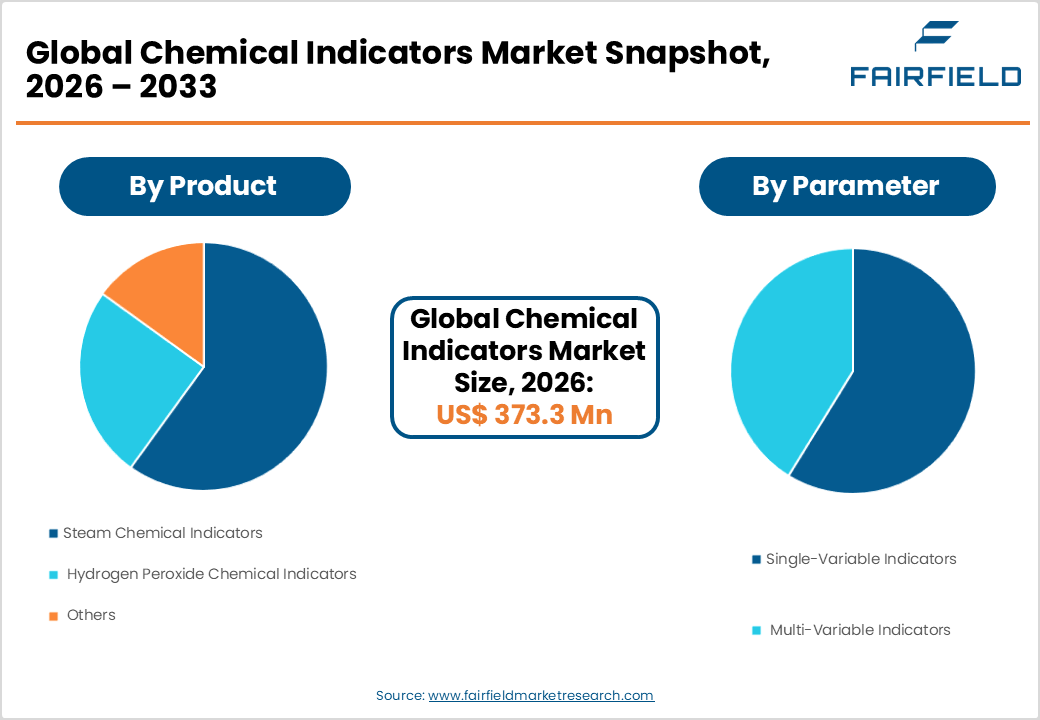
Steam Chemical Indicators dominate the chemical indicators market by product type, holding approximately 55% of total market share in 2026. This dominance reflects the near-universal adoption of steam (autoclaving) as the primary sterilization method in healthcare settings globally, given its cost efficiency, material compatibility, and proven microbial kill efficacy. Steam sterilization accounts for the majority of sterilization cycles conducted in hospitals, surgical centers, and dental clinics worldwide. According to guidelines from the Centers for Disease Control and Prevention (CDC), steam sterilization is the preferred method for heat-stable medical instruments. This entrenched adoption of steam autoclaving drives persistent and high-volume demand for steam chemical indicators particularly process indicators (Class 1) and integrating indicators (Class 5) across hospital, clinical, and dental sterilization workflows globally.
- By Parameter Analysis
Single-Variable Indicators lead the chemical indicators market by parameter, representing approximately 62% of total market share in 2026. These indicators, which respond to a single critical sterilization parameter such as temperature, are widely used as process indicators (Class 1) including indicator tape and pouches to distinguish processed from unprocessed items. Their low cost, ease of use, and suitability for high-volume routine sterilization workflows make them the most commonly procured indicator type across hospitals, dental clinics, and ambulatory surgery centers. The Association for the Advancement of Medical Instrumentation (AAMI) recognizes Class 1 process indicators as a foundational sterilization quality control tool. Their widespread use in general hospital sterilization departments, particularly in price-sensitive emerging markets, underpins their continued market leadership.
- By Sterilization Method Analysis
Steam Sterilization leads the chemical indicators market by sterilization method, commanding approximately 52% of total market share in 2026. Steam sterilization, or autoclaving, remains the gold standard for sterilizing heat- and moisture-stable medical instruments globally due to its rapid cycle time, broad material compatibility, and superior cost-effectiveness compared to alternative sterilization modalities. The CDC and the WHO both recommend steam sterilization as the first-choice method for critical and semi-critical medical devices whenever material properties permit. The continued global rollout of steam sterilization infrastructure particularly in public hospitals and healthcare centers across Asia Pacific, Latin America, and Africa sustains robust demand for steam-compatible chemical indicators as the dominant sterilization method category in the market.
- By End-user Analysis
Hospitals & Clinics represent the leading end-user segment in the chemical indicators market, accounting for approximately 60% of total market share in 2026. Hospitals are the highest-volume consumers of chemical indicators due to the sheer scale and frequency of sterilization cycles conducted across central sterile services departments (CSSDs), operating theatres, and clinical units. The WHO estimated that millions of surgical procedures are performed globally each year, each requiring sterile instruments that must be validated through chemical indicator monitoring. Accreditation standards from bodies such as The Joint Commission (TJC) and International Society for Quality in Health Care (ISQua) mandate chemical indicator use in institutional sterilization programs, creating structural and recurring demand. Continued global hospital capacity expansion, particularly in emerging economies, reinforces this segment's dominant market position.
Regional Insights
- North America Chemical Indicators Market Trends
North America leads the global chemical indicators market with approximately 38% of total market share, anchored by the United States' highly developed and regulated healthcare system. The U.S. FDA enforces rigorous sterilization monitoring requirements for medical devices and pharmaceutical products under 21 CFR Part 820 (Quality System Regulation) and related guidance. Hospital accreditation through The Joint Commission (TJC) and the American Association for Accreditation of Ambulatory Surgery Facilities (AAAASF) mandates systematic chemical indicator use, creating a stable, high-volume institutional demand base. The United States accounts for the vast majority of regional consumption, supported by a large and growing ambulatory surgery center (ASC) sector.
The North American market also benefits from a robust innovation ecosystem, with key players including 3M Company, STERIS Corporation, Advanced Sterilization Products (ASP), and Crosstex International headquartered in the region. These companies continuously introduce next-generation Class 5 and Class 6 indicator formats aligned with AAMI ST79 sterilization guidance. Canada's regulated healthcare procurement frameworks and growing surgical volume further contribute to regional demand. The combination of regulatory maturity, high hospital density, and ongoing innovation positions North America as the long-term market leader through 2033.
- Europe Chemical Indicators Market Trends
Europe represents the second-largest regional market for chemical indicators, driven by a sophisticated healthcare system, harmonized regulatory standards, and a strong infection control culture across member states. Germany, the United Kingdom, France, and Spain are the largest national markets, collectively accounting for a significant proportion of European demand. The European Centre for Disease Prevention and Control (ECDC) regularly publishes HAI prevalence data that informs national infection control investment priorities.
The EU Medical Device Regulation (MDR 2017/745) and its implementation continue to drive sterilization compliance investments among medical device manufacturers across Germany, France, and the Benelux region. The United Kingdom's Medicines and Healthcare products Regulatory Agency (MHRA) enforces equivalent standards post-Brexit. Getinge AB and Matachana Group are prominent European market players contributing to regional innovation. Growing hospital modernization programs across Eastern Europe, including Poland and the Czech Republic, are further expanding the addressable market for chemical indicator manufacturers within the region.
- Asia Pacific Chemical Indicators Market Trends
Asia Pacific is the fastest-growing regional market for chemical indicators, driven by rapid healthcare infrastructure expansion, rising surgical volumes, and strengthening regulatory frameworks across China, India, Japan, and ASEAN nations. China dominates regional demand, supported by the government's substantial investment in public hospital construction and infection control capability enhancement under the 14th Five-Year Plan. According to the National Health Commission of China, the country has been consistently expanding the number of accredited hospital sterilization departments, directly amplifying chemical indicator procurement volumes.
India's rapidly expanding healthcare sector with the government targeting 2.5% of GDP for public health spending under the National Health Policy is generating growing institutional demand for sterilization monitoring products. Japan's Ministry of Health, Labour and Welfare (MHLW) enforces rigorous sterilization standards across its dense network of hospitals. ASEAN markets including Thailand, Vietnam, and Indonesia are also scaling sterilization infrastructure as healthcare access improves. The region's large and growing pharmaceutical contract manufacturing base particularly in India and China further drives demand for chemical indicators used in GMP-compliant sterilization validation, positioning Asia Pacific as the highest-growth market through 2033.
Competitive Landscape
The global chemical indicators market exhibits a moderately consolidated structure, with 3M Company, STERIS Corporation, Getinge AB, and Advanced Sterilization Products (ASP) holding commanding positions through broad product portfolios, global distribution networks, and deep OEM relationships with sterilizer manufacturers. Market leaders differentiate through proprietary indicator chemistries aligned with ISO 11140 classification tiers, regulatory approval breadth across multiple geographies, and value-added service offerings including sterilization protocol consulting. Business model trends include bundled indicator sales with sterilization equipment and consumables, subscription-based supply contracts with hospitals, and strategic acquisitions of regional specialists to extend geographic reach. Smaller players compete on price and product specialization for niche sterilization methods including ethylene oxide and hydrogen peroxide applications.
Key Developments
- In February 2025, 3M Company launched an enhanced line of Attest steam chemical integrating indicators with faster color-change response technology, designed to reduce processing time in high-volume hospital central sterile services departments (CSSDs) across North America and Europe.
- In September 2024, STERIS Corporation expanded its chemical indicator product portfolio for hydrogen peroxide sterilization applications, introducing new Class 5 indicators compatible with next-generation low-temperature sterilization systems deployed in ambulatory surgery centers and specialized hospital units.
- In April 2023, Getinge AB announced a strategic partnership with a leading ASEAN healthcare distributor to expand its sterilization monitoring product reach across Indonesia, Vietnam, and Thailand, targeting the rapidly growing Asia Pacific hospital infrastructure development pipeline.
Companies Covered in Chemical Indicators Market
- 3M Company
- STERIS Corporation
- Getinge AB
- Advanced Sterilization Products (ASP)
- Fortive Corporation
- Crosstex International, Inc.
- Propper Manufacturing Co., Inc.
- Andersen Products, Inc.
- Tuttnauer
- Thermo Fisher Scientific Inc.
- Matachana Group
- Hu-Friedy Mfg. Co., LLC
- ETIGAM B.V.
- LISTER BioMedical Co., Ltd.
- BiomatiQ Scientific Pvt. Ltd.
- Sychem Group
- Medline Industries, LP
- Terragene S.A.
- Healthmark Industries Company, Inc.
- Ritter Medical GmbH
Market Segmentation
By Product
- Steam Chemical Indicators
- Hydrogen Peroxide Chemical Indicators
- Others
By Parameter
- Single-Variable Indicators
- Multi-Variable Indicators
By Sterilization Method
- Steam Sterilization
- Hydrogen Peroxide Sterilization
- Ethylene Oxide Sterilization
- Others
By End-user
- Hospital & Clinics
- Pharmaceutical & Medical Device Manufacturers
- Others
By Region
- North America
- Europe
- Asia Pacific
- Latin America
- Middle East & Africa
- Executive Summary
- Global Chemical Indicators Market Snapshot
- Future Projections
- Key Market Trends
- Regional Snapshot, by Value, 2026
- Analyst Recommendations
- Market Overview
- Market Definitions and Segmentations
- Market Dynamics
- Drivers
- Restraints
- Market Opportunities
- Value Chain Analysis
- COVID-19 Impact Analysis
- Porter's Five Forces Analysis
- Impact of Russia-Ukraine Conflict
- PESTLE Analysis
- Regulatory Analysis
- Price Trend Analysis
- Current Prices and Future Projections, 2025-2033
- Price Impact Factors
- Global Chemical Indicators Market Outlook, 2020 - 2033
- Global Chemical Indicators Market Outlook, by Product Type, Value (US$ Mn), 2020-2033
- Steam Chemical Indicators
- Global Chemical Indicators Market Outlook, by Product Type, Value (US$ Mn), 2020-2033
- 1.1.1.
- Hydrogen Peroxide Chemical Indicators
- Others
- Global Chemical Indicators Market Outlook, by Parameter, Value (US$ Mn), 2020-2033
- Single-Variable Indicators
- Multi-Variable Indicators
- Global Chemical Indicators Market Outlook, by Sterilization Method, Value (US$ Mn), 2020-2033
- Steam Sterilization
- Hydrogen Peroxide Sterilization
- Ethylene Oxide Sterilization
- Others
- Global Chemical Indicators Market Outlook, by End-user, Value (US$ Mn), 2020-2033
- Hospital & Clinics
- Pharmaceutical & Medical Device Manufacturers
- Others
- Global Chemical Indicators Market Outlook, by Region, Value (US$ Mn), 2020-2033
- North America
- Europe
- Asia Pacific
- Latin America
- Middle East & Africa
- North America Chemical Indicators Market Outlook, 2020 - 2033
- North America Chemical Indicators Market Outlook, by Product Type, Value (US$ Mn), 2020-2033
- Steam Chemical Indicators
- North America Chemical Indicators Market Outlook, by Product Type, Value (US$ Mn), 2020-2033
- 1.1.1.
- Hydrogen Peroxide Chemical Indicators
- Others
- North America Chemical Indicators Market Outlook, by Parameter, Value (US$ Mn), 2020-2033
- Single-Variable Indicators
- Multi-Variable Indicators
- North America Chemical Indicators Market Outlook, by Sterilization Method, Value (US$ Mn), 2020-2033
- Steam Sterilization
- Hydrogen Peroxide Sterilization
- Ethylene Oxide Sterilization
- Others
- North America Chemical Indicators Market Outlook, by End-user, Value (US$ Mn), 2020-2033
- Hospital & Clinics
- Pharmaceutical & Medical Device Manufacturers
- Others
- North America Chemical Indicators Market Outlook, by Country, Value (US$ Mn), 2020-2033
- U.S. Chemical Indicators Market Outlook, by Product Type, 2020-2033
- U.S. Chemical Indicators Market Outlook, by Parameter, 2020-2033
- U.S. Chemical Indicators Market Outlook, by Sterilization Method, 2020-2033
- U.S. Chemical Indicators Market Outlook, by End-user, 2020-2033
- Canada Chemical Indicators Market Outlook, by Product Type, 2020-2033
- Canada Chemical Indicators Market Outlook, by Parameter, 2020-2033
- Canada Chemical Indicators Market Outlook, by Sterilization Method, 2020-2033
- Canada Chemical Indicators Market Outlook, by End-user, 2020-2033
- BPS Analysis/Market Attractiveness Analysis
- Europe Chemical Indicators Market Outlook, 2020 - 2033
- Europe Chemical Indicators Market Outlook, by Product Type, Value (US$ Mn), 2020-2033
- Steam Chemical Indicators
- Europe Chemical Indicators Market Outlook, by Product Type, Value (US$ Mn), 2020-2033
- 1.1.1.
- Hydrogen Peroxide Chemical Indicators
- Others
- Europe Chemical Indicators Market Outlook, by Parameter, Value (US$ Mn), 2020-2033
- Single-Variable Indicators
- Multi-Variable Indicators
- Europe Chemical Indicators Market Outlook, by Sterilization Method, Value (US$ Mn), 2020-2033
- Steam Sterilization
- Hydrogen Peroxide Sterilization
- Ethylene Oxide Sterilization
- Others
- Europe Chemical Indicators Market Outlook, by End-user, Value (US$ Mn), 2020-2033
- Hospital & Clinics
- Pharmaceutical & Medical Device Manufacturers
- Others
- Europe Chemical Indicators Market Outlook, by Country, Value (US$ Mn), 2020-2033
- Germany Chemical Indicators Market Outlook, by Product Type, 2020-2033
- Germany Chemical Indicators Market Outlook, by Parameter, 2020-2033
- Germany Chemical Indicators Market Outlook, by Sterilization Method, 2020-2033
- Germany Chemical Indicators Market Outlook, by End-user, 2020-2033
- Italy Chemical Indicators Market Outlook, by Product Type, 2020-2033
- Italy Chemical Indicators Market Outlook, by Parameter, 2020-2033
- Italy Chemical Indicators Market Outlook, by Sterilization Method, 2020-2033
- Italy Chemical Indicators Market Outlook, by End-user, 2020-2033
- France Chemical Indicators Market Outlook, by Product Type, 2020-2033
- France Chemical Indicators Market Outlook, by Parameter, 2020-2033
- France Chemical Indicators Market Outlook, by Sterilization Method, 2020-2033
- France Chemical Indicators Market Outlook, by End-user, 2020-2033
- U.K. Chemical Indicators Market Outlook, by Product Type, 2020-2033
- U.K. Chemical Indicators Market Outlook, by Parameter, 2020-2033
- U.K. Chemical Indicators Market Outlook, by Sterilization Method, 2020-2033
- U.K. Chemical Indicators Market Outlook, by End-user, 2020-2033
- Spain Chemical Indicators Market Outlook, by Product Type, 2020-2033
- Spain Chemical Indicators Market Outlook, by Parameter, 2020-2033
- Spain Chemical Indicators Market Outlook, by Sterilization Method, 2020-2033
- Spain Chemical Indicators Market Outlook, by End-user, 2020-2033
- Russia Chemical Indicators Market Outlook, by Product Type, 2020-2033
- Russia Chemical Indicators Market Outlook, by Parameter, 2020-2033
- Russia Chemical Indicators Market Outlook, by Sterilization Method, 2020-2033
- Russia Chemical Indicators Market Outlook, by End-user, 2020-2033
- Rest of Europe Chemical Indicators Market Outlook, by Product Type, 2020-2033
- Rest of Europe Chemical Indicators Market Outlook, by Parameter, 2020-2033
- Rest of Europe Chemical Indicators Market Outlook, by Sterilization Method, 2020-2033
- Rest of Europe Chemical Indicators Market Outlook, by End-user, 2020-2033
- BPS Analysis/Market Attractiveness Analysis
- Asia Pacific Chemical Indicators Market Outlook, 2020 - 2033
- Asia Pacific Chemical Indicators Market Outlook, by Product Type, Value (US$ Mn), 2020-2033
- Steam Chemical Indicators
- Asia Pacific Chemical Indicators Market Outlook, by Product Type, Value (US$ Mn), 2020-2033
- 1.1.1.
- Hydrogen Peroxide Chemical Indicators
- Others
- Asia Pacific Chemical Indicators Market Outlook, by Parameter, Value (US$ Mn), 2020-2033
- Single-Variable Indicators
- Multi-Variable Indicators
- Asia Pacific Chemical Indicators Market Outlook, by Sterilization Method, Value (US$ Mn), 2020-2033
- Steam Sterilization
- Hydrogen Peroxide Sterilization
- Ethylene Oxide Sterilization
- Others
- Asia Pacific Chemical Indicators Market Outlook, by End-user, Value (US$ Mn), 2020-2033
- Hospital & Clinics
- Pharmaceutical & Medical Device Manufacturers
- Others
- Asia Pacific Chemical Indicators Market Outlook, by Country, Value (US$ Mn), 2020-2033
- China Chemical Indicators Market Outlook, by Product Type, 2020-2033
- China Chemical Indicators Market Outlook, by Parameter, 2020-2033
- China Chemical Indicators Market Outlook, by Sterilization Method, 2020-2033
- China Chemical Indicators Market Outlook, by End-user, 2020-2033
- Japan Chemical Indicators Market Outlook, by Product Type, 2020-2033
- Japan Chemical Indicators Market Outlook, by Parameter, 2020-2033
- Japan Chemical Indicators Market Outlook, by Sterilization Method, 2020-2033
- Japan Chemical Indicators Market Outlook, by End-user, 2020-2033
- South Korea Chemical Indicators Market Outlook, by Product Type, 2020-2033
- South Korea Chemical Indicators Market Outlook, by Parameter, 2020-2033
- South Korea Chemical Indicators Market Outlook, by Sterilization Method, 2020-2033
- South Korea Chemical Indicators Market Outlook, by End-user, 2020-2033
- India Chemical Indicators Market Outlook, by Product Type, 2020-2033
- India Chemical Indicators Market Outlook, by Parameter, 2020-2033
- India Chemical Indicators Market Outlook, by Sterilization Method, 2020-2033
- India Chemical Indicators Market Outlook, by End-user, 2020-2033
- Southeast Asia Chemical Indicators Market Outlook, by Product Type, 2020-2033
- Southeast Asia Chemical Indicators Market Outlook, by Parameter, 2020-2033
- Southeast Asia Chemical Indicators Market Outlook, by Sterilization Method, 2020-2033
- Southeast Asia Chemical Indicators Market Outlook, by End-user, 2020-2033
- Rest of SAO Chemical Indicators Market Outlook, by Product Type, 2020-2033
- Rest of SAO Chemical Indicators Market Outlook, by Parameter, 2020-2033
- Rest of SAO Chemical Indicators Market Outlook, by Sterilization Method, 2020-2033
- Rest of SAO Chemical Indicators Market Outlook, by End-user, 2020-2033
- BPS Analysis/Market Attractiveness Analysis
- Latin America Chemical Indicators Market Outlook, 2020 - 2033
- Latin America Chemical Indicators Market Outlook, by Product Type, Value (US$ Mn), 2020-2033
- Steam Chemical Indicators
- Latin America Chemical Indicators Market Outlook, by Product Type, Value (US$ Mn), 2020-2033
- 1.1.1.
- Hydrogen Peroxide Chemical Indicators
- Others
- Latin America Chemical Indicators Market Outlook, by Parameter, Value (US$ Mn), 2020-2033
- Single-Variable Indicators
- Multi-Variable Indicators
- Latin America Chemical Indicators Market Outlook, by Sterilization Method, Value (US$ Mn), 2020-2033
- Steam Sterilization
- Hydrogen Peroxide Sterilization
- Ethylene Oxide Sterilization
- Others
- Latin America Chemical Indicators Market Outlook, by End-user, Value (US$ Mn), 2020-2033
- Hospital & Clinics
- Pharmaceutical & Medical Device Manufacturers
- Others
- Latin America Chemical Indicators Market Outlook, by Country, Value (US$ Mn), 2020-2033
- Brazil Chemical Indicators Market Outlook, by Product Type, 2020-2033
- Brazil Chemical Indicators Market Outlook, by Parameter, 2020-2033
- Brazil Chemical Indicators Market Outlook, by Sterilization Method, 2020-2033
- Brazil Chemical Indicators Market Outlook, by End-user, 2020-2033
- Mexico Chemical Indicators Market Outlook, by Product Type, 2020-2033
- Mexico Chemical Indicators Market Outlook, by Parameter, 2020-2033
- Mexico Chemical Indicators Market Outlook, by Sterilization Method, 2020-2033
- Mexico Chemical Indicators Market Outlook, by End-user, 2020-2033
- Argentina Chemical Indicators Market Outlook, by Product Type, 2020-2033
- Argentina Chemical Indicators Market Outlook, by Parameter, 2020-2033
- Argentina Chemical Indicators Market Outlook, by Sterilization Method, 2020-2033
- Argentina Chemical Indicators Market Outlook, by End-user, 2020-2033
- Rest of LATAM Chemical Indicators Market Outlook, by Product Type, 2020-2033
- Rest of LATAM Chemical Indicators Market Outlook, by Parameter, 2020-2033
- Rest of LATAM Chemical Indicators Market Outlook, by Sterilization Method, 2020-2033
- Rest of LATAM Chemical Indicators Market Outlook, by End-user, 2020-2033
- BPS Analysis/Market Attractiveness Analysis
- Middle East & Africa Chemical Indicators Market Outlook, 2020 - 2033
- Middle East & Africa Chemical Indicators Market Outlook, by Product Type, Value (US$ Mn), 2020-2033
- Steam Chemical Indicators
- Middle East & Africa Chemical Indicators Market Outlook, by Product Type, Value (US$ Mn), 2020-2033
- 1.1.1.
- Hydrogen Peroxide Chemical Indicators
- Others
- Middle East & Africa Chemical Indicators Market Outlook, by Parameter, Value (US$ Mn), 2020-2033
- Single-Variable Indicators
- Multi-Variable Indicators
- Middle East & Africa Chemical Indicators Market Outlook, by Sterilization Method, Value (US$ Mn), 2020-2033
- Steam Sterilization
- Hydrogen Peroxide Sterilization
- Ethylene Oxide Sterilization
- Others
- Middle East & Africa Chemical Indicators Market Outlook, by End-user, Value (US$ Mn), 2020-2033
- Hospital & Clinics
- Pharmaceutical & Medical Device Manufacturers
- Others
- Middle East & Africa Chemical Indicators Market Outlook, by Country, Value (US$ Mn), 2020-2033
- GCC Chemical Indicators Market Outlook, by Product Type, 2020-2033
- GCC Chemical Indicators Market Outlook, by Parameter, 2020-2033
- GCC Chemical Indicators Market Outlook, by Sterilization Method, 2020-2033
- GCC Chemical Indicators Market Outlook, by End-user, 2020-2033
- South Africa Chemical Indicators Market Outlook, by Product Type, 2020-2033
- South Africa Chemical Indicators Market Outlook, by Parameter, 2020-2033
- South Africa Chemical Indicators Market Outlook, by Sterilization Method, 2020-2033
- South Africa Chemical Indicators Market Outlook, by End-user, 2020-2033
- Egypt Chemical Indicators Market Outlook, by Product Type, 2020-2033
- Egypt Chemical Indicators Market Outlook, by Parameter, 2020-2033
- Egypt Chemical Indicators Market Outlook, by Sterilization Method, 2020-2033
- Egypt Chemical Indicators Market Outlook, by End-user, 2020-2033
- Nigeria Chemical Indicators Market Outlook, by Product Type, 2020-2033
- Nigeria Chemical Indicators Market Outlook, by Parameter, 2020-2033
- Nigeria Chemical Indicators Market Outlook, by Sterilization Method, 2020-2033
- Nigeria Chemical Indicators Market Outlook, by End-user, 2020-2033
- Rest of Middle East Chemical Indicators Market Outlook, by Product Type, 2020-2033
- Rest of Middle East Chemical Indicators Market Outlook, by Parameter, 2020-2033
- Rest of Middle East Chemical Indicators Market Outlook, by Sterilization Method, 2020-2033
- Rest of Middle East Chemical Indicators Market Outlook, by End-user, 2020-2033
- BPS Analysis/Market Attractiveness Analysis
- Competitive Landscape
- Company Vs Segment Heatmap
- Company Market Share Analysis, 2025
- Competitive Dashboard
- Company Profiles
- 3M Company
- Company Overview
- Product Portfolio
- Financial Overview
- Business Strategies and Developments
- STERIS Corporation
- Getinge AB
- Advanced Sterilization Products (ASP)
- Fortive Corporation
- Crosstex International, Inc.
- Propper Manufacturing Co., Inc.
- Andersen Products, Inc.
- Tuttnauer
- Thermo Fisher Scientific Inc.
- Matachana Group
- Hu-Friedy Mfg. Co., LLC
- ETIGAM B.V.
- LISTER BioMedical Co., Ltd.
- BiomatiQ Scientific Pvt. Ltd.
- 3M Company
- Appendix
- Research Methodology
- Report Assumptions
- Acronyms and Abbreviations
|
BASE YEAR |
HISTORICAL DATA |
FORECAST PERIOD |
UNITS |
|||
 |
2025 |
 |
2019 - 2024 |
 |
2026 - 2033 |
Value: US$ Million |
|
REPORT FEATURES |
DETAILS |
|
By Product Type Coverage |
|
|
By Parameter Coverage |
|
|
Geographical Coverage |
|
|
Leading Companies |
|
|
Report Highlights |
Key Market Indicators, Macro-micro economic impact analysis, Technological Roadmap, Key Trends, Driver, Restraints, and Future Opportunities & Revenue Pockets, Porter’s 5 Forces Analysis, Historical Trend (2019-2024), Market Estimates and Forecast, Market Dynamics, Industry Trends, Competition Landscape, Category, Region, Country-wise Trends & Analysis, COVID-19 Impact Analysis (Demand and Supply Chain) |
Our Research Methodology
Considering the volatility of business today, traditional approaches to strategizing a game plan can be unfruitful if not detrimental. True ambiguity is no way to determine a forecast. A myriad of predetermined factors must be accounted for such as the degree of risk involved, the magnitude of circumstances, as well as conditions or consequences that are not known or unpredictable. To circumvent binary views that cast uncertainty, the application of market research intelligence to strategically posture, move, and enable actionable outcomes is necessary.
View Methodology
Quality Assured
Rigorous Validation Process

Confidentiality Assured
End-to-end Data Security

Custom Research Services
Tailored To Your Objectives
FAQs
The Chemical Indicators Market size is US$373.3 million in 2026.
The Chemical Indicators Market is projected 8.9% CAGR by 2033.
The Chemical Indicators Market growth drivers include sterilization regulation compliance, healthcare infrastructure expansion, and low-temperature sterilization adoption.
North America is the dominating region for Chemical Indicators Market.
3M, Steris, Getinge, Cantel Medical, and Matachana are some leading industry players in the Chemical Indicators Market.
Related Reports
Hydrogen Cyanide Market
Hydrogen Cyanide Market reaches USD 3.98 Billion by 2033 from USD 2.85 Billion in 2026, growing at 4.9% CAGR, with Chemicals & Plastics leading at 57%.
Seed Treatment Fungicides Market Insights, Competitive Landscape, and Market Forecast 2033
Seed Treatment Fungicides Market to reach USD 5.74 Bn by 2033, growing at 6.9% CAGR, driven by crop protection, disease control, and sustainable farming.
SDHI Fungicide Market Insights, Competitive Landscape, and Market Forecast 2033
SDHI Fungicide Market to reach USD 3.89 Bn by 2033, growing at 7.8% CAGR, driven by crop protection, disease control, and resistance management.
Lithium Manganese Iron Phosphate (LMFP) Battery Market Forecast - 2033
The global lithium manganese iron phosphate (LMFP) battery market is set to reach US$ 7.24 billion by 2033, growing at a 22.0% CAGR from 2026-2033
Ball Clay Market Insights, Competitive Landscape, and Market Forecast - 2033
Ball clay market is valued at USD 1.65 Billion in 2026 and projected to reach USD 2.26 Billion by 2033, expanding at a CAGR of 4.6%.
N-Vinylformamide Market Insights, Competitive Landscape, and Market Forecast - 2033
N-vinylformamide market is valued at USD 420.00 Million in 2026 and projected to reach USD 683.30 Million by 2033, expanding at a CAGR of 7.2%.