



Chromatography Systems Market
Chromatography Systems Market Insights, Competitive Landscape, and Market Forecast - 2033
Global Chromatography Systems Market Forecast
The Chromatography Systems Market is valued at USD 1.7 Bn in 2026 and is projected to reach USD 2.8 Bn, growing at a CAGR of 7% by 2033.
Chromatography Systems Market Insights
A Look Back and a Look Forward - Comparative Analysis
The chromatography systems market analysis has shown significant growth leading up to 2023, driven by increasing pharmaceutical applications, biotechnology, and environmental testing applications. The market is projected to expand at a CAGR of 8.0% during the forecast period from 2026 to 2033 indicating a solid upward trajectory post-2023.
The market growth is primarily attributed to the rising demand for analytical techniques that ensure product quality and safety particularly in the pharmaceutical sector where stringent regulatory requirements necessitate advanced chromatography solutions.
Several chromatography systems market trends and factors fuel the industry during this period. Technological advancements are at the forefront with innovations in high-performance liquid chromatography (HPLC) and gas chromatography (GC) enhancing analytical capabilities and efficiency. These advancements enable fast and accurate results making chromatography systems indispensable in laboratories.
The growing emphasis on regulatory compliance is driving demand. Strict regulations regarding product safety and environmental monitoring compel industries to invest in advanced chromatography systems for precise analysis.
The expansion of the biopharmaceutical sector is a significant growth driver. As drug development becomes complex, the need for reliable analytical methods increases further propelling the adoption of chromatography systems. Together, these factors position the chromatography systems market for sustained growth in the coming years.
Key Growth Determinants
- Increasing Demand in Pharmaceutical and Biopharmaceutical Industries
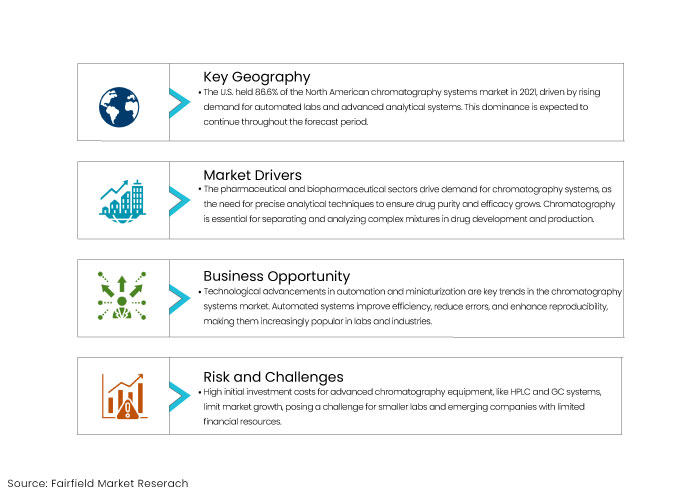
The pharmaceutical and biopharmaceutical sectors are primary growth drivers for the chromatography systems market demand. As these industries expand, the need for precise analytical techniques to ensure drug purity and efficacy becomes paramount. Chromatography plays a crucial role in the development and production of pharmaceuticals enabling the separation and analysis of complex mixtures.
The rise in drug development activities, particularly in biologics and biosimilars necessitates advanced chromatography systems for quality control and regulatory compliance. Additionally, the ongoing trend toward personalized medicine further fuels the demand for chromatography, as tailored therapies require meticulous analytical methods to ensure safety and effectiveness. This growing reliance on chromatography in drug development and production will significantly boost market growth.
- Technological Advancements in Chromatography Systems
Technological advancements are revolutionizing the chromatography systems market growth, driving growth through enhanced efficiency and capabilities. Innovations such as high-performance liquid chromatography (HPLC), ultra-high-performance liquid chromatography (UHPLC), and advancements in mass spectrometry integration are making chromatography systems effective and user-friendly paving the way for efficient and productive future.
Technologies allow fast analysis times, improved resolution, and greater sensitivity, which are critical in research and industrial applications. Moreover, the development of automated systems and software solutions for data analysis streamlines workflows and reduces human error, making chromatography more accessible to laboratories of all sizes. As these technologies evolve, they are expected to attract more users and applications further propelling market growth.
- Rising Environmental Concerns and Green Chemistry Initiatives
The increasing emphasis on environmental sustainability and green chemistry initiatives is another significant growth driver for the chromatography systems market expansion. As industries face pressure to reduce their ecological footprint, there is a growing demand for chromatography systems that minimize waste and energy consumption.
Green chromatography techniques such as the use of environment-friendly solvents and methods that reduce hazardous waste are gaining traction. Regulatory bodies are also promoting sustainable practices, encouraging companies to adopt green technologies. This shift not only aligns with global sustainability goals but also opens new market opportunities for manufacturers of chromatography systems that prioritize eco-friendly solutions. As awareness of environmental issues continues to rise, the potential for sustainable chromatography practices to drive innovation and market expansion is significant.
Key Growth Barriers
- High Initial Investment Costs
One of the primary restraints affecting chromatography systems market sales is the high initial investment costs associated with advanced chromatography equipment. Purchasing and installing sophisticated chromatography systems, such as high-performance liquid chromatography (HPLC) and gas chromatography (GC) systems, require significant capital expenditure. This can be a barrier for smaller laboratories and emerging companies that may not have the financial resources to invest in such technologies.
Ongoing maintenance and operational costs can further strain budgets, leading some organizations to delay or forgo upgrades to their analytical capabilities. As a result, the high cost of entry can limit market growth, particularly in regions where funding for research and development is constrained.
- Complexity of Operation and Training Requirements
Another significant restraint for the chromatography systems market growth is the complexity of operations and the need for specialized training. Advanced chromatography techniques often require skilled personnel who are well-versed in the intricacies of the equipment and the analytical processes involved. The need for extensive training can deter organizations from adopting new systems as it involves additional time and resources.
The rapid pace of technological advancements means ongoing training is necessary to keep staff updated on the latest methodologies and equipment functionalities. This complexity can lead to operational inefficiencies and increased reliance on external experts, which may not be feasible for all organizations.
Chromatography Systems Market Trends and Opportunities
- Technological Advancements in Automation and Miniaturization
A significant trend shaping the chromatography systems market is the ongoing technological advancements in automation and miniaturization. As laboratories strive for increased efficiency and productivity, the integration of automated systems is becoming prevalent. Automated chromatography systems reduce human error, streamline workflows, and enhance reproducibility making them highly attractive to researchers and industries alike.
The miniaturization of chromatography technologies allows for small sample sizes and reduced solvent consumption aligning with the growing emphasis on sustainability in laboratory practices. These advancements not only improve the analytical capabilities of chromatography systems but also make them accessible to a wider range of users including small laboratories that may have previously been deterred by the complexity and cost of traditional systems.
As automation and miniaturization continue to evolve, they are expected to drive significant growth in the chromatography market catering to the increasing demand for efficient and environment-friendly analytical solutions.
- A Significant Rise in the Demand for Monoclonal Antibodies
There has been a significant rise in the demand for monoclonal antibodies across various medical fields, particularly in oncology and the treatment of conditions such as Alzheimer’s disease and other inflammatory disorders. This surge is driven by the increasing recognition of monoclonal antibodies as effective therapeutic agents targeting specific pathways involved in these diseases, leading to enhanced treatment outcomes. This fuels the chromatography systems market expansion.
As healthcare providers seek effective solutions for complex medical conditions, the reliance on advanced biopharmaceuticals including monoclonal antibodies continues to grow. Consequently, this heightened demand is contributing to the expansion of the chromatography systems market as these systems are essential for the development, purification, and quality control of monoclonal antibodies ensuring their efficacy and safety in clinical applications.
How Does Regulatory Scenario Shape this Industry?
The regulatory landscape significantly influences the chromatography systems market growth, primarily through stringent guidelines and standards set by health and safety authorities.
Regulatory bodies, such as the FDA and EMA enforce rigorous testing and validation protocols for pharmaceuticals and biopharmaceuticals, necessitating advanced chromatography systems for quality control and assurance. These regulations ensure that products meet safety and efficacy standards driving demand for sophisticated chromatography technologies.
The increasing focus on environmental regulations is pushing companies to adopt green chromatography practices, which can lead to innovations in system design and operation. As regulations evolve, manufacturers are compelled to invest in efficient and compliant chromatography systems thereby shaping market dynamics and fostering growth.
Segments Covered in the Report
- Liquid Chromatography Takes the Lead with Expansive Use in Pharmaceuticals
Advancements in liquid chromatography equipment have significantly enhanced the efficiency and reduced the costs associated with chromatographic procedures, making it an essential tool in the pharmaceutical industry for laboratories of all sizes. Its wide-ranging applications, particularly in the quality assessment of pharmaceutical products and drug development are driving the increased adoption of liquid chromatography systems.
The integration of automation into chromatographic equipment streamlines processes allowing for great precision and productivity. Increased investments from both pharmaceutical manufacturers and government agencies are further driving the liquid chromatography techniques. As a result, this segment is experiencing robust expansion reflecting the critical role that liquid chromatography plays in advancing pharmaceutical research and ensuring product quality.
- Continuous Chromatography Systems to Dominate with a 40% Market Share
Continuous chromatography systems are projected to capture significant market share accounting for around 40% of the total market. These systems are specifically engineered to provide a continuous supply during the purification stage when linked to an upstream perfusion bioreactor. This innovative approach is particularly effective for purifying oligonucleotides, peptides and various biopharmaceuticals.
Continuous chromatography systems excel in both reversed-phase chromatography and ion-exchange chromatography delivering high productivity alongside exceptional purity and yield. This efficiency not only significantly reduces operational costs but also saves valuable time and minimizes product waste derived from crude materials.
As industries increasingly recognize these advantages, the adoption of continuous chromatography systems is expected to grow further solidifying their critical role in biopharmaceutical processing.
Regional Analysis
- The U.S. Turned Highly Lucrative in the North America Chromatography Systems Market
The U.S. accounted for a significant 86.6% of the market share in the North America chromatography systems sector in 2021. This dominance is projected to persist over the forecast period. The growth of the U.S. in the chromatography systems market is largely fueled by the escalating demand for automated laboratories and advanced analytical systems.
Key contributors to this growth include the proliferation of chromatography-focused conferences and symposia, which foster knowledge exchange and innovation, and a significant surge in venture capital funding. This influx of capital aimed at advancing research and development in analytical technologies underscores the commitment of the U.S. to innovation. The presence of well-developed infrastructural facilities further enhances the market's capacity to support cutting-edge chromatography solutions cementing the leadership of the U.S. in this field.
- Growing Emphasis on Biologics and Molecular Research to Drive U.K. Chromatography Systems Market
The U.K. is predicted to account for around 29.7% of the Europe chromatography systems market in 2024. This substantial market share can be attributed to the increasing focus on the production of novel biologics and significant advancements in genomics and proteomics in the region. These developments have led to a heightened demand for chromatography systems in both laboratory and production environments facilitating efficient and precise analytical processes.
The U.K. becomes a hub for innovative research with numerous institutions and companies investing in cutting-edge technologies to enhance their capabilities. As a result, the growing emphasis on biologics and molecular research is driving the adoption of chromatography systems. Consequently, contributing to the overall growth of the U.K. market in this competitive landscape.
Fairfield’s Competitive Landscape Analysis
The chromatography systems market is characterized by dynamic competition with key players engaging in acquisitions and partnerships to enhance their product offerings and market presence. Key developments reflect the ongoing trend of companies investing in cutting-edge technologies to meet the evolving needs of the market.
Partnerships between companies and research institutions are also becoming common facilitating the development of novel chromatography techniques and applications, thereby driving growth in this competitive landscape.
Key Market Companies
- Merck KGaA
- Sartorius AG
- Bio-Rad Laboratories, Inc.
- Thermo Fisher Scientific Inc.
- Shimadzu Corporation
- Malvern Panalytical Ltd
- CAMAG
- PerkinElmer Inc.
- Agilent Technologies
- Tosoh Corporation
- KNAUER Wissenschaftliche Geräte GmbH
- Repligen Corporation
- Bruker
- Waters Corporation
- Biobase Biodusty (Shandong), Co., Ltd.
- O.I. Corporation
- Gilson Incorporated
An Expert’s Eye
- The market is growing due to increasing pharmaceutical, biotechnology, and environmental testing applications.
- The market is driven by the rising demand for analytical techniques that ensure product quality and safety particularly in the pharmaceutical sector.
- Technological advancements are enhancing analytical capabilities and efficiency.
- The growing emphasis on regulatory compliance is increasing demand for advanced chromatography systems.
- The expansion of the biopharmaceutical sector is a significant growth driver as drug development becomes complex.
Global Chromatography Systems Market is Segmented as-
By Product
- Liquid Chromatography Systems
- Gas Chromatography Systems
- Supercritical Fluid Chromatography Systems
- Thin-Layer Chromatography Systems
- Chromatography Columns
- Auto-sampling Systems
- Consumables and Accessories
By Modality
- Single-use Chromatography Systems
- Multiple-use Chromatography Systems
- Continuous Chromatography Systems
- High-Performance Chromatography Systems
By Usage
- Process Development
- Commercial
By End User
- Biopharmaceutical Companies
- Hospitals
- Diagnostic Centers
- Clinical Research Organization
- Academic Institutes
By Region
- North America
- Latin America
- Europe
- South Asia
- East Asia
- Oceania
- The Middle East and Africa
- Executive Summary
- Global Chromatography Systems Market Snapshot
- Future Projections
- Key Market Trends
- Regional Snapshot, by Value, 2026
- Analyst Recommendations
- Market Overview
- Market Definitions and Segmentations
- Market Dynamics
- Drivers
- Restraints
- Market Opportunities
- Value Chain Analysis
- COVID-19 Impact Analysis
- Porter's Five Forces Analysis
- Impact of Russia-Ukraine Conflict
- PESTLE Analysis
- Regulatory Analysis
- Price Trend Analysis
- Current Prices and Future Projections, 2025-2033
- Price Impact Factors
- Global Chromatography Systems Market Outlook, 2020 - 2033
- Global Chromatography Systems Market Outlook, by Product, Value (US$ Mn), 2020-2033
- Liquid Chromatography Systems
- Gas Chromatography Systems
- Supercritical Fluid Chromatography Systems
- Thin-Layer Chromatography Systems
- Chromatography Columns
- Auto-sampling Systems
- Consumables and Accessories
- Global Chromatography Systems Market Outlook, by Modality, Value (US$ Mn), 2020-2033
- Single-use Chromatography Systems
- Multiple-use Chromatography Systems
- Continuous Chromatography Systems
- High-Performance Chromatography Systems
- Global Chromatography Systems Market Outlook, by Usage, Value (US$ Mn), 2020-2033
- Process Development
- Commercial
- Global Chromatography Systems Market Outlook, by End User, Value (US$ Mn), 2020-2033
- Biopharmaceutical Companies
- Hospitals
- Diagnostic Centers
- Clinical Research Organization
- Academic Institutes
- Global Chromatography Systems Market Outlook, by Region, Value (US$ Mn), 2020-2033
- North America
- Europe
- Asia Pacific
- Latin America
- Middle East & Africa
- Global Chromatography Systems Market Outlook, by Product, Value (US$ Mn), 2020-2033
- North America Chromatography Systems Market Outlook, 2020 - 2033
- North America Chromatography Systems Market Outlook, by Product, Value (US$ Mn), 2020-2033
- Liquid Chromatography Systems
- Gas Chromatography Systems
- Supercritical Fluid Chromatography Systems
- Thin-Layer Chromatography Systems
- Chromatography Columns
- Auto-sampling Systems
- Consumables and Accessories
- North America Chromatography Systems Market Outlook, by Modality, Value (US$ Mn), 2020-2033
- Single-use Chromatography Systems
- Multiple-use Chromatography Systems
- Continuous Chromatography Systems
- High-Performance Chromatography Systems
- North America Chromatography Systems Market Outlook, by Usage, Value (US$ Mn), 2020-2033
- Process Development
- Commercial
- North America Chromatography Systems Market Outlook, by End User, Value (US$ Mn), 2020-2033
- Biopharmaceutical Companies
- Hospitals
- Diagnostic Centers
- Clinical Research Organization
- Academic Institutes
- North America Chromatography Systems Market Outlook, by Country, Value (US$ Mn), 2020-2033
- U.S. Chromatography Systems Market Outlook, by Product, 2020-2033
- U.S. Chromatography Systems Market Outlook, by Modality, 2020-2033
- U.S. Chromatography Systems Market Outlook, by Usage, 2020-2033
- U.S. Chromatography Systems Market Outlook, by End User, 2020-2033
- Canada Chromatography Systems Market Outlook, by Product, 2020-2033
- Canada Chromatography Systems Market Outlook, by Modality, 2020-2033
- Canada Chromatography Systems Market Outlook, by Usage, 2020-2033
- Canada Chromatography Systems Market Outlook, by End User, 2020-2033
- BPS Analysis/Market Attractiveness Analysis
- North America Chromatography Systems Market Outlook, by Product, Value (US$ Mn), 2020-2033
- Europe Chromatography Systems Market Outlook, 2020 - 2033
- Europe Chromatography Systems Market Outlook, by Product, Value (US$ Mn), 2020-2033
- Liquid Chromatography Systems
- Gas Chromatography Systems
- Supercritical Fluid Chromatography Systems
- Thin-Layer Chromatography Systems
- Chromatography Columns
- Auto-sampling Systems
- Consumables and Accessories
- Europe Chromatography Systems Market Outlook, by Modality, Value (US$ Mn), 2020-2033
- Single-use Chromatography Systems
- Multiple-use Chromatography Systems
- Continuous Chromatography Systems
- High-Performance Chromatography Systems
- Europe Chromatography Systems Market Outlook, by Usage, Value (US$ Mn), 2020-2033
- Process Development
- Commercial
- Europe Chromatography Systems Market Outlook, by End User, Value (US$ Mn), 2020-2033
- Biopharmaceutical Companies
- Hospitals
- Diagnostic Centers
- Clinical Research Organization
- Academic Institutes
- Europe Chromatography Systems Market Outlook, by Country, Value (US$ Mn), 2020-2033
- Germany Chromatography Systems Market Outlook, by Product, 2020-2033
- Germany Chromatography Systems Market Outlook, by Modality, 2020-2033
- Germany Chromatography Systems Market Outlook, by Usage, 2020-2033
- Germany Chromatography Systems Market Outlook, by End User, 2020-2033
- Italy Chromatography Systems Market Outlook, by Product, 2020-2033
- Italy Chromatography Systems Market Outlook, by Modality, 2020-2033
- Italy Chromatography Systems Market Outlook, by Usage, 2020-2033
- Italy Chromatography Systems Market Outlook, by End User, 2020-2033
- France Chromatography Systems Market Outlook, by Product, 2020-2033
- France Chromatography Systems Market Outlook, by Modality, 2020-2033
- France Chromatography Systems Market Outlook, by Usage, 2020-2033
- France Chromatography Systems Market Outlook, by End User, 2020-2033
- U.K. Chromatography Systems Market Outlook, by Product, 2020-2033
- U.K. Chromatography Systems Market Outlook, by Modality, 2020-2033
- U.K. Chromatography Systems Market Outlook, by Usage, 2020-2033
- U.K. Chromatography Systems Market Outlook, by End User, 2020-2033
- Spain Chromatography Systems Market Outlook, by Product, 2020-2033
- Spain Chromatography Systems Market Outlook, by Modality, 2020-2033
- Spain Chromatography Systems Market Outlook, by Usage, 2020-2033
- Spain Chromatography Systems Market Outlook, by End User, 2020-2033
- Russia Chromatography Systems Market Outlook, by Product, 2020-2033
- Russia Chromatography Systems Market Outlook, by Modality, 2020-2033
- Russia Chromatography Systems Market Outlook, by Usage, 2020-2033
- Russia Chromatography Systems Market Outlook, by End User, 2020-2033
- Rest of Europe Chromatography Systems Market Outlook, by Product, 2020-2033
- Rest of Europe Chromatography Systems Market Outlook, by Modality, 2020-2033
- Rest of Europe Chromatography Systems Market Outlook, by Usage, 2020-2033
- Rest of Europe Chromatography Systems Market Outlook, by End User, 2020-2033
- BPS Analysis/Market Attractiveness Analysis
- Europe Chromatography Systems Market Outlook, by Product, Value (US$ Mn), 2020-2033
- Asia Pacific Chromatography Systems Market Outlook, 2020 - 2033
- Asia Pacific Chromatography Systems Market Outlook, by Product, Value (US$ Mn), 2020-2033
- Liquid Chromatography Systems
- Gas Chromatography Systems
- Supercritical Fluid Chromatography Systems
- Thin-Layer Chromatography Systems
- Chromatography Columns
- Auto-sampling Systems
- Consumables and Accessories
- Asia Pacific Chromatography Systems Market Outlook, by Modality, Value (US$ Mn), 2020-2033
- Single-use Chromatography Systems
- Multiple-use Chromatography Systems
- Continuous Chromatography Systems
- High-Performance Chromatography Systems
- Asia Pacific Chromatography Systems Market Outlook, by Usage, Value (US$ Mn), 2020-2033
- Process Development
- Commercial
- Asia Pacific Chromatography Systems Market Outlook, by End User, Value (US$ Mn), 2020-2033
- Biopharmaceutical Companies
- Hospitals
- Diagnostic Centers
- Clinical Research Organization
- Academic Institutes
- Asia Pacific Chromatography Systems Market Outlook, by Country, Value (US$ Mn), 2020-2033
- China Chromatography Systems Market Outlook, by Product, 2020-2033
- China Chromatography Systems Market Outlook, by Modality, 2020-2033
- China Chromatography Systems Market Outlook, by Usage, 2020-2033
- China Chromatography Systems Market Outlook, by End User, 2020-2033
- Japan Chromatography Systems Market Outlook, by Product, 2020-2033
- Japan Chromatography Systems Market Outlook, by Modality, 2020-2033
- Japan Chromatography Systems Market Outlook, by Usage, 2020-2033
- Japan Chromatography Systems Market Outlook, by End User, 2020-2033
- South Korea Chromatography Systems Market Outlook, by Product, 2020-2033
- South Korea Chromatography Systems Market Outlook, by Modality, 2020-2033
- South Korea Chromatography Systems Market Outlook, by Usage, 2020-2033
- South Korea Chromatography Systems Market Outlook, by End User, 2020-2033
- India Chromatography Systems Market Outlook, by Product, 2020-2033
- India Chromatography Systems Market Outlook, by Modality, 2020-2033
- India Chromatography Systems Market Outlook, by Usage, 2020-2033
- India Chromatography Systems Market Outlook, by End User, 2020-2033
- Southeast Asia Chromatography Systems Market Outlook, by Product, 2020-2033
- Southeast Asia Chromatography Systems Market Outlook, by Modality, 2020-2033
- Southeast Asia Chromatography Systems Market Outlook, by Usage, 2020-2033
- Southeast Asia Chromatography Systems Market Outlook, by End User, 2020-2033
- Rest of SAO Chromatography Systems Market Outlook, by Product, 2020-2033
- Rest of SAO Chromatography Systems Market Outlook, by Modality, 2020-2033
- Rest of SAO Chromatography Systems Market Outlook, by Usage, 2020-2033
- Rest of SAO Chromatography Systems Market Outlook, by End User, 2020-2033
- BPS Analysis/Market Attractiveness Analysis
- Asia Pacific Chromatography Systems Market Outlook, by Product, Value (US$ Mn), 2020-2033
- Latin America Chromatography Systems Market Outlook, 2020 - 2033
- Latin America Chromatography Systems Market Outlook, by Product, Value (US$ Mn), 2020-2033
- Liquid Chromatography Systems
- Gas Chromatography Systems
- Supercritical Fluid Chromatography Systems
- Thin-Layer Chromatography Systems
- Chromatography Columns
- Auto-sampling Systems
- Consumables and Accessories
- Latin America Chromatography Systems Market Outlook, by Modality, Value (US$ Mn), 2020-2033
- Single-use Chromatography Systems
- Multiple-use Chromatography Systems
- Continuous Chromatography Systems
- High-Performance Chromatography Systems
- Latin America Chromatography Systems Market Outlook, by Usage, Value (US$ Mn), 2020-2033
- Process Development
- Commercial
- Latin America Chromatography Systems Market Outlook, by End User, Value (US$ Mn), 2020-2033
- Biopharmaceutical Companies
- Hospitals
- Diagnostic Centers
- Clinical Research Organization
- Academic Institutes
- Latin America Chromatography Systems Market Outlook, by Country, Value (US$ Mn), 2020-2033
- Brazil Chromatography Systems Market Outlook, by Product, 2020-2033
- Brazil Chromatography Systems Market Outlook, by Modality, 2020-2033
- Brazil Chromatography Systems Market Outlook, by Usage, 2020-2033
- Brazil Chromatography Systems Market Outlook, by End User, 2020-2033
- Mexico Chromatography Systems Market Outlook, by Product, 2020-2033
- Mexico Chromatography Systems Market Outlook, by Modality, 2020-2033
- Mexico Chromatography Systems Market Outlook, by Usage, 2020-2033
- Mexico Chromatography Systems Market Outlook, by End User, 2020-2033
- Argentina Chromatography Systems Market Outlook, by Product, 2020-2033
- Argentina Chromatography Systems Market Outlook, by Modality, 2020-2033
- Argentina Chromatography Systems Market Outlook, by Usage, 2020-2033
- Argentina Chromatography Systems Market Outlook, by End User, 2020-2033
- Rest of LATAM Chromatography Systems Market Outlook, by Product, 2020-2033
- Rest of LATAM Chromatography Systems Market Outlook, by Modality, 2020-2033
- Rest of LATAM Chromatography Systems Market Outlook, by Usage, 2020-2033
- Rest of LATAM Chromatography Systems Market Outlook, by End User, 2020-2033
- BPS Analysis/Market Attractiveness Analysis
- Latin America Chromatography Systems Market Outlook, by Product, Value (US$ Mn), 2020-2033
- Middle East & Africa Chromatography Systems Market Outlook, 2020 - 2033
- Middle East & Africa Chromatography Systems Market Outlook, by Product, Value (US$ Mn), 2020-2033
- Liquid Chromatography Systems
- Gas Chromatography Systems
- Supercritical Fluid Chromatography Systems
- Thin-Layer Chromatography Systems
- Chromatography Columns
- Auto-sampling Systems
- Consumables and Accessories
- Middle East & Africa Chromatography Systems Market Outlook, by Modality, Value (US$ Mn), 2020-2033
- Single-use Chromatography Systems
- Multiple-use Chromatography Systems
- Continuous Chromatography Systems
- High-Performance Chromatography Systems
- Middle East & Africa Chromatography Systems Market Outlook, by Usage, Value (US$ Mn), 2020-2033
- Process Development
- Commercial
- Middle East & Africa Chromatography Systems Market Outlook, by End User, Value (US$ Mn), 2020-2033
- Biopharmaceutical Companies
- Hospitals
- Diagnostic Centers
- Clinical Research Organization
- Academic Institutes
- Middle East & Africa Chromatography Systems Market Outlook, by Country, Value (US$ Mn), 2020-2033
- GCC Chromatography Systems Market Outlook, by Product, 2020-2033
- GCC Chromatography Systems Market Outlook, by Modality, 2020-2033
- GCC Chromatography Systems Market Outlook, by Usage, 2020-2033
- GCC Chromatography Systems Market Outlook, by End User, 2020-2033
- South Africa Chromatography Systems Market Outlook, by Product, 2020-2033
- South Africa Chromatography Systems Market Outlook, by Modality, 2020-2033
- South Africa Chromatography Systems Market Outlook, by Usage, 2020-2033
- South Africa Chromatography Systems Market Outlook, by End User, 2020-2033
- Egypt Chromatography Systems Market Outlook, by Product, 2020-2033
- Egypt Chromatography Systems Market Outlook, by Modality, 2020-2033
- Egypt Chromatography Systems Market Outlook, by Usage, 2020-2033
- Egypt Chromatography Systems Market Outlook, by End User, 2020-2033
- Nigeria Chromatography Systems Market Outlook, by Product, 2020-2033
- Nigeria Chromatography Systems Market Outlook, by Modality, 2020-2033
- Nigeria Chromatography Systems Market Outlook, by Usage, 2020-2033
- Nigeria Chromatography Systems Market Outlook, by End User, 2020-2033
- Rest of Middle East Chromatography Systems Market Outlook, by Product, 2020-2033
- Rest of Middle East Chromatography Systems Market Outlook, by Modality, 2020-2033
- Rest of Middle East Chromatography Systems Market Outlook, by Usage, 2020-2033
- Rest of Middle East Chromatography Systems Market Outlook, by End User, 2020-2033
- BPS Analysis/Market Attractiveness Analysis
- Middle East & Africa Chromatography Systems Market Outlook, by Product, Value (US$ Mn), 2020-2033
- Competitive Landscape
- Company Vs Segment Heatmap
- Company Market Share Analysis, 2025
- Competitive Dashboard
- Company Profiles
- Merck KGaA
- Company Overview
- Product Portfolio
- Financial Overview
- Business Strategies and Developments
- Sartorius AG
- Bio-Rad Laboratories, Inc.
- Thermo Fisher Scientific Inc.
- Shimadzu Corporation
- Malvern Panalytical Ltd
- CAMAG
- PerkinElmer Inc.
- Agilent Technologies
- Tosoh Corporation
- KNAUER Wissenschaftliche Geräte GmbH
- Repligen Corporation
- Bruker
- Waters Corporation
- Biobase Biodusty (Shandong), Co., Ltd.
- Merck KGaA
- Appendix
- Research Methodology
- Report Assumptions
- Acronyms and Abbreviations
|
BASE YEAR |
HISTORICAL DATA |
FORECAST PERIOD |
UNITS |
|||
 |
2025 |
 |
2020 - 2025 |
 |
2026 - 2033 |
Value: US$ Million |
|
REPORT FEATURES |
DETAILS |
|
Product Coverage |
|
|
Modality Coverage |
|
|
Usage Coverage |
|
|
End User |
|
|
Geographical Coverage |
|
|
Leading Companies |
|
|
Report Highlights |
Key Market Indicators, Macro-micro economic impact analysis, Technological Roadmap, Key Trends, Driver, Restraints, and Future Opportunities & Revenue Pockets, Porter’s 5 Forces Analysis, Historical Trend (2019-2021), Market Estimates and Forecast, Market Dynamics, Industry Trends, Competition Landscape, Category, Region, Country-wise Trends & Analysis, COVID-19 Impact Analysis (Demand and Supply Chain) |
Our Research Methodology
Considering the volatility of business today, traditional approaches to strategizing a game plan can be unfruitful if not detrimental. True ambiguity is no way to determine a forecast. A myriad of predetermined factors must be accounted for such as the degree of risk involved, the magnitude of circumstances, as well as conditions or consequences that are not known or unpredictable. To circumvent binary views that cast uncertainty, the application of market research intelligence to strategically posture, move, and enable actionable outcomes is necessary.
View Methodology
Quality Assured
Rigorous Validation Process

Confidentiality Assured
End-to-end Data Security

Custom Research Services
Tailored To Your Objectives
FAQs
The market is predicted to rise from USD 1.7 Bn in 2026 to USD 2.8 Bn by 2033.
The U.S. led North America market in 2025 and commanded 86.6% of the market share.
Some of the leading industry players in the market are Bio-Rad Laboratories, Inc., Thermo Fisher Scientific Inc., Merck KGaA, and Sartorius AG.
Continuous chromatography systems are projected to capture significant market share in 20254 accounting for around 40% of the total market share.
A key opportunity lies in the technological advancements in automation and miniaturization.
Related Reports
Particle-Engineered Probiotic Stabilizers Market Size, Share, Insights, Competitive Landscape, and Forecast 2026 to 2033
The global particle-engineered probiotic stabilizers market is projected to reach US$ 2.98 Billion by 2033, growing at an 11.4% CAGR during 2026–2033
Probiotic Stability Excipients Market Size, Share, Insights, Competitive Landscape, and Forecast 2026 to 2033
The global probiotic stability excipients market is projected to reach US$ 2.8 Bn by 2033, growing at an 11.6% CAGR , driven by stable probiotic formulations
GLP-1 Telehealth Platforms Market Size, Share, Insights, Competitive Landscape, and Forecast 2026 to 2033
GLP-1 Telehealth Platforms Market is valued at US$0.7638 Billion in 2026 and projected to reach US$2.1199 Billion by 2033, growing at 15.7% CAGR.
GLP-1 Nutrition Coaching Market Size, Share, Insights, Competitive Landscape, and Forecast 2026 to 2033
GLP-1 Nutrition Coaching Market is projected to reach US$0.4095 billion by 2033 from US$0.1248 billion in 2026, growing at a CAGR of 18.5%.
Laboratory Andrology Equipment Market Size, Share, Insights, Competitive Landscape, and Forecast 2026 to 2033
Laboratory Andrology Equipment Market to reach US$1.4165 Bn by 2033, growing at 5.1% CAGR, driven by sample handling, automation, and preservation.
Lab Automation Workstations Market Size, Share, Insights, Competitive Landscape, and Forecast 2026 to 2033
Lab Automation Workstations Market to reach US$14.39 Bn by 2033, growing at 10.4% CAGR, driven by molecular biology, automation, and connected workflows.