



Citrus Extract Market
Citrus Extract Market Size, Share, Insights, Competitive Landscape, and Forecast 2026 to 2033
Citrus Extract Market Size and Trend Analysis
How Big Is the Citrus Extract Market in 2026?
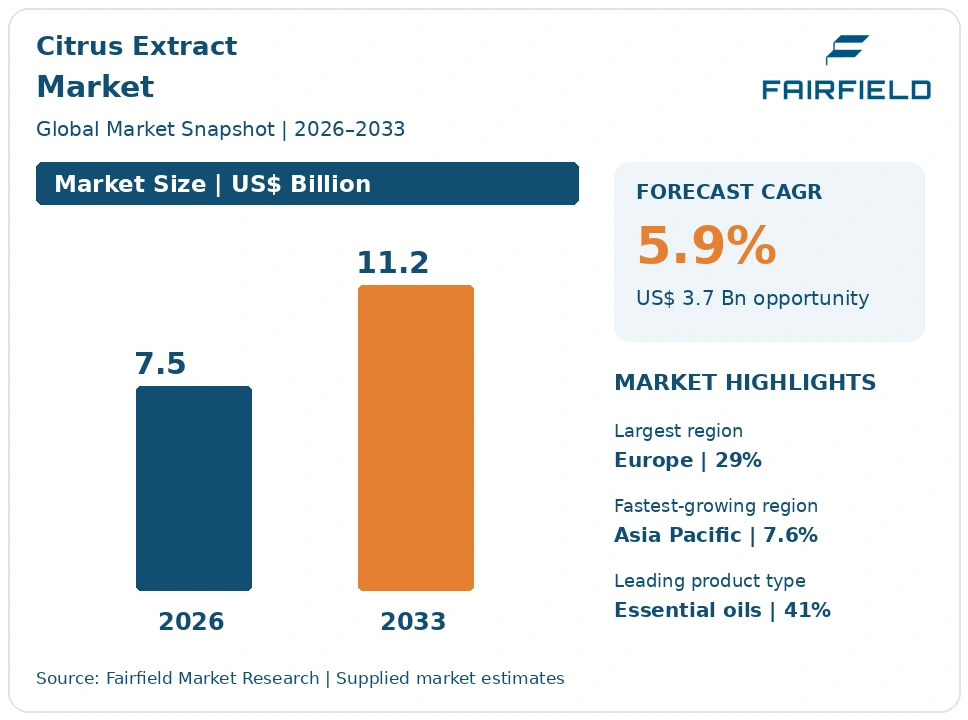
The global Citrus Extract market size is expected to be valued at US$ 7.5 billion in 2026 and projected to reach US$ 11.2 billion by 2033, growing at a CAGR of 5.9% between 2026 and 2033.
The category expanded at a 5.2% CAGR between 2020 and 2025, ending that period near US$ 7.1 billion, with progress held back by erratic orange and lemon harvests rather than by weak buying. Three forces set the path to 2033. Beverage and savoury food makers keep replacing declared synthetic flavourings with cold-pressed citrus oils and recovered aroma fractions. Cleaning product formulators keep substituting d-limonene for petrochemical solvents. Supplement and texturiser buyers are drawing more value from peel through bioflavonoids and citrus fibre. The direction is upward but supply-limited, because extract availability tracks the orange and lemon crush rather than order books.
Key Report Takeaways
- By Product Type: Citrus essential oils held 41% share in 2026, while citrus fibre is projected to expand at an 8.4% CAGR through 2033, driven by clean-label texturising systems that replace modified starch and added fat in sauces and bakery fillings.
- By Source Fruit: Orange accounted for 47% share in 2026, while bergamot is projected to grow at a 7.3% CAGR through 2033, supported by fine fragrance briefs and the premium tea and beverage flavour segment in which bergamot oil is difficult to imitate.
- By Form: Liquid grades held 64% share in 2026, while powder is projected to advance at a 7.6% CAGR through 2033, because spray-dried and encapsulated citrus oils survive dry blending, resist oxidation and simplify dosing in instant and tablet formats.
- By Application: Food and beverages held 37% share in 2026, while household and industrial cleaning is projected to rise at a 7.9% CAGR through 2033, reflecting solvent substitution programmes that favour bio-based d-limonene over petrochemical degreasers.
- By Geography: Europe led with 29% share in 2026, while Asia Pacific is projected to grow at a 7.6% CAGR through 2033, as regional flavour, fragrance and home care manufacturing capacity expands around China, India and Indonesia.
Global Citrus Extract Market Trends and Insights
Drivers Impact Analysis
Two forces account for most of the incremental demand expected across the citrus derivatives value chain between 2026 and 2033.
| Driver | Impact on CAGR Forecast | Geographic Relevance | Impact Timeline |
| Reformulation of beverages and foods toward natural flavourings and citrus oil emulsions | High | Global, led by North America and Europe | Short term ≤2 years |
| Sustained fragrance, air care and personal wash demand for citrus top notes | Medium | Global, strongest in Asia Pacific | Medium term 2–4 years |
Natural Flavouring Reformulation Pulls Cold-Pressed Oils and Aroma Fractions Into the Citrus Extract Market
Reformulation toward natural flavourings is the single largest source of new volume for citrus derivatives. Beverage houses, confectioners and savoury snack makers are rebuilding recipes so that the flavour line reads as a natural flavouring rather than as an additive. Cold-pressed orange, lemon and lime oils, folded oils and recovered aroma fractions all qualify, which moves purchase volumes from synthetic aroma chemicals to peel-derived material.
The mechanism is regulatory and definitional. The EU flavouring regulation and its Union list of authorised flavouring substances, together with the natural flavouring definition, set out when a material may be declared as natural. In the United States, FDA GRAS status for citrus oils and the FEMA GRAS programme give formulators a settled basis for use. Emulsion reformulation in citrus-flavoured soft drinks has added further pull for oils and weighting-free emulsion systems.
Citrus Top Notes Keep Fragrance and Personal Care Among the Largest Buyers of Citrus Extract
Fragrance and personal care remain the second engine of demand, and the pull is structural rather than seasonal. Citrus accords sit at the opening of a large share of fine fragrances, fabric care, dish care and air care briefs, and no synthetic reconstruction fully matches the freshness of a cold-pressed oil. That keeps perfumery houses buying orange, lemon, bergamot and mandarin oils even when prices move sharply.
The causal driver is category growth plus specification change. Rising personal wash and home fragrance consumption in China, India, Brazil and the Gulf states expands the absolute tonnage required. At the same time, the EU Cosmetic Products Regulation and its fragrance allergen labelling requirements, which cover limonene and citral among others, push buyers toward suppliers that can document composition precisely. Traceable, specification-controlled natural grades therefore gain share over commodity material.
Restraints Impact Analysis
The binding constraints on this market are physical supply and price ceilings, not demand.
| Restraint | Impact on CAGR Forecast | Geographic Relevance | Impact Timeline |
| Co-product dependence on the juice crush, worsened by citrus greening disease | High | Global, acute in Latin America and North America | Long term ≥4 years |
| Phototoxicity limits on leave-on use and competition from synthetic aroma chemicals | Medium | Europe and North America | Medium term 2–4 years |
Citrus Extract Supply Is Set by the Juice Crush, and Citrus Greening Has Cut That Crush Hard
Citrus extract is a co-product of the juice industry, and that single fact governs the market. Peel, pulp and the aroma streams recovered during evaporation exist only because fruit is being squeezed, so available tonnage is set by the orange and lemon crush rather than by extract orders. When juice volumes fall, oil, terpene and fibre supply tightens immediately, prices spike, and buyers reformulate or ration regardless of how strong underlying demand is.
The underlying cause is agronomic. Citrus greening disease, also called huanglongbing, has cut production hard in major growing regions, and Florida output in particular has fallen to a fraction of historic levels. Hurricanes, drought in Brazil, replanting costs and grove abandonment have compounded the decline. The result has been historic volatility in orange juice markets and, through the same mechanism, in peel availability and in cold-pressed oil pricing.
Phototoxicity Rules and Low-Cost Synthetic Aroma Chemicals Cap Citrus Extract Use Levels and Pricing
Two ceilings limit value capture. First, several cold-pressed citrus oils contain furocoumarins and are therefore restricted in leave-on cosmetic products, which caps the use level a perfumer may specify in a face cream or body lotion. Second, synthetic limonene and synthetic aroma chemicals set a reference price that buyers compare against, so natural grades can only command a premium up to the point where substitution becomes rational.
The technical cause of the first ceiling is photosensitisation. Bergapten and related furocoumarins in expressed bergamot, lime and bitter orange oils absorb ultraviolet light, which is why International Fragrance Association standards restrict furocoumarin-containing citrus oils in leave-on applications and why furocoumarin-reduced grades carry a processing cost. The second ceiling reflects production economics, since synthetic routes are not exposed to harvest risk and REACH registration of d-limonene has normalised industrial trade in both natural and synthetic material.
Market Opportunities
Citrus Fibre Opens a Clean-Label Texturiser Pool Beyond the Traditional Citrus Extract Buyer
Citrus fibre is the clearest new revenue pool in the category, because it sells to formulators who never bought an essential oil. Recovered from peel after juicing and pectin extraction, it functions as a water-binding and emulsion-stabilising ingredient that can reduce added fat, egg and modified starch in sauces, dressings, bakery fillings, plant-based products and processed meat. It therefore competes for texturiser budgets rather than flavour budgets, which widens the addressable spend per tonne of peel.
Juice processors with integrated pectin or fibre lines are best placed to capture it, alongside hydrocolloid specialists that already sell into industrial bakery and sauce plants. The demand comes from manufacturers rewriting ingredient declarations for retailer clean-label standards, where a recognisable fruit-derived fibre is preferred to a chemically modified alternative. Organic conversion, where organic certification standards require organic peel, adds a further premium tier.
Bio-Based Solvent Substitution and Fuller Peel Valorisation Create New Citrus Extract Revenue Streams
d-Limonene sold as a bio-based solvent opens an industrial revenue pool that is largely independent of flavour and fragrance cycles. Degreasers, adhesive removers, printing and electronics cleaning, agricultural adjuvants and specialty polymer applications all accept citrus terpene chemistry as a drop-in replacement for petrochemical solvents. Because these buyers purchase in bulk and specify on performance rather than organoleptics, they absorb grades that flavour houses would reject.
Chemical processors and juice groups with distillation capacity can capture this pool, supported by procurement teams replacing chlorinated and aromatic solvents under workplace exposure and emissions policy. The wider prize is fuller peel valorisation: a single tonne of peel can yield oil, d-limonene, pectin, fibre and bioflavonoids including hesperidin, naringin and the polymethoxyflavones. Processors that fractionate rather than discard raise revenue per tonne without needing a single extra fruit.
Segment Analysis
By Product Type: Cold-Pressed Oils Lead While Citrus Fibre Sets the Pace
Citrus essential oils, including d-limonene recovered from them, held 41% share in 2026, the largest of any product group. They lead because every juice line already produces oil as an unavoidable co-product, and because flavour, fragrance and cleaning buyers all draw from the same pool. Citrus bioflavonoids and terpene and aroma fractions follow, with citrus pectin sold as an extract where specifications allow. Citrus fibre is the fastest-growing product type at an 8.4% CAGR to 2033, expanding from a small base as sauce, bakery and plant-based manufacturers adopt it to cut added fat and modified starch. The commercial implication is that processors investing in downstream fractionation capture more value per tonne of peel than those selling crude oil alone, which is gradually shifting margin away from undifferentiated commodity streams.
By Source Fruit: Orange Dominates Volume While Bergamot Commands Growth
Orange accounted for 47% share in 2026, simply because orange juice is the largest single citrus crush worldwide and its peel supplies most available oil, d-limonene and fibre. Lemon ranks second, with lime, grapefruit and mandarin filling specialist flavour and fragrance roles. Bergamot is the fastest-growing source fruit at a 7.3% CAGR to 2033, supported by fine fragrance briefs, premium tea flavouring and the practical difficulty of reconstructing its profile synthetically. Supply is highly concentrated in a small growing area in southern Italy, which keeps volumes tight and prices firm. For buyers, the implication is that orange-derived material carries crush risk while bergamot carries geographic concentration risk, so sourcing teams increasingly hold dual qualifications and contract further forward than they did a decade ago.
By Form: Liquid Grades Hold the Base as Powders Gain Formulation Ground
Liquid grades held 64% share in 2026, covering cold-pressed oils, folded oils, distilled fractions, terpenes and liquid bioflavonoid concentrates. Liquids lead because extraction and recovery produce liquid material directly, and because flavour houses and cleaning formulators dose into liquid systems. Powder is the fastest-growing form at a 7.6% CAGR to 2033. Spray-dried and encapsulated citrus oils resist oxidation, survive dry blending and allow accurate dosing in instant beverages, seasoning blends, tablets and capsules, while citrus fibre is sold almost entirely as a powder. Encapsulation also protects volatile top notes through thermal processing. The business implication is that drying and encapsulation capacity, rather than extraction capacity, is becoming the constraint for suppliers chasing the higher-margin end of the citrus derivatives business.
By Application: Food and Beverages Lead While Cleaning Chemistry Grows Quickest
Food and beverages held 37% share in 2026, drawing on cold-pressed oils, folded oils and recovered aroma fractions for soft drinks, confectionery, dairy and bakery. Fragrance and personal care follows closely, with dietary supplements and animal feed taking smaller volumes. Household and industrial cleaning is the fastest-growing application at a 7.9% CAGR to 2033, as d-limonene displaces petrochemical solvents in degreasers, hard surface cleaners and industrial formulations. Procurement policies favouring bio-based inputs, together with workplace exposure rules on chlorinated and aromatic solvents, reinforce the shift. The broader implication is that cleaning chemistry now competes directly with flavour houses for the same terpene stream, which tightens allocation in short crop years and gives integrated processors the option to route material toward whichever outlet is paying best.
Geography Analysis
United States Juice Decline Reshapes North America Citrus Extract Supply and Sourcing
North America accounted for 26% share in 2026 and is expected to grow at a 5.1% CAGR to 2033, the slowest of the five regions. The United States remains a major consumer through its beverage, household cleaning and fragrance industries, but domestic raw material supply has weakened severely as citrus greening disease and hurricane damage cut Florida orange production. California continues to supply lemon and specialty oils, and Canada is a net importer. The practical consequence is a structural shift from domestic sourcing to imports, with buyers contracting further ahead and qualifying multiple origins. The opportunity here lies in higher-value derivatives, since regional processors increasingly focus on folded oils, encapsulated powders and fibre rather than competing on crude oil tonnage they can no longer secure locally.
Which Region Is Leading the Citrus Extract Market?
Europe leads the citrus extract market with 29% share in 2026, growing at a 5.2% CAGR to 2033. Leadership rests on demand rather than on fruit, because the region hosts the largest concentration of flavour and fragrance houses, premium cosmetic manufacturers and compounders. France, Switzerland, Germany and the United Kingdom anchor creative and compounding activity, while Spain and Italy supply lemon, mandarin and bergamot. Regulation is a second reason for leadership: the Cosmetic Products Regulation, fragrance allergen labelling and the Union list of authorised flavouring substances force detailed specification work that favours established suppliers. The main change shaping the region is tighter documentation of composition and origin, which is pushing buyers toward suppliers able to prove traceability from grove to drum rather than toward the cheapest available lot.
Which Region Is Growing Fastest in the Citrus Extract Market?
Asia Pacific is the fastest-growing region in the citrus extract market, advancing at a 7.6% CAGR to 2033 from 26% share in 2026. Growth is driven by manufacturing capacity rather than by groves. China has built substantial flavour, fragrance, home care and personal care production, India is expanding both consumption and its own mandarin and lime processing, and Japan sustains a distinctive demand base around yuzu and related citrus. Indonesia, Vietnam and Thailand add beverage and cleaning product volume. The region also imports heavily, since local crush volumes cannot cover demand. The defining change is the move of compounding and application laboratories into the region, which shortens development cycles and steadily converts imported bulk oil into locally formulated finished goods.
Brazil Anchors Latin America as the World’s Largest Citrus Processing Base
Latin America held 12% share in 2026 and is forecast to grow at a 5.6% CAGR to 2033, with its importance to the industry far exceeding its consumption share. Brazil operates the world’s largest orange crush, making it the dominant origin for cold-pressed orange oil, d-limonene and recovered aroma fractions, while Mexico is a leading lime and grapefruit oil supplier and Argentina is a major lemon origin. The principal barriers are logistics cost, currency volatility and disease pressure, with citrus greening and drought having already forced grove removal. The opportunity is downstream: processors that add folding, deterpenation, fibre and pectin capacity locally can retain margin that currently leaves the region inside bulk drums of crude oil.
Gulf Fragrance Culture and African Citrus Origins Define Middle East & Africa Demand
Middle East & Africa represented 7% share in 2026 and is projected to expand at a 6.2% CAGR to 2033. Demand is anchored by a strong regional fragrance culture, with the Gulf states among the highest per-capita consumers of fine fragrance and oud-based compositions that use citrus top notes. South Africa is a significant citrus exporter and produces oils as a processing co-product, while Egypt, Morocco and Turkey supply orange, lemon and mandarin material. Barriers include limited local extraction and deterpenation capacity, fragmented cold chain and logistics, and dependence on imported technology. The clearest opportunity is co-product recovery at existing packhouses and juice plants, where peel is still frequently treated as waste rather than as a saleable raw material.
Competitive Landscape
The citrus extract market is moderately concentrated, with a different structure at each layer of the chain. Crude oil and terpene supply is concentrated among a small number of very large juice processors, because only an industrial crush generates peel at scale. Downstream, the flavour and fragrance houses that fold, deterpenate, fractionate and compound are also concentrated, with a handful of global ingredient groups holding most compounding volume. Between those two layers sits a fragmented tier of traders, distillers, bioflavonoid specialists and fibre producers. Consolidation has mostly taken the form of large ingredient groups acquiring natural extract capability and juice processors integrating forward into co-product refining.
Competition turns on raw material access first and technical service second. Suppliers that can guarantee tonnage through a poor crop year hold decisive advantage, which is why multi-origin sourcing, long-term grower relationships and forward contracting matter more here than in most ingredient categories. Beyond supply, vendors compete on consistency of organoleptic profile, documented traceability, furocoumarin-reduced and allergen-declared grades, organic and sustainability certification, and application support. New entrants tend to arrive from adjacent positions: pectin and hydrocolloid producers moving into citrus fibre, and chemical processors entering the d-limonene solvent trade.
Strategic activity across the industry clusters around securing peel streams and extracting more value from them. Forward integration by juice groups into deterpenation, fibre and pectin lines, backward integration by ingredient houses into origin processing, and joint development work between suppliers and brand owners on clean-label texturisers are all recurring patterns. Sustainability positioning around co-product valorisation has become a standard part of commercial argument.
Strategic direction is converging on three themes: resilience of supply against disease and weather, fractionation that lifts revenue per tonne of peel, and documentation strong enough to satisfy cosmetic and flavour regulators in every market served.
Citrus Extract Industry Leaders
- Givaudan SA
- International Flavors & Fragrances Inc.
- Symrise AG
- dsm-firmenich AG
- Citrosuco S.A.
Recent Industry Developments
August 2024: The US Food and Drug Administration final rule revoking the food additive authorisation for brominated vegetable oil took effect, with a compliance date in August 2025 – it forced reformulation of citrus-flavoured beverage emulsions and raised demand for alternative citrus oil emulsion systems.
March 2024: The United States Department of Agriculture Strengthening Organic Enforcement rule reached its compliance date, tightening certification and traceability across imported organic supply chains – it raised documentation requirements for organic citrus peel and organic extract grades.
July 2026: Expanded fragrance allergen labelling requirements under the EU Cosmetic Products Regulation became applicable to newly placed cosmetic products, with existing stock given a later deadline – it increased the compositional detail suppliers must provide on citrus oils containing limonene and citral.
Citrus Extract Market Report Scope
| Metric | Value |
| Study Period | 2020–2033 |
| Market Size 2026 | US$ 7.5 Billion |
| Market Size 2033 | US$ 11.2 Billion |
| CAGR 2026–2033 | 5.9% |
| Absolute Dollar Opportunity | US$ 3.7 Billion |
| Largest Market | Europe (29% share in 2026) |
| Fastest-Growing Market | Asia Pacific (7.6% CAGR) |
| Market Concentration | Medium |
| Major Players | Givaudan SA, Symrise AG, International Flavors & Fragrances Inc., Treatt plc |
This report covers extracts and derivatives obtained from citrus fruit, and above all from the peel and pulp left over from juicing. Coverage includes cold-pressed citrus essential oils, d-limonene, citrus bioflavonoids, citrus fibre, citrus pectin treated as an extract, and recovered terpene and aroma fractions. Whole fruit, juice and juice concentrate are excluded. The base year is 2025, and the forecast period runs from 2026 to 2033, valued in US$ Billion.
Citrus Extract Market Segmentation
Product Type
- Citrus essential oils
- Citrus bioflavonoids
- Citrus fibre
- Citrus pectin
- Terpene and aroma fractions
Source Fruit
- Orange
- Lemon
- Lime
- Grapefruit
- Mandarin
- Bergamot
Form
- Liquid
- Powder
Application
- Food and beverages
- Fragrance and personal care
- Household and industrial cleaning
- Dietary supplements
- Animal feed
Regions
- North America
- Europe
- Asia Pacific
- Latin America
- Middle East & Africa
- Executive Summary
- Global Citrus Extract Market Snapshot
- Future Projections
- Key Report Takeaways
- Regional Snapshot
- Market Overview
- Market Definition and Report Scope
- Historical Trends 2020–2025
- Market Dynamics
- Drivers
- Natural Flavouring Reformulation Pulls Cold-Pressed Oils and Aroma Fractions Into the Citrus Extract Market
- Citrus Top Notes Keep Fragrance and Personal Care Among the Largest Buyers of Citrus Extract
- Restraints
- Citrus Extract Supply Is Set by the Juice Crush, and Citrus Greening Has Cut That Crush Hard
- Phototoxicity Rules and Low-Cost Synthetic Aroma Chemicals Cap Citrus Extract Use Levels and Pricing
- Market Opportunities
- Citrus Fibre Opens a Clean-Label Texturiser Pool Beyond the Traditional Citrus Extract Buyer
- Bio-Based Solvent Substitution and Fuller Peel Valorisation Create New Citrus Extract Revenue Streams
- Drivers
- Global Citrus Extract Market Outlook, 2020–2033
- Global Citrus Extract Market Outlook, by Product Type, Value (US$ Billion), 2020–2033
- Citrus essential oils
- Citrus bioflavonoids
- Citrus fibre
- Citrus pectin
- Terpene and aroma fractions
- Global Citrus Extract Market Outlook, by Source Fruit, Value (US$ Billion), 2020–2033
- Orange
- Lemon
- Lime
- Grapefruit
- Mandarin
- Bergamot
- Global Citrus Extract Market Outlook, by Form, Value (US$ Billion), 2020–2033
- Liquid
- Powder
- Global Citrus Extract Market Outlook, by Application, Value (US$ Billion), 2020–2033
- Food and beverages
- Fragrance and personal care
- Household and industrial cleaning
- Dietary supplements
- Animal feed
- Global Citrus Extract Market Outlook, by Region, Value (US$ Billion), 2020–2033
- North America
- Europe
- Asia Pacific
- Latin America
- Middle East & Africa
- Global Citrus Extract Market Outlook, by Product Type, Value (US$ Billion), 2020–2033
- North America Citrus Extract Market Outlook, 2020–2033
- North America Citrus Extract Market Outlook, by Product Type, Value (US$ Billion), 2020–2033
- Citrus essential oils
- Citrus bioflavonoids
- Citrus fibre
- Citrus pectin
- Terpene and aroma fractions
- North America Citrus Extract Market Outlook, by Source Fruit, Value (US$ Billion), 2020–2033
- Orange
- Lemon
- Lime
- Grapefruit
- Mandarin
- Bergamot
- North America Citrus Extract Market Outlook, by Form, Value (US$ Billion), 2020–2033
- Liquid
- Powder
- North America Citrus Extract Market Outlook, by Application, Value (US$ Billion), 2020–2033
- Food and beverages
- Fragrance and personal care
- Household and industrial cleaning
- Dietary supplements
- Animal feed
- North America Citrus Extract Market Outlook, by Country, Value (US$ Billion), 2020–2033
- United States Citrus Extract Market Outlook, by Product Type, 2020–2033
- United States Citrus Extract Market Outlook, by Source Fruit, 2020–2033
- United States Citrus Extract Market Outlook, by Form, 2020–2033
- United States Citrus Extract Market Outlook, by Application, 2020–2033
- Canada Citrus Extract Market Outlook, by Product Type, 2020–2033
- Canada Citrus Extract Market Outlook, by Source Fruit, 2020–2033
- Canada Citrus Extract Market Outlook, by Form, 2020–2033
- Canada Citrus Extract Market Outlook, by Application, 2020–2033
- North America Citrus Extract Market Outlook, by Product Type, Value (US$ Billion), 2020–2033
- Europe Citrus Extract Market Outlook, 2020–2033
- Europe Citrus Extract Market Outlook, by Product Type, Value (US$ Billion), 2020–2033
- Citrus essential oils
- Citrus bioflavonoids
- Citrus fibre
- Citrus pectin
- Terpene and aroma fractions
- Europe Citrus Extract Market Outlook, by Source Fruit, Value (US$ Billion), 2020–2033
- Orange
- Lemon
- Lime
- Grapefruit
- Mandarin
- Bergamot
- Europe Citrus Extract Market Outlook, by Form, Value (US$ Billion), 2020–2033
- Liquid
- Powder
- Europe Citrus Extract Market Outlook, by Application, Value (US$ Billion), 2020–2033
- Food and beverages
- Fragrance and personal care
- Household and industrial cleaning
- Dietary supplements
- Animal feed
- Europe Citrus Extract Market Outlook, by Country, Value (US$ Billion), 2020–2033
- France Citrus Extract Market Outlook, by Product Type, 2020–2033
- France Citrus Extract Market Outlook, by Source Fruit, 2020–2033
- France Citrus Extract Market Outlook, by Form, 2020–2033
- France Citrus Extract Market Outlook, by Application, 2020–2033
- Switzerland Citrus Extract Market Outlook, by Product Type, 2020–2033
- Switzerland Citrus Extract Market Outlook, by Source Fruit, 2020–2033
- Switzerland Citrus Extract Market Outlook, by Form, 2020–2033
- Switzerland Citrus Extract Market Outlook, by Application, 2020–2033
- Germany Citrus Extract Market Outlook, by Product Type, 2020–2033
- Germany Citrus Extract Market Outlook, by Source Fruit, 2020–2033
- Germany Citrus Extract Market Outlook, by Form, 2020–2033
- Germany Citrus Extract Market Outlook, by Application, 2020–2033
- United Kingdom Citrus Extract Market Outlook, by Product Type, 2020–2033
- United Kingdom Citrus Extract Market Outlook, by Source Fruit, 2020–2033
- United Kingdom Citrus Extract Market Outlook, by Form, 2020–2033
- United Kingdom Citrus Extract Market Outlook, by Application, 2020–2033
- Spain Citrus Extract Market Outlook, by Product Type, 2020–2033
- Spain Citrus Extract Market Outlook, by Source Fruit, 2020–2033
- Spain Citrus Extract Market Outlook, by Form, 2020–2033
- Spain Citrus Extract Market Outlook, by Application, 2020–2033
- Italy Citrus Extract Market Outlook, by Product Type, 2020–2033
- Italy Citrus Extract Market Outlook, by Source Fruit, 2020–2033
- Italy Citrus Extract Market Outlook, by Form, 2020–2033
- Italy Citrus Extract Market Outlook, by Application, 2020–2033
- Europe Citrus Extract Market Outlook, by Product Type, Value (US$ Billion), 2020–2033
- Asia Pacific Citrus Extract Market Outlook, 2020–2033
- Asia Pacific Citrus Extract Market Outlook, by Product Type, Value (US$ Billion), 2020–2033
- Citrus essential oils
- Citrus bioflavonoids
- Citrus fibre
- Citrus pectin
- Terpene and aroma fractions
- Asia Pacific Citrus Extract Market Outlook, by Source Fruit, Value (US$ Billion), 2020–2033
- Orange
- Lemon
- Lime
- Grapefruit
- Mandarin
- Bergamot
- Asia Pacific Citrus Extract Market Outlook, by Form, Value (US$ Billion), 2020–2033
- Liquid
- Powder
- Asia Pacific Citrus Extract Market Outlook, by Application, Value (US$ Billion), 2020–2033
- Food and beverages
- Fragrance and personal care
- Household and industrial cleaning
- Dietary supplements
- Animal feed
- Asia Pacific Citrus Extract Market Outlook, by Country, Value (US$ Billion), 2020–2033
- China Citrus Extract Market Outlook, by Product Type, 2020–2033
- China Citrus Extract Market Outlook, by Source Fruit, 2020–2033
- China Citrus Extract Market Outlook, by Form, 2020–2033
- China Citrus Extract Market Outlook, by Application, 2020–2033
- India Citrus Extract Market Outlook, by Product Type, 2020–2033
- India Citrus Extract Market Outlook, by Source Fruit, 2020–2033
- India Citrus Extract Market Outlook, by Form, 2020–2033
- India Citrus Extract Market Outlook, by Application, 2020–2033
- Japan Citrus Extract Market Outlook, by Product Type, 2020–2033
- Japan Citrus Extract Market Outlook, by Source Fruit, 2020–2033
- Japan Citrus Extract Market Outlook, by Form, 2020–2033
- Japan Citrus Extract Market Outlook, by Application, 2020–2033
- Indonesia Citrus Extract Market Outlook, by Product Type, 2020–2033
- Indonesia Citrus Extract Market Outlook, by Source Fruit, 2020–2033
- Indonesia Citrus Extract Market Outlook, by Form, 2020–2033
- Indonesia Citrus Extract Market Outlook, by Application, 2020–2033
- Vietnam Citrus Extract Market Outlook, by Product Type, 2020–2033
- Vietnam Citrus Extract Market Outlook, by Source Fruit, 2020–2033
- Vietnam Citrus Extract Market Outlook, by Form, 2020–2033
- Vietnam Citrus Extract Market Outlook, by Application, 2020–2033
- Thailand Citrus Extract Market Outlook, by Product Type, 2020–2033
- Thailand Citrus Extract Market Outlook, by Source Fruit, 2020–2033
- Thailand Citrus Extract Market Outlook, by Form, 2020–2033
- Thailand Citrus Extract Market Outlook, by Application, 2020–2033
- Asia Pacific Citrus Extract Market Outlook, by Product Type, Value (US$ Billion), 2020–2033
- Latin America Citrus Extract Market Outlook, 2020–2033
- Latin America Citrus Extract Market Outlook, by Product Type, Value (US$ Billion), 2020–2033
- Citrus essential oils
- Citrus bioflavonoids
- Citrus fibre
- Citrus pectin
- Terpene and aroma fractions
- Latin America Citrus Extract Market Outlook, by Source Fruit, Value (US$ Billion), 2020–2033
- Orange
- Lemon
- Lime
- Grapefruit
- Mandarin
- Bergamot
- Latin America Citrus Extract Market Outlook, by Form, Value (US$ Billion), 2020–2033
- Liquid
- Powder
- Latin America Citrus Extract Market Outlook, by Application, Value (US$ Billion), 2020–2033
- Food and beverages
- Fragrance and personal care
- Household and industrial cleaning
- Dietary supplements
- Animal feed
- Latin America Citrus Extract Market Outlook, by Country, Value (US$ Billion), 2020–2033
- Brazil Citrus Extract Market Outlook, by Product Type, 2020–2033
- Brazil Citrus Extract Market Outlook, by Source Fruit, 2020–2033
- Brazil Citrus Extract Market Outlook, by Form, 2020–2033
- Brazil Citrus Extract Market Outlook, by Application, 2020–2033
- Mexico Citrus Extract Market Outlook, by Product Type, 2020–2033
- Mexico Citrus Extract Market Outlook, by Source Fruit, 2020–2033
- Mexico Citrus Extract Market Outlook, by Form, 2020–2033
- Mexico Citrus Extract Market Outlook, by Application, 2020–2033
- Argentina Citrus Extract Market Outlook, by Product Type, 2020–2033
- Argentina Citrus Extract Market Outlook, by Source Fruit, 2020–2033
- Argentina Citrus Extract Market Outlook, by Form, 2020–2033
- Argentina Citrus Extract Market Outlook, by Application, 2020–2033
- Latin America Citrus Extract Market Outlook, by Product Type, Value (US$ Billion), 2020–2033
- Middle East & Africa Citrus Extract Market Outlook, 2020–2033
- Middle East & Africa Citrus Extract Market Outlook, by Product Type, Value (US$ Billion), 2020–2033
- Citrus essential oils
- Citrus bioflavonoids
- Citrus fibre
- Citrus pectin
- Terpene and aroma fractions
- Middle East & Africa Citrus Extract Market Outlook, by Source Fruit, Value (US$ Billion), 2020–2033
- Orange
- Lemon
- Lime
- Grapefruit
- Mandarin
- Bergamot
- Middle East & Africa Citrus Extract Market Outlook, by Form, Value (US$ Billion), 2020–2033
- Liquid
- Powder
- Middle East & Africa Citrus Extract Market Outlook, by Application, Value (US$ Billion), 2020–2033
- Food and beverages
- Fragrance and personal care
- Household and industrial cleaning
- Dietary supplements
- Animal feed
- Middle East & Africa Citrus Extract Market Outlook, by Country, Value (US$ Billion), 2020–2033
- South Africa Citrus Extract Market Outlook, by Product Type, 2020–2033
- South Africa Citrus Extract Market Outlook, by Source Fruit, 2020–2033
- South Africa Citrus Extract Market Outlook, by Form, 2020–2033
- South Africa Citrus Extract Market Outlook, by Application, 2020–2033
- Egypt Citrus Extract Market Outlook, by Product Type, 2020–2033
- Egypt Citrus Extract Market Outlook, by Source Fruit, 2020–2033
- Egypt Citrus Extract Market Outlook, by Form, 2020–2033
- Egypt Citrus Extract Market Outlook, by Application, 2020–2033
- Morocco Citrus Extract Market Outlook, by Product Type, 2020–2033
- Morocco Citrus Extract Market Outlook, by Source Fruit, 2020–2033
- Morocco Citrus Extract Market Outlook, by Form, 2020–2033
- Morocco Citrus Extract Market Outlook, by Application, 2020–2033
- Turkey Citrus Extract Market Outlook, by Product Type, 2020–2033
- Turkey Citrus Extract Market Outlook, by Source Fruit, 2020–2033
- Turkey Citrus Extract Market Outlook, by Form, 2020–2033
- Turkey Citrus Extract Market Outlook, by Application, 2020–2033
- Middle East & Africa Citrus Extract Market Outlook, by Product Type, Value (US$ Billion), 2020–2033
- Competitive Landscape
- Market Concentration and Industry Leaders
- Competitive Differentiation
- Strategic Moves and Market Direction
- Recent Industry Developments
- Company Profiles
- Givaudan SA
- dsm-firmenich AG
- International Flavors & Fragrances Inc.
- Symrise AG
- Takasago International Corporation
- Robertet Group
- Treatt plc
- Citrosuco S.A.
- Louis Dreyfus Company
- Döhler GmbH
- CP Kelco
- Fiberstar, Inc.
- Florida Chemical Company, LLC
- Kerry Group plc
- Appendix
- Research Methodology
- Report Assumptions
- Acronyms and Abbreviations
Product Type
- Citrus essential oils
- Citrus bioflavonoids
- Citrus fibre
- Citrus pectin
- Terpene and aroma fractions
Source Fruit
- Orange
- Lemon
- Lime
- Grapefruit
- Mandarin
- Bergamot
Form
- Liquid
- Powder
Application
- Food and beverages
- Fragrance and personal care
- Household and industrial cleaning
- Dietary supplements
- Animal feed
Regions
- North America
- Europe
- Asia Pacific
- Latin America
- Middle East & Africa
Our Research Methodology
Considering the volatility of business today, traditional approaches to strategizing a game plan can be unfruitful if not detrimental. True ambiguity is no way to determine a forecast. A myriad of predetermined factors must be accounted for such as the degree of risk involved, the magnitude of circumstances, as well as conditions or consequences that are not known or unpredictable. To circumvent binary views that cast uncertainty, the application of market research intelligence to strategically posture, move, and enable actionable outcomes is necessary.
View Methodology
Quality Assured
Rigorous Validation Process

Confidentiality Assured
End-to-end Data Security

Custom Research Services
Tailored To Your Objectives
FAQs
The citrus extract market is valued at US$ 7.5 billion in 2026, covering oils, bioflavonoids, fibre, pectin and recovered aroma fractions from citrus peel.
The market is projected to reach US$ 11.2 billion by 2033, expanding at a 5.9% CAGR and adding US$ 3.7 billion in absolute value.
Citrus essential oils lead with 41% share in 2026, because every juice processing line produces oil as an unavoidable co-product of the crush.
Citrus fibre grows fastest among products at an 8.4% CAGR, while Asia Pacific leads regional growth at a 7.6% CAGR to 2033.
Europe holds the largest share at 29% in 2026, supported by its concentration of flavour, fragrance and cosmetic manufacturing and strict composition rules.
Related Reports
Quick Service Restaurants Market Size, Share, Insights, Competitive Landscape, and Forecast 2026 to 2033
The global quick service restaurants market is valued at US$1,090.0 billion in 2026, reaching US$1,556.0 billion by 2033, growing at a 5.2% CAGR
Plant Extracts Market Size, Share, Insights, Competitive Landscape, and Forecast 2026 to 2033
The global plant extracts market is valued at US$42.0 billion in 2026, reaching US$68.5 billion by 2033, growing at a 7.2% CAGR
Kombucha Market Size, Share, Insights, Competitive Landscape, and Forecast 2026 to 2033
The Kombucha Market is projected to grow from US$ 3.2 billion in 2026 to US$ 4.8 billion by 2033 at a 6.0% CAGR. Explore trends and leading segments.
Insect Protein Market Size, Share, Insights, Competitive Landscape, and Forecast 2026 to 2033
Insect Protein Market is projected to grow from US$ 1.03 billion in 2026 to US$ 3.17 billion by 2033 at a 17.4% CAGR. Explore trends and key segments.
Functional Mushroom Market Size, Share, Insights, Competitive Landscape, and Forecast 2026 to 2033
Explore the Functional Mushroom Market, projected to grow from US$ 2.6 billion in 2026 to US$ 4.4 billion by 2033 at a 7.8% CAGR. See trends and segments.
Food Preservatives Market Size, Share, Insights, Competitive Landscape, and Forecast 2026 to 2033
The food preservatives market is valued at US$ 3.67 billion in 2026 and projected to reach US$ 4.97 billion by 2033 at a CAGR of 4.4%.