



Compression Sleeves Market
Compression Sleeves Market Insights, Competitive Landscape, and Market Forecast - 2033
Global Compression Sleeves Market Forecast
The Compression Sleeves Market is valued at USD 1.44 Bn in 2026 and is projected to reach USD 1.9 Bn, growing at a CAGR of 4% by 2033.
Compression Sleeves Market Insights
A Look Back and a Look Forward - Comparative Analysis
The compression sleeves market experienced significant growth pre-2023 driven by increasing awareness of sports injuries, chronic venous disorders, and the benefits of compression therapy for circulation improvement. Athletes and fitness enthusiasts widely adopted compression sleeves to enhance performance, reduce muscle fatigue, and support fast recovery
The growing geriatric population coupled with the rising prevalence of varicose veins, edema, and deep vein thrombosis (DVT) further fuelled demand. The healthcare sector also integrated compression sleeves for post-surgical recovery supporting rehabilitation and improving patient outcomes. With expanding applications in sports and medicine, the market experienced significant growth particularly in North America, Europe, and Asia Pacific.
Post-2024, the market is projected to expand further primarily driven by technological innovations in materials and design. Advances such as smart compression sleeves with embedded sensors for real-time monitoring of vital signs and muscle performance are anticipated to enhance user experience and broaden adoption.
Growing interest in preventive healthcare and wellness trends will also contribute to market growth, as more consumers seek non-invasive solutions for improved circulation and recovery. The increasing penetration of e-commerce platforms will drive product accessibility and sales across emerging regions. The market is poised for continued growth with rising demand in sports, healthcare, and wellness sectors.
Key Growth Determinants
- Growing Awareness of Sports-Related Benefits
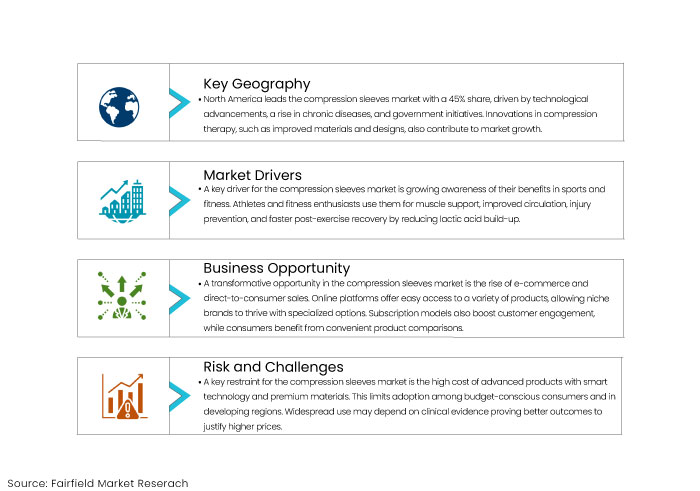
One of the key growth drivers for the compression sleeves market is the rising awareness of their benefits in sports and physical fitness.
Athletes, fitness enthusiasts, and even recreational exercisers increasingly rely on compression sleeves to enhance muscle support, improve circulation, and reduce muscle fatigue during workouts or competitions.
Compression sleeves help stabilize muscles, minimize vibrations, and reduce the risk of injuries like strains and sprains by applying targeted pressure. They are also instrumental in post-exercise recovery as they aid in reducing lactic acid build-up, which accelerates muscle recovery and reduces soreness.
With the increasing popularity of marathons, endurance events, and team sports, the demand for compression sleeves has surged. This growing trend is further bolstered by professional athletes, trainers, and sports medicine specialist’s endorsements, which have helped drive consumer awareness and market adoption.
- Technological Advancements in Smart Compression Sleeves
Technological innovations are creating transformative growth opportunities in the compression sleeves market particularly with the development of smart compression sleeves. The advanced products feature embedded sensors and wearable technology allowing for real-time monitoring of muscle performance, blood circulation, and vital signs during physical activities or post-surgical recovery. Such a data-driven approach enables personalized feedback and optimization, enhancing the efficacy of compression therapy.
Integrating IoT (Internet of Things) and app-based connectivity allows users to track their progress, adjust compression levels, and receive alerts for potential health risks such as poor circulation or muscle strain. These innovations cater to athletes and patients looking for more precise and customized compression solutions thereby driving demand in the market.
As consumers become more focused on preventive healthcare and performance enhancement, smart compression sleeves are expected to gain significant traction particularly in developed markets with high adoption of wearable health technologies.
- Rising Prevalence of Venous Disorders and Chronic Conditions
The increasing incidence of chronic venous insufficiency, varicose veins, and deep vein thrombosis (DVT) is a significant driver for the compression sleeves market. Compression therapy is widely recommended by healthcare professionals for patients suffering from these conditions to improve blood flow, reduce swelling, and prevent further complications.
The growing geriatric population who are more susceptible to these conditions has particularly fuelled demand for compression sleeves as a non-invasive treatment option. Conditions like lymphedema and diabetes, which affect circulation are on the rise globally creating a larger pool of patients who benefit from regular use of compression sleeves.
The use of compression sleeves for daily circulation support and post-surgical recovery is expected to continue expanding in the healthcare sector as the prevalence of these chronic conditions increases, particularly in aging populations and sedentary lifestyles.
Key Growth Barriers
- High Costs of Advanced Compression Sleeves
One of the primary restraints for the compression sleeves market is the high cost associated with advanced compression products particularly those incorporating smart technology and premium materials.
While basic compression sleeves are affordable integrating sensors, real-time monitoring, and customizable compression levels significantly increases the price of these products. This cost barrier can limit adoption especially among budget-conscious consumers and patients in developing regions.
Healthcare institutions and insurance companies may also be willing to cover these higher-priced devices if there is clear clinical evidence of improved outcomes compared to traditional solutions.
The high price point may deter widespread use for athletes and fitness enthusiasts, especially for non-professional users. As a result, the premium pricing of advanced compression sleeves could slow market growth, particularly in segments where consumers are sensitive to cost or need more reimbursement options.
- Lack of Awareness and Accessibility in Developing Regions
A significant growth restraint for the compression sleeves market is the lack of awareness and limited accessibility in developing regions. While compression therapy is well-known in North America and Europe, many consumers and healthcare providers in Asia Pacific, Latin America, and Africa are less familiar with its benefits for sports recovery, venous disorders, or post-surgical rehabilitation.
Healthcare infrastructure in these regions may not prioritize non-invasive treatments like compression therapy focusing instead on more traditional approaches to managing venous conditions and circulation issues.
The limited availability of high-quality compression sleeves in rural areas and inadequate e-commerce reach restrict access to these products. Overcoming this barrier will require targeted awareness campaigns, healthcare education, and broader distribution networks to make compression sleeves more accessible and widely recognized in emerging markets.
Compression Sleeves Market Trends and Opportunities
- Expansion of E-Commerce and Direct-to-Consumer Sales
One of the most transformative opportunities in the compression sleeves market is the growth of e-commerce and direct-to-consumer (DTC) sales channels.
Online platforms have democratized access to compression sleeves making it easy for consumers to purchase various products from the comfort of their homes. This shift has also enabled small and niche brands to enter the market offering specialized and customizable compression sleeves for specific needs such as sports recovery or medical conditions.
The rise of subscription models for health and wellness products creates new avenues for ongoing customer engagement. E-commerce also facilitates easy comparisons of features and pricing helping consumers make informed decisions.
The convenience of digital platforms paired with targeted online marketing and social media campaigns allows companies to reach a broad, diverse customer base globally particularly in regions where physical retail access may be limited.
- Technological Innovation of Smart Compression Sleeves
The development of smart compression sleeves represents a significant growth opportunity, bringing wearable technology into the compression therapy space.
Smart sleeves equipped with embedded sensors can monitor muscle activity, blood circulation, and recovery metrics, catering to athletes and patients recovering from injuries or surgeries. This data-driven approach allows users to optimize compression therapy, providing personalized feedback and preventive health insights.
Integration with mobile apps and cloud-based platforms enables users to track their health metrics over time, enhancing engagement and user satisfaction. Combining health data analytics with wearable compression technology opens up possibilities for new revenue streams in digital health and telemedicine, especially as healthcare becomes more focused on remote patient monitoring and preventive care. These innovations will likely to reshape the market, offering premium solutions to health-conscious consumers and athletes seeking optimized performance.
How Does Regulatory Scenario Shape this Industry?
The regulatory scenario in the compression sleeves market is becoming increasingly structured as these products medical and wellness applications expand.
For compression sleeves used in medical treatments such as for managing venous disorders or post-surgical recovery, regulatory agencies like the U.S. FDA and the European Medicines Agency (EMA) classify them as medical devices. Before being marketed, these products must meet stringent regulatory requirements for safety, efficacy, and control.
Manufacturers must undergo rigorous testing and certification processes, including clinical trials in some cases, to demonstrate that their products meet established medical standards. Compression sleeves are generally subject to less stringent regulations in the sports and fitness segment, as they are often classified as consumer products. However, any claims related to therapeutic benefits or enhanced performance may attract regulatory scrutiny, mainly if misleading claims are made.
The growing medical applications of compression sleeves are pushing regulators to monitor product claims, quality, and performance standards closely. Compliance with these evolving regulations will be vital to gaining consumer trust and maintaining market competitiveness, particularly as demand for smart and innovative compression sleeves rises.
Segments Covered in the Report
- Arm Compression Sleeves to be the Top Products Category
Arm compression sleeve sales are projected to expand at a CAGR of 5% while accounting for a market share of 36%. The growing global focus on physical fitness has resulted in the acceptance of arm compression sleeves among fitness aficionados. These sleeves facilitate recuperation following rigorous training sessions and can be employed to avert sports-related ailments, including tennis elbow and golfer's elbow.
Arm sleeves tailored for athletes, runners, cyclists, hikers, and other performance-oriented folks are offered in diverse styles. Such sleeves provide warmth and are favoured by those residing in colder regions. This product sector has become a significant driver for compression sleeves market expansion.
- Hospitals to Remain Leading Value Creator
Hospitals are favoured among other healthcare institutions because they provide complete care for individuals with intricate medical requirements. Hospitals to account for 35% of the total compression sleeves market share.
Hospitals provide the requisite infrastructure, skilled experts, and ample resources to ensure optimal treatment outcomes while successfully maintaining and monitoring patient conditions. These can offer prompt access to sophisticated medical care in emergencies or difficulties.
Compression treatment devices are extensively utilized in hospitals to address illnesses like venous problems, lymphedema, and postoperative recovery. The utilization of these products in hospitals has risen owing to their shown efficacy in managing complex illnesses and enhancing patient outcomes.
Regional Analysis
- North America Compression Sleeves Market Takes the Charge in the Market
North America commanded the compression sleeves market with a revenue share of 45%, attributed to technical improvements, a rising incidence of chronic diseases, and governmental initiatives. The market expansion is additionally ascribed to technological developments in compression therapy including creating unique materials and enhanced designs that increase patient comfort and experience.
The increasing incidence of chronic diseases such as diabetes and obesity results in circulatory complications, hence driving market expansion in the region.
The studies carried out by the National Institutes of Health Research in April 2023 indicated that over 25 million individuals in the U.S. are impacted by varicose veins, and approximately 6 million suffer from severe venous disease, rendering chronic venous disease (CVD) a widespread health issue. The increasing occurrence of such cases propels the region's market expansion of compression therapy.
- Europe Compression Sleeves Market Emerges as a Significant Market
The compression sleeves market in Europe is projected to grow significantly during the forecast period. The market expansion in the Europe area is attributable to an increasing elderly population and advancements in compression therapy technology.
The sophisticated healthcare infrastructure and emphasis on invasive medical procedures enhance market expansion. The UK compression therapy market is projected to experience a moderate CAGR rate during the forecast period.
The causes contributing to this growth include an increasing senior population and a high prevalence of venous ulcers, foot ulcers, and edema, which enhance the acceptance of compression therapy in the country. The increasing occurrence is propelling the use of compression therapy including compression hosiery, bandaging, and other devices which are essential in managing DVT.
Fairfield’s Competitive Landscape Analysis
The compression sleeves market is competitive with both established players and emerging brands vying for market share. Key companies like Sigvaris, 2XU, CEP, Zensah, and Nike dominate the landscape by offering a range of medical-grade and athletic compression sleeves.
Leading players focus on product innovation leveraging advanced materials, comfort, and durability to cater to diverse customer needs from sports recovery to chronic venous disorders.
New entrants and small brands are gaining ground through e-commerce platforms and direct-to-consumer models offering specialized solutions for niche markets.
The rise of smart compression sleeves with embedded sensors intensifies competition pushing companies to invest in research and development, and digital health integration to stay competitive.
Key Market Companies
- Tommie Copper
- 2XU
- Abco Tech
- Run Forever Sports
- BeVisible Sports
- Thirty 48
- Camden Gear
- Zensah
- BodyMate
- Mojo
- Tommie Copper
- Rikedom
- Zareus
- McDavid
- eSmartr Inc.
- Essity
- DJO
- medi GmbH & co. KG
- Nike
An Expert’s Eye
- The increasing use of compression sleeves in treating chronic venous disorders, lymphedema, and post-surgical recovery is a key driver for compression sleeves market.
- The rise in aging populations and a greater focus on non-invasive treatments are expected to accelerate growth in this sector further.
- Integrating wearable sensors and IoT technology is a game-changer, enabling users to track circulation and muscle recovery, enhancing their therapeutic and athletic value.
- Compression sleeves are gaining traction among athletes and fitness enthusiasts, a significant market-driving element.
Global Compression Sleeves Market is Segmented as-
By Product
- Arm Compression Sleeves
- Bandages
- Leg Compression Sleeves
By Application
- Varicose Veins
- Wound Care
- Burns
- Oncology
By Technique
- Static
- Dynamic
By Distribution Channel
- Hospitals Pharmacies
- Retail Pharmacies
- Online Sales
By Region
- North America
- Europe
- Latin America
- East Asia
- South Asia & Oceania
- Executive Summary
- Global Compression Sleeves Market Snapshot
- Future Projections
- Key Market Trends
- Regional Snapshot, by Value, 2026
- Analyst Recommendations
- Market Overview
- Market Definitions and Segmentations
- Market Dynamics
- Drivers
- Restraints
- Market Opportunities
- Value Chain Analysis
- COVID-19 Impact Analysis
- Porter's Five Forces Analysis
- Impact of Russia-Ukraine Conflict
- PESTLE Analysis
- Regulatory Analysis
- Price Trend Analysis
- Current Prices and Future Projections, 2025-2033
- Price Impact Factors
- Global Compression Sleeves Market Outlook, 2020 - 2033
- Global Compression Sleeves Market Outlook, by Product, Value (US$ Mn), 2020-2033
- Arm Compression Sleeves
- Bandages
- Leg Compression Sleeves
- Global Compression Sleeves Market Outlook, by Application, Value (US$ Mn), 2020-2033
- Varicose Veins
- Wound Care
- Burns
- Oncology
- Global Compression Sleeves Market Outlook, by Technique, Value (US$ Mn), 2020-2033
- Static
- Dynamic
- Global Compression Sleeves Market Outlook, by Distribution Channel, Value (US$ Mn), 2020-2033
- Hospitals Pharmacies
- Retail Pharmacies
- Online Sales
- Global Compression Sleeves Market Outlook, by Region, Value (US$ Mn), 2020-2033
- North America
- Europe
- Asia Pacific
- Latin America
- Middle East & Africa
- Global Compression Sleeves Market Outlook, by Product, Value (US$ Mn), 2020-2033
- North America Compression Sleeves Market Outlook, 2020 - 2033
- North America Compression Sleeves Market Outlook, by Product, Value (US$ Mn), 2020-2033
- Arm Compression Sleeves
- Bandages
- Leg Compression Sleeves
- North America Compression Sleeves Market Outlook, by Application, Value (US$ Mn), 2020-2033
- Varicose Veins
- Wound Care
- Burns
- Oncology
- North America Compression Sleeves Market Outlook, by Technique, Value (US$ Mn), 2020-2033
- Static
- Dynamic
- North America Compression Sleeves Market Outlook, by Distribution Channel, Value (US$ Mn), 2020-2033
- Hospitals Pharmacies
- Retail Pharmacies
- Online Sales
- North America Compression Sleeves Market Outlook, by Country, Value (US$ Mn), 2020-2033
- U.S. Compression Sleeves Market Outlook, by Product, 2020-2033
- U.S. Compression Sleeves Market Outlook, by Application, 2020-2033
- U.S. Compression Sleeves Market Outlook, by Technique, 2020-2033
- U.S. Compression Sleeves Market Outlook, by Distribution Channel, 2020-2033
- Canada Compression Sleeves Market Outlook, by Product, 2020-2033
- Canada Compression Sleeves Market Outlook, by Application, 2020-2033
- Canada Compression Sleeves Market Outlook, by Technique, 2020-2033
- Canada Compression Sleeves Market Outlook, by Distribution Channel, 2020-2033
- BPS Analysis/Market Attractiveness Analysis
- North America Compression Sleeves Market Outlook, by Product, Value (US$ Mn), 2020-2033
- Europe Compression Sleeves Market Outlook, 2020 - 2033
- Europe Compression Sleeves Market Outlook, by Product, Value (US$ Mn), 2020-2033
- Arm Compression Sleeves
- Bandages
- Leg Compression Sleeves
- Europe Compression Sleeves Market Outlook, by Application, Value (US$ Mn), 2020-2033
- Varicose Veins
- Wound Care
- Burns
- Oncology
- Europe Compression Sleeves Market Outlook, by Technique, Value (US$ Mn), 2020-2033
- Static
- Dynamic
- Europe Compression Sleeves Market Outlook, by Distribution Channel, Value (US$ Mn), 2020-2033
- Hospitals Pharmacies
- Retail Pharmacies
- Online Sales
- Europe Compression Sleeves Market Outlook, by Country, Value (US$ Mn), 2020-2033
- Germany Compression Sleeves Market Outlook, by Product, 2020-2033
- Germany Compression Sleeves Market Outlook, by Application, 2020-2033
- Germany Compression Sleeves Market Outlook, by Technique, 2020-2033
- Germany Compression Sleeves Market Outlook, by Distribution Channel, 2020-2033
- Italy Compression Sleeves Market Outlook, by Product, 2020-2033
- Italy Compression Sleeves Market Outlook, by Application, 2020-2033
- Italy Compression Sleeves Market Outlook, by Technique, 2020-2033
- Italy Compression Sleeves Market Outlook, by Distribution Channel, 2020-2033
- France Compression Sleeves Market Outlook, by Product, 2020-2033
- France Compression Sleeves Market Outlook, by Application, 2020-2033
- France Compression Sleeves Market Outlook, by Technique, 2020-2033
- France Compression Sleeves Market Outlook, by Distribution Channel, 2020-2033
- U.K. Compression Sleeves Market Outlook, by Product, 2020-2033
- U.K. Compression Sleeves Market Outlook, by Application, 2020-2033
- U.K. Compression Sleeves Market Outlook, by Technique, 2020-2033
- U.K. Compression Sleeves Market Outlook, by Distribution Channel, 2020-2033
- Spain Compression Sleeves Market Outlook, by Product, 2020-2033
- Spain Compression Sleeves Market Outlook, by Application, 2020-2033
- Spain Compression Sleeves Market Outlook, by Technique, 2020-2033
- Spain Compression Sleeves Market Outlook, by Distribution Channel, 2020-2033
- Russia Compression Sleeves Market Outlook, by Product, 2020-2033
- Russia Compression Sleeves Market Outlook, by Application, 2020-2033
- Russia Compression Sleeves Market Outlook, by Technique, 2020-2033
- Russia Compression Sleeves Market Outlook, by Distribution Channel, 2020-2033
- Rest of Europe Compression Sleeves Market Outlook, by Product, 2020-2033
- Rest of Europe Compression Sleeves Market Outlook, by Application, 2020-2033
- Rest of Europe Compression Sleeves Market Outlook, by Technique, 2020-2033
- Rest of Europe Compression Sleeves Market Outlook, by Distribution Channel, 2020-2033
- BPS Analysis/Market Attractiveness Analysis
- Europe Compression Sleeves Market Outlook, by Product, Value (US$ Mn), 2020-2033
- Asia Pacific Compression Sleeves Market Outlook, 2020 - 2033
- Asia Pacific Compression Sleeves Market Outlook, by Product, Value (US$ Mn), 2020-2033
- Arm Compression Sleeves
- Bandages
- Leg Compression Sleeves
- Asia Pacific Compression Sleeves Market Outlook, by Application, Value (US$ Mn), 2020-2033
- Varicose Veins
- Wound Care
- Burns
- Oncology
- Asia Pacific Compression Sleeves Market Outlook, by Technique, Value (US$ Mn), 2020-2033
- Static
- Dynamic
- Asia Pacific Compression Sleeves Market Outlook, by Distribution Channel, Value (US$ Mn), 2020-2033
- Hospitals Pharmacies
- Retail Pharmacies
- Online Sales
- Asia Pacific Compression Sleeves Market Outlook, by Country, Value (US$ Mn), 2020-2033
- China Compression Sleeves Market Outlook, by Product, 2020-2033
- China Compression Sleeves Market Outlook, by Application, 2020-2033
- China Compression Sleeves Market Outlook, by Technique, 2020-2033
- China Compression Sleeves Market Outlook, by Distribution Channel, 2020-2033
- Japan Compression Sleeves Market Outlook, by Product, 2020-2033
- Japan Compression Sleeves Market Outlook, by Application, 2020-2033
- Japan Compression Sleeves Market Outlook, by Technique, 2020-2033
- Japan Compression Sleeves Market Outlook, by Distribution Channel, 2020-2033
- South Korea Compression Sleeves Market Outlook, by Product, 2020-2033
- South Korea Compression Sleeves Market Outlook, by Application, 2020-2033
- South Korea Compression Sleeves Market Outlook, by Technique, 2020-2033
- South Korea Compression Sleeves Market Outlook, by Distribution Channel, 2020-2033
- India Compression Sleeves Market Outlook, by Product, 2020-2033
- India Compression Sleeves Market Outlook, by Application, 2020-2033
- India Compression Sleeves Market Outlook, by Technique, 2020-2033
- India Compression Sleeves Market Outlook, by Distribution Channel, 2020-2033
- Southeast Asia Compression Sleeves Market Outlook, by Product, 2020-2033
- Southeast Asia Compression Sleeves Market Outlook, by Application, 2020-2033
- Southeast Asia Compression Sleeves Market Outlook, by Technique, 2020-2033
- Southeast Asia Compression Sleeves Market Outlook, by Distribution Channel, 2020-2033
- Rest of SAO Compression Sleeves Market Outlook, by Product, 2020-2033
- Rest of SAO Compression Sleeves Market Outlook, by Application, 2020-2033
- Rest of SAO Compression Sleeves Market Outlook, by Technique, 2020-2033
- Rest of SAO Compression Sleeves Market Outlook, by Distribution Channel, 2020-2033
- BPS Analysis/Market Attractiveness Analysis
- Asia Pacific Compression Sleeves Market Outlook, by Product, Value (US$ Mn), 2020-2033
- Latin America Compression Sleeves Market Outlook, 2020 - 2033
- Latin America Compression Sleeves Market Outlook, by Product, Value (US$ Mn), 2020-2033
- Arm Compression Sleeves
- Bandages
- Leg Compression Sleeves
- Latin America Compression Sleeves Market Outlook, by Application, Value (US$ Mn), 2020-2033
- Varicose Veins
- Wound Care
- Burns
- Oncology
- Latin America Compression Sleeves Market Outlook, by Technique, Value (US$ Mn), 2020-2033
- Static
- Dynamic
- Latin America Compression Sleeves Market Outlook, by Distribution Channel, Value (US$ Mn), 2020-2033
- Hospitals Pharmacies
- Retail Pharmacies
- Online Sales
- Latin America Compression Sleeves Market Outlook, by Country, Value (US$ Mn), 2020-2033
- Brazil Compression Sleeves Market Outlook, by Product, 2020-2033
- Brazil Compression Sleeves Market Outlook, by Application, 2020-2033
- Brazil Compression Sleeves Market Outlook, by Technique, 2020-2033
- Brazil Compression Sleeves Market Outlook, by Distribution Channel, 2020-2033
- Mexico Compression Sleeves Market Outlook, by Product, 2020-2033
- Mexico Compression Sleeves Market Outlook, by Application, 2020-2033
- Mexico Compression Sleeves Market Outlook, by Technique, 2020-2033
- Mexico Compression Sleeves Market Outlook, by Distribution Channel, 2020-2033
- Argentina Compression Sleeves Market Outlook, by Product, 2020-2033
- Argentina Compression Sleeves Market Outlook, by Application, 2020-2033
- Argentina Compression Sleeves Market Outlook, by Technique, 2020-2033
- Argentina Compression Sleeves Market Outlook, by Distribution Channel, 2020-2033
- Rest of LATAM Compression Sleeves Market Outlook, by Product, 2020-2033
- Rest of LATAM Compression Sleeves Market Outlook, by Application, 2020-2033
- Rest of LATAM Compression Sleeves Market Outlook, by Technique, 2020-2033
- Rest of LATAM Compression Sleeves Market Outlook, by Distribution Channel, 2020-2033
- BPS Analysis/Market Attractiveness Analysis
- Latin America Compression Sleeves Market Outlook, by Product, Value (US$ Mn), 2020-2033
- Middle East & Africa Compression Sleeves Market Outlook, 2020 - 2033
- Middle East & Africa Compression Sleeves Market Outlook, by Product, Value (US$ Mn), 2020-2033
- Arm Compression Sleeves
- Bandages
- Leg Compression Sleeves
- Middle East & Africa Compression Sleeves Market Outlook, by Application, Value (US$ Mn), 2020-2033
- Varicose Veins
- Wound Care
- Burns
- Oncology
- Middle East & Africa Compression Sleeves Market Outlook, by Technique, Value (US$ Mn), 2020-2033
- Static
- Dynamic
- Middle East & Africa Compression Sleeves Market Outlook, by Distribution Channel, Value (US$ Mn), 2020-2033
- Hospitals Pharmacies
- Retail Pharmacies
- Online Sales
- Middle East & Africa Compression Sleeves Market Outlook, by Country, Value (US$ Mn), 2020-2033
- GCC Compression Sleeves Market Outlook, by Product, 2020-2033
- GCC Compression Sleeves Market Outlook, by Application, 2020-2033
- GCC Compression Sleeves Market Outlook, by Technique, 2020-2033
- GCC Compression Sleeves Market Outlook, by Distribution Channel, 2020-2033
- South Africa Compression Sleeves Market Outlook, by Product, 2020-2033
- South Africa Compression Sleeves Market Outlook, by Application, 2020-2033
- South Africa Compression Sleeves Market Outlook, by Technique, 2020-2033
- South Africa Compression Sleeves Market Outlook, by Distribution Channel, 2020-2033
- Egypt Compression Sleeves Market Outlook, by Product, 2020-2033
- Egypt Compression Sleeves Market Outlook, by Application, 2020-2033
- Egypt Compression Sleeves Market Outlook, by Technique, 2020-2033
- Egypt Compression Sleeves Market Outlook, by Distribution Channel, 2020-2033
- Nigeria Compression Sleeves Market Outlook, by Product, 2020-2033
- Nigeria Compression Sleeves Market Outlook, by Application, 2020-2033
- Nigeria Compression Sleeves Market Outlook, by Technique, 2020-2033
- Nigeria Compression Sleeves Market Outlook, by Distribution Channel, 2020-2033
- Rest of Middle East Compression Sleeves Market Outlook, by Product, 2020-2033
- Rest of Middle East Compression Sleeves Market Outlook, by Application, 2020-2033
- Rest of Middle East Compression Sleeves Market Outlook, by Technique, 2020-2033
- Rest of Middle East Compression Sleeves Market Outlook, by Distribution Channel, 2020-2033
- BPS Analysis/Market Attractiveness Analysis
- Middle East & Africa Compression Sleeves Market Outlook, by Product, Value (US$ Mn), 2020-2033
- Competitive Landscape
- Company Vs Segment Heatmap
- Company Market Share Analysis, 2025
- Competitive Dashboard
- Company Profiles
- Tommie Copper
- Company Overview
- Product Portfolio
- Financial Overview
- Business Strategies and Developments
- 2XU
- Abco Tech
- Run Forever Sports
- BeVisible Sports
- Thirty 48
- Camden Gear
- Zensah
- BodyMate
- Mojo
- Tommie Copper
- Rikedom
- Zareus
- McDavid
- eSmartr Inc.
- Tommie Copper
- Appendix
- Research Methodology
- Report Assumptions
- Acronyms and Abbreviations
|
BASE YEAR |
HISTORICAL DATA |
FORECAST PERIOD |
UNITS |
|||
 |
2025 |
 |
2020 - 2025 |
 |
2026 - 2033 |
Value: US$ Billion |
|
REPORT FEATURES |
DETAILS |
|
Product Coverage |
|
|
Application Coverage |
|
|
Technique Coverage |
|
|
Distribution Channel Coverage |
|
|
Geographical Coverage |
|
|
Leading Companies |
|
|
Report Highlights |
Key Market Indicators, Macro-micro economic impact analysis, Technological Roadmap, Key Trends, Driver, Restraints, and Future Opportunities & Revenue Pockets, Porter’s 5 Forces Analysis, Historical Trend (2019-2021), Market Estimates and Forecast, Market Dynamics, Industry Trends, Competition Landscape, Category, Region, Country-wise Trends & Analysis, COVID-19 Impact Analysis (Demand and Supply Chain) |
Our Research Methodology
Considering the volatility of business today, traditional approaches to strategizing a game plan can be unfruitful if not detrimental. True ambiguity is no way to determine a forecast. A myriad of predetermined factors must be accounted for such as the degree of risk involved, the magnitude of circumstances, as well as conditions or consequences that are not known or unpredictable. To circumvent binary views that cast uncertainty, the application of market research intelligence to strategically posture, move, and enable actionable outcomes is necessary.
View Methodology
Quality Assured
Rigorous Validation Process

Confidentiality Assured
End-to-end Data Security

Custom Research Services
Tailored To Your Objectives
FAQs
The market is expected to be valued at USD 1.44 Bn in 2026.
The compression sleeves market is estimated to exhibit a growth rate 6% over the forecast period.
Zensah, BodyMate, Mojo, Tommie Copper, are some key industry players operating in the market.
North American region dominates the market.
Arm compression sleeves is the leading product type in the market.
Related Reports
Advanced Therapy Medicinal Products Market
The global advanced therapy medicinal products market will reach US$ 48.04 Bn by 2033, growing at a 14.6% CAGR, driven by demand for innovative therapies
Pen and Injector Drug Delivery Devices Market
The global pen and injector drug delivery devices market will reach US$ 20.88 Billion by 2033, growing at an 8.9% CAGR from 2026-2033
Healthcare Waste Treatment Market Insights, Competitive Landscape, and Market Forecast - 2033
The healthcare waste treatment market will grow from USD12.80 billion in 2026 to USD20.15 billion by 2033, driven by expanding healthcare systems.
Medical Rehabilitation Service Market Size and Forecast 2033
Medical Rehabilitation Service Market to reach USD 54.27 Bn by 2033, growing at 7.6% CAGR, driven by aging populations, outpatient care, and home-based rehabilitation.
Growth Factor Plus Market Insights, Competitive Landscape, and Market Forecast 2033
Growth Factor Plus Market to reach USD 798.88 Mn by 2033, growing at 9.6% CAGR, driven by clinical skincare, dermatology, medical aesthetics, and premium formulations.
At-home Genetic Testing Market Insights, Competitive Landscape, and Market Forecast - 2033
The at-home genetic testing market is expected to grow from USD 3.10 billion in 2026 to USD 7.38 billion by 2033, driven by rising consumer health data interest