



Construction Sand Market
Construction Sand Market Insights, Competitive Landscape, and Market Forecast - 2033
The Construction Sand Market is valued at USD 89 Bn in 2026 and is projected to reach USD 119.5 Bn, growing at a CAGR of 4% by 2033.
Quick Report Digest
A Look Back and a Look Forward - Comparative Analysis
The construction sand market is thriving amidst global construction needs. Urbanisation, infrastructure projects, and sustainable practices drive current demand. Market players focus on meeting evolving construction requirements while addressing environmental concerns.
Since 2018, the construction sand market has adapted to urbanisation and construction trends. Advances in extraction methods and environmental considerations have shaped the industry's trajectory, ensuring resilience and meeting the demands of the built environment.
The future foresees sustained demand, integrating smart construction technologies and eco-friendly practices. Innovations in recycling and alternative materials will likely define the construction sand market, aligning with global sustainability goals and ensuring long-term viability.
Key Growth Determinants
- Demand for Eco-friendly Sand Alternatives
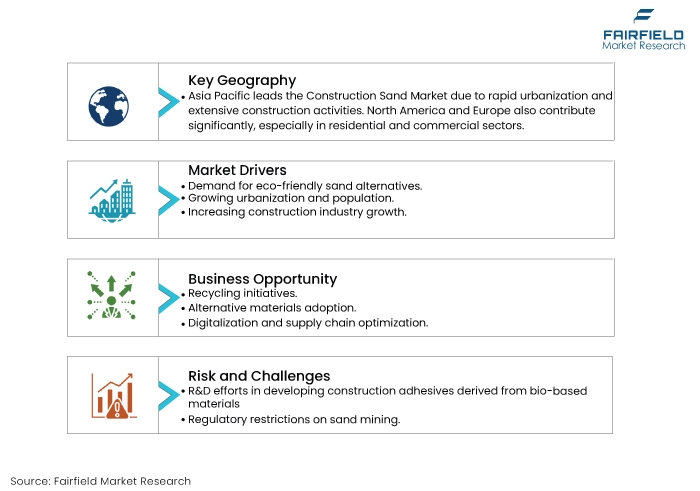
The construction sand market experiences a surge in demand for eco-friendly alternatives due to environmental concerns. Stringent regulations and heightened environmental awareness drive the adoption of sustainable practices.
Innovations in recycled and synthetic sand alternatives gain momentum, offering environmentally conscious options to construction companies, aligning with global sustainability goals, and mitigating the ecological impact of traditional sand extraction methods.
- Growing Urbanisation Pace
The construction sand market sees heightened demand propelled by global urbanisation and population growth. Rapid urban expansion requires extensive construction, driving the need for sand in infrastructure, residential, and commercial projects.
As more people move to urban areas, the construction sector, a key consumer of sand, responds to accommodate the growing population, stimulating sustained demand in the market.
- Construction Industry’s Growth
The continuous growth of the global construction industry buoys the construction sand market. Booming infrastructure projects, residential developments, and commercial constructions worldwide contribute to the increasing demand for construction sand.
As economies expand and modernise, the construction sector thrives, driving the need for this essential material and creating a positive outlook for the construction sand market's future.
Major Growth Barriers
- R&D Efforts in Developing Construction Adhesives Derived from Bio-Based Materials
The construction sand market faces a restraint in limited R&D efforts focused on developing construction adhesives from bio-based materials. While eco-friendly alternatives are in demand, the industry encounters challenges in finding sustainable bonding solutions.
The need for innovative adhesives derived from bio-based materials is hindered by the complexity of formulations and the requirement for extensive testing, impeding the swift adoption of environmentally friendly adhesives within the construction sector.
- Regulatory Restrictions on Sand Mining
Regulatory restrictions on sand mining pose a significant constraint on the construction sand market. Stringent environmental regulations and concerns about the ecological impact of sand extraction lead to limitations on mining activities.
These restrictions, often imposed to protect ecosystems and prevent habitat disruption, can result in reduced sand supply, causing supply chain challenges and potential increases in construction costs. Compliance with evolving regulations becomes crucial for industry players to navigate this restraint effectively.
Key Trends and Opportunities to Look at
The construction sand market sees a growing trend in recycling initiatives, with companies developing technologies to reuse and recycle construction waste, reducing reliance on traditional sand sources. This trend gains popularity globally, aligning with sustainability goals. Key players invest in recycling technologies, enhancing brand reputation and meeting eco-conscious consumer demands.
- Alternative Materials Adoption
- Digitalisation, and Supply Chain Optimisation
An emerging trend involves the adoption of alternative materials like manufactured sand and industrial by-products. Companies leverage technological advancements to produce high-quality alternatives, gaining popularity in regions with stringent environmental regulations. Brands investing in research and development to enhance the performance of these alternatives position themselves as leaders in sustainable construction practices.
The construction sand market is experiencing a trend toward digitalisation and supply chain optimisation. Companies deploy technologies for real-time monitoring of sand extraction, transportation, and distribution. This trend is widespread, enhancing efficiency and reducing costs. Brands investing in digital solutions showcase innovation, streamline operations, and strengthen their competitive position in diverse regional markets.
How Does the Regulatory Scenario Shape this Industry?
The regulatory scenario profoundly shapes the construction sand market. Stricter environmental standards, safety protocols, and ethical considerations guide the development and deployment of robotic solutions. Regulations addressing workplace safety, emissions, and ethical use of automation influence industry practices. Compliance with these regulations becomes a pivotal factor for market players.
Companies investing in ethical and sustainable robotics, aligning with evolving regulations, position themselves as industry leaders. Regulatory frameworks also drive innovation, pushing the industry towards environmentally friendly and socially responsible solutions and shaping the trajectory of the construction sand market.
Fairfield’s Ranking Board
Top Segments
Natural sand remains the largest segment in the construction sand market. Its abundance and widespread use in traditional construction applications contribute to its dominant market share. While there is a growing interest in alternative materials like manufactured sand, the sheer volume and availability of natural sand sustain its position as the primary type in the market.
Manufactured sand emerges as the fastest-growing segment in the construction sand market. As awareness of environmental concerns grows, and regulations on natural sand extraction tighten, the demand for manufactured sand surges. Companies investing in advanced production technologies and promoting the benefits of manufactured sand capitalise on this trend, driving its rapid adoption.
- Infrstructure Industry Continues to Register Maximum Consumption Rate
Infrastructure stands as the largest application segment in the construction sand market. The demand for sand in large-scale construction projects such as roads, bridges, and other infrastructure developments contributes significantly to this segment's dominance. The robust growth in global infrastructure projects sustains the demand for construction sand in this application.
Residential construction emerges as the fastest-growing application in the construction sand market. Rapid urbanisation, population growth, and a surge in housing projects globally propel the demand for construction sand in residential applications. Companies aligning their strategies with this trend cater to the increasing need for Sand in residential construction, positioning themselves for substantial growth.
Regional Outlook
Revenu Generation Concentrated in Asia Pacific
Asia Pacific holds the largest regional market share in the construction sand market. Rapid urbanisation, extensive infrastructure projects, and a booming construction sector drive the region's dominance. Robust economic growth in countries like China, and India fuels the demand for construction sand.
North America, and Europe also contribute significantly to mature construction industries. Companies operating in these regions benefit from a consistent demand for construction sand, strategic partnerships, and regional expansions to capture market share.
Construction Sand Sales to Take off in the Middle East and Africa
The Middle East and Africa represent the fastest-growing regional markets in the construction sand market. The region experiences a construction boom, with major infrastructure and real estate projects driving the demand for construction sand.
Governments' focus on economic diversification and urban development fuels the construction sector, propelling the need for sand. Companies targeting the Middle East and Africa leverage these growth opportunities, establishing strong market positions through partnerships, expansions, and tailored product offerings.
Fairfield’s Competitive Landscape Analysis
The competitive landscape of the construction sand market is characterised by key leaders such as Vulcan Materials Company, Martin Marietta Materials, Inc., CEMEX S.A.B. de C.V., and CRH plc. These industry giants strategically focus on sustainable practices, technological innovation, and geographic expansions.
Vulcan Materials, a frontrunner, emphasises eco-friendly solutions and efficient supply chain management. Martin Marietta stands out for its robust distribution network and diversified product portfolio. CEMEX leads with a global footprint and commitment to sustainable construction. CRH excels in strategic acquisitions and a comprehensive range of construction materials. The competitive scenario underscores the significance of innovation, sustainability, and strategic alliances for market leadership in the construction sand industry.
Who are the Leaders in the Global Construction Sand Space?
- Vulcan Materials Company
- Martin Marietta Materials, Inc.
- Cemex S.A.B. de C.V.
- HeidelbergCement AG
- CRH plc
- Sumitomo Osaka Cement Co., Ltd.
- LafargeHolcim Ltd.
- Adelaide Brighton Ltd.
- CEMEX S.A.B. de C.V.
- US Concrete, Inc.
An Expert’s Eye
Demand and Future Growth
The construction sand market anticipates sustained demand, driven by global urbanisation, infrastructure developments, and population growth. The future holds promising opportunities as the construction industry evolves. Innovations in sustainable practices, recycling, and alternative materials will shape the market's trajectory.
Companies investing in eco-friendly solutions and adapting to changing consumer preferences will thrive. The market's future growth hinges on technological advancements, strategic collaborations, and a proactive response to environmental challenges.
Supply Side of the Market
A balance between traditional extraction methods and innovative solutions characterises the supply side of the construction sand market. While natural sand extraction remains prevalent, the industry witnesses a shift towards sustainable practices, recycling initiatives, and the production of alternative materials.
Companies investing in efficient extraction, processing technologies, and environmentally conscious practices strengthen their supply chain resilience. The future supply side is likely to see increased emphasis on responsible sourcing, reduced environmental impact, and advanced logistics to meet the evolving demands of the construction sector.
Global Construction Sand Market is Segmented as Below:
By Type:
- Natural Sand
- Manufactured Sand
By Application:
- Industrial
- Commercial
- Residential
- Infrastructure
By Geographic Coverage:
- North America
- Europe
- Asia Pacific
- Latin America
- Middle East & Africa
- Executive Summary
- Global Construction Sand Market Snapshot
- Future Projections
- Key Market Trends
- Regional Snapshot, by Value, 2026
- Analyst Recommendations
- Market Overview
- Market Definitions and Segmentations
- Market Dynamics
- Drivers
- Restraints
- Market Opportunities
- Value Chain Analysis
- COVID-19 Impact Analysis
- Porter's Five Forces Analysis
- Impact of Russia-Ukraine Conflict
- PESTLE Analysis
- Regulatory Analysis
- Price Trend Analysis
- Current Prices and Future Projections, 2025-2033
- Price Impact Factors
- Global Construction Sand Market Outlook, 2020 - 2033
- Global Construction Sand Market Outlook, by Type, Value (US$ Mn), 2020-2033
- Natural Sand
- Manufactured Sand
- Global Construction Sand Market Outlook, by Application, Value (US$ Mn), 2020-2033
- Industrial
- Commercial
- Residential
- Infrastructure
- Global Construction Sand Market Outlook, by Region, Value (US$ Mn), 2020-2033
- North America
- Europe
- Asia Pacific
- Latin America
- Middle East & Africa
- Global Construction Sand Market Outlook, by Type, Value (US$ Mn), 2020-2033
- North America Construction Sand Market Outlook, 2020 - 2033
- North America Construction Sand Market Outlook, by Type, Value (US$ Mn), 2020-2033
- Natural Sand
- Manufactured Sand
- North America Construction Sand Market Outlook, by Application, Value (US$ Mn), 2020-2033
- Industrial
- Commercial
- Residential
- Infrastructure
- North America Construction Sand Market Outlook, by Country, Value (US$ Mn), 2020-2033
- U.S. Construction Sand Market Outlook, by Type, 2020-2033
- U.S. Construction Sand Market Outlook, by Application, 2020-2033
- Canada Construction Sand Market Outlook, by Type, 2020-2033
- Canada Construction Sand Market Outlook, by Application, 2020-2033
- BPS Analysis/Market Attractiveness Analysis
- North America Construction Sand Market Outlook, by Type, Value (US$ Mn), 2020-2033
- Europe Construction Sand Market Outlook, 2020 - 2033
- Europe Construction Sand Market Outlook, by Type, Value (US$ Mn), 2020-2033
- Natural Sand
- Manufactured Sand
- Europe Construction Sand Market Outlook, by Application, Value (US$ Mn), 2020-2033
- Industrial
- Commercial
- Residential
- Infrastructure
- Europe Construction Sand Market Outlook, by Country, Value (US$ Mn), 2020-2033
- Germany Construction Sand Market Outlook, by Type, 2020-2033
- Germany Construction Sand Market Outlook, by Application, 2020-2033
- Italy Construction Sand Market Outlook, by Type, 2020-2033
- Italy Construction Sand Market Outlook, by Application, 2020-2033
- France Construction Sand Market Outlook, by Type, 2020-2033
- France Construction Sand Market Outlook, by Application, 2020-2033
- U.K. Construction Sand Market Outlook, by Type, 2020-2033
- U.K. Construction Sand Market Outlook, by Application, 2020-2033
- Spain Construction Sand Market Outlook, by Type, 2020-2033
- Spain Construction Sand Market Outlook, by Application, 2020-2033
- Russia Construction Sand Market Outlook, by Type, 2020-2033
- Russia Construction Sand Market Outlook, by Application, 2020-2033
- Rest of Europe Construction Sand Market Outlook, by Type, 2020-2033
- Rest of Europe Construction Sand Market Outlook, by Application, 2020-2033
- BPS Analysis/Market Attractiveness Analysis
- Europe Construction Sand Market Outlook, by Type, Value (US$ Mn), 2020-2033
- Asia Pacific Construction Sand Market Outlook, 2020 - 2033
- Asia Pacific Construction Sand Market Outlook, by Type, Value (US$ Mn), 2020-2033
- Natural Sand
- Manufactured Sand
- Asia Pacific Construction Sand Market Outlook, by Application, Value (US$ Mn), 2020-2033
- Industrial
- Commercial
- Residential
- Infrastructure
- Asia Pacific Construction Sand Market Outlook, by Country, Value (US$ Mn), 2020-2033
- China Construction Sand Market Outlook, by Type, 2020-2033
- China Construction Sand Market Outlook, by Application, 2020-2033
- Japan Construction Sand Market Outlook, by Type, 2020-2033
- Japan Construction Sand Market Outlook, by Application, 2020-2033
- South Korea Construction Sand Market Outlook, by Type, 2020-2033
- South Korea Construction Sand Market Outlook, by Application, 2020-2033
- India Construction Sand Market Outlook, by Type, 2020-2033
- India Construction Sand Market Outlook, by Application, 2020-2033
- Southeast Asia Construction Sand Market Outlook, by Type, 2020-2033
- Southeast Asia Construction Sand Market Outlook, by Application, 2020-2033
- Rest of SAO Construction Sand Market Outlook, by Type, 2020-2033
- Rest of SAO Construction Sand Market Outlook, by Application, 2020-2033
- BPS Analysis/Market Attractiveness Analysis
- Asia Pacific Construction Sand Market Outlook, by Type, Value (US$ Mn), 2020-2033
- Latin America Construction Sand Market Outlook, 2020 - 2033
- Latin America Construction Sand Market Outlook, by Type, Value (US$ Mn), 2020-2033
- Natural Sand
- Manufactured Sand
- Latin America Construction Sand Market Outlook, by Application, Value (US$ Mn), 2020-2033
- Industrial
- Commercial
- Residential
- Infrastructure
- Latin America Construction Sand Market Outlook, by Country, Value (US$ Mn), 2020-2033
- Brazil Construction Sand Market Outlook, by Type, 2020-2033
- Brazil Construction Sand Market Outlook, by Application, 2020-2033
- Mexico Construction Sand Market Outlook, by Type, 2020-2033
- Mexico Construction Sand Market Outlook, by Application, 2020-2033
- Argentina Construction Sand Market Outlook, by Type, 2020-2033
- Argentina Construction Sand Market Outlook, by Application, 2020-2033
- Rest of LATAM Construction Sand Market Outlook, by Type, 2020-2033
- Rest of LATAM Construction Sand Market Outlook, by Application, 2020-2033
- BPS Analysis/Market Attractiveness Analysis
- Latin America Construction Sand Market Outlook, by Type, Value (US$ Mn), 2020-2033
- Middle East & Africa Construction Sand Market Outlook, 2020 - 2033
- Middle East & Africa Construction Sand Market Outlook, by Type, Value (US$ Mn), 2020-2033
- Natural Sand
- Manufactured Sand
- Middle East & Africa Construction Sand Market Outlook, by Application, Value (US$ Mn), 2020-2033
- Industrial
- Commercial
- Residential
- Infrastructure
- Middle East & Africa Construction Sand Market Outlook, by Country, Value (US$ Mn), 2020-2033
- GCC Construction Sand Market Outlook, by Type, 2020-2033
- GCC Construction Sand Market Outlook, by Application, 2020-2033
- South Africa Construction Sand Market Outlook, by Type, 2020-2033
- South Africa Construction Sand Market Outlook, by Application, 2020-2033
- Egypt Construction Sand Market Outlook, by Type, 2020-2033
- Egypt Construction Sand Market Outlook, by Application, 2020-2033
- Nigeria Construction Sand Market Outlook, by Type, 2020-2033
- Nigeria Construction Sand Market Outlook, by Application, 2020-2033
- Rest of Middle East Construction Sand Market Outlook, by Type, 2020-2033
- Rest of Middle East Construction Sand Market Outlook, by Application, 2020-2033
- BPS Analysis/Market Attractiveness Analysis
- Middle East & Africa Construction Sand Market Outlook, by Type, Value (US$ Mn), 2020-2033
- Competitive Landscape
- Company Vs Segment Heatmap
- Company Market Share Analysis, 2025
- Competitive Dashboard
- Company Profiles
- Vulcan Materials Company
- Company Overview
- Product Portfolio
- Financial Overview
- Business Strategies and Developments
- Martin Marietta Materials, Inc.
- Cemex S.A.B. de C.V.
- HeidelbergCement AG
- CRH plc
- Sumitomo Osaka Cement Co., Ltd.
- LafargeHolcim Ltd.
- Adelaide Brighton Ltd.
- CEMEX S.A.B. de C.V.
- US Concrete, Inc.
- Vulcan Materials Company
- Appendix
- Research Methodology
- Report Assumptions
- Acronyms and Abbreviations
|
BASE YEAR |
HISTORICAL DATA |
FORECAST PERIOD |
UNITS |
|||
 |
2025 |
 |
2019 - 2024 |
 |
2026 - 2033 |
Value: US$ Billion |
|
REPORT FEATURES |
DETAILS |
|
Type Coverage |
|
|
Application Coverage |
|
|
Geographical Coverage |
|
|
Leading Companies |
|
|
Report Highlights |
Key Market Indicators, Macro-micro economic impact analysis, Technological Roadmap, Key Trends, Driver, Restraints, and Future Opportunities & Revenue Pockets, Porter’s 5 Forces Analysis, Historical Trend (2019-2021), Market Estimates and Forecast, Market Dynamics, Industry Trends, Competition Landscape, Category, Region, Country-wise Trends & Analysis, COVID-19 Impact Analysis (Demand and Supply Chain) |
Our Research Methodology
Considering the volatility of business today, traditional approaches to strategizing a game plan can be unfruitful if not detrimental. True ambiguity is no way to determine a forecast. A myriad of predetermined factors must be accounted for such as the degree of risk involved, the magnitude of circumstances, as well as conditions or consequences that are not known or unpredictable. To circumvent binary views that cast uncertainty, the application of market research intelligence to strategically posture, move, and enable actionable outcomes is necessary.
View Methodology
Quality Assured
Rigorous Validation Process

Confidentiality Assured
End-to-end Data Security

Custom Research Services
Tailored To Your Objectives
FAQs
The global construction sand market size was approximately USD 89 Bn in 2026.
Asia Pacific currently holds the largest share of the construction sand market.
The primary factor projected to drive the construction sand market expansion is due to demand for eco-friendly sand alternatives.
In 2025, the natural sand category held a significant share of the global market.
The infrastructure segment constitutes a major share of the global construction sand market.
Related Reports
Pyrogel Insulation Insights, Competitive Landscape, and Market Forecast 2026 to 2033
Pyrogel Insulation Market is valued at US$1.02 billion in 2026 and projected to reach US$2.23 billion by 2033, growing at 11.8% CAGR.
High-Speed Separators Insights, Competitive Landscape, and Market Forecast 2026 to 2033
The global High-Speed Separators Market is projected to grow from US$2.90 billion in 2026 to US$4.30 billion by 2033, at a CAGR of 5.8%.
Space Materials Insights, Competitive Landscape, and Market Forecast 2026 to 2033
The global space materials market is valued at US$4.5 billion in 2026 and is projected to reach US$8.4 billion by 2033, growing at 9.3% CAGR
Recyclable Polyolefin Impact Modifiers Market Insights, Competitive Landscape, and Market Forecast 2033
Recyclable Polyolefin Impact Modifiers Market to reach USD 2.81 Bn by 2033, growing at 8.4% CAGR, driven by recycling, and sustainability demand.
Zero-Waste Beauty Market Insights, Competitive Landscape, and Market Forecast 2033
Zero-Waste Beauty Market to reach USD 5.97 Bn by 2033, growing at 14.6% CAGR, driven by packaging, waterless formulations, and consumer demand.
Dispersible Bio Films Market Insights, Competitive Landscape, and Market Forecast 2033
Dispersible Bio Films Market to reach USD 829.66 Mn by 2033, growing at 16.2% CAGR, driven by pharma delivery, nutraceuticals, and convenient dosing.