



Consumer Electronics Market
Consumer Electronics Market Insights, Competitive Landscape, and Market Forecast - 2033
Consumer Electronics Market Size, Share, and Growth Forecast 2026 - 2033
Key Market Highlights
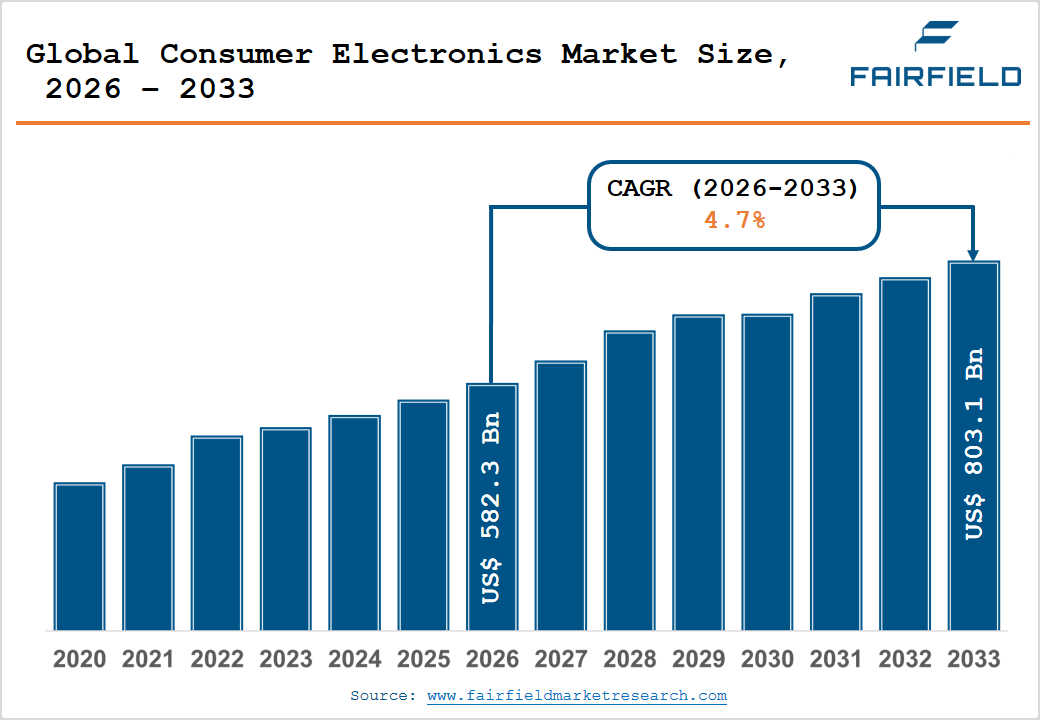
- The global Consumer Electronics Market size is likely to be valued at USD 582.3 billion in 2026 and is expected to reach USD 803.1 billion by 2033, growing at a CAGR of 4.70% during the forecast period from 2026 to 2033.
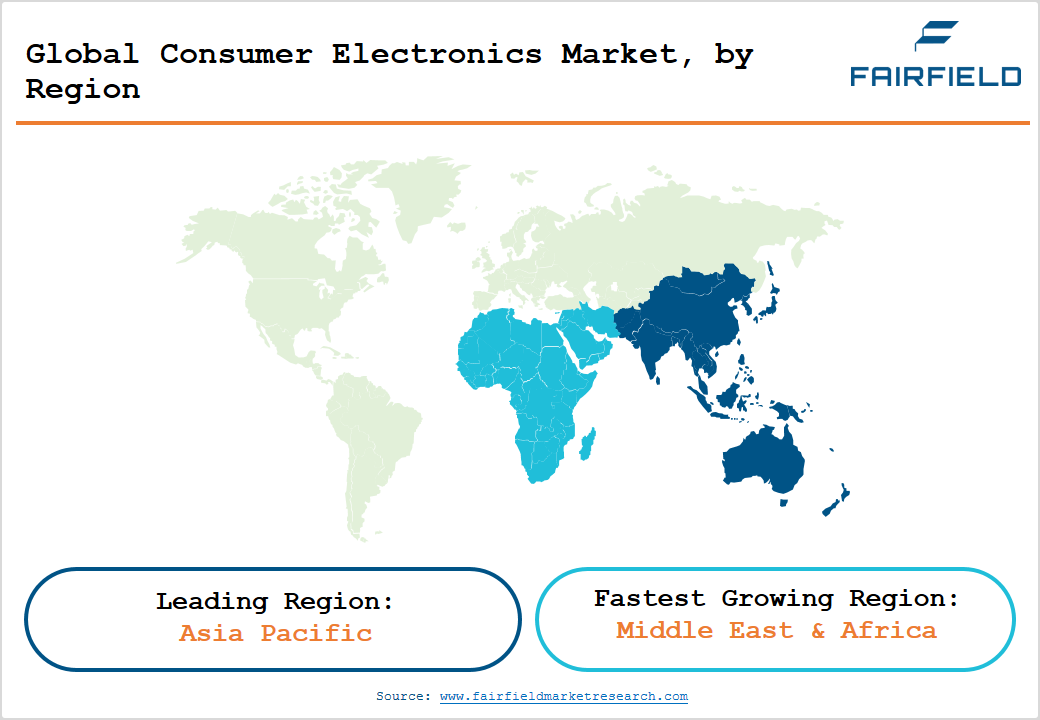
- North America leads the global consumer electronics market with approximately 41% revenue share, underpinned by high per capita consumer spending, advanced 5G infrastructure, and sustained demand for premium smartphones, smart home devices, and personal computing products across the United States.
- Asia Pacific is the fastest-growing regional market, driven by rapid smartphone penetration in India and China, expanding 4G/5G network infrastructure, government-backed manufacturing incentives including India's PLI scheme, and a large, digitally engaged young consumer demographic.
- Smartphones dominate the consumer electronics market by product type with approximately 38% market share, sustained by accelerating 5G upgrade cycles, continuous AI-enhanced hardware innovation by Apple Inc. and Samsung Electronics, and expanding first-time adoption in emerging economies.
- The online sales channel is the fastest-growing distribution segment, propelled by e-commerce expansion across Asia Pacific, rising digital payment adoption, and competitive pricing advantages offered by leading platforms including Amazon, Flipkart, and JD.com.
- Artificial Intelligence (AI) integration across consumer electronics represents the key market opportunity, enabling manufacturers to create premium, high-margin product tiers with differentiated user experiences, stronger brand loyalty, and elevated average selling prices across smartphones, smart appliances, and computing devices.
Market Dynamics
Market Growth Drivers
- Rising Smartphone Penetration and Accelerating 5G Network Adoption
Global smartphone adoption remains the most powerful single demand catalyst for the consumer electronics industry, and the ongoing rollout of 5G networks is significantly amplifying this effect. According to the GSMA, 5G connections are projected to account for more than 40% of all mobile connections globally by 2027, with leading markets such as U.S, , South Korea, and China already surpassing 50% 5G adoption thresholds as of 2023. This technological transition is compelling consumers to upgrade existing handsets to 5G-compatible models, shortening replacement cycles meaningfully. Manufacturers including Samsung Electronics, Apple Inc., and Huawei Technologies are investing aggressively in next-generation chipsets, foldable display formats, and AI-enhanced photography capabilities to capture this upgrade wave. The expanding 5G device ecosystem further stimulates demand for complementary wearables and mobile computing accessories, generating a compounding multiplier effect across the broader consumer electronics value chain.
- Smart Home Ecosystem Proliferation and IoT Integration
The convergence of Internet of Things (IoT) technology with household appliances and entertainment systems is generating sustained incremental demand across multiple consumer electronics product categories, including connected televisions, smart refrigerators, and AI-enabled washing machines. The Consumer Technology Association (CTA) reported that smart home device ownership among U.S. broadband households reached approximately 69% in 2023, reflecting deep market penetration in the world's most mature consumer technology market. Companies including LG Electronics, Samsung, and Google LLC are actively developing interoperable smart home ecosystems that integrate voice control, energy management, and predictive maintenance features, substantially elevating product value propositions. Government-backed smart city programs across Europe and Asia Pacific are reinforcing the infrastructure prerequisites for widespread connected appliance adoption, creating a structurally supportive demand environment throughout the forecast period.
Market Restraints
- Semiconductor Supply Chain Vulnerabilities and Geopolitical Risks
The consumer electronics sector remains deeply exposed to semiconductor supply chain disruptions, which have historically resulted in prolonged production delays, elevated component costs, and missed shipment targets. The global chip shortage that emerged in 2020 highlighted the structural fragility of just-in-time semiconductor supply networks, disproportionately affecting laptop, gaming console, and premium smartphone production globally. The Semiconductor Industry Association (SIA) reported that global semiconductor revenues reached US$ 526.8 Billion in 2023, yet supply-demand imbalances in specialized chip categories persist. Ongoing geopolitical tensions between U.S. and China regarding advanced semiconductor manufacturing technology and export controls continue to introduce structural sourcing uncertainty, compelling manufacturers to invest heavily in supply chain diversification strategies that increase operational costs and reduce procurement flexibility.
- E-Waste Regulatory Compliance and Environmental Cost Pressures
Increasingly stringent environmental regulations governing electronic waste (e-waste) management and product lifecycle compliance represent a growing operational burden for consumer electronics manufacturers globally. The United Nations (UN) reported that global e-waste generation reached 62 million metric tonnes in 2022, with projections indicating a 32% increase by 2030, intensifying regulatory scrutiny across all major markets. The European Union's Waste Electrical and Electronic Equipment (WEEE) Directive and Restriction of Hazardous Substances (RoHS) regulations impose significant compliance obligations, requiring manufacturers to invest in sustainable product design, product take-back programs, and certified recycling infrastructure. These regulatory requirements materially elevate the cost of market participation, particularly for companies expanding into EU markets where environmental compliance standards are among the world's most demanding.
Market Opportunities
- Accelerating Electronics Adoption Across Emerging Market Economies
Emerging economies across Asia Pacific, Latin America and Africa represent a transformative and largely underpenetrated growth frontier for consumer electronics companies. In India, smartphone shipments surpassed 150 million units in 2023, according to the India Cellular & Electronics Association (ICEA), while the government's Production-Linked Incentive (PLI) scheme is catalyzing major manufacturing investment from global brands including Apple Inc. and Samsung Electronics, reducing consumer pricing and improving local market accessibility. In Brazil, Indonesia, and Nigeria, expanding mobile internet penetration is creating first-time device adoption opportunities for competitively priced product portfolios. Huawei Technologies, Lenovo, and ZTE Corporation are actively targeting these markets, while Panasonic Holdings and LG Electronics are developing smart appliance lines tailored to emerging market utility profiles and income demographics, unlocking a new and sizable incremental revenue dimension for the industry.
- Artificial Intelligence Integration Creating Premium Product Tiers
The embedding of Artificial Intelligence (AI) and Machine Learning (ML) capabilities across consumer electronics product categories represents one of the most consequential value-creation opportunities for market participants in the coming years. On-device AI processing is enabling real-time language translation, adaptive camera intelligence, predictive appliance maintenance, and personalized content recommendation features rapidly becoming central to consumer purchasing decisions in premium and mid-range segments alike. Apple Inc. and Google LLC have demonstrated the commercial viability of on-device AI through their flagship device ecosystems, while Sony Corporation and Samsung Electronics are integrating AI-driven image processing into cameras and televisions. The Consumer Technology Association (CTA) identified AI-integrated consumer electronics among the fastest-growing product categories at CES 2024. Manufacturers investing in proprietary AI chipsets and software platforms are positioned to command premium pricing, superior brand loyalty, and substantially expanded profit margins relative to commodity hardware competitors.
Segmental Insights
- By Product Type Analysis
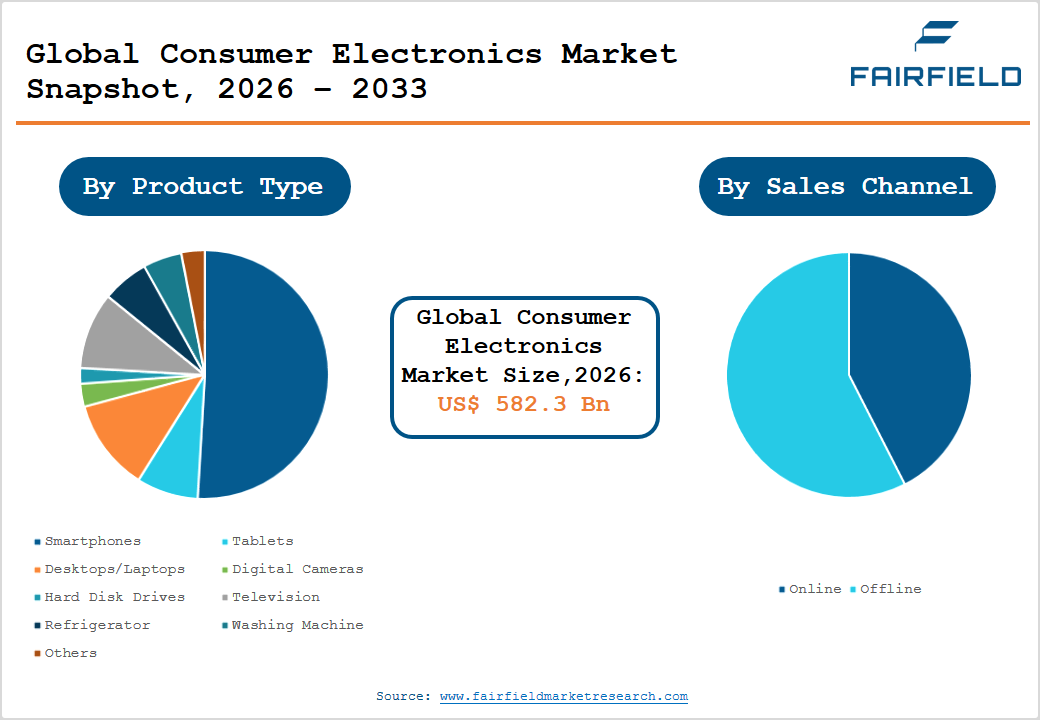
Smartphones represent the dominant segment within the consumer electronics market by product type, commanding approximately 38% of total market share across the forecast period. This leadership is firmly anchored by the category's indispensable role in modern daily life, high consumer replacement frequency driven by rapid technological innovation cycles, and the accelerating global rollout of 5G infrastructure compelling mass device upgrades. According to GSMA Intelligence, global mobile subscribers surpassed billions in 2023, with smartphone penetration expanding steadily in emerging markets including India, Indonesia, and Brazil. The continuous introduction of foldable display formats, AI-enhanced camera systems, and satellite connectivity features by leading brands including Apple Inc., Samsung Electronics, and Huawei Technologies sustains strong consumer appetite for device upgrades. The segment's broad price spectrum spanning entry-level to ultra-premium tiers ensures consistent demand generation across diverse global income demographics.
- By Sales Channel Analysis
The offline sales channel maintains its leading position in the consumer electronics market by sales channel, accounting for approximately 58% of total global revenue. Physical retail dominance reflects the high-involvement nature of consumer electronics purchasing decisions, where consumers consistently prefer hands-on product evaluation before committing to significant expenditures on premium devices and appliances. Large-format electronics specialty retailers, hypermarkets, and manufacturer-operated experience stores deliver immersive product demonstrations and personalized expert consultation that remain difficult for digital channels to replicate effectively. According to the National Retail Federation (NRF), physical retail continues to serve as the primary conversion channel for high-value electronics purchases across North America and Europe. Nonetheless, the online channel is the fastest-growing distribution segment, propelled by expanding e-commerce ecosystems in Asia Pacific, improved last-mile logistics, and competitive pricing on platforms including Amazon, Flipkart, and JD.com.
Regional Insights
- North America Consumer Electronics Trends
North America commands the leading position in the global consumer electronics market, contributing approximately 41% of total global revenue, driven by high consumer spending capacity, advanced digital infrastructure, and a deeply entrenched culture of technology adoption. U.S. serves as the primary revenue engine for the region, with consumers demonstrating robust demand for premium smartphones, smart home devices, laptops, and connected entertainment systems. The Consumer Technology Association (CTA) projected that the U.S. consumer technology industry would generate approximately US$ 512 Billion in revenues in 2024, reflecting the exceptional scale and maturity of the domestic market.
The regional market benefits further from proactive regulatory investment in digital infrastructure, including the Federal Communications Commission (FCC)'s 5G spectrum allocation initiatives and broadband expansion programs. Domestic manufacturing incentives embedded within the CHIPS and Science Act are encouraging semiconductor and electronics production within North America, progressively strengthening supply chain resilience. Leading innovators including Apple Inc., Google LLC, and Dell Technologies continue to invest substantially in R&D from their North American bases, reinforcing the region's global technology leadership and driving sustained premium product category growth.
- Europe Consumer Electronics Trends
Europe represents a mature yet strategically significant market for consumer electronics, with Germany, U.K., France, and Spain collectively driving the majority of regional revenues. Germany leads as Europe's largest economy and a significant adopter of personal computing, smart home technologies, and premium audiovisual equipment. The European Commission's Digital Decade policy framework, which targets 80% of EU adults possessing basic digital skills by 2030, is creating durable demand for consumer-facing computing and connectivity devices across all member states.
The EU's regulatory environment is simultaneously generating compliance pressures and product innovation incentives for electronics manufacturers. The Ecodesign for Sustainable Products Regulation (ESPR) and the EU Right to Repair legislation are compelling manufacturers to extend product lifecycles and improve device repairability reshaping both hardware design philosophies and service business models. France and the United Kingdom are prominent markets for premium audio equipment and smart home platforms, while Spain is experiencing accelerating connected appliance adoption in urban centers. The EU's mandated standardization of USB-C charging interfaces, effective from 2024, exemplifies how regulatory harmonization is actively shaping hardware design decisions across the industry.
- Asia Pacific Consumer Electronics Trends
Asia Pacific is the fastest-growing regional market for consumer electronics globally, uniquely positioned as both the world's preeminent electronics manufacturing hub and a rapidly expanding consumer base. China dominates regional production and consumption simultaneously, with brands including Huawei Technologies, ZTE Corporation, and Lenovo leveraging domestic manufacturing scale to compete aggressively in global markets. The Ministry of Industry and Information Technology (MIIT) of China reported that the country's electronics manufacturing output exceeded in 2023, underscoring the industrial scale underpinning Asia Pacific's structural cost advantages.
India is emerging as the region's most dynamic high-growth market, with smartphone shipments surpassing millions of units in 2023 per the India Cellular & Electronics Association (ICEA), and the government's PLI scheme catalyzing major domestic manufacturing investment from global players including Apple Inc. and Samsung Electronics. ASEAN markets particularly Vietnam, Indonesia, and Thailand are experiencing rapid digital adoption supported by expanding 4G/5G network infrastructure and a large, digitally engaged young demographic. The combination of manufacturing cost advantages, government incentives, and burgeoning consumer demand makes Asia Pacific the most strategically critical growth region for the consumer electronics industry through 2033.
Competitive Landscape
The global consumer electronics market exhibits a moderately consolidated competitive structure, with Samsung Electronics Co., Ltd., Apple Inc., LG Electronics, and Sony Corporation collectively accounting for a substantial portion of global revenues. These leaders sustain competitive advantages through proprietary technology ecosystems, premium brand equity, and deeply integrated global distribution networks. Mid-tier challengers including Huawei Technologies, Lenovo, and ZTE Corporation compete aggressively on price-performance ratios, particularly in high-growth emerging markets. The landscape is increasingly defined by vertical integration, exemplified by Apple's proprietary M-series and A-series chipsets, and by strategic partnerships with AI software companies. Targeted acquisitions and co-development agreements with cloud providers are becoming primary growth levers as companies race to embed intelligence and connectivity across entire product portfolios.
Key Developments
- In January 2025, Samsung Electronics launched the Galaxy S25 series featuring embedded on-device AI capabilities powered by the Snapdragon 8 Elite processor, marking a significant step in the mainstreaming of generative AI features within premium consumer smartphones.
- In September 2024, Apple Inc. introduced the iPhone 16 lineup with Apple Intelligence AI features including enhanced writing assistance and visual intelligence generating record pre-order volumes across North America, Europe, and Asia Pacific markets.
- In March 2024, LG Electronics announced a major expansion of its ThinQ AI smart home platform, integrating advanced AI energy management and predictive maintenance across its refrigerator and washing machine product lines, targeting accelerated smart home adoption in North America and Europe.
Companies Covered in Consumer Electronics Market
- ACER INC.
- Apple Inc.
- Canon Inc.
- Dell Technologies
- Google LLC
- Harman International
- Huawei Technologies Co., Ltd.
- LENOVO
- LG ELECTRONICS
- Nikon
- Panasonic Holdings Corporation
- Samsung Electronics Co., Ltd.
- Sonos Inc.
- Sony Corporation
- Toshiba Corporation
- ZTE Corporation
- Xiaomi Corporation
- com, Inc.
- Microsoft Corporation
- Philips (TP Vision)
Market Segmentation
By Product Type
- Smartphones
- Tablets
- Desktops/Laptops
- Digital Cameras
- Hard Disk Drives
- Television
- Refrigerator
- Washing Machine
- Others
By Sales Channel
- Offline
- Online
By Region
- North America
- Europe
- Asia Pacific
- Latin America
- Middle East & Africa
- Executive Summary
- Global Consumer Electronics Market Snapshot
- Future Projections
- Key Market Trends
- Regional Snapshot, by Value, 2026
- Analyst Recommendations
- Market Overview
- Market Definitions and Segmentations
- Market Dynamics
- Drivers
- Restraints
- Market Opportunities
- Value Chain Analysis
- COVID-19 Impact Analysis
- Porter's Five Forces Analysis
- Impact of Russia-Ukraine Conflict
- PESTLE Analysis
- Regulatory Analysis
- Price Trend Analysis
- Current Prices and Future Projections, 2025-2033
- Price Impact Factors
- Global Consumer Electronics Market Outlook, 2020 - 2033
- Global Consumer Electronics Market Outlook, by Product Type, Value (US$ Bn), 2020-2033
- Smartphones
- Tablets
- Desktops/Laptops
- Digital Cameras
- Hard Disk Drives
- Television
- Refrigerator
- Washing Machine
- Others
- Global Consumer Electronics Market Outlook, by Sales Channel, Value (US$ Bn), 2020-2033
- Online
- Offline
- Global Consumer Electronics Market Outlook, by Region, Value (US$ Bn), 2020-2033
- North America
- Europe
- Asia Pacific
- Latin America
- Middle East & Africa
- Global Consumer Electronics Market Outlook, by Product Type, Value (US$ Bn), 2020-2033
- North America Consumer Electronics Market Outlook, 2020 - 2033
- North America Consumer Electronics Market Outlook, by Product Type, Value (US$ Bn), 2020-2033
- Smartphones
- Tablets
- Desktops/Laptops
- Digital Cameras
- Hard Disk Drives
- Television
- Refrigerator
- Washing Machine
- Others
- North America Consumer Electronics Market Outlook, by Sales Channel, Value (US$ Bn), 2020-2033
- Online
- Offline
- North America Consumer Electronics Market Outlook, by Country, Value (US$ Bn), 2020-2033
- U.S. Consumer Electronics Market Outlook, by Product Type, 2020-2033
- U.S. Consumer Electronics Market Outlook, by Sales Channel, 2020-2033
- Canada Consumer Electronics Market Outlook, by Product Type, 2020-2033
- Canada Consumer Electronics Market Outlook, by Sales Channel, 2020-2033
- BPS Analysis/Market Attractiveness Analysis
- North America Consumer Electronics Market Outlook, by Product Type, Value (US$ Bn), 2020-2033
- Europe Consumer Electronics Market Outlook, 2020 - 2033
- Europe Consumer Electronics Market Outlook, by Product Type, Value (US$ Bn), 2020-2033
- Smartphones
- Tablets
- Desktops/Laptops
- Digital Cameras
- Hard Disk Drives
- Television
- Refrigerator
- Washing Machine
- Others
- Europe Consumer Electronics Market Outlook, by Sales Channel, Value (US$ Bn), 2020-2033
- Online
- Offline
- Europe Consumer Electronics Market Outlook, by Country, Value (US$ Bn), 2020-2033
- Germany Consumer Electronics Market Outlook, by Product Type, 2020-2033
- Germany Consumer Electronics Market Outlook, by Sales Channel, 2020-2033
- Italy Consumer Electronics Market Outlook, by Product Type, 2020-2033
- Italy Consumer Electronics Market Outlook, by Sales Channel, 2020-2033
- France Consumer Electronics Market Outlook, by Product Type, 2020-2033
- France Consumer Electronics Market Outlook, by Sales Channel, 2020-2033
- U.K. Consumer Electronics Market Outlook, by Product Type, 2020-2033
- U.K. Consumer Electronics Market Outlook, by Sales Channel, 2020-2033
- Spain Consumer Electronics Market Outlook, by Product Type, 2020-2033
- Spain Consumer Electronics Market Outlook, by Sales Channel, 2020-2033
- Russia Consumer Electronics Market Outlook, by Product Type, 2020-2033
- Russia Consumer Electronics Market Outlook, by Sales Channel, 2020-2033
- Rest of Europe Consumer Electronics Market Outlook, by Product Type, 2020-2033
- Rest of Europe Consumer Electronics Market Outlook, by Sales Channel, 2020-2033
- BPS Analysis/Market Attractiveness Analysis
- Europe Consumer Electronics Market Outlook, by Product Type, Value (US$ Bn), 2020-2033
- Asia Pacific Consumer Electronics Market Outlook, 2020 - 2033
- Asia Pacific Consumer Electronics Market Outlook, by Product Type, Value (US$ Bn), 2020-2033
- Smartphones
- Tablets
- Desktops/Laptops
- Digital Cameras
- Hard Disk Drives
- Television
- Refrigerator
- Washing Machine
- Others
- Asia Pacific Consumer Electronics Market Outlook, by Sales Channel, Value (US$ Bn), 2020-2033
- Online
- Offline
- Asia Pacific Consumer Electronics Market Outlook, by Country, Value (US$ Bn), 2020-2033
- China Consumer Electronics Market Outlook, by Product Type, 2020-2033
- China Consumer Electronics Market Outlook, by Sales Channel, 2020-2033
- Japan Consumer Electronics Market Outlook, by Product Type, 2020-2033
- Japan Consumer Electronics Market Outlook, by Sales Channel, 2020-2033
- South Korea Consumer Electronics Market Outlook, by Product Type, 2020-2033
- South Korea Consumer Electronics Market Outlook, by Sales Channel, 2020-2033
- India Consumer Electronics Market Outlook, by Product Type, 2020-2033
- India Consumer Electronics Market Outlook, by Sales Channel, 2020-2033
- Southeast Asia Consumer Electronics Market Outlook, by Product Type, 2020-2033
- Southeast Asia Consumer Electronics Market Outlook, by Sales Channel, 2020-2033
- Rest of SAO Consumer Electronics Market Outlook, by Product Type, 2020-2033
- Rest of SAO Consumer Electronics Market Outlook, by Sales Channel, 2020-2033
- BPS Analysis/Market Attractiveness Analysis
- Asia Pacific Consumer Electronics Market Outlook, by Product Type, Value (US$ Bn), 2020-2033
- Latin America Consumer Electronics Market Outlook, 2020 - 2033
- Latin America Consumer Electronics Market Outlook, by Product Type, Value (US$ Bn), 2020-2033
- Smartphones
- Tablets
- Desktops/Laptops
- Digital Cameras
- Hard Disk Drives
- Television
- Refrigerator
- Washing Machine
- Others
- Latin America Consumer Electronics Market Outlook, by Sales Channel, Value (US$ Bn), 2020-2033
- Online
- Offline
- Latin America Consumer Electronics Market Outlook, by Country, Value (US$ Bn), 2020-2033
- Brazil Consumer Electronics Market Outlook, by Product Type, 2020-2033
- Brazil Consumer Electronics Market Outlook, by Sales Channel, 2020-2033
- Mexico Consumer Electronics Market Outlook, by Product Type, 2020-2033
- Mexico Consumer Electronics Market Outlook, by Sales Channel, 2020-2033
- Argentina Consumer Electronics Market Outlook, by Product Type, 2020-2033
- Argentina Consumer Electronics Market Outlook, by Sales Channel, 2020-2033
- Rest of LATAM Consumer Electronics Market Outlook, by Product Type, 2020-2033
- Rest of LATAM Consumer Electronics Market Outlook, by Sales Channel, 2020-2033
- BPS Analysis/Market Attractiveness Analysis
- Latin America Consumer Electronics Market Outlook, by Product Type, Value (US$ Bn), 2020-2033
- Middle East & Africa Consumer Electronics Market Outlook, 2020 - 2033
- Middle East & Africa Consumer Electronics Market Outlook, by Product Type, Value (US$ Bn), 2020-2033
- Smartphones
- Tablets
- Desktops/Laptops
- Digital Cameras
- Hard Disk Drives
- Television
- Refrigerator
- Washing Machine
- Others
- Middle East & Africa Consumer Electronics Market Outlook, by Sales Channel, Value (US$ Bn), 2020-2033
- Online
- Offline
- Middle East & Africa Consumer Electronics Market Outlook, by Country, Value (US$ Bn), 2020-2033
- GCC Consumer Electronics Market Outlook, by Product Type, 2020-2033
- GCC Consumer Electronics Market Outlook, by Sales Channel, 2020-2033
- South Africa Consumer Electronics Market Outlook, by Product Type, 2020-2033
- South Africa Consumer Electronics Market Outlook, by Sales Channel, 2020-2033
- Egypt Consumer Electronics Market Outlook, by Product Type, 2020-2033
- Egypt Consumer Electronics Market Outlook, by Sales Channel, 2020-2033
- Nigeria Consumer Electronics Market Outlook, by Product Type, 2020-2033
- Nigeria Consumer Electronics Market Outlook, by Sales Channel, 2020-2033
- Rest of Middle East Consumer Electronics Market Outlook, by Product Type, 2020-2033
- Rest of Middle East Consumer Electronics Market Outlook, by Sales Channel, 2020-2033
- BPS Analysis/Market Attractiveness Analysis
- Middle East & Africa Consumer Electronics Market Outlook, by Product Type, Value (US$ Bn), 2020-2033
- Competitive Landscape
- Company Vs Segment Heatmap
- Company Market Share Analysis, 2025
- Competitive Dashboard
- Company Profiles
- ACER INC.
- Company Overview
- Product Portfolio
- Financial Overview
- Business Strategies and Developments
- Apple Inc.
- Canon Inc.
- Dell Technologies
- Google LLC
- Harman International
- Huawei Technologies Co., Ltd.
- LENOVO
- LG ELECTRONICS
- Nikon
- Panasonic Holdings Corporation
- Samsung Electronics Co., Ltd.
- Sonos Inc.
- Sony Corporation
- Toshiba Corporation
- ACER INC.
- Appendix
- Research Methodology
- Report Assumptions
- Acronyms and Abbreviations
|
BASE YEAR |
HISTORICAL DATA |
FORECAST PERIOD |
UNITS |
|||
 |
2025 |
 |
2019 - 2024 |
 |
2026 - 2033 |
Value: US$ Million |
|
REPORT FEATURES |
DETAILS |
|
By Product Type Coverage |
|
|
By Sales Channel Coverage |
|
|
Geographical Coverage |
|
|
Leading Companies |
|
|
Report Highlights |
Key Market Indicators, Macro-micro economic impact analysis, Technological Roadmap, Key Trends, Driver, Restraints, and Future Opportunities & Revenue Pockets, Porter’s 5 Forces Analysis, Historical Trend (2019-2024), Market Estimates and Forecast, Market Dynamics, Industry Trends, Competition Landscape, Category, Region, Country-wise Trends & Analysis, COVID-19 Impact Analysis (Demand and Supply Chain) |
Our Research Methodology
Considering the volatility of business today, traditional approaches to strategizing a game plan can be unfruitful if not detrimental. True ambiguity is no way to determine a forecast. A myriad of predetermined factors must be accounted for such as the degree of risk involved, the magnitude of circumstances, as well as conditions or consequences that are not known or unpredictable. To circumvent binary views that cast uncertainty, the application of market research intelligence to strategically posture, move, and enable actionable outcomes is necessary.
View Methodology
Quality Assured
Rigorous Validation Process

Confidentiality Assured
End-to-end Data Security

Custom Research Services
Tailored To Your Objectives
FAQs
The Consumer Electronics market size is US$582.3 billion in 2026.
The Consumer Electronics market is projected 4.70% CAGR by 2033.
The Consumer Electronics market growth drivers include 5G/IoT connectivity, household digitization, and premiumization trends.
North America is a dominating region for Consumer Electronics market.
Apple, Samsung, Sony, Xiaomi, and LG are some leading industry players in the Consumer Electronics market.
Related Reports
Knee High Boots Market Size, Share, Insights, Competitive Landscape, and Forecast 2026 to 2033
The global knee high boots market is valued at US$18.7 billion in 2026, reaching US$26.4 billion by 2033, growing at a 5.05% CAGR
Drop Shipping Market Size, Share, Insights, Competitive Landscape, and Forecast 2026 to 2033
The global drop shipping market is valued at US$420.0 billion in 2026, reaching US$985.0 billion by 2033, growing at a 12.95% CAGR
Esports Arenas Market Size, Share, Insights, Competitive Landscape, and Forecast 2026 to 2033
Esports Arenas Market to reach US$6.5 Bn by 2033, growing at 14.0% CAGR, driven by esports events, venue upgrades, and broadcast infrastructure.
Automated Tape Application Systems (ATAS) Market Size, Share, Insights, Competitive Landscape, and Forecast 2026 to 2033
The Automated Tape Application Systems market, valued at US$ 0.46 billion in 2026, and projected to reach US$ 0.82 billion by 2033 at an 8.6% CAGR.
Surf Parks Market Size, Share, Insights, Competitive Landscape, and Forecast 2026 to 2033
Surf Parks Market to reach US$4.1 Bn by 2033, growing at 16.59% CAGR, driven by wave technology, resort development, and tourism investment.
Golf Simulator Lounges Market Size, Share, Insights, Competitive Landscape, and Forecast 2026 to 2033
Golf Simulator Lounges Market to reach US$14.8 Bn by 2033, growing at 13.24% CAGR, driven by indoor golf, memberships, and social play.