



Cryostat Market
Cryostat Market Insights, Competitive Landscape, and Market Forecast - 2033
Global Cryostat Market Forecast
The Cryostat Market is valued at USD 2.46 Bn in 2026 and is projected to reach USD 3.5 Bn, growing at a CAGR of 5% by 2033.
A Quick Report Digest
A Look Back and a Look Forward - Comparative Analysis
The cryostat market is growing due to its indispensable role in enabling low-temperature research and applications across diverse fields such as medical diagnostics, materials science, and quantum computing. Advancements in scientific research, increased demand for precise temperature control, and expanding applications in emerging technologies drive the market's growth. Cryostats play a vital role in enabling breakthroughs in multiple industries, leading to their sustained expansion.
The market witnessed staggered growth during the historical period 2020 – 2025. This is due to the substantial growth of the major end-use application sectors, such as Healthcare, Energy, and power. The Energy and power application in the cryostat market is growing due to its crucial role in superconducting power systems and grid infrastructure. Cryostats are employed to maintain the low temperatures required for superconducting materials, enabling energy-efficient power transmission and storage, driving their adoption in this sector.
The future of the cryostat market looks promising, with continued growth anticipated. Advancements in materials and design will lead to more efficient and versatile cryostat systems. Emerging applications in quantum computing and biobanking, along with ongoing research in fundamental sciences, will drive demand. Additionally, the market is likely to witness innovation in energy-efficient cryogenic technologies, expanding its reach into diverse industries and research disciplines.
Key Growth Determinants
- High Demand for Effective Healthcare Services in Developing Economies
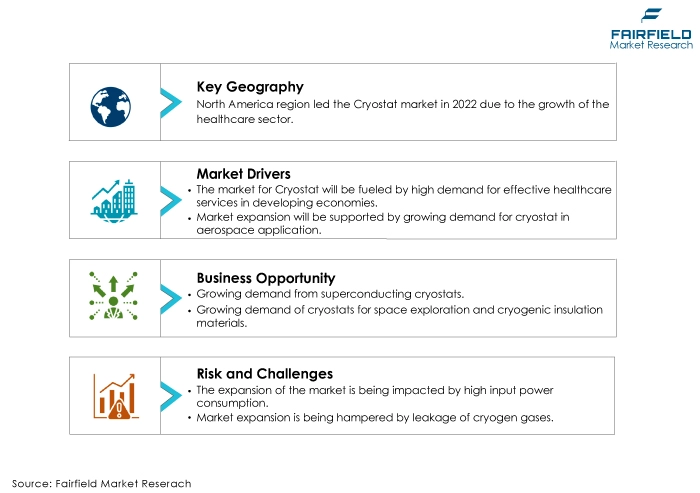
The high demand for effective healthcare services in developing economies is driving the cryostat market for several reasons. As these countries invest in upgrading their healthcare infrastructure, there is a growing need for advanced diagnostic and research equipment, including cryostats, which are essential for preserving tissue samples and facilitating accurate pathology studies.
Rising healthcare awareness and increasing research activities in developing regions are boosting the demand for cryostats, particularly in fields like cancer research, drug discovery, and biotechnology.
The surge in chronic diseases and infectious illnesses in these regions necessitates precise diagnostics and therapies, fueling the adoption of cryostats for tissue sectioning and analysis. As a result, the cryostat market in developing economies is expanding rapidly to meet these evolving healthcare demands and research needs.
- Growing Demand for Aerospace Application
The growing demand for cryostats in aerospace applications is propelling the cryostat market due to several factors. Cryostats are crucial for testing and cooling aerospace components, especially those used in space exploration and satellite technology. The need for reliable and precise cooling systems in extreme conditions is driving increased adoption.
Moreover, advancements in aerospace technology and the expansion of commercial space endeavors are further boosting the demand for cryostats, making them a critical component in the aerospace industry's pursuit of innovation and exploration.
- Increase in Production of LNG
The increase in (liquefied natural gas (LNG) production is driving the cryostat market due to its pivotal role in the LNG value chain. Cryostats are essential for maintaining the extremely low temperatures required to liquefy natural gas for storage and transportation.
As global demand for cleaner energy sources continues to rise, there's a corresponding surge in LNG production and infrastructure development. Consequently, the cryostat market is witnessing growth as it becomes integral to supporting the expanding LNG industry's storage, transportation, and distribution needs.
Major Growth Barriers
- High Input Power Consumption
Cryostats demand substantial power to maintain ultra-low temperatures, which can be costly and environmentally unsustainable. Increasing awareness of energy conservation and environmental regulations is pressuring the industry to develop more power-efficient cryostats.
Meeting these demands while maintaining optimal performance poses a challenge for cryostat manufacturers. Addressing input power consumption is essential for sustainability and cost-effectiveness, driving innovation and competition within the cryostat market.
- Leakage of Cryogen Gases
The leakage of cryogenic gases presents a significant challenge to the cryostat market. Cryostats are designed to maintain extremely low temperatures, and any leakage of cryogenic gases not only leads to performance issues but also poses safety hazards. Ensuring the integrity of seals and insulation materials is crucial.
Additionally, environmental concerns related to the release of cryogenic gases further emphasize the need for leak prevention. Addressing these challenges through improved sealing technologies and rigorous safety measures is essential for maintaining the reliability and safety of cryostats.
Key Trends and Opportunities to Look at
Superconducting cryostats are innovative devices in the cryostat market, maintaining ultra-low temperatures for applications like quantum computing and particle physics. They employ superconducting materials and advanced cooling techniques, enabling the creation of stable, energy-efficient environments critical for research and technology development at the forefront of scientific discovery.
- Cryostats for Space Exploration
- Cryogenic Insulation Materials
Cryostats for space exploration are vital in the cryostat market, supporting missions by cooling sensitive instruments like infrared and X-ray detectors to extremely low temperatures. These cryostats employ cutting-edge thermal insulation and refrigeration technologies, enabling precise space observations and furthering our understanding of the cosmos.
Cryogenic insulation materials are key innovations in the cryostat market. These materials, such as aerogels and multilayer insulation, significantly improve cryostat efficiency by reducing heat transfer and thermal losses, allowing for the maintenance of ultra-low temperatures essential for various scientific and industrial applications, including space exploration and scientific research.
How Does the Regulatory Scenario Shape this Industry?
The regulatory scenario significantly shapes the cryostat Market by influencing safety standards, quality control, and compliance requirements. Cryostats are used in various applications, including medical diagnostics, materials research, and semiconductor manufacturing, where precision and safety are paramount.
Regulations, such as those related to the use of cryogenic materials, electromagnetic compatibility, and workplace safety, guide the design, production, and use of cryostats. Adherence to these regulations ensures product quality, user safety, and environmental compliance.
Moreover, regulatory changes and updates can affect product development, certification, and market access. Cryostat manufacturers must stay informed about evolving regulations and standards to meet compliance requirements and maintain market competitiveness.
Fairfield’s Ranking Board
Top Segments
Closed-cycle cryostats have captured the largest market share in the cryostat market due to their versatility, efficiency, and cost-effectiveness. These cryostats utilse closed-cycle refrigeration systems, eliminating the need for cryogenic liquids and minimising maintenance.
This type of cryostats is well-suited for a wide range of applications, including materials research, medical diagnostics, and superconducting technology. Their ease of operation and reduced operational costs make them a preferred choice for many industries, contributing to their dominant market position.
Multistage cryostats, on the other hand, are expected to due to their ability to achieve extremely low temperatures and precise thermal control. These cryostats are in demand for cutting-edge research in quantum computing, material science, and condensed matter physics.
The capacity of these cryostats to maintain stable cryogenic conditions for extended periods and accommodate diverse experimental set-ups positions them as a preferred choice for advanced research applications, resulting in the highest CAGR in the market.
- Dewars System Component at the Forefront
- Helium Cryogen Takes the Lead
- Healthcare Industry Leads Adoption Trail
Dewars system components have captured the largest market share in the cryostat market because of their fundamental role in cryogenic temperature management and storage. Dewars are essential for storing and transporting cryogenic fluids and samples in various applications, from medical diagnostics to scientific research. Their reliability, safety, and efficiency in maintaining ultra-low temperatures make them a cornerstone component.
Additionally, advancements in dewar technology, including the development of specialised dewars for different applications, have further solidified their dominant position in the market.
High vacuum pump system controllers play a vital role in achieving and maintaining the required vacuum conditions in cryostat systems. They play a crucial part in ensuring the proper functioning of cryostats, especially in advanced applications like quantum computing and materials research.
The growing demand for precise control and automation in cryogenic experiments and processes is driving the adoption of advanced high vacuum pump system controllers, leading to the highest CAGR in the market.
Helium cryogens have captured the largest market share in the cryostat market due to their unique properties that make them ideal for achieving and maintaining extremely low temperatures.
Helium is abundant, non-reactive, and exhibits efficient heat transfer characteristics, making it the cryogen of choice for various applications. It is crucial in fields such as medical imaging, quantum computing, and scientific research. Its widespread availability, reliability, and cost-effectiveness have solidified helium's dominant position in the market.
On the other hand, nitrogen cryogens witness increasing adoption in various applications, including biological sample preservation, medical diagnostics, and semiconductor manufacturing. Nitrogen's non-reactive nature and affordability make it an attractive alternative to helium for achieving cryogenic temperatures.
Moreover, as sustainability becomes a focus, the use of nitrogen cryogens aligns with environmental considerations, driving their growth in the market, especially in applications where extremely low temperatures are not required.
The healthcare application has captured the largest market share in the cryostat market due to its critical role in medical diagnostics, particularly in histology and pathology laboratories. Cryostats are essential for preparing thin tissue sections for accurate disease diagnosis.
The growing prevalence of chronic diseases and increasing demand for early and precise diagnostics drive their adoption. Additionally, advancements in cryostat technology, such as improved temperature control and automation, enhance their efficiency in healthcare applications, solidifying their dominant market position.
The aerospace sector is likely to be experiencing the highest CAGR in the cryostat market due to its increasing use of cryostats in research, testing, and development of aerospace technologies.
Cryostats are crucial for simulating extreme cold conditions that aircraft and spacecraft encounter, aiding in the development and testing of materials, components, and propulsion systems. As aerospace innovation continues to expand, the demand for cryostats in this sector grows, contributing to the highest CAGR in the market.
Regional Frontunners
North America Holds a Commanding Share
North America has captured the largest market share in the cryostat market due to several key factors. The region boasts advanced healthcare and research infrastructure, including medical diagnostics and life sciences laboratories, which drive substantial demand for cryostats in applications like histology and tissue analysis.
North America is home to major players in the semiconductor and electronics industries, where cryostats are used for materials research and testing. Robust investments in research and development, coupled with government funding for scientific projects, fuel the adoption of advanced cryostat technologies. Stringent quality standards and regulatory requirements in the region ensure the reliability and safety of cryostat systems, bolstering their market presence in North America.
Demand will be the Fastest Across Asia Pacific
Asia Pacific's expanding healthcare sector, including medical research and diagnostics, drives demand for cryostats. The semiconductor and electronics industries are flourishing, leading to increased utilisation of cryostats for materials testing and research.
Additionally, growing investments in scientific research, coupled with a burgeoning biotechnology sector, contribute to the rising demand. Furthermore, initiatives promoting research and development in countries like China, and India are propelling the adoption of advanced cryostat technologies, resulting in the highest CAGR in the Asia Pacific region.
Fairfield’s Competitive Landscape
The global cryostat market is a consolidated market with fewer major players present across the globe. The key players are introducing new products as well as working on the distribution channels to enhance their worldwide presence. Moreover, Fairfield Market Research is expecting the market to witness more consolidation over the coming years.
Who are the Leaders in the Global Cryostat Space?
- Thermo Fisher Scientific Inc.
- Leica Biosystems Nussloch GmbH
- Cryomech Inc.
- Janis Research Company, LLC
- Advanced Research Systems, Inc.
- Advanced Technology Inc.
- Bluefors Oy
- HICO Group
- Riber Group
- Iwatani Corporation
- JPK Instruments AG
- Oxford Instruments plc
- Scientifica Ltd.
- CryoConcepts LP
- Quorum Technologies Ltd.
An Expert’s Eye
Demand and Future Growth
An increase in demand for aerospace products is driving the market. The cryostat market is experiencing robust demand driven by its critical role in applications like medical diagnostics, materials research, and semiconductor manufacturing.
Growing investments in healthcare, scientific research, and the semiconductor industry are fueling this demand. As technologies advance, cryostats are expected to become more versatile and efficient.
The future growth of the cryostat market is promising, with an emphasis on enhancing precision, reducing energy consumption, and expanding applications in emerging fields like quantum computing and biobanking.
Supply Side of the Market
The major countries in the cryostat market include the US, Canada, Germany, the UK, France, China, Japan, South Korea, India, and Brazil. These countries have well-established healthcare and research sectors where cryostats are extensively used for various applications. They are hubs for semiconductor manufacturing and materials research, driving significant demand for cryostats in these regions.
Fast-developing economies like India, and Brazil are also witnessing growing adoption of cryostat technologies in research and healthcare, contributing to their prominence in the market.
The cryostat market relies on various critical raw materials and components, including stainless steel for construction, insulation materials such as foam or glass wool for thermal management, compressors for cooling, cryogenic fluids like helium or nitrogen for temperature control, cryogenic valves, vacuum pumps, instrumentation and control systems, cryogenic temperature sensors, cryogenic dewars for storage, and cryocoolers.
Leading manufacturers of these raw materials and components include companies like Outokumpu, Owens Corning, Emerson Electric, Linde Group, Parker Hannifin, Leybold, Honeywell, Lake Shore Cryotronics, Chart Industries, and Sunpower Inc. contributing to the functionality and performance of cryostat systems in various applications.
Global Cryostat Market is Segmented as Below:
By Type:
- Closed-Cycle Crystals
- Continuous-flow Crystals
- Bath Crystals
- Multistage Crystals
By System Component:
- Dewars
- Transfer Tubes
- Gas Flow Pumps
- Temperature Controllers
- High Vacuum Pumps
- Microtome Blades
By Cryogen:
- Helium
- Nitrogen
By Application:
- Healthcare
- Energy & Power
- Aerospace
- Metallurgy
- Biotechnology
- Forensic Science
- Marine Biology
By Geographic Coverage:
- North America
- Europe
- Asia Pacific
- Latin America
- Middle East & Africa
- Executive Summary
- Global Cryostat Market Snapshot
- Future Projections
- Key Market Trends
- Regional Snapshot, by Value, 2026
- Analyst Recommendations
- Market Overview
- Market Definitions and Segmentations
- Market Dynamics
- Drivers
- Restraints
- Market Opportunities
- Value Chain Analysis
- COVID-19 Impact Analysis
- Porter's Five Forces Analysis
- Impact of Russia-Ukraine Conflict
- PESTLE Analysis
- Regulatory Analysis
- Price Trend Analysis
- Current Prices and Future Projections, 2025-2033
- Price Impact Factors
- Global Cryostat Market Outlook, 2020 - 2033
- Global Cryostat Market Outlook, by Type, Value (US$ Bn), 2020-2033
- Closed-Cycle Crystals
- Continuous-flow Crystals
- Bath Crystals
- Multistage Crystals
- Global Cryostat Market Outlook, by System Component, Value (US$ Bn), 2020-2033
- Dewars
- Transfer Tubes
- Gas Flow Pumps
- Temperature Controllers
- High Vacuum Pumps
- Microtome Blades
- Global Cryostat Market Outlook, by Cryogen, Value (US$ Bn), 2020-2033
- Helium
- Nitrogen
- Global Cryostat Market Outlook, by Application, Value (US$ Bn), 2020-2033
- Healthcare
- Energy & Power
- Aerospace
- Metallurgy
- Biotechnology
- Forensic Science
- Marine Biology
- Global Cryostat Market Outlook, by Region, Value (US$ Bn), 2020-2033
- North America
- Europe
- Asia Pacific
- Latin America
- Middle East & Africa
- Global Cryostat Market Outlook, by Type, Value (US$ Bn), 2020-2033
- North America Cryostat Market Outlook, 2020 - 2033
- North America Cryostat Market Outlook, by Type, Value (US$ Bn), 2020-2033
- Closed-Cycle Crystals
- Continuous-flow Crystals
- Bath Crystals
- Multistage Crystals
- North America Cryostat Market Outlook, by System Component, Value (US$ Bn), 2020-2033
- Dewars
- Transfer Tubes
- Gas Flow Pumps
- Temperature Controllers
- High Vacuum Pumps
- Microtome Blades
- North America Cryostat Market Outlook, by Cryogen, Value (US$ Bn), 2020-2033
- Helium
- Nitrogen
- North America Cryostat Market Outlook, by Application, Value (US$ Bn), 2020-2033
- Healthcare
- Energy & Power
- Aerospace
- Metallurgy
- Biotechnology
- Forensic Science
- Marine Biology
- North America Cryostat Market Outlook, by Country, Value (US$ Bn), 2020-2033
- U.S. Cryostat Market Outlook, by Type, 2020-2033
- U.S. Cryostat Market Outlook, by System Component, 2020-2033
- U.S. Cryostat Market Outlook, by Cryogen, 2020-2033
- U.S. Cryostat Market Outlook, by Application, 2020-2033
- Canada Cryostat Market Outlook, by Type, 2020-2033
- Canada Cryostat Market Outlook, by System Component, 2020-2033
- Canada Cryostat Market Outlook, by Cryogen, 2020-2033
- Canada Cryostat Market Outlook, by Application, 2020-2033
- BPS Analysis/Market Attractiveness Analysis
- North America Cryostat Market Outlook, by Type, Value (US$ Bn), 2020-2033
- Europe Cryostat Market Outlook, 2020 - 2033
- Europe Cryostat Market Outlook, by Type, Value (US$ Bn), 2020-2033
- Closed-Cycle Crystals
- Continuous-flow Crystals
- Bath Crystals
- Multistage Crystals
- Europe Cryostat Market Outlook, by System Component, Value (US$ Bn), 2020-2033
- Dewars
- Transfer Tubes
- Gas Flow Pumps
- Temperature Controllers
- High Vacuum Pumps
- Microtome Blades
- Europe Cryostat Market Outlook, by Cryogen, Value (US$ Bn), 2020-2033
- Helium
- Nitrogen
- Europe Cryostat Market Outlook, by Application, Value (US$ Bn), 2020-2033
- Healthcare
- Energy & Power
- Aerospace
- Metallurgy
- Biotechnology
- Forensic Science
- Marine Biology
- Europe Cryostat Market Outlook, by Country, Value (US$ Bn), 2020-2033
- Germany Cryostat Market Outlook, by Type, 2020-2033
- Germany Cryostat Market Outlook, by System Component, 2020-2033
- Germany Cryostat Market Outlook, by Cryogen, 2020-2033
- Germany Cryostat Market Outlook, by Application, 2020-2033
- Italy Cryostat Market Outlook, by Type, 2020-2033
- Italy Cryostat Market Outlook, by System Component, 2020-2033
- Italy Cryostat Market Outlook, by Cryogen, 2020-2033
- Italy Cryostat Market Outlook, by Application, 2020-2033
- France Cryostat Market Outlook, by Type, 2020-2033
- France Cryostat Market Outlook, by System Component, 2020-2033
- France Cryostat Market Outlook, by Cryogen, 2020-2033
- France Cryostat Market Outlook, by Application, 2020-2033
- U.K. Cryostat Market Outlook, by Type, 2020-2033
- U.K. Cryostat Market Outlook, by System Component, 2020-2033
- U.K. Cryostat Market Outlook, by Cryogen, 2020-2033
- U.K. Cryostat Market Outlook, by Application, 2020-2033
- Spain Cryostat Market Outlook, by Type, 2020-2033
- Spain Cryostat Market Outlook, by System Component, 2020-2033
- Spain Cryostat Market Outlook, by Cryogen, 2020-2033
- Spain Cryostat Market Outlook, by Application, 2020-2033
- Russia Cryostat Market Outlook, by Type, 2020-2033
- Russia Cryostat Market Outlook, by System Component, 2020-2033
- Russia Cryostat Market Outlook, by Cryogen, 2020-2033
- Russia Cryostat Market Outlook, by Application, 2020-2033
- Rest of Europe Cryostat Market Outlook, by Type, 2020-2033
- Rest of Europe Cryostat Market Outlook, by System Component, 2020-2033
- Rest of Europe Cryostat Market Outlook, by Cryogen, 2020-2033
- Rest of Europe Cryostat Market Outlook, by Application, 2020-2033
- BPS Analysis/Market Attractiveness Analysis
- Europe Cryostat Market Outlook, by Type, Value (US$ Bn), 2020-2033
- Asia Pacific Cryostat Market Outlook, 2020 - 2033
- Asia Pacific Cryostat Market Outlook, by Type, Value (US$ Bn), 2020-2033
- Closed-Cycle Crystals
- Continuous-flow Crystals
- Bath Crystals
- Multistage Crystals
- Asia Pacific Cryostat Market Outlook, by System Component, Value (US$ Bn), 2020-2033
- Dewars
- Transfer Tubes
- Gas Flow Pumps
- Temperature Controllers
- High Vacuum Pumps
- Microtome Blades
- Asia Pacific Cryostat Market Outlook, by Cryogen, Value (US$ Bn), 2020-2033
- Helium
- Nitrogen
- Asia Pacific Cryostat Market Outlook, by Application, Value (US$ Bn), 2020-2033
- Healthcare
- Energy & Power
- Aerospace
- Metallurgy
- Biotechnology
- Forensic Science
- Marine Biology
- Asia Pacific Cryostat Market Outlook, by Country, Value (US$ Bn), 2020-2033
- China Cryostat Market Outlook, by Type, 2020-2033
- China Cryostat Market Outlook, by System Component, 2020-2033
- China Cryostat Market Outlook, by Cryogen, 2020-2033
- China Cryostat Market Outlook, by Application, 2020-2033
- Japan Cryostat Market Outlook, by Type, 2020-2033
- Japan Cryostat Market Outlook, by System Component, 2020-2033
- Japan Cryostat Market Outlook, by Cryogen, 2020-2033
- Japan Cryostat Market Outlook, by Application, 2020-2033
- South Korea Cryostat Market Outlook, by Type, 2020-2033
- South Korea Cryostat Market Outlook, by System Component, 2020-2033
- South Korea Cryostat Market Outlook, by Cryogen, 2020-2033
- South Korea Cryostat Market Outlook, by Application, 2020-2033
- India Cryostat Market Outlook, by Type, 2020-2033
- India Cryostat Market Outlook, by System Component, 2020-2033
- India Cryostat Market Outlook, by Cryogen, 2020-2033
- India Cryostat Market Outlook, by Application, 2020-2033
- Southeast Asia Cryostat Market Outlook, by Type, 2020-2033
- Southeast Asia Cryostat Market Outlook, by System Component, 2020-2033
- Southeast Asia Cryostat Market Outlook, by Cryogen, 2020-2033
- Southeast Asia Cryostat Market Outlook, by Application, 2020-2033
- Rest of SAO Cryostat Market Outlook, by Type, 2020-2033
- Rest of SAO Cryostat Market Outlook, by System Component, 2020-2033
- Rest of SAO Cryostat Market Outlook, by Cryogen, 2020-2033
- Rest of SAO Cryostat Market Outlook, by Application, 2020-2033
- BPS Analysis/Market Attractiveness Analysis
- Asia Pacific Cryostat Market Outlook, by Type, Value (US$ Bn), 2020-2033
- Latin America Cryostat Market Outlook, 2020 - 2033
- Latin America Cryostat Market Outlook, by Type, Value (US$ Bn), 2020-2033
- Closed-Cycle Crystals
- Continuous-flow Crystals
- Bath Crystals
- Multistage Crystals
- Latin America Cryostat Market Outlook, by System Component, Value (US$ Bn), 2020-2033
- Dewars
- Transfer Tubes
- Gas Flow Pumps
- Temperature Controllers
- High Vacuum Pumps
- Microtome Blades
- Latin America Cryostat Market Outlook, by Cryogen, Value (US$ Bn), 2020-2033
- Helium
- Nitrogen
- Latin America Cryostat Market Outlook, by Application, Value (US$ Bn), 2020-2033
- Healthcare
- Energy & Power
- Aerospace
- Metallurgy
- Biotechnology
- Forensic Science
- Marine Biology
- Latin America Cryostat Market Outlook, by Country, Value (US$ Bn), 2020-2033
- Brazil Cryostat Market Outlook, by Type, 2020-2033
- Brazil Cryostat Market Outlook, by System Component, 2020-2033
- Brazil Cryostat Market Outlook, by Cryogen, 2020-2033
- Brazil Cryostat Market Outlook, by Application, 2020-2033
- Mexico Cryostat Market Outlook, by Type, 2020-2033
- Mexico Cryostat Market Outlook, by System Component, 2020-2033
- Mexico Cryostat Market Outlook, by Cryogen, 2020-2033
- Mexico Cryostat Market Outlook, by Application, 2020-2033
- Argentina Cryostat Market Outlook, by Type, 2020-2033
- Argentina Cryostat Market Outlook, by System Component, 2020-2033
- Argentina Cryostat Market Outlook, by Cryogen, 2020-2033
- Argentina Cryostat Market Outlook, by Application, 2020-2033
- Rest of LATAM Cryostat Market Outlook, by Type, 2020-2033
- Rest of LATAM Cryostat Market Outlook, by System Component, 2020-2033
- Rest of LATAM Cryostat Market Outlook, by Cryogen, 2020-2033
- Rest of LATAM Cryostat Market Outlook, by Application, 2020-2033
- BPS Analysis/Market Attractiveness Analysis
- Latin America Cryostat Market Outlook, by Type, Value (US$ Bn), 2020-2033
- Middle East & Africa Cryostat Market Outlook, 2020 - 2033
- Middle East & Africa Cryostat Market Outlook, by Type, Value (US$ Bn), 2020-2033
- Closed-Cycle Crystals
- Continuous-flow Crystals
- Bath Crystals
- Multistage Crystals
- Middle East & Africa Cryostat Market Outlook, by System Component, Value (US$ Bn), 2020-2033
- Dewars
- Transfer Tubes
- Gas Flow Pumps
- Temperature Controllers
- High Vacuum Pumps
- Microtome Blades
- Middle East & Africa Cryostat Market Outlook, by Cryogen, Value (US$ Bn), 2020-2033
- Helium
- Nitrogen
- Middle East & Africa Cryostat Market Outlook, by Application, Value (US$ Bn), 2020-2033
- Healthcare
- Energy & Power
- Aerospace
- Metallurgy
- Biotechnology
- Forensic Science
- Marine Biology
- Middle East & Africa Cryostat Market Outlook, by Country, Value (US$ Bn), 2020-2033
- GCC Cryostat Market Outlook, by Type, 2020-2033
- GCC Cryostat Market Outlook, by System Component, 2020-2033
- GCC Cryostat Market Outlook, by Cryogen, 2020-2033
- GCC Cryostat Market Outlook, by Application, 2020-2033
- South Africa Cryostat Market Outlook, by Type, 2020-2033
- South Africa Cryostat Market Outlook, by System Component, 2020-2033
- South Africa Cryostat Market Outlook, by Cryogen, 2020-2033
- South Africa Cryostat Market Outlook, by Application, 2020-2033
- Egypt Cryostat Market Outlook, by Type, 2020-2033
- Egypt Cryostat Market Outlook, by System Component, 2020-2033
- Egypt Cryostat Market Outlook, by Cryogen, 2020-2033
- Egypt Cryostat Market Outlook, by Application, 2020-2033
- Nigeria Cryostat Market Outlook, by Type, 2020-2033
- Nigeria Cryostat Market Outlook, by System Component, 2020-2033
- Nigeria Cryostat Market Outlook, by Cryogen, 2020-2033
- Nigeria Cryostat Market Outlook, by Application, 2020-2033
- Rest of Middle East Cryostat Market Outlook, by Type, 2020-2033
- Rest of Middle East Cryostat Market Outlook, by System Component, 2020-2033
- Rest of Middle East Cryostat Market Outlook, by Cryogen, 2020-2033
- Rest of Middle East Cryostat Market Outlook, by Application, 2020-2033
- BPS Analysis/Market Attractiveness Analysis
- Middle East & Africa Cryostat Market Outlook, by Type, Value (US$ Bn), 2020-2033
- Competitive Landscape
- Company Vs Segment Heatmap
- Company Market Share Analysis, 2025
- Competitive Dashboard
- Company Profiles
- Thermo Fisher Scientific Inc.
- Company Overview
- Product Portfolio
- Financial Overview
- Business Strategies and Developments
- Leica Biosystems Nussloch GmbH
- Cryomech Inc.
- Janis Research Company, LLC
- Advanced Research Systems, Inc.
- Advanced Technology Inc.
- Bluefors Oy
- HICO Group
- Riber Group
- Iwatani Corporation
- Thermo Fisher Scientific Inc.
- Appendix
- Research Methodology
- Report Assumptions
- Acronyms and Abbreviations
|
BASE YEAR |
HISTORICAL DATA |
FORECAST PERIOD |
UNITS |
|||
 |
2025 |
 |
2020 - 2025 |
 |
2026 - 2033 |
Value: US$ Million |
|
REPORT FEATURES |
DETAILS |
|
Type Coverage |
|
|
System Components Coverage |
|
|
Cryogen Coverage |
|
|
Application Coverage |
|
|
Geographical Coverage |
|
|
Leading Companies |
|
|
Report Highlights |
Key Market Indicators, Macro-micro economic impact analysis, Technological Roadmap, Key Trends, Driver, Restraints, and Future Opportunities & Revenue Pockets, Porter’s 5 Forces Analysis, Historical Trend (2019-2021), Market Estimates and Forecast, Market Dynamics, Industry Trends, Competition Landscape, Category, Region, Country-wise Trends & Analysis, COVID-19 Impact Analysis (Demand and Supply Chain) |
Our Research Methodology
Considering the volatility of business today, traditional approaches to strategizing a game plan can be unfruitful if not detrimental. True ambiguity is no way to determine a forecast. A myriad of predetermined factors must be accounted for such as the degree of risk involved, the magnitude of circumstances, as well as conditions or consequences that are not known or unpredictable. To circumvent binary views that cast uncertainty, the application of market research intelligence to strategically posture, move, and enable actionable outcomes is necessary.
View Methodology
Quality Assured
Rigorous Validation Process

Confidentiality Assured
End-to-end Data Security

Custom Research Services
Tailored To Your Objectives
FAQs
The global cryostat market is experiencing growth due to increased applications in medical imaging, material science, and semiconductor industries. Rising demand for precise temperature control and advancements in cryogenic technologies are key drivers.
The challenges include adherence to stringent regulatory standards, especially in healthcare applications, and addressing technological barriers related to system complexity and energy consumption. Companies are investing in compliance measures and continuous technological advancements to overcome these challenges.
Geopolitical factors such as trade tensions, and regulatory policies can affect the supply chain and market dynamics, influencing the cost of raw materials and components, and potentially impacting the pricing and profitability of cryostat manufacturers on the global stage.
The market for cryostat is competitive with key players focusing on product innovation, strategic collaborations, and mergers to expand their product portfolios and global presence. Technological advancements, such as automated systems and improved energy efficiency, are also crucial factors.
The healthcare sector is a key driver, with the rising adoption of cryostats for medical imaging applications such as MRI, and increasing demand for cryopreservation of biological samples, fostering growth in the global cryostat market.
Related Reports
Oral Cancer Rapid Test Kit Market
The oral cancer rapid test kits market will grow from USD 240.00 Mn in 2026 to USD 550.80 Mn by 2033, driven by early detection and point-of-care screening.
Non-Hodgkin Lymphoma Therapeutics Market Insights, Competitive Landscape, and Market Forecast 2033
The non-Hodgkin lymphoma therapeutics market will expand from USD 16.80 billion in 2026 to USD 28.98 billion by 2033, driven by targeted therapies.
In Vitro Toxicology Testing Market Insights, Competitive Landscape, and Market Forecast 2033
The in vitro toxicology testing market is expected to grow from USD 8.60 billion in 2026 to USD 16.03 billion by 2033, driven by animal testing alternatives.
Healthcare Fintech Market Insights, Competitive Landscape, and Market Forecast 2033
Healthcare Fintech Market to reach USD 26.40 Bn by 2033, growing at 16.8% CAGR, driven by digital billing, patient payments, and claims automation.
Diagnostic Ultrasound Market Insights, Competitive Landscape, and Market Forecast - 2033
Diagnostic Ultrasound Market is valued at USD 9.70 Billion in 2026 and projected to reach USD 14.78 Billion by 2033, growing at a 6.2% CAGR.
Infection Control Supplies Market Forecast - 2033
The global infection control supplies market is set to reach US$ 19.76 Bn by 2033, growing at a 6.4% CAGR, driven by infection prevention demand