



Curved Glass Panel Market
Curved Glass Panel Market Insights, Competitive Landscape, and Market Forecast - 2033
The Curved Glass Panel Market is valued at USD 9 Bn in 2026 and is projected to reach USD 15.7 Bn, growing at a CAGR of 8% by 2033.
Quick Report Digest
Key Growth Determinants
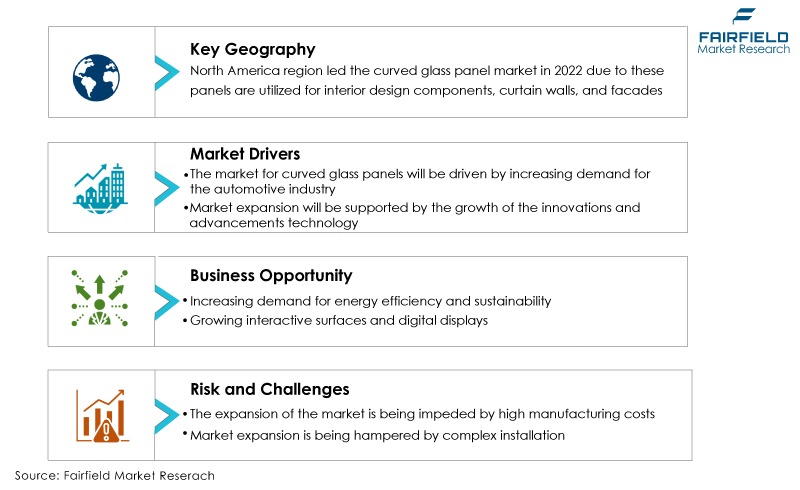
- Increasing Application Across Automotive Industry
Automobile designers frequently use curved glass panels to produce svelte, contemporary, and aesthetically pleasing vehicles. The curved design can provide a touch of sophistication and elegance to the exterior of cars. Curved windscreens and windows can improve an automobile's aerodynamics, improving fuel efficiency and reducing wind noise, making them desirable to both manufacturers and buyers.
Laminated and tempered glass choices are frequently used in curved glass panels on autos to ensure that they meet safety standards. When there is an accident, these safety features safeguard the passengers, making such cars more desirable. Curve glass panels in cars are frequently made of laminated or tempered glass to meet safety requirements. These safety features safeguard passengers in collisions, enhancing the allure of such cars.
- Growing Technological Innovations
Curved glass panels are now easier and more efficiently produced due to the development of innovative manufacturing techniques like hot bending, cold bending, and chemical strengthening. Because of this, curved glass is now more widely available in numerous industries. Curved glass panels now have better durability, scratch resistance, and energy efficiency due to advancements in glass coating technology.
Due to these coatings, curved glass panels are now more appealing for use in architectural and automotive end-users. Due to the incorporation of smart glass technology, curved glass panels now have more options for use in dynamic facades, interactive displays, and privacy glasses. Smart glass technology allows the glass to switch between transparent and opaque states electrically.
- Growing Demand for High-resolution Displays in Consumer Electronics to Drive The Market Growth
The immersive viewing experience of high-end televisions with curved panels has increased in popularity. These TVs use curved glass panels for a larger field of vision and a more immersive experience. Computer monitors use curved glass panels to create a more immersive and comfortable viewing environment.
Professionals and gamers frequently prefer curved displays because of their improved visual engagement and decreased glare. Curved glass panels are a common feature of top smartphones. These curved screens enhance aesthetics while providing a more immersive viewing experience for multimedia content.
Major Growth Barriers
- High Manufacturing Costs
Curved glass panel manufacturing demands specialised tools, materials, and methods, which can drastically increase production costs. Due to this, curved glass panels are less economical than traditional flat glass substitutes. Many sectors, like consumer electronics and construction, are price-sensitive markets.
Curved glass panels can become pricey due to high manufacturing costs, losing some of their appeal to consumers and businesses on a tight budget. Companies producing curved glass panels may find it challenging to compete with manufacturers of flat glass products that can offer lower prices due to economies of scale and lower production costs.
- Complex Installations
Curved glass panel installation frequently necessitates the use of specialised knowledge and abilities. The lack of expertise of some installation or building teams may result in delays and inflated expenses. The exact installation of curved glass panels necessitates skilled labour, which can be costly and drive up project costs.
Longer project timelines may not be possible for projects with tight deadlines due to the difficulties of installing curved glass panels. Curved glass panel's unique shape can make them more vulnerable to damage during installation, raising the possibility of breakage and the accompanying costs.
Key Trends and Opportunities to Look at
Advanced coatings and insulating features can enhance thermal performance in curved glass panels. This contributes to energy-efficient building designs by minimising heat gain during the summer and heat loss during the winter.
Curved glass panels with solar control coatings can reduce solar heat gain while letting in plenty of natural light, making them more energy-efficient. In turn, energy efficiency is improved because there is less reliance on air conditioning equipment.
Achieving LEED certification and other green building criteria can be facilitated by the use of curved glass panels in sustainable building designs. These qualifications are being sought after by architects and contractors more frequently.
- Smart Glass Technology
- Growing Interactive Surfaces and Digital Displays
Curved glass panels with smart glass can dynamically transform between transparent and opaque states, allowing for improved sight, privacy, and light transmission. Both automobile and architectural end-users of this property are widely desired.
Smart glass can save energy by managing the quantity of sunlight entering a structure or vehicle. When tinted or opaque prevents solar heat gain, lowering the need for air conditioning and enhancing energy efficiency.
In retail environments, curved glass panels create eye-catching, interactive displays that draw people and improve the shopping experience. Interactive displays can provide product details, simulated fittings, and tailored recommendations.
In museums and exhibitions, curved glass panels display artwork, artifacts, and interactive educational displays. They increase visitor interaction and produce a memorable experience.
How Does the Regulatory Scenario Shape this Industry?
Over the last three years, the market for curved glass panels has been governed by several regulatory frameworks and standards that guarantee the products' compliance, quality, and safety in various end-users. American National Standards Institute (ANSI) standards cover safety glazing materials in automobiles and structures. These standards require glass's ability to withstand impacts, breaks, and other safety-related factors.
A global leader in safety certification, Underwriters Laboratories (UL) assesses and certifies goods for compliance with safety standards. Underwriters Laboratories (UL) standards cover a variety of glass panel-related topics, including building construction safety and fire resistance.
Industry organisations, like the Glass Association of North America (GANA), significantly impact the development and promotion of industry standards and best practices. They collaborate closely with oversight organisations to guarantee compliance with industry standards.
Curved glass panels are required to meet safety, performance, and environmental regulations in various end-users, including construction, automotive, and consumer electronics.
Fairfield’s Ranking Board
Top Segments
In 2022, the category of double-glazed curved glass panels dominated the market. Compared to single-pane glass, double-glazed curved glass panels provide better insulation. As an insulating barrier, the area between the glass layers slows heat transfer. As a result, buildings use less energy and spend less money on heating and cooling.
Sound insulation is further aided by the air or gas-filled gap between the panes of glass. Double-glazed curved glass panels are frequently used when noise reduction is crucial, such as in cities or near busy roads.
Furthermore, the single-glazed curved glass panels category is anticipated to grow fastest. Because of their streamlined, contemporary design, single-glazed curved glass panels are highly sought after. They are favoured in modern architectural designs because they don't have an additional glass layer or insulation, which gives them a simple and clear appearance.
- Architectural End User Category Spearheads
The architecture category dominated the market in 2022. This is due to the modern architectural ideas that used curved glass panels to provide appealing and distinctive building facades. These panels can be bent in various forms, such as cylindrical, spherical, or conical shapes, giving the outside of buildings a distinctive and futuristic feel.
Entrance systems, such as revolving doors and glass canopies, frequently use curved glass panels. They protect us from the weather and provide a welcoming, contemporary entrance.
During the forecast period, the electronics category is expected to grow significantly. This is because many consumer electronics products, including curved TVs, computer monitors, and gaming displays, are made using curved glass panels.
By providing a panoramic and immersive view, the curvature improves the viewing experience. Curved glass panels give high-end audio devices, including soundbars and speakers, a sleek, contemporary look.
Regional Frontrunners
North America Brings in the Maximum Revenue
North America is expected to dominate the curved glass panel market during the forecast period. Curved glass panels are extensively used in commercial and residential construction in North America, particularly in large cities like New York, Chicago, and Los Angeles. These panels are utilised for interior design components, curtain walls, and facades.
Moreover, Curved glass panels are included in automobiles made in the United States, a hub for the worldwide automotive industry. Curved windscreens, sunroofs, and cutting-edge displays are examples of this in automobiles, SUVs, and trucks.
Asia Pacific Grows Lucrative
Asia Pacific is expected to be the fastest-growing curved glass panel market region. This is due to the demand for high-end products and homes driven by the region's expanding affluent middle class. Curved glass panels create distinctive and aesthetically beautiful designs in opulent residences, hotels, and commercial buildings.
The development of advanced curved glass panel solutions, including smart glass technology and interactive displays, was facilitated by the Asia Pacific region's role as a center of technical innovation. Large-scale consumer electronics manufacturing is located in the area.
Curved glass panels are used in goods like curved TVs, smartphones, and gaming displays to improve aesthetics and give customers immersive experiences. India is increasingly implementing strict safety regulations in the automotive and construction industries. These standards are preferred for curved glass panels because of their dependability and safety features.
Fairfield’s Competitive Landscape Analysis
It is a market with several significant players present globally, and the worldwide curved glass panel market is consolidated. The major firms are launching new items and improving the distribution networks to increase global visibility. More market consolidation is also expected in the upcoming years, according to Fairfield Market Research.
Who are the Leaders in Global Curved Glass Panel Space?
- AGC Inc.
- Saint-Gobain S.A.
- Schott AG
- Guardian Industries
- Corning Incorporated
- Bent Glass Design, Inc.
- HHH Tempering Resources Inc.
- Goldray Industries Ltd.
- Viracon
- Vitro Architectural Glass
- GSC Glass Ltd.
- Duratuf Glass Industries Pvt. Ltd.
- PRL Glass Systems Inc.
- Fuyao Glass Industry Group Co. Ltd.
- Euroglas GmbH
An Expert’s Eye
Demand and Future Growth
As per Fairfield’s Analysis, with increasing technological advancements, the production of curved glass panels has become simpler and more affordable because of advancements in glass manufacturing techniques, including hot bending and cold bending. By making curved glass more widely available this promotes market growth.
Furthermore, increased skyscraper and high-rise building construction result from the global trend towards urbanisation. However, the curved glass panel market is expected to face considerable challenges because of high manufacturing costs.
Supply Side of the Market
These producers use specialised tools and procedures to produce curved glass panels with different dimensions, shapes, and requirements. They frequently provide customisation choices to satisfy certain project requirements. The raw material suppliers needed to produce curved glass panels are part of the supply chain. This includes the glass substrates, finishes, interlayers, and additional components required to produce curved glass panels with the desired properties.
In the supply chain, distributors and wholesalers are essential because they offer curved glass panels to various end-use sectors, building projects, and consumer electronics and automotive goods producers. The curved glass panel market's supply chain is a complex ecosystem of several players, including distributors, manufacturers, and raw materials suppliers. The sector's success depends on its capacity to meet the demand for curved glass panels while maintaining quality, safety, and sustainability standards standards.
Global Curved Glass Panel Market is Segmented as Below:
By Type:
- Single-glazed Curved Glass Panels
- Double-glazed Curved Glass Panels
- Laminated Curved Glass Panels
- Annealed Curved Glass Panels
By End User:
- Architectural
- Transportation
- Electronics
- Miscellaneous
By Geographic Coverage:
- North America
- Europe
- Asia Pacific
- Latin America
- Middle East & Africa
- Executive Summary
- Global Curved Glass Panel Market Snapshot
- Future Projections
- Key Market Trends
- Regional Snapshot, by Value, 2026
- Analyst Recommendations
- Market Overview
- Market Definitions and Segmentations
- Market Dynamics
- Drivers
- Restraints
- Market Opportunities
- Value Chain Analysis
- COVID-19 Impact Analysis
- Porter's Five Forces Analysis
- Impact of Russia-Ukraine Conflict
- PESTLE Analysis
- Regulatory Analysis
- Price Trend Analysis
- Current Prices and Future Projections, 2025-2033
- Price Impact Factors
- Global Curved Glass Panel Market Outlook, 2020 - 2033
- Global Curved Glass Panel Market Outlook, by Type, Value (US$ Mn), 2020-2033
- Single-glazed Curved Glass Panels
- Double-glazed Curved Glass Panels
- Laminated Curved Glass Panels
- Annealed Curved Glass Panels
- Global Curved Glass Panel Market Outlook, by End-user, Value (US$ Mn), 2020-2033
- Architectural
- Transportation
- Electronics
- Miscellaneous
- Global Curved Glass Panel Market Outlook, by Region, Value (US$ Mn), 2020-2033
- North America
- Europe
- Asia Pacific
- Latin America
- Middle East & Africa
- Global Curved Glass Panel Market Outlook, by Type, Value (US$ Mn), 2020-2033
- North America Curved Glass Panel Market Outlook, 2020 - 2033
- North America Curved Glass Panel Market Outlook, by Type, Value (US$ Mn), 2020-2033
- Single-glazed Curved Glass Panels
- Double-glazed Curved Glass Panels
- Laminated Curved Glass Panels
- Annealed Curved Glass Panels
- North America Curved Glass Panel Market Outlook, by End-user, Value (US$ Mn), 2020-2033
- Architectural
- Transportation
- Electronics
- Miscellaneous
- North America Curved Glass Panel Market Outlook, by Country, Value (US$ Mn), 2020-2033
- U.S. Curved Glass Panel Market Outlook, by Type, 2020-2033
- U.S. Curved Glass Panel Market Outlook, by End-user, 2020-2033
- Canada Curved Glass Panel Market Outlook, by Type, 2020-2033
- Canada Curved Glass Panel Market Outlook, by End-user, 2020-2033
- BPS Analysis/Market Attractiveness Analysis
- North America Curved Glass Panel Market Outlook, by Type, Value (US$ Mn), 2020-2033
- Europe Curved Glass Panel Market Outlook, 2020 - 2033
- Europe Curved Glass Panel Market Outlook, by Type, Value (US$ Mn), 2020-2033
- Single-glazed Curved Glass Panels
- Double-glazed Curved Glass Panels
- Laminated Curved Glass Panels
- Annealed Curved Glass Panels
- Europe Curved Glass Panel Market Outlook, by End-user, Value (US$ Mn), 2020-2033
- Architectural
- Transportation
- Electronics
- Miscellaneous
- Europe Curved Glass Panel Market Outlook, by Country, Value (US$ Mn), 2020-2033
- Germany Curved Glass Panel Market Outlook, by Type, 2020-2033
- Germany Curved Glass Panel Market Outlook, by End-user, 2020-2033
- Italy Curved Glass Panel Market Outlook, by Type, 2020-2033
- Italy Curved Glass Panel Market Outlook, by End-user, 2020-2033
- France Curved Glass Panel Market Outlook, by Type, 2020-2033
- France Curved Glass Panel Market Outlook, by End-user, 2020-2033
- U.K. Curved Glass Panel Market Outlook, by Type, 2020-2033
- U.K. Curved Glass Panel Market Outlook, by End-user, 2020-2033
- Spain Curved Glass Panel Market Outlook, by Type, 2020-2033
- Spain Curved Glass Panel Market Outlook, by End-user, 2020-2033
- Russia Curved Glass Panel Market Outlook, by Type, 2020-2033
- Russia Curved Glass Panel Market Outlook, by End-user, 2020-2033
- Rest of Europe Curved Glass Panel Market Outlook, by Type, 2020-2033
- Rest of Europe Curved Glass Panel Market Outlook, by End-user, 2020-2033
- BPS Analysis/Market Attractiveness Analysis
- Europe Curved Glass Panel Market Outlook, by Type, Value (US$ Mn), 2020-2033
- Asia Pacific Curved Glass Panel Market Outlook, 2020 - 2033
- Asia Pacific Curved Glass Panel Market Outlook, by Type, Value (US$ Mn), 2020-2033
- Single-glazed Curved Glass Panels
- Double-glazed Curved Glass Panels
- Laminated Curved Glass Panels
- Annealed Curved Glass Panels
- Asia Pacific Curved Glass Panel Market Outlook, by End-user, Value (US$ Mn), 2020-2033
- Architectural
- Transportation
- Electronics
- Miscellaneous
- Asia Pacific Curved Glass Panel Market Outlook, by Country, Value (US$ Mn), 2020-2033
- China Curved Glass Panel Market Outlook, by Type, 2020-2033
- China Curved Glass Panel Market Outlook, by End-user, 2020-2033
- Japan Curved Glass Panel Market Outlook, by Type, 2020-2033
- Japan Curved Glass Panel Market Outlook, by End-user, 2020-2033
- South Korea Curved Glass Panel Market Outlook, by Type, 2020-2033
- South Korea Curved Glass Panel Market Outlook, by End-user, 2020-2033
- India Curved Glass Panel Market Outlook, by Type, 2020-2033
- India Curved Glass Panel Market Outlook, by End-user, 2020-2033
- Southeast Asia Curved Glass Panel Market Outlook, by Type, 2020-2033
- Southeast Asia Curved Glass Panel Market Outlook, by End-user, 2020-2033
- Rest of SAO Curved Glass Panel Market Outlook, by Type, 2020-2033
- Rest of SAO Curved Glass Panel Market Outlook, by End-user, 2020-2033
- BPS Analysis/Market Attractiveness Analysis
- Asia Pacific Curved Glass Panel Market Outlook, by Type, Value (US$ Mn), 2020-2033
- Latin America Curved Glass Panel Market Outlook, 2020 - 2033
- Latin America Curved Glass Panel Market Outlook, by Type, Value (US$ Mn), 2020-2033
- Single-glazed Curved Glass Panels
- Double-glazed Curved Glass Panels
- Laminated Curved Glass Panels
- Annealed Curved Glass Panels
- Latin America Curved Glass Panel Market Outlook, by End-user, Value (US$ Mn), 2020-2033
- Architectural
- Transportation
- Electronics
- Miscellaneous
- Latin America Curved Glass Panel Market Outlook, by Country, Value (US$ Mn), 2020-2033
- Brazil Curved Glass Panel Market Outlook, by Type, 2020-2033
- Brazil Curved Glass Panel Market Outlook, by End-user, 2020-2033
- Mexico Curved Glass Panel Market Outlook, by Type, 2020-2033
- Mexico Curved Glass Panel Market Outlook, by End-user, 2020-2033
- Argentina Curved Glass Panel Market Outlook, by Type, 2020-2033
- Argentina Curved Glass Panel Market Outlook, by End-user, 2020-2033
- Rest of LATAM Curved Glass Panel Market Outlook, by Type, 2020-2033
- Rest of LATAM Curved Glass Panel Market Outlook, by End-user, 2020-2033
- BPS Analysis/Market Attractiveness Analysis
- Latin America Curved Glass Panel Market Outlook, by Type, Value (US$ Mn), 2020-2033
- Middle East & Africa Curved Glass Panel Market Outlook, 2020 - 2033
- Middle East & Africa Curved Glass Panel Market Outlook, by Type, Value (US$ Mn), 2020-2033
- Single-glazed Curved Glass Panels
- Double-glazed Curved Glass Panels
- Laminated Curved Glass Panels
- Annealed Curved Glass Panels
- Middle East & Africa Curved Glass Panel Market Outlook, by End-user, Value (US$ Mn), 2020-2033
- Architectural
- Transportation
- Electronics
- Miscellaneous
- Middle East & Africa Curved Glass Panel Market Outlook, by Country, Value (US$ Mn), 2020-2033
- GCC Curved Glass Panel Market Outlook, by Type, 2020-2033
- GCC Curved Glass Panel Market Outlook, by End-user, 2020-2033
- South Africa Curved Glass Panel Market Outlook, by Type, 2020-2033
- South Africa Curved Glass Panel Market Outlook, by End-user, 2020-2033
- Egypt Curved Glass Panel Market Outlook, by Type, 2020-2033
- Egypt Curved Glass Panel Market Outlook, by End-user, 2020-2033
- Nigeria Curved Glass Panel Market Outlook, by Type, 2020-2033
- Nigeria Curved Glass Panel Market Outlook, by End-user, 2020-2033
- Rest of Middle East Curved Glass Panel Market Outlook, by Type, 2020-2033
- Rest of Middle East Curved Glass Panel Market Outlook, by End-user, 2020-2033
- BPS Analysis/Market Attractiveness Analysis
- Middle East & Africa Curved Glass Panel Market Outlook, by Type, Value (US$ Mn), 2020-2033
- Competitive Landscape
- Company Vs Segment Heatmap
- Company Market Share Analysis, 2025
- Competitive Dashboard
- Company Profiles
- AGC Inc.
- Company Overview
- Product Portfolio
- Financial Overview
- Business Strategies and Developments
- Saint-Gobain S.A.
- Schott AG
- Guardian Industries
- Corning Incorporated
- Bent Glass Design, Inc.
- HHH Tempering Resources Inc.
- Goldray Industries Ltd.
- Viracon
- Vitro Architectural Glass
- AGC Inc.
- Appendix
- Research Methodology
- Report Assumptions
- Acronyms and Abbreviations
|
BASE YEAR |
HISTORICAL DATA |
FORECAST PERIOD |
UNITS |
|||
 |
2025 |
 |
2019 - 2024 |
 |
2026 - 2033 |
Value: US$ Billion |
|
REPORT FEATURES |
DETAILS |
|
Type Coverage |
|
|
End User Coverage |
|
|
Geographical Coverage |
|
|
Leading Companies |
|
|
Report Highlights |
Key Market Indicators, Macro-micro economic impact analysis, Technological Roadmap, Key Trends, Driver, Restraints, and Future Opportunities & Revenue Pockets, Porter’s 5 Forces Analysis, Historical Trend (2019-2021), Market Estimates and Forecast, Market Dynamics, Industry Trends, Competition Landscape, Category, Region, Country-wise Trends & Analysis, COVID-19 Impact Analysis (Demand and Supply Chain) |
Our Research Methodology
Considering the volatility of business today, traditional approaches to strategizing a game plan can be unfruitful if not detrimental. True ambiguity is no way to determine a forecast. A myriad of predetermined factors must be accounted for such as the degree of risk involved, the magnitude of circumstances, as well as conditions or consequences that are not known or unpredictable. To circumvent binary views that cast uncertainty, the application of market research intelligence to strategically posture, move, and enable actionable outcomes is necessary.
View Methodology
Quality Assured
Rigorous Validation Process

Confidentiality Assured
End-to-end Data Security

Custom Research Services
Tailored To Your Objectives
FAQs
The global curved glass panel market is expected to jump up from approximately USD 9 Bn recorded in 2026, to nearly 15.7 Bn Bn by the end of 2033.
The market for curved glass panels is projected to see a CAGR of 8% during the period of forecast, 2026 – 2033.
North America currently captures the largest share of the global curved glass panel market.
The primary factor projected to drive the curved glass panel market expansion is an increasing demand from the automotive industry, growing innovations and advancements in technology, and rising demand for high-resolution displays in consumer electronics.
In 2025, the double-glazed curved glass panels category held a significant share of the global market for curved glass panels. Based on end user analysis, the architectural segment constituted a major market share in 2025.
Related Reports
Hydrogen Cyanide Market
Hydrogen Cyanide Market reaches USD 3.98 Billion by 2033 from USD 2.85 Billion in 2026, growing at 4.9% CAGR, with Chemicals & Plastics leading at 57%.
Seed Treatment Fungicides Market Insights, Competitive Landscape, and Market Forecast 2033
Seed Treatment Fungicides Market to reach USD 5.74 Bn by 2033, growing at 6.9% CAGR, driven by crop protection, disease control, and sustainable farming.
SDHI Fungicide Market Insights, Competitive Landscape, and Market Forecast 2033
SDHI Fungicide Market to reach USD 3.89 Bn by 2033, growing at 7.8% CAGR, driven by crop protection, disease control, and resistance management.
Lithium Manganese Iron Phosphate (LMFP) Battery Market Forecast - 2033
The global lithium manganese iron phosphate (LMFP) battery market is set to reach US$ 7.24 billion by 2033, growing at a 22.0% CAGR from 2026-2033
Ball Clay Market Insights, Competitive Landscape, and Market Forecast - 2033
Ball clay market is valued at USD 1.65 Billion in 2026 and projected to reach USD 2.26 Billion by 2033, expanding at a CAGR of 4.6%.
N-Vinylformamide Market Insights, Competitive Landscape, and Market Forecast - 2033
N-vinylformamide market is valued at USD 420.00 Million in 2026 and projected to reach USD 683.30 Million by 2033, expanding at a CAGR of 7.2%.