



Custom Foot Orthotics Market
Custom Foot Orthotics Market Insights, Competitive Landscape, and Market Forecast - 2033
Global Custom Foot Orthotics Market Forecast
The Custom Foot Orthotics Market is valued at USD 5.3 Bn in 2026 and is projected to reach USD 8.9 Bn, growing at a CAGR of 8% by 2033.
Custom Foot Orthotics Market Insights
A Look Back and a Look Forward - Comparative Analysis
The custom foot orthotics market experienced notable growth during the historical period from 2020 to 2025, driven by increasing awareness of foot-related issues, the rise in chronic conditions like diabetes and arthritis, and a growing aging population.
The market was also supported by advancements in 3D printing technology, enabling better customization and production efficiency. By 2022, the market saw significant demand from both sports enthusiasts and individuals seeking relief from conditions such as plantar fasciitis.
The market is expected to witness accelerated growth fueled by advancements in digital healthcare solutions and biomechanical assessments, enhancing the accuracy of orthotic designs. The rise of telemedicine and e-commerce platforms is likely to increase accessibility allowing more patients to obtain custom orthotics without frequent in-person visits.
The growing interest in preventive healthcare and increased demand for personalized treatments will further expand the market. Technological innovations, such as AI-driven designs and more sustainable materials, are anticipated to improve product offerings.
Asia Pacific and Latin America are expected to emerge as key growth regions due to their expanding healthcare infrastructure and consumer awareness of foot health.
Key Growth Determinants
- Rising Prevalence of Chronic Foot Conditions
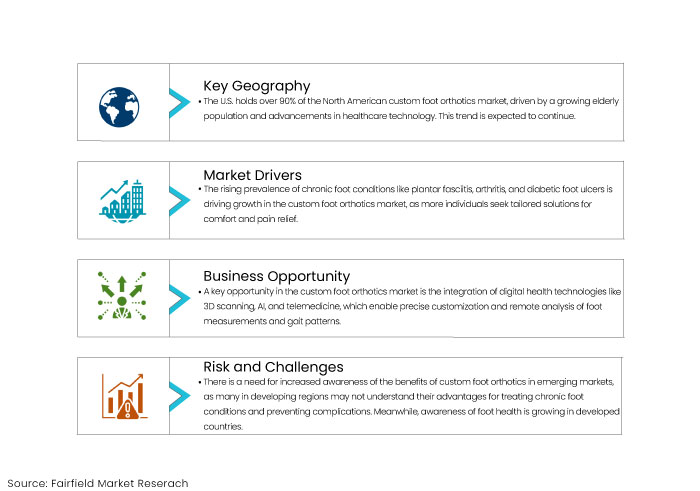
The increasing prevalence of chronic foot conditions such as plantar fasciitis, arthritis, and diabetic foot ulcers is a significant growth driver for the custom foot orthotics market. As more individuals experience foot pain or complications due to these conditions, the demand for tailored solutions that offer comfort, pain relief, and corrective support has surged.
Diabetic patients, in particular are at risk for foot complications, which require specialized orthotics to prevent ulcers and other severe issues. With chronic diseases like diabetes on the rise globally, custom foot orthotics are increasingly seen as a preventive measure. Healthcare providers recommend these products to reduce the risk of complications and improve quality of life, contributing to sustained market growth.
- Growing Awareness of Preventive Healthcare
Preventive healthcare is becoming an increasingly important focus globally as consumers prioritize solutions that help avoid future medical complications. Custom foot orthotics are increasingly seen not only as a treatment option but also as a preventive measure to correct foot misalignments, support proper biomechanics, and prevent further deterioration of foot health.
The growing awareness of the long-term benefits of custom orthotics such as reduced strain on joints and improved posture is driving custom foot orthotics market growth.
Both healthcare professionals and consumers recognize the importance of proactively addressing foot health especially in older adults and athletes It is supported by educational initiatives from healthcare organizations making consumers inclined to invest in custom orthotics before severe issues arise, thus expanding the market.
Key Growth Barriers
- Limited Awareness in Emerging Markets
More knowledge about the benefits of custom foot orthotics in emerging markets is needed to restrict custom foot orthotics market growth while awareness of foot health is growing in developed countries. In many developing regions, people may not fully understand the advantages of custom orthotics in treating chronic foot conditions, reducing foot pain, or preventing complications from diseases like diabetes.
Healthcare providers in these regions may not prioritize or recommend custom orthotics due to lacking training, infrastructure, or access to advanced diagnostic tools such as gait analysis. This gap in awareness hinders the market’s expansion potential in countries where foot-related conditions are prevalent but underdiagnosed.
As a result, the market’s growth remains concentrated in developed regions, leaving untapped potential in countries where a significant portion of the population could benefit from custom orthotics but lacks access.
- High Cost of Custom Foot Orthotics
One key constraint for the custom foot orthotics market is the high cost associated with these personalized medical devices. Custom orthotics require detailed foot assessments, advanced 3D scanning, and specialized manufacturing processes, contributing to the overall expense. These costs can be prohibitive for many individuals, especially in countries with limited healthcare coverage.
Patients may opt for cheaper, over-the-counter alternatives in regions where custom foot orthotics are not covered by insurance or are only partially reimbursed. The said cost barrier limits market penetration, particularly in price-sensitive markets such as parts of Asia Pacific, Africa, and Latin America, where access to affordable healthcare is already a challenge. As a result, despite the growing need for custom solutions, the market faces slower adoption among middle- and low-income consumers.
Custom Foot Orthotics Market Trends and Opportunities
- Integration of Digital Health Technologies
One of the most transformative opportunities in the custom foot orthotics market is the integration of digital health technologies, such as 3D scanning, artificial intelligence (AI), and telemedicine. Such advancements allow for more precise customization of orthotics, enabling healthcare professionals to capture detailed foot measurements and analyze gait patterns remotely.
Telemedicine platforms offer patients the convenience of consultations without needing in-person visits, expanding access to custom orthotics in remote or rural areas. AI-driven algorithms can also help analyze foot biomechanics efficiently creating highly personalized orthotic designs that enhance accuracy, and reduce production times making custom orthotics more accessible to a broader range of patients.
As digital health technologies become more prevalent, they will drive rapid adoption of custom orthotics by simplifying the process for both providers and patients.
- Demand for Sustainability and Eco-Friendly Materials
As sustainability becomes a key concern for consumers and manufacturers alike, the development of eco-friendly materials and sustainable production methods presents a transformative opportunity in the custom foot orthotics market.
Traditional orthotics are made from non-biodegradable materials like plastics and synthetic foams, which are increasingly viewed as environmentally harmful. By adopting sustainable materials such as biodegradable polymers, recycled components, and plant-based alternatives, companies can align with the growing consumer demand for environmentally responsible products.
Such innovations can differentiate brands in a competitive market, attracting eco-conscious consumers. Companies that invest in R&D to create durable, sustainable orthotics can capture market share and appeal to the population's health-conscious and environment-conscious segments.
How Does Regulatory Scenario Shape this Industry?
The regulatory landscape is increasingly important in shaping the custom foot orthotics market, ensuring product safety, efficacy, and quality standards. Custom orthotics are classified in many countries as medical devices, requiring compliance with stringent regulatory frameworks set by health authorities like the U.S.
Food and Drug Administration (FDA) and the European Medicines Agency (EMA), and these regulations ensure that orthotics meet medical-grade standards regarding materials, design, and patient outcomes. In the U.S., for instance, custom orthotics must adhere to the FDA’s Class I medical device requirements, including proper labelling, manufacturing practices, and post-market surveillance.
The European Union’s Medical Device Regulation (MDR), which came into full effect in 2021, has significantly tightened oversight on custom medical devices, including foot orthotics, that mandates manufacturers to provide detailed clinical evaluations and risk assessments, with a strong emphasis on patient safety and long-term device performance, ensuring that the products are not only effective but also safe for long-term use.
Globally, the regulatory scenario is evolving to accommodate new technologies such as 3D printing and AI-driven designs, prompting regulators to update standards to ensure that digital and biomechanical innovations in custom orthotics meet healthcare compliance and influence market growth and product development strategies.
Segments Covered in the Report
- Thermoplastic Material Influences Market Growth
The thermoplastic segment accumulated around 58% of the market and is projected to experience a robust CAGR of around 7% from 2024 to 2031. Segment growth in the custom foot orthotics market is owing to the accompanying advantages, like comfort and exceptional durability offered by this material.
Thermoplastic is a heat-mouldable material that is becoming increasingly popular among individuals who prioritize foot care and those requiring therapeutic support while ambulating. Inflexible thermoplastics have restricted use for older people with a significant physiological reserve and those with inflexible feet. Nonetheless, semi-rigid thermoplastic offers superior pain tolerance for the senior demographic and is utilized for those experiencing biomechanical foot pain
- Highest Sales Come from Hospitals & Specialty Clinics
The hospitals and clinics distribution channel segment accounted for 40% of the total market share. The segment is projected to expand at a CAGR of 7% over the forecast period, which is primarily due to the substantial influence of patients and their preferences among consumer.
Patients strongly prefer hospitals and clinics while acquiring foot orthotic insoles. Hospitals and clinics provide highly skilled and experienced staff, adequate treatment infrastructure, and reliable sales channels. Further, the drug stores segment is projected to demonstrate a profitable CAGR during the forecast period.
The rise of drug stores segment is mostly ascribed to the proliferation of medical and pharmaceutical establishments worldwide particularly in emerging areas. Numerous pharmacies are progressively providing foot orthotic insoles through this retail channel.
The second most reliable sales channel as considered by consumers is typically drugstores. The market expansion is estimated to be propelled by consumer perception and an increasing preference for the channel.
Regional Analysis
- Rising Geriatric Population and Technological Advancements in the Healthcare Sector
The U.S. accounted for more than 90% share of the North American custom foot orthotics market, and a similar trend is expected over the forecast period. In the United States, market growth is being driven by the increasing elderly population and different technological advancements in healthcare systems.
Chronic disorders such as arthritis, diabetes, and others affect almost 3/4 of the overall senior population in the United States. Foot orthotics are mostly used by the elderly for pain treatment and comfort. Emerging technologies such as additive manufacturing are increasingly being used to create personalized foot orthotics that cater to each patient individually, which presents a lucrative opportunity for market participants in the U.S.
Fairfield’s Competitive Landscape Analysis
The competitive landscape of the custom foot orthotics market is characterized by a mix of established companies and emerging players, each leveraging innovation and specialization to gain market share.
Leading players like Bauerfeind, Aetrex Worldwide, and Superfeet Worldwide dominate the market through advanced technologies such as 3D printing and biomechanical assessments, offering highly customized solutions. Technological advancements, particularly in digital scanning and AI-driven design, have intensified competition pushing companies to invest in research and development.
Strategic partnerships with healthcare providers and expanding e-commerce channels are critical competitive strategies. Market players also differentiate themselves through sustainable materials and tailored orthotic solutions to meet consumer demand for eco-friendly products.
Key Market Companies
- Reckitt Benckiser Group plc (Dr. Scholl's)
- SIDAS
- Powerstep (Stable Step, LLC)
- Superfeet Worldwide, Inc
- Bauerfeind AG
- Blatchford Limited
- Aetrex Worldwide, Inc.
- Amfit Inc.
- Arden Orthotics
- Algeo Limited
- Create O & P
- Groupe Gorgé
- Foot Science International
An Expert’s Eye
- Advancements in 3D printing and AI-driven biomechanical analysis are revolutionizing custom orthotics, improving precision, reducing production costs, and enhancing patient outcomes.
- A growing shift towards preventive healthcare is one of the crucial market-driving elements.
- Increased awareness of foot health and orthotics' role in preventing chronic issues like arthritis and diabetes-related complications boosts the market.
- A rising interest in eco-friendly materials for orthotics, with experts suggesting that sustainable production will be a key differentiator for companies in the coming years.
Global Custom Foot Orthotics Market is Segmented as-
By Material
- Thermoplastics
- Polyethylene Foams
- Leather
- Composite Carbon Fibers
By Distribution Channel
- Hospitals & Specialty Clinics
- Drug Stores
- Online Stores
By Application
- Sports & Athletics
- Medical
- Personal Comfort
By Region
- North America
- Latin America
- Europe
- Asia Pacific
- The Middle East & Africa
- Executive Summary
- Global Custom Foot Orthotics Market Snapshot
- Future Projections
- Key Market Trends
- Regional Snapshot, by Value, 2026
- Analyst Recommendations
- Market Overview
- Market Definitions and Segmentations
- Market Dynamics
- Drivers
- Restraints
- Market Opportunities
- Value Chain Analysis
- COVID-19 Impact Analysis
- Porter's Five Forces Analysis
- Impact of Russia-Ukraine Conflict
- PESTLE Analysis
- Regulatory Analysis
- Price Trend Analysis
- Current Prices and Future Projections, 2025-2033
- Price Impact Factors
- Global Custom Foot Orthotics Market Outlook, 2020 - 2033
- Global Custom Foot Orthotics Market Outlook, by Material, Value (US$ Mn), 2020-2033
- Thermoplastics
- Polyethylene Foams
- Leather
- Composite Carbon Fibers
- Global Custom Foot Orthotics Market Outlook, by Distribution Channel, Value (US$ Mn), 2020-2033
- Hospitals & Specialty Clinics
- Drug Stores
- Online Stores
- Global Custom Foot Orthotics Market Outlook, by Application, Value (US$ Mn), 2020-2033
- Sports & Athletics
- Medical
- Personal Comfort
- Global Custom Foot Orthotics Market Outlook, by Region, Value (US$ Mn), 2020-2033
- North America
- Europe
- Asia Pacific
- Latin America
- Middle East & Africa
- Global Custom Foot Orthotics Market Outlook, by Material, Value (US$ Mn), 2020-2033
- North America Custom Foot Orthotics Market Outlook, 2020 - 2033
- North America Custom Foot Orthotics Market Outlook, by Material, Value (US$ Mn), 2020-2033
- Thermoplastics
- Polyethylene Foams
- Leather
- Composite Carbon Fibers
- North America Custom Foot Orthotics Market Outlook, by Distribution Channel, Value (US$ Mn), 2020-2033
- Hospitals & Specialty Clinics
- Drug Stores
- Online Stores
- North America Custom Foot Orthotics Market Outlook, by Application, Value (US$ Mn), 2020-2033
- Sports & Athletics
- Medical
- Personal Comfort
- North America Custom Foot Orthotics Market Outlook, by Country, Value (US$ Mn), 2020-2033
- U.S. Custom Foot Orthotics Market Outlook, by Material, 2020-2033
- U.S. Custom Foot Orthotics Market Outlook, by Distribution Channel, 2020-2033
- U.S. Custom Foot Orthotics Market Outlook, by Application, 2020-2033
- Canada Custom Foot Orthotics Market Outlook, by Material, 2020-2033
- Canada Custom Foot Orthotics Market Outlook, by Distribution Channel, 2020-2033
- Canada Custom Foot Orthotics Market Outlook, by Application, 2020-2033
- BPS Analysis/Market Attractiveness Analysis
- North America Custom Foot Orthotics Market Outlook, by Material, Value (US$ Mn), 2020-2033
- Europe Custom Foot Orthotics Market Outlook, 2020 - 2033
- Europe Custom Foot Orthotics Market Outlook, by Material, Value (US$ Mn), 2020-2033
- Thermoplastics
- Polyethylene Foams
- Leather
- Composite Carbon Fibers
- Europe Custom Foot Orthotics Market Outlook, by Distribution Channel, Value (US$ Mn), 2020-2033
- Hospitals & Specialty Clinics
- Drug Stores
- Online Stores
- Europe Custom Foot Orthotics Market Outlook, by Application, Value (US$ Mn), 2020-2033
- Sports & Athletics
- Medical
- Personal Comfort
- Europe Custom Foot Orthotics Market Outlook, by Country, Value (US$ Mn), 2020-2033
- Germany Custom Foot Orthotics Market Outlook, by Material, 2020-2033
- Germany Custom Foot Orthotics Market Outlook, by Distribution Channel, 2020-2033
- Germany Custom Foot Orthotics Market Outlook, by Application, 2020-2033
- Italy Custom Foot Orthotics Market Outlook, by Material, 2020-2033
- Italy Custom Foot Orthotics Market Outlook, by Distribution Channel, 2020-2033
- Italy Custom Foot Orthotics Market Outlook, by Application, 2020-2033
- France Custom Foot Orthotics Market Outlook, by Material, 2020-2033
- France Custom Foot Orthotics Market Outlook, by Distribution Channel, 2020-2033
- France Custom Foot Orthotics Market Outlook, by Application, 2020-2033
- U.K. Custom Foot Orthotics Market Outlook, by Material, 2020-2033
- U.K. Custom Foot Orthotics Market Outlook, by Distribution Channel, 2020-2033
- U.K. Custom Foot Orthotics Market Outlook, by Application, 2020-2033
- Spain Custom Foot Orthotics Market Outlook, by Material, 2020-2033
- Spain Custom Foot Orthotics Market Outlook, by Distribution Channel, 2020-2033
- Spain Custom Foot Orthotics Market Outlook, by Application, 2020-2033
- Russia Custom Foot Orthotics Market Outlook, by Material, 2020-2033
- Russia Custom Foot Orthotics Market Outlook, by Distribution Channel, 2020-2033
- Russia Custom Foot Orthotics Market Outlook, by Application, 2020-2033
- Rest of Europe Custom Foot Orthotics Market Outlook, by Material, 2020-2033
- Rest of Europe Custom Foot Orthotics Market Outlook, by Distribution Channel, 2020-2033
- Rest of Europe Custom Foot Orthotics Market Outlook, by Application, 2020-2033
- BPS Analysis/Market Attractiveness Analysis
- Europe Custom Foot Orthotics Market Outlook, by Material, Value (US$ Mn), 2020-2033
- Asia Pacific Custom Foot Orthotics Market Outlook, 2020 - 2033
- Asia Pacific Custom Foot Orthotics Market Outlook, by Material, Value (US$ Mn), 2020-2033
- Thermoplastics
- Polyethylene Foams
- Leather
- Composite Carbon Fibers
- Asia Pacific Custom Foot Orthotics Market Outlook, by Distribution Channel, Value (US$ Mn), 2020-2033
- Hospitals & Specialty Clinics
- Drug Stores
- Online Stores
- Asia Pacific Custom Foot Orthotics Market Outlook, by Application, Value (US$ Mn), 2020-2033
- Sports & Athletics
- Medical
- Personal Comfort
- Asia Pacific Custom Foot Orthotics Market Outlook, by Country, Value (US$ Mn), 2020-2033
- China Custom Foot Orthotics Market Outlook, by Material, 2020-2033
- China Custom Foot Orthotics Market Outlook, by Distribution Channel, 2020-2033
- China Custom Foot Orthotics Market Outlook, by Application, 2020-2033
- Japan Custom Foot Orthotics Market Outlook, by Material, 2020-2033
- Japan Custom Foot Orthotics Market Outlook, by Distribution Channel, 2020-2033
- Japan Custom Foot Orthotics Market Outlook, by Application, 2020-2033
- South Korea Custom Foot Orthotics Market Outlook, by Material, 2020-2033
- South Korea Custom Foot Orthotics Market Outlook, by Distribution Channel, 2020-2033
- South Korea Custom Foot Orthotics Market Outlook, by Application, 2020-2033
- India Custom Foot Orthotics Market Outlook, by Material, 2020-2033
- India Custom Foot Orthotics Market Outlook, by Distribution Channel, 2020-2033
- India Custom Foot Orthotics Market Outlook, by Application, 2020-2033
- Southeast Asia Custom Foot Orthotics Market Outlook, by Material, 2020-2033
- Southeast Asia Custom Foot Orthotics Market Outlook, by Distribution Channel, 2020-2033
- Southeast Asia Custom Foot Orthotics Market Outlook, by Application, 2020-2033
- Rest of SAO Custom Foot Orthotics Market Outlook, by Material, 2020-2033
- Rest of SAO Custom Foot Orthotics Market Outlook, by Distribution Channel, 2020-2033
- Rest of SAO Custom Foot Orthotics Market Outlook, by Application, 2020-2033
- BPS Analysis/Market Attractiveness Analysis
- Asia Pacific Custom Foot Orthotics Market Outlook, by Material, Value (US$ Mn), 2020-2033
- Latin America Custom Foot Orthotics Market Outlook, 2020 - 2033
- Latin America Custom Foot Orthotics Market Outlook, by Material, Value (US$ Mn), 2020-2033
- Thermoplastics
- Polyethylene Foams
- Leather
- Composite Carbon Fibers
- Latin America Custom Foot Orthotics Market Outlook, by Distribution Channel, Value (US$ Mn), 2020-2033
- Hospitals & Specialty Clinics
- Drug Stores
- Online Stores
- Latin America Custom Foot Orthotics Market Outlook, by Application, Value (US$ Mn), 2020-2033
- Sports & Athletics
- Medical
- Personal Comfort
- Latin America Custom Foot Orthotics Market Outlook, by Country, Value (US$ Mn), 2020-2033
- Brazil Custom Foot Orthotics Market Outlook, by Material, 2020-2033
- Brazil Custom Foot Orthotics Market Outlook, by Distribution Channel, 2020-2033
- Brazil Custom Foot Orthotics Market Outlook, by Application, 2020-2033
- Mexico Custom Foot Orthotics Market Outlook, by Material, 2020-2033
- Mexico Custom Foot Orthotics Market Outlook, by Distribution Channel, 2020-2033
- Mexico Custom Foot Orthotics Market Outlook, by Application, 2020-2033
- Argentina Custom Foot Orthotics Market Outlook, by Material, 2020-2033
- Argentina Custom Foot Orthotics Market Outlook, by Distribution Channel, 2020-2033
- Argentina Custom Foot Orthotics Market Outlook, by Application, 2020-2033
- Rest of LATAM Custom Foot Orthotics Market Outlook, by Material, 2020-2033
- Rest of LATAM Custom Foot Orthotics Market Outlook, by Distribution Channel, 2020-2033
- Rest of LATAM Custom Foot Orthotics Market Outlook, by Application, 2020-2033
- BPS Analysis/Market Attractiveness Analysis
- Latin America Custom Foot Orthotics Market Outlook, by Material, Value (US$ Mn), 2020-2033
- Middle East & Africa Custom Foot Orthotics Market Outlook, 2020 - 2033
- Middle East & Africa Custom Foot Orthotics Market Outlook, by Material, Value (US$ Mn), 2020-2033
- Thermoplastics
- Polyethylene Foams
- Leather
- Composite Carbon Fibers
- Middle East & Africa Custom Foot Orthotics Market Outlook, by Distribution Channel, Value (US$ Mn), 2020-2033
- Hospitals & Specialty Clinics
- Drug Stores
- Online Stores
- Middle East & Africa Custom Foot Orthotics Market Outlook, by Application, Value (US$ Mn), 2020-2033
- Sports & Athletics
- Medical
- Personal Comfort
- Middle East & Africa Custom Foot Orthotics Market Outlook, by Country, Value (US$ Mn), 2020-2033
- GCC Custom Foot Orthotics Market Outlook, by Material, 2020-2033
- GCC Custom Foot Orthotics Market Outlook, by Distribution Channel, 2020-2033
- GCC Custom Foot Orthotics Market Outlook, by Application, 2020-2033
- South Africa Custom Foot Orthotics Market Outlook, by Material, 2020-2033
- South Africa Custom Foot Orthotics Market Outlook, by Distribution Channel, 2020-2033
- South Africa Custom Foot Orthotics Market Outlook, by Application, 2020-2033
- Egypt Custom Foot Orthotics Market Outlook, by Material, 2020-2033
- Egypt Custom Foot Orthotics Market Outlook, by Distribution Channel, 2020-2033
- Egypt Custom Foot Orthotics Market Outlook, by Application, 2020-2033
- Nigeria Custom Foot Orthotics Market Outlook, by Material, 2020-2033
- Nigeria Custom Foot Orthotics Market Outlook, by Distribution Channel, 2020-2033
- Nigeria Custom Foot Orthotics Market Outlook, by Application, 2020-2033
- Rest of Middle East Custom Foot Orthotics Market Outlook, by Material, 2020-2033
- Rest of Middle East Custom Foot Orthotics Market Outlook, by Distribution Channel, 2020-2033
- Rest of Middle East Custom Foot Orthotics Market Outlook, by Application, 2020-2033
- BPS Analysis/Market Attractiveness Analysis
- Middle East & Africa Custom Foot Orthotics Market Outlook, by Material, Value (US$ Mn), 2020-2033
- Competitive Landscape
- Company Vs Segment Heatmap
- Company Market Share Analysis, 2025
- Competitive Dashboard
- Company Profiles
- Reckitt Benckiser Group plc (Dr. Scholl's)
- Company Overview
- Product Portfolio
- Financial Overview
- Business Strategies and Developments
- SIDAS
- Powerstep (Stable Step, LLC)
- Superfeet Worldwide, Inc
- Bauerfeind AG
- Blatchford Limited
- Aetrex Worldwide, Inc.
- Amfit Inc.
- Arden Orthotics
- Algeo Limited
- Create O & P
- Groupe Gorgé
- Foot Science International
- Reckitt Benckiser Group plc (Dr. Scholl's)
- Appendix
- Research Methodology
- Report Assumptions
- Acronyms and Abbreviations
|
BASE YEAR |
HISTORICAL DATA |
FORECAST PERIOD |
UNITS |
|||
 |
2025 |
 |
2020 - 2025 |
 |
2026 - 2033 |
Value: US$ Million |
|
REPORT FEATURES |
DETAILS |
|
Material Coverage |
|
|
Distribution Channel Coverage |
|
|
Application Coverage |
|
|
Geographical Coverage |
|
|
Leading Companies |
|
|
Report Highlights |
Key Market Indicators, Macro-micro economic impact analysis, Technological Roadmap, Key Trends, Driver, Restraints, and Future Opportunities & Revenue Pockets, Porter’s 5 Forces Analysis, Historical Trend (2019-2021), Market Estimates and Forecast, Market Dynamics, Industry Trends, Competition Landscape, Category, Region, Country-wise Trends & Analysis, COVID-19 Impact Analysis (Demand and Supply Chain) |
Our Research Methodology
Considering the volatility of business today, traditional approaches to strategizing a game plan can be unfruitful if not detrimental. True ambiguity is no way to determine a forecast. A myriad of predetermined factors must be accounted for such as the degree of risk involved, the magnitude of circumstances, as well as conditions or consequences that are not known or unpredictable. To circumvent binary views that cast uncertainty, the application of market research intelligence to strategically posture, move, and enable actionable outcomes is necessary.
View Methodology
Quality Assured
Rigorous Validation Process

Confidentiality Assured
End-to-end Data Security

Custom Research Services
Tailored To Your Objectives
FAQs
The market value is expected to be valued at USD 5.3 Bn in 2026.
The market is projected to exhibit a CAGR of 8% over the forecast period.
Some of the leading industry players in the market are Amfit Inc., Arden Orthotics, and Algeo Limited.
North American region dominates the custom foot orthotics market.
Hospitals & Specialty Clinics are the dominant distribution channel.
Related Reports
Particle-Engineered Probiotic Stabilizers Market Size, Share, Insights, Competitive Landscape, and Forecast 2026 to 2033
The global particle-engineered probiotic stabilizers market is projected to reach US$ 2.98 Billion by 2033, growing at an 11.4% CAGR during 2026–2033
Probiotic Stability Excipients Market Size, Share, Insights, Competitive Landscape, and Forecast 2026 to 2033
The global probiotic stability excipients market is projected to reach US$ 2.8 Bn by 2033, growing at an 11.6% CAGR , driven by stable probiotic formulations
GLP-1 Telehealth Platforms Market Size, Share, Insights, Competitive Landscape, and Forecast 2026 to 2033
GLP-1 Telehealth Platforms Market is valued at US$0.7638 Billion in 2026 and projected to reach US$2.1199 Billion by 2033, growing at 15.7% CAGR.
GLP-1 Nutrition Coaching Market Size, Share, Insights, Competitive Landscape, and Forecast 2026 to 2033
GLP-1 Nutrition Coaching Market is projected to reach US$0.4095 billion by 2033 from US$0.1248 billion in 2026, growing at a CAGR of 18.5%.
Laboratory Andrology Equipment Market Size, Share, Insights, Competitive Landscape, and Forecast 2026 to 2033
Laboratory Andrology Equipment Market to reach US$1.4165 Bn by 2033, growing at 5.1% CAGR, driven by sample handling, automation, and preservation.
Lab Automation Workstations Market Size, Share, Insights, Competitive Landscape, and Forecast 2026 to 2033
Lab Automation Workstations Market to reach US$14.39 Bn by 2033, growing at 10.4% CAGR, driven by molecular biology, automation, and connected workflows.