



Digital Remittance Market
Digital Remittance Market Insights, Competitive Landscape, and Market Forecast - 2033
Digital Remittance Market is projected to grow significantly, rising from USD 32.8 billion in 2026 to USD 94.4 billion by 2033 at a CAGR of 16.3%.
Quick Report Digest
A Look Back and a Look Forward - Comparative Analysis
The market for digital remittance has grown in popularity as a result of factors such as globalisation, increased international migration, and the widespread adoption of digital payment technologies. Companies within this market offer services enabling individuals and businesses to transfer money internationally, making it an essential component of the global financial system. This sector is marked by intense competition and continual technological innovation.
The market witnessed staggered growth during the historical period 2018 – 2022. This is due to the substantial growth of the major end-use application sectors such as small businesses, and others. However, in some applications, the demand for digital remittance has increased, including migrant labour workforce, personnel.
The growth of the market is further fuelled by regulatory efforts aimed at enhancing transparency among financial institutions, thereby improving data ecosystems and partnerships. Additionally, the rise in immigration rates from developing to developed countries, driven by opportunities for education and employment, is driving growth in the global digital remittance market.
Key Growth Determinants
- Rapid Growth in Urbanisation, and Cross-Border Transactions
The global population is experiencing rapid urbanisation and industrialisation, leading to the development of rural and semi-rural areas worldwide. According to the World Bank, the current urban population stands at 56% of the world's population, totaling 4.4 billion people, with projections indicating that this figure will more than double by 2050, with nearly 7 out of 10 individuals residing in cities. This trend is observable across the globe, with a growing proportion of people choosing urban living. In 2012, urban dwellers accounted for 52.5% of the population, a figure projected to increase to 56.9% by 2022.
Urbanisation rates vary between developed and developing regions, with 79.7% of the population living in urban areas in developed countries compared to 52.3% in developing nations. In the least developed countries (LDCs), urban populations remain a minority, constituting 35.8%. This migration trend is driven by individuals seeking employment opportunities, launching businesses, and pursuing job prospects across international borders and within various cities. Consequently, there has been a notable increase in cross-border transactions.
Traditionally, such transactions were predominantly conducted by large corporations and governmental entities. However, the emergence of digital platforms has democratised these transactions, facilitating a broad spectrum of microtransactions involving small-scale organisations, individual purchases, microloans, micropayments, and freelance work through contractual agreements.
Platforms like Kickstarter, Zopa, and Kiva have become instrumental in facilitating cross-border financial interactions. Kiva, for instance, has facilitated money transfers for over 1 million individuals across 190 countries. Kickstarter, a crowdfunding platform connecting entrepreneurs with backers interested in supporting their creative projects, has garnered the participation of 5.8 million individuals from 214 countries. Since its inception in 2009, Kickstarter has facilitated pledges totaling US$1 billion for 58,000 creative ventures.
- Rocketing Smartphone Sales
The burgeoning emphasis on digital remittance, driven by the rapid pace of digitalisation, is fuelling market expansion. According to the GSMA’s annual State of Mobile Internet Connectivity Report 2023 (SOMIC), over half of the global population, amounting to approximately 4.3 billion individuals, now owns smartphones.
Of the 4.6 billion people using mobile internet, nearly 4 billion utilize smartphones, constituting close to half of the world's population. Additionally, 600 million people, representing 8% of the global population, access the internet via feature phones. This widespread smartphone adoption underscores a growing preference for digital solutions in financial transactions.
Digital remittance platforms offer a convenient and efficient means of transferring money globally, eliminating the necessity for physical visits to traditional financial institutions. The increasing prevalence of smartphones and improved internet connectivity further bolster the market's growth trajectory. Moreover, users can easily access digital remittance services through intuitive mobile applications or websites, facilitating seamless international money transfers.
Furthermore, the digitisation of remittance processes enables real-time tracking and notifications, enhancing transparency and security in transactions. These features contribute to the ease of conducting remittances and support market expansion. Additionally, financial technology (FinTech) companies are channeling investments into innovative solutions, ensuring that digital remittance remains a preferred choice for users seeking simplicity and convenience in cross-border money transfers.
- Surge in International Transactions
International money transactions involve the direct transfer of funds to an individual's or company's overseas bank account. These transfers can be facilitated through banks, international money transfer services, online platforms, or specialised agents. Digital remittances offer faster and more efficient transfer options compared to traditional methods, leveraging new money movement networks and often bypassing correspondent banking channels.
For instance, in May 2022, the World Bank, a US-based international financial institution, projected a 4.2% increase in officially registered money transfers to low- and middle-income countries (LMICs), reaching $630 billion. This uptick in international transactions underscores the driving force behind the growth of the digital remittance market.
Major Growth Barriers
- Cybersecurity Risks Are Limiting Market Expansion
The growth of the digital remittance market is hampered by significant cybersecurity risks. Handling sensitive financial data makes these services prime targets for cybercriminals seeking to exploit vulnerabilities, leading to security breaches, data theft, and fraudulent activities. Such incidents not only cause financial losses for users but also damage the reputation of service providers, hindering market growth.
Cyber attacks, rated as the fifth top risk in 2020, have become increasingly common across public and private sectors. This trend persists in 2024, with IoT cyberattacks expected to double by 2025. The World Economic Forum’s 2020 Global Risk Report indicates a low detection rate of cybercrimes in the U.S., while Cybersecurity Ventures predicts that global cybercrime will cost companies $10.5 trillion annually by 2025, representing the largest transfer of economic wealth in history. Small businesses, in particular, are vulnerable, with 43% targeted by cyber attacks but only 14% adequately prepared for defense.
To address these risks, digital remittance companies must invest significantly in cybersecurity measures such as encryption, multi-factor authentication, and continuous monitoring. However, these investments increase operational costs and may reduce profit margins, affecting the competitiveness of digital remittance services.
Additionally, regulatory bodies are imposing stricter cybersecurity compliance requirements, necessitating ongoing adjustments and investments to meet evolving standards. Failure to comply with these regulations can lead to legal consequences and penalties, further impeding market growth. Overall, the persistent and evolving nature of cybersecurity threats poses a significant challenge to the expansion and sustainability of the digital remittance market.
- Regulatory Challenges, and Compliance Requirements
Governments and regulatory bodies enforce rules to combat money laundering, terrorism financing, and other illicit activities. Compliance with these regulations presents a complex and costly challenge for remittance service providers, requiring them to implement robust compliance measures, conduct thorough customer due diligence, and maintain extensive reporting systems. The necessity to navigate these compliance challenges and ensure regulatory adherence can impede the growth and expansion of digital remittance services.
Key Trends and Opportunities to Look at
The incorporation of blockchain technology and cryptocurrencies into the digital remittance market is creating exciting opportunities for advancement and expansion. Blockchain's decentralised and immutable ledger system provides heightened security, transparency, and traceability, fostering trust among users seeking reliable and secure cross-border transaction solutions. This, in turn, accelerates market adoption.
Cryptocurrencies, especially stablecoins, offer the potential for swift and cost-effective international transfers, bypassing traditional intermediaries like banks. This can result in more competitive pricing and faster transaction settlements, addressing longstanding issues associated with traditional remittance methods.
Moreover, the flexibility of blockchain and cryptocurrencies enables providers to reach previously underserved markets with limited banking infrastructure, significantly enhancing the market's accessibility and global reach. As these technologies mature and gain acceptance, digital remittance companies that embrace them can differentiate themselves, attract tech-savvy customers, and create new revenue streams, strategically positioning themselves for success in this rapidly evolving industry.
- Efforts to Enhance Security During Digital Money Transfer
- Untapped Potential in Developing Markets
Several startups have emerged with software and applications aimed at streamlining international remittance processes, reducing both time and cost while enhancing user-friendliness. Examples include TransferWise and Wave, which prioritize encrypting financial messages to safeguard user data from potential hackers. Wave, in particular, focuses on various aspects of security such as data security, mobile security, fraud prevention, and bank access security. The company employs robust measures like locking consumer data with up to 256-bit TLS encryption.
In addition to startups, e-banking systems are also investing in enhancing advanced encryption standards and security models. These systems are transitioning towards utilizing a combination of fingerprint biometric scans and image verification to offer a more secure authentication mechanism. By connecting a biometric scanning dongle to the server, the system automatically verifies if the MAC address of the dongle matches the username and password of the account. Furthermore, image verification is employed, requiring users to identify images provided by their respective banks to prevent unauthorised access attempts. Moreover, banks are utilizing Public Key Infrastructure (PKI) to secure sender and receiver account details, further enhancing security measures.
In numerous developing countries, substantial populations lack access to traditional banking services. However, the widespread availability of affordable smartphones and increasing internet connectivity offers a pathway to reach these underserved populations with digital remittance solutions.
By delivering convenient and cost-effective remittance services to these markets, companies have the chance to access a vast customer base and position themselves as significant contributors to the expanding digital economy. This initiative not only fosters increased financial inclusion and economic empowerment for individuals in these regions but also stimulates growth within the digital remittance market as a whole.
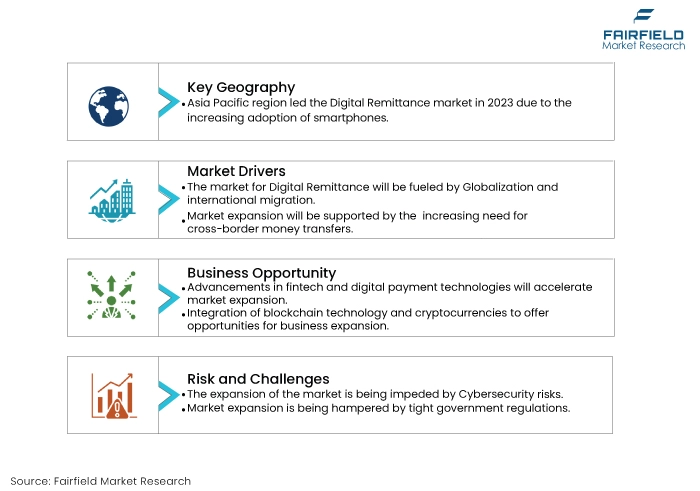
How Does the Regulatory Scenario Shape this Industry?
In August 2019, the Federal Reserve unveiled plans to develop a new interbank real-time gross settlement service known as the FedNowSM Service. This initiative aims to support seamless, secure, and efficient instant payments across the United States, operating 24x7x365. The service is scheduled to launch in 2023 and will be available to participating depository institutions.
Additionally, the Federal Reserve announced that the Fedwire Funds Service will adopt the ISO 20022 format, a move aimed at modernizing payment systems. Both the Reserve Banks and the Clearing House (TCH) intend to implement the ISO 20022 payment format standard for their domestic and cross-border wire payment systems.
Furthermore, there are discussions around considering the same standard for the domestic retail automated clearinghouse (ACH) system. On the international front, the Money Transfer Service Scheme (MTSS) facilitates the transfer of personal remittances from abroad to beneficiaries in India. According to the Reserve Bank of India (RBI), only inward personal remittances into India are permitted, including those intended for family maintenance and remittances for foreign tourists visiting India.
Outward remittances from India are not allowed under this scheme. The introduction of FedNowSM aims to provide seamless, secure, and efficient real-time payments in the US, improving domestic remittance transactions. The adoption of ISO 20022 by Fedwire and others modernizes payment systems, streamlining cross-border remittances for greater interoperability and simplicity
Fairfield’s Ranking Board
Top Segments
The outward digital remittance segment dominated the market in 2023. Individuals residing in foreign nations are sending funds back to their families for support, with the assistance of financial institutions and banks. These institutions prioritize swift and secure transfer services, while also striving to minimize fees and expand their clientele base. International banks and financial entities ensure the safety of outward remittances through a secure banking framework, thereby mitigating risks of financial detriment and fraudulent activities for both the sender and recipient.
Furthermore, the inward digital remittance category is projected to experience the fastest market growth. The expected surge in segment growth is driven by the rising acceptance of mobile payment technology for migrant money transfers. Financial institutions and banks worldwide are prioritizing the integration of real-time banking technology, particularly leveraging immediate payment service (IMPS). This technological advancement enables banks to extend their services to both resident and non-resident customers. Migrant workers are increasingly turning to wire transfer services for inward remittances due to their reputation for being the safest, quickest, and most widely embraced method of fund transfer.
- Money Transfer Operators Continue to Surge Ahead
- Personal End User Leads the Way
In 2023, the money transfer operators category dominated the industry. Money transfer operators consistently offer lower transfer fees compared to banks while maintaining the same level of reliability and security. One of the key advantages they provide is the speed of transactions, with transfers being initiated promptly and processed within one to two days. The emergence of digital-first money transfer operators and the swift integration of funding and digital initiation features by established operators are anticipated to propel this sector forward in the forecast period.
The online platforms category is anticipated to grow substantially throughout the projected period. Online money transfer platforms effectively facilitate the transfer of funds between organisations and between organisations and their customers. These platforms enable users to directly access and easily execute money transactions. Many online money transfer platforms prioritize providing user-friendly services to their clients, aiding them in navigating their platforms effortlessly. Additionally, the rising adoption of digital wallets is anticipated to further drive growth in this sector, as digital wallets allow customers to conveniently monitor their funds through dedicated applications.
The personal segment dominated the market in 2023. Numerous new products and services are being extensively crafted to enhance the convenient utilisation of financial customer accounts. Furthermore, the surge in global migration is projected to fuel the uptake of digital remittance services among individuals seeking to send money to their home countries. The expanding penetration of smartphones and the internet worldwide is expected to drive growth in the personal segment throughout the forecast period. Innovative solutions are already reshaping the landscape of remittance services by enhancing convenience and lowering costs for senders of remittances and their families.
The migrant labour workforce category is expected to experience the fastest growth within the forecast time frame. The digital remittance service aids migrant labourers in comparing transfer costs and efficiently identifying support organisations. Additionally, this service has simplified and made sending money home more cost-effective for migrant workers. Developments in fintech and innovations in cross-border payments are anticipated to continue driving growth in this segment. Furthermore, despite the challenges posed by the COVID-19 pandemic, migrant labourers persisted in their efforts to earn money for their families, thereby contributing to the growth of the segment.
Regional Frontrunners
Asia Pacific’s Rvenue Contribution Remains Maximum
Cross-border migration plays a pivotal role in the advancement of regional remittance services. India, China, and the Philippines are recognised as the primary recipients of remittances, with formal remittances amounting to US$165 billion annually. The World Bank reports a significant increase in the number of Indian students migrating to the United States of America (USA) in 2022, reaching 1.9 lakh from 1.25 lakh in 2021.
Canada emerged as the second most favoured destination for Indian students, nearly doubling to 1.85 lakh in 2022 from 1.02 lakh in 2021. The United Kingdom (UK) follows closely behind, with 1.32 lakh Indian students migrating in 2022 compared to just 77000 in 2021 and 25000 in 2018. Despite the proliferation of formal remittance service providers and their cost-effective offerings, many remittance transactions in the Asia Pacific region still rely on informal channels. This can be attributed to inadequate marketing and channel strategies employed by market players to directly engage with migrant labourers across different countries within and outside the region.
The significant growth in the manufacturing and IT sectors in key countries is attracting international workers, likely driving up remittance outflows from within the region. In developing economies, notable increases in the ICT-to-GDP ratio are fuelling digital money transfers and the digitisation of the banking sector. Malaysia, Singapore, and Thailand are ranked among the top 10 economies with the highest ICT-to-GDP ratios. The substantial expansion of the ICT industry, coupled with ongoing efforts to enhance online payment systems and formalize the economy, is anticipated to drive growth in the regional digital money transfer and remittance market.
Exploding Smartphone Ownership Elevates North America’s Market Attractiveness
This growth can be attributed to several factors, including the well-established financial infrastructure of the region, high rates of internet and smartphone usage, and a sizable population of migrants who regularly send money back to their home countries. As of 2023, smartphone ownership in the United States stood at 81.6%, encompassing approximately 270 million individuals.
Americans typically spend an average of 5 hours and 24 minutes on their mobile devices each day, checking their phones around 96 times daily, roughly once every 10 minutes. Notably, smartphone ownership has risen across all age groups in the US since 2012, with a particularly significant increase among individuals aged 65 and older, climbing from 13% in 2012 to 61% in 2021. Additionally, the presence of advanced digital payment systems and a strong inclination towards technology adoption in North America has facilitated the expansion of digital remittance services.
Fairfield’s Competitive Landscape Analysis
•Azimo Limited
•Digital Wallet Corporation
•InstaReM Pvt. Ltd.
•MoneyGram
•PayPal Holdings, Inc.
•Ria Financial Services Ltd.
•TransferGo Ltd.
•TransferWise Ltd. (Wise)
•Western Union Holdings, Inc.
•WorldRemit Ltd.
Digital Remittance Market Segmentation
By Type
•Inward Digital Remittance
•Outward Digital Remittance
By Channel
•Banks
•Money Transfer Operators
•Online Platforms
•Others
By End Use
•Migrant Labor Workforce
•Personal
•Small Businesses
•Others
By Platform
•Web-Based Remittance
•Mobile-Based Remittance
By Region
•North America
•Europe
•Asia Pacific
•Latin America
•Middle East & Africa
- Executive Summary
- Global Digital Remittance Market Snapshot
- Future Projections
- Key Market Trends
- Regional Snapshot, by Value, 2026
- Analyst Recommendations
- Market Overview
- Market Definitions and Segmentations
- Market Dynamics
- Drivers
- Restraints
- Market Opportunities
- Value Chain Analysis
- COVID-19 Impact Analysis
- Porter's Five Forces Analysis
- Impact of Russia-Ukraine Conflict
- PESTLE Analysis
- Regulatory Analysis
- Price Trend Analysis
- Current Prices and Future Projections, 2025-2033
- Price Impact Factors
- Global Digital Remittance Market Outlook, 2020 - 2033
- Global Digital Remittance Market Outlook, by Type, Value (US$ Bn), 2020-2033
- Inward Digital Remittance
- Outward Digital Remittance
- Global Digital Remittance Market Outlook, by Channel, Value (US$ Bn), 2020-2033
- Banks
- Money Transfer Operators
- Online Platforms
- Others
- Global Digital Remittance Market Outlook, by End Use, Value (US$ Bn), 2020-2033
- Migrant Labor Workforce
- Personal
- Small Businesses
- Others
- Global Digital Remittance Market Outlook, by Platform, Value (US$ Bn), 2020-2033
- Web-Based Remittance
- Mobile-Based Remittance
- Global Digital Remittance Market Outlook, by Region, Value (US$ Bn), 2020-2033
- North America
- Europe
- Asia Pacific
- Latin America
- Middle East & Africa
- Global Digital Remittance Market Outlook, by Type, Value (US$ Bn), 2020-2033
- North America Digital Remittance Market Outlook, 2020 - 2033
- North America Digital Remittance Market Outlook, by Type, Value (US$ Bn), 2020-2033
- Inward Digital Remittance
- Outward Digital Remittance
- North America Digital Remittance Market Outlook, by Channel, Value (US$ Bn), 2020-2033
- Banks
- Money Transfer Operators
- Online Platforms
- Others
- North America Digital Remittance Market Outlook, by End Use, Value (US$ Bn), 2020-2033
- Migrant Labor Workforce
- Personal
- Small Businesses
- Others
- North America Digital Remittance Market Outlook, by Platform, Value (US$ Bn), 2020-2033
- Web-Based Remittance
- Mobile-Based Remittance
- North America Digital Remittance Market Outlook, by Country, Value (US$ Bn), 2020-2033
- U.S. Digital Remittance Market Outlook, by Type, 2020-2033
- U.S. Digital Remittance Market Outlook, by Channel, 2020-2033
- U.S. Digital Remittance Market Outlook, by End Use, 2020-2033
- U.S. Digital Remittance Market Outlook, by Platform, 2020-2033
- Canada Digital Remittance Market Outlook, by Type, 2020-2033
- Canada Digital Remittance Market Outlook, by Channel, 2020-2033
- Canada Digital Remittance Market Outlook, by End Use, 2020-2033
- Canada Digital Remittance Market Outlook, by Platform, 2020-2033
- BPS Analysis/Market Attractiveness Analysis
- North America Digital Remittance Market Outlook, by Type, Value (US$ Bn), 2020-2033
- Europe Digital Remittance Market Outlook, 2020 - 2033
- Europe Digital Remittance Market Outlook, by Type, Value (US$ Bn), 2020-2033
- Inward Digital Remittance
- Outward Digital Remittance
- Europe Digital Remittance Market Outlook, by Channel, Value (US$ Bn), 2020-2033
- Banks
- Money Transfer Operators
- Online Platforms
- Others
- Europe Digital Remittance Market Outlook, by End Use, Value (US$ Bn), 2020-2033
- Migrant Labor Workforce
- Personal
- Small Businesses
- Others
- Europe Digital Remittance Market Outlook, by Platform, Value (US$ Bn), 2020-2033
- Web-Based Remittance
- Mobile-Based Remittance
- Europe Digital Remittance Market Outlook, by Country, Value (US$ Bn), 2020-2033
- Germany Digital Remittance Market Outlook, by Type, 2020-2033
- Germany Digital Remittance Market Outlook, by Channel, 2020-2033
- Germany Digital Remittance Market Outlook, by End Use, 2020-2033
- Germany Digital Remittance Market Outlook, by Platform, 2020-2033
- Italy Digital Remittance Market Outlook, by Type, 2020-2033
- Italy Digital Remittance Market Outlook, by Channel, 2020-2033
- Italy Digital Remittance Market Outlook, by End Use, 2020-2033
- Italy Digital Remittance Market Outlook, by Platform, 2020-2033
- France Digital Remittance Market Outlook, by Type, 2020-2033
- France Digital Remittance Market Outlook, by Channel, 2020-2033
- France Digital Remittance Market Outlook, by End Use, 2020-2033
- France Digital Remittance Market Outlook, by Platform, 2020-2033
- U.K. Digital Remittance Market Outlook, by Type, 2020-2033
- U.K. Digital Remittance Market Outlook, by Channel, 2020-2033
- U.K. Digital Remittance Market Outlook, by End Use, 2020-2033
- U.K. Digital Remittance Market Outlook, by Platform, 2020-2033
- Spain Digital Remittance Market Outlook, by Type, 2020-2033
- Spain Digital Remittance Market Outlook, by Channel, 2020-2033
- Spain Digital Remittance Market Outlook, by End Use, 2020-2033
- Spain Digital Remittance Market Outlook, by Platform, 2020-2033
- Russia Digital Remittance Market Outlook, by Type, 2020-2033
- Russia Digital Remittance Market Outlook, by Channel, 2020-2033
- Russia Digital Remittance Market Outlook, by End Use, 2020-2033
- Russia Digital Remittance Market Outlook, by Platform, 2020-2033
- Rest of Europe Digital Remittance Market Outlook, by Type, 2020-2033
- Rest of Europe Digital Remittance Market Outlook, by Channel, 2020-2033
- Rest of Europe Digital Remittance Market Outlook, by End Use, 2020-2033
- Rest of Europe Digital Remittance Market Outlook, by Platform, 2020-2033
- BPS Analysis/Market Attractiveness Analysis
- Europe Digital Remittance Market Outlook, by Type, Value (US$ Bn), 2020-2033
- Asia Pacific Digital Remittance Market Outlook, 2020 - 2033
- Asia Pacific Digital Remittance Market Outlook, by Type, Value (US$ Bn), 2020-2033
- Inward Digital Remittance
- Outward Digital Remittance
- Asia Pacific Digital Remittance Market Outlook, by Channel, Value (US$ Bn), 2020-2033
- Banks
- Money Transfer Operators
- Online Platforms
- Others
- Asia Pacific Digital Remittance Market Outlook, by End Use, Value (US$ Bn), 2020-2033
- Migrant Labor Workforce
- Personal
- Small Businesses
- Others
- Asia Pacific Digital Remittance Market Outlook, by Platform, Value (US$ Bn), 2020-2033
- Web-Based Remittance
- Mobile-Based Remittance
- Asia Pacific Digital Remittance Market Outlook, by Country, Value (US$ Bn), 2020-2033
- China Digital Remittance Market Outlook, by Type, 2020-2033
- China Digital Remittance Market Outlook, by Channel, 2020-2033
- China Digital Remittance Market Outlook, by End Use, 2020-2033
- China Digital Remittance Market Outlook, by Platform, 2020-2033
- Japan Digital Remittance Market Outlook, by Type, 2020-2033
- Japan Digital Remittance Market Outlook, by Channel, 2020-2033
- Japan Digital Remittance Market Outlook, by End Use, 2020-2033
- Japan Digital Remittance Market Outlook, by Platform, 2020-2033
- South Korea Digital Remittance Market Outlook, by Type, 2020-2033
- South Korea Digital Remittance Market Outlook, by Channel, 2020-2033
- South Korea Digital Remittance Market Outlook, by End Use, 2020-2033
- South Korea Digital Remittance Market Outlook, by Platform, 2020-2033
- India Digital Remittance Market Outlook, by Type, 2020-2033
- India Digital Remittance Market Outlook, by Channel, 2020-2033
- India Digital Remittance Market Outlook, by End Use, 2020-2033
- India Digital Remittance Market Outlook, by Platform, 2020-2033
- Southeast Asia Digital Remittance Market Outlook, by Type, 2020-2033
- Southeast Asia Digital Remittance Market Outlook, by Channel, 2020-2033
- Southeast Asia Digital Remittance Market Outlook, by End Use, 2020-2033
- Southeast Asia Digital Remittance Market Outlook, by Platform, 2020-2033
- Rest of SAO Digital Remittance Market Outlook, by Type, 2020-2033
- Rest of SAO Digital Remittance Market Outlook, by Channel, 2020-2033
- Rest of SAO Digital Remittance Market Outlook, by End Use, 2020-2033
- Rest of SAO Digital Remittance Market Outlook, by Platform, 2020-2033
- BPS Analysis/Market Attractiveness Analysis
- Asia Pacific Digital Remittance Market Outlook, by Type, Value (US$ Bn), 2020-2033
- Latin America Digital Remittance Market Outlook, 2020 - 2033
- Latin America Digital Remittance Market Outlook, by Type, Value (US$ Bn), 2020-2033
- Inward Digital Remittance
- Outward Digital Remittance
- Latin America Digital Remittance Market Outlook, by Channel, Value (US$ Bn), 2020-2033
- Banks
- Money Transfer Operators
- Online Platforms
- Others
- Latin America Digital Remittance Market Outlook, by End Use, Value (US$ Bn), 2020-2033
- Migrant Labor Workforce
- Personal
- Small Businesses
- Others
- Latin America Digital Remittance Market Outlook, by Platform, Value (US$ Bn), 2020-2033
- Web-Based Remittance
- Mobile-Based Remittance
- Latin America Digital Remittance Market Outlook, by Country, Value (US$ Bn), 2020-2033
- Brazil Digital Remittance Market Outlook, by Type, 2020-2033
- Brazil Digital Remittance Market Outlook, by Channel, 2020-2033
- Brazil Digital Remittance Market Outlook, by End Use, 2020-2033
- Brazil Digital Remittance Market Outlook, by Platform, 2020-2033
- Mexico Digital Remittance Market Outlook, by Type, 2020-2033
- Mexico Digital Remittance Market Outlook, by Channel, 2020-2033
- Mexico Digital Remittance Market Outlook, by End Use, 2020-2033
- Mexico Digital Remittance Market Outlook, by Platform, 2020-2033
- Argentina Digital Remittance Market Outlook, by Type, 2020-2033
- Argentina Digital Remittance Market Outlook, by Channel, 2020-2033
- Argentina Digital Remittance Market Outlook, by End Use, 2020-2033
- Argentina Digital Remittance Market Outlook, by Platform, 2020-2033
- Rest of LATAM Digital Remittance Market Outlook, by Type, 2020-2033
- Rest of LATAM Digital Remittance Market Outlook, by Channel, 2020-2033
- Rest of LATAM Digital Remittance Market Outlook, by End Use, 2020-2033
- Rest of LATAM Digital Remittance Market Outlook, by Platform, 2020-2033
- BPS Analysis/Market Attractiveness Analysis
- Latin America Digital Remittance Market Outlook, by Type, Value (US$ Bn), 2020-2033
- Middle East & Africa Digital Remittance Market Outlook, 2020 - 2033
- Middle East & Africa Digital Remittance Market Outlook, by Type, Value (US$ Bn), 2020-2033
- Inward Digital Remittance
- Outward Digital Remittance
- Middle East & Africa Digital Remittance Market Outlook, by Channel, Value (US$ Bn), 2020-2033
- Banks
- Money Transfer Operators
- Online Platforms
- Others
- Middle East & Africa Digital Remittance Market Outlook, by End Use, Value (US$ Bn), 2020-2033
- Migrant Labor Workforce
- Personal
- Small Businesses
- Others
- Middle East & Africa Digital Remittance Market Outlook, by Platform, Value (US$ Bn), 2020-2033
- Web-Based Remittance
- Mobile-Based Remittance
- Middle East & Africa Digital Remittance Market Outlook, by Country, Value (US$ Bn), 2020-2033
- GCC Digital Remittance Market Outlook, by Type, 2020-2033
- GCC Digital Remittance Market Outlook, by Channel, 2020-2033
- GCC Digital Remittance Market Outlook, by End Use, 2020-2033
- GCC Digital Remittance Market Outlook, by Platform, 2020-2033
- South Africa Digital Remittance Market Outlook, by Type, 2020-2033
- South Africa Digital Remittance Market Outlook, by Channel, 2020-2033
- South Africa Digital Remittance Market Outlook, by End Use, 2020-2033
- South Africa Digital Remittance Market Outlook, by Platform, 2020-2033
- Egypt Digital Remittance Market Outlook, by Type, 2020-2033
- Egypt Digital Remittance Market Outlook, by Channel, 2020-2033
- Egypt Digital Remittance Market Outlook, by End Use, 2020-2033
- Egypt Digital Remittance Market Outlook, by Platform, 2020-2033
- Nigeria Digital Remittance Market Outlook, by Type, 2020-2033
- Nigeria Digital Remittance Market Outlook, by Channel, 2020-2033
- Nigeria Digital Remittance Market Outlook, by End Use, 2020-2033
- Nigeria Digital Remittance Market Outlook, by Platform, 2020-2033
- Rest of Middle East Digital Remittance Market Outlook, by Type, 2020-2033
- Rest of Middle East Digital Remittance Market Outlook, by Channel, 2020-2033
- Rest of Middle East Digital Remittance Market Outlook, by End Use, 2020-2033
- Rest of Middle East Digital Remittance Market Outlook, by Platform, 2020-2033
- BPS Analysis/Market Attractiveness Analysis
- Middle East & Africa Digital Remittance Market Outlook, by Type, Value (US$ Bn), 2020-2033
- Competitive Landscape
- Company Vs Segment Heatmap
- Company Market Share Analysis, 2025
- Competitive Dashboard
- Company Profiles
- Azimo Limited
- Company Overview
- Product Portfolio
- Financial Overview
- Business Strategies and Developments
- Digital Wallet Corporation
- InstaReM Pvt. Ltd.
- MoneyGram
- PayPal Holdings, Inc.
- Ria Financial Services Ltd.
- TransferGo Ltd.
- TransferWise Ltd. (Wise)
- Western Union Holdings, Inc.
- WorldRemit Ltd.
- Azimo Limited
- Appendix
- Research Methodology
- Report Assumptions
- Acronyms and Abbreviations
|
BASE YEAR |
HISTORICAL DATA |
FORECAST PERIOD |
UNITS |
|||
 |
2025 |
 |
2020 - 2025 |
 |
2026 - 2033 |
Value: US$ Million |
Our Research Methodology
Considering the volatility of business today, traditional approaches to strategizing a game plan can be unfruitful if not detrimental. True ambiguity is no way to determine a forecast. A myriad of predetermined factors must be accounted for such as the degree of risk involved, the magnitude of circumstances, as well as conditions or consequences that are not known or unpredictable. To circumvent binary views that cast uncertainty, the application of market research intelligence to strategically posture, move, and enable actionable outcomes is necessary.
View Methodology
Quality Assured
Rigorous Validation Process

Confidentiality Assured
End-to-end Data Security

Custom Research Services
Tailored To Your Objectives
FAQs
The Digital Remittance market size is USD 32.8 billion in 2026.
The Digital Remittance market is projected to grow at a 16.3% CAGR by 2033.
The Digital Remittance market growth drivers include rising cross-border migration, increasing smartphone penetration, and demand for low-cost fast transfers.
The Asia-Pacific region is a dominating region for Digital Remittance market.
Western Union, MoneyGram, Wise, PayPal, and Remitly are some leading industry players in the Digital Remittance market.
Related Reports
Software-Defined Defence Satellites Market Size, Share, Insights, Competitive Landscape, and Forecast 2026 to 2033
Multi-Band Reflectarray Antennas Market to reach US$2.86 Bn by 2033, growing at 14.6% CAGR, driven by multi-band connectivity, and spacecraft demand.
Multi-Band Reflectarray Antennas Market Size, Share, Insights, Competitive Landscape, and Forecast 2026 to 2033
Software-Defined Defence Satellites Market to reach US$22.18 Bn by 2033, growing at 18.4% CAGR, driven by mission reconfiguration, onboard processing.
Electronic Circuit Protectors Market Size, Share, Insights, Competitive Landscape, and Forecast 2026 to 2033
Electronic Circuit Protectors Market to reach US$5.63 Bn by 2033, driven by power protection, branch isolation, and electronics demand.
Building Information Modeling Market Size, Share, Insights, Competitive Landscape, and Forecast 2026 to 2033
The building information modeling market is set to reach US$29.8 Bn by 2033, growing at a 14.3% CAGR from US$11.7 Bn in 2026, driven by digital construction
Smart Water Meter Market Size, Share, Insights, Competitive Landscape, and Forecast 2026 to 2033
The smart water meter market is projected to grow from US$7.8 billion in 2026 to US$15.4 billion by 2033, at a 10.2% CAGR
Battery Leasing-as-a-Service Insights, Competitive Landscape, and Market Forecast 2026 to 2033
Battery Leasing-as-a-Service Market to reach US$11.5 Bn by 2033, growing at 22.4% CAGR, driven by EV adoption, battery swapping, and fleet electrification.